New Book | Marguerite Gérard (1761–1837)
Distributed by ACC Art Books:
Carole Blumenfeld, Marguerite Gérard, 1761–1837 (Montreuil: Gourcuff Gradenigo, 2018), 272 pages, ISBN: 978-2353402731, £45.
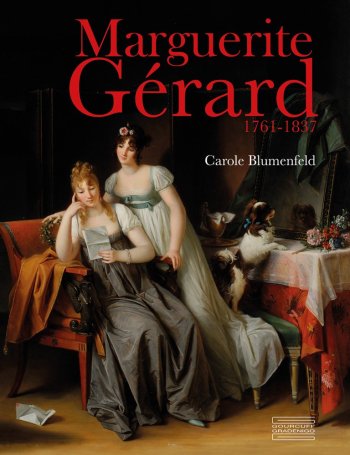 Often dismissed merely as Fragonard’s sister-in-law, Marguerite Gérard (1761–1837) was in fact one of the major artists working in France in the late eighteenth century. Initially Fragonard’s pupil, then his assistant and finally his collaborator, she found success as an artist in her own right, becoming known for her portraits and sometimes voluptuous genre scenes. The only female genre artist of her time, she excelled in the treatment of reflections and surfaces, in the rendering of flesh, and in domestic scenes of daily life.
Standing alongside Elisabeth Vigée Le Brun and Adélaïde Labille-Guiard, Marguerite Gérard is another in the distinguished company of French female artists of the late eighteenth and early nineteenth centuries whose major talents and formidable characters are now being rediscovered.
New Book | A Cultural History of the Senses in the Age of Enlightenment
One of a series of seven volumes on the ‘Cultural History of the Senses’, the volume addressing the Enlightenment, edited by Anne Vila, first appeared in 2014. It, along with the entire series, is now available in paperback from Bloomsbury Academic. More information (including a discounted offer) is available on the flyer for the series:
Anne Vila, ed., A Cultural History of the Senses in the Age of Enlightenment (London: Bloomsbury Academic, 2018), 288 pages, ISBN: 978-1350077911, £25 / $35.
 This volume examines the varied ways in which the senses were perceived afresh during the Enlightenment. In addition to introducing new philosophical and scientific models which sometimes upended the classic hierarchy of the senses, this period witnessed major changes in living and working habits, including urbanization, travel and exploration, the invention of new sonic and visual media, and the rise of comfort and pleasure as values that cut across a range of social classes. As this volume shows, those developments inspired a wealth of sensorially stimulating styles of design, art, music, poetry, foodstuffs, material goods and modes of worship and entertainment.
The volume also demonstrates the period’s countervailing concern with managing the senses, evident in fields like natural philosophy, medicine, education, religion, and public hygiene. Finally, it explores some of the Enlightenment’s desensualizing tendencies, like the separation of sensuous body from discerning mind in certain arenas of science and manufacturing, and the late 18th-century shift away from a politics of publicity, or intense visual and aural scrutiny, toward the secret ballot. A Cultural History of the Senses in the Age of Enlightenment presents essays on the following topics: the social life of the senses; urban sensations; the senses in the marketplace; the senses in religion; the senses in philosophy and science; medicine and the senses; the senses in literature; art and the senses; and sensory media.
Anne C. Vila is Professor of French in the Department of French and Italian at the University of Wisconsin-Madison. She is the author of Enlightenment and Pathology: Sensibility in the Literature and Medicine of Eighteenth-century France (1998), as well as many articles on the body in the culture of the Enlightenment. She is currently completing a book entitled Singular Beings: Passions and Pathologies of the Scholar in France, 1720–1840.
New Book | Natter’s Museum Britannicum
From Archaeopress Archaeology:
John Boardman, Julia Kagan, and Claudia Wagner, with contributions by Catherine Phillips, Natter’s Museum Britannicum: British Gem Collections and Collectors of the Mid-Eighteenth Century (Oxford: Archaeopress Archaeology, 2018), 316 pages, ISBN: 978-1784917272, £55 / $110.
 The German gem-engraver, medallist, and amateur scholar Lorenz Natter (1705–1763), was so impressed by the size and quality of the collections of ancient and later engraved gems which he found in Britain that he proposed the publication of an extraordinarily ambitious catalogue—Museum Britannicum—which would present engravings and descriptions of the most important pieces. He made considerable progress to this end, producing several hundred drawings, but in time he decided to abandon the near completed project in the light of the apparent lack of interest shown in Britain. Only one of the intended plates in its final form ever appeared, in a catalogue which he published separately for Lord Bessborough’s collection.
On Natter’s death the single copy of his magnum opus vanished mysteriously, presumed lost forever. All hope of recovering Natter’s unpublished papers seemed vain, and their very existence had come to be doubted. Yet they were to be found more than two hundred years after his death, in spring 1975, when the classical scholar and renowned expert in gems, Oleg Neverov, chanced upon them at the bottom of a pile of papers in the archives of the State Hermitage Museum in St Petersburg. Neverov and his colleague Julia Kagan carried out the initial research on the Hermitage manuscripts and produced the first published account of this archival treasure.
The present volume builds upon their earlier work to produce the first comprehensive publication of Museum Britannicum, offering full discussion in English and presenting Natter’s drawings and comments alongside modern information on the gems that can be identified and located through fresh research. This book is the result of a ten-year collaboration between scholars on the Beazley Archive gems research programme at Oxford’s Classical Art Research Centre and the State Hermitage Museum. It fulfills Natter’s vision for the Museum Britannicum—albeit two and a half centuries late—to the benefit of art historians, cultural historians, curators, and gem-lovers of today.
Sir John Boardman, FBA, is Emeritus Lincoln Professor of Classical Archaeology and Art in the University of Oxford. His many books include Greek Gems and Finger Rings (2001), The Greeks Overseas (1999), Greek Art (2016), The History of Greek Vases (2006), and The World of Ancient Art (2006).
Julia Kagan is the Curator of post-Classical engraved gems in the State Hermitage Museum in St. Petersburg. She has contributed to the history of glyptics in Great Britain with major publications, such as Gem Engraving in Britain from Antiquity to the Present (2010) and curated important exhibitions, such as the gem collection of the Duc D’Orleans in Paris (2001).
Claudia Wagner is Director of the gems databases at the Beazley Archive in the University of Oxford and Senior Research Lecturer at Lady Margaret Hall, Oxford. She is joint author, with John Boardman, of seven books devoted to the study and publication of ancient gems, including The Guy Ladrière Collection of Gems and Rings (2015) and The Beverley Collection of Gems at Alnwick Castle (2016), both written with Diana Scarisbrick.
C O N T E N T S
Preface
Part One
1 An Anglo-Russian Project
2 Lorenz Natter: Early Career
3 Natter in Britain
4 Natter in Russia
5 The Museum Britannicum Rediscovered
6 Afterword
Part Two
7 The Museum Britannicum: The Catalogue and Drawings
8 The Collectors and Their Gems
9 Lorenz Natter’s Own Collection
10 Natter’s Index of the Museum Britannicum
11 Natter’s Treatise and Miscellaneous Drawings
Index of Gem Subjects
Index of Inscriptions
General Index
New Book | The Server: A Media History
The original German edition Der Diener: Mediengeschichte einer Figur zwischen König und Klient appeared in 2011; the English translation was published in June by Yale UP:
Markus Krajewski, The Server: A Media History from the Present to the Baroque, translated by Ilinca Iurascu (New Haven: Yale University Press, 2018), 456 pages, ISBN: 978-0300180817, $50.
 Though classic servants like the butler or the governess have largely vanished, the Internet is filled with servers: web, ftp, mail, and others perform their daily drudgery, going about their business noiselessly and unnoticed. Why then are current-day digital drudges called servers? Markus Krajewski explores this question by going from the present back to the Baroque to study historical aspects of service through various perspectives, be it the servants’ relationship to architecture or their function in literary or scientific contexts. At the intersection of media studies, cultural history, and literature, this work recounts the gradual transition of agency from human to nonhuman actors to show how the concept of the digital server stems from the classic role of the servant.
Markus Krajewski is professor of media history at the University of Basel, Switzerland. He is the author of numerous articles and several books, including Paper Machines: About Cards and Catalogs, 1548–1929 and World Projects: Global Information Before World War I, which was awarded the 2007 Prize of the German Society for the History of Medicine, Science and Technology. He also works as a software developer and maintainer of his bibliography software Synapsen: A Hypertextual Card Index (www.synapsen.ch). Ilinca Iurascu is assistant professor of German at the University of British Columbia, specializing in nineteenth-century cultural studies and media theory.
C O N T E N T S
Ilinca Iurascu, Introduction to the English Edition: Jeeves Transatlantic
Introduction: Listen, James
Part One: Objects Assistants, Analog
1 Masters / Servants: Everyone is a Subaltern
2 The Servant as Information Center
3 In Waiting
Part Two: The Interregnum of the Subject
4 Holding the Reins: On Demons and Other Ministering Spirits of Science
5 Channel Service
6 At the Stove
Part Three: Diener, Digital
7 Agents: The Lord of (the) Things
Epilogue: Idle Time
Notes
Bibliography
Index
Exhibition | The Furniture of Isaac Vose
Now on view at the Massachusetts Historical Society:
Entrepreneurship and Classical Design in Boston’s South End: The Furniture of Isaac Vose and Thomas Seymour, 1815–1825
Massachusetts Historical Society, Boston, 11 May — 14 September 2018
 Virtually forgotten for 200 years, Isaac Vose and his brilliant furniture are revealed in a new exhibition and accompanying volume. Beginning with a modest pair of collection boxes he made for his local Boston church in 1788, Vose went on to build a substantial business empire and to make furniture for the most prominent Boston families. The exhibition and catalog restore Vose from relative obscurity to his rightful position as one of Boston’s most important craftsmen.
Robert Mussey and Clark Pearce, Rather Elegant Than Showy: The Classical Furniture of Isaac Vose (Boston: David R Godine, 2018), 312 pages, ISBN: 978-1567926194, $50.
C O N T E N T S
Dennis M. Fiori
Foreword
Robert D. Mussey, Jr.
• Introduction: Isaac Vose Forgotten, Rediscovered
• Early Career and Partnerships, 1788–1819
• Boston’s Classical Style Matures: The Salisbury Group
• The Global Elite: Vose & Son and the World of Imports
• Demanding the Finest
• A Hero Returns, an Era Ends
Clark Pearce
• By These Signs You Will Know Them: Connoisseurship and Construction of Vose Furniture
Appendix 1: Labeled, Signed, and Documented Furniture by Isaac Vose
Appendix 2: Vose’s Partners, Journeymen, Subcontractors, and Apprentices
Index
Colophon
New Book | The Minard System
From Princeton Architectural Press:
Sandra Rendgen, The Minard System: The Graphical Works of Charles-Joseph Minard (Princeton Architectural Press, 2018), 176 pages, ISBN: 978-1616896331, $60.
 If you have any interest in information graphics, maps, or history, you know of the seminal flow map of Napoleon’s 1812 march into Russia by Charles-Joseph Minard (1781–1870), made famous by Edward Tufte, and considered to be one of the most magnificent data graphics ever produced. The Minard System explores the nineteenth-century civil engineer’s career and the story behind this masterpiece of multivariate data, as well as sixty of Minard’s other statistical graphics reflecting social and economic changes of the Industrial Revolution in Europe and around the world. These stunning drawings are from the collection of the École Nationale des Ponts et Chaussées in Paris and have never before been published in their entirety.
Exhibition | Laurent Amiot: Canadian Master Silversmith
Now on view at the National Gallery of Canada:
Laurent Amiot: Canadian Master Silversmith
National Gallery of Canada, Ottawa, 11 May — 23 September 2018
Curated by René Villeneuve
 Laurent Amiot: Canadian Master Silversmith brings together an exceptional selection of silver pieces from the collection of the National Gallery of Canada, as well as from various public and private collections around the world. Considered one of the most influential Canadian silversmiths of the 18th and 19th centuries, Laurent Amiot (1764–1839) completely redefined his craft, turning it into an art form. Visitors to the National Gallery of Canada can explore the brilliance and delicacy of his work through the presentation of nearly a hundred key works, most exhibited for the first time. In addition to religious vessels, accessories, and commemorative and domestic objects, the exhibition features a unique set of preparatory drawings by the artist, as well as several portraits of patrons and paintings providing further context for Amiot’s life and work.
More information is available here»
René Villeneuve, Laurent Amiot: Canadian Master Silversmith (Vancouver: Figure 1 Publishing, In partnership with the National Gallery of Canada, 2018), 240 pages, ISBN: 978-1773270418, $50. Also available in French.
Laurent Amiot was born in Quebec City in 1764, and after a first apprenticeship stayed in Paris for five years, just before the French Revolution, to perfect his artistic training. He returned to his hometown in the spring of 1787, acquainted with the latest European stylistic trends, mastering the art of composition and possessing a solid technique. He opened a workshop in the Old City the following year, inaugurating a fruitful practice that spans five decades. This illustrated catalog, containing some 80 works on display, is published on the occasion of the presentation of the first retrospective devoted to the artist. Three chapters highlight the fundamental role of Amiot’s contribution to the development of art in Canada. The first two scrutinize his training, his practice, the operation of the workshop, the role of the collaborators and relationships with patrons. The third analyzes the work, trying to advance knowledge of the society in which it blossomed.
New Book | Francesco Solimena (1657–1747)
From ArtBooks.com:
Nicola Spinosa, Francesco Solimena (1657–1747) e le Arti a Napoli (Rome: Ugo Bozzi, 2018), 2 volumes, 1100 pages, ISBN: 978-8870030600, 320€ / $425.
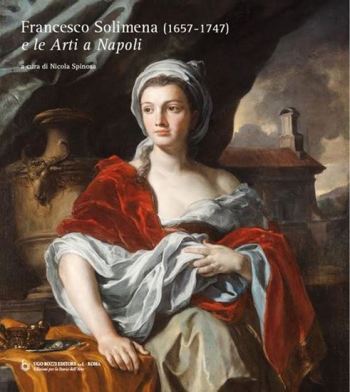 Vol. 1 – dedicato al catalogo ragionato dei dipinti di Solimena (Nicola Spinosa); indici dei nomi e dei luoghi realtivi al volume I. Vol. 2 – dedicato al catalogo ragionato dei disegni di Solimena (Cristiana Romalli); con saggi sull’architettura (Leonardo Di Mauro), sulla scultura e le arti decorative (Gian Giotto Borrelli), su Solimena illustratore (Lorella Starita) e sulla musica al tempo di Solimena (Dinko Farbis); regesto su Solimena pittore a cura di Tiziana La Marca; Bibliografia generale (volumi I e II; indici dei nomi e dei luoghi relativi al volume II).
New Book | Human Redemption: The Cycle in the Chiesa Nuova
Published by Gangemi, and available from ArtBooks.com:
Giulia Silvia Ghia, ed., La Salvazione Umana: Il ciclo della Chiesa Nuova in cerca di un mecenate / Human Redemption: The Cycle in the Chiesa Nuova in Search of a Patron (Rome: Gangemi Editore, 2018), 160 pages, ISBN: 9788849236194, $65. Italian and English text.
 The majestic cycle of fifteen canvases completing the decoration of Santa Maria in Vallicella was unveiled just prior to the 1700 Jubilee. This church is now owned by the Fondo Edifici di Culto, which safeguards, conserves, and promotes more than 820 religious structures across Italy. Lining the path toward St Peter’s Basilica, its paintings continue to present the world with the precious message of Human Redemption. This book retraces the history, importance, and exceptional beauty of this largely unknown cycle. More importantly it brings attention to the need for its restoration that, now as 320 years ago, requires the support of one or more patrons, inspired by a passion for this story.
C O N T E N T S
• The Cycle of Human Redemption: A Comprehensive Overview
• The Chiesa Nuova before the 1675 Jubilee
• The Decoration of the Chiesa Nuova during the Last Quarter of the Seventeenth Century
• A Study of the Use of Materials, Methods of Realization, and Requirements for the Restoration of the Cycle of Human Redemption
Exhibition | Masterpieces of French Faience
Press release for the exhibition opening this fall
Masterpieces of French Faience: Selections from the Sidney R. Knafel Collection
The Frick Collection, New York, 9 October 2018 — Autumn 2019
Curated by Charlotte Vignon
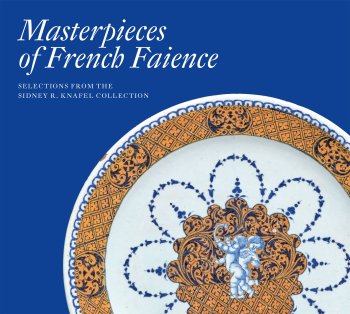 This fall, an exhibition at the Frick will draw from the holdings of Sidney R. Knafel, who has one of the world’s finest and most comprehensive private collections of French faience. With seventy-five objects, the presentation in the Portico Gallery tells the fascinating and complex history of an aspect of European decorative arts that warrants greater attention. The production of faience, a colorful tin-glazed earthenware, spans a vast history of more than two centuries. The earliest French examples were made in Lyon in the sixteenth century, while works from France’s Golden Age of production were made in Nevers and Rouen in the seventeenth and early eighteenth centuries. Production in the eighteenth century expanded to other locations, including Marseille, Moustiers, Sinceny, and Moulins. Comments Charlotte Vignon, the Frick’s Curator of Decorative Arts and organizer of the exhibition, “Faience was largely commissioned by a local regional aristocracy, and the result is another wonderful chapter in the history of ceramics that developed quite apart from the centers of political power and artistic innovation in Versailles and Paris. The Frick has never before exhibited such a large and impressive body of French faience, and we are delighted to illuminate the topic through such a distinguished collection.” The exhibition will be accompanied by a catalogue published in hard and softcover editions by the Frick, in association with D Giles Ltd.
As with other types of earthenware, faience remains porous after firing and therefore must be covered with a glaze. The glazes used include a tin oxide that creates the opaque white surface that covers the color of the underlying clay and also creates a stable surface for painting. The Knafel Collection comprises pieces decorated exclusively with the grand feu (literally, “ high fire”) technique, in which metal oxides are mixed with water and applied to the tin-glazed surface before firing at a temperature of about 1650° F. The palette is necessarily limited to those oxides that can withstand such extreme heat: cobalt (blue), antimony (yellow), manganese (purple and brown), iron (red-orange), and copper (green).
The production of faience in France corresponds to the arrival in Lyon, during the second half of the sixteenth century, of several Italian maiolica potters and painters seeking opportunities outside Italy. This influence is reflected in the French word faience, which derives from the northern Italian city of Faenza, an important center of maiolica production during the Renaissance. French faience draws inspiration from multiple sources, with decoration simultaneously indebted to Italian maiolica, Asian porcelain, and contemporary engravings, while the forms derived mostly from European ceramics and silver.
The function of a piece of French faience depended on the nature of the commission, the patron who first owned it, and its price. During the late sixteenth and seventeenth centuries, objects in faience were costly and therefore acquired, collected, and gifted exclusively by those at the highest levels of French society. Consequently, earlier pieces from Lyon and Nevers in the Knafel Collection were originally intended only for display, to be admired by their owners and guests. The spread of faience workshops in Nevers, Rouen, and elsewhere in France during the eighteenth century inevitably changed the status of these objects and hence their function. One of the most important changes was the later use of faience as dishware, on which to eat or serve food. To ensure the success of their workshops, French potters—beginning with those in Rouen—closely followed the culinary developments occurring in France at the time. Multiple dishes in different shapes and sizes were created in response to the requirements of the service à la française, which necessitated serving various dishes of a particular course at the same time. As the eighteenth century progressed, faience was increasingly used at all times of the day. In the morning, small faience boxes and jars stored pomades, powders, and other accessories of make up, alongside silver and porcelain vessels on a dressing table for ‘la toilette’.
Charlotte Vignon, Masterpieces of French Faience: Selections from the Sidney R. Knafel Collection (London: D. Giles, 2018), 72 pages, ISBN: 978-1911282310.










 Enfilade
leave a comment