New Book | The Enchanted Clock
From Columbia UP:
Julia Kristeva, The Enchanted Clock: A Novel, translated by Armine Kotin Mortimer (New York: Columbia University Press, 2018), 336 pages, ISBN: 978-0231180467, $30 / £24.
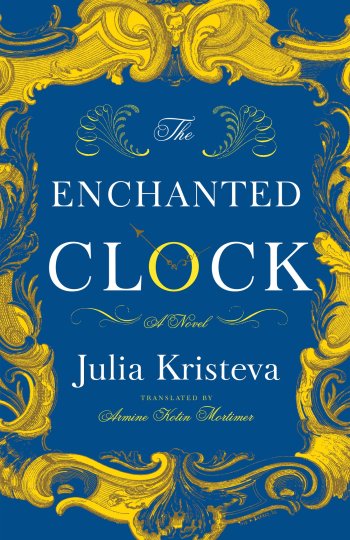 In the Palace of Versailles there is a fabulous golden clock, made for Louis XV by the king’s engineer, Claude-Siméon Passemant. The astronomical clock shows the phases of the moon and the movements of the planets, and it will tell time—hours, minutes, seconds, and even sixtieths of seconds—until the year 9999. Passemant’s clock brings the nature of time into sharp focus in Julia Kristeva’s intricate, poetic novel The Enchanted Clock.
Nivi Delisle, a psychoanalyst and magazine editor, nearly drowns while swimming off the Île de Ré; the astrophysicist Theo Passemant fishes her out of the water. They become lovers. While Theo wonders if he is descended from the clockmaker Passemant, Nivi’s son Stan, who suffers from occasional comas, develops a passion for the remarkable clock at Versailles. Soon Nivi is fixated on its maker. But then the clock is stolen, and when a young writer for Nivi’s magazine mysteriously dies, the clock is found near his body. The Enchanted Clock combines past and present, jumping back and forth between points of view and across eras from eighteenth-century Versailles to the present day. Its stylistically inventive narrative voices bring both immediacy and depth to our understanding of consciousness. Nivi’s life resembles her creator’s in many respects, coloring Kristeva’s customary erudition with autobiographical poignancy. Part detective mystery, part historical fiction, The Enchanted Clock is a philosophically and linguistically multifaceted novel, full of poetic ruminations on memory, love, and the transcendence of linear time. It is one of the most illuminating works of one of France’s great writers and thinkers.
Julia Kristeva is professor emerita of linguistics at the Université de Paris VII and author of many acclaimed works and novels. Her Columbia University Press books include Murder in Byzantium: A Novel (2005); Teresa, My Love: An Imagined Life of the Saint of Avila (2014); and, with Philippe Sollers, Marriage as a Fine Art (2016).
Armine Kotin Mortimer is professor emerita of French literature at the University of Illinois at Urbana-Champaign. Her contributions to French culture were recognized with the Palmes académiques distinction in 2009. She is the translator of two books by Philippe Sollers.
New Book | China’s Philological Turn
From Columbia UP:
Ori Sela, China’s Philological Turn: Scholars, Textualism, and the Dao in the Eighteenth Century (Columbia University Press, 2018), 328 pages, ISBN: 978-0231183826, $65 / £50.
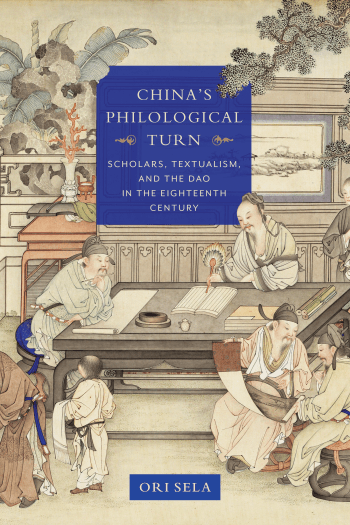 In eighteenth-century China, a remarkable intellectual transformation took place, centered on the ascendance of philology. Its practitioners were preoccupied with the reliability of sources as evidence for restoring ancient texts and meanings and with the centrality of facts and truth to their scholarship and identity. With the power to construct the textual past, philology has the potential to shape both individual and collective identities, and its rise to prominence consequently deeply affected contemporaneous political, social, and cultural agendas.
Ori Sela foregrounds the polymath Qian Daxin (1728–1804), one of the most distinguished scholars of the Qing dynasty, to tell this story. China’s Philological Turn traces scholars’ social networks and the production of knowledge, considering the texts they studied along with their reading practices and the assumptions about knowledge, facts, and truth that came with them. The book considers fundamental issues of eighteenth-century intellectual life: the tension between antiquity’s elevated status and the question of what antiquity actually was; the status of scientific knowledge, especially astronomy, mathematics, and calendrical studies; and the relationship between learned debates and cultural anxieties, especially scholars’ self-characterization and collective identity. Sela brings to light manuscripts, biographies, letters, handwritten notes, epitaphs, and more to highlight the creativity and openness of his subjects. A pioneering book in the cultural history of intellectuals across disciplinary boundaries, China’s Philological Turn reconstructs the history of eighteenth-century Chinese learning and its long-lasting consequences.
Ori Sela is an associate professor in the Department of East Asian Studies at Tel Aviv University.
C O N T E N T S
Preface and Acknowledgments
Introduction: The Way and Its Crossroads
Part I | The Way of Man: Scholarly Networks and the Social History of Scholarship
1 Learning to Be a Scholar
2 Official Scholars and the Growing Philologists’ Networks
3 Private Scholars, Private Academies, and the Community of Knowledge
Part II | The Way of Antiquity: Searching for the True Way in the Past
4 The Way of Ancient Learning: Philology, Antiquity, and Ru Identity
5 Philology and the Message of the Sages: The Classics and the Four Books
6 Historical Philology: Navigating the Sources
Part III | The Way of Heaven and Earth: The Mandate of Scholarship and the Search for Order
7 Astronomy, Mathematics, and Calendar: Historical Perspective
8 Ancient Learning Encounters Western Learning: Scientific Knowledge and Its Cultural Baggage
9 Fate, Ritual, and Ordering All Under Heaven
Conclusion: The Consequences of the Eighteenth-Century Intellectual Turns
Appendix A: Selections from Qian Daxin’s 1754 Palace Examination Answer
Appendix B: Major Shuowen and Erya Studies of the Qian-Jia Period (and Related Works)
Appendix C: Qian Daxin’s Letter to Dai Zhen
Appendix D: Questions and Answers About Astronomy
Appendix E: Essay on the Value of Pi Π
Appendix F: Qian Daxin’s Writings on Mathematics, Astronomy, and Divination
Appendix G: On Saṃsāra
Appendix H: Sources for the Works of Qian Daxin
Note on Abbreviations and Citations
Notes
Selected Bibliography of Chinese and Japanese Titles
Index
Exhibition | Triumph of the Baroque, Painting from 1600 to 1800
Now on view at the Hofburg:
Triumph des Barock: Malerei von 1600 bis 1800 / Il Trionfo del Barocco: Pittura dal 1600 al 1800
Diocesan Museum, Hofburg (Bishop’s Palace), Brixen / Bressanone, Italy, 28 April — 31 October 2018
 Barocke Kunst ist triumphale Ausdruckskunst. So auch in der Malerei. Die Ausstellung schöpft aus dem umfangreichen Bestand der Hofburg und zeigt Gemälde von den frühen Anfängen um 1600 bis in die Spätphase um 1800. Eine Schaulust für das Auge.
Nie waren den Menschen der Himmel und das Leben mit den Himmlischen so vertraut wie in der Barockzeit. Erzählungen aus der Bibel, Schilderungen aus dem Leben von Heiligen, Darstellungen von Maria mit dem Jesuskind—sie alle führen das Auf und Ab des Lebens vor Augen. Berühmte Maler aus Tirol sowie überregional bedeutende Künstler schufen Altarbilder für Kirchen und sakrale Gemälde zur privaten Andacht. Eine Auswahl ihrer Werke ist in der Ausstellung zu sehen, darunter Bilder von Stephan Kessler, Johann Georg Grasmair und Ulrich Glantschnigg, von Martin Theophil Polak, Karl Skreta und Johann Lingelbach. Auch Gemälde der in Wien zu Ruhm gelangten Tiroler Barockmaler, wie Paul Troger, Michael Angelo Unterberger und Josef Ignaz Mildorfer, sind ausgestellt.
Kopien nach berühmten Meistern spielten in der barocken Malerei eine große Rolle. Sie vermittelten das gedankliche Konzept des Originals nahezu ungeschmälert und trugen wesentlich zur Beliebtheit einzelner Bildmotive dar. Eine Auswahl hochwertiger Kopien wird in der Ausstellung gezeigt.
Neben Altarbildern und religiösen Werken sind auch Porträts zu sehen, einige von ihnen zum ersten Mal. Porträts stellten Macht und Reichtum, Bildung und Stand der Dargestellten zur Schau. Sie stehen für Inszenierung und Selbstdarstellung von Klerus, Adel und Bürgertum.
Johann Kronbichler, Die barocken Gemälde der Hofburg Brixen (Brixen: Hofburg, 2018), 396 pages, ISBN: 978-8888570235, $75.
 Zur Ausstellung erscheint ein Bestandskatalog. Dieser enthält—über die in der Ausstellung gezeigten Werke hinaus—alle barocken Gemälde aus der Schausammlung und den Depots sowie die Gemälde und Wandmalereien der barocken Ausstattung der Hofburg. Mit seinen knapp 700 vorgestellten Werken und dem umfangreichen Bildmaterial stellt der von Johann Kronbichler verfasste Bestandskatalog ein unverzichtbares Grundlagenwerk zur Barockkunst in Südtirol dar. Der Katalog, Band 4 der Veröffentlichungen der Hofburg Brixen, ist in der Hofburg und im Buchhandel erhältlich.
New Book | George Washington’s Washington
From the University of Georgia Press:
Adam Costanzo, George Washington’s Washington: Visions for the National Capital in the Early American Republic (Athens: University of Georgia Press, 2018), 264 pages, ISBN: 978-0820352855 (hardcover), $75 / ISBN: 978-0820353890 (paperback), $30.
 This book traces the history of the development, abandonment, and eventual revival of George Washington’s original vision for a grand national capital on the Potomac. In 1791 Washington’s ideas found form in architect Peter Charles L’Enfant’s plans for the city. Yet the unprecedented scope of the plan; reliance on the sale of city lots to fund construction of the city and the public buildings; the actions of unscrupulous land speculators; and the convoluted mixture of state, local, and federal authority in effect in the District all undermined Federalist hopes for creating a substantial national capital.
In an era when the federal government had relatively few responsibilities, the tangible intersections of ideology and policy were felt through the construction, development, and oversight of the federal city. During the Washington and Adams administrations, for example, Federalists lacked the funds, the political will, and the administrative capacity to make their hopes for the capital a reality. Across much of the next three decades, Thomas Jefferson and other Jeffersonian politicians stifled the growth of the city by withholding funding and support for any project not directly related to the workings of the government. After decades of stagnation, only the more pragmatic approach begun in the Jacksonian era succeeded in fostering development in the District. And throughout these decades, driven by a mixture of self-interest and national pride, local leaders worked to make Washington’s vision a reality and to earn the respect of the nation.
George Washington’s Washington is not simply a history of the city during the first president’s life but a history of his vision for the national capital and of the local and national conflicts surrounding this vision’s acceptance and implementation.
Adam Costanzo is a professional assistant professor of history at Texas A&M University, Corpus Christi.
Exhibition | The American Revolution: A World War

Louis-Nicolas Van Blarenberge, The Siege of Yorktown, 1786; gouache on panel, 24 × 37 inches
(Private Collection of Nicholas Taubman)
◊ ◊ ◊ ◊ ◊
Van Blarenberghe’s two Yorktown paintings were on view last year at Philadelphia’s Museum of the American Revolution. Press release (21 June 2018) from The National Museum of American History:
The American Revolution: A World War
Smithsonian’s National Museum of American History, Washington, D.C., 26 June — 9 July 2019
Curated by David Allison
A global lens is placed on the story of American independence in the exhibition The American Revolution: A World War, open June 26 through July 9, 2019, at the Smithsonian’s National Museum of American History. The focal point of this one-year exhibition, on view in The Nicholas F. and Eugenia Taubman Gallery, centers on two historical paintings that depict the culminating events at Yorktown in 1781, which ended the war on American soil, and a portrait of General George Washington.

Charles Willson Peale, Washington at Yorktown, 1780–82, painted for French General Comte de Rochambeau.
The American Revolution: A World War explores the Franco-American partnership during the Revolution and the extent to which international relations shaped the formation of the United States. General Jean-Baptiste Donatien de Vimeur, Comte de Rochambeau, led the French forces at Yorktown. Two of the paintings were created by Louis-Nicolas Van Blarenberghe and are copies he made for Rochambeau of paintings presented to King Louis XVI. The Washington portrait is by Charles Willson Peale. All three once hung in Rochambeau’s home as reminders of his partnership with Washington that resulted in the American victory.
“The American colonies had no hope of winning their independence alone,” said David Allison, project director and senior curator of the exhibition. “They had to gain support from other European powers, most importantly from France and Spain and the involvement of these nations would affect not only the history of the new United States of America, but their own histories as well.”
The Siege of Yorktown and The Surrender of Yorktown, both painted in 1786, and the Washington portrait painted in 1780–82 are united for the first time in a national museum since they were displayed together in the 1700s in Rochambeau’s chamber. The Van Blarenberghe paintings will each be augmented by an interactive computer, allowing visitors to examine enlargements of the paintings and to read eyewitness accounts of the events.
Other artifacts to be displayed include a pistol given to Washington by British General Edward Braddock during the Seven Years War; a cannon used at Yorktown, representing how the French supplied weapons, soldiers, funding and warships to America; Washington’s Yorktown siege map drawn after the conflict; a ship model of Admiral de Grasse’s Ville de Paris, which led the French fleet that blocked British ships; and an almanac and memorabilia commemorating the Marquis de Lafayette’s visit to the United States near the 50th anniversary of Independence. In addition to Peale’s Washington, images of the other three leaders involved in the American Revolution will be on display: Rochambeau, the Marquis de Lafayette of France and General Charles Cornwallis of Great Britain.
Americans often think that the American Revolution ended with the Siege of Yorktown in 1781, but, in fact, war continued around the world as European powers fought to defend their interests. These wider conflicts ultimately determined the terms Britain accepted in the 1783 treaty granting the United States its independence. Britain also had to negotiate treaties with France, Spain and the Dutch Republic before the wider war connected to the American Revolution finally concluded in 1784.
The exhibition is made possible through the generous support of Ambassador Nicholas F. and Eugenia L. Taubman with additional support from Jeff and Mary Lynn Garrett and Susan and Elihu Rose. A number of objects are on loan from private collections, museums and other institutions, including the Society of the Cincinnati, Winterthur and the Musée de l’Armée in Paris. The exhibition will open in the recently transformed wing of the museum’s second floor, which is themed The Nation We Build Together and features exhibitions that tell the story of America’s founding and future as a country built on the ideals and ideas of freedom and opportunity.
A book to accompany the exhibition will be published in November:
David Allison and Larrie Ferreiro, eds., The American Revolution: A World War (Washington, D.C.: Smithsonian Books, 2018), 272 pages, ISBN: 978-1588346339, $30.
 The American Revolution: A World War argues for the importance of understanding the American Revolution in a global context. The illustrated companion volume to the Smithsonian National Museum of American History exhibition of the same name, this book posits that it is not possible to fully understand the Revolution if it is seen as a solely American conflict. Instead, American motivations and contributions must be considered alongside those of the British, French, Spanish, and Dutch. Highlighting the often overlooked international nature of the Revolution while grounding it in its origins—the fight for independence from Great Britain—this collection of essays from leading writers on the Revolution touches on such topics as European diplomacy, overseas empires, economic rivalries, supremacy of the seas, and more. Together the book’s incisive text, full-color images, and topical sidebars underscore that America’s fight for independence is most clearly comprehended as one of the first global struggles for power.
David K. Allison is Senior Scholar at the Smithsonian’s National Museum of American History. Larrie D. Ferreiro teaches history and engineering at George Mason University in Virginia, Georgetown University in Washington, D.C., and the Stevens Institute of Technology in New Jersey. He is the author of Brothers at Arms: American Independence and the Men of France and Spain Who Saved It, a finalist for the Pulitzer Prize.
New Book | Committed to Memory: The Art of the Slave Ship Icon
From Princeton UP:
Cheryl Finley, Committed to Memory: The Art of the Slave Ship Icon (Princeton: Princeton University Press, 2018), 320 pages, ISBN: 978-0691136844, $50 / £40.
 How an eighteenth-century engraving of a slave ship became a cultural icon of black resistance, identity, and remembrance
One of the most iconic images of slavery is a schematic wood engraving depicting the human cargo hold of a slave ship. First published by British abolitionists in 1788, it exposed this widespread commercial practice for what it really was—shocking, immoral, barbaric, unimaginable. Printed as handbills and broadsides, the image Cheryl Finley has termed the ‘slave ship icon’ was easily reproduced, and by the end of the eighteenth century it was circulating by the tens of thousands around the Atlantic rim. Committed to Memory provides the first in-depth look at how this artifact of the fight against slavery became an enduring symbol of black resistance, identity, and remembrance.
Finley traces how the slave ship icon became a powerful tool in the hands of British and American abolitionists, and how its radical potential was rediscovered in the twentieth century by black artists, activists, writers, filmmakers, and curators. Finley offers provocative new insights into the works of Amiri Baraka, Romare Bearden, Betye Saar, and many others. She demonstrates how the icon was transformed into poetry, literature, visual art, sculpture, performance, and film—and became a medium through which diasporic Africans have reasserted their common identity and memorialized their ancestors.
Beautifully illustrated, Committed to Memory features works from around the world, taking readers from the United States and England to West Africa and the Caribbean. It shows how contemporary black artists and their allies have used this iconic eighteenth-century engraving to reflect on the trauma of slavery and come to terms with its legacy.
Cheryl Finley is associate professor of art history at Cornell University. She is the coauthor of Harlem: A Century in Images and the coeditor of Diaspora, Memory, Place: David Hammons, Maria Magdalena Campos-Pons, Pamela Z.
Exhibition | Storytelling: French Art from the Horvitz Collection
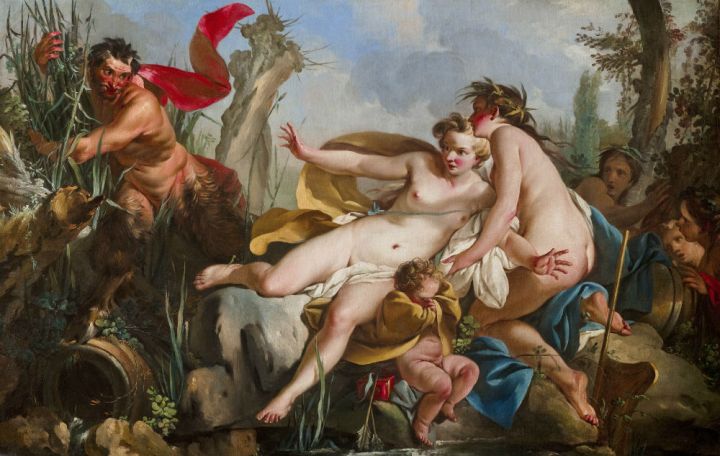
Jean-Baptiste-Marie Pierre, Pan and Syrinx, 1746, oil on canvas, 90 × 141 cm
(Boston: The Horvitz Collection, P-F-57).
◊ ◊ ◊ ◊ ◊
Now on view at the Cummer Museum:
Storytelling: French Art from the Horvitz Collection
Cummer Museum of Art & Gardens, Jacksonville, Florida, 25 May — 29 July 2018
John and Marble Ringling Museum of Art, Sarasota, Florida, 9 September — 2 December 2018
Fairfield University Art Museum, Fairfield, Connecticut, 25 January — 29 March 2019
Curated by Alvin Clark
Storytelling: French Art from the Horvitz Collection combines two exhibitions: Imaging Text: Drawings for French Book Illustration and Seventeenth- and Eighteenth-Century French Paintings, from one of the world’s finest private collections of French art. Created between the 16th and 19th centuries, and ranging from mythological and biblical studies to more playful imagery, the 80 works included in the exhibition vary in terms of style, genre, and period. Captured in crisp and swift pen strokes, finely modulated chalk, or brilliant colors, these captivating compositions were produced by some of the most prominent artists of their time, such as Charles Le Brun (1619–1690), Charles-Nicolas Cochin, the younger (1715–1790), and Jean-Honoré Fragonard (1732–1806).
The exhibition is curated by Alvin L. Clark, Jr, Curator, The Horvitz Collection, Department of Drawings, Division of European and American Art, Harvard Art Museums.
Alvin Clark and Elizabeth M. Rudy, Imaging Text: French Drawings for Book Illustration from The Horvitz Collection (Boston: The Horvitz Collection, 2018), 76 pages, ISBN: 978-0991262533, $15.
◊ ◊ ◊ ◊ ◊
Note (added 10 January 2018) — The posting was updated to included Fairfield University Art Museum.
Exhibition | Pastels at the Louvre
Now on view at the Louvre:
Pastels in the Musée du Louvre: The 17th and 18th Centuries
Musée du Louvre, Paris, 7 June — 10 September 2018
Curated by Xavier Salmon
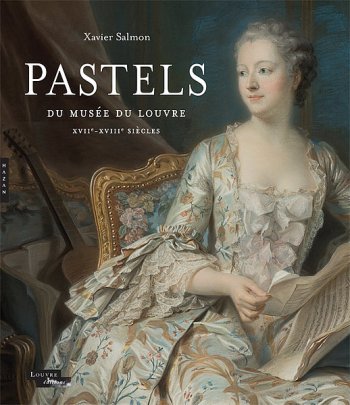 The Louvre holds an unrivaled collection of European pastels from the 17th and 18th centuries. Mostly dating from the reigns of Louis XV and Louis XVI, these extremely fragile works, created with a colored powder that has often been compared to that of a butterfly’s wings, introduce us to Enlightenment society and illustrate the genius of its most celebrated artists: Rosalba Carriera, Maurice Quentin de La Tour, Jean-Baptiste Siméon Chardin, Jean-Baptiste Perronneau, Jean Étienne Liotard, Jean-Marc Nattier, and Élisabeth Louise Vigée Le Brun, together with lesser known artists such as Marie-Suzanne Giroust, Adélaïde Labille-Guiard, Joseph Boze, and Joseph Ducreux.
These pastels illustrate the genius of the artists who produced them as artworks in their own right rather than preparatory studies enhanced with color. Many of them still have their original frame, and sometimes their original glass.
Thanks to the support of American Friends of the Louvre and Joan and Mike Kahn, the more than 150 works in the collection were systematically conserved and remounted to protect them from dust—a long-term project which provided an opportunity for new research on the collection. The results are included in a comprehensive annotated inventory, published in French and English with the support of the Joan Kahn Family Trust.
The exhibition takes a new look at masterpieces such as Maurice Quentin de La Tour’s Portrait of the Marquise de Pompadour and features new acquisitions such as Simon Bernard Lenoir’s portrait of the actor Lekain. It is also an opportunity to compare these works by French artists with others by eminent international pastel artists such as Rosalba Carriera in Venice, Jean-Étienne Liotard in Geneva, and John Russell in London.
The exhibition is curated by Xavier Salmon, director of the Départment des Arts Graphiques and general heritage curator at the Musée du Louvre.
The catalogue, in French and English editions, is published by Hazan and distributed by Yale UP:
Xavier Salmon, Pastels du musée du Louvre, XVIIe XVIIIe siècle (Paris: Hazan, 2018), 384 pages, ISBN: 978-2754114547 (French) / ISBN: 978-0300238631 (English), €59 / $75.
New Book | Jean-Baptiste-Pierre LeBrun (1748–1813)
From Rowman & Littlefield and available from Artbooks.com:
Bette Oliver, Jean-Baptiste-Pierre LeBrun (1748–1813): In Pursuit of Art (Hamilton Books, 2018), 108 pages, ISBN: 978-0761870272, $65 / £45
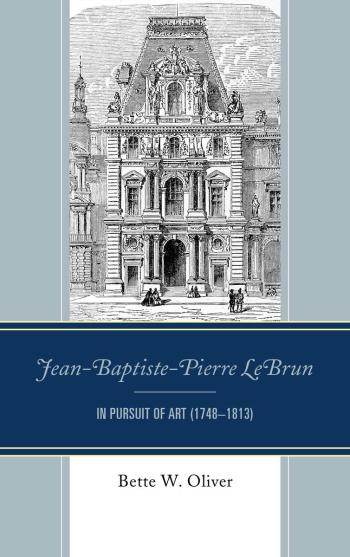 Jean-Baptiste Pierre LeBrun’s life was marked by his intense interest in art, first as an artist, and then from 1770 until his death in 1813, as an art dealer/connoisseur and as a participant in the transformation of the Louvre into a national museum during the French Revolution. He managed to accommodate whichever regime assumed power, from monarchy to republic to empire. He married the artist Elisabeth Vigée in 1776, and together they figured prominently in the pre-revolutionary cultural world of Paris. LeBrun travelled widely, buying art for his gallery and contributing to a number of aristocratic collections. His expertise in attributions of 17th-century Dutch and Flemish paintings was acknowledged internationally, while his reference work on the subject was considered the most comprehensive ever written.
LeBrun, the grand-nephew of the illustrious artist Charles LeBrun, became one of the most successful art dealers in Paris. He played an active role in the politics of art between 1789 and 1802, serving as an expert-commissioner in restoration at the national museum. His inventories of artworks, confiscated from all over Europe by Napoleon’s armies, have provided a valuable record of the development of the French national museum. In addition, his inventories have been useful in the identification and recovery of Nazi confiscations during World War II. LeBrun’s accomplishments during a tumultuous period of political and artistic change present evidence of his contributions to the concept of the modern art museum, notably in the areas of conservation, restoration, and arrangement.
Bette W. Oliver of Austin, Texas, is an independent scholar and editor with a PhD in modern European history from the University of Texas at Austin. A specialist in the period of the French Revolution, she is the author of five books focusing on that pivotal period, as well as eleven volumes of poetry.
The Burlington Magazine, June 2018
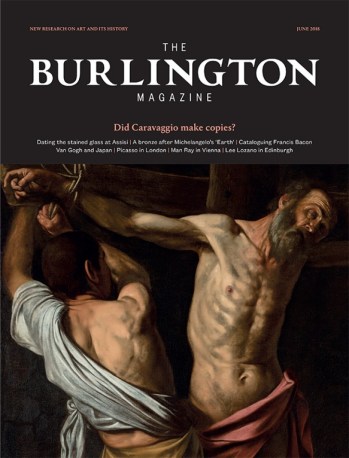
As the June 2018 issue of The Burlington launches a new design (the work of Studio Frank), editor Michael Hall provides a brief overview of the history of the journal’s design in his editorial comments, noting that “many readers now access the magazine in its digital edition and for most people the first sight of the cover is likely to be on the screen of a tablet or smartphone, meaning that it has to work on a small scale” (453).
The eighteenth century in The Burlington:
The Burlington Magazine 160 (June 2018)
 A R T I C L E S
• Tessa Murdoch, “A Set of Silver-Gilt Waiters by Benjamin Pyne for the Courtenay Family of Powderham Castle, Devon,” pp. 478–89.
R E V I E W S
• Xavier F. Salomon, Review of the exhibition Tiepolo Segreto (Vicenza: Palladio Museum, 2017–18), pp. 495–97.
• Sanda Miller, Review of the exhibition Fashioned from Nature (London: V&A, 2018), 497–99.
• Steven Jaron, Review of John Onians, European Art: A Neuroarthistory (Yale UP, 2016), 516–17.
• Antoine Maës, Review of Alexandre Maral, François Girardon (1628–1715): Le Sculpteur de Louis XIV (Arthena, 2015), p. 519.
• Clare Hornsby, Review of Paola Bianchi and Karin Wolfe, eds., Turin and the British in the Age of the Grand Tour (Cambridge UP, 2017), pp. 520–21.
• Jonathan Brown, Review of Elena Santiago Páez, ed., Ceán Bermúdez: Historiador del arte y coleccionista ilustrado (Centro de Estudios Europa Hispánica, 2016), p. 521.
• Timothy Wilcox, Review of Ann Gunn, The Prints of Paul Sandby (1731–1809): A Catalogue Raisonné (Brepols, 2016), pp. 521–23.
• Caroline Finkel, Review of Francis Russell, 123 Places in Turkey: A Private Grand Tour (Bitter Lemon Press, 2017), p. 527.










 Enfilade
leave a comment