New Book | George Washington’s Washington
From the University of Georgia Press:
Adam Costanzo, George Washington’s Washington: Visions for the National Capital in the Early American Republic (Athens: University of Georgia Press, 2018), 264 pages, ISBN: 978-0820352855 (hardcover), $75 / ISBN: 978-0820353890 (paperback), $30.
 This book traces the history of the development, abandonment, and eventual revival of George Washington’s original vision for a grand national capital on the Potomac. In 1791 Washington’s ideas found form in architect Peter Charles L’Enfant’s plans for the city. Yet the unprecedented scope of the plan; reliance on the sale of city lots to fund construction of the city and the public buildings; the actions of unscrupulous land speculators; and the convoluted mixture of state, local, and federal authority in effect in the District all undermined Federalist hopes for creating a substantial national capital.
In an era when the federal government had relatively few responsibilities, the tangible intersections of ideology and policy were felt through the construction, development, and oversight of the federal city. During the Washington and Adams administrations, for example, Federalists lacked the funds, the political will, and the administrative capacity to make their hopes for the capital a reality. Across much of the next three decades, Thomas Jefferson and other Jeffersonian politicians stifled the growth of the city by withholding funding and support for any project not directly related to the workings of the government. After decades of stagnation, only the more pragmatic approach begun in the Jacksonian era succeeded in fostering development in the District. And throughout these decades, driven by a mixture of self-interest and national pride, local leaders worked to make Washington’s vision a reality and to earn the respect of the nation.
George Washington’s Washington is not simply a history of the city during the first president’s life but a history of his vision for the national capital and of the local and national conflicts surrounding this vision’s acceptance and implementation.
Adam Costanzo is a professional assistant professor of history at Texas A&M University, Corpus Christi.
Exhibition | The American Revolution: A World War

Louis-Nicolas Van Blarenberge, The Siege of Yorktown, 1786; gouache on panel, 24 × 37 inches
(Private Collection of Nicholas Taubman)
◊ ◊ ◊ ◊ ◊
Van Blarenberghe’s two Yorktown paintings were on view last year at Philadelphia’s Museum of the American Revolution. Press release (21 June 2018) from The National Museum of American History:
The American Revolution: A World War
Smithsonian’s National Museum of American History, Washington, D.C., 26 June — 9 July 2019
Curated by David Allison
A global lens is placed on the story of American independence in the exhibition The American Revolution: A World War, open June 26 through July 9, 2019, at the Smithsonian’s National Museum of American History. The focal point of this one-year exhibition, on view in The Nicholas F. and Eugenia Taubman Gallery, centers on two historical paintings that depict the culminating events at Yorktown in 1781, which ended the war on American soil, and a portrait of General George Washington.

Charles Willson Peale, Washington at Yorktown, 1780–82, painted for French General Comte de Rochambeau.
The American Revolution: A World War explores the Franco-American partnership during the Revolution and the extent to which international relations shaped the formation of the United States. General Jean-Baptiste Donatien de Vimeur, Comte de Rochambeau, led the French forces at Yorktown. Two of the paintings were created by Louis-Nicolas Van Blarenberghe and are copies he made for Rochambeau of paintings presented to King Louis XVI. The Washington portrait is by Charles Willson Peale. All three once hung in Rochambeau’s home as reminders of his partnership with Washington that resulted in the American victory.
“The American colonies had no hope of winning their independence alone,” said David Allison, project director and senior curator of the exhibition. “They had to gain support from other European powers, most importantly from France and Spain and the involvement of these nations would affect not only the history of the new United States of America, but their own histories as well.”
The Siege of Yorktown and The Surrender of Yorktown, both painted in 1786, and the Washington portrait painted in 1780–82 are united for the first time in a national museum since they were displayed together in the 1700s in Rochambeau’s chamber. The Van Blarenberghe paintings will each be augmented by an interactive computer, allowing visitors to examine enlargements of the paintings and to read eyewitness accounts of the events.
Other artifacts to be displayed include a pistol given to Washington by British General Edward Braddock during the Seven Years War; a cannon used at Yorktown, representing how the French supplied weapons, soldiers, funding and warships to America; Washington’s Yorktown siege map drawn after the conflict; a ship model of Admiral de Grasse’s Ville de Paris, which led the French fleet that blocked British ships; and an almanac and memorabilia commemorating the Marquis de Lafayette’s visit to the United States near the 50th anniversary of Independence. In addition to Peale’s Washington, images of the other three leaders involved in the American Revolution will be on display: Rochambeau, the Marquis de Lafayette of France and General Charles Cornwallis of Great Britain.
Americans often think that the American Revolution ended with the Siege of Yorktown in 1781, but, in fact, war continued around the world as European powers fought to defend their interests. These wider conflicts ultimately determined the terms Britain accepted in the 1783 treaty granting the United States its independence. Britain also had to negotiate treaties with France, Spain and the Dutch Republic before the wider war connected to the American Revolution finally concluded in 1784.
The exhibition is made possible through the generous support of Ambassador Nicholas F. and Eugenia L. Taubman with additional support from Jeff and Mary Lynn Garrett and Susan and Elihu Rose. A number of objects are on loan from private collections, museums and other institutions, including the Society of the Cincinnati, Winterthur and the Musée de l’Armée in Paris. The exhibition will open in the recently transformed wing of the museum’s second floor, which is themed The Nation We Build Together and features exhibitions that tell the story of America’s founding and future as a country built on the ideals and ideas of freedom and opportunity.
A book to accompany the exhibition will be published in November:
David Allison and Larrie Ferreiro, eds., The American Revolution: A World War (Washington, D.C.: Smithsonian Books, 2018), 272 pages, ISBN: 978-1588346339, $30.
 The American Revolution: A World War argues for the importance of understanding the American Revolution in a global context. The illustrated companion volume to the Smithsonian National Museum of American History exhibition of the same name, this book posits that it is not possible to fully understand the Revolution if it is seen as a solely American conflict. Instead, American motivations and contributions must be considered alongside those of the British, French, Spanish, and Dutch. Highlighting the often overlooked international nature of the Revolution while grounding it in its origins—the fight for independence from Great Britain—this collection of essays from leading writers on the Revolution touches on such topics as European diplomacy, overseas empires, economic rivalries, supremacy of the seas, and more. Together the book’s incisive text, full-color images, and topical sidebars underscore that America’s fight for independence is most clearly comprehended as one of the first global struggles for power.
David K. Allison is Senior Scholar at the Smithsonian’s National Museum of American History. Larrie D. Ferreiro teaches history and engineering at George Mason University in Virginia, Georgetown University in Washington, D.C., and the Stevens Institute of Technology in New Jersey. He is the author of Brothers at Arms: American Independence and the Men of France and Spain Who Saved It, a finalist for the Pulitzer Prize.
New Book | Committed to Memory: The Art of the Slave Ship Icon
From Princeton UP:
Cheryl Finley, Committed to Memory: The Art of the Slave Ship Icon (Princeton: Princeton University Press, 2018), 320 pages, ISBN: 978-0691136844, $50 / £40.
 How an eighteenth-century engraving of a slave ship became a cultural icon of black resistance, identity, and remembrance
One of the most iconic images of slavery is a schematic wood engraving depicting the human cargo hold of a slave ship. First published by British abolitionists in 1788, it exposed this widespread commercial practice for what it really was—shocking, immoral, barbaric, unimaginable. Printed as handbills and broadsides, the image Cheryl Finley has termed the ‘slave ship icon’ was easily reproduced, and by the end of the eighteenth century it was circulating by the tens of thousands around the Atlantic rim. Committed to Memory provides the first in-depth look at how this artifact of the fight against slavery became an enduring symbol of black resistance, identity, and remembrance.
Finley traces how the slave ship icon became a powerful tool in the hands of British and American abolitionists, and how its radical potential was rediscovered in the twentieth century by black artists, activists, writers, filmmakers, and curators. Finley offers provocative new insights into the works of Amiri Baraka, Romare Bearden, Betye Saar, and many others. She demonstrates how the icon was transformed into poetry, literature, visual art, sculpture, performance, and film—and became a medium through which diasporic Africans have reasserted their common identity and memorialized their ancestors.
Beautifully illustrated, Committed to Memory features works from around the world, taking readers from the United States and England to West Africa and the Caribbean. It shows how contemporary black artists and their allies have used this iconic eighteenth-century engraving to reflect on the trauma of slavery and come to terms with its legacy.
Cheryl Finley is associate professor of art history at Cornell University. She is the coauthor of Harlem: A Century in Images and the coeditor of Diaspora, Memory, Place: David Hammons, Maria Magdalena Campos-Pons, Pamela Z.
Exhibition | Storytelling: French Art from the Horvitz Collection
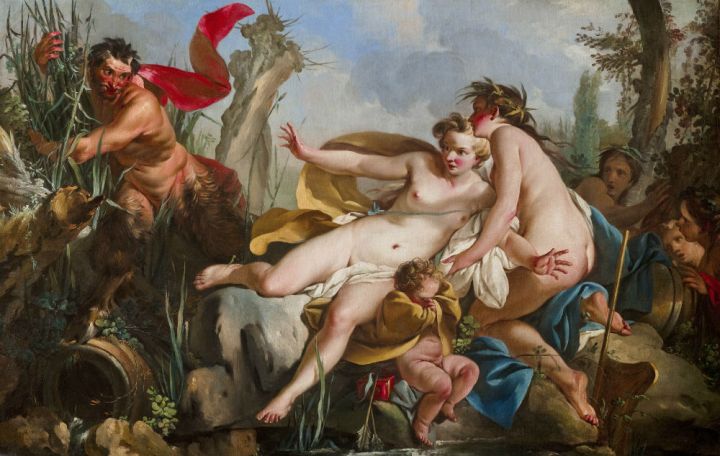
Jean-Baptiste-Marie Pierre, Pan and Syrinx, 1746, oil on canvas, 90 × 141 cm
(Boston: The Horvitz Collection, P-F-57).
◊ ◊ ◊ ◊ ◊
Now on view at the Cummer Museum:
Storytelling: French Art from the Horvitz Collection
Cummer Museum of Art & Gardens, Jacksonville, Florida, 25 May — 29 July 2018
John and Marble Ringling Museum of Art, Sarasota, Florida, 9 September — 2 December 2018
Fairfield University Art Museum, Fairfield, Connecticut, 25 January — 29 March 2019
Curated by Alvin Clark
Storytelling: French Art from the Horvitz Collection combines two exhibitions: Imaging Text: Drawings for French Book Illustration and Seventeenth- and Eighteenth-Century French Paintings, from one of the world’s finest private collections of French art. Created between the 16th and 19th centuries, and ranging from mythological and biblical studies to more playful imagery, the 80 works included in the exhibition vary in terms of style, genre, and period. Captured in crisp and swift pen strokes, finely modulated chalk, or brilliant colors, these captivating compositions were produced by some of the most prominent artists of their time, such as Charles Le Brun (1619–1690), Charles-Nicolas Cochin, the younger (1715–1790), and Jean-Honoré Fragonard (1732–1806).
The exhibition is curated by Alvin L. Clark, Jr, Curator, The Horvitz Collection, Department of Drawings, Division of European and American Art, Harvard Art Museums.
Alvin Clark and Elizabeth M. Rudy, Imaging Text: French Drawings for Book Illustration from The Horvitz Collection (Boston: The Horvitz Collection, 2018), 76 pages, ISBN: 978-0991262533, $15.
◊ ◊ ◊ ◊ ◊
Note (added 10 January 2018) — The posting was updated to included Fairfield University Art Museum.
Exhibition | Pastels at the Louvre
Now on view at the Louvre:
Pastels in the Musée du Louvre: The 17th and 18th Centuries
Musée du Louvre, Paris, 7 June — 10 September 2018
Curated by Xavier Salmon
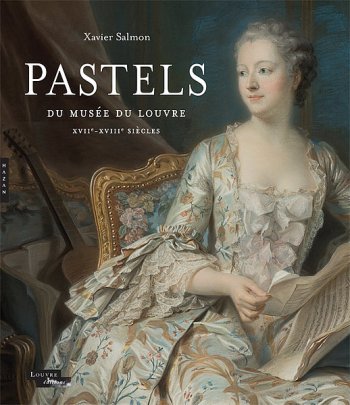 The Louvre holds an unrivaled collection of European pastels from the 17th and 18th centuries. Mostly dating from the reigns of Louis XV and Louis XVI, these extremely fragile works, created with a colored powder that has often been compared to that of a butterfly’s wings, introduce us to Enlightenment society and illustrate the genius of its most celebrated artists: Rosalba Carriera, Maurice Quentin de La Tour, Jean-Baptiste Siméon Chardin, Jean-Baptiste Perronneau, Jean Étienne Liotard, Jean-Marc Nattier, and Élisabeth Louise Vigée Le Brun, together with lesser known artists such as Marie-Suzanne Giroust, Adélaïde Labille-Guiard, Joseph Boze, and Joseph Ducreux.
These pastels illustrate the genius of the artists who produced them as artworks in their own right rather than preparatory studies enhanced with color. Many of them still have their original frame, and sometimes their original glass.
Thanks to the support of American Friends of the Louvre and Joan and Mike Kahn, the more than 150 works in the collection were systematically conserved and remounted to protect them from dust—a long-term project which provided an opportunity for new research on the collection. The results are included in a comprehensive annotated inventory, published in French and English with the support of the Joan Kahn Family Trust.
The exhibition takes a new look at masterpieces such as Maurice Quentin de La Tour’s Portrait of the Marquise de Pompadour and features new acquisitions such as Simon Bernard Lenoir’s portrait of the actor Lekain. It is also an opportunity to compare these works by French artists with others by eminent international pastel artists such as Rosalba Carriera in Venice, Jean-Étienne Liotard in Geneva, and John Russell in London.
The exhibition is curated by Xavier Salmon, director of the Départment des Arts Graphiques and general heritage curator at the Musée du Louvre.
The catalogue, in French and English editions, is published by Hazan and distributed by Yale UP:
Xavier Salmon, Pastels du musée du Louvre, XVIIe XVIIIe siècle (Paris: Hazan, 2018), 384 pages, ISBN: 978-2754114547 (French) / ISBN: 978-0300238631 (English), €59 / $75.
New Book | Jean-Baptiste-Pierre LeBrun (1748–1813)
From Rowman & Littlefield and available from Artbooks.com:
Bette Oliver, Jean-Baptiste-Pierre LeBrun (1748–1813): In Pursuit of Art (Hamilton Books, 2018), 108 pages, ISBN: 978-0761870272, $65 / £45
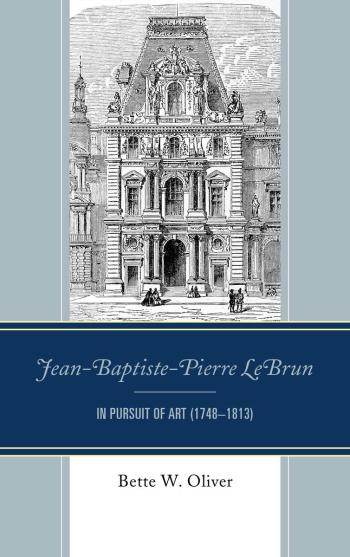 Jean-Baptiste Pierre LeBrun’s life was marked by his intense interest in art, first as an artist, and then from 1770 until his death in 1813, as an art dealer/connoisseur and as a participant in the transformation of the Louvre into a national museum during the French Revolution. He managed to accommodate whichever regime assumed power, from monarchy to republic to empire. He married the artist Elisabeth Vigée in 1776, and together they figured prominently in the pre-revolutionary cultural world of Paris. LeBrun travelled widely, buying art for his gallery and contributing to a number of aristocratic collections. His expertise in attributions of 17th-century Dutch and Flemish paintings was acknowledged internationally, while his reference work on the subject was considered the most comprehensive ever written.
LeBrun, the grand-nephew of the illustrious artist Charles LeBrun, became one of the most successful art dealers in Paris. He played an active role in the politics of art between 1789 and 1802, serving as an expert-commissioner in restoration at the national museum. His inventories of artworks, confiscated from all over Europe by Napoleon’s armies, have provided a valuable record of the development of the French national museum. In addition, his inventories have been useful in the identification and recovery of Nazi confiscations during World War II. LeBrun’s accomplishments during a tumultuous period of political and artistic change present evidence of his contributions to the concept of the modern art museum, notably in the areas of conservation, restoration, and arrangement.
Bette W. Oliver of Austin, Texas, is an independent scholar and editor with a PhD in modern European history from the University of Texas at Austin. A specialist in the period of the French Revolution, she is the author of five books focusing on that pivotal period, as well as eleven volumes of poetry.
The Burlington Magazine, June 2018
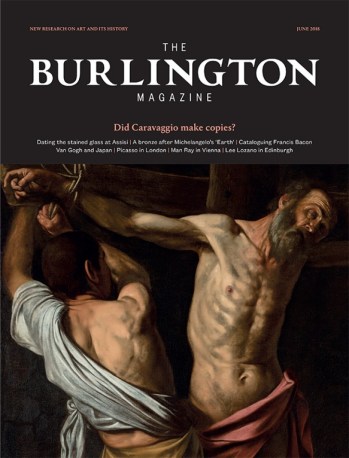
As the June 2018 issue of The Burlington launches a new design (the work of Studio Frank), editor Michael Hall provides a brief overview of the history of the journal’s design in his editorial comments, noting that “many readers now access the magazine in its digital edition and for most people the first sight of the cover is likely to be on the screen of a tablet or smartphone, meaning that it has to work on a small scale” (453).
The eighteenth century in The Burlington:
The Burlington Magazine 160 (June 2018)
 A R T I C L E S
• Tessa Murdoch, “A Set of Silver-Gilt Waiters by Benjamin Pyne for the Courtenay Family of Powderham Castle, Devon,” pp. 478–89.
R E V I E W S
• Xavier F. Salomon, Review of the exhibition Tiepolo Segreto (Vicenza: Palladio Museum, 2017–18), pp. 495–97.
• Sanda Miller, Review of the exhibition Fashioned from Nature (London: V&A, 2018), 497–99.
• Steven Jaron, Review of John Onians, European Art: A Neuroarthistory (Yale UP, 2016), 516–17.
• Antoine Maës, Review of Alexandre Maral, François Girardon (1628–1715): Le Sculpteur de Louis XIV (Arthena, 2015), p. 519.
• Clare Hornsby, Review of Paola Bianchi and Karin Wolfe, eds., Turin and the British in the Age of the Grand Tour (Cambridge UP, 2017), pp. 520–21.
• Jonathan Brown, Review of Elena Santiago Páez, ed., Ceán Bermúdez: Historiador del arte y coleccionista ilustrado (Centro de Estudios Europa Hispánica, 2016), p. 521.
• Timothy Wilcox, Review of Ann Gunn, The Prints of Paul Sandby (1731–1809): A Catalogue Raisonné (Brepols, 2016), pp. 521–23.
• Caroline Finkel, Review of Francis Russell, 123 Places in Turkey: A Private Grand Tour (Bitter Lemon Press, 2017), p. 527.
Exhibition | Fashioned from Nature
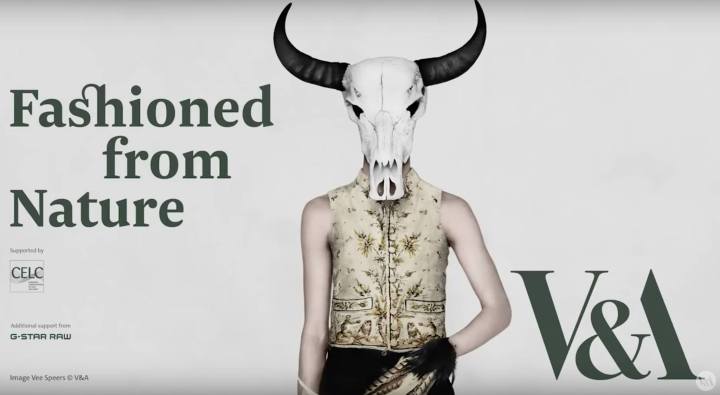
Press release for the V&A exhibition:
Fashioned from Nature
Victoria and Albert Museum, London, 21 April 2018 — 27 Jan 2019
Curated by Edwina Ehrman
A pineapple fibre clutch-bag, Emma Watson’s Calvin Klein dress made from recycled plastic bottles, and a cape of cockerel feathers are amongst the 300 beautiful, intriguing and unsettling objects from the V&A’s most recent major fashion exhibition. Fashioned from Nature traces the complex relationship between fashion and the natural world since 1600. It shows how fashionable dress recurringly draws on the beauty and power of nature for inspiration, with exquisite garments and accessories from Christian Dior, Dries van Noten, and Philip Treacy. It explores how fashion’s processes and constant demand for raw materials damage the environment, featuring campaigners and protest groups that have effectively highlighted this issue such as Fashion Revolution and Vivienne Westwood. It looks at the role of design in creating a better, more sustainable fashion industry.

Waistcoat, 1780–89, France (London: Victoria and Albert Museum, T.49-1948).
The exhibition showcases contemporary designers of desirable, creative and sustainable popular fashion. Menswear and womenswear from Stella McCartney, known for a commitment to and success in developing new alternative sustainable materials, is displayed alongside an upcycled dress by Christopher Raeburn. At the 2016 Met Gala, actor Emma Watson wore a Calvin Klein look made from recycled plastic bottles. With separate parts, it was intended to be re-worn in different ways. The look was created as part of the ‘Green Carpet Challenge’ with Eco-Age, an initiative to pair sustainability with glamour. It is shown with a floral dress from Erdem’s Green Carpet Challenge collection. Fashioned from Nature draws attention to the use of innovative fabrics. Vegea use grape waste from the wine industry to form a leather-substitute and their Grape gown is on show, as is a Ferragamo ensemble made from ‘Orange Fiber’ derived from waste from the Italian citrus industry and an H&M Conscious dress made from recycled shoreline plastic.
The exhibition looks to the past 400 years of fashion to explore what we can learn from fashion practice in the past, with objects dating to the early 1600s. Items include an 1875 pair of earrings formed from the heads of two real Honeycreeper birds—a hugely popular item sold in enormous volume at the time—and a 1860s muslin dress decorated with the iridescent green wing cases of hundreds of jewel beetles. They are shown alongside natural history specimens to indicate the ways fashion has used animal materials in its designs and production.
The natural world has always provided rich inspiration for beautiful fashion. This is shown in displays of exquisite garments from the historic to the contemporary. They range from a 1780s man’s waistcoat, expertly embroidered with a pattern of playful Macacque monkeys, to Gucci’s contemporary bag decorated with stag beetle motifs. One of the earliest pieces in the exhibition, a women’s jacket from the early 1600s, is intricately embroidered with designs of pea-shoots and flowers. A 2016 Giles Deacon haute-couture dress features a pattern of delicate bird’s eggs, whilst gowns from Jean Paul Gaultier (1997) and Busvine (1933–34) both feature leopard print.
 The exhibition also focuses closely on the raw materials used in the production of fashion. Arranged chronologically, it introduces the main fibres used in the 17th and 18th centuries—silk, flax, wool, and cotton—as well as now controversial materials like whalebone, demonstrated by an x-ray by Nick Veasey of a pair of 1780s stays, and turtle shell, used in a fan from 1700. It goes on to chart the expansion in international trade, import of precious materials, and later introduction of man-made materials, which brought fashionable dress to the masses but also contributed to the air and water pollution to which the textile industry is such a significant contributor.
A bold display of posters, slogan clothes, and artworks show how protest movements have helped draw attention to the harmful side of fashion. Figures like Vivienne Westwood have popularised these issues and a mannequin pays homage to an outfit worn by her whilst protesting against climate change. A man’s outfit from Katharine Hamnett’s 1989 ‘Clean Up or Die’ collection is on show alongside posters from Fashion Revolution, a collective aiming to change the way clothes are sourced, produced and consumed. Customising and re-wearing clothes are highlighted through a vintage outfit and a jacket customised by London designer Katie Jones for fashion writer and editor Susie Lau to wear during Fashion Revolution Week 2015.
The exhibition presents a range of solutions to reducing fashion’s impact on the environment from low water denim and using wild rubber to more conceptual and collaborative projects. These include a dress grown from plant roots by the artist Diana Scherer, who uses seed, soil, and water to train root systems into textile-like material, a bio-luminescent genetically- engineered silk dress created by Sputniko!, the MIT Lab and the National Institute of Agricultural Science (NIAS), South Korea, and a tunic and trousers made from synthetic spider silk from Bolt Threads x Stella McCartney.
Fashioned from Nature is curated by Edwina Ehrman, Curator of Textiles and Fashion at the V&A. She also curated the exhibition The Wedding Dress: 300 Years of Bridal Fashions. She was a co-author of The London Look: Fashion from Street to Catwalk (2004) and a contributor to The Englishness of English Dress (2002).
Centre for Sustainable Fashion (CSF) at London College of Fashion, UAL, present two interactive installations which explore ‘Fashion Now’ and ‘Fashion Future.’ ‘Fashion Now’ takes five iconic contemporary fashion pieces and using sensors, visitors are able to explore the unseen impact on nature of the construction, making, wearing and discarding of each item. ‘Fashion Future’ immerses viewers into the fashion world of the future, inviting us to question what fashion means and show us a future we are yet to imagine. The CSF installations are curated by Professor Dilys Williams, founder and Director of CSF, and Ligaya Salazar, Director, Fashion Space Gallery with help from London College of Fashion MA Fashion Futures students.
Edwina Ehrman, Fashioned From Nature (London: V&A Publishing, 2018), 192 pages, ISBN: 978-1851779451, £25 / $40.

Mantua, 1760s, France (London: Victoria and Albert Museum, T.252 to C-1959).
Exhibition | Jean Cotelle (1646–1708): Gardens and Gods
From Versailles:
Jean Cotelle (1646–1708): Gardens and Gods
Grand Trianon, Château de Versailles, 12 June — 16 September 2018
Curated by Béatrice Sarrazin with Clara Terreaux
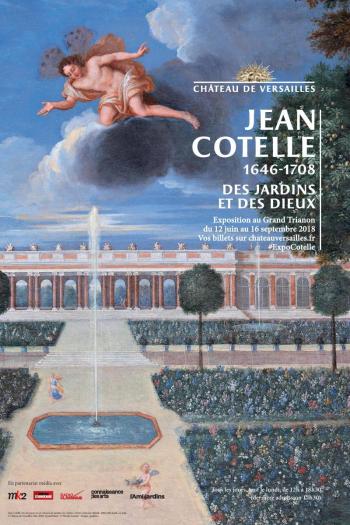 Jean Cotelle (1646–1708): Gardens and Gods, the first exhibition dedicated to the painter, will honour an artist who was very popular in his time, featuring some 120 works: paintings, drawings, engravings, miniatures, and sculptures from public and private collections. Jean Cotelle the Younger belonged to the generation of painters called upon by Louis XIV to decorate the Grand Trianon, a pleasure palace secluded from the hustle and bustle of the court.
For the Trianon Gallery, which overlooks the gardens and connects the Cool Room and the Garden Room, Cotelle was entrusted with the largest portion of the commission: twenty-one paintings. In order to adapt to the setting, he painted in vertical format, rather unusual for landscape painting, to create topographical representations of the Versailles gardens. He adorned the scenes with characters from mythology or fables arranged in two registers (earthly and heavenly), modelled upon the bucolic landscapes of Bolognese painter Albani.
This cycle, completed by three paintings by Jean-Baptiste Martin and Etienne Allegrain, represents a unique ensemble, providing insight into the king’s taste for his gardens which had recently been created by André Le Notre. Hidden by vegetation, the groves served as a backdrop for the portrayal of the loves and pleasures of the gods.
The exhibition will feature the twenty-four restored paintings following a restoration campaign that lasted several years. Along with the large format canvases, the fifteen gouaches created by the artist, masterpieces of miniature painting, will also be displayed. Additionally, a selection of lead sculptures will be included in the exhibition to evoke the decoration of the groves which have since disappeared, in relation to Cotelle’s paintings.
While the Trianon commission represents one of the highlights of Cotelle’s career, retracing the various stages of his work nevertheless reveals different aspects of his talent and his varied career in Saint-Cloud and Versailles as well as in Provence.

Jean Cotelle, Fountain Scene with Alpheus Pursuing Arethusa, 1689–91 (Château de Versailles, Dist. RMN/Jean-Marc Manaï).
Jean Cotelle the Younger was born into a cultured family in Paris in 1646. He grew up in the company of artists, especially painters, including his father Jean Cotelle the Elder, painter to the King, decorator and ornamental painter. He most likely received his early training from the portrait painter Claude Lefèvre. Jean Cotelle the Younger then visited Rome, where he stayed from 1665 until 1670 at his own expense.
His notable works from 1675 and the years which followed include miniatures to illustrate The Campaigns of Louis XIV as well as a large-format May for Notre-Dame in 1681 representing The Marriage at Cana. Cotelle also worked on other decorative commissions, in particular in Saint-Cloud where he created the jewellery cabinet as part of the decoration depicting the story of Venus and Aeneas.
The most important commission he received was a commission in 1688 from Louis XIV to decorate the Trianon gallery also called the Cotelle gallery. Cotelle painted twenty-one topographical representations of the gardens of Versailles, which he adorned with mythological and literary characters. At the same time, he carried out a series of twenty gouaches representing the Trianon Gallery in miniature.
In 1693, he left Paris for Provence, first making a stop in Lyon, where he created the decoration on the ceiling of the great hall for the Château de la Damette. From 1695 to 1700, he lived in Marseille and became the co-director of the opera with Duplessis. He also created ephemeral decorations such as The Entry of the Duke of Burgundy and the Duke of Berry into the City of Avignon. Jean Cotelle the Younger returned to Paris in 1703 where he continued his work for the Academy until his death in 1708.
Beatice Sarazin, ed., Jean Cotelle (1646–1708): Des Jardins et des Dieux (Paris: Liénart, 2018), 240 pages, ISBN: 978-2359062366, 39€ / $68.
◊ ◊ ◊ ◊ ◊
In preparation for the exhibition on Jean Cotelle, the Palace of Versailles launches a research notice for three works attributed to the painter: two gouaches and a drawing. These works disappeared from the public eye in the 1980s for two of them and soon after the year 2000 for the last one. However, reproductions and publications confirm that they exist (see the Château de Versailles website for images).
The works are:
• La Toilette de Vénus, drawing
• Vue du Château de Choisy du côté des parterres et la famille de Louvois, gouache
• Eliezer et Rebecca au Puits, gouache
Once found, their identification would enrich the corpus of the artist and the value of these works, which could be displayed in the exhibition. Internet users are invited to spread this search as far as possible with the hashtag: #ExpoCotelle. People having information about these works can contact the Palace of Versailles through: cotelle@chateauversailles.fr.
New Book | Unfabling the East
From Princeton UP:
Jürgen Osterhammel, Unfabling the East: The Enlightenment’s Encounter with Asia, translated by Robert Savage (Princeton: Princeton University Press, 2018), 696 pages, ISBN: 9780691172729 (hardcover), $35 / ISBN: 9781400889471 (ebook).
 During the long eighteenth century, Europe’s travelers, scholars, and intellectuals looked to Asia in a spirit of puzzlement, irony, and openness. In this panoramic and colorful book, Jürgen Osterhammel tells the story of the European Enlightenment’s nuanced encounter with the great civilizations of the East, from the Ottoman Empire and India to China and Japan.
Here is the acclaimed book that challenges the notion that Europe’s formative engagement with the non-European world was invariably marred by an imperial gaze and presumptions of Western superiority. Osterhammel shows how major figures such as Leibniz, Voltaire, Gibbon, and Hegel took a keen interest in Asian culture and history, and introduces lesser-known scientific travelers, colonial administrators, Jesuit missionaries, and adventurers who returned home from Asia bearing manuscripts in many exotic languages, huge collections of ethnographic data, and stories that sometimes defied belief. Osterhammel brings the sights and sounds of this tumultuous age vividly to life, from the salons of Paris and the lecture halls of Edinburgh to the deserts of Arabia, the steppes of Siberia, and the sumptuous courts of Asian princes. He demonstrates how Europe discovered its own identity anew by measuring itself against its more senior continent, and how it was only toward the end of this period that cruder forms of Eurocentrism–and condescension toward Asia—prevailed.
A momentous work by one of Europe’s most eminent historians, Unfabling the East takes readers on a thrilling voyage to the farthest shores, bringing back vital insights for our own multicultural age.
Jürgen Osterhammel is professor of modern and contemporary history at the University of Konstanz. He is a recipient of the Gottfried Wilhelm Leibniz Prize, Germany’s most prestigious academic award. His books include The Transformation of the World: A Global History of the Nineteenth Century and, with Jan C. Jansen, Decolonization: A Short History (both Princeton). He lives in Freiburg, Germany.










 Enfilade
leave a comment