Exhibition | ‘So That You Might Know Each Other’
From the press release (19 April 2018) for the exhibition:
‘So That You Might Know Each Other’: Faith and Culture in Islam
Sharjah Museum of Islamic Civilisation, Emirate of Sharjah, United Arab Emirates, 2014
National Museum of Australia, Canberra, 20 April — 22 July 2018
 Fine embroidered textiles, camel and horse saddles, musical instruments, and carved amulets headline a new exhibition on view at the National Museum of Australia in Canberra, which showcases intriguing objects from the Anima Mundi Museum, the section of the Vatican Museums devoted to extra-European collections, and the Sharjah Museums Authority, United Arab Emirates.
Featuring over 100 precious 18th- to 20th-century objects from over twenty countries, ‘So That You Might Know Each Other’: Faith and Culture in Islam illustrates the evolution of Islam across the globe and celebrates diverse Muslim societies from the Middle East, through to Africa and India, China and South East Asia. Inspired by a verse from the Holy Qur’an, the exhibition’s title invites visitors to learn more about each other’s lives, religions, and cultures in a spirit of intercultural respect and dialogue.
Including many everyday items, the exhibition—which opened at the National Museum as its only Australian venue—tells the stories of ordinary peoples’ lives, beliefs, and cultural traditions. It is the first time these objects, rarely seen outside their own institutions, have been displayed in Australia. This unique international collection is being complemented by Australian objects that celebrate the contributions made by people of Islamic faith to Australian history.
National Museum of Australia director, Dr Mathew Trinca, said he was delighted Australian audiences would have the opportunity to see these distinctive and beautiful collections. “Islamic arts and decorative crafts are globally recognised for their beauty and artistry, and we hope this exhibition promotes mutual understanding and dialogue between cultures and faiths,” said Dr Trinca. “There has never been a more important time for a show of this kind in Australia.”
Director of the Vatican Museums, Dr Barbara Jatta, said she hopes Australian audiences would embrace the show. “As I followed the preparation of this exhibition, I was sincerely struck by the beauty and sophistication of the Islamic world—I saw firsthand the refined productions of people living across a vast area stretching from Africa to Australia.”
Director General, Sharjah Museums Authority, Manal Ataya, hoped the exhibition boosted intercultural understanding: “‘So That You Might Know Each Other’ is an unique exhibition devised to give a glimpse of the diversity of Muslim material culture and is intended to foster intercultural dialogue and promote tolerance and peace—among Muslims the world over and between Islam and other faiths.”
Key objects in the exhibition include a late 19th-century wood and leather horse saddle from Tunisia; a late 19th- or early 20th-century silver coral, horn, and glass necklace from Libya; a tapestry wool and silk overcoat from Syria; traditional women’s and men’s costumes from Sharjah; an illuminated Qur’an from Ottoman Turkey; and an 18th-or 19th-century vase from China, combining Islamic inscriptions and Buddhist symbols.
These are complemented by Australian objects from the National Museum’s collection, including an intricate bark painting depicting early contact between Aboriginal people in north Australia and Muslim fisherman from Makassar in southern Sulawesi, Indonesia, who came to Australia in search of trepang or sea cucumber, a delicacy they traded to China as food and medicine.
The exhibition highlights the role Muslims played in the exploration and opening up of huge expanses of outback Australia for the pastoral industry and trade. On show is a rare original drawing made in 1953, of Bejah Dervish. Described as Australia’s ‘greatest cameleer’, Bejah was born in Baluchistan (now Pakistan) and came to Australia in 1890 as a camel-handler. He excelled in this profession, helping to save members of the ill-fated Calvert Expedition of 1896–97, and later running a successful camel string at Marree, on the Birdsville track, for a further thirty years. The drawing is featured alongside a rare early camel saddle on loan from the Museum of Arts and Applied Sciences, Sydney.
The ‘Afghans’ or ‘Ghans’, as they became known (although they mainly came from India and present-day Pakistan), pioneered a network of tracks that became the major roads of Central Australia. Apart from Australian Aborigines, they were the first people who were able to navigate and survive these challenging terrains. Together with their imported camels, they hauled the equipment, water, food and other supplies needed for building the great desert railways, and, with their work on the Overland Telegraph Line, they helped revolutionise communications in Australia.
From the 1860s to the 1920s, an estimated 20,000 camels and 2000 cameleers reached Australia. While many of the men who were indentured to large agricultural companies returned to their countries of origin, others, like Bejah Dervish, remained, building mosques and raising families who formed the first Islamic communities in Australia.
Launched in April 2018, ‘So That You Might Know Each Other’: Faith and Culture in Islam invites Muslim and non-Muslim people to learn more about each others’ lives across regions, religions, beliefs, and cultures. The objects highlight and celebrate the diverse cultures of traditional Muslim societies ranging from Africa and the Middle East, to China, India, Indonesia, and Australia.
The exhibition is an unprecedented collaboration between the Vatican Anima Mundi Museum, the Sharjah Museums Authority and the National Museum of Australia. It focuses on areas around the world and in Australia, where Muslim people have settled and created communities. The objects from the Vatican Museums and Sharjah Museums have not appeared in Australia before, nor have many been on display elsewhere, apart from the previous 2014 exhibition at the Sharjah Museum of Islamic Civilisation, Emirate of Sharjah, United Arab Emirates.
The majority of the objects in the exhibition came to the Vatican Museums as gifts sent to Pope Pius XI, on the occasion of the Universal Exposition held in Rome in 1925. These gifts formed the basis of the Vatican’s large extra-European collections, recently rebranded as the Vatican Anima Mundi (‘Soul of the World’) Museum. Almost 90 years later, after preserving and caring for these gifts with the same dedication extended to Italian masterpieces, the Vatican offered a selection of its collection for the exhibition, displayed at the Sharjah Museum of Islamic Civilization in 2014. This first exhibition was also called ‘So That You Might Know Each Other’.
The Sharjah Museum of Islamic Civilization opened in 2008 and is just one of 16 museums that form the Sharjah Museums Authority (SMA). This Museum and others—including the Sharjah Maritime Museum, Calligraphy Museum, Heritage Museum, and the Bait Al Naboodah Museum—have contributed objects for the exhibition in Canberra.
‘So That You Might Know Each Other’: Faith and Culture in Islam (Canberra: National Museum of Australia Press, 2018), 120 pages, ISBN: 978-1921953316, $30.
Exhibition | Religion in Early America
From the Smithsonian:
Religion in Early America
National Museum of American History, Washington, D.C., 28 June 2017 — 3 June 2018

Thomas Jefferson’s private text, The Life and Morals of Jesus of Nazareth—colloquially known as the Jefferson Bible (Smithsonian’s National Museum of American History; photo by Hugh Talman).
The role of religion in the formation and development of the United States is at the heart of this one-year exhibition that explores the themes of religious diversity, freedom, and growth from the colonial era through the 1840s. National treasures from the Museum’s own collection are on view, such as George Washington’s christening robe from 1732, Thomas Jefferson’s The Life and Morals of Jesus of Nazareth, also known as ‘The Jefferson Bible’, and Wampum beads. Significant objects on loan include Massachusetts Bay Colony-founder John Winthrop’s communion cup, circa 1630; a Torah scroll on loan from New York’s Congregation Shearith Israel, founded in 1654; a chalice used by John Carroll, the first Roman Catholic bishop in the U.S. and founder of Georgetown University; and a first edition of the Book of Mormon. The objects represent the diverse range of Christian, Native American, and African traditions as well as Mormonism, Islam, and Judaism that wove through American life in this era.
◊ ◊ ◊ ◊ ◊
Peter Manseau, Objects of Devotion: Religion in Early America (Washington, D.C.: Smithsonian Books, 2017), 260 pages, ISBN: 978-1588345929, $30.
 Objects of Devotion: Religion in Early America tells the story of religion in the United States through the material culture of diverse spiritual pursuits in the nation’s colonial period and the early republic. The beautiful, full-color companion volume to a Smithsonian National Museum of American History exhibition, the book explores the wide range of religious traditions vying for adherents, acceptance, and a prominent place in the public square from the 1630s to the 1840s. The original thirteen states were home to approximately three thousand churches and more than a dozen Christian denominations, including Anglicans, Baptists, Catholics, Congregationalists, Lutherans, Methodists, Presbyterians, and Quakers. A variety of other faiths also could be found, including Judaism, Islam, traditional African practices, and Native American beliefs. As a result, America became known throughout the world as a place where, in theory, if not always in practice, all are free to believe and worship as they choose. The featured objects include an 1814 Revere and Sons church bell from Salem, the Jefferson Bible, wampum beads, a 1654 Torah scroll brought to the New World, the only known religious text written by an enslaved African Muslim, and other revelatory artifacts. Together these treasures illustrate how religious ideas have shaped the country and how the treatment and practice of religion have changed over time. Objects of Devotion emphasizes how religion can be understood through the objects, both rare and everyday, around which Americans of every generation have organized their communities and built this nation.
Peter Manseau is the Lilly Endowment Curator of American Religious History at the Smithsonian Institution’s National Museum of American History. He holds a doctorate in religion from Georgetown University and writes frequently for publications including The New York Times, The Atlantic, and The Wall Street Journal.
Exhibition | The Great Spectacle: 250 Years of the Summer Exhibition
From the RA:
The Great Spectacle: 250 Years of the Summer Exhibition
Royal Academy of Arts, London, 12 June — 19 August 2018
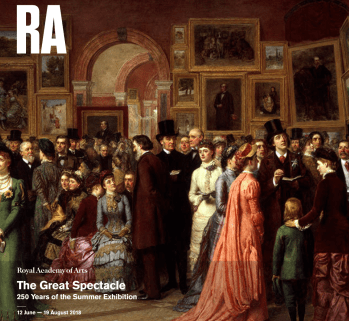 The Great Spectacle tells the story of 250 years of the Summer Exhibition, the world’s longest running annual display of contemporary art. Ever since 1769, and at a succession of locations ranging from Pall Mall to Piccadilly, the Academy’s exhibition rooms have been crowded for some two months each year with hundreds of paintings and sculptures produced by many of Britain’s leading artists.
Over the last two hundred and fifty years, these spectacular displays of art—dominated by what has become a famously crowded and collage-like arrangement of pictures across the Academy’s walls—have provided thousands of artists with a crucial form of competition, inspiration and publicity, and captured the interest of millions of visitors. The Great Spectacle tells the story of these exhibitions and, in doing so, offers an innovative, illuminating and visually stunning celebration of the Academy’s first 250 years and demonstrates the impact of these exhibitions on art in Britain and internationally.
Staged to coincide with the Summer Exhibition of 2018, and taking the form of a sequence of interlinked gallery displays that will recreate a series of important moments in the history of the Academy and its shows, The Great Spectacle will dramatise the excitement, variety and richness of the Summer Exhibition, offering visitors a fascinating, ever-changing journey from Joshua Reynolds to Wolfgang Tillmans.
Mark Hallett and Sarah Victoria Turner, The Great Spectacle 250 Years of the Summer Exhibition (London: ACC Publishing Group, 2018), 224 pages, ISBN: 9781910350706, £25.
Note added (23 August 2018) — Also, see the related online publication: Hallett, Mark, Sarah Victoria Turner, Jessica Feather, Baillie Card, Tom Scutt, and Maisoon Rehani, eds., The Royal Academy Summer Exhibition: A Chronicle, 1769–2018 (London: Paul Mellon Centre for Studies in British Art, 2018).
New Book | The Royal Academy of Arts: History and Collections
From Yale UP:
Robin Simon and MaryAnne Stevens, eds., The Royal Academy of Arts: History and Collections (London: Paul Mellon Centre for Studies in British Art, 2018), 676 pages, ISBN: 9780300232073, $95.
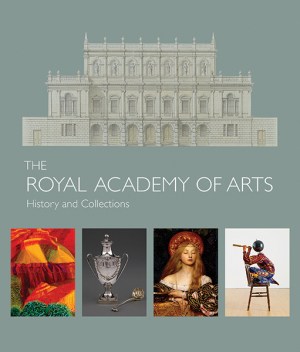 Animated by an unprecedented study of its collections, this book tells the story of the Royal Academy of Arts, London, and illuminates the history of art in Britain over the past two and a half centuries. Thousands of paintings, sculptures, drawings, and engravings, as well as silver, furniture, medals, and historic photographs, make up this monumental collection, featured here in stunning illustrations, and including an array of little-studied works of art and other objects of the highest quality. The works of art complement an archive of 600,000 documents and the first library in Britain dedicated to the fine arts. This fresh history reveals the central role of the Royal Academy in British national life, especially during the 19th century. It also explores periods of turmoil in the 20th century, when the Academy sought either to defy or to come to terms with modernism, challenging linear histories and frequently held notions of progress and innovation.
Robin Simon is editor of the British Art Journal and honorary professor of English at University College London. MaryAnne Stevens is an independent art historian and curator.
Exhibition | Napoleon the Strategist
From the press release for the exhibition:
Napoleon the Strategist / Napoléon stratège
Musée de l’Armée, Paris, 6 April — 22 July 2018
 Following on from the presentation of Napoleon’s political vision with the 2013 exhibition Napoleon and Europe and an exploration in 2016 of his fall and his legend with Napoleon in Saint Helena: His Fight for His Story, in spring 2018 the Musée de l’Armée will tackle another aspect of the history of Napoleon, whose skills as a ‘military genius’ are universally recognised.
Any examination of Napoleon the strategist has to start by defining the notion of strategy and how it evolved. For it was in Napoleon’s time that the notion became inextricably linked to power and the abilities of the person wields it. The word ‘strategy’ emerged in the military world, gradually taking on the meaning and form that are now applied more broadly to politics, the economy, finance, and communications. The idea behind the exhibition is therefore to train the spotlight on strategy, the intangible expression of Napoleonic thinking where the skill lies in mastering a vast range of parameters and their interactions. The exhibition will draw on maps, documents illustrating the master strategist’s deliberations, and objects—vestiges, symbols and representations of historical facts—that embody the tangible reality that strategic thinking seeks to control.
To ensure that the theme is as widely accessible as possible, Napoleon’s role will be illustrated in the context of his era, including a description of his education, abilities, and the means available to him and to his enemies. The exhibition sets out to show the strategist at work, explain the issues at stakes and how campaigns progressed, and get to the heart of the action to analyse his most famous battles, defeats as well as victories.
Although the new event is separate from the permanent collection galleries devoted to the Revolution and the Empire, it contributes to them with a complementary viewpoint. Multimedia tools will offer an immersive experience to help visitors grasp what is an abstract and complex notion. The permanent galleries will feature new digital installations providing a more narrative and explanatory approach to Napoleon’s strategic ideas. Visitors will be able to move freely between these two approaches. The visit continues on the Invalides site with an exploration of the Dome church, home to Napoleon’s tomb.
François Lagrange and Émilie Robbe, eds., Napoléon stratège (Paris: Lienart, 2018), 296 pages, ISBN: 978-2359062328, 29€.
New Book | European Porcelain in the Metropolitan Museum of Art
Distributed by Yale UP:
Jeffrey Munger, with an essay by Elizabeth Sullivan, European Porcelain in the Metropolitan Museum of Art (New York: The Metropolitan Museum of Art, 2018), 288 pages, ISBN: 9781588396433, $65.
 The quest to discover the process of making porcelain was one of the defining aspects of post-Renaissance Europe, and it had significant artistic, technical, and commercial ramifications. This beautifully illustrated book showcases ninety works, spanning the late 16th to the mid-19th century, and reflecting the major currents of European porcelain production. Each work is shown in glorious new photography, accompanied by analysis and interpretation by one of the leading experts in European decorative arts. Featuring blue-and-white wares from Italy, rare examples of German Meissen, French Sèvres, British Chelsea porcelain, and much more, this is a long-overdue survey of the greatest porcelain treasures from The Met’s vast collection.
Jeffrey H. Munger is former curator, and Elizabeth Sullivan is former associate research curator, both in the Department of European Sculpture and Decorative Arts at The Metropolitan Museum of Art.
Exhibition | France Viewed from the Grand Siècle
Now on view at the Louvre:
France Viewed from the Grand Siècle: Drawings by Israël Silvestre (1621–1691)
Musée du Louvre, Paris, 15 March — 25 June 2018
Curated by Bénédicte Gady and Juliette Trey
 While Israël Silvestre’s engravings circulated widely, his drawings remain relatively unknown. The Musée du Louvre is home to a remarkable collection of them, to be shown to the public for the first time.
After training as an engraver under Jacques Callot, Israel Silvestre very quickly turned to the cityscape. Small and picturesque, his early ‘views’ were of his native Nancy and the cities he passed through on the several journeys he made between Paris and Rome. By contrast, his mature works offer broad panoramas of the French capital, with its royal festivities and the changes it was undergoing, and outlines of the cities conquered by Louis XIV in Lorraine and the Ardennes. In addition, his series devoted to the handsome Ile-de-France châteaux—Vaux-le-Vicomte, Meudon, Montmorency, Versailles—brought a fresh eye to architecture and gardens.
The exhibition is organized by Bénédicte Gady and Juliette Trey of the Department of Prints and Drawings, Musée du Louvre.
Benedicte Gady and Juliette Trey, La France vue du Grand Siècle: Dessins d’Israël Silvestre (1621–1691) (Paris: Lienart, 2018), 208 pages, ISBN: 978-2359062311, 29€.
New Book | The Queen’s Embroiderer
From Bloomsbury:
Joan DeJean, The Queen’s Embroiderer: A True Story of Paris, Lovers, Swindlers, and the First Stock Market Crisis (London: Bloomsbury, 2018), 400 pages, ISBN: 978-1632864741, £30.
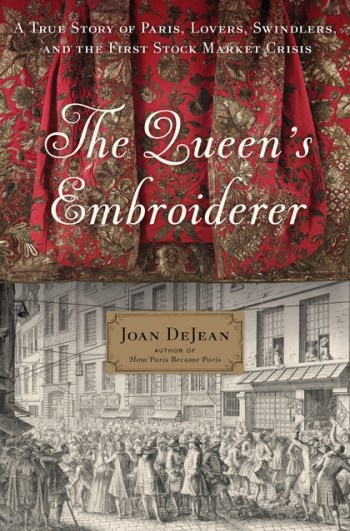 From the author of How Paris Became Paris, a sweeping history of high finance, the origins of high fashion, and a pair of star-crossed lovers in 18th-century France.
Paris, 1719. The stock market is surging and the world’s first millionaires are buying everything in sight. Against this backdrop, two families, the Magoulets and the Chevrots, rose to prominence only to plummet in the first stock market crash. One family built its name on the burgeoning financial industry, the other as master embroiderers for Queen Marie-Thérèse and her husband, King Louis XIV. Both patriarchs were ruthless money-mongers, determined to strike it rich by arranging marriages for their children.
But in a Shakespearean twist, two of their children fell in love. To remain together, Louise Magoulet and Louis Chevrot fought their fathers’ rage and abuse. A real-life heroine, Louise took on Magoulet, Chevrot, the police, an army regiment, and the French Indies Company to stay with the man she loved.
Following these families from 1600 until the Revolution of 1789, Joan DeJean recreates the larger-than-life personalities of Versailles, where displaying wealth was a power game; the sordid cells of the Bastille; the Louisiana territory, where Frenchwomen were forcibly sent to marry colonists; and the legendary ‘Wall Street of Paris’, Rue Quincampoix, a world of high finance uncannily similar to what we know now. The Queen’s Embroiderer is both a story of star-crossed love in the most beautiful city in the world and a cautionary tale of greed and the dangerous lure of windfall profits. And every bit of it is true.
Joan DeJean is Trustee Professor at the University of Pennsylvania. She is the author of ten books on French literature, history, and material culture, including most recently The Age of Comfort: When Paris Discovered Casual and the Modern Home Began and The Essence of Style: How the French Invented High Fashion, Fine Food, Chic Cafés, Style, Sophistication, and Glamour. She lives in Philadelphia and, when in Paris, on the street where the number 4 bus began service on July 5, 1662.
Exhibition | The Chocolate Girl by Liotard
On view this fall at the Zwinger in Dresden:
‘The Most Beautiful Pastel Ever Seen’: The Chocolate Girl by Jean-Étienne Liotard
Zwinger, Staatliche Kunstsammlungen Dresden, 28 September 2018 — 6 January 2019

Jean-Étienne Liotard, The Chocolate Girl, ca. 1744–45 (Dresden: SKD, Gemäldegalerie Alte Meister).
The exhibition focuses on one of the most famous works in the collection of the Dresden Gemäldegalerie, The Chocolate Girl by the Swiss artist Jean-Étienne Liotard (1702–1789). Liotard enjoyed enormous success as a pastel painter; even Rosalba Carriera, whose mastery of the medium had helped transform it into a serious and highly-admired art form, declared The Chocolate Girl to be “the most beautiful pastel ever seen.”
It was thanks to the art dealer Count Francesco Algarotti, who purchased the picture in Venice in 1745, buying it directly from the artist for the Dresden collection of Augustus III, that the gallery first began to show works by contemporary artists. The pastel medium suited the Rococo taste for lifelike, brilliant portraits and allowed Liotard to create flawless, porcelain-smooth surfaces. The great popularity of the picture, however, also rests on the fact that it depicts a simple, unidentified housemaid, a hitherto rare motif. The clear-eyed precision of Liotard’s observation anticipated not only the art of the Enlightenment but also nineteenth-century Realism.
Equally worthy of mention are the countless adaptations and appropriations of the motif for other, often trivial purposes. Of no less interest is the eccentric painter himself. A true cosmopolitan, he travelled far and wide, sported a luxuriant beard, exotic clothing and a turban and called himself ‘Le peintre turc’. The exhibition’s epilogue showcases Hann Trier’s take on Liotard’s masterpiece. Painted in 1991, Trier’s three-part sequence La Tasse au chocolat, reinterpreted The Chocolate Girl for the twentieth century.
Stephan Koja and Roland Enke, eds., ‘The Most Beautiful Pastel Ever Seen’: The Chocolate Girl by Jean-Étienne Liotard in the Dresden Gemäldegalerie (Munich: Hirmer Verlag, 2018), 272 pages, ISBN: 978-3777431369, $42.
A full press release is available via Art Daily.
◊ ◊ ◊ ◊ ◊
Note (added 28 September 2018) — The posting was updated to include details of the catalogue and a link to the press release.
New Book | Poetry and the Idea of Progress, 1760–1790
From Anthem Press:
John Regan, Poetry and the Idea of Progress, 1760–1790 (London: Anthem Press, 2018), 222 pages, ISBN 9781783087723, £70 / $115.
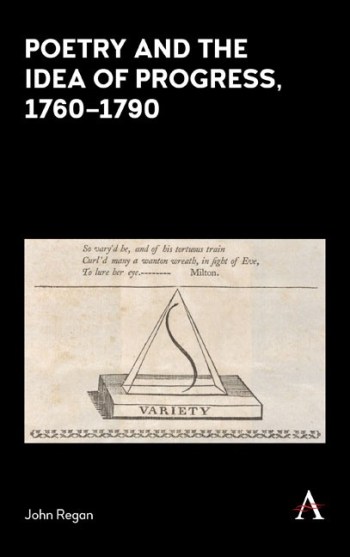 Poetry and the Idea of Progress, 1760–1790 explores under-examined relationships between poetry and historiography in the eighteenth century, deepening our understanding of the relationship between poetry and ideas of progress with sustained attention to aesthetic, historical, antiquarian, and prosodic texts from the period. Its central contention is that the historians and theorists of the time did not merely instrumentalize verse in the construction of narratives of human progress, but that the aesthetics of verse had a kind of agency—it determined the character of—historical knowledge of the period. With numerous examples from poems and writing on poetics, Poetry and the Idea of Progress, 1760–1790 shows how the poetic line became a site at which one could make assertions about human development even as one experienced the expressive effects of metred language.
John Regan is a research fellow in English literature at the University of Cambridge. His research interests centre on the cultural dialogue between poetics and historical writing in the long eighteenth century.
C O N T E N T S
List of Figures
Acknowledgements
Introduction
1 Progress by Prescription
2 Thomas Sheridan and the Divine Harmony of Progress
3 ‘There Is a Natural Propensity in the Human Mind to Apply Number and Measure to Every Thing We Hear’: Monboddo, Steele and Prosody as Rhythm
4 ‘[C]ut into, distorted, twisted’: Thomas Percy, Editing and the Idea of Progress
5 ‘Manners’ and ‘Marked Prosody’: Hugh Blair and Henry Home, Lord Kames
Afterword: Rude Manners, ‘Stately’ Measures: Byron and the Idea of Progress in the New Century
Conclusion
Notes
Bibliography
Index










 Enfilade
leave a comment