Print Quarterly, December 2017
The eighteenth century in the current issue of Print Quarterly:
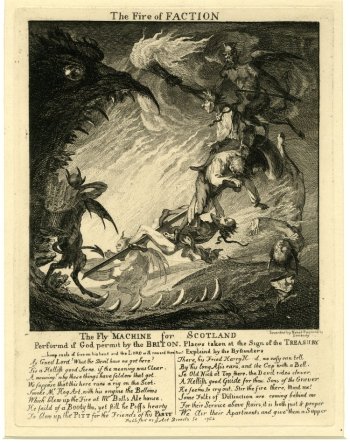
Paul Sandby, The Fire of Faction. The Fly Machine for Scotland, 1762, etching (London: The British Museum).
Print Quarterly 34.4 (December 2017)
A R T I C L E S
• Aaron M. Hyman, “Patterns of Colonial Transfer: An Album of Prints in Mexico City,” pp. 393–99.
“The rediscovery of an album of European prints in Mexico City promises to fill in some of the scholarly gaps by bringing to roughly 500 the number of extant, loose-leaf European prints in Mexico that survive from the colonial period—vastly more than scholars were aware of only a decade ago. . . The album is loosely organized chronologically and by national schools, with the earliest prints appearing at the beginning, followed by the eighteenth-century material that constitutes most of it.”
• Ann V. Gunn, “The Fire of Faction: Sources of Paul Sandby’s Satires of 1762–63,” pp. 400–18.
“On 23 September 1762, ‘The Butifyer, a touch on the times. Also a poor man loaded with mischief, or John Bull and his sister Peg . . . Likewise the Fire of Faction’ were announced in The Public Advertiser, the first of three of a series of seven satirical prints created by Paul Sandy (1731–1809) in late 1762 during the negotiations for the Treaty of Paris that ended the Seven Years’ War . . . This group, however, has never been examined as a whole before. This article discusses the context within which these prints were made and identifies the imagery and literary sources employed in them.”
N O T E S A N D R E V I E W S
• Louis Marchesano, Review of Kristina Deutsch, Jean Marot: Un graveur d’architecture à l’époque de Louis XIV (Berlin: De Gruyter, 2015), pp. 437–38.
• James Grantham Turner, Review of an issue of Casabella 856 (December 2015), dedicated to the Fondazione Querini Stampalia’s 2016 exhibition Giulio Romano’s I Modi and the Modi of of Carlo Scarpa and Alvaro Siza, which featured drawings by two modern architects with sexually explicit Italian prints from the sixteenth to nineteenth centuries, pp. 441–42.
• Antony Griffiths, Review of the exhibition catalogue Freyda Spira and Peter Parshall, The Power of Prints: The Legacy of William M. Ivins and A. Hyatt Mayor (New Haven: Yale University Press, 2016), pp. 468–70.
P U B L I C A T I O N S R E C E I V E D
• Sharon Liberman Mintz, Shaul Seidler-Feller, and David Wachtel, eds., The Writing on the Wall: A Catalogue of Judaica Broadsides from the Valmadonna Trust Library (London: Valmadonna Trust Library, 2015), p. 462.
• Christien Melzer, ed., Im Zeichen der Lilie: Französische Druckgraphik zur Zeit Ludwigs XIV (Bremen: Kunstverein Bremen, 2017), pp. 462–63.
• Petra Zelenková, Jan Kupecký a ‘černé umění’ / Johann Kupezky (1666–1740) and ‘The Black Art’ (Prague: National Gallery, 2016), p. 463.
• Anna Schultz, Johann Gottlieb Glume (1711–1778): Das Druckgraphische Werk (Berlin: Galerie Bassenge, 2016), p. 463.
• Laura Moretti, Recasting the Past: An Early Modern ‘Tales of Ise’ for Children (Leiden: Brill, 2016), p. 463.
Exhibition | The Business of Prints
Press release (via Art Daily) for the exhibition:
The Business of Prints, 1400–1850
The British Museum, London, 21 September 2017 — 28 January 2018
Curated by Antony Griffiths
 The British Museum has one of the greatest collections of prints in the world and holds the UK’s national collection. The majority of this collection, which totals more than two million prints, was made in the years before the invention of photography. Due to the sheer volume of the collection it can become difficult to grasp its contents, and many of the prints are today very unfamiliar and puzzling. For the past century, prints have usually been discussed either as finished works of art or as illustrations of a particular subject. This exhibition reverses the perspective in a way that has not been attempted before, and endeavours to show prints as an object of trade.
The exhibition The Business of Prints is in part based on the book The Print before Photography: An Introduction to European Printmaking, 1550–1820 by Antony Griffiths, published last year by British Museum Press. This won the Apollo Prize for the best art book of the year 2016. It is the first work ever to attempt to explain how the print world worked.
The exhibition focuses on four major topics: the production of prints, the lettering on prints, the usage of prints, and the collecting of prints and the concern for quality. In addition, books and series are being shown in table cases, and framed prints on the wall. Famous works by artists such as Dürer, Rembrandt, and Goya are being shown alongside far less familiar subjects by artists of the print trade who have almost been forgotten. Among them is a rabbit used as target practice, a prompt for an early form of karaoke, and prints from plates that had been so heavily used that they had almost worn out. The display offers a more complete understanding of the lettering on prints, the information it gives us, and some of the complicated ways in which images were linked with text.
We are now so used to the deluge of photographically-derived imagery of the modern world that it is difficult to imagine a period which lasted for nearly 450 years, from around 1400 to 1850, when every pictorial image had to be designed by someone and then cut by a craftsman onto a copper plate or wooden block—there were no mechanical aids. These were then printed by another expert, and distributed by printsellers to buyers around the whole of Europe. Behind them stood the publishers and entrepreneurs, who financed the production, and frequently came up with ideas for new subjects. It was a huge business, which gave work to thousands of people. The exhibition sheds light on this forgotten trade of mass production which required numerous collaborations in order to produce a single print, whilst revealing some of the complexities of the craftsmanship and the process, the varied nature of the prints themselves, and the ways in which buyers used or collected them.
Johannes Gutenberg invented moveable type in Mainz in the late 1440s. However, type is designed to deal with words, and as soon as the need to communicate goes beyond the verbal, the support of another variety of printing must be called on—one that is specifically suited for images. Two such technologies were used alongside type, one based around cutting designs into wooden blocks (the relief process of woodcut), the other in which the design was incised as lines into a copper plate (the intaglio processes such as engraving and etching).
The uses to which these technologies were put were enormously varied. The printing of maps and music, wallpaper, diagrams, decorative paper, bank notes, playing cards and fans, as well as many types of decoration of textiles and ceramics, depended on woodcut or engraving. Many of these applications spun off to become separate businesses. In museums the field is conventionally narrowed to one area of this vast expanse, that of pictorial images on sheets of paper. This is still very wide, covering a wide range of functions, such as portraits, devotional images, current events, landscape and topography, caricature, fantasy and designs for the decorative arts. Many of these classes of print did not need the support of typography, and most intaglio prints carried their text engraved on the plate itself alongside the image. One example that demonstrates the volume and diversity of the European print trade is the mass production of the recognisable image of a devotional saint which would have been sold by pedlars and worn as amulets by peasants. These were often printed on vellum, a more durable material than paper, to withstand daily wear and tear.
When speaking of the display, curator Antony Griffiths highlights that “this is the first exhibition ever to demonstrate what prints can tell us about the vast business of trading prints. The exhibition aims to open the visitor’s eyes to the business of printing. Prints were multiples made in the hope that people would buy lots of them. The range of subjects, sizes and purposes was huge—far larger than people realise today.”
New Book | Edward the Black Prince in Georgian and Victorian England
From Boydell & Brewer:
Barbara Gribling, The Image of Edward the Black Prince in Georgian and Victorian England: Negotiating the Late Medieval Past (London: Royal Historical Society, 2017), 189 pages, ISBN: 9780861933426, $90.
 During the Georgian and Victorian periods, the fourteenth-century hero Edward the Black Prince became an object of cultural fascination and celebration: he and his battles played an important part in a wider reimagining of the British as a martial people, reinforced by an interest in chivalric character and a burgeoning nationalism. Drawing on a wealth of literature, histories, drama, art, and material culture, this book explores the uses of Edward’s image in debates about politics, character, war, and empire, assessing the contradictory meanings ascribed to the late Middle Ages by groups ranging from royals to radicals. It makes a special claim for the importance of the fourteenth century as a time of heroic virtues, chivalric escapades, royal power, and parliamentary development, adding to a growing literature on Georgian uses of the past by exposing an active royal and popular investment in the medieval. Disputing current assumptions that the Middle Ages represented a romanticized and unproblematic past, it shows how this investment was increasingly contested in the Victorian era.
C O N T E N T S
Introduction
Royal Associations: Heroic Character and Chivalric Ceremony at the Court of George III
Prince George Reclaims the Heroic? Transition, Ambition, and Domesticity
Chivalry and Politics in Victoria’s Early Reign: Art, Exhibitions and Palace Renditions
Politics, Parliament, and the People’s Prince
Emulating Edward? Redefining Chivalry and Character
Warrior for Nation and Empire
Conclusion
New Book | Exiles in a Global City: The Irish and Early Modern Rome
From Brill:
Clare Lois Carroll, Exiles in a Global City: The Irish and Early Modern Rome, 1609–1783 (Leiden: Brill, 2017), 342 pages, ISBN: 978 900433 5165, €149 / $172.
 In Exiles in a Global City, Clare Carroll explores Irish migrants’ experiences in early modern Rome and interprets representations of their cultural identities in relation to their interaction with world-wide Spanish and Roman institutions. This study focuses on some sources in Roman archives not previously considered by Irish historians. The book examines a wide array of cultural productions—Ó Cianáin’s account of O’Neill’s progress from Ireland to Rome, Luke Wadding’s history of the Franciscan order, the portraits at S. Isidoro, the first printed Irish grammar, the letters of Oliver Plunkett, the records of a hospice for converts, Charles Wogan’s memoir, and reports on the national college—for how they transformed emerging senses of an Irish nation.
Clare Carroll (Professor of Comparative Literature, Queens College and The Graduate Center, CUNY) is the author of Circe’s Cup: Cultural Transformations in Early Modern Ireland (Cork UP, 2001) and editor of Ireland and Postcolonial Theory (Cork, 2003).
C O N T E N T S
Acknowledgements
List of Illustrations
Introduction
1 The ‘Nation’ in Rome: Ó Cianáin’s “Pilgrimage of the Earls” (1609)
2 The Exile as Historian: Luke Wadding’s Annales Minorum (1625–54) between Global and Local Affiliations
3 The Transculturation of Exile: Visual Style and Identity in the Frescoes of the Aula Maxima at St. Isidore’s (1672)
4 A Poetic Anthology for Exiles: Irish Cultural Memory in the First Printed Gaelic Grammar (1677)
5 The Return of the Exile: Oliver Plunkett between Rome and Ireland
6 Irish Protestants in the Theater of the World: The Apostolic Hospice for the Converting, Rome, 1677–1745
7 The Romance and Disillusionment of Exile: Charles Wogan and his Memoir of Clementina Sobieska
8 ‘The Spiritual Government of the Entire World’: A Memorial for the Irish College Rome, January 1783
Conclusion
Appendix 1: Comparison of GLH with manuscript Grammars
Appendix 2: Index of first lines in Grammatica Latino-Hibernica
Appendix 3: List of Irish Guests at the Ospizio Apostolico dei Convertendi
Bibliography
Index
Exhibition | Napoleon: The Imperial Household
On this day, 2 December, in 1804, Napoleon became emperor of the French. This exhibition exploring the imperial household opens in February in Montreal:
Napoleon: The Imperial Household / Napoléon: La maison de l’empereur
Montreal Museum of Fine Arts, 3 February — 6 May 2018
Virginia Museum of Fine Arts, Richmond, 9 June — 3 September 2018
Nelson-Atkins Museum of Art, Kansas City, 4 October 2018 — 13 January 2019
Musée National du Château de Fontainebleau, 13 April — 15 July 2019
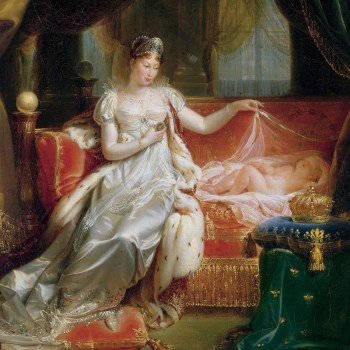
Joseph Franque, Empress Marie-Louise Watching over the Sleeping King of Rome, 1811 (Châteaux de Versailles et de Trianon).
The Imperial Household was a key institution during the reign of Napoléon Bonaparte (1769–1821). It was responsible for the daily lives of the Imperial family and the day-to-day existence of former general Bonaparte, who became Emperor Napoleon in 1804. Napoleon: The Imperial Household aims to re-create the ambience and capture the spirit that prevailed in the French court during the Empire. A selection of works and objets d’art, most of which have never before been exhibited in North America, will reveal the Imperial Household’s role in fashioning a monarchic identity for the new emperor who ruled France following the Revolution, as well as his family and loyal entourage.
The Imperial Household consisted of six departments, each headed by a grand officer, a high-ranking dignitary of the Empire: the grand chaplain, grand master of ceremonies, grand marshal of the Palace, grand master of the hunt, grand chamberlain and grand equerry were each involved in orchestrating every minute of the pageantry in the Court. This is another aspect of the Napoleonic saga that will be presented here, with more than 250 works in which the fine arts and decorative arts were used for purposes of ideology and official propaganda.
Sylvain Cordier, Napoleon: The Imperial Household (New Haven: Yale University Press, 2018), 350 pages, ISBN: 978 030023 3469, $50 / £40.
◊ ◊ ◊ ◊ ◊
Note (added 17 August 2018) — The posting was updated to include dates for venues other than Montreal. It’s also worth noting that the exhibition title varies according to location; in Richmond and Kansas City it’s called Napoleon: Power and Splendor.
New Book | François Boucher: Sociability, Mondanité, and the Academy
From Artbooks.com:
Christoph Vogtherr and Leda Cosentino, eds., François Boucher: Sociability, Mondanité, and the Academy in the Age of Louis XV (Oakville: Mosaic Press, 2017) 360 pages, ISBN: 9780993658839, $50.
 This volume assembles a group of interrelated thought-provoking essays from leading international scholars originally presented at the conference Boucher and the Enlightenment, held at the Wallace Collection in London in 2005. The conference was one of a series of extraordinary events celebrating the tercentenary of the artist’s birth: exhibitions were held in Paris, Dijon, London, and New York, a conference was dedicated to the artist’s work at The Getty Research Institute in Los Angeles, and a number of associated ground-breaking publications were published. All were agreed on the significance of Boucher’s achievement, his contemporary success, and the startlingly rapid critical decline. Yet, although much valuable new research was presented elsewhere regarding the connoisseurship, interpretation, and critical reception of Boucher’s work, the Wallace Collection conference was outstanding in its emphasis on the essentially social nature of Boucher’s artistic enterprise, the seriousness of his artistic ambition, and how the artistic relationships he forged both influenced his artistic practice and affected his critical reputation for both good and bad.
Subsequent research in eighteenth-century studies has confirmed many of the ideas first posited at the conference, but no other major publication on the artist has appeared in the intervening ten-year period that has been able to present or benefit from the advances made at the Wallace Collection. It has thus become increasingly obvious that the original conference papers, unpublished at the time, should be issued. The papers have been revised and enriched with further original research, incorporating important recent discoveries and trends in Boucher scholarship. Taken as a whole, the essays present a wealth of new material concerning Boucher’s social and professional relationships to his patrons, dealers, and fellow artists, which in turn illuminate, as no subsequent publication has done, his extraordinary position at the crossroads of the fine, decorative, literary and musical arts of his time. The book includes a variety of inter-disciplinary topics including new biographical information regarding Boucher’s life, artistic practices, and relationships, while new research is also published regarding the detailed connoisseurship and dating of his work alongside new interpretations of its iconography and critical and commercial reception. The diverse subject matter and variety of art-historical approach of the essays open up new perspectives in our understanding not only of François Boucher but also of the wider cultural and social context of his time. Together they shed new light on Boucher’s significance as one of the most original and controversial artists of the eighteenth century.
The Burlington Magazine, November 2017
The eighteenth century in The Burlington:
The Burlington Magazine 159 (November 2017)
 A R T I C L E S
• Oronzo Brunetti, “A Nymphaeum for the Villa Salviati at Ponte alla Badia in Florence,” pp. 893–99.
R E V I E W S
• Jeremy Warren, Review of Mark Gregory d’Apuzzo, La collezione dei bronzi del Museo Civico Medievale di Bologna (Libro Co. Italia, 2017), pp. 912–13.
• François Marandet, Review of Hannah Williams, Académie Royale: A History in Portraits (Ashgate, 2015), pp. 918–19.
• Peter Murray, Review of Jane Fenlon, Ruth Kenny, Caroline Pegum, and Brendan Rooney, eds., Irish Fine Art in the Early Modern Period: New Perspectives on Artistic Practice, 1620–1820 (Irish Academic Press, 2016), p. 923.
• David Cowan, Review of the exhibition Bonnie Prince Charlie and the Jacobites (National Museum of Scotland, Edinburgh, 2017), pp. 930–31.
• Xavier F. Salomon, Review of the exhibition Caroline Murat, Sister of Napoleon, Queen of the Arts / Caroline, Soeur de Napoléon, Reine des Arts (Palais Fesch, Musée des Beaux-Arts, Ajaccio, Corsica, 2017), pp. 940–41.
New Book | The East India Company at Home
From UCL Press:
Margot Finn and Kate Smith, eds., The East India Company at Home, 1757–1857 (London: University College London Press, 2018) 500 pages, ISBN: 978 178735 0281 (hardback), £50 / ISBN: 978 178735 0298 (paperback), £30 / ISBN: 978 178735 0274 (open access PDF), free.
 The East India Company at Home, 1757–1857 explores how empire in Asia shaped British country houses, their interiors, and the lives of their residents. It includes chapters from researchers based in a wide range of settings such as archives and libraries, museums, heritage organisations, the community of family historians, and universities. It moves beyond conventional academic narratives and makes an important contribution to ongoing debates around how empire impacted Britain.
The volume focuses on the propertied families of the East India Company at the height of Company rule. From the Battle of Plassey in 1757 to the outbreak of the Indian Uprising in 1857, objects, people and wealth flowed to Britain from Asia. As men in Company service increasingly shifted their activities from trade to military expansion and political administration, a new population of civil servants, army officers, surveyors and surgeons journeyed to India to make their fortunes. These Company men and their families acquired wealth, tastes and identities in India, which travelled home with them to Britain. Their stories, the biographies of their Indian possessions and the narratives of the stately homes in Britain that came to house them, frame our explorations of imperial culture and its British legacies.
Margot Finn is Professor of Modern British History at UCL. The author of After Chartism (1993) and The Character of Credit (2003), she has published extensively on the families and material culture of the East India Company. A former editor of the Journal of British Studies, she is President of the Royal Historical Society.
Kate Smith is Senior Lecturer in Eighteenth-Century History at the University of Birmingham. Kate specialises in material culture in eighteenth- and nineteenth-century Britain. She published Material Goods, Moving Hands: Perceiving Production in England, 1700–1830 in 2014.
New Book | Cultivating Commerce
From Cambridge UP:
Sarah Easterby-Smith, Cultivating Commerce: Cultures of Botany in Britain and France, 1760–1815 (Cambridge: Cambridge University Press, 2017) 252 pages, ISBN: 978 131641 1339, $99.
 Sarah Easterby-Smith rewrites the histories of botany and horticulture from the perspectives of plant merchants who sold botanical specimens in the decades around 1800. These merchants were not professional botanists, nor were they the social equals of refined amateurs of botany. Nevertheless, they participated in Enlightenment scholarly networks, acting as intermediaries who communicated information and specimens. Thanks to their practical expertise, they also became sources of new knowledge in their own right. Cultivating Commerce argues that these merchants made essential contributions to botanical history, although their relatively humble status means that their contributions have received little sustained attention to date. Exploring how the expert nurseryman emerged as a new social figure in Britain and France, and examining what happened to the elitist, masculine culture of amateur botany when confronted by expanding public participation, Easterby-Smith sheds fresh light on the evolution of transnational Enlightenment networks during the Age of Revolutions.
New Book | The Social Life of Maps in America, 1750–1860
From UNC Press:
Martin Brückner, The Social Life of Maps in America, 1750–1860 (Chapel Hill: University of North Carolina Press, 2017), 384 pages, ISBN: 978 14696 32605, $50.
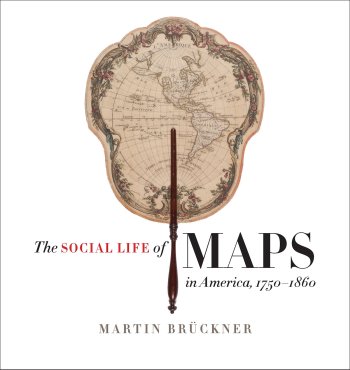 In the age of MapQuest and GPS, we take cartographic literacy for granted. We should not; the ability to find meaning in maps is the fruit of a long process of exposure and instruction. A ‘carto-coded’ America—a nation in which maps are pervasive and meaningful—had to be created. The Social Life of Maps tracks American cartography’s spectacular rise to its unprecedented cultural influence. Between 1750 and 1860, maps did more than communicate geographic information and political pretensions. They became affordable and intelligible to ordinary American men and women looking for their place in the world. School maps quickly entered classrooms, where they shaped reading and other cognitive exercises; giant maps drew attention in public spaces; miniature maps helped Americans chart personal experiences. In short, maps were uniquely social objects whose visual and material expressions affected commercial practices and graphic arts, theatrical performances and the communication of emotions. This lavishly illustrated study follows popular maps from their points of creation to shops and galleries, schoolrooms and coat pockets, parlors, and bookbindings. Between the decades leading up to the Revolutionary War and the Civil War, early Americans bonded with maps; Martin Bruckner’s comprehensive history of quotidian cartographic encounters is the first to show us how.
Published by the Omohundro Institute of Early American History and Culture and the University of North Carolina Press
Martin Brückner is professor of English and material culture studies at the University of Delaware.
C O N T E N T S
Acknowledgments
List of Illustrations
Preface: Introducing the Social Life of American Maps
Part One: American Mapworks
1 The Artisanal Map, 1750–1815: Workshops and Shopkeepers from Lewis Evans to Samuel Lewis
2 The Manufactured Map, 1790–1830: Centralization and Integration from Mathew Carey to John Melish
3 The Industrial Map, 1820–1860: Innovation and Diversification from Henry S. Tanner to S. Augustus Mitchell
Part Two: The Spectacle of Maps
4 Public Giants: Re-Staging Power and the Theatricality of Maps
5 Private Properties: Ornamental Maps and the Decorum of Interiority
6 Self-Made Spectacles: The Look of Maps and Cartographic Visualcy
Part Three: The Mobilization of Maps
7 Looking Small and Made To Go: The Atlas and the Rise of the Cartographic Vade Mecum
8 Cartographic Transfers: Education and the Art of Mappery
Epilogue: Cartoral Arts and Material Metaphors
Appendix 1: Price Table—Maps and Their Sales Prices, 1755–1860
Appendix 2: Inventory of “John Melish Geographer and Map Publisher”
Graphs
Index










 Enfilade
leave a comment