Exhibition | Gods in Color: Polychromy in the Ancient World
From the Fine Arts Museums of San Francisco:
Gods in Color: Polychromy in the Ancient World
Bunte Götter: Die Farbigkeit antiker Skulptur
Glyptothek, Munich, 2003
Liebieghaus Sculpture Collection, Frankfurt am Main, 2008
Legion of Honor Museum, San Francisco, 28 October 2017 — 7 January 2018

Reconstruction (A1) of the so-called Chios kore from the Akropolis in Athens, 2012. Copy of the original: Athens, ca.500 BCE. Crystalline acrylic glass, with applied pigments in tempera. Liebieghaus Skulpturensammlung, Polychromy Research Project, Frankfurt am Main, acquired in 2016 as gift from U. Koch-Brinkmann and V. Brinkmann (Fine Arts Museums of San Francisco).
Gods in Color: Polychromy in the Ancient World will offer an astonishing look at Classical sculpture swathed in their original vibrant colors questioning the perception of an all-white ‘classical’ ideal. Ancient sculpture and architecture from Greece and Rome will be revealed as intended—garishly colorful, richly ornamented, and full of life—along with original sculpture from the Near East, Egypt, Greece, and Rome against the backdrop of the Legion of Honor’s neoclassical building.
To find out more about the exhibition, explore this digital offering from the Liebieghaus in Frankfurt:
In the eighteenth century there was already considerable debate about the extent to which ancient architecture and sculptures were painted. Two centuries later technical investigations with ultraviolet light and glancing light are providing new evidence about ancient polychromy. Investigations carried out in Munich’s Glyptothek in the 1960s resulted in important findings. In the 1980s a group of researchers associated with the archaeologist Volkmar von Graeve studied the polychromy of ancient works of art with the help of modern technological aids. At the time, Vinzenz Brinkmann was a member of von Graeve’s team. Later, as head of the Liebieghaus’s Department of Antiquities, he brought the research subject to Frankfurt.
By now the original painting of hundreds of Greek and Roman artworks around the world has been studied. Thanks to the development of new investigative methods, scholars have meanwhile been able to provide an increasingly precise sense of the kind and extent of the painting. Over the course of centuries of damage owing to wars or weathering it was lost. Even though only scant traces of pigment and scoring have survived, they can provide valuable information. Our newly won understanding of the original polychromy leads in many cases to surprising discoveries!
From FAMSF Publications:
Vinzenz Brinkmann, Renée Dreyfus, and Ulrike Koch-Brinkmann, eds., Gods in Color: Polychromy in the Ancient World (New York: Prestel, 2017), 192 pages, ISBN: 978 379135 7072, $40.
 Although not widely known, antiquities were colored to dazzling and powerful effect. Polychromy—the painting of objects in a variety of hues—was a regular feature of the sculpture and architecture of most ancient cultures, especially in Egypt, Mesopotamia, the Aegean, Greece, and Rome. When such works began to be rediscovered in the eighteenth century after prolonged exposure to the elements, their colored surfaces were often so faded that later sculptors evoked classicism by leaving white marble and bronze surfaces unadorned.
Published on the occasion of an exhibition at the Legion of Honor in San Francisco, Gods in Color: Polychromy in the Ancient World reintroduces the unexpected effect of these bright pigments. Through reconstructions of well-known sculptural works dating from Bronze Age Greece to Imperial Rome, readers can see firsthand how these objects would have appeared when they were first created. Complementing these reconstructions are many fine examples of original antiquities, many with surviving polychromy, from ancient Greece and Rome and beyond to Egypt and the Near East. Rounding out these offerings are breathtaking watercolors of Greece’s landscapes and monuments painted in 1805 and 1806 by English antiquarian Edward Dodwell and Italian artist Simone Pomardi.
This handsome volume features six essays alongside catalogue entries that describe the cultural contexts of the ancient works and the modern technological methods to uncover their original coloration. Vinzenz Brinkmann and Ulrike Koch-Brinkmann offer a history of the research and scholarship of polychromy since the eighteenth century; with Heinrich Piening, they also describe the pigments and techniques used. Renée Dreyfus discusses polychrome examples from Egypt and the Near East to demonstrate the strong influences these cultures left on the classical world. Oliver Primavesi recounts the dilemma of eighteenth-century German archaeologist Johann Joachim Winckelmann, who at once celebrated the “pure” form of classical Greek and Roman sculpture but became increasingly aware that such works were originally colored and ornamented. John Camp describes the Greek tour of Dodwell and Pomardi as they depicted classical monuments, some of which still retained their original color.
An enduring scholarly record, Gods in Color reveals how ancient sculpture is incomplete without color. White or monochrome sculpture, an inherited notion of the classical ideal, would have been as strange to the ancients as these color reconstructions might seem to us today.
• Vinzenz Brinkmann is head of the department of antiquities at the Liebieghaus Sculpture Collection, Frankfurt and professor of classical archaeology at Goethe University, Frankfurt.
• Renée Dreyfus is curator in charge of ancient art and interpretation at the Fine Arts Museums of San Francisco.
• Ulrike Koch-Brinkmann is an archaeologist of classical antiquity based in Frankfurt. She is also assistant lecturer of classical archaeology at Georg August University in Göttingen.
• John Camp is the Stavros Niarchos Foundation Professor of Classics at Randolph-Macon College in Ashland, Virginia and the director of the Agora excavations in Athens.
• Martin Chapman is curator in charge of European decorative arts and sculpture at the Fine Arts Museums of San Francisco.
• Louise Chu is associate curator of ancient art and interpretation at the Fine Arts Museums of San Francisco.
• Jens Daehner is associate curator of antiquities at the J. Paul Getty Museum in Los Angeles.
• Jonathan Elias is an Egyptologist and the director of the Akhmim Mummy Studies Consortium.
• Kenneth Lapatin is curator of antiquities at the J. Paul Getty Museum in Los Angeles.
• Rebecca Levitan is a PhD student in the history of art department at the University of California, Berkeley.
• Heinrich Piening heads the department of restoration and conservation, furniture and art objects of wood, at the Bavarian Department of State-Owned Palaces, Gardens, and Lakes in Germany.
• Oliver Primavesi is professor of Greek philology and philosophy at the Ludwig-Maximilian University in Munich. In 2007 he was a recipient of the Gottfried Wilhelm Leibniz Prize, an important research award given by the German Research Foundation.
• Andrew Stewart is Nicholas C. Petris Professor of Greek Studies and professor of ancient Mediterranean art and archaeology at the University of California at Berkeley and curator of Mediterranean archaeology at UCB’s Phoebe A. Hearst Museum of Anthropology.
Exhibition | Napoleon: Images of the Legend
From the Châteaux de Versailles:
Napoleon: Images of the Legend
Arras Musée des Beaux-Arts, 7 October 2017 — 4 November 2018
Curated by Frédéric Lacaille and Marie-Lys Marguerite
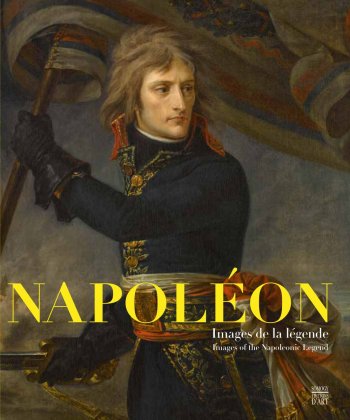 The exhibition will present a large selection of the Napoleonic collection from the palaces of Versailles and Trianon, which is the world’s largest on the subject. Visitors will be able to discover the history of Napoleon in chronological order, from General Bonaparte to the fallen Emperor.
The exhibition will also throw the spotlight on the Emperor’s close circle (family, important officers, imperial Court) and the Parisian and international societies of the time (artists, scholars, foreign sovereigns etc.) It will show how, from very early on, Napoleon wanted to write his own legend for posterity by commissioning multiple paintings commemorating key moments of his life. Paintings, sculptures, and furniture will reveal the wealth and quality of artistic production at the time and will lead visitors in the footsteps of Napoleon Bonaparte, whose unique destiny forever.
The exhibition is part of a partnership project between three major institutions: the region Hauts-de-France, the town of Arras, and the Palace of Versailles. This large-scale partnership was established in 2011, allowing collections from Versailles to be displayed in Arras. Major event-exhibitions are held alongside educational and cultural work in order to allow as many people as possible to discover the history and heritage of the Palace of Versailles.
The exhibition is curated by Frédéric Lacaille, Curator in charge of 19th-century paintings at the Musée National des Châteaux de Versailles et de Trianon, and Marie-Lys Marguerite, Director of Arras Musée des Beaux-Arts.
Frédéric Lacaille, ed., Napoléon: Images de la Légende (Paris: éditions Somogy, 2017), 280 pages, ISBN: 978 27572 12929, 28€.
The Burlington Magazine, October 2017
The eighteenth century in The Burlington:
The Burlington Magazine 159 (October 2017)
 A R T I C L E S
• Gauvin Alexander Bailey, “Rococo in Eighteenth-Century Beijing: Ornament Prints and the Design of the European Palaces at Yuanming Yuan,” pp. 778–88.
• J. P. Losty, “Eighteenth-Century Mughal Paintings from the Swinton Collection,” pp. 789–99.
R E V I E W S
• Rose Kerr, Review of John Ayers, Chinese and Japanese Works of Art in the Collection of Her Majesty The Queen (Royal Collection Trust, 2016), pp. 822–23.
• Marjorie Trusted, Review of Alan Chong, ed., Christianity in Asia: Sacred Art and Visual Splendour (Asian Civilizations Museum, 2016), pp. 823–24.
• Milo Beach, Review of Terence McInerney, Divine Pleasures: Painting from India’s Rajput Courts: The Kronos Collections (The Metropolitan Museum of Art, 2016), pp. 824–25.
• Aida Yuen Wong, Review of Petra ten-Doesschate Chu and Ning Ding, eds., Qing Encounters: Artistic Exchanges Between China and the West (Getty Publications, 2015), p. 826.
• David Bindman, Review of Elizabeth Einberg, William Hogarth: A Complete Catalogue of the Paintings (The Paul Mellon Centre for Studies in British Art, 2016), pp. 827–29.
• Robert O’Byrne, Review of Mark Clark, The Dublin Civic Portrait Collection: Patronage, Politics, and Patriotism, 1603–2013 (Four Courts Press, 2016), p. 832.
• Charles Beddington, Review of the exhibition Eyewitness Views: Making History in Eighteenth-Century Europe (The Getty Center, Los Angeles, 2017; Minneapolis Institute of Art, 2017; and The Cleveland Museum of Art, 2018), pp. 856–58.
New Book | Livre de Croquis de Gabriel de Saint-Aubin
From Musée du Louvre Éditions:
Xavier Salmon, Livre de Croquis de Gabriel de Saint-Aubin Peintre, 1760–1778 (Milan: Officina Libraria, 2017), 2 vols., 196 pages, ISBN: 978 889976 5385, £40 / €45.
 En 1783, soit trois années après la mort de Gabriel de Saint-Aubin, Pahin de la Blancherie indiquait que l’on n’avait jamais rencontré l’artiste « qu’un crayon à la main, dessinant tout ce qui se présentait à ses yeux ». Cependant, malgré cette passion du dessin, le chroniqueur de la vie parisienne fut bien vite oublié et il fallut attendre les Goncourt à la fin du XIXème siècle pour le redécouvrir. Chacun, dès lors, goûta l’art de Saint-Aubin et rechercha ses œuvres. Grand collectionneur du XVIIIe siècle français, Camille Groult entra en possession d’un exceptionnel carnet réunissant plus d’une centaine de pages sur lesquelles le maître avait griffonné son quotidien. Longtemps ce rarissime témoignage de l’art de Saint-Aubin demeura jalousement gardé. Edmond de Goncourt ne put en donner qu’un dépouillement incomplet. Quelques années après, Emile Dacier, grand spécialiste de l’artiste, ajouta quelques éléments nouveaux mais sans avoir obtenu de pouvoir examiner en détail le carnet. Le 20 novembre 1941, le Louvre en faisait l’acquisition. L’œuvre livrait enfin tous ses secrets. Dacier en reprit l’étude et publia en 1943 un opuscule de quarante planches.
Aujourd’hui, c’est l’ensemble du carnet qui est pour la première fois reproduit à l’échelle réelle et étudié de manière exhaustive. De petites dimensions (18 x 12,5 cm), et réunissant 108 pages dont 103 illustrées et annotées entre 1759 et 1778, l’ouvrage est un document inestimable. L’artiste nous invite à parcourir les rues de Paris, à découvrir certains de ses monuments, à partager avec lui quelques événements marquants ou bien encore à vivre le quotidien de son petit monde peuplé de si nombreuses jeunes femmes toutes occupées à la lecture, à la musique ou aux travaux d’aiguille. De sa fine écriture souvent si difficile à lire, il a couvert de jour comme de nuit les pages de nombreuses annotations, noms de collectionneurs, prix de denrées, maximes ou bien encore localisations. Pour qui aime le Paris du XVIIIe siècle, pour qui cherche à mieux connaître l’art de Saint-Aubin, le carnet du Louvre invite indéniablement à la plus passionnante des découvertes.
Distributed by ACC Publishing:
Gabriel de Saint-Aubin (Paris, 1724–1780) was “never seen without a pencil in his hand, intent in sketching all that appeared in front of his eyes.” His Livre de Croquis (sketchbook) is a veritable chronicle of Parisian life in the 18th century. Compiled between 1760 and 1778, it contains views of the streets and monuments of the ville lumière, scenes at the theatre or of a grand ball, portraits of young workers writing, sewing or playing an instrument. Saint-Aubin’s minute annotations are deciphered and explained in the commentary volume. The sketchbook, acquired from the heirs of Saint-Aubin, was guarded jealously in a private collection—and was, therefore, almost unknown—until 1941 when it was acquired by the Louvre. It has never before been reproduced in its entirety. Text in French.
Xavier Salmon is the director of the Prints and Drawings Department at the Musée du Louvre. He has curated many exhibitions and edited their catalogues. His book Fontainebleau: Le temps des Italiens was awarded the ‘grand prix de l’Académie Française’ in 2014.
Volume 1: Reproduction
Same size as the Louvre’s album containing the drawings
Volume 2: Commentary
• Introduction: Across Paris Accompanied by Gabriel de Saint-Aubin
• Description of the Sketchbook
• Bibliography
New Book | Highland Retreats
From Rizzoli:
Mary Miers, Highland Retreats: The Architecture and Interiors of Scotland’s Romantic North (New York: Rizzoli, 2017), 288 pages, ISBN: 978 08478 44760, $65.
 Featuring breathtaking photographs of some of Scotland’s most remarkable and little-known houses, this book tells the story of how incomers adopted the North of Scotland as a recreational paradise and left an astonishing legacy of architecture and decoration inspired by the romanticized image of the Highlands. Known as shooting lodges because they were designed principally to accommodate the parties of guests that flocked north for the annual sporting season, these houses range from Picturesque cottages ornées and Scotch Baronial castles to Arts and Crafts mansions and modern eco-lodges. While their designs respond to some of Britain’s wildest and most stirring landscapes, inside many were equipped with the latest domestic technology and boasted opulent decoration and furnishings from the smartest London and Parisian firms. A good number survive little altered in their original state, and some are still owned by descendants of the families that built them.
Images from the famous Country Life Picture Library and specially commissioned photographs evoke the dramatic settings and arresting detail of these houses, making the book as appealing to decorators and architectural historians as it is to travelers and sportsmen.
Mary Miers commutes between her home in the Scottish Highlands and the London offices of Country Life magazine, where she works as fine arts and books editor. Her books include American Houses: The Architecture of Fairfax & Sammons and The English Country House.
Paul Barker was one of England’s premier interior and architectural photographers, whose books included English Country House Interiors, The Drawing Room, and English Ruins.
New Book | Travel and the British Country House
From Oxford UP:
Jon Stobart, ed., Travel and the British Country House: Cultures, Critiques, and Consumption in the Long Eighteenth Century (Manchester: Manchester University Press, 2017), 272 pages, ISBN: 978 15261 10329, $115.
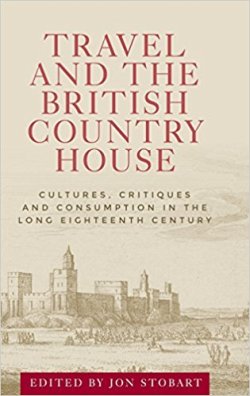 Travel and the British Country House explores the ways in which travel by owners, visitors, and material objects shaped country houses during the long eighteenth century. It provides a richer and more nuanced understanding of this relationship and how it varied according to the identity of the traveller and the geography of their journeys. The essays explore how travel on the Grand Tour, and further afield, formed an inspiration to build or remodel houses and gardens, the importance of country house visiting in shaping taste amongst British and European elites, and the practical aspects of travel, including the expenditure involved. Suitable for a scholarly audience, including postgraduate and undergraduate students, but also accessible to the general reader, Travel and the British Country House offers a series of fascinating studies of the country house that serve to animate the country house with flows of people, goods and ideas.
Jon Stobart is Professor of History at Manchester Metropolitan University.
C O N T E N T S
1 Introduction: Travel and the British Country House, Jon Stobart
2 From Rome to Stourhead and Thence to Rome Again: The Phenomenon of the Eighteenth-Century English Landscape Garden, John Harrison
3 Virtual Travel and Virtuous Objects: Chinoiserie and the Country House, Emile de Bruijn
4 Gentlemen Tourists in the Early Eighteenth Century: The Travel Journals of William Hanbury and John Scattergood, Rosie MacArthur
5 A Foreign Appreciation of English Country Houses and Castles: Dutch Travel Accounts on Proto Museums Visited en Route, 1683–1855, Hanneke Ronnes and Renske Koster
6 ‘Worth Viewing by Travellers’: Arthur Young and Country House Picture Collections in the Late Eighteenth Century, Jocelyn Anderson
7 ‘Enjoying Country Life to the Full—Only the English Know How To Do That!’: Appreciation of the British Country House by Hungarian Aristocratic Travellers, Kristof Fatsar
8 Magnificent and Mundane: Transporting People and Goods to the Country House, c. 1730–1800, Jon Stobart
9 On the Road (and the Thames) with William Cavendish, 1st Earl of Devonshire 1597–1623, Peter Edwards
10 ‘No Lady Could Do This’: Navigating Gender and Collecting Objects in India and Scotland, c. 1810–50, Ellen Filor
Index
New Book | William Hunter
From Routledge:
Helen McCormack, William Hunter and His Eighteenth-Century Cultural Worlds: The Anatomist and the Fine Arts (New York: Routledge, 2017), 208 pages, ISBN: 978 14724 24426, $150.
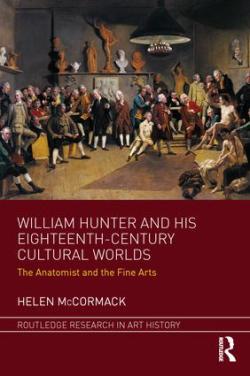 The eminent physician and anatomist Dr William Hunter (1718–1783) made an important and significant contribution to the history of collecting and the promotion of the fine arts in Britain in the eighteenth century. Born at the family home in East Calderwood, he matriculated at the University of Glasgow in 1731 and was greatly influenced by some of the most important philosophers of the Scottish Enlightenment, including Francis Hutcheson (1694–1746). Hunter quickly abandoned his studies in theology for Medicine and, in 1740, left Scotland for London where he steadily acquired a reputation as an energetic and astute practitioner; he combined his working life as an anatomist successfully with a wide range of interests in natural history, including mineralogy, conchology, botany, and ornithology; and in antiquities, books, medals, and artefacts; in the fine arts, he worked with artists and dealers and came to own a number of beautiful oil paintings and volumes of extremely fine prints. He built an impressive school of anatomy and a museum which housed these substantial and important collections. William Hunter’s life and work is the subject of this book, a cultural-anthropological account of his influence and legacy as an anatomist, physician, collector, teacher, and demonstrator. Combining Hunter’s lectures to students of anatomy with his teaching at the St Martin’s Lane Academy, his patronage of artists, such as Robert Edge Pine, George Stubbs, and Johan Zoffany, and his associations with artists at the Royal Academy of Arts, the book positions Hunter at the very centre of artistic, scientific, and cultural life in London during the period, presenting a sustained and critical account of the relationship between anatomy and artists over the course of the long eighteenth century.
Helen McCormack is a Lecturer in Art, Design, History and Theory at Glasgow School of Art. She studied Art History at Birkbeck College, University of London, and the History of Design and Material Culture at the Victoria and Albert Museum and Royal College of Art, London. She was the David Carritt Scholar in the History of Art at the University of Glasgow where she completed her PhD on the subject of William Hunter as a collector of the fine arts.
C O N T E N T S
List of Figures
Acknowledgements
Introduction: Art, Science, Curiosity and Commerce
1 Forming the Museum: Context and Chronology
2 The Great Windmill Street Anatomy School and Museum
3 Patronage and Patriots: Hunter and a National School of Artists
4 Collecting Ambitions (1770–83) The Grand Tour Paintings
5 Pursuing the Imitation of Nature in and beyond the Royal Academy of Arts
Conclusion
Bibliography
Index
New Book | Empire of Ruin: Black Classicism
From Oxford UP:
John Levi Barnard, Empire of Ruin: Black Classicism and American Imperial Culture (Oxford: Oxford University Press, 2017), 248 pages, ISBN: 978 019066 3599, $75.
 From the US Capitol to the Lincoln Memorial and the 9/11 Memorial Museum, classical forms and ideas have been central to an American nationalist aesthetic. Beginning with an understanding of this centrality of the classical tradition to the construction of American national identity and the projection of American power, Empire of Ruin describes a mode of black classicism that has been integral to the larger critique of American politics, aesthetics, and historiography that African American cultural production has more generally advanced. While the classical tradition has provided a repository of ideas and images that have allowed white American elites to conceive of the nation as an ideal Republic and the vanguard of the idea of civilization, African American writers, artists, and activists have characterized this dominant mode of classical appropriation as emblematic of a national commitment to an economy of enslavement and a geopolitical project of empire. If the dominant forms of American classicism and monumental culture have asserted the ascendancy of what Thomas Jefferson called an “empire for liberty,” for African American writers and artists it has suggested that the nation is nothing exceptional, but rather another iteration of what the radical abolitionist Henry Highland Garnet identified as an “empire of slavery,” inexorably devolving into an “empire of ruin.” Washington architecture.
John Levi Barnard is an Assistant Professor of English at The College of Wooster.
Introduction
1 Phillis Wheatley and the Affairs of State
2 In Plain Sight: Slavery and the Architecture of Democracy
3 Ancient History, American Time: Charles Chesnutt and the Sites of Memory
4 Crumbling into Dust: Conjure and the Ruins of Empire
5 National Monuments and the Residue of History
Exhibition | The King of Spain’s Grandchildren by Mengs
From the Uffizi Galleries:
The King of Spain’s Grandchildren: Anton Raphael Mengs at the Pitti Palace
Pitti Palace, Florence, 19 September 2017 — 7 January 2018
Curated by Matteo Ceriana and Steffi Roettgen

Anton Raphael Mengs, Double Portrait of the Archdukes Ferdinando (1769–1824) and Maria Anna (1770–1809) di Asburgo Lorena, 1770–71 (Florence: Uffizi Galleries).
Barely twenty days after the opening of an exhibition at the Uffizi devoted to the purchase of two preparatory paintings by Luca Giordano and Taddeo Mazzi, the Uffizi Galleries are now launching a second exhibition to present the prestigious acquisition of yet another important painting in 2016, by Anton Raphael Mengs (1728–1779), portraying Ferdinando and Maria Anna, two of the children of Archduke of Tuscany Pietro Leopoldo of Lorraine and of his consort María Luisa de Borbón y Sajonia, dressed in contemporary costume and depicted inside the Pitti Palace.
Eike D. Schmid: “The task of a living museum is to safeguard works of art, to preserve memory and to transmit culture through exhibitions and research, but also to allow its collections to ‘breathe’ with targeted additions closely linked to the story of the city, of its hinterland and of the collection of which they are going to become a part. Acquisitions, especially if they are so subtly motivated, are a crucial part of a museum’s life, particularly if they are the product of research guaranteeing both their provenance and a fertile interaction with the museum’s existing heritage.”
When this unfinished painting appeared on the antique market, it was instantly clear that it had to enter the collections of the Gallerie degli Uffizi so that we could showcase it in the Pitti Palace, because even if Anton Raphael Mengs did not paint the picture entirely in the palace, he certainly conceived it there. The young princes lived in the Pitti Palace with their family, under the watchful eye of governesses and tutors, of course, but more especially under that of their own parents, while the Boboli Garden was their playground.
We were eager to celebrate the new acquisition, which would not have been possible without the generous cooperation of the Galleria Virgilio in Rome, with an exhibition illustrating the historical and artistic environment in which the portrait was painted.
Mengs was born in Bohemia but soon moved to the west, becoming an adoptive Italian and Spaniard. He sought permission from King Charles III of Spain to travel to Rome so that he could both work and pursue his study of Classical antiquities and of the great Renaissance artists, chiefly that of Raphael after whom he had been named. The Spanish King, who loved Italy and had once almost governed Tuscany himself (eventually becoming the King of Naples), granted Mengs permission to make the trip but only on condition that he send him portraits from Florence of his young grandchildren, the children of his daughter María Luisa de Borbón y Sajonia and of Pietro Leopoldo of Lorraine. The pictures, loaned to the exhibition by the Museo del Prado where they normally hang, were painted while Mengs was in the Tuscan capital from April 1770 to January 1771. The portraits show us Pietro Leopoldo’s two extremely young children dressed in Spanish court attire with the marks of royalty (the Golden Fleece) in the traditional dress of the Infantes, as reported in the Gazzetta Toscana published on 29 September 1770. Once finished, but before they were packed up and shipped to the Spanish court, the portraits were shown to the Florentine public in the Pitti Palace, where they were much admired both for their sparkling technique and for their accurate rendering of the sitters’ features.

Anton Raphael Mengs, Double Portrait of the Archduke Ferdinand (1769–1824) and Maria Anna (1770–1809), 1770–71 (Madrid: Museo del Prado).
At the same time as Mengs was painting these portraits of the children for their grandfather, the Spanish King, however, he must also have produced the picture recently purchased by the Uffizi Galleries portraying Ferdinando and Anna Maria with a totally different approach and in a very different spirit. The two children portrayed here, looking happier than the children depicted in many of Mengs’s other works, are shown in contemporary clothing, and the choice of full, resonant hues such as the green and pink of their attire instantly reveals this new spirit. The prince is dressed in boy’s costume and the feather hat in his right hand is the kind of headgear one might have worn for strolling or hunting, thus introducing a touching note of daily intimacy into the picture—a far cry from the stiff, ceremonial approach evinced in the official portraits now in Madrid. The painting must have been very much to the liking of Pietro Leopoldo, a man of stern tastes, an enlightened sovereign, a reformer, in fact a thoroughly ‘modern’ (not to say bourgeois) monarch in both his public and his private life. We are drawn to the picture because we can not only see the lesson of Velázquez in it, but we actually get a foretaste of Goya, a great admirer of Mengs, and even of Manet.
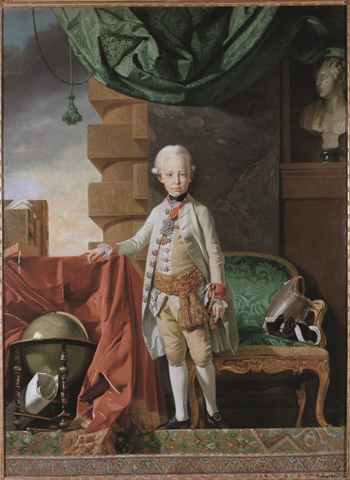
Johan Zoffany, Francis I, Grand Duke of Tuscany of the House of Lorraine (1708–1765), 1775 (Vienna: Kunsthistorisches Museum).
The official court portrait painter to Pietro Leopoldo, however, was another German—albeit a naturalised Englishman—called Johann Zoffany. The exhibition showcases the portrait that he painted of Pietro Leopoldo’s first-born son Francis, the first Grand Duke of Tuscany of the House of Lorraine, which was painted for Francis’s paternal grandmother, the Empress Maria Theresa of Austria, and which has been loaned by the Kunsthistorisches Museum in Vienna. Having doffed the dazzling turquoise attire of a Spanish Infante, we discover him in the courtyard of the Pitti Palace leaning against the majestic rustication, a small man fairly split between his government duties, his arms and his studies. This very fine portrait, which has returned to Florence for the first time since it was despatched to Vienna, depicts a boy who, while he may appear a little melancholic, is already very much aware of his imperial destiny.
The exhibition opens with portraits of the sitters’ grandparents, parents, and little cousins from Naples and Parma and closes with the self-portraits of the two painters from the Uffizi’s celebrated collection: Mengs’s famous, heroic self-portrait, bursting with emotion even though it is not yet Romantic, and Zoffany’s subtly ironic self-portrait in which he portrays himself with his small dog a painting that will come as a pleasant surprise to visitors after being specially restored for the exhibition.
Matteo Ceriana and Steffi Roettgen, I Nipoti del Re di Spagna: Anton Raphael Mengs a Palazzo Pitti (Livorno: Sillabe, 2017), 184 pages, ISBN: 978 888347 9687, $35.
Exhibition | Becoming a Woman in the Age of Enlightenment
While, as a rule, I don’t re-post announcements, because this one now includes important details that were previously omitted—additional information regarding the catalogue, venues, and the conferences—I’m glad to make an exception. I wish I could be there next weekend for what sure to be an amazing conference! –CAH
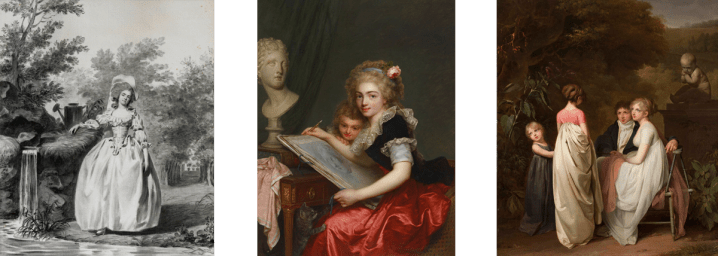
Jacques-Antoine-Marie Lemoine, Woman Standing in a Garden, 1783, black chalk and brush with gray wash on off-white laid paper; Antoine Vestier, Allegory of the Arts, 1788, oil on canvas; and Louis-Léopold Boilly, Conversation in a Park, oil on canvas. All on loan from The Horvitz Collection.
◊ ◊ ◊ ◊ ◊
From the Harn Museum of Art:
Becoming a Woman in the Age of Enlightenment: French Art from The Horvitz Collection
Harn Museum of Art, University of Florida, Gainesville, 6 October — 31 December 2017
Ackland Art Museum, The University of North Carolina at Chapel Hill, 26 January — 8 April 2018
Crocker Art Museum, Sacramento, 13 May — 19 August 2018
Smith College Museum of Art, Northampton, MA, dates TBA
Curated by Melissa Hyde and Mary D. Sheriff
Organized by Alvin Clark
Becoming a Woman in the Age of Enlightenment: French Art from the Horvitz Collection is primarily an exhibition of drawings but will include pastels, paintings, and sculptures selected from one of the world’s best private collections of French drawings. The exhibition will feature nearly 120 works by many of the most prominent artists of the eighteenth century, including Antoine Watteau, Nicolas Lancret, François Boucher, Jean-Honoré Fragonard, as well as lesser-known artists both male and female, such as Anne Vallayer-Coster, Gabrielle Capet, François-André Vincent, Philibert-Louis Debucourt. Ranging from spirited, improvisational sketches and figural studies, to highly finished drawings of exquisite beauty, the works included in the exhibition vary in terms of style, genre, and period.
Becoming a Woman will be organized into thematic sections that address some of the most important and defining questions of women’s lives in the eighteenth century. These include: how the stages of a woman’s life were measured; what cultural attitudes and conditions in France shaped how women were defined; what significant relations women formed with men; what social and familial rituals gave order to their lives; what pleasures they pursued; and what work they accomplished. The aim is to bring new insights to the questions of what it meant to be a woman in this period, by offering the first exhibition to focus specifically on representations of women of a broad range of ages and conditions.
The exhibition will offer fresh perspectives on a subject that still has direct relevance to our times but that has not been the focus of a significant exhibition for decades. Through its conceptual framework, thematic organization, and its emphasis on historical context, the exhibition will provide viewers opportunities to consider what issues pertaining to women’s lives seem to have changed or persisted through time and across space. Although the circumstances and the specifics have changed, many issues remain with us today and can still provoke contentious debates. Pay equity, reproductive rights, gender-discrimination, violence against women, work-family balance, the ‘plight’ of the alpha-female, and the devaluation of the stay-at-home mom, are but a few of the women’s issues that are still hotly contested in the media, in cultural production of all kinds, in politics, and in public and private life.
Becoming a Woman is curated by Melissa Hyde, Professor of Art History, University of Florida Research Foundation Professor, University of Florida, and the late Mary D. Sheriff, W.R. Kenan J. Distinguished Professor of Art History, University of North Carolina, Chapel Hill; the exhibition is organized by Alvin L. Clark, Jr, Curator, The Horvitz Collection and The J.E. Horvitz Research Curator, Harvard Art Museums/Fogg.
The catalogue is available from ArtBooks.com:
Melissa Hyde, Mary D. Sheriff, and Alvin Clark, Becoming a Woman in the Age of Enlightenment: French Art from The Horvitz Collection (Boston: The Horvitz Collection, 2017), 208 pages, ISBN: 978 099126 2526, $39.

François Boucher, Young Travelers, black chalk on cream antique laid paper, framing line in black ink, laid down on a decorated mount, 295 × 188 mm; Jacques-Louis David, Andromache Mourning the Death of Hector, pen with black ink and brush with gray wash over traces of black chalk on cream antique laid paper, 293 × 248 mm; Jean-Baptiste Greuze, The Chestnut Vendor, brush with gray and brown wash on cream antique laid paper, 385 × 460 mm. All works on loan from The Horvitz Collection.
◊ ◊ ◊ ◊ ◊
From the Lecture and Symposium Schedule:
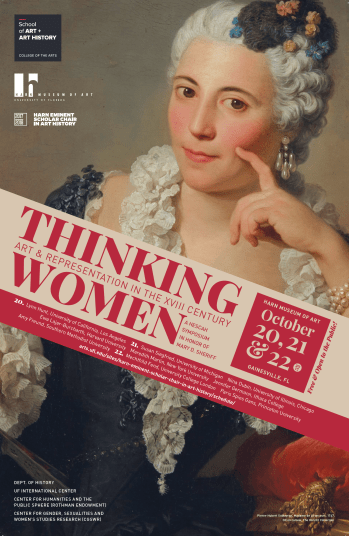
Thinking Women: Art and Representation in the Eighteenth Century
A Symposium in Honor of Mary D. Sheriff
Harn Museum of Art, University of Florida, Gainesville, 20–22 October 2017
• Keynote Address: “The Woman Artist and the Uncovering of the Social World,” Lynn Hunt, Distinguished Research Professor, University of California, Los Angeles
Art, women, and society came together in surprising ways at the end of the eighteenth century. ‘Society’ only began to be conceptualized as an object for study at the end of the 1700s, in particular in reaction to the French Revolution. Art, especially engraving and painting, helped make society visible to itself. Women could join the art world but rarely as fully fledged members, and as a consequence they occupied a kind of in-between position that made them especially attuned to social relations. The life and work of Marie-Gabrielle Capet will be highlighted to show how the social world could be uncovered.
 • “Fashion in Time: Visualizing Costume in the Eighteenth Century,” Susan Siegfried, Denise Riley Collegiate Professor of the History of Art and Women’s Studies, Department of Art History, University of Michigan
• “Beauty Is a Letter of Credit,” Nina Dubin, Associate Professor, Department of Art and Art History University of Illinois, Chicago
• “Chardin: Gender and Interiority,” Ewa Lajer-Burcharth, William Dorr Boardman Professor of Fine Arts, Department of History of Art and Architecture, Harvard University
• “The Global Allure of the Porcelain Room,” Meredith Martin, Department of Art History, New York University
• “Pictured Together? Questions of Gender, Race, and Social Rank in the Portrait of Dido Elizabeth Belle and Lady Elizabeth Murray,” Jennifer Germann, Associate Professor, Department of Art History, Ithaca College
• “Becoming an Animal in the Age of Enlightenment,” Amy Freund, Associate Professor & Kleinheinz Family Endowed Chair in Art History, Southern Methodist University
• “Marguerite Lecomte’s Smile: Portrait of a Woman Engraver,” Mechthild Fend, Reader in the History of Art, Department of History of Art, University College London
• “Exceptional, but not Exceptions: Women Artists in the Age of Revolution,” Paris Spies Gans, Doctoral Candidate, Department of History, Princeton University
The final program, with times, is available here»
At the Ackland Art Museum at UNC, Chapel Hill, there will be a sister symposium in Mary’s honor entitled “Taking Exception: Women, Gender, Representation in the Eighteenth Century,” 1–3 February 2018.










 Enfilade
leave a comment