Exhibition | Exchanging Gazes: Between China and Europe

Chinese Ladies Playing a Board Game, Qing Dynasty, Qianlong Period (1736–1795), 2nd half of the 18th century, watercolour and opaque watercolour on silk (Museum für Völkerkunde Hamburg)
◊ ◊ ◊ ◊ ◊
Press release from the Berlin State Museums:
Exchanging Gazes: Between China and Europe, 1669–1907
Kunstbibliothek, Staatliche Museen zu Berlin, 29 September 2017 — 7 January 2018
China and Europe are linked by a long tradition of reciprocal cultural exchange. These transactions were particularly intensive during the Qing Dynasty (1644–1911), which is regarded as one of the key phases of Chinese cultural and political history. Exquisite gifts were exchanged. European envoys attempted to establish official trade relations with China. But their efforts were in vain, as the Chinese established trade barriers, with the exception of the port of Canton—although they were very much interested in European science, art, and culture.
The exhibition illustrates the richly varied nature of this mutual fascination in objects ranging in date between 1669 and 1907. Many of the almost one hundred pieces could be classified as Chinoiserie or so-called Europerie: they provide us with information about early modern European images of China and also allow us to trace the predominant images of Europe in China. Highlights of the exhibition include impressive paintings, exquisite porcelain objects, a door from a wood-paneled room, as well as large-format photographs and copper engravings. The photographs and engravings show the ‘European palaces’ which Emperor Qianlong, who reigned from 1736 to 1795, had built in one of his parks. Today, only their ruins exist: British and French troops burned down the palaces and destroyed the extensive gardens during their 1860 Chinese campaign. Surprisingly, however, in this way they created a visual subject that was much-loved by European photographers after 1870.
 Until now, the reciprocity—and sheer variety—of cultural exchange between China and Europe has hardly been appreciated or shown in an exhibition setting. The chosen objects offer impressive testimony to a long- lived and mutual interest between the two cultures. In addition, they can help us understand how Europe’s conception of China and China’s conception of Europe changed over the course of 250 years.
Particularly in the 18th century, it was not only Europe looking to China’s art production but also China looking to that of Europe. The fact that these exchanging gazes are to be taken quite literally and that they were cast back and forth now and again is demonstrated by the Chinese production of porcelain: around 1700, European missionaries living at the imperial court contributed to the development of the so-called foreign colours (yangcai). The chinaware that was subsequently decorated with the new shades of red and pink (famille rose) became so popular that it developed into an export hit and hence also had a lasting impact on European dining culture.
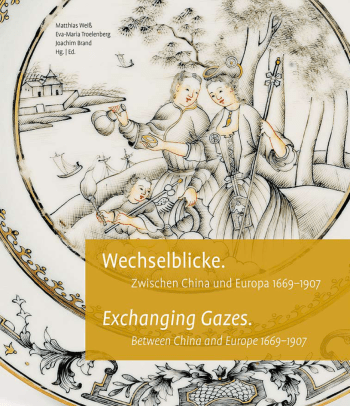
An exported plate, which was produced in China and shows two pilgrims on their way to Cythera, the island of love, allows the term ‘exchange of gazes’ to be connected more closely to the 18th century. In the European love discourse of that time, this term is connected with the concept of the love of souls. This type of love enables an encounter between lovers at eye level; yet it also involves the danger of unilateral self-reflection. Certainly this metaphor of love cannot be transferred unmitigatedly to the cooperation of cultures. Nevertheless, it points at two contradictory foundations of cultural exchange: such an exchange is only possible if, apart from differences, common features are recognized, for instance in the characteristics of systems of rule or in courtly cultures. At the same time, ‘exchange of gazes’ can allude to the fact that it is first and foremost one’s own self-interest that is respected in these constellations.
Due to political and economic changes, China and Europe had to repeatedly reconsider themselves, which means they had to come to a kind of self-understanding as well as set themselves in relation to each other. This becomes particularly evident when looking at objects called Chinoiseries, as they reflect the European image of China prevalent throughout the 18th century. Chinoiseries can be juxtaposed with the so-called Europeries, which were produced in China and give insight into the Chinese image of Europe. In order to present the foreign as alien, it had to be at least partially adapted to the familiar, which is why the objects exhibited here can be aesthetically classed in-between China and Europe. Many objects can additionally be found ‘between’ China and Europe because they circulated as export goods, diplomatic gifts or as possessions acquired abroad, all in order to develop an altered effect in their respective new repositories. It is furthermore evident that motifs and techniques migrated not only between these cultures but also between genres and materials. Prints, for example, became built architecture and vice versa. The exhibition, moreover, offers the rare occasion to simultaneously view Chinoseries and Europeries, which are usually stored in different collections. This therefore allows the gaze to wander back and forth and, in so doing, to comprehend that China and Europe share a common history.
Even though there are hardly definite dates that mark the history of exchange between China and Europe, the years in the exhibition’s title indicate two important stages in the European production of images of China. In 1669, Johan Nieuhof’s travelogue was published. Nieuhof had joined the first Dutch delegation of the United East India Company travelling to China in order to intensify the trade relationship with the empire that increasingly isolated itself—a venture which failed. From a historic point of view, the journey’s true success was Nieuhof’s richly illustrated travelogue that was published in large numbers and became one of the most important sources for European knowledge about China.
1907, on the other hand, marks the creation of four architectural photographs by Ernst Boerschmann, who travelled China as an architectural historian and re-established Western knowledge on Chinese architecture. This had become possible only because the major European powers had gradually forced the opening of China beginning in the second half of the 19th century. The objects exhibited here render not only the changing relationship between China and Europe from the late 17th to the early 20th century comprehensible—how and why it shifted in the direction of colonial policy—but also the traditional tendencies which persisted through these changes. Boerschmann, for instance, perpetuated the myth that porcelain was used as construction material, even though this was not his personal view.
A special exhibition of the Kunstbibliothek – Staatliche Museen zu Berlin, in cooperation with the Max Planck Research Group ‘Objects in the Contact Zone: The Cross-Cultural Lives of Things’ at the Kunsthistorisches Institut in Florence – Max Planck Institute.
Curatorial concept: Professor Dr. Matthias Weiß
From Michael Imhof Verlag:
Matthias Weiß, Eva-Maria Troelenberg, and Joachim Brand, eds., Wechselblicke: Zwischen China und Europa 1669–1907 / Exchanging Gazes: Between China and Europe 1669–1907 (Petersberg: Michael Imhof Verlag, 2017), 352 pages, ISBN: 9783731905738, $70.
New Book | The Mercantile Effect
Distributed by The University of Chicago Press:
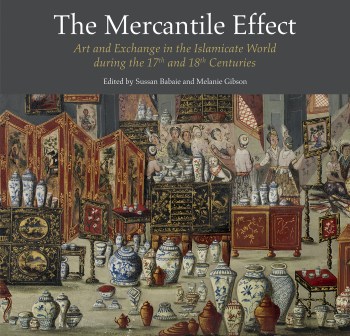
Sussan Babaie and Melanie Gibson, eds., The Mercantile Effect: Art and Exchange in the Islamicate World during the 17th and 18th Centuries (London: Ginko Library, 2017), 160 pages, ISBN: 978 190994 2103, $60.
 With Contributions by Anna Ballian, Nicole Kancal Ferrari, Frederica Gigante, Francesco Gusella, Negar Habibi, Sinem Erdoğan Işkorkutan, Gul Kale, Dipti Khera, William Kynan-Wilson, Suet May Lam, Amy Landau, George Manginis, Zaheen Maqbool, Christos Merantzas, Alexandra Roy, and Nancy Um
This lavishly illustrated book collects papers delivered at the third Gingko conference The Mercantile Effect: On Art and Exchange in the Islamicate World During 17th–18th Centuries. Held in Berlin, this meeting brought together a group of established and early-career scholars to discuss how the movement of Armenian, Indian, Chinese, Persian, Turkish, and European merchants and their trade goods spread new ideas and new technologies across Western Asia in the early modern era. Through the newly-established Dutch, English, and French East India companies, as well as much older mercantile networks, prestigious exotic commodities—silk, ivory, books, glazed porcelains—were transported east and west. The collected essays in this volume introduce a fascinating array of not only trade objects but also customs and traditions that bring this period of intense cultural interplay to life.
Sussan Babaie is the Andrew W. Mellon Reader in the Arts of Iran and Islam at the Courtauld Institute of Art, University of London. Melanie Gibson is the senior editor of the Gingko Library Arts Series.
Exhibition | Canova, Hayez, and Cicognara: The Last Glory of Venice
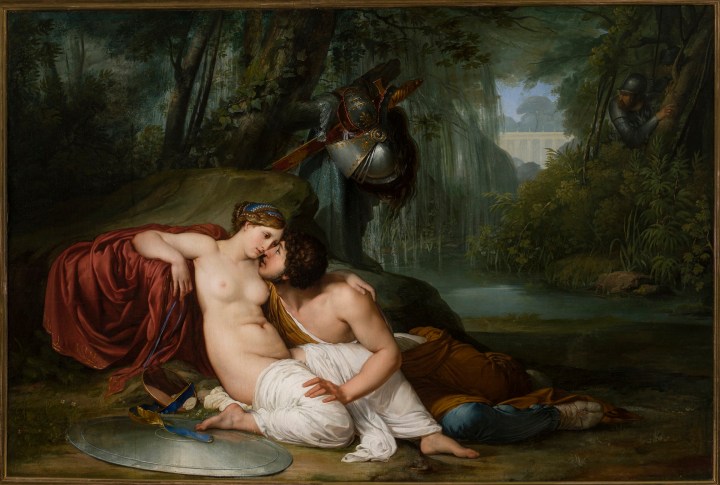
Francesco Hayez, Rinaldo and Armida, 1812–13, oil on canvas
(Venice: Museo Nazionale Gallerie dell’Accademia)
◊ ◊ ◊ ◊ ◊
From Et Electa:
Canova, Hayez, and Cicognara: The Last Glory of Venice
Gallerie dell’Accademia, Venice, 29 September 2017 — 2 April 2018
Curated by Paola Marini, Fernando Mazzocca, and Roberto De Feo
In the year of the bicentennial celebrations of the opening of the Gallerie dell’Accademia—an international institution first founded to compensate for the loss of so many masterpieces removed during the suppression of schools and religious institutions—the exhibition Canova, Hayez, Cicognara: L’ultima gloria di Venezia pays homage to a unique moment in the artistic history of the Serenissima, its cultural revival initiated in 1815 when the Four Horses of Saint Mark, the iconic symbol of the city, were returned from Paris.
The acknowledged leader of this revival was the intellectual Count Leopoldo Cicognara, President of the Accademia di Belle Arti, who together with his friend Antonio Canova, the guiding spirit of the project, and Francesco Hayez, worked to create a museum on an international scale, a worthy setting for Venice’s unrivaled art heritage, yet one also suitable for promoting contemporary art.
The exhibition includes 100 major works, arranged in nine thematic sections, including a series of artefacts known as ‘The Homage of the Venetian Provinces’ sent to the imperial court of Vienna in 1818 to mark the fourth marriage of Emperor Francis I, reunited and returning to their native city for the first time in 200 years.
Highlights of the exhibition also include the opening section dedicated to the return of the Four Horses of St Mark and the cameo depicting Jupiter the Shield Bearer, a masterpiece whose beauty was hymned by Canova, and further on the commemoration of the acquisition of a series of drawings by Leonardo da Vinci and Raphael from Canova and Cicognara’s mutual friend Giuseppe Bossi, a purchase which significantly enriched the Academy’s collection.
Fernando Mazzocca et al., Canova, Hayez, Cicognara: L’ultima Gloria di Venezia (Venice: Marsilio, 2017), 352 pages, ISBN: 9788831728225, $65.
New Book | Messerschmidt’s Character Heads
Now available from Routledge:
Michael Yonan, Messerschmidt’s Character Heads: Maddening Sculpture and the Writing of Art History (New York: Routledge, 2018), 194 pages, ISBN: 978 113821 3432 (hardcover), $150 / ISBN: 978 131544 8404 (ebook), $55.
 This book examines a famous series of sculptures by the German artist Franz Xaver Messerschmidt (1736–1783) known as his ‘Character Heads’. These are busts of human heads, highly unconventional for their time, representing strange, often inexplicable facial expressions. Scholars have struggled to explain these works of art. Some have said that Messerschmidt was insane, while others suggested that he tried to illustrate some sort of intellectual system. Michael Yonan argues that these sculptures are simultaneously explorations of art’s power and also critiques of the aesthetic limits that would be placed on that power.
Michael Yonan is associate professor of art history at the University of Missouri–Columbia. He is a specialist in eighteenth-century European art and material culture.
C O N T E N T S
List of Figures
Acknowledgments
Introduction
I Writing the Artist’s Mind
Introduction to Part I
1 Nicolai’s Dreamer
2 Kris’s Psychotic
II Writing the Artist’s Context
Introduction to Part II
3 Mesmer’s Acolyte
4 Lichtenberg’s Ally
III Writing the Artist’s Project
Introduction to Part III
5 The Game of Making
6 The Envy of the Gods
Conclusion
Bibliography
Index
Exhibition | Chaekgeori: Korean Painted Screens
In terms of objects, it is a nineteenth-century exhibition, but this fascinating genre dates to the late eighteenth century. From SUNY Press:
Chaekgeori: Pleasure of Possessions in Korean Painted Screens
Charles B. Wang Center, Stony Brook University, 29 September — 23 December 2016
Spencer Museum of Art, The University of Kansas, 15 April — 11 June 2017
The Cleveland Museum of Art, 5 August — 5 November 2017
 Chaekgeori explores the genre of Korean still-life painting known as chaekgeori (loosely translated as ‘books and things’). Encouraged and popularized by King Jeongjo (1752–1800, r. 1776–1800) as a political tool to promote societal conservatism against an influx of ideas from abroad, chaekgeori was one of the most enduring and prolific art forms of Korea’s Joseon dynasty (1392–1910). It depicts books and other material commodities as symbolic embodiments of knowledge, power, and social reform.
Chaekgeori has maintained its popularity in Korea for more than two centuries, and remains a force in Korean art to this day. No other genre or medium in the entirety of Korean art, including both court and folk paintings, has so engaged and documented the image of books and collectable commodities and their place in an ever-evolving Korean society. When it transitioned into folk-style painting, unexpected and creative visual elements emerged. Folk versions of chaekgeori from the eighteenth and nineteenth centuries often show an exquisite fusion of Korean and Western composition that feels modern to our contemporary eyes. Not only books but many other commodities are depicted to represent the commoner’s desire for higher social status, wealth, and knowledge.
The first large-scale traveling exhibition of its kind to be published, The Power and Pleasure of Possessions in Korean Painted Screens is made possible by generous grants from the Korea Foundation and the Gallery Hyundai.
Byungmo Chung and Sunglim Kim, eds., Chaekgeori: The Power and Pleasure of Possessions in Korean Painted Screens (Albany: State University of New York Press, 2017), 250 pages, ISBN: 978 14384 68112, $60.
Byungmo Chung is Professor in the Department of Cultural Assets at Gyeongju University, Korea. He was a visiting scholar in the Department of Asian Cultures and Languages at Rutgers University and President of the Korean Folk Painting Society. His scholarship focuses on the genre paintings and Minhwa—the folk painting of Korea. He has organized several Minhwa exhibitions in Korea and written numerous articles and books about Korean folk and genre paintings, including Chaesaekhwa: Polychrome Paintings of Korea.
Sunglim Kim is Assistant Professor of Korean Art History in the Department of Art History and the Asian and Middle Eastern Studies Program, Dartmouth College. Her scholarship focuses on premodern and early twentieth-century Korean art and culture, including the rise of consumer culture and the role of professional nouveau riche in late Joseon Korea, Japanese colonial photographs of Korea, and Korean women artists. She has curated several exhibitions in the United States and written numerous publications on Korean art.
New Book | The Conversation Piece
From Yale UP:
Kate Retford, The Conversation Piece: Making Modern Art in Eighteenth-Century Britain (London: Paul Mellon Centre for Studies in British Art, 2017), 440 pages, ISBN: 978 030019 4807, $75.
 Pioneered by William Hogarth (1697–1764) and his peers in the early eighteenth century, and then revitalized by Johan Zoffany (1733–1810), the conversation piece was an innovative mode of portraiture, depicting groups posed in landscape or domestic settings. These artists grappled with creating complex multi-figured compositions and intricate narratives, filling their paintings with representations of socially, nationally, and temporally precise customs. Paying particular attention to the vibrant (and at times fabricated) interior and exterior settings in these works, Kate Retford discusses the various ways that the conversation piece engaged with the rich material culture of Georgian Britain. The book also explores how these portraits served a wide array of interests and concerns among familial networks and larger social groups. From codifying performances of politeness to engaging in cross-cultural exchanges, the conversation piece was a complex and nuanced expression of a multifaceted society.
Kate Retford is senior lecturer in 18th- and early 19th-century art at Birkbeck, University of London.
New Book | Longford Castle
With the Bouverie family’s purchase of Longford Castle in 1717, the launch of the book coincides with the tercentenary of the family’s ownership of the house. From Unicorn Publishing:
Amelia Smith, Longford Castle: The Treasures and the Collectors (London: Unicorn Publishing, 2017), 208 pages, ISBN: 9781910787687, £40.
 Longford Castle is a fine Elizabethan country house, home to a world-class collection of art built up in the eighteenth and nineteenth centuries by the Bouverie family and still owned today by their descendants. Until now, it has been relatively less known amongst the pantheon of English country houses. This book, richly illustrated and based on extensive scholarly research into the family archive, tells a comprehensive story of the collectors who amassed these treasures. It explores the acquisition and commission of works of art from Holbein’s Erasmus and The Ambassadors, to exquisite landscapes by Claude and Poussin, and family portraits by Thomas Gainsborough and Sir Joshua Reynolds. It explores how Longford, an unusual triangular-shaped castle that inspired Sir Philip Sidney’s Arcadia and Disney’s The Princess Diaries, was decorated and furnished to house these works of fine art. The book brings the story up to the present day, with an introduction and conclusion by the current owner, the 9th Earl of Radnor, himself a keen collector of art, to celebrate this remarkable house and collection.
Amelia Smith grew up in Surrey and attended university in London. She recently completed a PhD on the Longford Castle art collections at Birkbeck College in collaboration with the National Gallery. Amelia Smith graduated in 2012 with a first class degree in History of Art from University College London, where she was awarded the Gombrich Prize and Zilkha Prize. She went on to gain an MA in Curating the Art Museum at the Courtauld Institute of Art in 2013 and undertook a curatorial internship at the National Portrait Gallery, researching for the exhibition The Great War in Portraits (2014).
◊ ◊ ◊ ◊ ◊
From the National Gallery:
Longford Castle: Past and Present
National Gallery, London, Friday, 13 October 2017, 6pm
Join art historian Amelia Smith as she introduces her new book on Longford Castle, its treasures and its collectors, and also Lord Radnor, the castle’s owner, in discussion about his current art collecting. The evening begins with a short interview between Lord Radnor and Susanna Avery-Quash. Amelia Smith’s lecture will follow, and the event will end with a drinks reception, where you will have the opportunity to buy a copy of Smith’s book, signed by the author. The event is free, though tickets are required.
Longford Castle sits on the banks of the River Avon in Wiltshire and is home to a world-class collection including works by Holbein, Claude, Poussin, Gainsborough, and Reynolds. The National Gallery has a long-standing relationship with the Castle, having acquired and enjoyed works of art from its collection over the years. In recent years, visitors have enjoyed guided tours of the Castle, organised by the Gallery.
New Book | John Baskerville: Art and Industry
From Liverpool UP: (with a book launch scheduled for Sunday, 8 October, at 5pm at Waterstone’s Birmingham).
Caroline Archer-Parré and Malcolm Dick, John Baskerville: Art and Industry in the Enlightenment (Liverpool: Liverpool University Press, 2017), 288 pages, ISBN: 978 17869 40643, £80.
 This book is concerned with the eighteenth-century typographer, printer, industrialist, and Enlightenment figure John Baskerville (1707–1775). Baskerville was a Birmingham inventor, entrepreneur, and artist with a worldwide reputation who made eighteenth-century Birmingham a city without typographic equal, by changing the course of type design. Baskerville not only designed one of the world’s most historically important typefaces; he also experimented with casting and setting type, improved the construction of the printing-press, developed a new kind of paper, and refined the quality of printing inks. His typographic experiments put him ahead of his time, had an international impact, and did much to enhance the printing and publishing industries of his day. Yet despite his importance, fame, and influence many aspects of Baskerville’s work and life remain unexplored and his contribution to the arts, industry, culture, and society of the Enlightenment are largely unrecognized. Moreover, recent scholarly research in archaeology, art and design, history, literary studies, and typography is leading to a fundamental reassessment of many aspects of Baskerville’s life and impact, including his birthplace, his work as an industrialist, the networks which sustained him, and the reception of his printing in Britain and overseas. The last major, but inadequate publication of Baskerville dates from 1975. Now, forty years on, the time is ripe for a new book. This interdisciplinary approach provides an original contribution to printing history, eighteenth-century studies, and the dissemination of ideas.
Caroline Archer-Parré is Professor of Typography at Birmingham City University, Director of the Centre for Printing History & Culture and Chairman of the Baskerville Society. She is the author of The Kynoch Press, 1876–1982: The Anatomy of a Printing House (British Library, 2000); Paris Underground (MBP, 2004); and Tart Cards: London’s Illicit Advertising Art (MBP, 2003). Caroline is currently Co-investigator on the AHRC-funded project, ‘Letterpress Printing: past, present, future’.
Malcolm Dick is Director of the Centre for West Midlands History at the University of Birmingham. He directed two history projects in Birmingham between 2000 and 2004: the ‘Millennibrum Project’, which created a multi-media archive of post-1945 Birmingham history, and ‘Revolutionary Players’, which produced an online resource of the history of the West Midlands region. Malcolm has published books on Joseph Priestley, Matthew Boulton, and the history of Birmingham; he co-directs the Centre for Printing History & Culture.
C O N T E N T S
List of Figures
Acknowledgements
Foreword
Timeline
Baskerville Family Tree
Introduction: John Baskerville: Art and Industry of the Enlightenment, Caroline Archer-Parré and Malcolm Dick
1 The Topographies of a Typographer: Mapping John Baskerville since the Eighteenth Century, Malcolm Dick
2 Baskerville’s Birmingham: Printing and the EnglishUrban Renaissance, John Hinks
3 Place, Home and Workplace: Baskerville’s Birthplace and Buildings, George Demidowicz
4 John Baskerville: Japanner of ‘Tea Trays and other Household Goods’, Yvonne Jones
5 John Baskerville, William Hutton and their Social Networks, Susan Whyman
6 John Baskerville the Writing Master: Calligraphy and Type in the Seventeenth and Eighteenth Centuries, Ewan Clayton
7 A Reappraisal of Baskerville’s Greek Types, Gerry Leonidas
8 John Baskerville’s Decorated Papers, Barry McKay and Diana Patterson
9 The ‘Baskerville Bindings’, Aurélie Martin
10 After the ‘Perfect Book’: English Printers and their Use of Baskerville’s Type, 1767–90, Martin Killeen
11 The Cambridge Cult of the Baskerville Press, Caroline Archer-Parre
Appendix 1 The ‘Baskerville Bindings’
Appendix 2 Members of the Baskerville Club
Appendix 3 Comparative Bibliography
Further Reading
General Bibliography
Notes on the Contributors
Index
New Book | Eighteenth-Century Neapolitan Staircases
From ArtBooks.com:
Dirk De Meyer, Eighteenth-Century Neapolitan Staircases: Showpiece and Utility (Gent: A&S Books, 2017), 128 pages, ISBN: 978 90767 14493, $48.
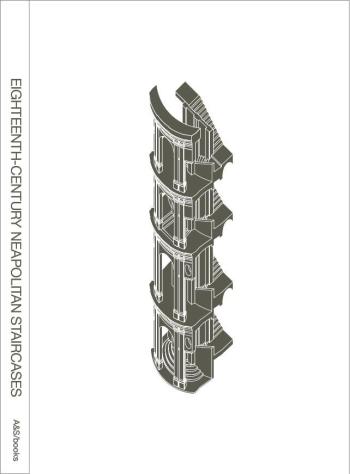 Eighteenth-century Neapolitan staircases present a shift from the traditional, monumental Baroque palace stairs towards the staircase serving four, five, or more levels of apartments of different social standing. While prefiguring stairs in modern apartment buildings, they solve issues of aristocratic etiquette as well as practical plan arrangements. They are showpiece and utility in one. At times grand and imposing, at times cramped in tapered courtyards, these staircases are numerous and disparate in form. Eighteenth-Century Neapolitan Staircases: Showpiece and Utility documents seven sets of stairs by Neapolitan architects such as Ferdinando Sanfelice. It is the outcome of a master seminar in Architectural History at the Department of Architecture and Urban Planning of Ghent University.
New Book | Synagogues In Hungary, 1782–1918
Klein’s magnum opus was first published in Hungarian in 2011. It’s recently been translated into English. From the Central European Press:
Rudolf Klein, Synagogues In Hungary, 1782–1918 (Budapest: Terc Press, 2017), 800 pages, ISBN: 978 615544 5088, $120 / €106 / £92.
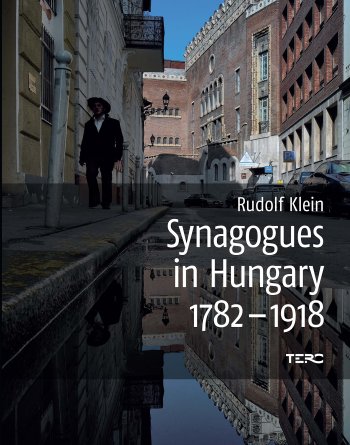 This is the first comprehensive study that systematically covers all synagogues in Hungary from the Edict of Tolerance by Joseph II to the end of World War I. Unlike prior attempts, dealing only with post-World-War-II Hungary, the geographical range of this study includes historic Hungary, including the Austro-Hungarian successor states. The study presents the architecture of Hungarian synagogues chronologically, giving special attention to the boom of synagogue architecture and art from 1867 to 1918, a time also called ‘the modern Jewish Renaissance’. The greatest contribution of this book is the innovative matrix method, which the author applies to determine the basic types of synagogues by using eight basic criteria. The book also deals with the problem of urban context, the position of the synagogue in the city and its immediate environment. There are two detailed case studies addressing how communities built their synagogues and how these were received by the general public. A theoretical summary tries to determine the role of post-emancipation period synagogues in general architectural history.
Rudolf Klein is Professor of modern architectural history, Szent István University, Miklós Ybl Faculty of Architecture and Civil Engineering, Budapest.










 Enfilade
leave a comment