New Book | The Anatomy of Color (or Colour)
From Thames & Hudson:
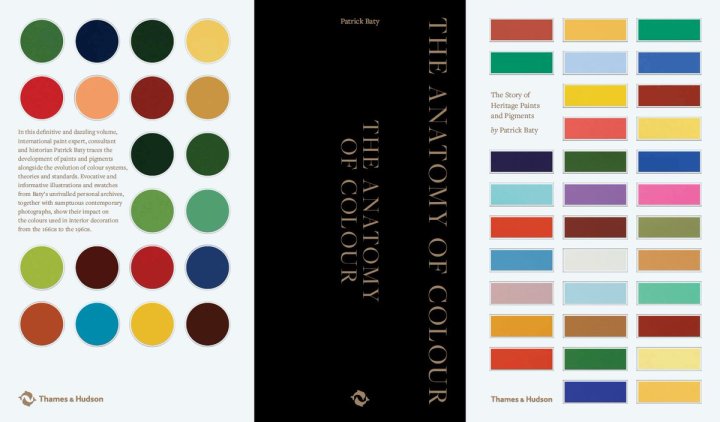
Patrick Baty, The Anatomy of Colour: The Story of Heritage Paints and Pigments (London: Thames & Hudson, 2017), 352 pages, ISBN: 978 05005 19332, $50.
Why were primary colors popular in postwar kitchens? Why did the Art Deco era prefer clean lines and pastel shades? This comprehensive illustrated history of the use of color and paint in interior decoration answers these questions and many more.
 Drawing on his huge specialist archive, historian and paint expert Patrick Baty traces the evolution of pigments and paint colors together with color systems and standards, and he examines their impact on the color palettes used in interiors from the 1650s to the 1960s. He charts the creation in paint of the common and expensive colors made from traditional earth pigments between 1650 and 1799. He then explores the emergence of color systems and standards and their influence on paint colors together with the effect of industrialized production on the texture and durability of paints. Finally, Baty turns his attention to twentieth-century color standards. Woven throughout the authoritative and revealing text are specially commissioned photographs of pages from rare color reference books. Reproductions of interiors from home decor books, dating from every era, are included throughout, highlighting the distinctive color trends and styles of painting particular to each period.
Patrick Baty is a historian of architectural paint and color. He works as a consultant in the decoration of historic buildings and runs the family paint business Papers and Paints in London. He lectures and contributes regularly to magazines and journals.
New Book | Gainsborough: A Portrait
From Weidenfeld & Nicolson:
James Hamilton, Gainsborough: A Portrait (London: W&N, 2017), 448 pages, ISBN: 978 147460 0521, £25.
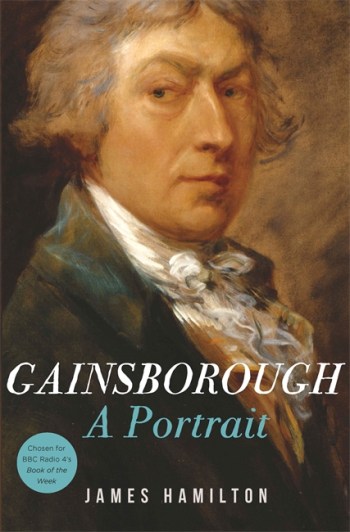 Frank, lucid and modern, this is a fresh portrait of Thomas Gainsborough, the most sensuous artist of the eighteenth century. Thomas Gainsborough (1727–1788) lived as if electricity shot through his sinews and crackled at his finger ends. He was a gentle and empathetic family man but had a volatility that could lead him to slash his paintings and a loose libidinous way of speaking, writing, and behaving that shocked many deeply. He would be dynamite in polite society today.
In this exhilarating new biography—the first in decades—James Hamilton reveals Gainsborough in his many contexts: the easy-going Suffolk lad, transported to the heights of fashion by a natural talent; the rake-on-the-make in London, learning his art in the shadow of Hogarth; falling on his feet when he married a duke’s daughter with a handsome private income; the top society-portrait painter in Bath and London who earned huge sums by bringing the right people into his studio; the charming and amusing friend of George III and Queen Charlotte who nevertheless kept clear of the aristocratic embrace.
There has been much art history written about this chameleon of art, but with fresh insights into original sources, Gainsborough: A Portrait transforms our understanding of this fascinating man and enlightens the century that bore him.
James Hamilton is an art and cultural historian. His books include Turner: A Life; Faraday: The Life, shortlisted for the James Tait Black Memorial Prize; and A Strange Business: Making Art and Money in Nineteenth-Century Britain, which in 2014 was named Art Book of the Year by The Sunday Times. Hamilton was, until retirement in 2013, curator of art collections and projects in Portsmouth, Wakefield, Sheffield, Leeds, and the University of Birmingham, where he is a Fellow of the Barber Institute of Fine Arts.
New Book | Idols and Museum Pieces: The Nature of Sculpture
Published by De Gruyter and available from ArtBooks.com:
Caroline van Eck, ed., Idols and Museum Pieces: The Nature of Sculpture, Its Historiography, and Exhibition History, 1640–1880 (Berlin: De Gruyter, 2017), ISBN: 978 31104 06917, 50€ / $58 / £41.
 The publication of Winckelmann’s Geschichte der Kunst des Altertums in 1764 is considered as the defining moment in the genesis of the modern, scientific study of sculpture. It was a formalist and secular history, concentrating on the statue as a work of art, and studying sculpture in a museum setting, abstracting from its original religious, social or political functions. Other 17th- and 18th-century authors tried to understand those functions and why statues so often excited violent reactions ranging from adoration to abuse. The collection of essays aims to be a first investigation of the questions that arise out of an awareness that the origins of the Western historiography are much more complex than may appear from the perspective of Winckelmann’s vision of the Graeco-Roman tradition.
C O N T E N T S
• Erin Downey, Sculptures in Print, The Galleria Giustiniana as Exemplar and Agent of Taste
• Frits Scholten, The Amsterdam Ivories of Francis van Bossuit: Reception and Transformation in the Eighteenth Century
• Anne Ritz-Guilbert, La sculpture comme source historique: Les dessins de la collection de François-Roger de Gaignières (1642–1715)
• Anna C. Knaap, Sculpture in Pieces: Peter Paul Rubens’s Miracles of Francis Xavier and the Visual Tradition of Broken Idols
• Stijn Bussels, Medusa’s Terror in the Amsterdam Town Hall: How to Look at Sculptures in the Dutch Golden Age
• Ruurd Halbertsma, ‘Admirari vel deridere’: Calvinistic Approaches to Classical Sculpture in the Netherlands
• Hans Christian Hönes, Allegory, Ornament, and Prehistory’s ‘Secret Influence’: D’Hancarville versus Winckelmann
• Tomas Macsotay, Baron D’Hancarville’s Recherches on the Evolution of Sculpture: Submerged Emblems and the Collective Self
• Bram van Oostveldt, ‘Ut Sculptura Theatrum’: On the Relation between Theatre and Sculpture in the Late Eighteenth Century
• Pascal Griener, Plaster versus Marble: Wilhelm and Caroline von Humboldt and the Agency of Antique Sculpture
• Caroline van Eck, How Does an Idol enter a Museum? Immersion and Aesthetic Autonomy at the Musée Charles X in the Louvre
• Cecilia Hurley, La présentation du ‘paragone’ dans les dispositifs muséaux au XIXe siècle
• Thomas Beaufils, Idoles de l’Île de Nias: Origines d’un Entichement Musèal
Exhibition | Homage to the Grand Duke
◊ ◊ ◊ ◊ ◊
Now on view at the Pitti Palace, with a catalogue published by Sillabe and available from ArtBooks.com:
Homage to the Grand Duke: Memories of Silver Plates for the Feast of St. John
Omaggio al Granduca: Memorie dei piatti d’argento per la festa di San Giovanni
Palazzo Pitti, Florence, 24 June — 24 September 2017
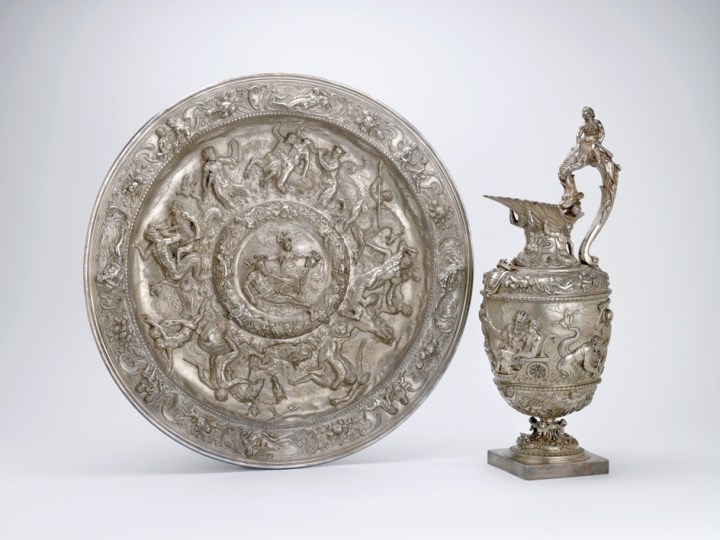
The precious items in the Tesoro dei Granduchi include a number of 18th-century moulds of the now lost ‘St. John’s plates’, a nostalgic echo of masterpieces of the Roman silversmith’s art in the age of the Baroque. The fifty-eight magnificent silver ewers were intended as a gift for Grand Duke Cosimo III (1642–1723) and, after him, for Gian Gastone (1671–1737), his successor on the throne of Tuscany. One ewer was presented every year on 24 June, the feast of St. John, from 1680 until the Medici dynasty became extinct in 1737.
 The silver ewers—weighing some fifteen pounds (or five kg) and worth 300 Roman scudi each—were meticulously embossed and chased with scenes celebrating the most illustrious members of the House of Medici from Lorenzo the Magnificent down to the reigning Grand Dukes. It was probably the fact that the ewers depicted the unusual subject of her family’s history that prompted the Electress Palatine Anna Maria Luisa (1667–1743) to do everything in her power to safeguard them from the threat of destruction at the hands of the House of Lorraine, who succeeded the Medici on the throne of Tuscany and whose military expenditure meant that they were regularly strapped for cash.
The ewers were jealously guarded in the Wardrobe in Palazzo Vecchio, leaving the premises only from 1789 to 1791 for display in the ‘Medal Room’ in the Galleria degli Uffizi. Sent back to the Wardrobe as their popularity declined, they set off down the path to oblivion. It is only thanks to casts commissioned by the Marchese Carlo Ginori and made in his Manufactory in Doccia between 1746 and 1748 that we can appreciate at least a pale reflection of their splendour today.
Rita Balleri and Maria Sframeli, eds., Omaggio al Granduca: Memorie dei piatti d’argento per la festa di San Giovanni (Livorno: Sillabe, 2017), 328 pages, ISBN: 978 8883 479595, 35€ / $60.
New Book | Representing Duchess Anna Amalia’s Bildung
From Routledge:
Christina Lindeman, Representing Duchess Anna Amalia’s Bildung: A Visual Metamorphosis in Portraiture from Political to Personal in Eighteenth-Century Germany (New York: Routledge, 2017), 210 pages, ISBN: 978 147246 7386, $150.
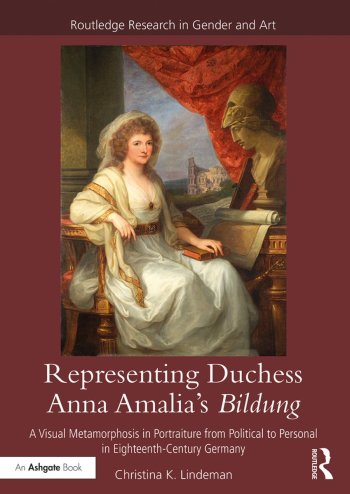 The cultural milieu in the ‘Age of Goethe’ of eighteenth-century Germany is given fresh context in this art historical study of the noted writers’ patroness: Anna Amalia, Duchess of Weimar-Sachsen-Eisenach. An important noblewoman and patron of the arts, Anna Amalia transformed her court into one of the most intellectually and culturally brilliant in Europe; this book reveals the full scope of her impact on the history of art of this time and place. More than just biography or a patronage study, this book closely examines the art produced by German-speaking artists and the figure of Anna Amalia herself. Her portraits demonstrate the importance of social networks that enabled her to construct scholarly, intellectual identities not only for herself, but for the region she represented. By investigating ways in which the duchess navigated within male-dominated institutions as a means of advancing her own self-cultivation—or Bildung—this book demonstrates the role accorded to women in the public sphere, cultural politics, and historical memory. Cumulatively, Christina Lindeman traces how Anna Amalia, a woman from a small German principality, was represented as an active participant in enlightened discourses. The author presents a novel and original argument concerned with how a powerful woman used art to shape her identity, how that identity changed over time, and how people around her shaped it—an approach that elucidates the power of portraiture in eighteenth- and early nineteenth-century Europe.
Christina K. Lindeman is Assistant Professor of Art History at the University of South Alabama. A scholar of eighteenth-century art and material culture, she has contributed essays to edited volumes and Source.
C O N T E N T S
List of illustrations
Acknowledgments
Introduction
1 Setting the Stage
2 Composing a Musical Portrait
3 Representing the Female Grand Tourist
4 The Scientific Lady in Naples
5 Materializing Anna Amalia’s Bildung
6 Anna Amalia’s Gedenktafel: The Making of an Icon
Conclusion
Appendix A
Appendix B
Bibliography
Index
Exhibition | Sampled Lives

Press release for the exhibition now on view at The Fitzwilliam:
Sampled Lives: Samplers from the Fitzwilliam Museum
The Fitzwilliam Museum, Cambridge, 6 May 2017 — 8 April 2018
Coloured silks and metal threads, white-work, and needle lace… Over 120 beautifully embroidered samplers—some hundreds of years old—have gone on display in Cambridge in the exhibition Sampled Lives: Samplers from the Fitzwilliam Museum. Each one meticulously stitched by a girl or young woman, the samplers and accompanying book give a glimpse of past lives: from mid-17th-century English Quakers to early 20th-century school pupils. The skill employed in making them is remarkable—works by girls as young as nine years old are shown.
Very rarely seen due to their fragility and sensitivity to the light, several samplers have been newly conserved and cleaned for the show. This will be the first time so many fine examples from The Fitzwilliam’s outstanding collection of samplers have gone on display together.
The sampler was an essential part of a young woman’s education. It showed much more than just her ability with a needle and thread—it was a stitched CV, representing her competence to run a future home, or for seeking employment where such needle skills would be to her advantage. Samplers were also a work of creativity and pride, some containing hidden messages in the symbols and images used, referring to the girls’ political or religious beliefs. Many are stitched with names and ages. In some cases it is the only surviving document to record the existence of an ordinary young woman.
 As the centuries progressed the sampler also became part of exercises towards literacy. Stitched prayers and odes to charity and faith adorned the fabric alongside alphabets and numerals. The displays highlight the importance of samplers as documentary evidence of past lives, revealing their education, employment, religion, family, societal status, and needlework skills. A fully- illustrated catalogue by Carol Humphrey, Honorary Keeper of Textiles, includes new high resolution photography to reveal the intricacy of the coloured silk stitches. It explores some of the personal stories that archival and genealogic research has revealed, as well as showing the evolution of different embroidery styles. It is hoped that the exhibition and book of Sampled Lives will stimulate further research, revealing more about the hidden histories of their makers.
Carol Humphrey commented: “The samplers are a stunning example of the needlework of the past and a masterclass for anyone interested in the changing fashions and styles of embroidery over the centuries. Much has changed in the study of samplers during the last thirty years or so. Now samplers can be seen as a valid means of studying the circumstances and material culture of their makers. When researched in depth, they can reveal not only personal details about an individual girl but also provide a key to family histories. We hope that visitors will enjoy discovering more about the techniques and past lives revealed in the exhibition and the book, and that further discoveries will come to light in the future.”
Carol Humphrey, Sampled Lives: Samplers from the Fitzwilliam Museum (Cambridge: The Fitzwilliam Museum, 2017), 242 pages, ISBN: 978 1910731 079, £20.
New Book | Dans l’œil du connaisseur: Pierre-Jean Mariette
From PUR:
Valérie Kobi, Dans l’œil du connaisseur: Pierre-Jean Mariette (1694–1774) et la construction des savoirs en histoire de l’art (Rennes: Presses Universitaires de Rennes, 2017), 322 pages, ISBN: 978 27535 53149, 28€.
 En partant du cas singulier du collectionneur Pierre-Jean Mariette (1694–1774), cet ouvrage vise à mieux définir les étapes qui jalonnent la formation des connaissances en histoire de l’art au xviiie siècle et, plus largement, à questionner le rôle joué par la figure du connaisseur dans cette dynamique. En somme, il s’agit de répondre aux interrogations suivantes : sur quels éléments repose la réputation de l’amateur et comment s’organise la reconnaissance de son autorité par ses pairs ? Quels sont les instruments, matériels ou intellectuels, déployés par l’expert ? Et, finalement, sous quelles formes se présente son savoir lorsqu’il se matérialise par l’écrit ?
Dans ce but, l’identité et l’activité de Mariette se trouvent ici interrogées à travers six chapitres thématiques scindés en deux parties. La première, intitulée La naissance d’un amateur, analyse l’émergence de la figure de l’amateur à travers trois moments-clés : la constitution d’une identité, le voyage d’Italie et l’insertion de l’érudit dans la République des Lettres. La seconde, dévouée aux Savoirs mis en œuvre, examine les modalités de la divulgation scientifique, de ses modèles théoriques à ses représentations visuelles.
Plus qu’un panorama exhaustif d’une pensée savante, le développement suivi enquête sur la façon dont le livre devient, au cours du xviiie siècle, un véritable laboratoire des savoirs ; un espace privilégié où se déroule, entre amateurs, le débat qui participe à l’élaboration d’une connaissance empirique dans le domaine de l’histoire de l’art. À cet égard, la présente étude pose non seulement un regard nouveau sur l’apport de Pierre-Jean Mariette au champ historique mais elle réfléchit aussi de manière originale aux pratiques socio-culturelles et aux enjeux esthétiques qui façonnent la discipline à l’époque des Lumières.
Valérie Kobi a reçu son doctorat en histoire de l’art de l’université de Neuchâtel (Suisse). Elle a été boursière à l’Institut suisse de Rome, au Getty Research Institute et à la Ludwig-Maximilians-Universität München. Depuis mai 2015, elle mène ses recherches postdoctorales entre Bielefeld et Weimar dans le cadre du projet Parergonale Rahmungen. Zur Ästhetik wissenschaftlicher Dinge bei Goethe.
T A B L E D E S M A T I È R E S
Remerciements
Préface de Pascal Griener
Introduction
Première partie: La naissance d’un amateur
Destinée historiographique
Un œil poli: La formation d’un amateur entre préjugés et émancipation
Cultiver les muses: Transactions érudites et collaborations scientifiques au sein de la République des Lettres
Conclusion
Seconde partie: Les savoirs mis en œuvre
Le catalogue comme modèle de connaissance
L’esprit de l’original et les protocoles de la reproduction
Mariette et Bouchardon : la rhétorique d’une amitié
Conclusion
Conclusion générale
Annexes
Bibliographie
Index
Table des illustrations
New Book | Settecento romano: Reti del Classicismo arcadico
From Viella and available from ArtBooks.com:
Beatrice Alfonzetti, ed., Settecento romano: Reti del Classicismo arcadico (Rome: Viella, 2017), 532 pages, ISBN: 978 88672 88571, 50€ / $75.
 Questo libro—nato da una ricerca d’équipe composta da letterati, storici dell’architettura, dell’arte e della musica—propone per la prima volta di unificare sotto la categoria di Classicismo arcadico tutto ciò che si crea ed elabora a Roma dalla fondazione dell’Arcadia in avanti. Non valida, ad esempio, per Torino, questa estensione permette di superare le viete periodizzazioni come la divisone per secoli fra Sei e Settecento o fra il primo e il secondo Settecento; e ci consente finalmente di intravedere la continuità, tutta romana, fra l’idea del bello di Bellori, la ragione poetica di Gravina, il recupero del tragico di Alfieri e Monti, tutti attivi, dall’inizio alla fine del secolo, proprio a Roma, accanto a Mengs, Füssli, Winckelmann, David. Al centro l’Arcadia che, con le acclamazioni o iscrizioni di cardinali, principi, sovrani, letterati, artisti di passaggio o residenti a Roma, era riuscita nell’impresa di fondare una repubblica letteraria sovranazionale che guardava persino a Voltaire. Era all’avanguardia, allora, Roma nelle arti, nelle accademie, nelle biblioteche, nei teatri e nella letteratura sinora chiamata neoclassica.
C O N T E N T S
Beatrice Alfonzetti, Introduzione
Parte prima
I. Il Classicismo restaurato
• Amedeo Quondam, Roma 1672: il Classicismo restaurato. L’idea del bello e il canone delle arti secondo Bellori
Parte seconda
I. L’Arcadia e la Roma di Clemente XI
• Valentina Gallo, La Basilissa: Cristina di Svezia in Arcadia
• Javier Gutiérrez Carou, Endimione fra Alessandro Guidi e Francesco de Lemene: drammaturgia, spettacolo, struttura dei finali
• Marina Formica, Dominare il tempo. Clemente XI e i tentativi di riforma del calendario
• Simone Caputo, Il ‘teatro della festa’ nella Roma di Clemente XI
II. Il Classicismo arcadico
• Franco Piperno, Architettura e musica nella Roma del Classicismo arcadico
• Angela Cipriani, Un secolo di premiazioni in Campidoglio (1696–1795). Le quattro arti liberali in mutuo soccorso
• Nicola Badolato, Il Ciro di Pietro Ottoboni e Alessandro Scarlatti e gli allestimenti operistici romani di Filippo Juvarra
• Massimo Zammerini, Architettura e scenografia nella Roma del Settecento
• Ilaria Delsere, L’Arcadia alla corte pontificia: la collaborazione tra Ludovico Sergardi e Antonio Valeri alla Fabbrica di San Pietro (1713–1726)
• Valter Curzi, Memoria dell’antico nella pittura di storia a Roma tra Seicento e Settecento: un contributo per la revisione storico-critica del Neoclassicismo
• Silvia Tatti, L’Arcadia di Crescimbeni e il trionfo della poesia: l’incoronazione in Campidoglio del 1725
• Alviera Bussotti, La recita del Temistocle di Michele Giuseppe Morei: tra Zeno e Metastasio
• Roberto Gigliucci, Il cardinale Pietro Ottoboni tra San Filippo Neri e San Casimiro
III. L’Arcadia: una rete transnazionale
• Maurizio Campanelli, I Sermones di Giovan Battista Casti (1762–1764)
• Elodie Oriol, Mecenatismo e sviluppo delle carriere musicali: il ruolo delle famiglie Acquaviva, Stuart e Albani nella Roma settecentesca
• Piermario Vescovo, Goldoni: vacanze romane
• Rosanna Cioffi, Tra Arcadia e Neoclassicismo. Da Maratti a Mengs nel segno di Shaftesbury e Winckelmann
• Marina Caffiero, Dal monastero al salotto alla tribuna. La mediazione culturale femminile nella Roma di metà Settecento
• Beatrice Alfonzetti, Poeti italiani e stranieri nelle adunanze arcadiche
• Andrea Fabiano, Astacide Tespio ovvero Poinsinet le Noyé (le Mystifié): un librettista comico francese in Arcadia
• Franca Sinopoli, Giovanni Battista Audiffredi e la realizzazione del modello di biblioteca universale
• Antonio Rostagno, Il ‘nuovo Dante’ nella musica. Dante e Petrarca in due manoscritti romani di Nicolò Antonio Zingarelli
• Orietta Rossi Pinelli, Gli artisti stranieri a Roma nel XVIII secolo
Indice dei nomi
New Book | Empire of the Senses
Scheduled for publication this fall from Brill:
Daniela Hacke and Paul Musselwhite, eds., Empire of the Senses: Sensory Practices of Colonialism in Early America (Leiden: Brill, 2017), ISBN: 978 90043 40633, 135€ / $156.
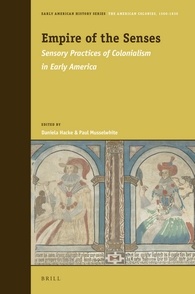 Empire of the Senses brings together pathbreaking scholarship on the role the five senses played in early America. With perspectives from across the hemisphere, exploring individual senses and multi-sensory frameworks, the volume explores how sensory perception helped frame cultural encounters, colonial knowledge, and political relationships. From early French interpretations of intercultural touch, to English plans to restructure the scent of Jamaica, these essays elucidate different ways the expansion of rival European empires across the Americas involved a vast interconnected range of sensory experiences and practices. Empire of the Senses offers a new comparative perspective on the way European imperialism was constructed, operated, implemented and, sometimes, counteracted by rich and complex new sensory frameworks in the diverse contexts of early America.
Daniela Hacke is Professor of Early Modern History at the Free University of Berlin. She has published monographs, translations and many articles on European Gender and Cultural History and is currently researching a History of the Senses in Venice.
Paul Musselwhite is Assistant Professor of History at Dartmouth College. He researches and publishes on early British America and the development of plantation society.
◊ ◊ ◊ ◊ ◊
C O N T E N T S
List of Illustrations
Notes on Contributors
Introduction: Making Sense of Colonial Encounters and New Worlds, Daniela Hacke and Paul Musselwhite
I | Cultural Encounters
1 Touching on Communication: Visual and Textual Representations of Touch as Friendship in Early Colonial Encounters, Céline Carayon
2 Mission Soundscapes: Demons, Jesuits, and Sounds in Antonio Ruiz de Montoya’s Conquista Espiritual (1639), Jutta Toelle
3 Singing with Strangers in Early Seventeenth-century New France, Michaela Ann Cameron
II | Colonial Subjectivity
4 The Pain of Senses Escaping: Eighteenth-century Europeans and the Sensory Challenges of the Caribbean, Annika Raapke
5 Color Visions: Perceiving Nature in the Portuguese Atlantic World, Marília dos Santos Lopes
III | Structures of Knowledge
6 Colonial Sensescapes: Thomas Harriot and the Production of Knowledge, Daniela Hacke
7 Merian and the Pineapple: Visual Representation of the Senses, Megan Baumhammer and Claire Kennedy
8 ‘Delightful a Fragrance’: Native American Olfactory Aesthetics within the Eighteenth-Century Anglo-American Botanical Community, Andrew Kettler
IV | Colonial Projects
9 The Aromas of Flora’s Wide Domains: Cultivating Gardens, Aromas, and Political Subjects in the Late Seventeenth-Century English Atlantic, Kate Mulry
10 Exploring Underwater Worlds: Diving in the Late Seventeenth-/Early Eighteenth-Century British Empire, Rebekka von Mallinckrodt
Index
New Book | The Collector’s Cabinet and Miniature Pharmacy
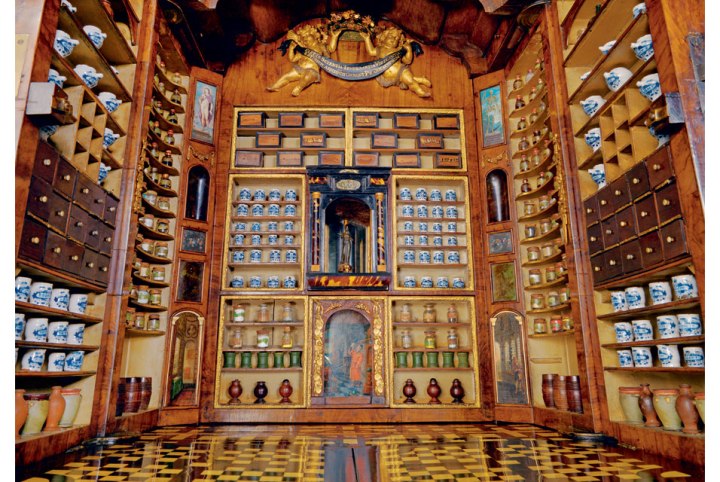
Collector’s Cabinet with Miniature Apothecary’s Shop, 1730
(Amsterdam: Rijksmuseum)
◊ ◊ ◊ ◊ ◊
Press release (23 June 2017) from the Rijksmuseum. The English edition of the book should be be available from Distributed Art Publishers (DAP) in August.
Paul van Duin, ed., The Collector’s Cabinet and Miniature Pharmacy / Verzamelaarskast met miniatuurapotheek (Amsterdam: Rijksmuseum, 2017), 184 pages, ISBN: 978 949171 4610 (Dutch edition) / ISBN: 978 949171 4726 (English edition), 40€ / $60. Essays by Reinier Baarsen, Annette Bierman, Judith van der Brugge-Mulder, Gerhard Cadée, Roelof van Gelder, and Dave van Gompel.
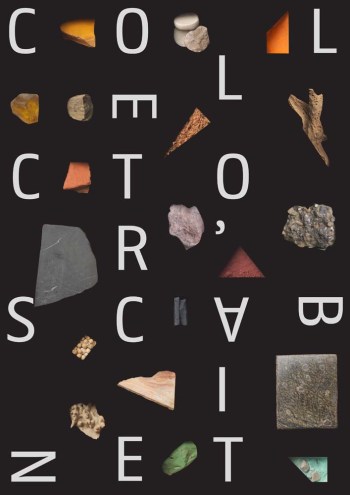 In the last few years no fewer than 50 experts have been involved in conducting research on the only eighteenth-century miniature apothecary’s shop in the Netherlands. The Rijksmuseum is now presenting the results of this research and conservation project in an extensive publication, designed by Irma Boom and showing the miniature pharmacy and 56 secret drawers for the first time, at almost actual size.
This rare collector’s cabinet houses an abundance of curiosities including a fully fitted miniature apothecary’s shop containing more than three hundred Delftware pots, glass bottles, tiny wooden drawers, paintings, and gilded ornaments. Concealed beside and behind the miniature pharmacy are no fewer than 56 secret drawers, all but five of which contain the collection of nearly 2000 varieties of naturalia, including seeds, flowers, roots, animal parts, rocks, minerals, and fossils.
The research has now been completed, providing a far deeper understanding of the cabinet’s origins, its purpose, the exceptional naturalia it contains, and the collectors’ world it inhabited. We can now be fairly certain that the cabinet was made in Amsterdam in 1730 for a wealthy doctor or apothecary, as a curiosity for the entertainment of a select group of friends and fellow collectors. The study also revealed that most of the naturalia items form the original contents of the cabinet. The naturalia even include uraninite and two other minerals containing uranium—for safety reasons, these materials are now safely stored in lead caskets in the Rijksmuseum’s depot, in accordance with the regulations and permit issued under the Dutch Nuclear Energy Act.
The conservation and restoration work have for a large part returned the cabinet and miniature apothecary’s shop to their former glory, and this object is now one of the highlights of the eighteenth-century galleries in the Rijksmuseum.
With thanks to the Cultural Heritage Agency of the Netherlands, Naturalis Biodiversity Center, Leiden University, and the Royal Netherlands Institute of Sea Research. The research, conservation, and publication were made possible by the Bank of America Merrill Lynch Art Conservation Project.










 Enfilade
leave a comment