New Book | Heinrich Graf von Brühl
Papers from the March 2014 conference, which marked the 250th anniversary of Heinrich Graf von Brühl’s death, have recently been published by Sandstein Verlag.
Ute Koch and Cristina Ruggero, eds., Heinrich Graf von Brühl: Ein sächsischer Mäzen in Europa—Akten der internationalen Tagung zum 250. Todesjahr (Dresden: Sandstein Verlag, 2017), 548 pages, ISBN: 978 39549 82974, 68€. With essays in German, English, French, and Italian.
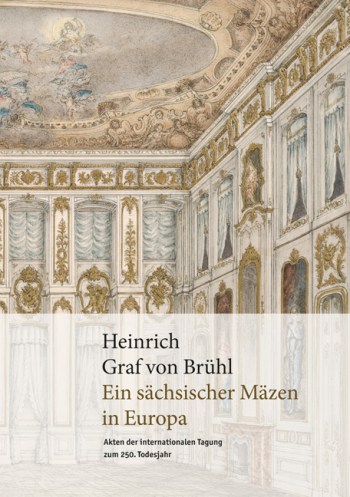 Die Brühlsche Terrasse, das Schwanenservice oder auch die Sixtinische Madonna—sie alle sind auf das Engste mit dem sächsischen Premierminister Heinrich Graf von Brühl (1700–1763) verbunden. Als Mäzen setzte er zudem—mit eigenen kostbaren Sammlungen und Schlössern—Maßstäbe in ganz Europa. Die vorliegende Publikation bricht die Verengung des Blicks auf Brühls regionale Bedeutung für Dresden und Sachsen auf und legt erstaunliche Verbindungen frei. Sie versteht sich als »Türöffner« für die Erforschung der kulturellen und politischen Bedeutung Sachsens im 18. Jahrhundert in Europa und der Welt.
Brühl’s Terrace, the Swan Service, and the Sistine Madonna are all closely connected with the Saxon Prime Minister Heinrich Count von Bruhl (1700–1763). He was a patron of the arts whose precious collections and castles set standards in the whole of Europe. The present publication moves away from the somewhat narrow focus on Brühl’s regional importance for Dresden and Saxony. It reveals unexpected connections and opens the door for the study of the cultural and political importance of 18th-century Saxony in Europe and the rest of the world.
New Book | Early Professional Women in Northern Europe, c. 1650–1850
Scheduled for release in July from Routledge:
Johanna Ilmakunnas, Marjatta Rahikainen, and Kirsi Vainio-Korhonen, eds., Early Professional Women in Northern Europe, c. 1650–1850 (New York: Routledge, 2017), 312 pages, ISBN: 978 14724 71345, $150.
 This book focuses on early examples of women who may be said to have anticipated, in one way or another, modern professional and/or career-oriented women. The contributors to the book discuss women who may at least in some respect be seen as professionally ambitious, unlike the great majority of working women in the past. In order to improve their positions or to find better business opportunities, the women discussed in this book invested in developing their qualifications and professional skills, took economic or other kinds of risks, or moved to other countries. Socially, they range from elite women to women of middle-class and lower middle-class origin.
In terms of theory, the book brings fresh insights into issues that have been long discussed in the field of women’s history and are also debated today. However, despite its focus on women, the book is conceptually not so much focused on gender as it is on profession, business, career, qualifications, skills, and work. By applying such concepts to analyzing women’s endeavours, the book aims at challenging the conventional ideas about them.
Johanna Ilmakunnas is acting professor of Finnish history at the University of Turku, Finland.
Marjatta Rahikainen is a docent of social history at the University of Helsinki, Finland.
Kirsi Vainio-Korhonen is a professor of Finnish history at the University of Turku, Finland.
◊ ◊ ◊ ◊ ◊
C O N T E N T S
1 Johanna Ilmakunnas, Marjatta Rahikainen and Kirsi Vainio-Korhonen, Women and Professional Ambitions in Northern Europe, c.1650–1850
2 Kirsi Vainio-Korhonen, Midwives: Birthing Care Professionals in Eighteenth-Century Sweden and Finland
3 Britta Kägler, Serving the Prince as the First Step of Female Careers: The Electoral Court of Munich, c.1660–1840
4 Johanna Ilmakunnas, From Mother to Daughter: Noblewomen in Service at the Swedish Royal Court, c.1740–1840
5 Anna Lena Lindberg, Remarkable Women Artists: Flower Painting and Professional Changes in Copenhagen, c.1690–1790
6 Marie Steinrud, Performing Women: The Life and Work of Actresses in Stockholm, c.1780–1850
7 Deborah Simonton, ‘Sister to the Tailor’: Guilds, Gender and the Needle Trades in Eighteenth-Century Europe
8 Galina Ulianova, Independent Managers: Female Factory Owners in the Northern Provinces of the Russian Empire, c.1760–1810
9 Marjatta Rahikainen, Urban Opportunities: Women in the Restaurant Business in Swedish and Finnish Cities, c.1800–1850
10 Åsa Karlsson Sjögren, Desirable Qualifications and Undesirable Behaviour: Teachers in Swedish Schools for Poor Children, c.1780–1820
11 Olga Solodyankina, Cross-Cultural Closeness: Foreign Governesses in the Russian Empire, c.1700–1850
12 Marjatta Rahikainen, Shaping Middle-Class and Upper-Class Girls: Women as Teachers of Daughters of Good Families in the Baltic Sea World, c.1780–1850
New Book | Baroque Seville: Sacred Art in a Century of Crisis
The focus rests on the 1660s and 70s—with plenty, nonetheless, relevant for the eighteenth century. –CH.
From Penn State UP:
Amanda Wunder, Baroque Seville: Sacred Art in a Century of Crisis (University Park: Penn State University Press, 2017), 232 pages, ISBN: 978 02710 76645, $85.
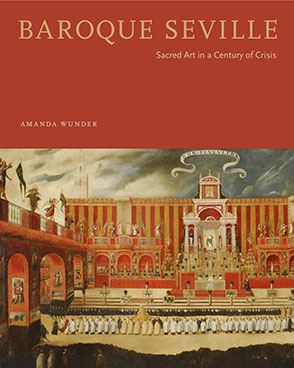 Baroque art flourished in seventeenth-century Seville during a tumultuous period of economic decline, social conflict, and natural disasters. This volume explores the patronage that fueled this frenzy of religious artistic and architectural activity and the lasting effects it had on the city and its citizens.
Amanda Wunder investigates the great public projects of sacred artwork that were originally conceived as medios divinos—divine solutions to the problems that plagued Seville. These commissions included new polychromed wooden sculptures and richly embroidered clothing for venerable old images, gilded altarpieces and monumental paintings for church interiors, elaborate ephemeral decorations and festival books by which to remember them, and the gut renovation or rebuilding of major churches that had stood for hundreds of years. Meant to revive the city spiritually, these works also had a profound real-world impact. Participation in the production of sacred artworks elevated the social standing of the artists who made them and the devout benefactors who commissioned them, and encouraged laypeople to rally around pious causes. Using a diverse range of textual and visual sources, Wunder provides a compelling look at the complex visual world of seventeenth-century Seville and the artistic collaborations that involved all levels of society in the attempt at its revitalization.
Amanda Wunder is Associate Professor of History at Lehman College and of Art History at the Graduate Center of the City University of New York.
◊ ◊ ◊ ◊ ◊
C O N T E N T S
List of Illustrations
Acknowledgments
Currency, Weights, and Measures
Introduction
1 The Art of Disillusionment: The Patronage of Mateo Vázquez de Leca
2 The Piety of Powerful Neighbors: The Renovation of Santa María la Blanca
3 A Temporary Triumph: The Seville Cathedral’s Festival for San Fernando
4 The Nobility of Charity: The Church and Hospital of the Santa Caridad
5 The Phoenix of Seville: Rebuilding the Church of San Salvador
Conclusion
Chronology
Notes
Bibliography
Index
Exhibition | Casanova: The Seduction of Europe
From the Kimbell Art Museum and Distributed Art Publishers (DAP) . . .
Casanova: The Seduction of Europe / Casanova’s Europe: Art, Pleasure, and Power
Kimbell Art Museum, Fort Worth, 27 August — 31 December 2017
The Legion of Honor, San Francisco, 10 February — 28 May 2018
Museum of Fine Arts, Boston, 1 July — 8 October 2018

Jean-Marc Nattier, Portrait of Manon Balletti, 1757, oil on canvas, 54 × 47.5 cm (London: National Gallery). Balletti was the fiancée (1757–60) of Giacomo Casanova and then wife (1760–74) of the architect Jacques-François Blondel.
Casanova: The Seduction of Europe explores the 18th century across Europe through the eyes of one of its most colorful characters, Giacomo Casanova (1725–1798). Renowned in modern times for his amorous pursuits, Casanova lived not only in Italy, but in France and England, and his travels took him to the Ottoman Empire and to meet Catherine the Great in Saint Petersburg. Bringing together paintings, sculpture, works on paper, furnishings, porcelains, silver, and period costume, Casanova will bring this world to life. Following its display in Fort Worth, the exhibition will be on view at the Fine Arts Museum of San Francisco and the Museum of Fine Arts, Boston.
Frederick Ilchman, Thomas Michie, C.D. Dickerson III, and Esther Bell, with texts by Meredith Chilton, Jeffrey Collins, Nina Dubin, Courtney Leigh Harris, James Johnson, Pamela Parmal, Malina Stefanovska, Susan Wager, and Michael Yonan, Casanova: The Seduction of Europe (Boston: MFA Publications, 2017), 344 pages, ISBN: 978 087846 8423, $45.
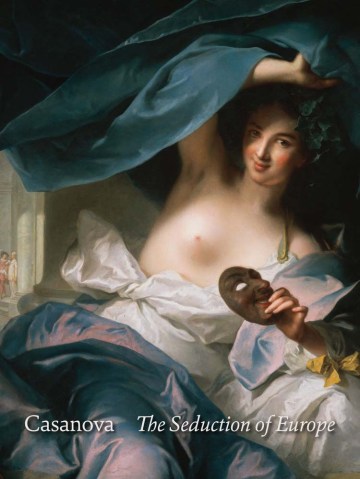 In 18th-century Europe, while the old order reveled in the luxurious excesses of the Rococo style and the Enlightenment sowed the seeds of revolution, the shapeshifting libertine Giacomo Casanova seduced his way across the continent. Although notorious for the scores of amorous conquests he recorded in his remarkably frank memoirs, Casanova was just as practiced at charming his way into the most elite social circles, through an inimitable mix of literary ambition, improvisational genius and outright fraud. In his travels across Europe and through every level of society from the theatrical demimonde to royal courts, he was also seduced by the visual splendors he encountered.
This volume accompanies the first major art exhibition outside Europe to lavishly recreate Casanova’s visual world, from his birthplace of Venice, city of masquerades, to the cultural capitals of Paris and London and the outposts of Eastern Europe. Summoning up the people he met and the cityscapes, highways, salons, theaters, masked balls, boudoirs, gambling halls and dining rooms he frequented, it provides a survey of important works of 18th-century European art by masters such as Canaletto, Fragonard, Boucher, Houdon, and Hogarth, along with exquisite decorative arts objects. Twelve essays by prominent scholars illuminate multiple facets of Casanova’s world as reflected in the arts of his time, providing a fascinating grand tour of Europe conducted by a quintessential figure of the 18th century as well as a splendid visual display of the spirit of the age.
◊ ◊ ◊ ◊ ◊
Note (added 20 August 2018) — This article might be of interest for anyone thinking about the exhibition and its reception within our own political/cultural context: Cynthia Durcanin, “Casanova as Case Study: How Should Art Museums Present Problematic Aspects of the Past?,” ArtNews (13 August 2018). As noted in the essay: “The MFA also changed the show’s title from the Legion of Honor’s, removing the word ‘seduction’ so that it became ‘Casanova’s Europe: Art, Pleasure and Power in the 18th Century’.” According to Katie Getchell, the chief brand officer and deputy director of the MFA Boston, “It’s an important nuance. The show is not about Casanova—it’s about Europe in Casanova’s time.”
New Book | Penser le « petit » de l’Antiquité au premier XXe siècle
Addressing textual approaches and practices of artistic miniaturization from antiquity to the nineteenth century, this volume presents essays that grew out of a colloquium on the subject in October 2015. Available from Les libraires ensemble:
Sophie Duhem, Estelle Galbois et Anne Perrin Khelissa, eds., Penser le « petit » de l’Antiquité au premier XXe siècle: Approches textuelles et pratiques de la miniaturisation artistique (Lyon: Fage, 2017), 224 pages, ISBN: 978 284975 4306, 25€.
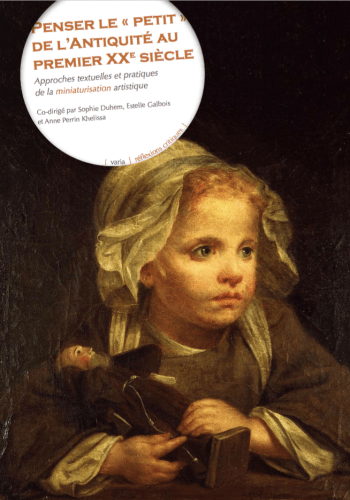 From Tanagra statuettes to the automata of the industrial age, there are many material manifestations of the ancient fascination with shapes, images, and tiny objects. Examples abound: carved micro-architectures of Gothic buildings, small engravings by Stefano della Bella or Sébastien Leclerc, eighteenth-century objects of vertu, and the Lilliputian creatures of children’s literature. Rare, however, are the historical sources that allow us to understand their cultural foundations. While the written sources usually consider the ‘small’ only in relationship to the ‘big’, the analysis of the consumption of these objects reveals a set of practical, symbolic, and artistic skills such as manoeuvrability, mobility, economy, poverty, preciousness, thoroughness, prettiness, and strangeness. Too often, the dominant sources focus on the size of the objects, diminishing other considerations. At times, miniaturization reduces the scale of a given object, while at other times it may be an independent creation governed by specific criteria. Whatever the case, miniaturization is based on a set of justifications, usages, and judgments that this conference aims to clarify.
C O N T E N T S
Essais introductifs
Sophie Duhem, Estelle Galbois, Anne Perrin Khelissa, Le « petit » : un concept opératoire pour penser l’art et son récit
Jean-Marie Guillouët, Une perspective préalable depuis le Moyen Âge : la question des échelles de l’œuvre
Partie 1 : Technique, esthétiques et fonctions du changement d’échelle
• Jan Blanc, Valeurs et enjeux théoriques du ‘petit’ à l’époque moderne
• Véronique Sarrazin, Le « format Collombat », ou comment le petit format d’un modeste livret est devenu une référence de goût et de commodité au xviiie siècle
• Tamara Préaud, Petits bibelots ou vraies sculptures ? L’exemple de Vincennes-Sèvres au xviiie siècle
• Cyril Lécosse, Stratégie de distinction chez les « pygmées de l’art » : peindre la miniature en grand autour de 1800
• Élodie Voillot, Un musée dans chaque foyer. Les réductions de sculptures, du grand art au petit bibelot, 1839–1900
Partie 2 : Luxe, préciosités et réceptions de l’objet minuscule
• Alice Delage, La microarchitecture dans l’orfèvrerie florentine : la Renaissance du « petit »
• Françoise Gilbert, Le sonnet 465 du « Parnasso espanol » : un petit bijou de la main de Quevedo
• Anne Perrin Khelissa, Menace sur le « grand » art. Le peuple des magots et des statuettes en porcelaine au Siècle des Lumières
• Michel Sandras, « La miette de Cellini / Vaut le bloc de Michel-Ange ». Petites formes et artisanat du style, 1830–1890
Partie 3 : Souvenir, circulations et pouvoirs mémoriels de l’objet miniature
• Rori Bloom, « Voilà mon portrait que je vous donne » : la boîte à portrait dans la littérature précieuse
• Manuel Charpy, Réductions, miniatures et fragments. La religion du souvenir et du passé dans les espaces intimes au xixe siècle
• Manuel Royo, « Voir le grand dans le petit », enjeux mémoriels de la maquette d’architecture : le cas de Rome à la fin du xixe siècle et au début du xx e siècle
• Claire Barbillon, Le paradoxe de la monumentalité en format réduit : la statuaire monumentale publique et la carte postale
Partie 4 : Poésie, images et représentations du « petit » monde
• François Ripoll, « Si parua licet componere magnis » (Georg., IV, 176) : la dialectique du « grand » et du « petit » dans les chants III et IV des Géorgiques de Virgile
• Vincent Robert-Nicoud, Grand débat sur le « petit » monde : l’homme microcosme de Rabelais à Scève
• Sarah Grandin, « Cironalité universelle » : taille, échelle et perspective dans L’Autre monde de Cyrano
• Nathalie Rizzoni, « Les Petits toure lourirette / Valent bien les grands » : les enfants sur les scènes de théâtre en France au premier xviiie siècle
Présentation des auteurs
2017 AAMC Awards Announced
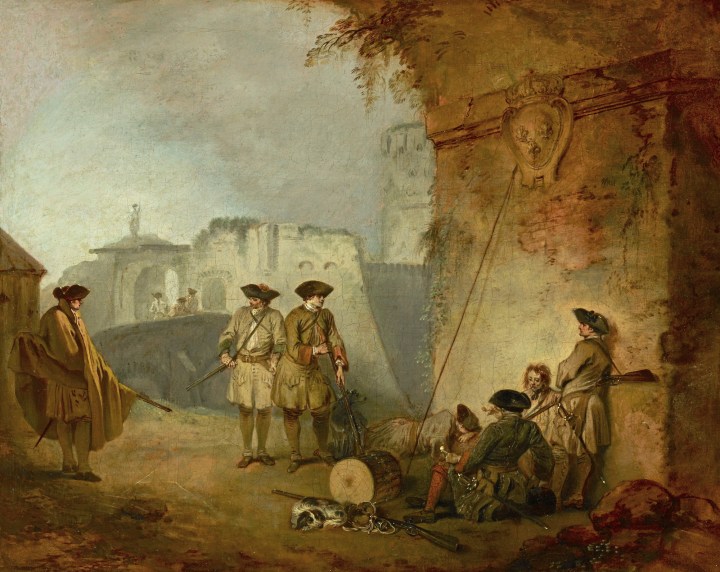
Jean-Antoine Watteau, The Portal of Valenciennes, ca. 1710–11, oil on canvas, 32.5 × 40.5 cm (New York: The Frick Collection, purchased with funds from the bequest of Arthemise Redpath, 91.1.173 / photo: Michael Bodycomb).
◊ ◊ ◊ ◊ ◊
Congratulations to Aaron Wile! His essay “Watteau and the Inner Life of War”—from the catalogue Watteau’s Soldiers: Scenes of Military Life in Eighteenth-Century France , published in conjunction with the exhibition that Wile also curated for The Frick Collection—was awarded the 2017 Prize for ‘Best Article, Essay, or Extended Catalogue Entry’ from the Association of Art Museum Curators (AAMC).
A full list of awards is available here»
New Book | Miniatur-Geschichten: Indian Painting at Dresden
Published by Sandstein Verlag and distributed in the U.S. by ISD:
Monica Juneja and Petra Kuhlmann-Hodick, eds., Miniatur-Geschichten: Die Sammlung indischer Malerei im Dresdner Kupferstich-Kabinett (Dresden: Sandstein Verlag, 2017), 256 pages, ISBN: 978 39549 82714, $28.
 Two collections, hitherto all but unknown, of Indian painting from the late 17th and early 18th centuries, which are part of the Dresden Copper Plate Cabinet, are the focus of these miniature stories. An inventory of the art collections of the Saxon Elector August the Strong, drawn up in 1738, lists a number of albums with portraits of Indian rulers and princes. In 1848, this collection was enlarged by a donation of 78 works, more diverse in terms of subject matter, from the estate of the German linguist and Indologist August Wilhelm Schlegel.
The catalog offers a representative selection of the Dresden inventory which was enriched by the recent donation of a Shahnama manuscript from Kashmir. The exhibition presents this inventory in the context of loans from Mumbai, London, Paris, Vienna, Amsterdam, and Berlin. Eleven essays in German and English discuss the background of, and provide insights into, the fascinating world of Indian painting.
C O N T E N T S
Dank
Förderer
Grußwort
Vorwort
E S S A Y S
with English summaries / mit deutschen Zusammenfassungen
• Petra Kuhlmann-Hodick, Berührungspunkte: Werke indischer Malerei im Dresdner Kupferstich-Kabinett
• Monica Juneja, Sehen, Begehren, Sammeln: Ästhetische Wahrnehmungen in den frühmodernen Bildkulturen Südasiens
• Vandana Prapanna, The Collections of the Chhatrapati Shivaji Maharaj Vastu Sangrahalaya, Mumbai
• Dipanwita Donde, Portraiture in Mughal Manuscripts: Re-Mapping the Portrait of Akbar between 1600 and 1700
• Ursula Weekes, Medallion Portraits in India and Europe
• Pauline Lunsingh Scheurleer, Indian Miniatures for Europe: The Dutch Market in the 17th and 18th Centuries
• Dirk Syndram, Der »Thron des Großmoguls«: Ein königlicher Traum vom Fernen Osten
• Roger Paulin, August Wilhelm Schlegel und Indien
• Jürgen Hanneder, August Wilhelm Schlegel als Indienforscher
• Olaf Simon, »… wie du hier sehen kannst«: Kunsttechnologische Untersuchungen und Restaurierung der indischen Bestände des Dresdner Kupferstich-Kabinetts
• Neha Berlia, From Timur to the Marathas: Dynasties of India as Represented in Late 17th- to Early 18th-Century Portrait Albums in European Collections
K A T A L O G
Sammlungsgeschichten. Heucher 1738 – Schlegel 1848
Blicke in die Welt indischer Malerei
Darbar und darshan. Porträtkunst und höfische Repräsentation
Prinzessinnen, Asketen, Helden. Genreszenen und Illustrationen
Zur Praxis der Miniaturmalerei
Die Gegenstandswelt der indischen Malerei
Aus den Rüstkammern indischer Fürstenhöfe
Aus dīwān, mardāna und zenāna
Götterbilder und Gebetsketten
Zahlungsmittel im Mogulreich
Kultureller Austausch
Motiv-Wanderungen zwischen Indien und Europa
Berichte und Reisebeschreibungen der Barockzeit
August Wilhelm Schlegel. Indologe und Sammler
Literatur
Personenregister
Bildnachweis
Abkürzungen
Impressum
New Book | Heaven, Hell, and Everything in Between
From University of Texas Press:
Ananda Cohen Suarez, Heaven, Hell, and Everything in Between: Murals of the Colonial Andes (Austin: University of Texas Press, 2016), 304 pages, ISBN: 978 14773 09544 (hardcover), $90 / ISBN: 978 14773 09551 (softcover), $30.
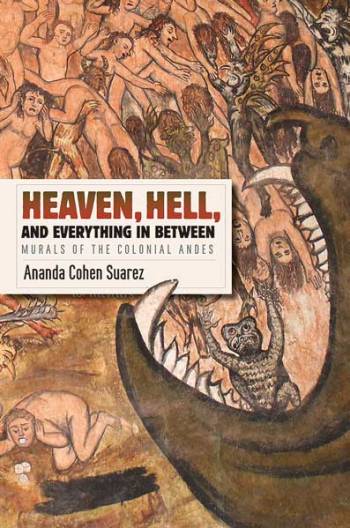 This first comprehensive English-language study of the church-wall paintings created in Peru’s Cuzco region from the sixteenth through the early nineteenth centuries unveils the complex intersections of religious artists, indigenous congregants, and colonizers.
Examining the vivid, often apocalyptic church murals of Peru from the early colonial period through the nineteenth century, Heaven, Hell, and Everything in Between explores the sociopolitical situation represented by the artists who generated these murals for rural parishes. Arguing that the murals were embedded in complex networks of trade, commerce, and the exchange of ideas between the Andes and Europe, Ananda Cohen Suarez also considers the ways in which artists and viewers worked through difficult questions of envisioning sacredness.
This study brings to light the fact that, unlike the murals of New Spain, the murals of the Andes possess few direct visual connections to a pre-Columbian painting tradition; the Incas’ preference for abstracted motifs created a problem for visually translating Catholic doctrine to indigenous congregations, as the Spaniards were unable to read Inca visual culture. Nevertheless, as Cohen Suarez demonstrates, colonial murals of the Andes can be seen as a reformulation of a long-standing artistic practice of adorning architectural spaces with images that command power and contemplation. Drawing on extensive secondary and archival sources, including account books from the churches, as well as on colonial Spanish texts, Cohen Suarez urges us to see the murals not merely as decoration or as tools of missionaries but as visual archives of the complex negotiations among empire, communities, and individuals.
C O N T E N T S
Acknowledgements
Introduction
1 The Painted Walls of the Andes: Chronology, Techniques, and Meanings
2 The Road to Hell is Paved with Flowers: Journeys to the Afterlife at the Church of Andahuaylillas
3 Clothing the Architectonic Body: Textile Murals of the Seventeenth and Eighteenth Centuries
4 Turning the Jordan River into a Pacarina: Murals of the Baptism of Christ at the Churches of Urcos and Pitumarca
5 Earthly Violence/Divine Justice: Tadeo Escalante’s Murals at the Church of Huaro
Conclusion
Notes
Bibliography
Index
New Book | Magical Manuscripts in Early Modern Europe
From Palgrave Macmillan:
Daniel Bellingradt and Bernd-Christian Otto, Magical Manuscripts in Early Modern Europe: The Clandestine Trade In Illegal Book Collections (London: Palgrave Macmillan, 2017), ISBN 978 3319 595245, $60.
This book presents the story of a unique collection of 140 manuscripts of ‘learned magic’ that was sold for a fantastic sum within the clandestine channels of the German book trade in the early eighteenth century. The book will interpret this collection from two angles—as an artefact of the early modern book market as well as the longue-durée tradition of Western learned magic—thus taking a new stance towards scribal texts that are often regarded as eccentric, peripheral, or marginal. The study is structured by the apparent exceptionality, scarcity, and illegality of the collection and provides chapters on clandestine activities in European book markets, questions of censorship regimes and efficiency, the use of manuscripts in an age of print, and the history of learned magic in early modern Europe. As the collection has survived till this day in Leipzig University Library, the book provides a critical edition of the 1710 selling catalogue, which includes a brief content analysis of all extant manuscripts. The study will be of interest to scholars and students from a variety of fields, such as early modern book history, the history of magic, cultural history, the sociology of religion, or the study of Western esotericism.
Daniel Bellingradt is Professor of Book Studies at Erlangen-Nuremberg University, Germany, co-editor of the German Yearbook for the History of Communications and co-editor of Books in Motion in Early Modern Europe: Beyond Production, Circulation, and Consumption (2017).
Bernd-Christian Otto is postdoctoral researcher at the Max Weber Center for Advanced Cultural and Social Studies at the University of Erfurt, Germany. His book publications include Magie: Rezeptions- und diskursgeschichtliche Analysen von der Antike bis zur Neuzeit (2011) and, as co-editor, Defining Magic: A Reader (2013) and History and Religion: Narrating a Religious Past (2015).
Exhibition | Lives Bound Together: Slavery at Mount Vernon
◊ ◊ ◊ ◊ ◊
Now on view at Mount Vernon:
Lives Bound Together: Slavery at George Washington’s Mount Vernon
The Donald W. Reynolds Museum, Mount Vernon, 1 October 2016 –30 September 2017
Mount Vernon was George Washington’s home. It was also home to hundreds of enslaved people who lived and worked under Washington’s control: in 1799, there were 317 men, women, and children enslaved at Mount Vernon’s five farms, which covered 8,000 acres. They made up more than 90% of the population of the estate.
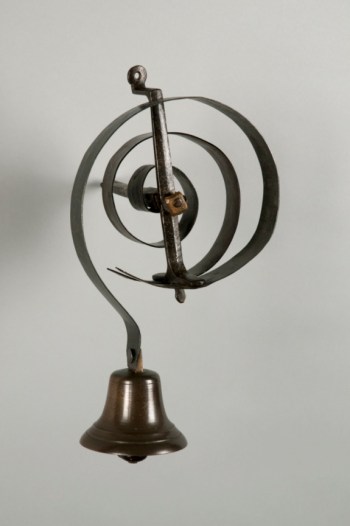
House Bell, ca. 1784–88; Copper alloy, iron (Mount Vernon).
Through household furnishings, art works, archaeological discoveries, documents, and interactive displays, the exhibition, which spans 4,400 square feet throughout all seven galleries of the Donald W. Reynolds Museum, demonstrates how closely intertwined the lives of the Washingtons were with those of the enslaved. Nineteen enslaved individuals are featured throughout the exhibit, represented with life-size silhouettes and interactive touchscreens providing biographical details.
More than 350 items are on view—seeds and animal bones, ceramic fragments, and metal buttons unearthed from archaeological excavations around the estate, as well as fine tablewares and furniture from the Washington household, providing insights into the enslaved community’s daily lives and work. Guests gain a better understanding of Washington’s changing views towards slavery, culminating in his landmark decision to include in his will a provision freeing the slaves that he owned. Visitors will have an opportunity to view original manuscript pages from George Washington’s will, written in July 1799, showing his decision to free the slaves he owned. The exhibition profiles 19 individuals enslaved at Mount Vernon, using George Washington’s extensive records to piece together what is known of their lives in interactive displays.
Susan P. Schoelwer, ed., with an introduction by Annette Gordon-Reed, Lives Bound Together: Slavery at George Washington’s Mount Vernon (2016), 172 pages, ISBN: 978 970931 9170, $20.
Lives Bound Together provides fresh research on this important topic, with brief biographies of 19 enslaved individuals, 10 essays, and 130 illustrations, including paintings, prints, and household furnishings from the Mansion, artifacts excavated by archaeologists from the slave quarters, documents, maps, and conjectural silhouettes that suggest the presence of the enslaved.










 Enfilade
leave a comment