Exhibition | Drawing Gold and Silver: Odiot
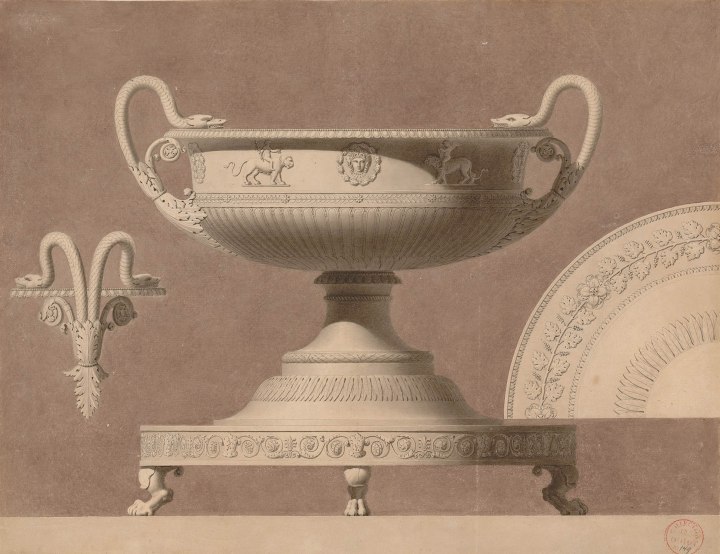
‘Snake handles’ dish, attributed to Charles-Jean-Alexandre Moreau, creator of the model; drawing attributed to Auguste Garneray, draughtsman in Jean-Baptiste-Claude Odiot’s workshop, ca. 1810; graphite, pen and grey ink, grey and sepia wash on paper (Paris: Les Arts Décoratifs).
◊ ◊ ◊ ◊ ◊
Now on view at the Musée des Arts Décoratifs:
Drawing Gold and Silver: Jean-Baptiste-Claude Odiot
Dessiner l’or et l’argent: Odiot (1763–1850), orfèvre
Musée des Arts Décoratifs, Paris, 8 March — 7 May 2017
Jean-Baptiste-Claude Odiot (1763–1850) became one of the most successful and prolific gold and silversmiths during the Empire and Restoration periods. He received several important royal commissions from the courts of Europe, including a sumptuous table service, a dressing table for empress Marie-Louise, and a cradle for the King of Rome.
The Musée des Arts Décoratifs has an exceptional collection of 33 silverware pieces and—acquired in 2009—176 original drawings from Odiot’s workshop, classified as important works of heritage by the Ministry of Culture’s Consultative Commission on National Treasures. On display for the first time, this exhibition reunites Odiot’s design drawings with the executed pieces, demonstrating his creative process, as well as his formal development and experimentation. Dating from the first quarter of the 19th century, these drawings are superbly executed in graphite and pen and enhanced with ink wash, watercolor, and gouache.
The drawings illustrate the various stages of a piece’s creation, from the initial sketches to the final detailed drawings presented to clients. On sheets of paper often measuring more than one meter high, tableware, dressing tables, and desks pieces are represented to scale, displaying the splendor and refinement of the art of living in the early 19th century. The drawings also propose different versions of the same model, offering alternatives for applied ornaments, handles, etc. Each drawing reveals an ornamental repertoire that became Odiot’s hallmark that he repeatedly employed in varying combinations from the beginning of the Empire period to the end of the Restoration. Only ten of the drawings are signed by colleagues of Odiot, including draughtsmen Auguste Garneray (1785–1824) and Adrien-Louis-Marie Cavelier (1785–1867), and the silversmith Jacques-Henry Fauconnier (1779–1839). The drawings also feature the names of prestigious clients such as Count Demidov, Countess Branicka, and members of the Imperial Family, including Madame Mère (Napoleon’s mother), Empress Marie-Louise, and Jerome I of Westphalia. These 176 drawings complement the Museum’s collection of 31 bronze models, a sugar bowl, and ‘Venus’s breast and butterfly’ bowl in vermeil, all by Odiot.

Jean-Baptiste-Claude Odiot, ‘Venus breast and butterfly’ bowl, ca. 1810–20; silver-gilt, hammered, cast, chased and engraved (Paris: Les Arts Décoratifs, Paris / photo: Jean Tholance).
The forms of the bronze models are as varied as the drawings: tea urns, soup tureens, dishes, wine coolers, oil cruets, saltcellars… Their handles, legs, and applied decoration incorporate an ornamental vocabulary derived from Antiquity. In addition to the central theme of the procession of Bacchus, Odiot’s pieces and drawings incorporates other iconographical figures such as of Hebe, Ceres, Leda, Venus, Adonis, Flora, and allegories of Victory. Snakes, swans, and mermaids lend their sinuous forms to handles, while monopod winged sphinxes and lion’s paws were better suited as legs. The foliated friezes framing the piece’s main body are decorated with panthers, reeds, vine branches, ears of wheat, and dolphins.
In 1835, Odiot donated 31 models to the Chambre des Pairs (Upper House of the French Parliament) for posterity and to serve as models for his successors. The models were initially displayed in the Musée du Luxembourg, which was, in the 19th century, devoted to painting and sculpture by living artists. In 1852, the models were transferred to the storerooms of the Louvre where they were gradually forgotten.
Simultaneously, initiatives were taking place to create the Musée des Arts Décoratifs during the second half of the 19th century. The museum of the ‘beautiful in the useful’ opened in 1882 with the goal of encouraging links between art and industry by providing models and references for workers and artisans. As there was a clear connection between Odiot’s motives and those of the new museum, Odiot’s models were put on permanent loan to the Musée des Arts Décoratifs in 1892. In 1907–08, the Musée des Arts Décoratifs commissioned Christofle to gold and silver-plate these models in order to give them the appearance of silver. In 2016, the models were officially added to the inventory of the Musée des Arts Décoratifs.
 These models were executed with great finesse. Their components, assembled by a system of nuts and bolts, were chased to heighten the relief decoration and provide contrast between matte and reflective surfaces. As a result of recent scientific analysis by the Centre de Recherche et de Restauration des Musées de France, the pieces, previously described in Odiot’s terminology as bronze, are, in fact, made of brass. The rare opportunity to showcase the Museum’s collection of Odiot silver alongside the drawings creates a unique dialogue in the history of decorative arts.
The Silversmith Jean-Baptiste-Claude Odiot’s Designs for Silver and Gold exhibition explores this dialogue between a piece’s initial conception on the drawing board and the finished work in Jean- Baptiste-Claude Odiot’s workshop. A selection of approximately 100 drawings, exhibited for the first time, will be displayed alongside 33 pieces of silver, revealing this great silversmith’s creative process. The exhibition will be accompanied by a catalogue of the collection and interactive digital media.
Audrey Gay-Mazuel and Julie Ruffet-Troussard, Odiot: Un atelier d’orfèvrerie sous l’Empire et la Restauration (Paris: Les Arts Décoratifs, 2017), 240 pages, ISBN : 978 2916914 688, 45€.
Exhibition | 18th-Century Masterpieces in the Churches of Paris
From the press release for the exhibition:
Enlightenment Baroque: 18th-Century Masterpieces in the Churches of Paris
Le Baroque des Lumières: Chefs-d’œuvre des églises parisiennes au XVIIIe siècle
Petit Palais, Paris, 21 March — 9 July 2017
Curated by Christophe Leribault and Marie Monfort
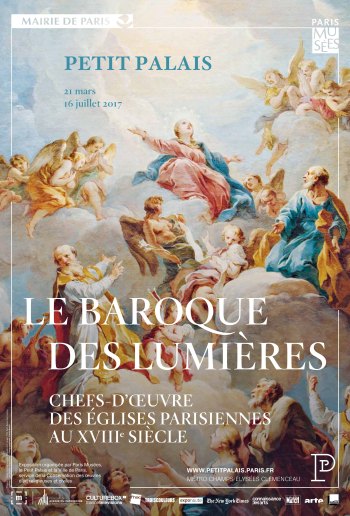 For the first time the Petit Palais is offering the public a spectacular ensemble of 18th-century religious paintings created for the churches of Paris. Through some 200 works the museum will reveal the significance and diversity of artistic output in Paris from the Regency to the French Revolution: from such heirs to the age of Louis XIV as Largillière and Restout to the exponents of rocaille, from Lemoine to Carle Van Loo, and the best of Neo-Classicism, from Vien to David. Produced in partnership with COARC (Conservation of Religious and Secular works of Art for the City of Paris), this exhibition is an extension of the one at the Musée Carnavalet (Paris) in 2012, which focused on 17th-century painting in Paris churches and the rediscovery of an enormous, little-known heritage.
The emphasis of 18th-century French painting was more on the sophistication of the fête galante and the portrait than the elaborateness of great religious art. Outside the Salon season, however, it was in the churches of Paris that art lovers could view contemporary painting, and so the city’s artists gave of their best there. Indeed, parishes and congregations bent on renovating the capital’s places of worship were among the main sponsors of history painting, and it is this forgotten segment of 18th-century art that Enlightenment Baroque aims to reassess. In a spectacular decor evocative of the inside of a church and its related spaces—the chapels and the sacristy, for example—the exhibition itinerary highlights numerous masterpieces, often very large, that have benefited from unprecedentedly thorough renovation. In addition to the pictures still to be seen in churches today, the exhibition brings together works which since the Revolution have been scattered. The masterpieces come from institutions (the Louvre, the Château de Versailles, and the art museums of Lyon, Rennes, Marseille, Brest, and elsewhere), churches and cathedrals nearby (Saint Denis and Villeneuve-Saint-Georges, for example), or further away (Mâcon, Lyon).
Divided into eight sections, the exhibition delights the eye with the finesse and varying styles of altarpieces, the colourful grace of François Lemoine, Jean-François de Troy and Noël Hallé, and the unadorned Neo-Classicism of Drouais and, of course, David, whose large portrait of Christ closes the exhibition. There are also references to ornamental ensembles, some of which, like Charles Natoire’s decor for the Chapelle des Enfants Trouvés have been lost or destroyed. Other sections are devoted to images of the new saints of the Counter-Reformation, smaller works intended for private devotion, commissioning procedures and the restorations that took place at the time in ancient buildings like the Invalides.
Along the way viewers will find two educational spaces, one given over to restoration campaigns and the other to religious imagery. Visitors will also be able to take part in guided tours of various religious edifices in Paris. This groundbreaking panorama of religious painting in 18th-century Paris is nothing short of a revelation: the pictures brought together for the occasion have been endowed with an unsuspected vividness of colour harking back to what we find so agreeable in the art of the Age of Enlightenment.
Christine Gouzi and Christophe Leribault, eds, Le Baroque des Lumières: Chefs-d’œuvre des églises parisiennes au XVIIIe siècle (Paris: Paris musées, 2017), 368 pages, ISBN : 978 27596 03442, 50€.
Curators
Christophe Leribault, Director, Petit Palais
Marie Monfort, Head of Conservation of Religious and Secular works of Art for the City of Paris
Associate Curators
Maryline Assante di Panzillo (Petit Palais), Lionel Britten (Musée d’Orsay), Jessica Degain, Nicolas Engel et Emmanuelle Federspiel (COARC), Christine Gouzi (Université de Paris- Sorbonne), et Guillaume Kazerouni (Musée des Beaux-Arts de Rennes)
Exhibition | The Art of Power: Treasures from the Bute Collection
Opening at the end of the month at both The Hunterian and Mount Stuart:
The Art of Power: Treasures from the Bute Collection at Mount Stuart
Hunterian Museum and Art Gallery, Glasgow, 31 March 2017 — 14 January 2018
Mount Stuart, Isle of Bute, 31 March 2017 — 14 January 2018
Curated by Caitlin Blackwell and Peter Black

Sir Joshua Reynolds, Portrait of John Stuart, 3rd Earl of Bute, 1773 (The Bute Collection at Mount Stuart).
This new exhibition offers a unique opportunity to see major paintings from the Bute Collection at Mount Stuart on the Isle of Bute. Merging art, biography and cultural history, Art of Power uncovers the fascinating Enlightenment figure, John Stuart, Third Earl of Bute, and his collection of rarely-seen masterpieces.
The exhibition is split across two venues—The Hunterian and Mount Stuart—offering visitors the chance to experience two world-class collections. Art of Power: Treasures from Mount Stuart marks the tercentenary of Mount Stuart, an architectural jewel on the Isle of Bute which houses the Bute Collection, one of the foremost private collections of artworks and artefacts in the UK.
The exhibition reveals a selection of rarely-seen masterpieces collected by the fascinating Enlightenment figure, John Stuart, Third Earl of Bute (1713–1792), the first Scottish-born Prime Minister and ‘favourite’ of George III. After retiring from politics, Bute amassed a great art collection, which was particularly renowned for its Dutch and Flemish paintings. This major exhibition brings a selection of European and British masterpieces from the Bute Collection to the Hunterian Art Gallery, many of which have not been on public display in over a century.
Highlights include works by Dutch Golden Age masters like Jan Steen and Jacob van Ruisdael, Grand Manner portraits by Sir Anthony Van Dyck, Joshua Reynolds and Allan Ramsay, and Italianate landscapes and history subjects by Claude Lorrain and Veronese. A portion of these works will be displayed at the Hunterian, along with works on paper, including botanical illustrations and satirical engravings from the collection. The remainder of the paintings will be displayed at Mount Stuart, where they will be accompanied by historical artefacts, such as costume, letters, and rare books.
◊ ◊ ◊ ◊ ◊
Caitlin Blackwell, Peter Black, and Oliver Cox, Art of Power: Masterpieces from the Bute Collection at Mount Stuart (New York: Prestel, 2017), 144 pages, ISBN: 978 37913 56631, $50.
John Stuart, 3rd Earl of Bute, was one of history’s most enthusiastic art collectors. As tutor to Prince George, Bute became indispensable to the royal household. Soon after his accession to the throne, the King made Bute Prime Minister―a career that was cut short after the Peace of Paris in 1763.
Forced out of London by an angry mob, Bute retired to an estate at Luton, where he spent the rest of his years in private study and amassing a collection of 500 paintings, including major works by Venetian painters such as Tintoretto, Bordone, and Veronese. Bute had a special interest in Dutch and Flemish pictures, building the greatest collection of its kind in Britain. This book features over thirty masterpieces, mainly genre paintings and landscapes, and including jewel-like landscapes by Brueghel and Savery. The collection is housed at the Bute family’s Scottish seat, Mount Stuart, on the Isle of Bute. Essays by leading scholars delve into the history of Bute’s collection, focusing on his relationship with King George III, and his wide ranging passions, which resulted in rooms filled floor to ceiling with works of art.
Caitlin Blackwell is the inaugural Bute Fellow at Mount Stuart, which is located on the Isle of Bute off the coast of Scotland. Peter Black is curator at the Hunterian and has published widely on Dutch and Flemish art. Oliver Cox is Heritage Engagement Fellow at the University of Oxford.
◊ ◊ ◊ ◊ ◊
From CODART, with text from Peter Black, Curator of Dutch and Flemish Paintings and Prints, Hunterian Museum and Art Gallery (12 December 2016). . .
The Bute Collection is housed at Mount Stuart (1880–1912), the Gothic Revival Palace by Robert Rowand Anderson on the Isle of Bute. It contains, besides a truly great collection of 18th-century portraits, important Dutch and Flemish works that were collected in the 1760s and 1770s by John Stuart, Third Earl of Bute (1713–1792). Bute was tutor to King George III when he was Prince of Wales, advising him, among other things, on acquisitions for the royal collection. Soon after the coronation in 1760, Bute was given power by his former pupil, becoming Prime Minister in 1762. His main business was to negotiate the Peace of Paris, ending the Seven Years’ War. Within one year, however, Bute resigned and was forced to leave London to escape the London mob. He bought a country house at Luton, which he had remodeled by Adam, and landscaped by Capability Brown. There he settled down to become the most important British collector of Dutch paintings, assembling for the purpose a library and collection of prints and drawings (dispersed 1794–1809). At the time of his death, there were 500 works in the house. Bute had more than a penchant for Venetian art and the grand rooms on the ground floor were hung with works by Tintoretto, Veronese and Bordone, as well as some of the finest examples of the work of Francesco Zuccarelli. Masterpieces by Dutch artists in the library included a magnificent Windy Autumn Day landscape by Berchem (Mount Stuart), and Cuyp’s River Landscape with Horseman and Peasants (now in the National Gallery, London). That painting is said to have started the craze for Cuyp among British collectors when Bute acquired it in the early 1760s. The smaller Dutch paintings were accommodated on the upper floor, clustered in dense thematic hangs in the bedrooms and dressing rooms.
The exhibition of 26 pictures in Glasgow University provides a window onto the riches of Mount Stuart, which can be visited in a day-trip by train and ferry from Glasgow. They are generally smaller works, including jewel-like landscapes by Savery, De Momper/Brueghel, Jan van der Heyden, Cuyp, Berchem, and Ruisdael, as well as genre scenes by Steen, Teniers, Verelst, Metsu and Bega. Visitors to Mount Stuart will see the extraordinary collection of family portraits by Batoni, Ramsay and Reynolds as well as works by Hobbema, Steen, Willem van Herp and Pieter van Slingelandt.

Mount Stuart, Isle of Bute (Wikimedia Commons, July 2006).
Exhibition | Aert Schouman and the Imagination of Nature

From CODART regarding the exhibition now on view at the Dordrechts Museum:
A Royal Paradise: Aert Schouman and the Imagination of Nature
Een Koninklijk Paradijs: Aert Schouman en de verbeelding van de natuur
Dordrechts Museum, 19 February — 17 September 2017
The Dordrechts Museum dedicates an exhibition to the Dordrecht painter Aert Schouman (1710–1792). On view will be a wall decoration of the Il Pastor Fido series. The paintings, only rediscovered in 2016, are an example of Schouman’s early work. The recently restored wall paintings of the Huis ten Bosch Palace will also be display. Due to the renovation work taking place at the palace, the series depicting the menagerie of Willem V may be exhibited in Dordrecht exclusively.
Het mooiste werk van dierenschilder Aert Schouman (1710–1792) komt samen in een feestelijke tentoonstelling voor kunst- en natuurliefhebbers. Absoluut hoogtepunt vormt de complete kamerbeschildering van Willem V uit Huis ten Bosch met daarop zijn bijzondere dierenverzameling. Deze ‘kamer in het rond’ is onlangs gerestaureerd en straks in het Dordrechts Museum nog één keer te bewonderen, voordat ze weer binnen de muren van het toekomstige woonpaleis van koning Willem-Alexander en koningin Máxima verdwijnt.
Met stukken uit musea en particuliere collecties in binnen- en buitenland laat de tentoonstelling het paradijs van Schouman zien vol inheemse en exotische dieren. Vooral zijn werken met schitterende vogels spreken tot de verbeelding. Schouman tekende bovendien de buitenplaatsen en tuinen die zijn rijke opdrachtgevers als aardse paradijzen lieten aanleggen.
Emile Havers, ed., Een Koninklijk Paradijs: Aert Schouman en de verbeelding van de natuur (Zwolle, W Books, 2017), 360 pages, ISBN: 978 94625 81852, 30€.
New Book | Inclinations: A Critique of Rectitude
The eighteenth century comes into the argument primarily only through Kant, but there might be wider implications: might the Rococo serve as a useful counter-example to the upright independence that Cavarero sees in Kant? –CH
Published in November by Stanford UP:
Adriana Cavarero, Inclinations: A Critique of Rectitude (Stanford: Stanford University Press, 2016), 208 pages, ISBN: 978 08047 92189 (cloth), $70 / ISBN: 978 15036 00409 (paperback), $20.
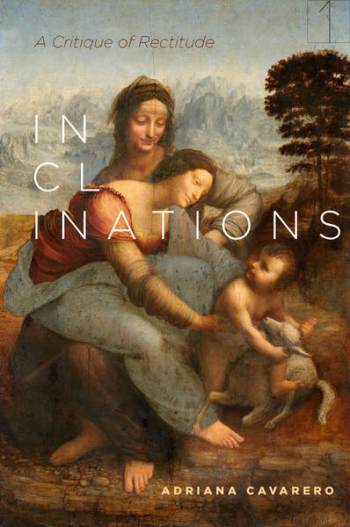 In this new and accessible book, Italy’s best known feminist philosopher examines the moral and political significance of vertical posture in order to rethink subjectivity in terms of inclination. Contesting the classical figure of homo erectus or ‘upright man’, Adriana Cavarero proposes an altruistic, open model of the subject—one who is inclined toward others. Contrasting the masculine upright with the feminine inclined, she references philosophical texts (by Plato, Thomas Hobbes, Immanuel Kant, Hannah Arendt, Elias Canetti, and others) as well as works of art (Barnett Newman, Leonardo da Vinci, Artemisia Gentileschi, and Alexander Rodchenko) and literature (Marcel Proust and Virginia Woolf).
Adriana Cavarero is Professor of Political Philosophy at the University of Verona. Her books in English include For More than One Voice (2005) and Horrorism (2008).
New Book | Making Magnificence
Scheduled for May release from Yale UP:
Christine Casey, Making Magnificence: Architects, Stuccatori, and the Eighteenth-Century Interior (New Haven: Yale University Press, 2017), 320 pages, ISBN: 978 03002 25778, $75.
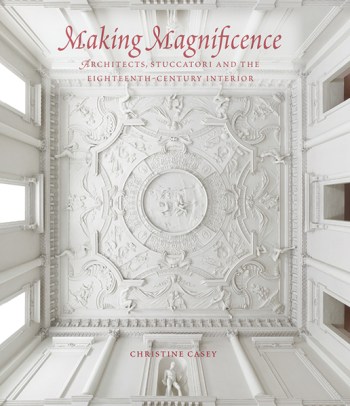 This book tells the remarkable story of the craftsmen of Ticino, in Italian-speaking Switzerland, who took their prodigious skills as specialist decorative plasterworkers throughout Northern Europe in the 18th century, adorning classical architecture with their rich and fluent décor. Their names are not widely known—Giuseppi Artari (c.1690–1771), Giovanni Battista Bagutti (1681–1755), and Francesco Vassalli (1701–1771) are a few—but their work transformed the interiors of magnificent buildings in Italy, Austria, Germany, the Netherlands, Britain, and Ireland. Among the interiors highlighted in this deeply researched, beautifully illustrated volume are Palazzo Reale in Turin, Upper Belvedere in Vienna, St. Martin in the Fields in London, the Radcliffe Camera in Oxford, Houghton Hall in Norfolk, and Carton House in Ireland.
Christine Casey is associate professor in architectural history, and the head of the Art Department, at Trinity College Dublin.
Exhibition | The First Jewish Americans
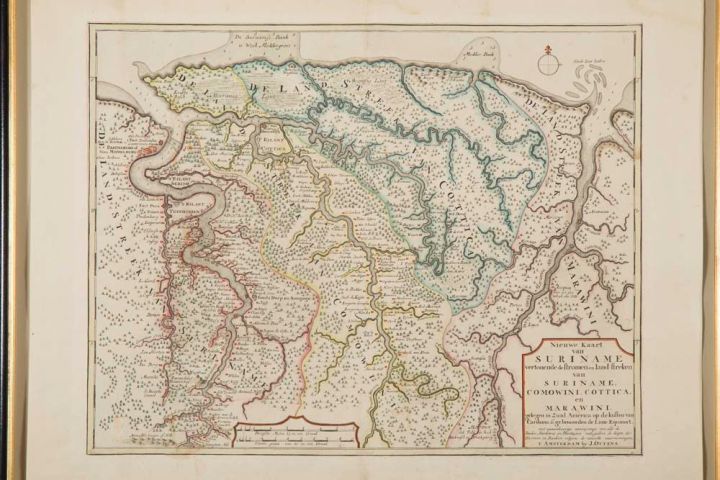
Suriname map, 1718. Nieuwe Kaart van Suriname vertonende de stromen en land-streken van Suriname, Comowini, Cottica, en Marawini; Amsterdam, 1718 (Collection of Leonard L. Milberg).
◊ ◊ ◊ ◊ ◊
Closing on Sunday at the New-York Historical Society (the exhibition was shown at Princeton in 2016 under the title By Dawn’s Early Light: Jewish Contributions to American Culture from the Nation’s Founding to the Civil War); from the press release:
The First Jewish Americans: Freedom and Culture in the New World
Princeton University Art Museum, 13 February — 12 June 2016
New-York Historical Society, 28 October 2016 — 12 March 2017
How did Jewish settlers come to inhabit—and change—the New World? Jews in colonial America and the young United States, while only a tiny fraction of the population, significantly negotiated the freedoms offered by the new nation and contributed to the flowering of American culture. The First Jewish Americans: Freedom and Culture in the New World follows the trajectory of a people forced from their ancestral lands in Europe, as well as their homes in South America and the Caribbean, to their controversial arrival in New Amsterdam in 1654 to the unprecedented political freedoms they gained in early 19th-century New York, Philadelphia, and Charleston. In this ground-breaking exhibition, rare portraits, drawings, maps, documents, and ritual objects illuminate how 18th- and 19th-century artists, writers, activists, and more adopted American ideals while struggling to remain distinct and socially cohesive amidst the birth of a new Jewish American tradition.

Gerardus Duyckinck I, Portrait of Jacob Franks (1688–1769), oil on canvas (Bentonville, Arkansas: Crystal Bridges Museum of American Art).
The exhibition explores the origins of the Jewish diaspora and paths to the New World, Jewish life in American port cities, and the birth of American Judaism in the 18th and early 19th centuries, as well as profile prominent Jewish Americans who made an impact on early American life.
European Jews fleeing persecution and seeking ports of refuge were propelled westward to the distant shores of New World colonies, which offered hope for a new beginning until the infamous Holy Inquisition followed them across the ocean. The exhibition powerfully illustrates this experience through the 1595 autobiography of Luis de Carvajal, a ‘converso’ Jew in Mexico and the nephew of a prominent governor, who was tried by the Inquisition and denounced more than 120 other secretly practicing Jews before he was burned at the stake in 1596. The recently rediscovered documents, which had gone missing from the National Archives of Mexico more than 75 years ago, will be on view at New-York Historical by special arrangement with the Mexican government before returning to Mexico.
The Jewish community in the New World dispersed throughout the colonies in the Caribbean, creating a network built on trade, family, and religious connections. Examples of these island communities and influences featured in the exhibition include a 1718 map of the Jewish settlement in Suriname, 18th-century texts of religious services for the circumcision of slaves, and Jamaican legal documents from 1823 that argued for Jewish voting rights.
During the colonial period, Jews clustered in the cosmopolitan and commercially minded port cities of New York, Philadelphia, and Charleston, and within each city, an elaborate communal infrastructure grew that supported all aspects of Jewish life. Shearith Israel, the first Jewish congregation in colonial North America, built its home in Lower Manhattan in 1730. The congregation has loaned significant objects to the exhibition, such as a Torah scroll that was burned by British soldiers during the Revolutionary War and a rare set of Torah bells (or rimonim) designed by Myer Myers—one of colonial America’s preeminent silversmiths and an active congregation member. Also on view are six oil paintings circa 1735 of the prominent Levy-Franks family of New York, also members of the congregation. On loan from the Crystal Bridges Museum of American Art, they emulate paintings of the British aristocracy.
The Philadelphia Jewish community grew during and after the Revolutionary War, with the city serving as a refuge for patriots fleeing British-occupied New York. Some Philadelphia Jews opposed Britain’s harsh restrictions on American trade by signing the Resolution of Non-Importation made by the Citizens of Philadelphia in 1765—one of the first official protests against British mercantile policy, which is on view in the exhibit. Also featured are portrait paintings of Philadelphia merchant Barnard Gratz, a signer of the resolution who supplied American militias; and of his niece Rebecca Gratz, who in 1819 established the Female Hebrew Benevolent Society, the first Jewish lay charity in the country.
In the first decades of the 19th century, Charleston was home to more Jews than any other place in North America and became a site of cultural and religious ferment. Congregation K.K. Beth Elohim—whose elegant synagogue is depicted in an 1838 oil painting on view—was the birthplace of the Reform movement in 1824, when a group of 47 members petitioned to make worship more accessible by introducing innovations that included prayers in English. The leadership refused, so the petitioners seceded and established the Reformed Society of Israelites for Promoting True Principles of Judaism According to Its Purity and Spirit. The exhibition features the group’s 1825 prayer book and speeches promoting their initially radical position, which soon became main stream. Also on view are earlier examples of revolutions in American Judaism, such as an English translation of a Hebrew prayer book from 1766, Samuel Johnson’s English and Hebrew Grammar book from 1771, and a lunar calendar of Jewish festivals and Sabbath observance from 1806.
The exhibition also features profiles of prominent Jewish Americans of the 18th and early 19th centuries, whose writing, activism, and artistic achievements provide a window into an era of cultural vitality and change in the new Republic. Among the highlighted figures are renown artist Camille Pissarro (1830–1903), a Caribbean Jew born in St. Thomas whose 1856 landscape paintings on view capture waterfront scenes of his island home; and Louis Moreau Gottschalk (1829–1860), a New Orleans-born piano prodigy and composer who became the first classically trained American pianist to achieve international fame. Science and medicine were remarkably open to Jewish men during the 19th century. On display are books written by Jewish Americans that made major contributions to American science and medicine as those fields were developing during this period. The exhibition concludes with views of newly flourishing cities, including Cincinnati, Los Angeles, and San Francisco that became home to American Jews as they ventured westward.
The exhibit is based primarily upon loans from the Princeton University Jewish American Collection, gift of Mr. Leonard L. Milberg, Class of 1953, and Mr. Leonard L. Milberg’s personal collection.
Adam Mendelsohn, By Dawn’s Early: Light Jewish Contributions to American Culture from the Nation’s Founding to the Civil War (Princeton: Princeton University Library, 2016), 352 pages, ISBN: 978 08781 10593.
Terrific installation photographs are available at Arts Summary.
New Book | Facing the Text: Extra-illustration
Distributed by Manchester University Press:
Lucy Peltz, Facing the Text: Extra-illustration, Print Culture, and Society in Britain, 1769–1840 (San Marino, Huntington Library Press, 2017), 424 pages, ISBN: 978 08732 82611, $150 / £115.
 During the eighteenth and nineteenth centuries, thousands of books were customized with prints and drawings in a practice called extra-illustration. These books were often massively extended, lavishly bound, and prized by their owners as objects of display, status, and exchange. The scale of these compilations as well their interdisciplinary nature—at once literary texts, printed books, art collections, and indexes of visual culture—have typically excluded them from histories of art and literature. In this book, Lucy Peltz maps a history of extra-illustration and its social and cultural meanings, providing a fascinating account of the practice itself and the often colourful personalities who engaged in it. The remarkable contents of key extra-illustrated books are explored, along with the broader historical and commercial contexts in which they were produced and enjoyed.
Lucy Peltz is Senior Curator of Eighteenth-Century Collections and Head of Collections Displays (Tudor to Regency) at the National Portrait Gallery, London.
◊ ◊ ◊ ◊ ◊
C O N T E N T S
Introduction: A Long History of Extra-Illustration
Part I: Getting Your Heads in Order: Engraved Portrait Collecting and the Origins of Extra-Illustration
1 ‘Of Collectors of English Portrait Prints’
2 Genteel Authorship, the Community of the Antiquarian Text, and the Invention of Extra-Illustration
3 Portraiture, Order, and Meaning
4 John, Lord Mountstuart and the Ends of the Bull Granger
Part II: From Domestic Retirement to a Commercial Marketplace: Amateurs, Antiquaries, and Entrepreneurs
5 ‘Retirement, Rural Quiet, Friendship, Books’: Amateurism and Its Trophies
6 Charting the Craze: Anthony Storer and Richard Bull
7 The Strawberry Hill Press and the Rituals of Bibliographic Exchange
8 Antiquarian Topography or Armchair Tourism: Thomas Pennant’s “Labors”
9 Popularizing Pennant’s London: How the Art World Sold Extra-Illustration
Part III: The Sutherland Clarendon: Gender, the Print Market, and National Heritage
10 ‘Buried under Its Own Grandeur’: Understanding the Sutherland Clarendon
12 The Cut and Thrust of the Print Market in the Early Nineteenth Century
13 Women, Widowhood, and Collecting: Charlotte Sutherland’s Inheritance
14 Monumentalizing the Sutherland Clarendon: Between Rhetoric and Content, 1820–1839
15 The Female Connoisseur and the Private Catalogue
16 A ‘National Work’ Completed: The Sutherland Clarendon and Cultural Heritage
Epilogue: Rethinking the Past, Securing the Future
Select Bibliography
Index
New Book | The Fabric of Creativity in the Dutch Republic, 1580–1800
Distributed by The University of Chicago Press:
Claartje Rasterhoff, The Fabric of Creativity in the Dutch Republic, 1580–1800 (Amsterdam: Amsterdam University Press, 2017), 352 pages, ISBN: 978 90896 47023, $149.
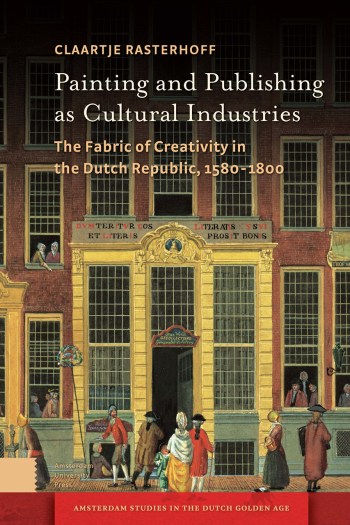 The Dutch Republic was a cultural powerhouse in the modern era, producing lasting masterpieces in painting and publishing—in the process transforming those fields from modest trades to booming industries. This book asks the question of how such a small nation could become such a major player in those fields. Claartje Rasterhoff shows how industrial organizations played a role in shaping patterns of growth and innovation—as early modern Dutch cultural industries were concentrated geographically, highly networked, and institutionally embedded, they were able to reduce uncertainty in the marketplace and stimulate the commercial and creative potential of painters and publishers—though those successes eventually came up against the limits of a saturated domestic market and an aversion to risk on the part of producers that ultimately brought an end to the boom.
Claartje Rasterhoff is a postdoctoral researcher and lecturer in arts and culture studies at Erasmus University, Rotterdam.
New Book | Merian, Metamorphosis insectorum Surinamensium
From Lannoo, with more information available here:
Maria Sibylla Merian, Metamorphosis insectorum Surinamensium Verandering der Surinaamsche insecten / Transformation of the Surinamese Insects, edited by Marieke van Delft (Tielt: Lannoo Publishers, 2017), 200 pages, ISBN: 978 94014 33785, $145 / €99.
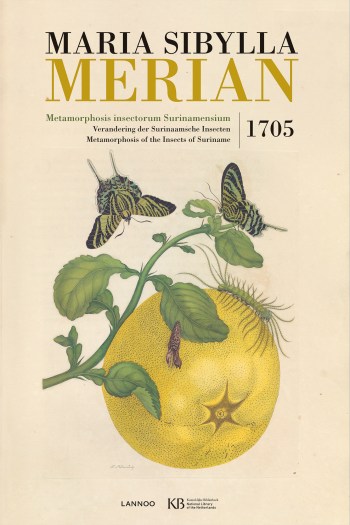 Maria Sibylla Merian (1647–1717) was a German naturalist and scientific illustrator. She is considered to be among the most significant contributors to the field of entomology because of her careful observations and documentation of the metamorphosis of the butterfly. In 1705, Merian published Metamorphosis Insectorum Surinamensium, for which she became famous. No more than 30 copies of this masterwork are left worldwide. In 2017, it will be 300 years since Maria Sibylla Merian’s death. To mark the occasion, a facsimile of Merian’s highly successful book will be released. Modern readers will at last be able to see with their own eyes how detailed and colourful Merian’s magnificent work was. The book includes a comprehensive introduction and background information by renowned historians and biologists.
Included is a foreword by Merian specialist Redmond O’Hanlon and a biographical introduction by art historian Ella Reitsman. Kay Etheridge, professor biology at Gettysburg College, discusses the meaning of Merian’s work for biology, and Bert van de Roemer talks about the historical context.
Marieke van Delft is Curator of Early Printed Collections at the Koninklijke Bibliotheek, National Library of the Netherlands, in The Hague. She studied history and book history at the universities of Amsterdam and Leiden and gained her doctorate in cultural studies at the KU Leuven. Van Delft has published on many aspects of the history of the printed book in the Netherlands. In collaboration with Uitgeverij Lannoo she has created real-size facsimile editions of major books from the collections of the Koninklijke Bibliotheek: Atlas De Wit (2012), Nozeman & Sepp, Nederlandsche vogelen (2014), and Merian’s Metamorphosis insectorum Surinamensium (2016).










 Enfilade
leave a comment