New Book | Inclinations: A Critique of Rectitude
The eighteenth century comes into the argument primarily only through Kant, but there might be wider implications: might the Rococo serve as a useful counter-example to the upright independence that Cavarero sees in Kant? –CH
Published in November by Stanford UP:
Adriana Cavarero, Inclinations: A Critique of Rectitude (Stanford: Stanford University Press, 2016), 208 pages, ISBN: 978 08047 92189 (cloth), $70 / ISBN: 978 15036 00409 (paperback), $20.
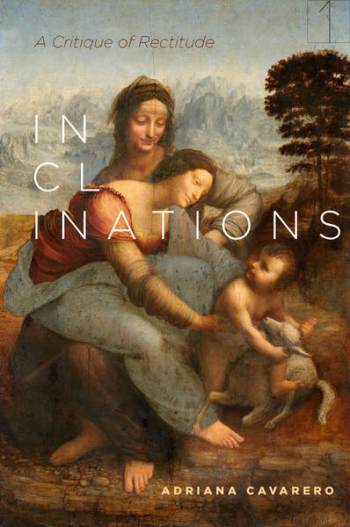 In this new and accessible book, Italy’s best known feminist philosopher examines the moral and political significance of vertical posture in order to rethink subjectivity in terms of inclination. Contesting the classical figure of homo erectus or ‘upright man’, Adriana Cavarero proposes an altruistic, open model of the subject—one who is inclined toward others. Contrasting the masculine upright with the feminine inclined, she references philosophical texts (by Plato, Thomas Hobbes, Immanuel Kant, Hannah Arendt, Elias Canetti, and others) as well as works of art (Barnett Newman, Leonardo da Vinci, Artemisia Gentileschi, and Alexander Rodchenko) and literature (Marcel Proust and Virginia Woolf).
Adriana Cavarero is Professor of Political Philosophy at the University of Verona. Her books in English include For More than One Voice (2005) and Horrorism (2008).
New Book | Making Magnificence
Scheduled for May release from Yale UP:
Christine Casey, Making Magnificence: Architects, Stuccatori, and the Eighteenth-Century Interior (New Haven: Yale University Press, 2017), 320 pages, ISBN: 978 03002 25778, $75.
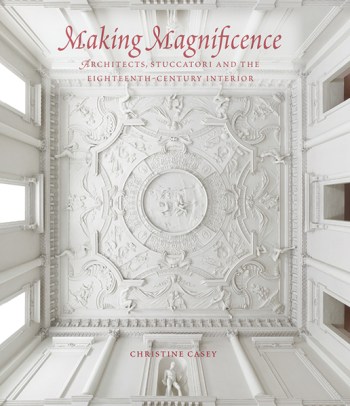 This book tells the remarkable story of the craftsmen of Ticino, in Italian-speaking Switzerland, who took their prodigious skills as specialist decorative plasterworkers throughout Northern Europe in the 18th century, adorning classical architecture with their rich and fluent décor. Their names are not widely known—Giuseppi Artari (c.1690–1771), Giovanni Battista Bagutti (1681–1755), and Francesco Vassalli (1701–1771) are a few—but their work transformed the interiors of magnificent buildings in Italy, Austria, Germany, the Netherlands, Britain, and Ireland. Among the interiors highlighted in this deeply researched, beautifully illustrated volume are Palazzo Reale in Turin, Upper Belvedere in Vienna, St. Martin in the Fields in London, the Radcliffe Camera in Oxford, Houghton Hall in Norfolk, and Carton House in Ireland.
Christine Casey is associate professor in architectural history, and the head of the Art Department, at Trinity College Dublin.
Exhibition | The First Jewish Americans
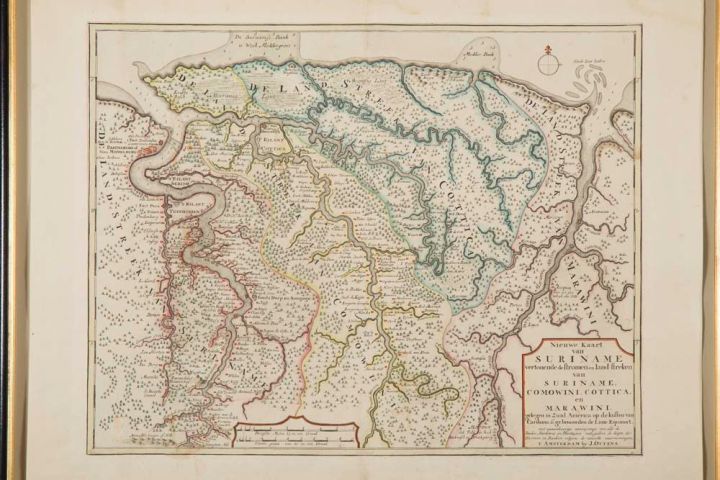
Suriname map, 1718. Nieuwe Kaart van Suriname vertonende de stromen en land-streken van Suriname, Comowini, Cottica, en Marawini; Amsterdam, 1718 (Collection of Leonard L. Milberg).
◊ ◊ ◊ ◊ ◊
Closing on Sunday at the New-York Historical Society (the exhibition was shown at Princeton in 2016 under the title By Dawn’s Early Light: Jewish Contributions to American Culture from the Nation’s Founding to the Civil War); from the press release:
The First Jewish Americans: Freedom and Culture in the New World
Princeton University Art Museum, 13 February — 12 June 2016
New-York Historical Society, 28 October 2016 — 12 March 2017
How did Jewish settlers come to inhabit—and change—the New World? Jews in colonial America and the young United States, while only a tiny fraction of the population, significantly negotiated the freedoms offered by the new nation and contributed to the flowering of American culture. The First Jewish Americans: Freedom and Culture in the New World follows the trajectory of a people forced from their ancestral lands in Europe, as well as their homes in South America and the Caribbean, to their controversial arrival in New Amsterdam in 1654 to the unprecedented political freedoms they gained in early 19th-century New York, Philadelphia, and Charleston. In this ground-breaking exhibition, rare portraits, drawings, maps, documents, and ritual objects illuminate how 18th- and 19th-century artists, writers, activists, and more adopted American ideals while struggling to remain distinct and socially cohesive amidst the birth of a new Jewish American tradition.

Gerardus Duyckinck I, Portrait of Jacob Franks (1688–1769), oil on canvas (Bentonville, Arkansas: Crystal Bridges Museum of American Art).
The exhibition explores the origins of the Jewish diaspora and paths to the New World, Jewish life in American port cities, and the birth of American Judaism in the 18th and early 19th centuries, as well as profile prominent Jewish Americans who made an impact on early American life.
European Jews fleeing persecution and seeking ports of refuge were propelled westward to the distant shores of New World colonies, which offered hope for a new beginning until the infamous Holy Inquisition followed them across the ocean. The exhibition powerfully illustrates this experience through the 1595 autobiography of Luis de Carvajal, a ‘converso’ Jew in Mexico and the nephew of a prominent governor, who was tried by the Inquisition and denounced more than 120 other secretly practicing Jews before he was burned at the stake in 1596. The recently rediscovered documents, which had gone missing from the National Archives of Mexico more than 75 years ago, will be on view at New-York Historical by special arrangement with the Mexican government before returning to Mexico.
The Jewish community in the New World dispersed throughout the colonies in the Caribbean, creating a network built on trade, family, and religious connections. Examples of these island communities and influences featured in the exhibition include a 1718 map of the Jewish settlement in Suriname, 18th-century texts of religious services for the circumcision of slaves, and Jamaican legal documents from 1823 that argued for Jewish voting rights.
During the colonial period, Jews clustered in the cosmopolitan and commercially minded port cities of New York, Philadelphia, and Charleston, and within each city, an elaborate communal infrastructure grew that supported all aspects of Jewish life. Shearith Israel, the first Jewish congregation in colonial North America, built its home in Lower Manhattan in 1730. The congregation has loaned significant objects to the exhibition, such as a Torah scroll that was burned by British soldiers during the Revolutionary War and a rare set of Torah bells (or rimonim) designed by Myer Myers—one of colonial America’s preeminent silversmiths and an active congregation member. Also on view are six oil paintings circa 1735 of the prominent Levy-Franks family of New York, also members of the congregation. On loan from the Crystal Bridges Museum of American Art, they emulate paintings of the British aristocracy.
The Philadelphia Jewish community grew during and after the Revolutionary War, with the city serving as a refuge for patriots fleeing British-occupied New York. Some Philadelphia Jews opposed Britain’s harsh restrictions on American trade by signing the Resolution of Non-Importation made by the Citizens of Philadelphia in 1765—one of the first official protests against British mercantile policy, which is on view in the exhibit. Also featured are portrait paintings of Philadelphia merchant Barnard Gratz, a signer of the resolution who supplied American militias; and of his niece Rebecca Gratz, who in 1819 established the Female Hebrew Benevolent Society, the first Jewish lay charity in the country.
In the first decades of the 19th century, Charleston was home to more Jews than any other place in North America and became a site of cultural and religious ferment. Congregation K.K. Beth Elohim—whose elegant synagogue is depicted in an 1838 oil painting on view—was the birthplace of the Reform movement in 1824, when a group of 47 members petitioned to make worship more accessible by introducing innovations that included prayers in English. The leadership refused, so the petitioners seceded and established the Reformed Society of Israelites for Promoting True Principles of Judaism According to Its Purity and Spirit. The exhibition features the group’s 1825 prayer book and speeches promoting their initially radical position, which soon became main stream. Also on view are earlier examples of revolutions in American Judaism, such as an English translation of a Hebrew prayer book from 1766, Samuel Johnson’s English and Hebrew Grammar book from 1771, and a lunar calendar of Jewish festivals and Sabbath observance from 1806.
The exhibition also features profiles of prominent Jewish Americans of the 18th and early 19th centuries, whose writing, activism, and artistic achievements provide a window into an era of cultural vitality and change in the new Republic. Among the highlighted figures are renown artist Camille Pissarro (1830–1903), a Caribbean Jew born in St. Thomas whose 1856 landscape paintings on view capture waterfront scenes of his island home; and Louis Moreau Gottschalk (1829–1860), a New Orleans-born piano prodigy and composer who became the first classically trained American pianist to achieve international fame. Science and medicine were remarkably open to Jewish men during the 19th century. On display are books written by Jewish Americans that made major contributions to American science and medicine as those fields were developing during this period. The exhibition concludes with views of newly flourishing cities, including Cincinnati, Los Angeles, and San Francisco that became home to American Jews as they ventured westward.
The exhibit is based primarily upon loans from the Princeton University Jewish American Collection, gift of Mr. Leonard L. Milberg, Class of 1953, and Mr. Leonard L. Milberg’s personal collection.
Adam Mendelsohn, By Dawn’s Early: Light Jewish Contributions to American Culture from the Nation’s Founding to the Civil War (Princeton: Princeton University Library, 2016), 352 pages, ISBN: 978 08781 10593.
Terrific installation photographs are available at Arts Summary.
New Book | Facing the Text: Extra-illustration
Distributed by Manchester University Press:
Lucy Peltz, Facing the Text: Extra-illustration, Print Culture, and Society in Britain, 1769–1840 (San Marino, Huntington Library Press, 2017), 424 pages, ISBN: 978 08732 82611, $150 / £115.
 During the eighteenth and nineteenth centuries, thousands of books were customized with prints and drawings in a practice called extra-illustration. These books were often massively extended, lavishly bound, and prized by their owners as objects of display, status, and exchange. The scale of these compilations as well their interdisciplinary nature—at once literary texts, printed books, art collections, and indexes of visual culture—have typically excluded them from histories of art and literature. In this book, Lucy Peltz maps a history of extra-illustration and its social and cultural meanings, providing a fascinating account of the practice itself and the often colourful personalities who engaged in it. The remarkable contents of key extra-illustrated books are explored, along with the broader historical and commercial contexts in which they were produced and enjoyed.
Lucy Peltz is Senior Curator of Eighteenth-Century Collections and Head of Collections Displays (Tudor to Regency) at the National Portrait Gallery, London.
◊ ◊ ◊ ◊ ◊
C O N T E N T S
Introduction: A Long History of Extra-Illustration
Part I: Getting Your Heads in Order: Engraved Portrait Collecting and the Origins of Extra-Illustration
1 ‘Of Collectors of English Portrait Prints’
2 Genteel Authorship, the Community of the Antiquarian Text, and the Invention of Extra-Illustration
3 Portraiture, Order, and Meaning
4 John, Lord Mountstuart and the Ends of the Bull Granger
Part II: From Domestic Retirement to a Commercial Marketplace: Amateurs, Antiquaries, and Entrepreneurs
5 ‘Retirement, Rural Quiet, Friendship, Books’: Amateurism and Its Trophies
6 Charting the Craze: Anthony Storer and Richard Bull
7 The Strawberry Hill Press and the Rituals of Bibliographic Exchange
8 Antiquarian Topography or Armchair Tourism: Thomas Pennant’s “Labors”
9 Popularizing Pennant’s London: How the Art World Sold Extra-Illustration
Part III: The Sutherland Clarendon: Gender, the Print Market, and National Heritage
10 ‘Buried under Its Own Grandeur’: Understanding the Sutherland Clarendon
12 The Cut and Thrust of the Print Market in the Early Nineteenth Century
13 Women, Widowhood, and Collecting: Charlotte Sutherland’s Inheritance
14 Monumentalizing the Sutherland Clarendon: Between Rhetoric and Content, 1820–1839
15 The Female Connoisseur and the Private Catalogue
16 A ‘National Work’ Completed: The Sutherland Clarendon and Cultural Heritage
Epilogue: Rethinking the Past, Securing the Future
Select Bibliography
Index
New Book | The Fabric of Creativity in the Dutch Republic, 1580–1800
Distributed by The University of Chicago Press:
Claartje Rasterhoff, The Fabric of Creativity in the Dutch Republic, 1580–1800 (Amsterdam: Amsterdam University Press, 2017), 352 pages, ISBN: 978 90896 47023, $149.
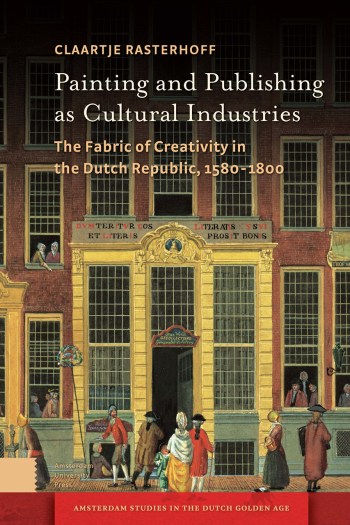 The Dutch Republic was a cultural powerhouse in the modern era, producing lasting masterpieces in painting and publishing—in the process transforming those fields from modest trades to booming industries. This book asks the question of how such a small nation could become such a major player in those fields. Claartje Rasterhoff shows how industrial organizations played a role in shaping patterns of growth and innovation—as early modern Dutch cultural industries were concentrated geographically, highly networked, and institutionally embedded, they were able to reduce uncertainty in the marketplace and stimulate the commercial and creative potential of painters and publishers—though those successes eventually came up against the limits of a saturated domestic market and an aversion to risk on the part of producers that ultimately brought an end to the boom.
Claartje Rasterhoff is a postdoctoral researcher and lecturer in arts and culture studies at Erasmus University, Rotterdam.
New Book | Merian, Metamorphosis insectorum Surinamensium
From Lannoo, with more information available here:
Maria Sibylla Merian, Metamorphosis insectorum Surinamensium Verandering der Surinaamsche insecten / Transformation of the Surinamese Insects, edited by Marieke van Delft (Tielt: Lannoo Publishers, 2017), 200 pages, ISBN: 978 94014 33785, $145 / €99.
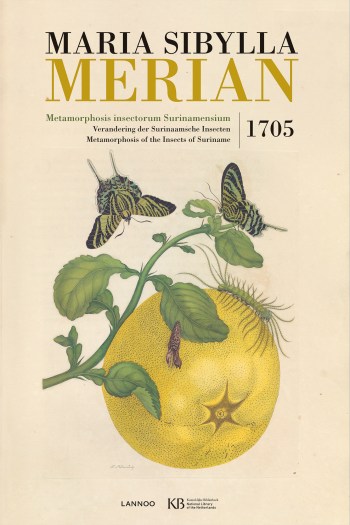 Maria Sibylla Merian (1647–1717) was a German naturalist and scientific illustrator. She is considered to be among the most significant contributors to the field of entomology because of her careful observations and documentation of the metamorphosis of the butterfly. In 1705, Merian published Metamorphosis Insectorum Surinamensium, for which she became famous. No more than 30 copies of this masterwork are left worldwide. In 2017, it will be 300 years since Maria Sibylla Merian’s death. To mark the occasion, a facsimile of Merian’s highly successful book will be released. Modern readers will at last be able to see with their own eyes how detailed and colourful Merian’s magnificent work was. The book includes a comprehensive introduction and background information by renowned historians and biologists.
Included is a foreword by Merian specialist Redmond O’Hanlon and a biographical introduction by art historian Ella Reitsman. Kay Etheridge, professor biology at Gettysburg College, discusses the meaning of Merian’s work for biology, and Bert van de Roemer talks about the historical context.
Marieke van Delft is Curator of Early Printed Collections at the Koninklijke Bibliotheek, National Library of the Netherlands, in The Hague. She studied history and book history at the universities of Amsterdam and Leiden and gained her doctorate in cultural studies at the KU Leuven. Van Delft has published on many aspects of the history of the printed book in the Netherlands. In collaboration with Uitgeverij Lannoo she has created real-size facsimile editions of major books from the collections of the Koninklijke Bibliotheek: Atlas De Wit (2012), Nozeman & Sepp, Nederlandsche vogelen (2014), and Merian’s Metamorphosis insectorum Surinamensium (2016).
New Book | The Botany of Empire in the Long Eighteenth Century
From Harvard UP:
Yota Batsaki, Sarah Burke Cahalan, and Anatole Tchikine, eds., The Botany of Empire in the Long Eighteenth Century, Dumbarton Oaks Symposia and Colloquia (Cambridge: Harvard University Press, 2017), 406 pages, ISBN: 978 08840 24163, $90 / £67 / €81.
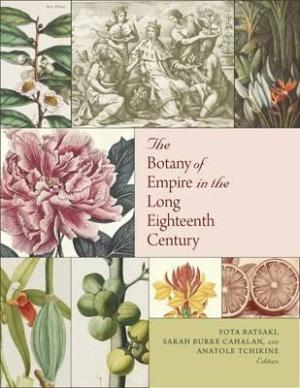 This book brings together an international body of scholars working on eighteenth-century botany within the context of imperial expansion. The eighteenth century saw widespread exploration, a tremendous increase in the traffic in botanical specimens, taxonomic breakthroughs, and horticultural experimentation. The contributors to this volume compare the impact of new developments and discoveries across several regions, broadening the geographical scope of their inquiries to encompass imperial powers that did not have overseas colonial possessions—such as the Russian, Ottoman, and Qing empires and the Tokugawa shogunate—as well as politically borderline regions such as South Africa, Yemen, and New Zealand. Essays examine the botanical ambitions of eighteenth-century empires; the figure of the botanical explorer; the links between imperial ambition and the impulse to survey, map, and collect botanical specimens in ‘new’ territories; and the relationships among botanical knowledge, self-representation, and material culture.
Yota Batsaki is Executive Director of Dumbarton Oaks.
Sarah Burke Cahalan is Director of the Marian Library, University of Dayton.
Anatole Tchikine is Assistant Director of Garden and Landscape Studies, Dumbarton Oaks.
New Book | Gardens of Court and Country: English Design, 1630–1730
From Yale UP:
David Jacques, Gardens of Court and Country: English Design, 1630–1730 (London: Paul Mellon Centre for Studies in British Art, 2017), 416 pages, ISBN: 978 0300 222012, £45 / $75.
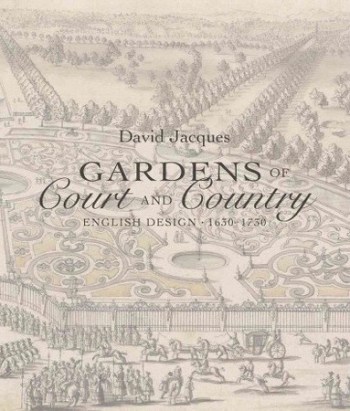 Gardens of Court and Country provides the first comprehensive overview of the development of the English formal garden from 1630 to 1730. Often overshadowed by the English landscape garden that became fashionable later in the 18th century, English formal gardens of the 17th century displayed important design innovations that reflected a broad rethinking of how gardens functioned within society. With insights into how the Protestant nobility planned and used their formal gardens, the domestication of the lawn, and the transformation of gardens into large rustic parks, David Jacques explores the ways forecourts, flower gardens, bowling greens, cascades, and more were created and reimagined over time. This handsome volume includes 300 illustrations—including plans, engravings, and paintings—that bring lost and forgotten gardens back to life.
David Jacques is an independent scholar and a consultant in historic landscapes, parks, and gardens.
Exhibition | Volcanoes

Sir William Hamilton’s volcano archive includes paintings he commissioned (Oxford: Bodleian).
◊ ◊ ◊ ◊ ◊
From the press release (16 January 2017) for the exhibition:
Volcanoes
Weston Library, Bodleian, Oxford, 10 February 2017 — 21 May 2017
Curated by David Pyle
A new exhibition at the Bodleian Libraries uses a spectacular selection of eye witness accounts, scientific observations, and artwork to chart how our understanding of volcanoes has evolved over the past two millennia. The exhibition examines some of the world’s most spectacular volcanoes including the 79 AD eruption of Vesuvius—one of the most catastrophic eruptions in European history—and the 19th-century eruptions of Krakatoa and Santorini, two of the first volcanic eruptions to be intensely studied by modern scientists.
Today, satellites monitor volcanic activity and anyone with internet access can watch volcanic eruptions live in real time. In the past, volcanic eruptions were described in letters, manuscript accounts, and early printed books and illustrated through sketches, woodcuts, and engravings. Many of these fascinating accounts are preserved in the Bodleian’s historic collections and will be on display in Volcanoes at the Weston Library.
The human encounters with volcanoes that are traced in the exhibition range from Pliny the Younger’s account of the dramatic eruption of Vesuvius in 79 CE to early Renaissance explorers who reported strange sightings of mountains that spewed fire and stones. Also explored is how scientific understanding of volcanoes and the Earth’s interior have developed over time, from classical mythology and early concepts of subterranean fires to the emergence of modern volcano science, or volcanology, in the 19th century. The exhibition brings together science and society, art, and history and will delight visitors of all ages.
 The exhibition is curated by David M. Pyle, Professor of Earth Sciences at the University of Oxford, whose research uses historical sources to improve our knowledge of past volcanic activity and to shed light on what might happen in the future at young or active volcanoes. It will feature treasures from the Bodleian Libraries, some of which have never been on public display before. In addition, the exhibition will feature items on loan from the Natural History Museum in London and from the University of Oxford’s Museum of Natural History, the Museum of the History of Science, and Magdalen College. Highlights of Volcanoes include:
• Fragments of ‘burnt’ papyrus scrolls from the ancient Roman town of Herculaneum, which were buried during the 79 AD eruption of Vesuvius
• The earliest known manuscript illustration of a volcano, found in the margin of a 14th-century account of the voyage of St Brendan, an Irish monk who travelled across the north Atlantic in the 6th century
• A stunning illustration of the Earth’s subterranean fires from Athanasius Kircher’s Mundus Subterraneus, an influential 17th-century work which proposed that volcanoes were created where the Earth’s internal fires escaped at the surface
• Spectacular 18th-century studies of Vesuvius by Scottish diplomat and early volcanologist William Hamilton who wrote one of the first descriptive monographs of an active volcano
• 18th- and 19th-century weather diaries and paintings that capture the distant effects and freak weather conditions caused by major volcanic eruptions in Iceland and Indonesia
• ‘Infographics’ from 19th-century natural historians Alexander von Humboldt and Charles Daubeny whose work has contributed greatly to our current understanding of volcanoes
• Lava and rock samples, maps, lecture notes, and scientific equipment from 19th-century volcanologists and explorers
The exhibition curator David Pyle said: “Humans have lived with volcanoes for millions of years yet scientists are still grappling with questions about how they work. This exhibition features historical representations and ideas about volcanoes that are captivating and dramatic but most importantly these works provide scientists today with valuable insights into how these enigmatic phenomena behave. Looking back at history can help us learn valuable lessons about how best to reduce the effects of future volcanic disasters.”
Richard Ovenden, Bodley’s Librarian said: “Volcanoes are one of the most extraordinary marvels of the natural world and have fascinated us for millennia. This exhibition draws on both the rich collections held at the Bodleian and cutting edge scientific research to demonstrate the power and fascination of volcanoes through time.”
David Pyle, Volcanoes (Oxford Bodleian Libraries, 2017), 224 pages, ISBN: ISBN: 978 18512 44591, £20.
New Book | Why Preservation Matters
Released in October from Yale UP:
Max Page, Why Preservation Matters (New Haven: Yale University Press, 2016), 224 pages, ISBN: 978 03002 18589, $25.
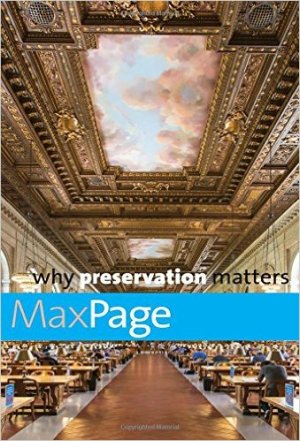 Commemorating the fiftieth anniversary of the National Historic Preservation Act, a critique of the preservation movement—and a bold vision for its future
Every day, millions of people enter old buildings, pass monuments, and gaze at landscapes unaware that these acts are possible only thanks to the preservation movement. As we approach the October 2016 anniversary of the United States National Historic Preservation Act, historian Max Page offers a thoughtful assessment of the movement’s past and charts a path toward a more progressive future.
Page argues that if preservation is to play a central role in building more-just communities, it must transform itself to stand against gentrification, work more closely with the environmental sustainability movement, and challenge societies to confront their pasts. Touching on the history of the preservation movement in the United States and ranging the world, Page searches for inspiration on how to rejuvenate historic preservation for the next fifty years. This illuminating work will be widely read by urban planners, historians, and anyone with a stake in the past.
Max Page is a professor of architecture and history at the University of Massachusetts Amherst, author of The City’s End: Two Centuries of Fantasies, Fears, and Premonitions of New York’s Destruction, and winner of the Spiro Kostof Award from the Society of Architectural Historians, a Guggenheim Fellowship and the Rome Prize. He lives in Amherst, MA.










 Enfilade
leave a comment