New Book | The Sovereign Artist: Charles Le Brun
From Paul Holberton:
Wolf Burchard, The Sovereign Artist: Charles Le Brun and the Image of Louis XIV (London: Paul Holberton Publishing, 2017), 288 pages, ISBN: 978 19113 00052, £40.
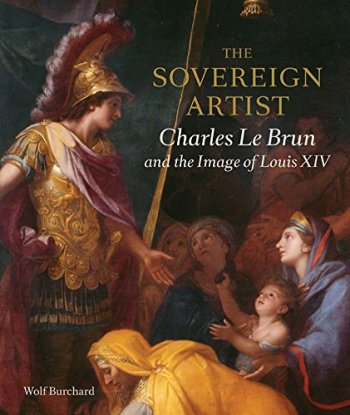 The first monograph to examine the wide artistic production of Louis XIV’s most prolific and powerful artist, Charles Le Brun (1619–1690), illustrating not only his paintings but the magnificence of the interiors and decorative works of art produced according to his designs. Revealing Le Brun’s extraordinary versatility and exploring his work at the Academy, the Gobelins and Savonnerie manufactories, and the royal building sites of the Louvre and Versailles, it is also the first book to explore in depth his artistic relationship to the Sun King.
In his joint capacities of Premier peintre du roi, director of the Gobelins manufactory and rector of the Académie royale de peinture et de sculpture, Le Brun exercised a previously unprecedented influence on the production of the visual arts—so much so that some scholars have repeatedly described him as ‘dictator’ of the arts in France. The Sovereign Artist explores how Le Brun operated in his diverse fields of activities, linking and juxtaposing his portraiture, history painting and pictorial theory with his designs for architecture, tapestries, carpets and furniture. It argues that Le Brun sought to create a repeatable and easily recognizable visual language associated with Louis XIV, in order to translate the king’s political claims for absolute power into a visual form. How he did this is discussed through a series of individual case studies ranging from Le Brun’s lost equestrian portrait of Louis XIV, and his involvement in the Querelle du coloris at the Académie, to his scheme for 93 Savonnerie carpets for the Grande Galerie at the Louvre, his Histoire du roy tapestry series, his decoration of the now destroyed Escalier des Ambassadeurs at Versailles.
One key theme is the relation between the unity of the visual arts, to which Le Brun aspired, and the strong hierarchical distinctions he made between the liberal arts and the mechanical crafts: while his lectures at the Académie advocated a visual and conceptual unity in painting and architecture, they were also a means by which he attempted to secure the newly gained status of painting as a liberal art, and therefore to distinguish it from the mechanical crafts which he oversaw the production of at the Gobelins manufactories. His artistic and architectural aspirations were comparable to those of his Roman contemporary Gianlorenzo Bernini, summoned to Paris in 1665 to design the Louvre’s East façade and to create a portrait bust of Louis XIV. Bernini’s failure to convince the king and Colbert of his architectural scheme offered new opportunities for Le Brun and his French contemporaries to prove themselves capable of solving the architectural problems of the Louvre and to transform it into a palace appropriate “to the grandeur and the magnificence of the prince who [was] to inhabit it” (Jean-Baptiste Colbert to Nicolas Poussin in 1664). The comparison between Le Brun and Bernini, made in the book, not only illustrates how France sought artistic supremacy over Italy during the second half of the 17th century, but further helps to demonstrate how Le Brun himself wanted to be perceived: beyond acting as a translator of the king’s artistic ambition, the artist appears to have sought his own sovereign authority over the visual arts.
Wolf Burchard is an art and architectural historian. He is the National Trust’s Furniture Research Curator and was formerly Curatorial Assistant at the Royal Collection Trust.
New Book | After the Fire: London Churches
From Pimpernel Press:
Angelo Hornak, After the Fire: London Churches in the Age of Wren, Hooke, Hawksmoor, and Gibbs (London: Pimpernel Press, 2016), 384 pages, ISBN: 978 191025 8088384, £50.
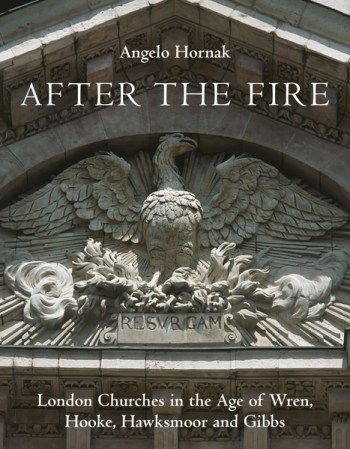 “London was but is no more!” In these words diarist John Evelyn summed up the destruction wrought by the Great Fire that swept through the City of London in 1666. The losses included St Paul’s Cathedral and eight-seven parish churches, as well as at least thirteen thousand houses.
In After the Fire, celebrated photographer and architectural historian Angelo Hornak explores, with the help of his own stunning photographs, the churches built in London during the sixty years that followed the Great Fire, as London rose from the ashes, more beautiful—and far more spectacular—than ever before. The catastrophe offered a unique opportunity to Christopher Wren and his colleagues—including Robert Hooke and Nicholas Hawksmoor—who, over the next forty years, rebuilt St Paul’s and fifty-one other London churches in a dramatic new style inspired by the European Baroque.
Forty-five years after the Fire, the Fifty New Churches Act of 1711 gave Nicholas Hawksmoor the scope to build breathtaking (and controversial) new churches including St Anne’s Limehouse, Christ Church Spitalfields and St George’s Bloomsbury. By the 1720s the pendulum was swinging away from the Baroque of Wren and Hawksmoor, and it was James Gibbs’ more restrained St Martin-in the-Fields that was to provide the prototype for churches throughout the English-speaking world—especially in North America—for the next hundred years.
Angelo Hornak is the author of Balloon over Britain (1991) and London from the Thames (1999) and has provided the photographs for many books, including histories of St Paul’s Cathedral and Westminster Abbey and the cathedrals of Canterbury, Winchester, Wells, Exeter, and Ely. He lives in London and Norfolk.
Exhibition | Canaletto and the Art of Venice
Press release (14 December 2016) from the Royal Collection Trust:
Canaletto and the Art of Venice
The Queen’s Gallery, Buckingham Palace, London, 19 May — 12 November 2017
The Queen’s Gallery, Palace of Holyroodhouse, Edinburgh, 11 May — 21 October 2018
National Gallery of Ireland, Dublin, 5 December 2018 — 24 March 2019
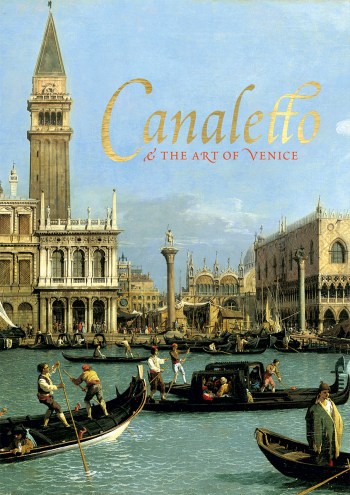 In 1762 the young monarch George III purchased virtually the entire collection of Joseph Smith, the greatest patron of art in Venice at the time. Thanks to this single acquisition, the Royal Collection contains one of the finest groups of 18th-century Venetian art in the world, including the largest collection of works by Giovanni Antonio Canal, better known as Canaletto.
Through over 200 paintings, drawings, and prints from the Royal Collection’s exceptional holdings, Canaletto and the Art of Venice presents the work of Venice’s most famous view-painter alongside that of his contemporaries, including Sebastiano and Marco Ricci, Rosalba Carriera, Francesco Zuccarelli, Giovanni Battista Piazzetta, and Pietro Longhi and explores how they captured the essence and allure of Venice for their 18th-century audience, as they still do today.
Joseph Smith (c.1674−1770) was an English merchant and later British Consul in Venice, a post dealing with Britain’s maritime, commercial, and trading interests. He had moved to Italy in around 1700 and over several decades built up an outstanding art collection, acting as both patron and dealer to many contemporary Venetian artists. Smith was Canaletto’s principal agent, selling his paintings to the wealthy Grand Tourists who were drawn to Venice’s cultural attractions. His palazzo on the Grand Canal became a meeting place for collectors, patrons, scholars, and tourists, where visitors could admire his vast collection and commission their own versions of Canaletto’s views to take home.
One of the most important of Smith’s commissions from Canaletto was the series of 12 paintings of the Grand Canal, which together create a near complete journey down the waterway. Canaletto’s sharp-eyed precision makes these views seem powerfully real; yet he rearranged and altered elements of each composition to create ideal impressions of the city. Two larger paintings are of festivals, including the ‘Sposalizio del Mar’, or ‘Wedding of the Sea’, which took place on Ascension Day and attracted crowds of British visitors. The Grand Canal was a subject frequently captured by Canaletto, including in a series of six drawings, among them Venice: The central stretch of the Grand Canal, c.1734. Intended as works of art in their own right, rather than as preparatory studies for paintings, the drawings are carefully constructed and rich in tone and detail.
Alongside the grand public entertainments, Venice boasted a thriving opera and theatre scene, especially during carnival season. The need to create stage sets within a very short period of time provided plentiful employment for Venetian artists. Both Marco Ricci and Canaletto worked for the theatre, where they learned how to manipulate perspective to heighten drama. The exhibition includes several of Ricci’s designs for the Venetian stage, such as A room with a balcony supported by Atlantes, c.1726. Marco Ricci also produced caricatures of opera singers, such as the drawing of the internationally famed castrato Farinelli, which were circulated among Joseph Smith and his fellow Venetian collectors and opera aficionados.
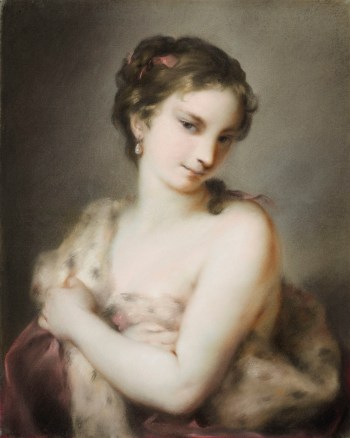
Rosalba Giovanna Carriera, A Personification of Winter, ca. 1726, pastel on paper (London: Royal Collection Trust, 400647).
On display together for the first time are personifications of the Four Seasons by Rosalba Carriera, whose pastels were highly prized by European collectors. They were intended to be hung in private domestic spaces, such as dressing rooms, bedrooms, or small antechambers. Carriera was one of the first artists to develop a commercial relationship with Joseph Smith, and her sensual pastel of Winter, c.1726, an allegorical female figure wrapped in furs, was one of the most admired works in Smith’s collection.
Canaletto, Marco Ricci, and Francesco Zuccarelli all contributed to the development of the genre known as the capriccio—scenes combining real and imaginary architecture, often set in an invented landscape, to create poetically evocative works. Ruins of ancient Rome in both Ricci’s Caprice View with Roman Ruins, c.1729, and Zuccarelli’s pastoral Landscape with Classical Ruins, Cattle and Figures, c.1741–42, convey a sense of the irrevocable loss of a great age.
There was a major revival in printmaking in Venice in the 18th century, with many publishers recruiting established artists, such as Giovanni Battista Piazzetta and Antonio Visentini, to provide designs for their publications. Joseph Smith was an enthusiastic print collector and one of the major supporters of contemporary printmaking in Venice. Smith financed and directed the Pasquali press, which contributed to the circulation of Enlightenment ideas, such as those of Isaac Newton, and imported banned foreign texts into Venice, including the work of Voltaire. Visentini was the chief draughtsman for the press, providing many hundreds of pen and ink drawings of initials and tailpieces, several of which will be on display in the exhibition.
The catalogue is distributed by The University of Chicago Press:
Lucy Whitaker and Rosie Razzall, Canaletto and the Art of Venice (London: Royal Collection Trust, 2017), 320 pages, ISBN: 978 190974 1409, $60.
Note (added 22 November 2018) — The posting was updated to include dates for Edinburgh and Dublin.
Exhibition | La Serenissima: Celebrating Venice
From the press release for the exhibition:
Sérénissime! Venise en fête, de Tiepolo à Guardi
La Serenissima: Celebrating Venice, from Tiepelo to Guardi
Musée Cognacq-Jay, Paris, 25 February — 25 June 2017
Curated by Rose-Marie Herda-Mousseaux and Benjamin Couilleaux
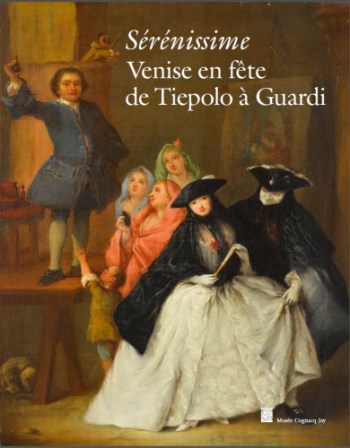 In the eighteenth century, the political and economic stability of the Serenissima Repubblica di Venezia gave rise to the last golden age of Venice, which would end with the Napoleonic conquest of 1797. This last chapter of a millenary history was marked by an unprecedented deployment of public and private events. Festivities, celebrations, regattas, and other spectacles set the tempo of city life and attracted the curious from all over Europe. Much more than simple amusements, these festivities were part of a political and religious pageant designed to promote Venice. Immortalized by some of the great names in painting—Tiepolo, Guardi, Longhi—they created a lasting impression and made known the charms of the City of the Doges throughout Europe. Over forty paintings, engravings, and drawings from prestigious French and European collections are presented to the public, bringing to life once again, for the duration of the exhibition, the opulence of the Most Serene Republic of Venice in the Age of Enlightenment.
The exhibition layout focuses on four themes related to Venetian celebrations:
Festivities Large and Small
Dance and music were highly esteemed by Venetian society, among both the aristocracy and the people.
From City to Stage
In the eighteenth century, the commedia dell’arte achieved unprecedented popularity, in particular with playwright Carlo Goldoni. Opera also benefited from majestic settings, the most famous of which is still La Fenice.
Power as Spectacle
Both secular and sacred institutions in the Most Serene Republic encouraged the crowds to attend major festivities that crystallized the image of Venice as a powerful and sumptuous city. Receptions for foreign princes, notably French, also provided an opportunity to organize extraordinary celebrations on Piazza San Marco or the Grand Canal.
At the Carnival
What would Venice be without its carnival? Dating from the Middle Ages, this colorful masked festival brought together an eighteenth-century cosmopolitan crowd that loved the open-air fairground attractions as much as it did the more discreet amusements of the Ridotto, the ancestor of the casino.
Rose-Marie Herda-Mousseaux and Benjamin Couilleaux, Sérénissime: Venise en fête, de Tiepolo à Guardi (Paris: Editions Paris Musées, 2017), 176 pages, ISBN: 978 27596 03428, 30€.
Exhibition | Gilded Interiors: French Masterpieces of Gilt Bronze

Jean-Baptiste Lepaute, Mantel clock, detail, 1781
(London: The Wallace Collection)
◊ ◊ ◊ ◊ ◊
From the press release for the exhibition:
Gilded Interiors: French Masterpieces of Gilt Bronze
The Wallace Collection, London, 4 May — 30 July 2017
Curated by Helen Jacobsen
Often designed by leading architects and modeled by important sculptors, gilt bronze was used to create beautiful yet functional objects such as clocks, candelabras, and firedogs and to decorate and embellish highly refined furniture and porcelain. This exhibition showcases luxurious artworks commissioned and owned by the wealthiest patrons and collectors, including leading figures of pre-revolutionary France like Marie-Antoinette, the duc d’Aumont, and the comte d’Artois as well international patrons such as the Prince of Wales (later George IV). Artists such as Pierre Gouthière, François Rémond, and Claude Pition, who ran the finest chasing and gilding workshops, created beautiful works, equal in expense and craftsmanship to some of the greatest paintings and sculpture of the period.
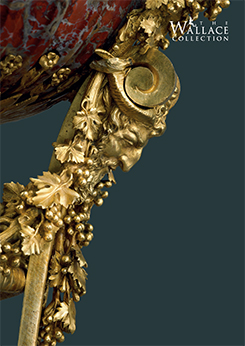 Largely drawn from The Wallace Collection, home to one of the world’s most important collections of French eighteenth-century gilt bronze, these exceptional objects include the exquisite perfume burner by Gouthière once owned by Marie-Antoinette and a pair of candlesticks made for the French Queen to celebrate the birth of her son. The Wallace Collection works will be shown alongside loans from other world-class collections including drawings from the Bibliothèque Municipale in Besançon.
The exhibition will feature drawings by Pierre-Adrien Pâris, one of the foremost architects and interior designers of the period. His highly-detailed works, never before seen in the UK, illustrate how buildings from ancient Rome were used as a fertile source of design for gilt-bronze masterpieces and reveal how the antique world provided artists with contemporary ideas for architecture and decorative art. Architects and designers who travelled to Rome took inspiration from the classical ruins with which they were surrounded and their drawings of architecture and Antique monuments provided the basis for some of the greatest gilt-bronze works ever created.
Gilded Interiors: French Masterpieces of Gilt Bronze will be an opportunity for visitors to engage more fully with these magnificent works, which will be given centre stage in the special exhibition galleries. Well-lit and with the works fully visible ‘in the round’, the exhibition will enable the viewer to experience these works of art in a different way, allowing the exquisite beauty and technical accomplishments of these pieces to be properly admired and enjoyed.
◊ ◊ ◊ ◊ ◊
From I. B. Tauris:
Helen Jacobsen, Gilded Interiors: Parisian Luxury and the Influence of Rome, 1770–1790 (London: Philip Wilson, 2017), 112 pages, ISBN: 978 178130 0589, £20 / $30.
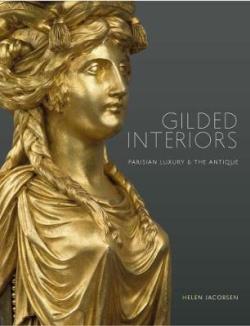 The Wallace Collection has an internationally-renowned collection of French eighteenth-century art but perhaps lesser known today is their stunning collection of gilt-bronze objects. These bronzes d’ameublement—from clocks and mounted Sevres porcelain to wall lights and candelabra—epitomise the levels of luxury achieved in Parisian interiors. Highly expensive and expertly wrought, they illustrate the heights of skilled craftsmanship achieved by French bronze workers in the eighteenth century as well as showcasing the wealth and connoisseurship of their owners. Lavishly illustrated with new photography, this publication will be a book of ‘highlights’ to include the very best of what the Wallace Collection has to offer in this field.
Helen Jacobsen is senior curator and curator of French eighteenth-century decorative arts at the Wallace Collection.
Exhibition | Poussin to David: French Drawings at the Albertina

Jacques-Louis David, The Combat of Diomedes, 1776
(Vienna: Albertina)
◊ ◊ ◊ ◊ ◊
Now on view at the Albertina:
Poussin to David: French Drawings at the Albertina
Poussin bis David: Französische Zeichnungen der Albertina
Albertina, Vienna, 25 January — 25 April 2017
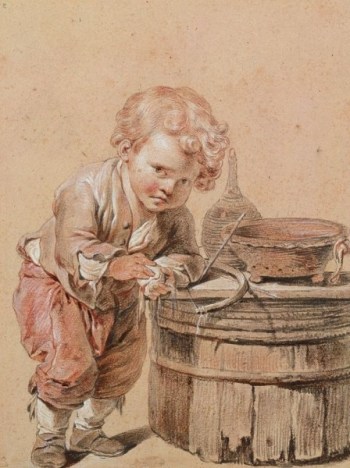
Jean-Baptiste Greuze, Boy with a Broken Egg, ca. 1756 (Vienna: Albertina).
Whether poetic love stories or mythological epics, whether atmospheric portrait studies or picturesque ruins—today, the masterpieces of French Baroque art are more enthralling than ever. 70 major works selected from the Albertina’s rich holdings of drawings sweep visitors into the dreamy and multi-layered cosmos of French art from the Baroque and Rococo periods: the works on display include Nicolas Poussin’s breath-taking free landscape studies as well as Claude Lorrain’s light-drenched depictions of nature, and playful masterpieces by François Boucher and Jean-Honoré Fragonard likewise assume their rightful places here, as do the lovely scenes of Jean-Baptiste Greuze. The crowning conclusion of this showing, which reflects two centuries of French art, is provided by the imposing creations of Jacques Louis David.
Christine Ekelhart, ed., From Poussin to David: French Drawings at the Albertina (Munich: Hirmer, 2017), 176 pages, ISBN: 978 37774 28369, $45.
Exhibition | Drawing Gold and Silver: Odiot
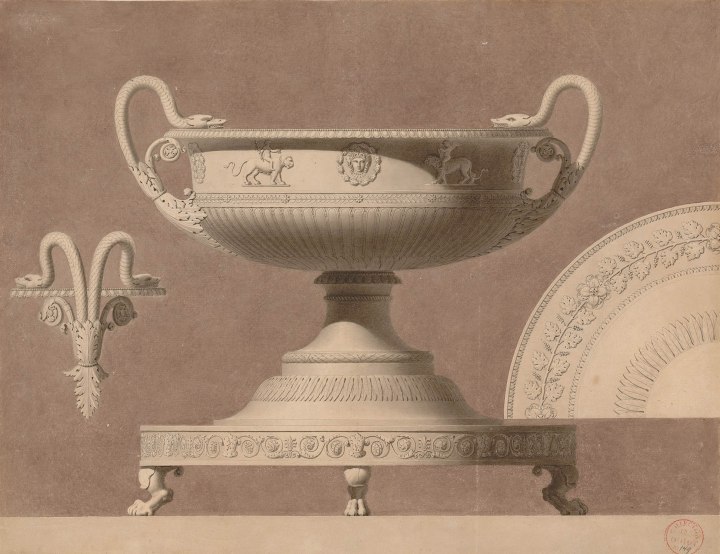
‘Snake handles’ dish, attributed to Charles-Jean-Alexandre Moreau, creator of the model; drawing attributed to Auguste Garneray, draughtsman in Jean-Baptiste-Claude Odiot’s workshop, ca. 1810; graphite, pen and grey ink, grey and sepia wash on paper (Paris: Les Arts Décoratifs).
◊ ◊ ◊ ◊ ◊
Now on view at the Musée des Arts Décoratifs:
Drawing Gold and Silver: Jean-Baptiste-Claude Odiot
Dessiner l’or et l’argent: Odiot (1763–1850), orfèvre
Musée des Arts Décoratifs, Paris, 8 March — 7 May 2017
Jean-Baptiste-Claude Odiot (1763–1850) became one of the most successful and prolific gold and silversmiths during the Empire and Restoration periods. He received several important royal commissions from the courts of Europe, including a sumptuous table service, a dressing table for empress Marie-Louise, and a cradle for the King of Rome.
The Musée des Arts Décoratifs has an exceptional collection of 33 silverware pieces and—acquired in 2009—176 original drawings from Odiot’s workshop, classified as important works of heritage by the Ministry of Culture’s Consultative Commission on National Treasures. On display for the first time, this exhibition reunites Odiot’s design drawings with the executed pieces, demonstrating his creative process, as well as his formal development and experimentation. Dating from the first quarter of the 19th century, these drawings are superbly executed in graphite and pen and enhanced with ink wash, watercolor, and gouache.
The drawings illustrate the various stages of a piece’s creation, from the initial sketches to the final detailed drawings presented to clients. On sheets of paper often measuring more than one meter high, tableware, dressing tables, and desks pieces are represented to scale, displaying the splendor and refinement of the art of living in the early 19th century. The drawings also propose different versions of the same model, offering alternatives for applied ornaments, handles, etc. Each drawing reveals an ornamental repertoire that became Odiot’s hallmark that he repeatedly employed in varying combinations from the beginning of the Empire period to the end of the Restoration. Only ten of the drawings are signed by colleagues of Odiot, including draughtsmen Auguste Garneray (1785–1824) and Adrien-Louis-Marie Cavelier (1785–1867), and the silversmith Jacques-Henry Fauconnier (1779–1839). The drawings also feature the names of prestigious clients such as Count Demidov, Countess Branicka, and members of the Imperial Family, including Madame Mère (Napoleon’s mother), Empress Marie-Louise, and Jerome I of Westphalia. These 176 drawings complement the Museum’s collection of 31 bronze models, a sugar bowl, and ‘Venus’s breast and butterfly’ bowl in vermeil, all by Odiot.

Jean-Baptiste-Claude Odiot, ‘Venus breast and butterfly’ bowl, ca. 1810–20; silver-gilt, hammered, cast, chased and engraved (Paris: Les Arts Décoratifs, Paris / photo: Jean Tholance).
The forms of the bronze models are as varied as the drawings: tea urns, soup tureens, dishes, wine coolers, oil cruets, saltcellars… Their handles, legs, and applied decoration incorporate an ornamental vocabulary derived from Antiquity. In addition to the central theme of the procession of Bacchus, Odiot’s pieces and drawings incorporates other iconographical figures such as of Hebe, Ceres, Leda, Venus, Adonis, Flora, and allegories of Victory. Snakes, swans, and mermaids lend their sinuous forms to handles, while monopod winged sphinxes and lion’s paws were better suited as legs. The foliated friezes framing the piece’s main body are decorated with panthers, reeds, vine branches, ears of wheat, and dolphins.
In 1835, Odiot donated 31 models to the Chambre des Pairs (Upper House of the French Parliament) for posterity and to serve as models for his successors. The models were initially displayed in the Musée du Luxembourg, which was, in the 19th century, devoted to painting and sculpture by living artists. In 1852, the models were transferred to the storerooms of the Louvre where they were gradually forgotten.
Simultaneously, initiatives were taking place to create the Musée des Arts Décoratifs during the second half of the 19th century. The museum of the ‘beautiful in the useful’ opened in 1882 with the goal of encouraging links between art and industry by providing models and references for workers and artisans. As there was a clear connection between Odiot’s motives and those of the new museum, Odiot’s models were put on permanent loan to the Musée des Arts Décoratifs in 1892. In 1907–08, the Musée des Arts Décoratifs commissioned Christofle to gold and silver-plate these models in order to give them the appearance of silver. In 2016, the models were officially added to the inventory of the Musée des Arts Décoratifs.
 These models were executed with great finesse. Their components, assembled by a system of nuts and bolts, were chased to heighten the relief decoration and provide contrast between matte and reflective surfaces. As a result of recent scientific analysis by the Centre de Recherche et de Restauration des Musées de France, the pieces, previously described in Odiot’s terminology as bronze, are, in fact, made of brass. The rare opportunity to showcase the Museum’s collection of Odiot silver alongside the drawings creates a unique dialogue in the history of decorative arts.
The Silversmith Jean-Baptiste-Claude Odiot’s Designs for Silver and Gold exhibition explores this dialogue between a piece’s initial conception on the drawing board and the finished work in Jean- Baptiste-Claude Odiot’s workshop. A selection of approximately 100 drawings, exhibited for the first time, will be displayed alongside 33 pieces of silver, revealing this great silversmith’s creative process. The exhibition will be accompanied by a catalogue of the collection and interactive digital media.
Audrey Gay-Mazuel and Julie Ruffet-Troussard, Odiot: Un atelier d’orfèvrerie sous l’Empire et la Restauration (Paris: Les Arts Décoratifs, 2017), 240 pages, ISBN : 978 2916914 688, 45€.
Exhibition | 18th-Century Masterpieces in the Churches of Paris
From the press release for the exhibition:
Enlightenment Baroque: 18th-Century Masterpieces in the Churches of Paris
Le Baroque des Lumières: Chefs-d’œuvre des églises parisiennes au XVIIIe siècle
Petit Palais, Paris, 21 March — 9 July 2017
Curated by Christophe Leribault and Marie Monfort
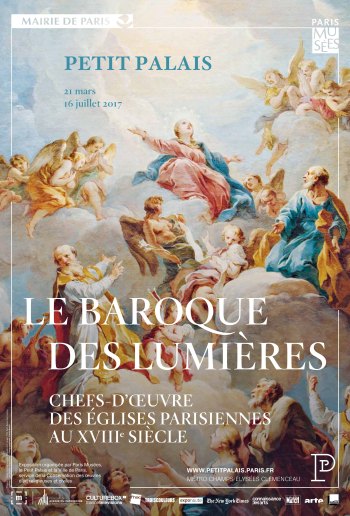 For the first time the Petit Palais is offering the public a spectacular ensemble of 18th-century religious paintings created for the churches of Paris. Through some 200 works the museum will reveal the significance and diversity of artistic output in Paris from the Regency to the French Revolution: from such heirs to the age of Louis XIV as Largillière and Restout to the exponents of rocaille, from Lemoine to Carle Van Loo, and the best of Neo-Classicism, from Vien to David. Produced in partnership with COARC (Conservation of Religious and Secular works of Art for the City of Paris), this exhibition is an extension of the one at the Musée Carnavalet (Paris) in 2012, which focused on 17th-century painting in Paris churches and the rediscovery of an enormous, little-known heritage.
The emphasis of 18th-century French painting was more on the sophistication of the fête galante and the portrait than the elaborateness of great religious art. Outside the Salon season, however, it was in the churches of Paris that art lovers could view contemporary painting, and so the city’s artists gave of their best there. Indeed, parishes and congregations bent on renovating the capital’s places of worship were among the main sponsors of history painting, and it is this forgotten segment of 18th-century art that Enlightenment Baroque aims to reassess. In a spectacular decor evocative of the inside of a church and its related spaces—the chapels and the sacristy, for example—the exhibition itinerary highlights numerous masterpieces, often very large, that have benefited from unprecedentedly thorough renovation. In addition to the pictures still to be seen in churches today, the exhibition brings together works which since the Revolution have been scattered. The masterpieces come from institutions (the Louvre, the Château de Versailles, and the art museums of Lyon, Rennes, Marseille, Brest, and elsewhere), churches and cathedrals nearby (Saint Denis and Villeneuve-Saint-Georges, for example), or further away (Mâcon, Lyon).
Divided into eight sections, the exhibition delights the eye with the finesse and varying styles of altarpieces, the colourful grace of François Lemoine, Jean-François de Troy and Noël Hallé, and the unadorned Neo-Classicism of Drouais and, of course, David, whose large portrait of Christ closes the exhibition. There are also references to ornamental ensembles, some of which, like Charles Natoire’s decor for the Chapelle des Enfants Trouvés have been lost or destroyed. Other sections are devoted to images of the new saints of the Counter-Reformation, smaller works intended for private devotion, commissioning procedures and the restorations that took place at the time in ancient buildings like the Invalides.
Along the way viewers will find two educational spaces, one given over to restoration campaigns and the other to religious imagery. Visitors will also be able to take part in guided tours of various religious edifices in Paris. This groundbreaking panorama of religious painting in 18th-century Paris is nothing short of a revelation: the pictures brought together for the occasion have been endowed with an unsuspected vividness of colour harking back to what we find so agreeable in the art of the Age of Enlightenment.
Christine Gouzi and Christophe Leribault, eds, Le Baroque des Lumières: Chefs-d’œuvre des églises parisiennes au XVIIIe siècle (Paris: Paris musées, 2017), 368 pages, ISBN : 978 27596 03442, 50€.
Curators
Christophe Leribault, Director, Petit Palais
Marie Monfort, Head of Conservation of Religious and Secular works of Art for the City of Paris
Associate Curators
Maryline Assante di Panzillo (Petit Palais), Lionel Britten (Musée d’Orsay), Jessica Degain, Nicolas Engel et Emmanuelle Federspiel (COARC), Christine Gouzi (Université de Paris- Sorbonne), et Guillaume Kazerouni (Musée des Beaux-Arts de Rennes)
Exhibition | The Art of Power: Treasures from the Bute Collection
Opening at the end of the month at both The Hunterian and Mount Stuart:
The Art of Power: Treasures from the Bute Collection at Mount Stuart
Hunterian Museum and Art Gallery, Glasgow, 31 March 2017 — 14 January 2018
Mount Stuart, Isle of Bute, 31 March 2017 — 14 January 2018
Curated by Caitlin Blackwell and Peter Black

Sir Joshua Reynolds, Portrait of John Stuart, 3rd Earl of Bute, 1773 (The Bute Collection at Mount Stuart).
This new exhibition offers a unique opportunity to see major paintings from the Bute Collection at Mount Stuart on the Isle of Bute. Merging art, biography and cultural history, Art of Power uncovers the fascinating Enlightenment figure, John Stuart, Third Earl of Bute, and his collection of rarely-seen masterpieces.
The exhibition is split across two venues—The Hunterian and Mount Stuart—offering visitors the chance to experience two world-class collections. Art of Power: Treasures from Mount Stuart marks the tercentenary of Mount Stuart, an architectural jewel on the Isle of Bute which houses the Bute Collection, one of the foremost private collections of artworks and artefacts in the UK.
The exhibition reveals a selection of rarely-seen masterpieces collected by the fascinating Enlightenment figure, John Stuart, Third Earl of Bute (1713–1792), the first Scottish-born Prime Minister and ‘favourite’ of George III. After retiring from politics, Bute amassed a great art collection, which was particularly renowned for its Dutch and Flemish paintings. This major exhibition brings a selection of European and British masterpieces from the Bute Collection to the Hunterian Art Gallery, many of which have not been on public display in over a century.
Highlights include works by Dutch Golden Age masters like Jan Steen and Jacob van Ruisdael, Grand Manner portraits by Sir Anthony Van Dyck, Joshua Reynolds and Allan Ramsay, and Italianate landscapes and history subjects by Claude Lorrain and Veronese. A portion of these works will be displayed at the Hunterian, along with works on paper, including botanical illustrations and satirical engravings from the collection. The remainder of the paintings will be displayed at Mount Stuart, where they will be accompanied by historical artefacts, such as costume, letters, and rare books.
◊ ◊ ◊ ◊ ◊
Caitlin Blackwell, Peter Black, and Oliver Cox, Art of Power: Masterpieces from the Bute Collection at Mount Stuart (New York: Prestel, 2017), 144 pages, ISBN: 978 37913 56631, $50.
John Stuart, 3rd Earl of Bute, was one of history’s most enthusiastic art collectors. As tutor to Prince George, Bute became indispensable to the royal household. Soon after his accession to the throne, the King made Bute Prime Minister―a career that was cut short after the Peace of Paris in 1763.
Forced out of London by an angry mob, Bute retired to an estate at Luton, where he spent the rest of his years in private study and amassing a collection of 500 paintings, including major works by Venetian painters such as Tintoretto, Bordone, and Veronese. Bute had a special interest in Dutch and Flemish pictures, building the greatest collection of its kind in Britain. This book features over thirty masterpieces, mainly genre paintings and landscapes, and including jewel-like landscapes by Brueghel and Savery. The collection is housed at the Bute family’s Scottish seat, Mount Stuart, on the Isle of Bute. Essays by leading scholars delve into the history of Bute’s collection, focusing on his relationship with King George III, and his wide ranging passions, which resulted in rooms filled floor to ceiling with works of art.
Caitlin Blackwell is the inaugural Bute Fellow at Mount Stuart, which is located on the Isle of Bute off the coast of Scotland. Peter Black is curator at the Hunterian and has published widely on Dutch and Flemish art. Oliver Cox is Heritage Engagement Fellow at the University of Oxford.
◊ ◊ ◊ ◊ ◊
From CODART, with text from Peter Black, Curator of Dutch and Flemish Paintings and Prints, Hunterian Museum and Art Gallery (12 December 2016). . .
The Bute Collection is housed at Mount Stuart (1880–1912), the Gothic Revival Palace by Robert Rowand Anderson on the Isle of Bute. It contains, besides a truly great collection of 18th-century portraits, important Dutch and Flemish works that were collected in the 1760s and 1770s by John Stuart, Third Earl of Bute (1713–1792). Bute was tutor to King George III when he was Prince of Wales, advising him, among other things, on acquisitions for the royal collection. Soon after the coronation in 1760, Bute was given power by his former pupil, becoming Prime Minister in 1762. His main business was to negotiate the Peace of Paris, ending the Seven Years’ War. Within one year, however, Bute resigned and was forced to leave London to escape the London mob. He bought a country house at Luton, which he had remodeled by Adam, and landscaped by Capability Brown. There he settled down to become the most important British collector of Dutch paintings, assembling for the purpose a library and collection of prints and drawings (dispersed 1794–1809). At the time of his death, there were 500 works in the house. Bute had more than a penchant for Venetian art and the grand rooms on the ground floor were hung with works by Tintoretto, Veronese and Bordone, as well as some of the finest examples of the work of Francesco Zuccarelli. Masterpieces by Dutch artists in the library included a magnificent Windy Autumn Day landscape by Berchem (Mount Stuart), and Cuyp’s River Landscape with Horseman and Peasants (now in the National Gallery, London). That painting is said to have started the craze for Cuyp among British collectors when Bute acquired it in the early 1760s. The smaller Dutch paintings were accommodated on the upper floor, clustered in dense thematic hangs in the bedrooms and dressing rooms.
The exhibition of 26 pictures in Glasgow University provides a window onto the riches of Mount Stuart, which can be visited in a day-trip by train and ferry from Glasgow. They are generally smaller works, including jewel-like landscapes by Savery, De Momper/Brueghel, Jan van der Heyden, Cuyp, Berchem, and Ruisdael, as well as genre scenes by Steen, Teniers, Verelst, Metsu and Bega. Visitors to Mount Stuart will see the extraordinary collection of family portraits by Batoni, Ramsay and Reynolds as well as works by Hobbema, Steen, Willem van Herp and Pieter van Slingelandt.

Mount Stuart, Isle of Bute (Wikimedia Commons, July 2006).
Exhibition | Aert Schouman and the Imagination of Nature

From CODART regarding the exhibition now on view at the Dordrechts Museum:
A Royal Paradise: Aert Schouman and the Imagination of Nature
Een Koninklijk Paradijs: Aert Schouman en de verbeelding van de natuur
Dordrechts Museum, 19 February — 17 September 2017
The Dordrechts Museum dedicates an exhibition to the Dordrecht painter Aert Schouman (1710–1792). On view will be a wall decoration of the Il Pastor Fido series. The paintings, only rediscovered in 2016, are an example of Schouman’s early work. The recently restored wall paintings of the Huis ten Bosch Palace will also be display. Due to the renovation work taking place at the palace, the series depicting the menagerie of Willem V may be exhibited in Dordrecht exclusively.
Het mooiste werk van dierenschilder Aert Schouman (1710–1792) komt samen in een feestelijke tentoonstelling voor kunst- en natuurliefhebbers. Absoluut hoogtepunt vormt de complete kamerbeschildering van Willem V uit Huis ten Bosch met daarop zijn bijzondere dierenverzameling. Deze ‘kamer in het rond’ is onlangs gerestaureerd en straks in het Dordrechts Museum nog één keer te bewonderen, voordat ze weer binnen de muren van het toekomstige woonpaleis van koning Willem-Alexander en koningin Máxima verdwijnt.
Met stukken uit musea en particuliere collecties in binnen- en buitenland laat de tentoonstelling het paradijs van Schouman zien vol inheemse en exotische dieren. Vooral zijn werken met schitterende vogels spreken tot de verbeelding. Schouman tekende bovendien de buitenplaatsen en tuinen die zijn rijke opdrachtgevers als aardse paradijzen lieten aanleggen.
Emile Havers, ed., Een Koninklijk Paradijs: Aert Schouman en de verbeelding van de natuur (Zwolle, W Books, 2017), 360 pages, ISBN: 978 94625 81852, 30€.










 Enfilade
leave a comment