New Book | Staging Blackness and Performing Whiteness
From Routledge:
Wendy Sutherland, Staging Blackness and Performing Whiteness in Eighteenth-Century German Drama (New York: Routledge, 2016), 272 pages, ISBN: 978 14094 24024, $150.
 Focusing on eighteenth-century cultural productions, Wendy Sutherland examines how representations of race in philosophy, anthropology, aesthetics, drama, and court painting influenced the construction of a white bourgeois German self. Sutherland positions her work within the framework of the transatlantic slave trade, showing that slavery, colonialism, and the triangular trade between Europe, West Africa, and the Caribbean function as the global stage on which German bourgeois dramas by Friedrich Wilhelm Ziegler, Ernst Lorenz Rathlef, and Theodor Körner (and a novella by Heinrich von Kleist on which Körner’s play was based) were performed against a backdrop of philosophical and anthropological influences. Plays had an important role in educating the rising bourgeois class in morality, Sutherland argues, with fathers and daughters offered as exemplary moral figures in contrast to the depraved aristocracy. At the same time, black female protagonists in nontraditional dramas represent the boundaries of physical beauty and marriage eligibility while also complicating ideas of moral beauty embodied in the concept of the beautiful soul. Her book offers convincing evidence that the eighteenth-century German stage grappled with the representation of blackness during the Age of Goethe, even though the German states were neither colonial powers nor direct participants in the slave trade.
Wendy Sutherland is Associate Professor of German at New College of Florida.
C O N T E N T S
Introduction
Race in Eighteenth-Century Germany
Slavery, Colonialism, and the Eighteenth-Century Global Stage
‘Looking at the Overlooked’: Stage Properties and the Table in Karl Lessing’s Die Mätresse (1780)
Excursus: The Court Moor and Eighteenth-Century Court Painting
The Construction of Whiteness in the Traditional German Bourgeois Drama
Race, Doubles, and Foils: Staging Blackness in Friedrich Wilhelm Ziegler’s Die Mohrinn (1801)
Race, Homosocial Desire, and the Black in Ernst Lorenz Rathlef’s Die Mohrinn zu Hamburg (1775)
Reading in the Dark? Racial Hierarchy and Miscegenation in Heinrich von Kleist’s Die Verlobung in St. Domingo (1811) and Theodor Körner’s Toni (1812)
Epilogue
Bibliography
Index
New Book | Artistes femmes
From CNRS:
Séverine Sofio, Artistes femmes: La parenthèse enchantée, XVIIIe–XIXe siècles (Paris, CNRS, 2016), 384 pages, ISBN: 978 2271 091918, 25€.
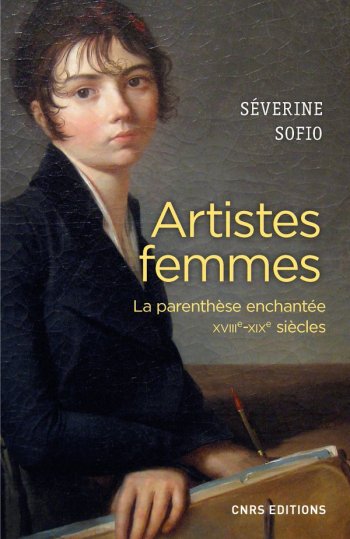 Entre 1750 et 1850, l’univers des beaux-arts connaît de profondes mutations, dont l’une des conséquences est la banalisation d’une image positive de la dame artiste. Progressivement, des barrières s’abaissent, des contraintes se desserrent et la pratique de la peinture est rendue plus accessible aux femmes. S’ouvre alors une période de créativité foisonnante associée aux noms—parfois oubliés aujourd’hui—d’Elisabeth Vigée-Lebrun, Adélaïde Labille-Guiard, Marie-Guillemine Benoist, Marguerite Gérard, Constance Mayer, Victoire Jaquotot, Lizinka de Mirbel, Rosa Bonheur…
Pourquoi les artistes femmes, à ce moment précis de l’histoire, ont-elles bénéficié de l’intérêt de leurs contemporains et de conditions de travail relativement égalitaires ? Pour saisir ce phénomène, Séverine Sofio réintègre les artistes des deux sexes dans la réalité quotidienne de leur travail de création.
Ni recueil d’analyses d’œuvres, ni histoire des femmes dans l’art, cet ouvrage traite de la pratique des beaux-arts, de son organisation et de ses réalités professionnelles, institutionnelles et économiques. Cette suspension relative de l’infériorisation des femmes dans les beaux-arts n’en demeure pas moins provisoire : si la parenthèse s’ouvre timidement dans les dernières décennies de l’Ancien Régime, elle se referme progressivement avant le milieu du siècle suivant.
Sociologue, diplômée de l’École du Louvre, Séverine Sofio est chargée de recherche au CNRS. Elle a notamment co-dirigé, avec Wenceslas Lizé et Delphine Naudier, Les Stratèges de la notoriété. Intermédiaires et production de la valeur dans les univers artistiques (2014).
New Book | Tudor Place: America’s Story Lives Here

The north facade and back gardens of Tudor Place, Washington, D.C. (Georgetown). The house was built in 1816–17 by Thomas and Martha Parke Custis Peter with William Thornton (Photo: Wikimedia Commons, December 2011).
◊ ◊ ◊ ◊ ◊
From The White House Historical Association:
Leslie Buhler, ed., with photography by Bruce White, Tudor Place: America’s Story Lives Here (Washington, D.C., The White House Historical Association, 2016), 304 pages, ISBN: 978 1931 917568 $50.
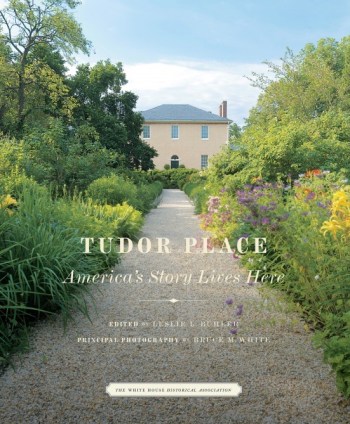 Released to mark the bicentennial of Tudor Place, this new title is the first comprehensive record of this important National Historic Landmark in the Georgetown neighborhood of Washington, D.C. Two grand houses were under construction in the young Federal City in 1816: one the President’s House, reconstructed after it was burned by the British in 1814, and the other Tudor Place, an elegant mansion rising on the heights above Georgetown. The connection between these two houses is more than temporal, as they were connected through lineage and politics for generations. The builders of Tudor Place were Thomas and Martha Parke Custis Peter, Martha Washington’s granddaughter. In the 1790s George Washington had been a frequent guest at the Peters’ townhouse when he was in the nascent Federal City, attending to its planning and selecting sites for the U.S. Capitol and the President’s House. In 1817, when President James Monroe moved back into the reconstructed President’s House following the fire of 1814, the Peters were completing their own grand home, Tudor Place, designed in concert with their friend, Dr. William Thornton, architect for the first U.S. Capitol Building. The White House and Tudor Place each represent the spirit and aspirations of the early Republic. Little more than two miles apart, each survives as a national architectural landmark. While the White House is perhaps the most well known building in the world, Tudor Place remained a family home until 1983 and very private, although the Peters welcomed some of the nation’s foremost leaders as their guests and were themselves guests at the White House.
Now a historic house and garden museum (open to the public since 1988), the house remains as the Peters lived in it, preserving spaces and belongings of many eras while adapting their home and landscape to contemporary fashion and functions. This year, as Tudor Place turns 200, this lavishly illustrated book—the first definitive history of the house and its collection—takes us into the house to explore its rooms, gardens, archival collections, and such rare artifacts as one of only three surviving letters from George to Martha Washington.
Leslie L. Buhler served as Executive Director of Tudor Place for 15 years, retiring in 2015.
◊ ◊ ◊ ◊ ◊
C O N T E N T S
• Joseph Ellis, Introduction
• Leslie Buhler, The Custis-Peter Family of Georgetown
• William C. Allen, An Architectural History of Tudor Place
• Patricia Marie O’Donnell, The Landscape of Tudor Place
• Erin Kuykenall and Leslie Buhler, Living at Tudor Place
New Book | Black Georgetown Remembered
From Georgetown UP:
Kathleen Menzie Lesko, Valerie Babb, and Carroll R. Gibbs, Black Georgetown Remembered: A History of Its Black Community from the Founding of ‘The Town of George’ in 1751 to the Present Day (Washington, D.C.: Georgetown University Press, 2016), 232 pages, ISBN: 978 1626 163263, $28.
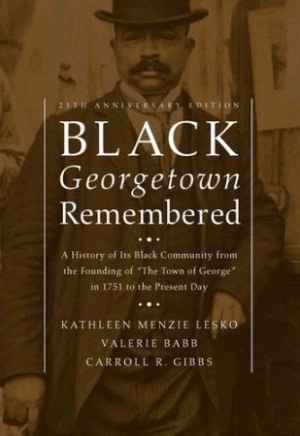 First published in 1991, Black Georgetown Remembered chronicles and celebrates the rich but little-known history of the Georgetown black community from the colonial period to the present. Drawing on primary sources, including oral interviews with past and current residents and extensive research in church and historical society archives, the authors record the hopes, dreams, disappointments, and successes of a vibrant neighborhood as it persevered through slavery and segregation, war and peace, prosperity and depression.
This 25th anniversary edition of Black Georgetown Remembered—with a new introduction by Kathleen Menzie Lesko and a foreword by Maurice Jackson—is completely redesigned and features high-quality scans of more than two hundred illustrations, including portraits of prominent community leaders, sketches, maps, and nineteenth-century and contemporary photographs. Kathleen Menzie Lesko’s new introduction describes the impact of this book.
Black Georgetown Remembered is a compelling and inspiring journey through more than two hundred years of history. It invites readers to share in the lives, dreams, aspirations, struggles, and triumphs of real people, to join them in their churches, at home, and on the street, and to consider how the unique heritage of this neighborhood intersects and contributes to broader themes in African American and Washington, DC, history and urban studies.
Kathleen Menzie Lesko is a former scholar-in-residence at the Folger Shakespeare Library and current research scholar at the Huntington Library in San Marino, California.
Valerie Babb is the Franklin Professor of English and director of the Institute for African American Studies at the University of Georgia.
Carroll R. Gibbs is a professional historian, lecturer, and author of numerous works on African American history.
New Book | Les progrès de l’industrie perfectionnée
This collection of essays grows out of the conference 2014, Workshops and Manufactures in the Years between the French Revolution and the Napoleonic Empire, 1789–1815. From PUM:
Natacha Coquery, Jörg Ebeling, Anne Perrin Khelissa, Philippe Sénéchal, eds., «Les progrès de l’industrie perfectionnée»: Luxe, arts décoratifs et innovation de la Révolution française au Premier Empire (Toulouse: Presses Universitaires du Midi, 2017), 200 pages, ISBN: 978 28107 04835, 22€.
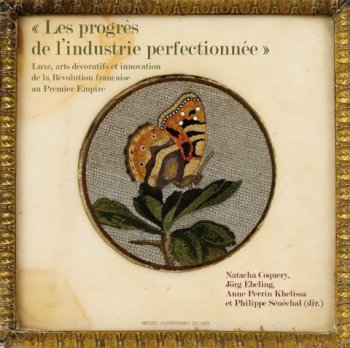 À la charnière entre les XVIIIe et XIXe siècles, entre la réunion des États généraux et la fin du Premier Empire, vingt-cinq ans s’écoulent pendant lesquels bouleversements politiques, économiques, sociaux et culturels créent un contexte d’instabilité pour le secteur du luxe et du demi-luxe français. Les ateliers et les manufactures sont confrontés à des conditions matérielles et organisationnelles difficiles. Le manque de matières premières, la détérioration des finances et la diminution du personnel en raison du départ des jeunes hommes aux armées ont un impact négatif sur la production artisanale. L’incertitude générale que représente cette période d’instabilité politique et de conflits armés n’empêche pourtant pas l’émergence de modes. De nouveaux marchés s’ouvrent et offrent de riches opportunités aux artistes et artisans pour diversifier et élargir leurs créations.
Souvent considérée comme un temps de rupture, en particulier dans le domaine du luxe dont elle remet en cause les fondements, la Révolution française apparaît au contraire comme le ferment d’une évolution vers l’innovation et l’industrialisation. Pluridisciplinaire, croisant l’histoire de l’art, l’histoire sociale, l’histoire économique, l’histoire culturelle et l’histoire des techniques, le présent ouvrage explore les conditions du changement et offre une approche plurielle des arts du décor.
T A B L E D E S M A T I È R E S
Remerciements
Introduction générale, Jean-François Belhoste, Philippe Bordes, Natacha Coquery, Jörg Ebeling, Anne Perrin Khelissa et Philippe Sénéchal
Partie I | L’État: Rôle et intervention
• Thomas Le Roux, La chimie, support du développement de l’industrie perfectionnée sous la Révolution et l’Empire
• Christiane Demeulenaere-Douyère, Le luxe sous l’Empire, ou la question des matières premières « indigènes »
• Camilla Murgia, The Crafty Link: Fine Arts and Industrial Exhibitions under the Consulate and the Empire
• Justin Beaugrand-Fortunel, Le mobilier de campagne de Napoléon ier: L’artisanat au service de l’Empereur
Partie II | Les secteurs de production: Organisation et fonctionnement
• Marie-Agnès Dequidt, L’horlogerie parisienne pendant la Révolution et l’Empire: Continuer à tourner dans un monde en bouleversement
• Élodie Voillot, Des canons aux statuettes: Les fabricants de bronze parisiens au début du xixe siècle
• David Celetti, Filer le luxe. Travail domestique, manufactures et usines dans la France révolutionnaire
• Stéphane Piques, L’organisation de la production dans l’industrie céramique sous la Révolution et l’Empire: La nébuleuse faïencière de Martres-Tolosane (Haute-Garonne)
Partie III | Les œuvres et les décors: Création et aménagement
• Bernard Jacqué, Des décors de luxe en papier peint pendant la Révolution française
• Valeria Mirra, Labor omnia vincit: La manufacture Piranesi de vases et ornements en terre cuite de Mortefontaine
• Iris Moon, Immutable Décor: Post-Revolutionary Luxury in the Platinum Cabinet at Aranjuez
• Ludmila Budrina, Lapidaires parisiens au service de Nicolas Demidoff: La collection d’objets en bronze doré et malachite avec mosaïques en relief de pierres dures réalisés par Thomire (d’après des documents inédits et les collections européennes)
• Hans Ottomeyer, Innovation by Design as Strategy for Luxury Goods
Index général
Bibliographie
Présentation des auteurs
New Book | A Taste for Luxury in Early Modern Europe
Due out in June from Bloomsbury Publishing:
Johanna Ilmakunnas and Jon Stobart, eds., A Taste for Luxury in Early Modern Europe: Display, Acquisition, and Boundaries (London: Bloomsbury Academic, 2017), 304 pages, ISBN: 978 14742 58234, $112.
 In the 18th century, debates raged about the economic, social and moral impacts of luxury, whilst taste was viewed as a refining influence and a marker of rank and status. This book takes a fresh, comparative approach to these ideas, drawing together new scholarship to examine three related areas in a wide variety of European contexts. First, the deployment of luxury goods in displays of status and how these practices varied across space and time. Secondly, the processes of communicating and acquiring taste and luxury: how did people obtain tasteful and luxurious goods, and how did they recognise them as such? Thirdly, the ways in which ideas of taste and luxury crossed national, political and economic boundaries: what happened to established ideas of luxury and taste as goods moved from one country to another, and during times of political transformation? Through the analysis of case studies looking at consumption practices, material culture, political economy, and retail marketing, A Taste for Luxury in Early Modern Europe challenges established readings of luxury and taste.
Johanna Ilmakunnas is Postdoctoral Research Fellow at the University of Helsinki, Finland. Jon Stobart is Professor of Social History at the University of Northampton, UK and Founding Editor of the new journal History of Retailing and Consumption.
◊ ◊ ◊ ◊ ◊
C O N T E N T S
I. Displaying Taste and Luxury
1 The Fabric of a Corporate Society: Sumptuary Laws, Social Order and Propriety in Early Modern Tallinn – Astrid Pajur (Uppsala University)
2 New and Old Luxuries Between the Court and the City: A Comparative Perspective on Material Cultures in Brussels and Antwerp, 1650–1735 – Bruno Blondé and Veerle de Laet (University of Antwerp)
3 Luxury and Taste in Eighteenth-Century Naples: Representations, Ideas and Social Practices at the Intersection Between the Global and the Local – Alida Clemente (University of Foggia).
4 What About the Moorish Footman? Portrait of a Dutch Nabob as a Dedicated Follower of Fashion– Yme Kuiper (University of Groningen)
5 Fashion and Luxury in Eighteenth-Century Germany – Michael North (University of Greifswald)
II. Making and Acquiring Taste
6 Taste Inequalities in the Art Consumption of Prince Nicolaus I Esterházy ‘the Magnificent’ – Kristof Fatsar (Corvinus University of Budapest)
7 Making an English Country House: Taste and Luxury in the Furnishing of Stoneleigh Abbey, 1763–1765 – Jon Stobart (Manchester Metropolitan University)
8 Between the Exotic and the Everyday: Sabine Winn at Home, 1765–1798 – Kerry Bristol (University of Leeds)
9 Books, Wine, and Fine China: Consumption Patterns of a Brukspatron in Early Nineteenth-Century Sweden – Marie Steinrud (Stockholm University)
10 To Buy a Plate: Retail and Shopping for Porcelain and Faience in Stockholm During the Eighteenth Century – Sofia Murhem and Göran Ulväng (Uppsala University)
III. Crossing Boundaries of Taste and Luxury
11 A Taste for French Style in Bourbon Spain: Food, Drink and Clothing in 1740s Madrid – Nadia Fernández-de-Pinedo (Universidad Autónoma de Madrid) and Corinne Thépaut-Cabasset (V&A Museum and Château de Versailles)
12 French Fashions: Aspects of Elite Lifestyle in Eighteenth-Century Sweden – Johanna Ilmakunnas (University of Helsinki)
13 English Luxuries in Nineteenth-Century Vyborg – Ulla Ijäs (University of Helsinki)
14 Luxury Goods Beyond Boundaries: The Parisian Market During the Terror – Natacha Coquery (University of Lyon 2)
Bibliography
Index
New Book | Britannia: Icon on the Coin
From The Royal Mint (at Llantrisant, just outside of Cardiff), which incidentally just this past year opened to the public with a new visitor’s center.
Katharine Eustace, Britannia: Icon on the Coin (Llantrisant: The Royal Mint Museum, 2016), 144 pages, ISBN: 978 18699 17029, £35.
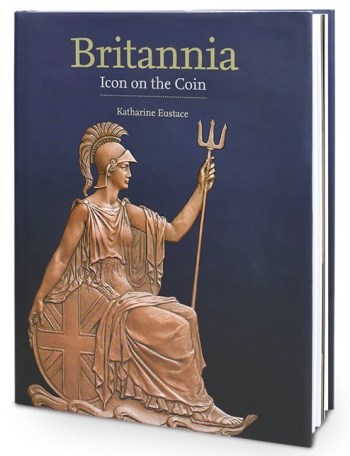 At a time when the idea of Britain is being debated more than ever, a book that reveals the rich history of British identity has been published. The story of Britannia on the coinage is also the story of Britain. Katharine Eustace charts Britannia’s history and explores the shifts in art and politics, technology and popular culture that have influenced the icon’s image. For two years, Eustace immersed herself in the subject of Britannia, and the result is a fascinating story revealed in this compelling new book. Her new history of Britannia on the coinage is an enlightening illustration of how studying one object can reveal a bigger picture. Britannia’s appearance on coins may have evolved over the centuries, but she has remained a popular symbol of the nation.
Katharine Eustace is an expert in eighteenth-century sculpture, with an extraordinary knowledge of decorative art and sculpture in Britain. She was a curator in the Ashmolean Museum and the National Portrait Gallery, and editor of the Sculpture Journal for ten years.
Christopher Eimer provides a helpful review at 3rd Dimension, the online newsletter of the Public Monuments and Sculpture Association.
Exhibition | The Pursuit of Immortality: Portrait Medals
Opening in May at The Frick:
The Pursuit of Immortality: Masterpieces from the Scher Collection of Portrait Medals
The Frick Collection, New York, 9 May — 10 September 2017
Curated by Aimee Ng and Stephen Scher
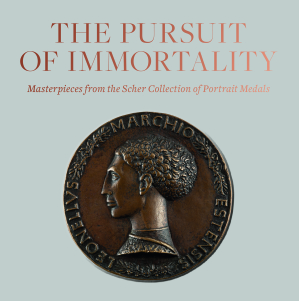 The Frick Collection recently announced the largest acquisition in its history—a promised gift of approximately 450 portrait medals from the incomparable collection of Stephen K. and Janie Woo Scher. Representing the development of the art of the portrait medal from its inception in fifteenth-century Italy to the nineteenth century, the Scher collection is arguably the world’s most comprehensive and significant collection of portrait medals. Comments Director Ian Wardropper, “Henry Clay Frick had an abiding interest in portraiture as expressed in the paintings, sculpture, enamels, and works on paper he acquired. The Scher medals will coalesce beautifully with these holdings, being understood in our galleries within the broader contexts of European art and culture. At the same time, the intimate scale of the institution will offer a superb platform for the medals to be appreciated as an independent art form, one long overdue for fresh attention and public appreciation.”
To celebrate the promised gift, The Frick Collection will mount an exhibition this spring entitled The Pursuit of Immortality: Masterpieces from the Scher Collection of Portrait Medals. The exhibition will explore the flourishing of the medallic arts in major European centers of artistic production and will feature superlative examples by masters of the art such as Pisanello (Italy), Dupré (France), and Reinhart (Germany). Taking and fresh approach to the study of medals, which have often been viewed in the past as specialist objects closer to the field of numismatics, this exhibition will examine medals within the larger context of art, honoring them as a triumph of sculptural production on a small scale. Visitors to the show will encounter a number of renowned sculptors who were also masters of the medal.
The Pursuit of Immortality: Masterpieces from the Scher Collection of Portrait Medals is organized by Aimee Ng, Associate Curator at the Frick, and Stephen K. Scher, an esteemed art historian as well as a collector. Accompanying the exhibition is a richly illustrated exhibition catalogue including an essay by Aimee Ng. (In the spring of 2018, a catalogue of the entire Scher Collection will be published, featuring essays by leading medals scholars and illustrated entries about each of the almost one thousand medals in the collection.)
◊ ◊ ◊ ◊ ◊
Aimee Ng, The Pursuit of Immortality: Masterpieces from the Scher Collection of Portrait Medals (London: Giles, 2017), 64 pages, ISBN: 978 19112 82068, £15 / $20.
Accompanying the exhibition is a richly illustrated exhibition catalogue including an essay by Aimee Ng. In the spring of 2018, a catalogue of the entire Scher Collection will be published, featuring essays by leading medals scholars and illustrated entries about each of the almost one thousand medals in the collection.
Aimee Ng is associate curator at The Frick Collection, New York, and a specialist in Italian Renaissance art. She has held curatorial and academic positions at the Morgan Library & Museum, where she was postdoctoral fellow at the Morgan’s Drawing Institute in 2014, and at Columbia University, where she earned her Ph.D. She was guest curator of The Poetry of Parmigianino’s ‘Schiava Turca’ (2014) and organizing curator of Andrea del Sarto: The Renaissance Workshop in Action (2015–16).
Exhibition | Alexandre Lenoir’s Museum of French Monuments
I’m nearly a year late with this posting, but the catalogue is still available. –CH
From the Louvre:
Un Musée révolutionnaire: Le musée des Monuments français d’Alexandre Lenoir
A Revolutionary Museum: Alexandre Lenoir’s Museum of French Monuments
Musée du Louvre, Paris, 7 April — 4 July 2016
Curated by Geneviève Bresc-Bautier and Béatrice de Chancel-Bardelot
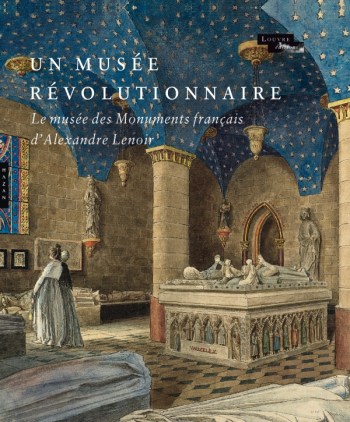 Dating from 1795, the Museum of French Monuments was France’s second national museum, coming in the wake of the Louvre, founded in 1793. It played a major part in the birth of the notion of heritage and the emergence of medieval history. However, it was closed in 1816 and its contents are currently to be found in institutions in France—the Louvre’s Department of Sculptures, the Ecole des Beaux-Arts in Paris, the basilica of Saint-Denis, the Musée de Cluny, Notre Dame, various churches in the Paris diocese—and abroad: mainly in the Metropolitan Museum in New York, but also in the Victoria and Albert Museum in London. The exhibition recounts the pioneering achievement of Alexandre Lenoir as museum curator, exhibition designer, and fervent heritage protector. It also explores the establishment and history of the Museum of French Monuments, whose exhibition style had a powerful influence on the sensibility and the arts of the period.
Organized by Geneviève Bresc-Bautier (Musée du Louvre), and Béatrice de Chancel-Bardelot (Musée de Cluny-Musée National du Moyen Âge).
From Hazan:
Geneviève Bresc-Bautier and Béatrice de Chancel-Bardelot, eds. Un Musée révolutionnaire: Le musée des Monuments français d’Alexandre Lenoir (Paris: Hazan, 2016), 380 pages, ISBN: 978 27541 09376, €45.
Alexandre Lenoir (1761–1839), fervent défenseur des arts face au vandalisme révolutionnaire, fut le créateur et l’administrateur du musée des Monuments français de 1791 à sa fermeture en 1816 et à la dispersion de ses collections.L’exposition qui se tiendra dans le hall Napoléon du musée du Louvre du 7 avril au 4 juillet 2016 s’attache dans un premier temps à présenter l’histoire et l’influence de cette institution et de son fondateur sur l’historiographie et la conservation du patrimoine français. Dans un second temps, l’exposition dévoile au public plusieurs ensembles de sculptures tels qu’ils étaient exposés au musée des Monuments français, notamment les statues-colonnes de Gaillon représentant Jeanne d’Arc et Louis XII ou encore le tombeau de Valentine Balbiani et du cardinal René de Birague. Plus qu’un catalogue d’exposition, la publication accompagnant cet événement constitue un véritable ouvrage de référence sur le musée des Monuments français. Dirigé par les commissaires d’exposition Geneviève Bresc-Bautier et Béatrice de Chancel, il rassemble vingt-huit textes d’historiens de l’art accompagnés de plus de deux cent cinquante illustrations, notamment les nombreuses vues de salles à l’aquarelle de Jean-Lubin Vauzelle qui font revivre un instant ce musée aujourd’hui disparu.
New Book | ‘Muilman, Crokatt, and Keable’ by Gainsborough, ca. 1750
My heading is something of a misnomer. This publication isn’t a codex and doesn’t work the way even a digital book typically does. And yet, it also is different from a collection of essays, such as one finds in a journal (whether with paper or digital formats). I don’t think we (yet) have a name for this sort of publication. Perhaps it’s simply a catalogue, but that seems to suggest something grander than this entirely focused scope. I would welcome suggestions. Looking too casually at the Tate’s website where the publication is hosted, one might think it comparable to the sorts of entries often available on museum websites. And it may be akin in some ways, but it is conceived as a coherent, discreet publication, complete with an editor and peer review. The default word (for almost everything) now seems to be ‘project’. Whatever we call it, I’m looking forward to using it in class later this spring. –CH
From Tate:
John Chu, ed., “A Tate In Focus Project: Peter Darnell Muilman, Charles Crokatt and William Keable in a Landscape c. 1750, by Thomas Gainsborough, ca. 1750,” with essays by John Chu, Huw David, Hannah French, Alexandra Gent, Rebecca Hellen, and Peter Moore, and a recording and interview by Hannah French (London: Tate Research Publication, 2017).
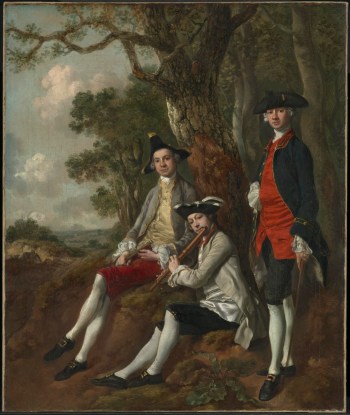
Thomas Gainsborough, Portrait of Peter Darnell Muilman, Charles Crokatt, and William Keable in a Landscape, ca.1750 (Tate T06746 / Gainsborough’s House).
Offering a multi-disciplinary discussion of Gainsborough’s early triple portrait, this project considers the painting as a depiction of polite and refined society, as a reflection of the growing wealth of a global mercantile elite, and as a ‘painting within a painting’ by an artist as renowned for his landscapes as he was his portraiture.
The mid-eighteenth-century ‘conversation piece’ Peter Darnell Muilman, Charles Crokatt and William Keable in a Landscape was painted by Thomas Gainsborough (1727–1788) when he was still making a name for himself as landscape and portrait painter. It was acquired jointly by Gainsborough’s House and Tate in 1993 and is regarded as a masterpiece of this early phase of his career. This project draws together expertise from the fields of art history, conservation, history of commerce and musicology to throw light on the social and cultural milieu that gave rise to the commission. It asks as many questions about the financial and social privileges of the portrait’s sitters as it does about Gainsborough himself, proposing new ways of understanding why Muilman, Crokatt and Keable presented themselves making music in the midst of a remote rustic landscape.
C O N T E N T S
• John Chu—The Painting and ‘Early Gainsborough’
• Huw David—Patronage: Mercantile Sitters
• Rebecca Hellen and Alexandra Gent—Painting the Picture
• John Chu—Portraiture, Conversation, Politeness
• Hannah French—Music, Refinement, Masculinity
• Hannah French and John Chu,—Baroque Flute Recording and Interview with Hannah French
• John Chu—Landscape, Imitation, Cosmopolitanism
• Peter Moore—Mercantile Culture and National Identity
• Acknowledgments
Contributors
John Chu, Assistant Curator, Pictures and Sculpture, National Trust
Huw T. David, Director of Development, Rothermere American Institute, University of Oxford
Rebecca Hellen, Paintings Conservator, Tate
Alexandra Gent, Paintings Conservator, Tate and Courtauld Institute of Art
Hannah French, musicologist and baroque flautist, Royal Academy of Music
Peter Moore, Research Curator, Gainsborough’s House










 Enfilade
leave a comment