New Book | A Taste for Luxury in Early Modern Europe
Due out in June from Bloomsbury Publishing:
Johanna Ilmakunnas and Jon Stobart, eds., A Taste for Luxury in Early Modern Europe: Display, Acquisition, and Boundaries (London: Bloomsbury Academic, 2017), 304 pages, ISBN: 978 14742 58234, $112.
 In the 18th century, debates raged about the economic, social and moral impacts of luxury, whilst taste was viewed as a refining influence and a marker of rank and status. This book takes a fresh, comparative approach to these ideas, drawing together new scholarship to examine three related areas in a wide variety of European contexts. First, the deployment of luxury goods in displays of status and how these practices varied across space and time. Secondly, the processes of communicating and acquiring taste and luxury: how did people obtain tasteful and luxurious goods, and how did they recognise them as such? Thirdly, the ways in which ideas of taste and luxury crossed national, political and economic boundaries: what happened to established ideas of luxury and taste as goods moved from one country to another, and during times of political transformation? Through the analysis of case studies looking at consumption practices, material culture, political economy, and retail marketing, A Taste for Luxury in Early Modern Europe challenges established readings of luxury and taste.
Johanna Ilmakunnas is Postdoctoral Research Fellow at the University of Helsinki, Finland. Jon Stobart is Professor of Social History at the University of Northampton, UK and Founding Editor of the new journal History of Retailing and Consumption.
◊ ◊ ◊ ◊ ◊
C O N T E N T S
I. Displaying Taste and Luxury
1 The Fabric of a Corporate Society: Sumptuary Laws, Social Order and Propriety in Early Modern Tallinn – Astrid Pajur (Uppsala University)
2 New and Old Luxuries Between the Court and the City: A Comparative Perspective on Material Cultures in Brussels and Antwerp, 1650–1735 – Bruno Blondé and Veerle de Laet (University of Antwerp)
3 Luxury and Taste in Eighteenth-Century Naples: Representations, Ideas and Social Practices at the Intersection Between the Global and the Local – Alida Clemente (University of Foggia).
4 What About the Moorish Footman? Portrait of a Dutch Nabob as a Dedicated Follower of Fashion– Yme Kuiper (University of Groningen)
5 Fashion and Luxury in Eighteenth-Century Germany – Michael North (University of Greifswald)
II. Making and Acquiring Taste
6 Taste Inequalities in the Art Consumption of Prince Nicolaus I Esterházy ‘the Magnificent’ – Kristof Fatsar (Corvinus University of Budapest)
7 Making an English Country House: Taste and Luxury in the Furnishing of Stoneleigh Abbey, 1763–1765 – Jon Stobart (Manchester Metropolitan University)
8 Between the Exotic and the Everyday: Sabine Winn at Home, 1765–1798 – Kerry Bristol (University of Leeds)
9 Books, Wine, and Fine China: Consumption Patterns of a Brukspatron in Early Nineteenth-Century Sweden – Marie Steinrud (Stockholm University)
10 To Buy a Plate: Retail and Shopping for Porcelain and Faience in Stockholm During the Eighteenth Century – Sofia Murhem and Göran Ulväng (Uppsala University)
III. Crossing Boundaries of Taste and Luxury
11 A Taste for French Style in Bourbon Spain: Food, Drink and Clothing in 1740s Madrid – Nadia Fernández-de-Pinedo (Universidad Autónoma de Madrid) and Corinne Thépaut-Cabasset (V&A Museum and Château de Versailles)
12 French Fashions: Aspects of Elite Lifestyle in Eighteenth-Century Sweden – Johanna Ilmakunnas (University of Helsinki)
13 English Luxuries in Nineteenth-Century Vyborg – Ulla Ijäs (University of Helsinki)
14 Luxury Goods Beyond Boundaries: The Parisian Market During the Terror – Natacha Coquery (University of Lyon 2)
Bibliography
Index
New Book | Britannia: Icon on the Coin
From The Royal Mint (at Llantrisant, just outside of Cardiff), which incidentally just this past year opened to the public with a new visitor’s center.
Katharine Eustace, Britannia: Icon on the Coin (Llantrisant: The Royal Mint Museum, 2016), 144 pages, ISBN: 978 18699 17029, £35.
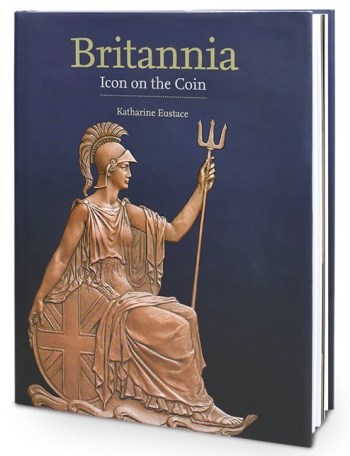 At a time when the idea of Britain is being debated more than ever, a book that reveals the rich history of British identity has been published. The story of Britannia on the coinage is also the story of Britain. Katharine Eustace charts Britannia’s history and explores the shifts in art and politics, technology and popular culture that have influenced the icon’s image. For two years, Eustace immersed herself in the subject of Britannia, and the result is a fascinating story revealed in this compelling new book. Her new history of Britannia on the coinage is an enlightening illustration of how studying one object can reveal a bigger picture. Britannia’s appearance on coins may have evolved over the centuries, but she has remained a popular symbol of the nation.
Katharine Eustace is an expert in eighteenth-century sculpture, with an extraordinary knowledge of decorative art and sculpture in Britain. She was a curator in the Ashmolean Museum and the National Portrait Gallery, and editor of the Sculpture Journal for ten years.
Christopher Eimer provides a helpful review at 3rd Dimension, the online newsletter of the Public Monuments and Sculpture Association.
Exhibition | The Pursuit of Immortality: Portrait Medals
Opening in May at The Frick:
The Pursuit of Immortality: Masterpieces from the Scher Collection of Portrait Medals
The Frick Collection, New York, 9 May — 10 September 2017
Curated by Aimee Ng and Stephen Scher
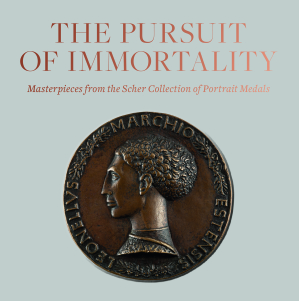 The Frick Collection recently announced the largest acquisition in its history—a promised gift of approximately 450 portrait medals from the incomparable collection of Stephen K. and Janie Woo Scher. Representing the development of the art of the portrait medal from its inception in fifteenth-century Italy to the nineteenth century, the Scher collection is arguably the world’s most comprehensive and significant collection of portrait medals. Comments Director Ian Wardropper, “Henry Clay Frick had an abiding interest in portraiture as expressed in the paintings, sculpture, enamels, and works on paper he acquired. The Scher medals will coalesce beautifully with these holdings, being understood in our galleries within the broader contexts of European art and culture. At the same time, the intimate scale of the institution will offer a superb platform for the medals to be appreciated as an independent art form, one long overdue for fresh attention and public appreciation.”
To celebrate the promised gift, The Frick Collection will mount an exhibition this spring entitled The Pursuit of Immortality: Masterpieces from the Scher Collection of Portrait Medals. The exhibition will explore the flourishing of the medallic arts in major European centers of artistic production and will feature superlative examples by masters of the art such as Pisanello (Italy), Dupré (France), and Reinhart (Germany). Taking and fresh approach to the study of medals, which have often been viewed in the past as specialist objects closer to the field of numismatics, this exhibition will examine medals within the larger context of art, honoring them as a triumph of sculptural production on a small scale. Visitors to the show will encounter a number of renowned sculptors who were also masters of the medal.
The Pursuit of Immortality: Masterpieces from the Scher Collection of Portrait Medals is organized by Aimee Ng, Associate Curator at the Frick, and Stephen K. Scher, an esteemed art historian as well as a collector. Accompanying the exhibition is a richly illustrated exhibition catalogue including an essay by Aimee Ng. (In the spring of 2018, a catalogue of the entire Scher Collection will be published, featuring essays by leading medals scholars and illustrated entries about each of the almost one thousand medals in the collection.)
◊ ◊ ◊ ◊ ◊
Aimee Ng, The Pursuit of Immortality: Masterpieces from the Scher Collection of Portrait Medals (London: Giles, 2017), 64 pages, ISBN: 978 19112 82068, £15 / $20.
Accompanying the exhibition is a richly illustrated exhibition catalogue including an essay by Aimee Ng. In the spring of 2018, a catalogue of the entire Scher Collection will be published, featuring essays by leading medals scholars and illustrated entries about each of the almost one thousand medals in the collection.
Aimee Ng is associate curator at The Frick Collection, New York, and a specialist in Italian Renaissance art. She has held curatorial and academic positions at the Morgan Library & Museum, where she was postdoctoral fellow at the Morgan’s Drawing Institute in 2014, and at Columbia University, where she earned her Ph.D. She was guest curator of The Poetry of Parmigianino’s ‘Schiava Turca’ (2014) and organizing curator of Andrea del Sarto: The Renaissance Workshop in Action (2015–16).
Exhibition | Alexandre Lenoir’s Museum of French Monuments
I’m nearly a year late with this posting, but the catalogue is still available. –CH
From the Louvre:
Un Musée révolutionnaire: Le musée des Monuments français d’Alexandre Lenoir
A Revolutionary Museum: Alexandre Lenoir’s Museum of French Monuments
Musée du Louvre, Paris, 7 April — 4 July 2016
Curated by Geneviève Bresc-Bautier and Béatrice de Chancel-Bardelot
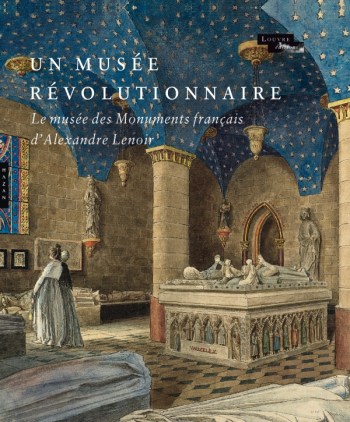 Dating from 1795, the Museum of French Monuments was France’s second national museum, coming in the wake of the Louvre, founded in 1793. It played a major part in the birth of the notion of heritage and the emergence of medieval history. However, it was closed in 1816 and its contents are currently to be found in institutions in France—the Louvre’s Department of Sculptures, the Ecole des Beaux-Arts in Paris, the basilica of Saint-Denis, the Musée de Cluny, Notre Dame, various churches in the Paris diocese—and abroad: mainly in the Metropolitan Museum in New York, but also in the Victoria and Albert Museum in London. The exhibition recounts the pioneering achievement of Alexandre Lenoir as museum curator, exhibition designer, and fervent heritage protector. It also explores the establishment and history of the Museum of French Monuments, whose exhibition style had a powerful influence on the sensibility and the arts of the period.
Organized by Geneviève Bresc-Bautier (Musée du Louvre), and Béatrice de Chancel-Bardelot (Musée de Cluny-Musée National du Moyen Âge).
From Hazan:
Geneviève Bresc-Bautier and Béatrice de Chancel-Bardelot, eds. Un Musée révolutionnaire: Le musée des Monuments français d’Alexandre Lenoir (Paris: Hazan, 2016), 380 pages, ISBN: 978 27541 09376, €45.
Alexandre Lenoir (1761–1839), fervent défenseur des arts face au vandalisme révolutionnaire, fut le créateur et l’administrateur du musée des Monuments français de 1791 à sa fermeture en 1816 et à la dispersion de ses collections.L’exposition qui se tiendra dans le hall Napoléon du musée du Louvre du 7 avril au 4 juillet 2016 s’attache dans un premier temps à présenter l’histoire et l’influence de cette institution et de son fondateur sur l’historiographie et la conservation du patrimoine français. Dans un second temps, l’exposition dévoile au public plusieurs ensembles de sculptures tels qu’ils étaient exposés au musée des Monuments français, notamment les statues-colonnes de Gaillon représentant Jeanne d’Arc et Louis XII ou encore le tombeau de Valentine Balbiani et du cardinal René de Birague. Plus qu’un catalogue d’exposition, la publication accompagnant cet événement constitue un véritable ouvrage de référence sur le musée des Monuments français. Dirigé par les commissaires d’exposition Geneviève Bresc-Bautier et Béatrice de Chancel, il rassemble vingt-huit textes d’historiens de l’art accompagnés de plus de deux cent cinquante illustrations, notamment les nombreuses vues de salles à l’aquarelle de Jean-Lubin Vauzelle qui font revivre un instant ce musée aujourd’hui disparu.
New Book | ‘Muilman, Crokatt, and Keable’ by Gainsborough, ca. 1750
My heading is something of a misnomer. This publication isn’t a codex and doesn’t work the way even a digital book typically does. And yet, it also is different from a collection of essays, such as one finds in a journal (whether with paper or digital formats). I don’t think we (yet) have a name for this sort of publication. Perhaps it’s simply a catalogue, but that seems to suggest something grander than this entirely focused scope. I would welcome suggestions. Looking too casually at the Tate’s website where the publication is hosted, one might think it comparable to the sorts of entries often available on museum websites. And it may be akin in some ways, but it is conceived as a coherent, discreet publication, complete with an editor and peer review. The default word (for almost everything) now seems to be ‘project’. Whatever we call it, I’m looking forward to using it in class later this spring. –CH
From Tate:
John Chu, ed., “A Tate In Focus Project: Peter Darnell Muilman, Charles Crokatt and William Keable in a Landscape c. 1750, by Thomas Gainsborough, ca. 1750,” with essays by John Chu, Huw David, Hannah French, Alexandra Gent, Rebecca Hellen, and Peter Moore, and a recording and interview by Hannah French (London: Tate Research Publication, 2017).
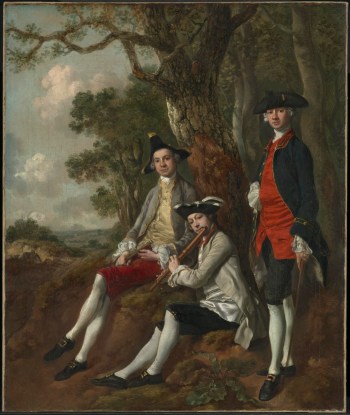
Thomas Gainsborough, Portrait of Peter Darnell Muilman, Charles Crokatt, and William Keable in a Landscape, ca.1750 (Tate T06746 / Gainsborough’s House).
Offering a multi-disciplinary discussion of Gainsborough’s early triple portrait, this project considers the painting as a depiction of polite and refined society, as a reflection of the growing wealth of a global mercantile elite, and as a ‘painting within a painting’ by an artist as renowned for his landscapes as he was his portraiture.
The mid-eighteenth-century ‘conversation piece’ Peter Darnell Muilman, Charles Crokatt and William Keable in a Landscape was painted by Thomas Gainsborough (1727–1788) when he was still making a name for himself as landscape and portrait painter. It was acquired jointly by Gainsborough’s House and Tate in 1993 and is regarded as a masterpiece of this early phase of his career. This project draws together expertise from the fields of art history, conservation, history of commerce and musicology to throw light on the social and cultural milieu that gave rise to the commission. It asks as many questions about the financial and social privileges of the portrait’s sitters as it does about Gainsborough himself, proposing new ways of understanding why Muilman, Crokatt and Keable presented themselves making music in the midst of a remote rustic landscape.
C O N T E N T S
• John Chu—The Painting and ‘Early Gainsborough’
• Huw David—Patronage: Mercantile Sitters
• Rebecca Hellen and Alexandra Gent—Painting the Picture
• John Chu—Portraiture, Conversation, Politeness
• Hannah French—Music, Refinement, Masculinity
• Hannah French and John Chu,—Baroque Flute Recording and Interview with Hannah French
• John Chu—Landscape, Imitation, Cosmopolitanism
• Peter Moore—Mercantile Culture and National Identity
• Acknowledgments
Contributors
John Chu, Assistant Curator, Pictures and Sculpture, National Trust
Huw T. David, Director of Development, Rothermere American Institute, University of Oxford
Rebecca Hellen, Paintings Conservator, Tate
Alexandra Gent, Paintings Conservator, Tate and Courtauld Institute of Art
Hannah French, musicologist and baroque flautist, Royal Academy of Music
Peter Moore, Research Curator, Gainsborough’s House
Exhibition | Classicisms
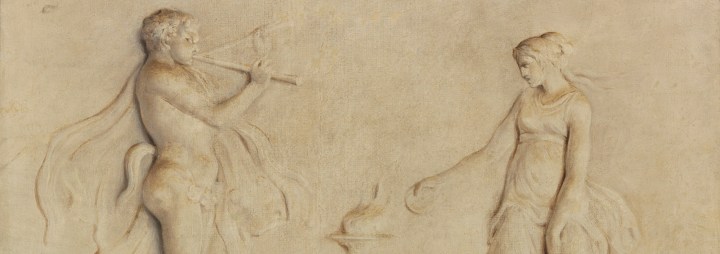
Tommaso Gherardini, Classical Relief (detail), 1765, oil on canvas (Chicago: Smart Museum of Art, Gift of the Collection of Edward A. and Inge Maser, 2008.23).
◊ ◊ ◊ ◊ ◊
From the Smart Museum of Art:
Classicisms
Smart Museum of Art, The University of Chicago, 16 February — 11 June 2017
Curated by Larry Norman and Anne Leonard
Classicism, as an aesthetic ideal, is often associated with a conventional set of rules founded on supposedly timeless notions such as order, reason, and decorum. As a result, it can be understood as rigid, outdated, or stodgy. But classicism is actually far from a stable concept—throughout history, it has given rise to more debate than consensus, and at times has been put to use for subversive ends.
Organized by the Smart Museum of Art and informed by an interdisciplinary planning process involving faculty members from across the University of Chicago, Classicisms explodes the idea of classicism as an unchanging ideal. The exhibition features 70 objects spanning diverse genres, eras, and media—paintings, ancient and modern sculpture, cast plaster replicas, and works on paper. Together with a scholarly catalogue, the exhibition traces classicism’s meanings across the centuries from varying artistic, cultural, and ideological perspectives to reveal a multifaceted concept with a complicated history.
◊ ◊ ◊ ◊ ◊
Distributed by The University of Chicago Press:
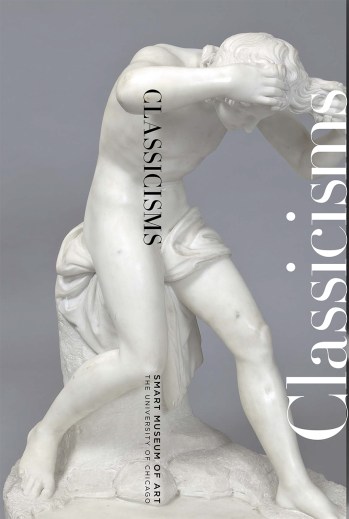 Larry F. Norman and Anne Leonard, ed., Classicisms (Chicago: Smart Museum of Art, The University of Chicago, 2017), 184 pages, ISBN: 978 0935 573572, $30. With essays by Richard T. Neer, Susanna Caviglia, Andrei Pop, Frederick A. de Armas, Benjamin Morgan, Jennifer Wild, Rebecca Zorach, and Glenn W. Most; and other contributions from Rainbow Porthé, Ji Gao, Esther Van Dyke, Caitlin Hoff, Rebecca Crisafulli, and James Nemiroff.
This volume explodes the idea of classicism as an unchanging ideal. Through essays and other contributions from an interdisciplinary group of scholars, it traces the shifting parameters of classicism from antiquity to the twentieth century, documenting an exhibition of seventy objects in various media from the collection of the Smart Museum of Art and other American and international institutions. With its impressive historical and conceptual reach—from ancient literature to contemporary race relations and beyond—this colorfully illustrated book is a dynamic exploration of classicism as a fluctuating stylistic and ideological category.
New Book | Mediterranean Encounters
From Penn State UP:
Elisabeth Fraser, Mediterranean Encounters: Artists between Europe and the Ottoman Empire, 1774–1839 (University Park: The Pennsylvania State University Press, 2017), 320 pages, ISBN: 978 0271 073200, $90.
 In this volume, Elisabeth Fraser shows that artists and the works they created in the Mediterranean during the late eighteenth and early nineteenth centuries were informed by mutual dependence and reciprocity between European nations and the Ottoman Empire. Her rich exploration of this vibrant cross-cultural exchange challenges the dominant interpretation of European relations with the East during the period, revealing a shared world of fluid and long-sustained interactions.
Voyagers to and from the Ottoman Empire documented their journeys in prints, paintings, and lavishly illustrated travelogues; many of these helped define Europe’s self-identified role as heir to Ottoman civilizations and bolstered its presence in the Islamic Mediterranean and beyond. Fraser finds that these works illuminate not only how travelers’ experiences abroad were more nuanced than the expansionist ideology with which they became associated, but also how these narratives depicted the vitality of Ottoman culture and served as extensions of Ottoman diplomacy. Ottomans were aware of and responded to European representations, using them to defend Ottoman culture and sovereignty. In embracing the art of both cultures and setting these works in a broader context, Fraser challenges the dominant historiographical tradition that sees Ottoman artists adopting European modes of art in a one-sided process of ‘Europeanization’.
Theoretically informed and rigorously researched, this cross-cultural approach to European and Ottoman art sheds much-needed critical light on the widely disseminated travel images of the era—important cultural artifacts in their own right—and provides a fresh and inviting understanding of the relationships among cultures in the Mediterranean during an era of increasing European expansionism.
Elisabeth A. Fraser is Professor of Art History at the University of South Florida and the author of Delacroix, Art, and Patrimony in Post-Revolutionary France.
◊ ◊ ◊ ◊ ◊
C O N T E N T S
List of Illustrations
Acknowledgments
Introduction: Interpreting Travel in the Ottoman Mediterranean
Part I: Power in Question
1 Reading Choiseul in the Gaps of the Orientalist Archive
2 In the Shadow of les Grands: Cassas’s Orientalist Self-Fashioning
Part II: Ottoman Culture Abroad
3 The Translator’s Art: Mouradgea d’Ohsson, Ottoman Dragoman in Paris
4 Miniatures in Black and White: Melling’s Istanbul
Part III: Contradictory Contact
5 Skin of Nation, Body of Empire: Louis Dupré in Ottoman Greece
6 A Painter’s Renunciation: Delacroix in North Africa
Postscript
Notes
Bibliography
Index
Exhibition | Images and Revolts in Book and Prints
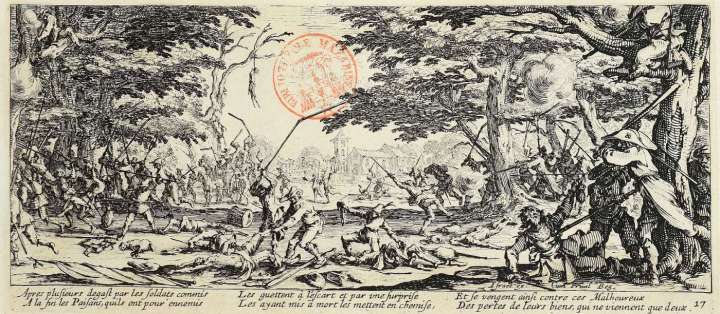
Now on view at the Bibliothèque Mazarine:
Images and Revolts in Book and Prints, 14th–Mid-18th Century
Images & Révoltes dans le livre et l’estampe, 14e–milieu du 18e siècle
Bibliothèque Mazarine, Paris, 14 December 2016 — 17 March 2017
Curated by Tiphaine Gaumy
Since the late Middle Ages, revolts and uprisings have marked European history. For a long time, historians believed that due to the extent of illiteracy, opponents had very few means of self-expression. However, the increase and widespread appearance of contesting images during periods of insurgency provides evidence of a visual and popular culture existing long before the French Revolution. Significant examples can be observed during the Bohemian Hussite movement in the 15th century or during the Peasants War in the Holy Roman Empire (1525).
An iconography of revolts emerged and spread, especially on ephemeral and scarcely preserved materials, but also in manuscripts, and very soon on new media. Opponents expressed their discontent through pamphlets and prints. In response, authorities tried to contain the dissemination of seditious images and to display, through other images, their own legitimacy and authority. This visual production raises many questions. How did rebels influence their creation? How did technical innovations (printing) or spiritual ones (reformation, iconoclasm…) determine their spread, form and content? Can historians trust them?
The exhibition features a broad variety of images, from rebellions of Flemish cities in the 14th century, to peasants revolts and religious troubles of the 15th and 16th centuries, uprisings and revolutions in the mid-17th century (in France, Portugal, Naples, the British Isles), and Jansenist protests in the 18th century. They form an unknown and astonishing visual legacy and a key testimony to understanding the political culture of Europe.
An exhibition organised by the Bibliothèque Mazarine, in collaboration with the ANR project Culture des révoltes et révolutions.
Stéphane Haffemayer, Alain Hugon, Yann Sordet, and Christophe Vellet, eds., Images & Révoltes dans le livre et l’estampe, XIVe–milieu du XVIIIe siècle (Paris: Bibliothèque Mazarine & Editions des Cendres, 2016), 315 pages, ISBN: 979 1090853 096, 38€.
Exhibition | House Style: Five Centuries of Fashion at Chatsworth

Mario Testino, Stella Tennant (in Junya Watanabe) with Her Grandmother the Duchess of Devonshire (in Oscar de la Renta), from British Vogue (December 2006). © Mario Testino.
◊ ◊ ◊ ◊ ◊
Press release (via Art Daily):
House Style: Five Centuries of Fashion at Chatsworth
Chatsworth House, Derbyshire, 25 March — 22 October 2017
Curated by Hamish Bowles
In 2017 Chatsworth will present its most ambitious exhibition to date, exploring the history of fashion and adornment: House Style: Five Centuries of Fashion at Chatsworth. Hamish Bowles, International Editor-at-Large at American Vogue, will curate this landmark show with creative direction and design by Patrick Kinmonth and Antonio Monfreda, the duo behind some of the most memorable fashion exhibitions of recent years. House Style will give unprecedented insight into the depth of the Devonshire Collection and the lives of renowned style icons from Georgiana, Duchess of Devonshire to Stella Tennant.
 The exhibition will bring to life the captivating individuals from the Cavendish family, including Bess of Hardwick, one of the most powerful women of the 16th century; the 18th-century ‘Empress of Fashion’ Georgiana, Duchess of Devonshire; and Adele Astaire, the sister and dance partner of Fred Astaire. Deborah Devonshire and Nancy Mitford (two of the Mitford sisters), model Stella Tennant, and John F. Kennedy’s sister ‘Kick’ Kennedy will also be central to the show. Telling the rich history of both international style and the Devonshire Collection, the exhibition will demonstrate the power of fashion to illuminate these extraordinary characters.
House Style will be woven throughout one of Britain’s finest stately homes, including the largest and grandest room of the Baroque house, the Painted Hall, the Chapel, and the lavishly decorated State Music Room. Layering art history, fashion, jewellery, archival material, design, and textiles, the exhibition will be organised by theme, including Coronation Dress, The Devonshire House Ball, Bess of Hardwick and the Tudor influence, The Georgiana Effect, Ducal Style, Country Living, The Circle of Life, and Entertaining at Chatsworth.
Highlights of the exhibition will include exceptional couture designed by Jean Phillipe Worth and Christian Dior, together with influential contemporary garments from designers such as Gucci, Helmut Lang, Margiela, Vivienne Westwood, Erdem, Alexander McQueen, Christopher Kane, and Vetements. The show will also feature personal family collections, including items belonging to the current Duke and Duchess of Devonshire, such as a Givenchy bolero worn on the Duchess’s wedding day. These pieces will be displayed alongside livery, uniforms, coronation robes, and fancy-dress costumes, demonstrating the varying breadth of fashion and adornment from the collection throughout the generations.
Important artworks will also be on display, including rare costume designs from the 1660s by Inigo Jones, Surveyor to the King’s Works and one of the most notable architects of 17th-century England. Contemporary artist T. J. Wilcox will be showing his intimate filmed portrait of Adele Astaire, which contains the only extant film of the star, found at Chatsworth in 2015.
Hamish Bowles commented: “To be let loose in the wardrobe rooms, the gold vaults, the muniment room, and the closets, cupboards, and attics of Chatsworth, in search of sartorial treasures has been a dream come true for me. Chatsworth is a real treasure house and the characters of generations of Cavendish family members who have peopled its rooms and gardens and landscapes is revealed as vividly through their choice of clothing and adornments, as through the canvases and lenses of the great artists and photographers who have memorialised them through the centuries. In House Style, we hope to bring these compelling and fascinating people and the very different worlds they inhabited to life, through the clothes and the jewels that they wore.”
Alessandro Michele, Creative Director at Gucci, commented: “Chatsworth is unlike anywhere else in the world—a place full of charm, history, and rituals. It is a piece of England, of Europe, and the contemporary world, all at the same time. You can see history everywhere, yet everything is alive.
This exhibition proves how much historical objects are an incredible source of inspiration for creating the present. Thus far the house has been speaking, now House Style gives a voice to the wardrobes of its inhabitants and guests.”
Patrick Kinmonth commented: “The patina of Chatsworth House itself is one of the greatest treasures of the collections, and looking at the surfaces and materials of clothes worn over hundreds of years in these very rooms proves to be a novel way to rediscover both the house and the wonderful things in it. Clothes and personal objects (especially jewels), in turn bring ghosts and visions of remarkable characters to the surface of the place, and we hope to conjure the presence of these remarkable men and women who have animated, loved and created this unique ensemble of great art, furniture, and personal style in its many layers.”
Hamish Bowles, ed., House Style: Five Centuries of Fashion at Chatsworth (New York: Rizzoli, 2017), 192 pages, ISBN: 978 0847 858965, $45. With a foreword by the Duke of Devonshire, an introduction by the Countess of Burlington, and essays and texts by Hamish Bowles, Kimberly Chrisman-Campbell, Charlotte Mosley, Sarah Mower, Diana Scarisbrick, and Lady Sophia Topley.
New Book | The Jacobites and Their Drinking Glasses
Charles Edward Stuart (Bonnie Prince Charlie) was born on this day (31 December) in 1720; whether you harbor Jacobite sympathies or simply anticipate ringing in the new year with a toast, these glasses might provide some inspiration. Happy New Year! –CH
From ACC Distribution:
Geoffrey B. Seddon, The Jacobites and Their Drinking Glasses, third edition (Woodbridge: Antique Collectors Club, 2016), 208 pages, ISBN: 978-1851497959, £35 / $65.
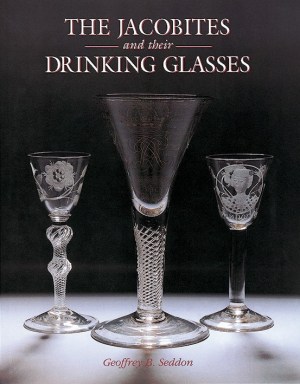 This book, first published in 1995, remains the most detailed study of Jacobite glass ever undertaken, and the glasses are described against the compelling history of the Jacobite movement in the 18th century. Hundreds of detailed photographs of the engravings help to authenticate the genuine glasses in a field well known to be infested with fakes. This third edition follows the same format as previous editions but is published in a more compact form, replete with an additional chapter.
The diamond point engraved ‘Amen’ glasses are, without question, the most valuable of all Jacobite glasses and indeed one of the most valuable of any of the 18th-century drinking glasses. Further studies have revealed that the ‘Amen’ glasses were engraved by the famous Scottish line engraver, Sir Robert Strange, and the evidence for this is provided in the final chapter.
Geoffrey B. Seddon, a retired medical practitioner, has been a member of the Glass Circle for over 40 years and has contributed papers to its publications and to Country Life magazine.










 Enfilade
leave a comment