New Book | ‘Drawing on Copper’: The Basire Family
From the newsletter of the Society of Antiquaries of London, Salon 379 (7 February 2017) . . .
Richard Goddard, ‘Drawing on Copper’: The Basire Family of Copper-Plate Engravers and their Works (Maastricht, 2017), 332 pages, ISBN: 978 946159 5911.
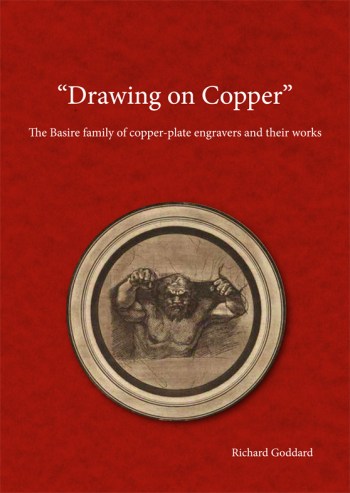
Julian Pooley FSA writes with news of a book about copper-plate engraving. Four generations of the Basire family of skilled printmakers, draughtsmen, and engravers, spanning 1730–1883, were celebrated for their skill in drawing, on copper and stone, accurate representations of monuments and antiquities. Their pictures can be found throughout Archaeologia, Vetusta Monumenta, and many of the most celebrated works of 18th- and 19th-century topography and antiquarianism (James Basire, 1730–1802, was engraver to the Society of Antiquaries for 20 years). Richard Goddard, a descendent of the Basire family, has published a meticulously researched and beautifully written study of their careers, interests and influence called ‘Drawing on Copper’: The Basire Family of Copper-Plate Engravers and their Works. It is beautifully illustrated by over 70 plates, says Pooley, and has six chapters assessing the medium of engraving and careers of successive members of the Basire family. Details can be found on the author’s website, where a PDF of the book can be downloaded.
New Book | Art and Celebrity
From Penn State University Press:
Heather McPherson, Art and Celebrity in the Age of Reynolds and Siddons (University Park: The Pennsylvania State University Press, 2017), 272 pages, ISBN: 978 0271 074078, $90.
 In this volume, Heather McPherson examines the connections among portraiture, theater, the visual arts, and fame to shed light on the emergence of modern celebrity culture in eighteenth-century England. Popular actors in Georgian London, such as David Garrick, Sarah Siddons, and John Philip Kemble, gave larger-than-life performances at Drury Lane and Covent Garden; their offstage personalities garnered as much attention through portraits painted by leading artists, sensational stories in the press, and often-vicious caricatures. Likewise, artists such as Joshua Reynolds and Thomas Lawrence figured prominently outside their studios—in polite society and the emerging public sphere. McPherson considers this increasing interest in theatrical and artistic celebrities and explores the ways in which aesthetics, cultural politics, and consumption combined during this period to form a media-driven celebrity culture that is surprisingly similar to celebrity obsessions in the world today.
This richly researched study draws on a wide variety of period sources, from newspaper reviews and satirical pamphlets to caricatures and paintings by Reynolds and Lawrence as well as Thomas Gainsborough, George Romney, and Angelica Kauffman. These transport the reader to eighteenth-century London and the dynamic venues where art and celebrity converged with culture and commerce. Interweaving art history, history of performance, and cultural studies, Art and Celebrity in the Age of Reynolds and Siddons offers important insights into the intersecting worlds of artist and actor, studio and stage, high art and popular visual culture.
Heather McPherson is Professor of Art History at the University of Alabama at Birmingham.
C O N T E N T S
List of Illustrations
Acknowledgments
Introduction: Studio and Stage in the Age of Reynolds and Siddons
1 Garrick, Reynolds, and the Apotheosis of Performance
2 Portraiture, Public Display, and the Politics of Representation
3 Staging Celebrity: Siddons and Tragic Pallor
4 Targeting Celebrity: Caricature and Cultural Politics
5 Artistic Afterlives and the Historiography of Fame
Notes
Selected Bibliography
Index
Exhibition | In the Name of the Lily: French Printmaking
Press release for the exhibition now on view in Bremen:
In the Name of the Lily: French Printmaking in the Age of Louis XIV
Im Zeichen der Lilie: Französische Druckgraphik zur Zeit Ludwigs XIV
Kunsthalle Bremen, 1 February — 28 May 2017

Pierre Drevet after Hyacinthe Rigaud, Portrait of Louis XIV, 1714/15, 39 × 52 cm (Kunsthalle Bremen).
This exhibition presents outstanding French prints from 1650 to 1715, an era in which the magnificence of Absolutism reached its climax. During the reign of Louis XIV, a principal task of the fine arts was to spread the glory and splendour of the Sun King as a statesman, general, and patron far beyond the borders of his own country. Prints were especially suited to this purpose. They were easy to transport; they could be produced in great numbers; they were sold individually or sumptuously bound together; and they could unequivocally serve political aspirations. Engravings after paintings in the King’s collections, views of his palaces, and images of his military victories advanced them to highly respected prestige objects.
In 1660, Louis XIV freed engravers from the restrictions of the guild system and elevated them to the rank of free artists. In 1663 they were allowed to enter the Royal Academy, which provided standardized training and thereby ensured an extraordinarily high level of technical skills. The precision and inventiveness of engravers such as Gérard Edelinck, Robert Nanteuil, Pierre Drevet, and Jean Audran—who used subtle graduated tonality, sophisticated lighting, and elaborately worked surfaces—contributed significantly to the formation of a French style that set the standard for later printmaking.
The engraver Anton Würth (b. 1957), who has explored the aesthetic quality of 17th-century French engravings in depth, has been invited to make a guest contribution.
Only a few minutes’ walk away from Bremen’s central market square, the Kunsthalle Bremen’s building has stood in the Wall gardens for over 150 years. The gallery’s private owner is to this day is the Kunstverein in Bremen (the Bremen Art Association), founded by the citizens of Bremen in 1823, making it one of the oldest art associations in Germany. With more than 9,000 members, it counts today one of the strongest memberships in the Federal Republic of Germany. As the city’s most distinguished art and cultural institution, its impact extends far beyond the region. Generous endowments, private donations, bequests by friends of the arts and allocations from the City of Bremen municipality form the basis for the gallery’s successful pursuit of its historic activity. Over the centuries, a rich and diverse collection has been assembled, containing outstanding paintings and sculptures as well as precious holdings of graphic art.
◊ ◊ ◊ ◊ ◊
Christien Melzer and Anton Würth, Im Zeichen der Lilie: Französische Druckgraphik zur Zeit Ludwigs XIV (Bremen: Kunstverein Bremen, 2017), 96 pages, ISBN: 978-3935127332.
 Der französische Kupferstich erlebte zwischen 1650 und 1715 eine besondere Blüte. Ausstellung und Katalog Im Zeichen der Lilie. Französische Druckgraphik zur Zeit Ludwigs XIV. stellen vom 1. Februar bis 28. Mai 2017 erstmals in der Kunsthalle Bremen eine Auswahl von rund 70 Kupferstichen und Radierungen von 25 Künstlern des Barock vor. Die Zeitspanne umfasst in etwa die Regierungszeit des französischen Sonnenkönigs, Ludwig XIV., der alle Künste der Staatsräson unterordnete. In der Druckgraphik erkannte er ein Massenmedium par excellence, um seinen Ruhm über die Grenzen Frankreichs hinaus zu verbreiten und seine Macht zu festigen. Zahlreiche, teils monumentale Kupferstiche in ausgezeichneter Qualität und hervorragender Erhaltung spiegeln die Machtentfaltung des französischen Monarchen. Auf höchstem technischem Niveau zeigen sie die Besitztümer des Königs, seien es Gemälde, Tapisserien, Fresken oder Gebäude. Dramatische Schlachtenbilder illustrieren die militärischen Erfolge des Königs, brillante Porträts hn unterordnete. In der Druckgraphik erkannte er ein Massenmedium par excellence, um seinen Ruhm über die Grenzen Frankreichs hinaus zu verbreiten und seine Macht zu festigen. Zahlreiche, teils monumentale Kupferstiche in ausgezeichneter Qualität und hervorragender Erhaltung spiegeln die Machtentfaltung des französischen Monarchen. Auf höchstem technischem Niveau zeigen sie die Besitztümer des Königs, seien es Gemälde, Tapisserien, Fresken oder Gebäude. Dramatische Schlachtenbilder illustrieren die militärischen Erfolge des Königs, brillante Porträts halten die Subjekte seines Staatswesens für die Ewigkeit fest, prachtvolle Allegorien führen seine Tugenden vor Augen. Die präzisen und zugleich höchst sinnlichen Stiche von Gérard Edelinck, Robert Nanteuil, Pierre Drevet oder Jean Audran zeichnen sich durch subtil abgestufte Tonalitäten, eine raffinierte Lichtregie und differenziert ausgearbeitete Oberflächen aus und etablierten einen genuin französischen Stil, der geschmacksbildend für ganz Europa werden sollte.
New Book | Battlefield Emotions, 1500–1800
From Palgrave Macmillan:
Erika Kuijpers and Cornelis van der Haven, eds., Battlefield Emotions, 1500–1800: Practices, Experience, Imagination (Basingstoke: Palgrave Macmillan, 2016), 303 pages, ISBN: 978 1137 564894, $109.
 This book explores changes in emotional cultures of the early modern battlefield. Military action involves extraordinary modes of emotional experience and affective control of the soldier, and it evokes strong emotional reactions in society at large. While emotional experiences of actors and observers may differ radically, they can also be tightly connected through social interaction, cultural representations and mediatisation. The book integrates psychological, social and cultural perspectives on the battlefield, looking at emotional behaviour, expression and representation in a great variety of primary source material. In three steps it discusses the emotional practices in the army, the emotional experiences of the individual combatant and the emotions of the mediated battlefield in the visual arts.
Erika Kuijpers teaches cultural history at VU University, the Netherlands. Her previous work concerned the social history of early modern migration and labour relations. From 2008 to 2013 she worked at Leiden University, researching memories of the Dutch Revolt, as part of the VICI research project Tales of the Revolt: Memory, Oblivion and Identity in the Low Countries, 1566–1700. She is co-editor of the volume Memory before Modernity: Practices of Memory in Early Modern Europe (2013) and is working on a monograph about the way early modern witnesses and victims of war dealt with traumatic memories.
Cornelis van der Haven is a literary historian who has published on Dutch and German theatre and literature in the 17th and 18th centuries, with a strong focus on the role of literary texts in shaping cultural and social identities. He lectures at the Literary Department of Ghent University, Belgium.
C O N T E N T S
1 Erika Kuijpers and Cornelis van der Haven, Battlefield Emotions 1500–1800: Practices, Experience, Imagination
2 Cornelis van der Haven, Drill and Allocution as Emotional Practices in Seventeenth-Century Dutch Poetry, Plays, and Military Treatises
3 Andreas Bähr, Magical Swords and Heavenly Weapons: Battlefield Fear(lessness) in the Seventeenth Century
4 Bettina Noak, Emotions, Imagination, and Surgery: Wounded Warriors in the Work of Ambroise Paré and Johan van Beverwijck
5 Ilya Berkovich, Fear, Honour and Emotional Control on the Eighteenth-Century Battlefield
6 Johan Verberckmoes, Early Modern Jokes on Fearing Soldiers
7 Brian Sandberg, ‘His Courage Produced More Fear in His Enemies than Shame in His Soldiers’: Siege Combat and Emotional Display in the French Wars of Religion
8 Marian Füssel, Emotions in the Making: The Transformation of Battlefield Experiences during the Seven Years’ War (1756–63)
9 Ian Germani, Mediated Battlefields of the French Revolution and Emotives at Work
10 Mary Favret, Whose Battlefield Emotion?
11 Lisa De Boer, The Sidelong Glance: Tracing Battlefield Emotions in Dutch Art of the Golden Age
12 Valerie Mainz, Deflecting the Fire of Eighteenth-Century French Battle Painting
13 Philip Shaw, Picturing Valenciennes: Philippe-Jacques de Loutherbourg and the Emotional Regulation of British Military Art in the 1790s
14 Dorothee Sturkenboom, Battlefield Emotions in Early Modern Europe: Trends, Key Issues, and Blind Spots
New Book | Days of Glory? Imaging Military Recruitment
From Palgrave Macmillan:
Valerie Mainz, Days of Glory? Imaging Military Recruitment and the French Revolution (Basingstoke, Palgrave Macmillan, 2016), 298 pages, ISBN 978 1137 542946, $90.
 This book examines a range of visual images of military recruitment to explore changing notions of glory, or of gloire, during the French Revolution. It raises questions about how this event re-orientated notions of ‘citizenship’ and of service to ‘la Patrie’. The opening lines of the Marseillaise are grandly declamatory: Allons enfants de la Patrie/le jour de gloire est arrivé! or, in English: Arise, children of the Homeland/The day of glory has arrived! What do these words mean in their later eighteenth-century French context? What was gloire and how was it changed by the revolutionary process? This military song, later adopted as the national anthem, represents a deceptively unifying moment of collective engagement in the making of the modern French nation. Valerie Mainz questions this through a close study of visual imagery dealing with the issue of military recruitment. From neoclassical painting to popular prints, such images typically dealt with the shift from civilian to soldier, focusing on how men, and not women, were called to serve the Homeland.
Valerie Mainz is Senior Lecturer in the School of Fine Art, History of Art and Cultural Studies at the University of Leeds, UK, having previously worked in both the commercial and subsidised sectors of the theatre. She has curated exhibitions on the French Revolution at the University Gallery, University of Leeds in 1998, at the Musée de la Révolution française, Vizille in 1999 and, together with Richard Williams, at the Henry Moore Institute, Leeds in 2006.
C O N T E N T S
Introduction
Signing Up before the Revolution
Transforming
Recruitment and Revolution before Thermidor
Fighting Women
Fame’s Two Trumpets
New Book | Staging Blackness and Performing Whiteness
From Routledge:
Wendy Sutherland, Staging Blackness and Performing Whiteness in Eighteenth-Century German Drama (New York: Routledge, 2016), 272 pages, ISBN: 978 14094 24024, $150.
 Focusing on eighteenth-century cultural productions, Wendy Sutherland examines how representations of race in philosophy, anthropology, aesthetics, drama, and court painting influenced the construction of a white bourgeois German self. Sutherland positions her work within the framework of the transatlantic slave trade, showing that slavery, colonialism, and the triangular trade between Europe, West Africa, and the Caribbean function as the global stage on which German bourgeois dramas by Friedrich Wilhelm Ziegler, Ernst Lorenz Rathlef, and Theodor Körner (and a novella by Heinrich von Kleist on which Körner’s play was based) were performed against a backdrop of philosophical and anthropological influences. Plays had an important role in educating the rising bourgeois class in morality, Sutherland argues, with fathers and daughters offered as exemplary moral figures in contrast to the depraved aristocracy. At the same time, black female protagonists in nontraditional dramas represent the boundaries of physical beauty and marriage eligibility while also complicating ideas of moral beauty embodied in the concept of the beautiful soul. Her book offers convincing evidence that the eighteenth-century German stage grappled with the representation of blackness during the Age of Goethe, even though the German states were neither colonial powers nor direct participants in the slave trade.
Wendy Sutherland is Associate Professor of German at New College of Florida.
C O N T E N T S
Introduction
Race in Eighteenth-Century Germany
Slavery, Colonialism, and the Eighteenth-Century Global Stage
‘Looking at the Overlooked’: Stage Properties and the Table in Karl Lessing’s Die Mätresse (1780)
Excursus: The Court Moor and Eighteenth-Century Court Painting
The Construction of Whiteness in the Traditional German Bourgeois Drama
Race, Doubles, and Foils: Staging Blackness in Friedrich Wilhelm Ziegler’s Die Mohrinn (1801)
Race, Homosocial Desire, and the Black in Ernst Lorenz Rathlef’s Die Mohrinn zu Hamburg (1775)
Reading in the Dark? Racial Hierarchy and Miscegenation in Heinrich von Kleist’s Die Verlobung in St. Domingo (1811) and Theodor Körner’s Toni (1812)
Epilogue
Bibliography
Index
New Book | Artistes femmes
From CNRS:
Séverine Sofio, Artistes femmes: La parenthèse enchantée, XVIIIe–XIXe siècles (Paris, CNRS, 2016), 384 pages, ISBN: 978 2271 091918, 25€.
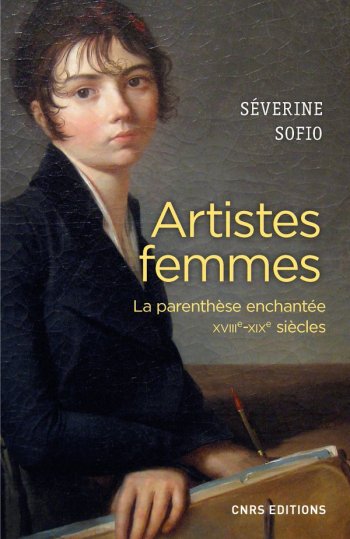 Entre 1750 et 1850, l’univers des beaux-arts connaît de profondes mutations, dont l’une des conséquences est la banalisation d’une image positive de la dame artiste. Progressivement, des barrières s’abaissent, des contraintes se desserrent et la pratique de la peinture est rendue plus accessible aux femmes. S’ouvre alors une période de créativité foisonnante associée aux noms—parfois oubliés aujourd’hui—d’Elisabeth Vigée-Lebrun, Adélaïde Labille-Guiard, Marie-Guillemine Benoist, Marguerite Gérard, Constance Mayer, Victoire Jaquotot, Lizinka de Mirbel, Rosa Bonheur…
Pourquoi les artistes femmes, à ce moment précis de l’histoire, ont-elles bénéficié de l’intérêt de leurs contemporains et de conditions de travail relativement égalitaires ? Pour saisir ce phénomène, Séverine Sofio réintègre les artistes des deux sexes dans la réalité quotidienne de leur travail de création.
Ni recueil d’analyses d’œuvres, ni histoire des femmes dans l’art, cet ouvrage traite de la pratique des beaux-arts, de son organisation et de ses réalités professionnelles, institutionnelles et économiques. Cette suspension relative de l’infériorisation des femmes dans les beaux-arts n’en demeure pas moins provisoire : si la parenthèse s’ouvre timidement dans les dernières décennies de l’Ancien Régime, elle se referme progressivement avant le milieu du siècle suivant.
Sociologue, diplômée de l’École du Louvre, Séverine Sofio est chargée de recherche au CNRS. Elle a notamment co-dirigé, avec Wenceslas Lizé et Delphine Naudier, Les Stratèges de la notoriété. Intermédiaires et production de la valeur dans les univers artistiques (2014).
New Book | Tudor Place: America’s Story Lives Here

The north facade and back gardens of Tudor Place, Washington, D.C. (Georgetown). The house was built in 1816–17 by Thomas and Martha Parke Custis Peter with William Thornton (Photo: Wikimedia Commons, December 2011).
◊ ◊ ◊ ◊ ◊
From The White House Historical Association:
Leslie Buhler, ed., with photography by Bruce White, Tudor Place: America’s Story Lives Here (Washington, D.C., The White House Historical Association, 2016), 304 pages, ISBN: 978 1931 917568 $50.
 Released to mark the bicentennial of Tudor Place, this new title is the first comprehensive record of this important National Historic Landmark in the Georgetown neighborhood of Washington, D.C. Two grand houses were under construction in the young Federal City in 1816: one the President’s House, reconstructed after it was burned by the British in 1814, and the other Tudor Place, an elegant mansion rising on the heights above Georgetown. The connection between these two houses is more than temporal, as they were connected through lineage and politics for generations. The builders of Tudor Place were Thomas and Martha Parke Custis Peter, Martha Washington’s granddaughter. In the 1790s George Washington had been a frequent guest at the Peters’ townhouse when he was in the nascent Federal City, attending to its planning and selecting sites for the U.S. Capitol and the President’s House. In 1817, when President James Monroe moved back into the reconstructed President’s House following the fire of 1814, the Peters were completing their own grand home, Tudor Place, designed in concert with their friend, Dr. William Thornton, architect for the first U.S. Capitol Building. The White House and Tudor Place each represent the spirit and aspirations of the early Republic. Little more than two miles apart, each survives as a national architectural landmark. While the White House is perhaps the most well known building in the world, Tudor Place remained a family home until 1983 and very private, although the Peters welcomed some of the nation’s foremost leaders as their guests and were themselves guests at the White House.
Now a historic house and garden museum (open to the public since 1988), the house remains as the Peters lived in it, preserving spaces and belongings of many eras while adapting their home and landscape to contemporary fashion and functions. This year, as Tudor Place turns 200, this lavishly illustrated book—the first definitive history of the house and its collection—takes us into the house to explore its rooms, gardens, archival collections, and such rare artifacts as one of only three surviving letters from George to Martha Washington.
Leslie L. Buhler served as Executive Director of Tudor Place for 15 years, retiring in 2015.
◊ ◊ ◊ ◊ ◊
C O N T E N T S
• Joseph Ellis, Introduction
• Leslie Buhler, The Custis-Peter Family of Georgetown
• William C. Allen, An Architectural History of Tudor Place
• Patricia Marie O’Donnell, The Landscape of Tudor Place
• Erin Kuykenall and Leslie Buhler, Living at Tudor Place
New Book | Black Georgetown Remembered
From Georgetown UP:
Kathleen Menzie Lesko, Valerie Babb, and Carroll R. Gibbs, Black Georgetown Remembered: A History of Its Black Community from the Founding of ‘The Town of George’ in 1751 to the Present Day (Washington, D.C.: Georgetown University Press, 2016), 232 pages, ISBN: 978 1626 163263, $28.
 First published in 1991, Black Georgetown Remembered chronicles and celebrates the rich but little-known history of the Georgetown black community from the colonial period to the present. Drawing on primary sources, including oral interviews with past and current residents and extensive research in church and historical society archives, the authors record the hopes, dreams, disappointments, and successes of a vibrant neighborhood as it persevered through slavery and segregation, war and peace, prosperity and depression.
This 25th anniversary edition of Black Georgetown Remembered—with a new introduction by Kathleen Menzie Lesko and a foreword by Maurice Jackson—is completely redesigned and features high-quality scans of more than two hundred illustrations, including portraits of prominent community leaders, sketches, maps, and nineteenth-century and contemporary photographs. Kathleen Menzie Lesko’s new introduction describes the impact of this book.
Black Georgetown Remembered is a compelling and inspiring journey through more than two hundred years of history. It invites readers to share in the lives, dreams, aspirations, struggles, and triumphs of real people, to join them in their churches, at home, and on the street, and to consider how the unique heritage of this neighborhood intersects and contributes to broader themes in African American and Washington, DC, history and urban studies.
Kathleen Menzie Lesko is a former scholar-in-residence at the Folger Shakespeare Library and current research scholar at the Huntington Library in San Marino, California.
Valerie Babb is the Franklin Professor of English and director of the Institute for African American Studies at the University of Georgia.
Carroll R. Gibbs is a professional historian, lecturer, and author of numerous works on African American history.
New Book | Les progrès de l’industrie perfectionnée
This collection of essays grows out of the conference 2014, Workshops and Manufactures in the Years between the French Revolution and the Napoleonic Empire, 1789–1815. From PUM:
Natacha Coquery, Jörg Ebeling, Anne Perrin Khelissa, Philippe Sénéchal, eds., «Les progrès de l’industrie perfectionnée»: Luxe, arts décoratifs et innovation de la Révolution française au Premier Empire (Toulouse: Presses Universitaires du Midi, 2017), 200 pages, ISBN: 978 28107 04835, 22€.
 À la charnière entre les XVIIIe et XIXe siècles, entre la réunion des États généraux et la fin du Premier Empire, vingt-cinq ans s’écoulent pendant lesquels bouleversements politiques, économiques, sociaux et culturels créent un contexte d’instabilité pour le secteur du luxe et du demi-luxe français. Les ateliers et les manufactures sont confrontés à des conditions matérielles et organisationnelles difficiles. Le manque de matières premières, la détérioration des finances et la diminution du personnel en raison du départ des jeunes hommes aux armées ont un impact négatif sur la production artisanale. L’incertitude générale que représente cette période d’instabilité politique et de conflits armés n’empêche pourtant pas l’émergence de modes. De nouveaux marchés s’ouvrent et offrent de riches opportunités aux artistes et artisans pour diversifier et élargir leurs créations.
Souvent considérée comme un temps de rupture, en particulier dans le domaine du luxe dont elle remet en cause les fondements, la Révolution française apparaît au contraire comme le ferment d’une évolution vers l’innovation et l’industrialisation. Pluridisciplinaire, croisant l’histoire de l’art, l’histoire sociale, l’histoire économique, l’histoire culturelle et l’histoire des techniques, le présent ouvrage explore les conditions du changement et offre une approche plurielle des arts du décor.
T A B L E D E S M A T I È R E S
Remerciements
Introduction générale, Jean-François Belhoste, Philippe Bordes, Natacha Coquery, Jörg Ebeling, Anne Perrin Khelissa et Philippe Sénéchal
Partie I | L’État: Rôle et intervention
• Thomas Le Roux, La chimie, support du développement de l’industrie perfectionnée sous la Révolution et l’Empire
• Christiane Demeulenaere-Douyère, Le luxe sous l’Empire, ou la question des matières premières « indigènes »
• Camilla Murgia, The Crafty Link: Fine Arts and Industrial Exhibitions under the Consulate and the Empire
• Justin Beaugrand-Fortunel, Le mobilier de campagne de Napoléon ier: L’artisanat au service de l’Empereur
Partie II | Les secteurs de production: Organisation et fonctionnement
• Marie-Agnès Dequidt, L’horlogerie parisienne pendant la Révolution et l’Empire: Continuer à tourner dans un monde en bouleversement
• Élodie Voillot, Des canons aux statuettes: Les fabricants de bronze parisiens au début du xixe siècle
• David Celetti, Filer le luxe. Travail domestique, manufactures et usines dans la France révolutionnaire
• Stéphane Piques, L’organisation de la production dans l’industrie céramique sous la Révolution et l’Empire: La nébuleuse faïencière de Martres-Tolosane (Haute-Garonne)
Partie III | Les œuvres et les décors: Création et aménagement
• Bernard Jacqué, Des décors de luxe en papier peint pendant la Révolution française
• Valeria Mirra, Labor omnia vincit: La manufacture Piranesi de vases et ornements en terre cuite de Mortefontaine
• Iris Moon, Immutable Décor: Post-Revolutionary Luxury in the Platinum Cabinet at Aranjuez
• Ludmila Budrina, Lapidaires parisiens au service de Nicolas Demidoff: La collection d’objets en bronze doré et malachite avec mosaïques en relief de pierres dures réalisés par Thomire (d’après des documents inédits et les collections européennes)
• Hans Ottomeyer, Innovation by Design as Strategy for Luxury Goods
Index général
Bibliographie
Présentation des auteurs










 Enfilade
leave a comment