New Book | William Hogarth: A Complete Catalogue of the Paintings
From Yale UP:
Elizabeth Einberg, William Hogarth: A Complete Catalogue of the Paintings (London: The Paul Mellon Centre for Studies in British Art, 2016), 432 pages, ISBN: 978 030 0221749, £95 / $150.
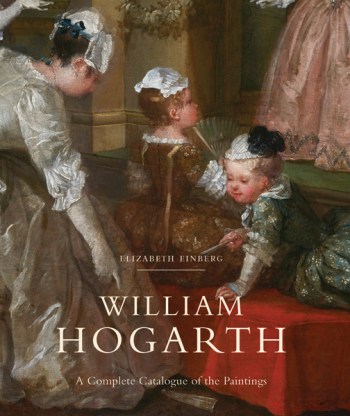 William Hogarth (1697–1764) was among the first British-born artists to rise to international recognition and acclaim and to this day he is considered one of the country’s most celebrated and innovative masters. His output encompassed engravings, paintings, prints, and editorial cartoons that presaged western sequential art.
This comprehensive catalogue of his paintings brings together over twenty years of scholarly research and expertise on the artist and serves to highlight the remarkable diversity of his accomplishments in this medium. Portraits, history paintings, theater pictures, and genre pieces are lavishly reproduced alongside detailed entries on each painting, including much previously unpublished material relating to his oeuvre. This deeply informed publication affirms Hogarth’s legacy and testifies to the artist’s enduring reputation.
Elizabeth Einberg is a senior research fellow at the Paul Mellon Centre for Studies in British Art and former curator at Tate Britain.
Exhibition | The Frick Collects: From Rubens to Monet

Arthur Devis, Sir Joshua Vanneck and His Family, 1752, oil on canvas, 146 × 142 cm
(Pittsburgh: Frick Art & Historical Center, 1984.24)
◊ ◊ ◊ ◊ ◊
Now on view at The Frick Pittsburgh:
The Frick Collects: From Rubens to Monet
Frick Art & Historical Center, Pittsburgh, 29 October 2016 — 14 May 2017
Take a look at the Frick in a new way in this exhibition, which, for the first time tells the story of the Frick through its collection. From Henry Clay Frick’s early purchases, to his daughter Helen’s collecting interests, through to the acquisitions that have been made by the museum in recent years, visitors will see and learn about the enduring legacy of the Frick family as art collectors. Objects will be brought together to tell a unified story—a story that doesn’t stop with Henry Clay Frick’s early purchases for Clayton, but continues, looking at both Henry and Helen as the collectors who have shaped the Frick Art & Historical Center’s holdings.
The earliest acquisitions in the collection date to Henry Clay Frick’s bachelor days. Before his marriage (and for the first months after his marriage) he lived in downtown Pittsburgh at the fashionable Monongahela House. He bought his first paintings and decorative objects for his rooms there: an elaborate rococo revival clock and candelabra set purchased through Tiffany’s, an ebonized cabinet, and his first documented painting purchase, a landscape by local artist George Hetzel.
When they moved into Clayton, Henry Clay Frick and his wife furnished it as many young couples do—most of the purchases were new, fashionable and of the period. Frick had met his wife, Adelaide Howard Childs (1859–1931) in February 1881. Adelaide was the sixth daughter of the wealthy Pittsburgh Childs family, who were manufacturers and importers of shoes and boots. For young couples during America’s Gilded Age like the Fricks, art collecting was not simply a way to exercise taste and create a suitable environment—although these were important considerations. More subtly the right objects gave their owner a sense of history and pedigree. Collecting was a personal pleasure and an indicator of status, discernment and good taste.
The rise in American collecting of this period also coincided with the establishment of the first museums in the country, including the Wadsworth Athenaeum of Hartford, Connecticut in 1842, the Museum of Fine Arts, Boston in 1870, New York’s Metropolitan Museum of Art in 1872, and in 1896, Pittsburgh’s Carnegie Institute. As the century progressed, forming collections and bequeathing them to the public became one way to put wealth and the accumulation of a collection to public service.
It was Helen Clay Frick’s vision that led to the restoration of Clayton as a house museum. The Frick Art Museum, which was opened to the public in 1970 just a block south of Clayton, was built primarily for the collection she developed, rather than the one she inherited. Helen even had the family cars and carriages carefully preserved and brought back to Pittsburgh from the family’s Massachusetts summer estate.
The Frick Art Museum opened in 1970 with its main galleries devoted to Helen’s greatest interests: early Italian Renaissance paintings and eighteenth-century French fine and decorative art. Since Helen’s death in 1984, the collection has continued to develop—through generous donations and acquisitions that reflect the same quality as that evinced by the founding collection. Through the foresight of Helen Clay Frick who valued Pittsburgh, and who understood that her youth at Clayton was one of unique privilege—not simply financially, but aesthetically—these collections are the heart of the experience at the Frick Pittsburgh.
The Frick Collects is accompanied by a new, fully-illustrated guide to the collection published by Scala, specialists in working with museums to produce beautiful publications. The publication is generously underwritten by The Richard C. von Hess Foundation.
Robin Nicholson, Sarah Hall, and Dawn Reid Brean, The Frick Pittsburgh: A Guide to the Collection (New York: Scala, 2016), 120 pages, ISBN: 9781785510717, $15.
 The collections at The Frick Pittsburgh are the combined legacy of famed art collector and industrialist Henry Clay Frick and his daughter Helen. Two essays tell the story of Frick’s early collecting and his daughter’s interest in continuing his mission to purchase great art and make it publicly accessible. The book also provides a photographic tour of Clayton, the Frick family’s historic Pittsburgh home, which is now a house museum.
Collection highlights presented include fabulous examples of early Renaissance Italian painting, eighteenth-century French painting, furniture, and decorative arts, spectacular Chinese porcelains, and masterpieces by artists like Rubens, Guardi, Boucher, Gainsborough, Fragonard, Millet, and Monet. The entirety of the Frick’s collections—spanning the thirteenth century to the present—are displayed at The Frick Art Museum, Clayton, and the Car and Carriage Museum—all located on the Frick’s five-plus acres of landscaped grounds.
Robin Nicholson has been Director of The Frick Pittsburgh since 2014. Sarah J. Hall began working at The Frick Pittsburgh in 1994 and has been Director of Curatorial Affairs since 2007. Dawn Reid Brean joined the Frick as Associate Curator of Decorative Arts in 2015.
New Book | Taste and the Antique
Forthcoming from Brepols:
Francis Haskell and Nicholas Penny / Eloisa Dodero and Adriano Aymonino, Taste and the Antique: The Lure of Classical Sculpture, 1500–1900, revised and extended edition (Turnhout: Harvey Miller Publishers, 2016), 400 pages, ISBN: 978-1909400252, $130.
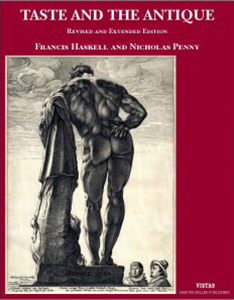 Taste and the Antique offers a comprehensive and accessible overview of the reception and afterlife of the most famous ancient statues discovered in Rome and Italy from the Renaissance to the close of the nineteenth century. Before Leonardo’s Mona Lisa, Botticelli’s Birth of Venus, or Van Gogh’s Sunflowers, sculptures like the Laocoön, the Apollo Belvedere, or the Medici Venus set the taste of artists, connoisseurs, and the educated elites of the West for almost five centuries. Reproduced in every possible media for gardens and palaces throughout Europe, celebrated by poets and writers from Marino and Byron to Proust and Dickens, they served as sources of inspiration for artists as diverse as Michelangelo, Rubens, and Turner.
Originally published in 1981, Taste and the Antique was hailed by Ernst Gombrich as a thought-provoking work that met a “long-felt want.” Reprinted five times since with minor alterations, Haskell and Penny’s book has become a classic of art history that is still used as the standard reference by scholars and anyone interested in the reception of the classical tradition. This new edition offers a complete revision of the original text to incorporate updates and new information on the single statues and their context in the light of research undertaken in the field over the past three decades.
Note (added 7 May 2018) — It’s still forthcoming, with publication now expected in 2019.
Exhibition | Carlos III: Majestad y Ornato
The exhibition is one of several held to mark the 300th anniversary of the birth of King Charles III of Spain:
Carlos III: Majestad y Ornato en los Escenarios del Rey Ilustrado
Palacio Real de Madrid, 6 December 2016 — 31 March 2017
Curated by María Pilar Benito García, Javier Jordán de Urríes, and José Luis Sancho Gaspar
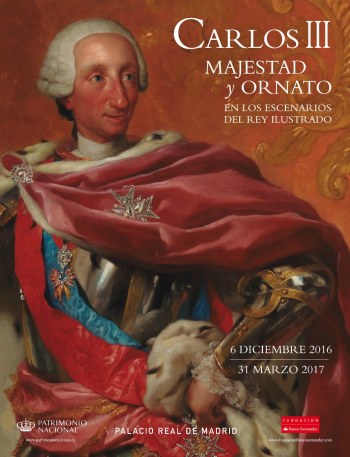 El próximo 6 de diciembre, en el Palacio Real de Madrid, se abre al público la exposición Carlos III. Majestad y Ornato en los Escenarios del Rey Ilustrado, con la que se conmemora del tercer centenario de este monarca y que permanecerá abierta hasta el 31 de marzo de 2017.
Soberano ilustrado y, como tal, mecenas de las artes, el monarca constituye el referente más indiscutible en la fértil relación que han mantenido la Corona y la Cultura en España durante la Edad Moderna. Su gobierno, además de las grandes obras públicas que promovió, supuso la intervención estatal en aspectos estéticos a una escala amplia y variada. Pero sin duda donde con más claridad se perciben tales innovaciones es en el propio entorno del monarca, en el arte cortesano creado bajo su directo mecenazgo, y que pone en valor esta exposición.
Estas obras artísticas, que servían para la vida cotidiana del rey y su familia, estaban pensadas tanto para fines funcionales, como ornamentales y representativos: su calidad, su magnificencia y suntuosidad, su tono cosmopolita constituían toda una declaración de poder. Expresaban no sólo la majestad del rey, sino la de la vasta monarquía simbolizaba en su persona. En sus palacios –tanto el de Madrid como el de los cuatro sitios reales donde la corte pasaba cada estación del año- se expresaba esta alianza entre el poder y la ilustración mediante todas las bellas artes: la pintura con figuras como Giambattista Tiepolo, el ya mencionado Mengs y todos sus discípulos españoles, entre ellos el incipiente genio de Francisco de Goya; las artes decorativas merced a las Reales Fábricas de tapices, de porcelana y piedras duras, de cristales y de relojes, y a los talleres dirigidos por diseñadores como Mattia Gasparini.
Reconocibles aún en los palacios, pero en gran medida dispersas debido a la misma evolución de la vida cortesana y a los avatares históricos, las obras ornamentales creadas para expresar la magnificencia de Carlos III constituyen uno de los tesoros culturales de España. Patrimonio Nacional plantea aquí una nueva lectura de esta página esencial en el acervo estético español, presentando obras emblemáticas y programas decorativos que no podían verse de forma conjunta desde el siglo XVIII, así como otras obras no mostradas al público en los últimos años o procedentes de colecciones extranjeras de difícil acceso. Asimismo, será la primera vez que se muestre el Retrato de Carlos III, pintado por Mengs y regalado por el monarca al rey Federico V de Dinamarca, que nunca se ha expuesto en España.
Los comisarios de esta exposición son Dña. María Pilar Benito García, D. Javier Jordán de Urríes y D. José Luis Sancho Gaspar.
◊ ◊ ◊ ◊ ◊
The catalogue is available from ArtBooks.com:
Pilar Benito Garcia, et al., Carlos III: Majestad y Ornato en los Escenarios del Rey Ilustrado (Madrid: El Viso, 2016), 392 pages, ISBN: 9788471205216, $62.
To commemorate the 300th anniversary of the birth of King Charles III (1716–1788), Patrimonio Nacional (National Heritage) has organised a show especially focused on studying the courtly art created under his direct patronage at Madrid’s Palacio Real. The catalogue assembles the complete renovation of all of the Royal Sites promoted by Charles III. The works that adorned the Royal Chamber, the mural paintings that decorated the archs of the royal palaces, as well as the most delicate works elaborated by the royal ateliers of workwood, bronze, and embroidery can be admired.
New Book | The Restoration of Paintings in Paris, 1750–1815
Scheduled for February release from The Getty:
Noémie Étienne, The Restoration of Paintings in Paris, 1750–1815: Practice, Discourse, Materiality (Los Angeles: Getty Conservation Institute, 2017), 384 pages, ISBN: 978-1606065167, $70.
 The decades following the 1973 publication of Alessandro Conti’s Storia del Restauro have seen considerable scholarly interest in the development of restoration in France in the second half of the eighteenth century. A number of technical treatises and biographies of restorers have offered insight into restoration practice. The Restoration of Paintings in Paris, 1750–1815, however, is the first book to situate this work within the broader historical and philosophical contexts of the time. Drawing on previously unpublished primary material from archives in Paris, Berlin, Rome, and Venice, Noemie Etienne combines art history with anthropology and sociology to survey the waning decades of the Ancien Régime and early post- Revolution France. Initial chapters present the diversity of restoration practice, encompassing not only royal institutions and the Louvre museum but also private art dealers, artists, and craftsmen, and examine questions of trade secrecy and the changing role of the restorer. Following chapters address the influence of restoration and exhibition on the aesthetic understanding of paintings as material objects. The book closes with a discussion of the institutional and political uses of restoration, along with an art historical consideration of such key concepts as authenticity, originality, and stability of artworks, emphasizing the multilayered dimension of paintings by such important artists as Titian and Raphael. There is also a useful dictionary of the main restorers active in France between 1750 and 1815.
Noémie Étienne is currently a fellow at the Getty Research Institute. Beginning in September 2016 she will be a Swiss National Science Foundation Professor of Art History at the University of Bern.
2016 Berger Prize for British Art History
 Giles Waterfield’s book The People’s Galleries: Art Museums and Exhibitions in Britain, 1800–1914 (New Haven: Yale University Press for The Paul Mellon Centre, 2015), is the winner of the 2016 William MB Berger Prize for Art History. Alex Kidson’s catalogue raisonné of George Romney’s paintings was included on the ‘short list’. The ‘long list’ of 45 books includes 20 titles relevant for eighteenth-century studies. From The British Art Journal:
• Adriano Aymonino and Anne Varick Lauder, Drawn From the Antique: Artists and the Classical Ideal (London: Sir John Soane’s Museum, 2015), 231 pages, ISBN: 978-0-957339897, £35.
• Christopher Baker, Duncan Bull, William Hauptman, Neil Jeffares, Aileen Ribeiro, MaryAnne Stevens, Jean-Etienne Liotard (1702–1789) (London: The Royal Academy of Arts and National Gallery of Scotland, 2015), 232 pages, ISBN: 978-1910350201, £27.
• Layla Bloom, Nicholas Grindle, et al., George Morland: Art, Traffic and Society in Late Eighteenth-Century England (Leeds: The Stanley & Audrey Burton Gallery, 2015), 99 pages, ISBN: 978-1874331544, £12.
• Oliver Bradbury, Sir John Soane’s Influence on Architecture from 1791: A Continuing Legacy (Farnham: Ashgate, 2015), 480 pages, ISBN: 978-1472409102, £95.
• Mary Clark, The Dublin Civic Portrait Collection: Patronage, Politics and Patriotism, 1603–2013 (Dublin: Four Courts Press, 2015), 224 pages, ISBN: 978-1846825842, £35.
• Tim Clayton and Sheila O’Connell, Bonaparte and the British: Prints and Propaganda in the Age of Napoleon (London: British Museum Press, 2015), 224 pages, ISBN: 978-0714126937, £25.
• Joan Coutu, Then and Now: Collecting and Classicism in Eighteenth-Century England (Montreal: McGill-Queen’s University Press, 2015), 336 pages, ISBN: 978-0773545434, £72.
• Lucy Davies and Mark Hallett, Joshua Reynolds: Experiments in Paint (London: Paul Holberton Publishing for The Wallace Collection, 2015), 192 pages, ISBN: 978-0900785757, £30.
• Loyd Grossman, Benjamin West and the Struggle To Be Modern (London: Merrell Publishers, 2015), 256 pages, ISBN: 978-1858946412, £35.
• E. Geoffrey Hancock, Nick Pearce, and Mungo Campbell, eds., William Hunter’s World: The Art and Science of Eighteenth-Century Collecting (Farnham: Ashgate, 2015), 424 pages, ISBN: 978-1409447740, £80.
• Simon Swynfen Jervis and Dudley Dodd, Roman Splendour / English Arcadia: The English Taste for Pietre Dure and the Sixtus Cabinet at Stourhead (London: Philip Wilson Publishing, 2015), 304 pages, ISBN: 978-1781300244, £45.
• Alex Kidson, George Romney: A Complete Catalogue of His Paintings (New Haven: Yale University Press for The Paul Mellon Centre for Studies in British Art, 2015), 960 pages, ISBN: 978-0300209693, £180.
• William Laffan and Christopher Monkhouse, with the assistance of Leslie Fitzpatrick, Ireland: Crossroads of Art and Design, 1690–1840 (New Haven: Yale University Press for the Art Institute of Chicago, 2015), ISBN: 978-0300210606, £30.
• Stephen Lloyd, ed., Art, Animals and Politics: Knowsley and the Earls of Derby (Unicorn Press, 2015), 822 pages, ISBN: 978-1910065, £60.
• Arthur MacGregor, ed., The Cobbe Cabinet of Curiosities: An Anglo-Irish Country House Museum (New Haven: Yale University Press for The Paul Mellon Centre, 2015), 495 pages, ISBN: 978-0300204353, £75.
• John Richard Moores, Representations of France in English Satirical Prints, 1740–1832 (New York: Palgrave Macmillan/Springer, 2015), 280 pages, ISBN: 978-0230545328, £60.
• Steven Parissien, ed., Celebrating Britain: Canaletto, Hogarth and Patriotism (London: Paul Holberton Publishing, 2015), 128 pages, ISBN: 978-1907372780, £25.
• Alison Smith, David Blayney Brown, Carol Jacobi, Artist and Empire: Facing Britain’s Imperial Past (London: Tate, 2015), 240 pages, ISBN: 978-1849763431, £40.
• David Solkin, Art in Britain, 1660–1815 (New Haven: Yale University Press / Pelican History of Art, 2015), 378 pages, ISBN: 978-0300215564, £55.
• Sheila White and Philip Sheail, eds and trans., Lord Fordwich’s Grand Tour, 1756–60 (Hertford: Hertfordshire Record Publications, 2015), 401 pages, ISBN: 978-0956511140, £22.
Exhibition | The Art of Law: Three Centuries of Justice Depicted
Now on view in Brugge:
The Art of Law: Three Centuries of Justice Depicted
De kunst van het recht: Drie eeuwen gerechtigheid in beeld
Groeningemuseum, Brugge, 28 October 2016 — 5 February 2017
Curated by Vanessa Paumen
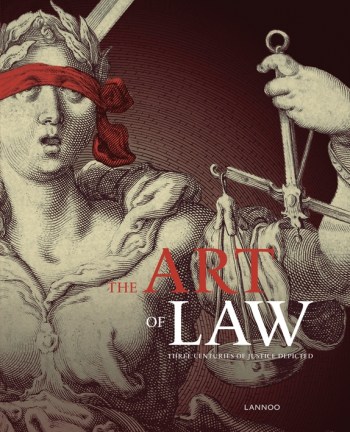 In the fifteenth century, it was customary to decorate courtrooms with works of art that were intended to ‘encourage’ the aldermen and judges to perform their duties in an honest and conscientious manner. These works often depicted the supreme moment of divine justice: the Last Judgement. But other scenes from the Bible were also used, as were images from more profane sources. Together, these are known as the exempla iustitiae (‘examples of fair justice’). In 1498, Gerard David was commissioned by the city council of Bruges to paint just such a work: The Judgement of Cambyses. This remarkably gruesome painting once hung in the courtroom of Bruges town hall and is now one of the finest masterpieces in the Groeningemuseum.
Subjects relating to justice were also depicted outside the courtroom in paintings, prints, drawings, sculpture and stained glass windows. The Art of Law exhibition has brought together some twenty works of art from the collections of Musea Brugge, supplemented by about hundred other pieces on loan from galleries and museums both at home and abroad. They paint a fascinating picture of the way in which justice and the law were represented in art during the Ancien Régime.
Vanessa Paumen works at the Groeningemuseum in Bruges as the coordinator of the Flemish Research Center for the Arts in the Burgundian Netherlands. She earned a BA degree, cum laude and an MA degree in Art History, with a focus on European Art at the University of Texas in Austin. In her master’s thesis, “Judged, Beheaded, Burned: Dieric Bouts, The Justice of Emperor Otto III within the Context of Fifteenth-Century Punitive Practices,” she looked at how justice paintings functioned in fifteenth-century Flemish society.
Vanessa Paumen, et al., The Art of Law: Three Centuries of Justice Depicted (Tielt: Lannoo Publishers, 2016), 208 pages, ISBN: 978 9401440417, £30.
Exhibition | Creating History: Stories of Ireland in Art
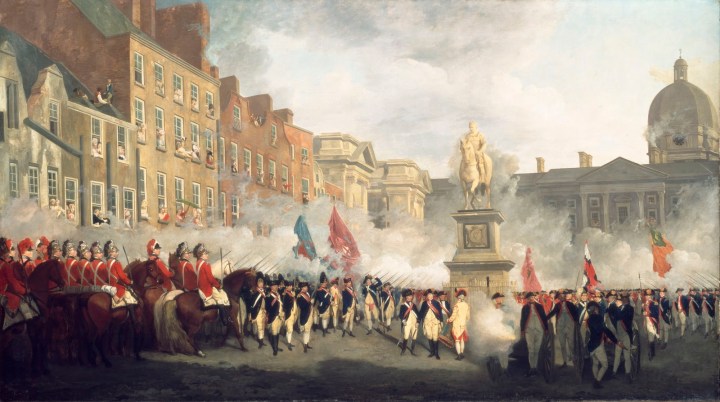
Francis Wheatley, The Dublin Volunteers on College Green, 4th November 1779, 1779–80, oil on canvas, 175 × 323 cm
(Dublin: National Gallery of Ireland)
◊ ◊ ◊ ◊ ◊
Now on view at the National Gallery of Ireland:
Creating History: Stories of Ireland in Art
National Gallery of Ireland, Dublin, 8 October 2016 – 15 January 2017
Curated by Brendan Rooney
This exhibition represents the Gallery’s principal contribution to the Decade of Centenaries. It brings together over 50 paintings spanning the seventeenth century to the 1930s, depicting or inspired by episodes in Irish history from the early fifth century arrival of St. Patrick to the establishment of the Free State. A significant number of paintings in the exhibition are drawn from the Gallery’s collection, many of which have undergone extensive conservation in preparation for this show, such as Jan Wyck’s The Battle of the Boyne, Francis Wheatley’s The Dublin Volunteers on College Green, 4th November 1779, and Joseph Patrick Haverty’s The Monster Meeting at Clifden. Other artists represented in the exhibition include James Barry, Charles Russell, John Lavery, Richard Thomas Moynan, Seán Keating, and Jack B. Yeats, complemented by loans from public and private collections in Ireland and overseas.
Brendan Rooney, ed., Creating History: Stories of Ireland in Art (Dublin: Irish Academic Press, 2016), 312 pages, ISBN: 978-1911024286, €25.
Brendan Rooney is Curator of Irish Art at the National Gallery of Ireland, and author/editor of numerous works on Irish art, including Thomas Roberts: Landscape and Patronage in Eighteenth-Century Ireland (2009) and A Time and a Place: Two Centuries of Irish Social Life (2006).
New Book | A Civic Utopia
When we noted the exhibition A Civic Utopia this past summer, we didn’t include information on the catalogue, which is now available from Drawing Matter:
Nicholas Olsberg and Basile Baudez, A Civic Utopia: Architecture and the City in France, 1765–1837 (London: Drawing Matter, 2016), 52 pages, ISBN: 978-0995630901, £20.
 This large format, finely illustrated edition is published to coincide with the exhibition A Civic Utopia at The Courtauld Gallery of Art. In addition to the ‘Introduction’, it contains an essay entitled ‘Law, Order and the Beautiful’ by Nicholas Olsberg and ‘Case Studies’ by Basile Baudez. The essay explores the Enlightenment themes: A New Rome, Porta, Ratio, Lex, Sanitas, Spectaculum, Lexicon, and Exemplum. The case studies examine the work of Louis Combes, Pierre-François-Léonard Fontaine, André Sainte-Marie Châtillon, Paul Piot, François-Joseph Bélanger, François-Joseph Bélanger, and Louis-Pierre Baltard. The book expands on a selection of architectural drawings from the exhibition that show public building and public space in Enlightenment-era France. The drawings served as models for the expression of an ordered and open civic life as the foundation of an ideal polity. They responded to the urgings of writers, critics, and philosophes to make a systematic effort toward civic improvement, or what Voltaire entitled the “embellissement de la ville.”
The book traces how, over the next century, a new model of the modern French city emerged, one that deployed a consistent architecture capable of expressing the liberal qualities of the civic life within it: ordered, open, and dignified. These ideal forms, the methods of visualising and realising them through drawing, and the techniques of design and construction developed to build them, were circulated through engravings and compendia throughout the world. With their new emphases on turning their principal face out towards the street and square, on the horizontal line, and on the evident entrance, these models established an international aesthetic for the architecture of public life, and a universal system of architectural training.
Basile Baudez is maître de conférences at Université Paris-Sorbonne, Paris IV and visiting professor at the Ecole nationale des Chartes. His main areas of research are the history of architectural schools and the Beaux-Arts system and the history of architectural representation in the Western world. Recent publications include, Les Hôtels de la Guerre et des Affaires étrangères à Versailles (co-editor), and Chalgrin, architectes et architecture entre l’Ancien Régime et l’Empire as well as numerous journal articles. His current book project addresses the history of colour in architectural representation.
Nicholas Olsberg is an historian, archivist, curator and writer. As Editor of the Colonial and State Records of South Carolina from 1967–74, he published numerous studies on political and civic life in the eighteenth and early nineteenth centuries, and as Archivist of the Commonwealth from 1975 to 1979 produced a major exhibition on the 1790 constitution of Massachusetts. His recent published works in architecture include major monographs on Cliff May, John Lautner, Arthur Erickson, and Ernest and Esther Born; a series of essays on Frank Lloyd Wright; and regular contributions to journals of architecture.
New Book | A Golden Age of European Art
From Yale UP:
Edited by James Clifton and Melina Kervandjian with essays by Barbara Baert, Andrea Bayer, Anne Dunlop, Steven Ostrow, Lisa Pon, Martin Postle, and Arthur K. Wheelock, A Golden Age of European Art: Celebrating Fifty Years of the Sarah Campbell Blaffer Foundation (New Haven: Yale University Press, 2016), 272 pages, ISBN: 978-0300207811, $65.
 Marking the 50th anniversary of the acclaimed Sarah Campbell Blaffer Foundation, this commemorative book presents masterpieces from the foundation’s collection. The works span more than 400 years, from the 16th through the early 20th century, and feature a range of media including paintings, prints, and printed books. After a comprehensive introduction to the foundation and its collection, essays by eight scholars present new scholarship on key works. The featured objects include an image of the Madonna and Child by the Florentine painter Giuliano Bugiardini; Richard Wilson’s iconic 18th-century composition The White Monk; printed materials in Venice that bridged Jewish and Christian cultures; and portraits by Paolo Veronese, Simon Vouet, and others. With more than 200 illustrations, this beautiful publication is a rich survey as well as a timely celebration of this exceptional collection.
James Clifton is director of the Sarah Campbell Blaffer Foundation and curator of Renaissance and Baroque painting at the Museum of Fine Arts, Houston.










 Enfilade
leave a comment