Exhibition | 350 Years of Creativity
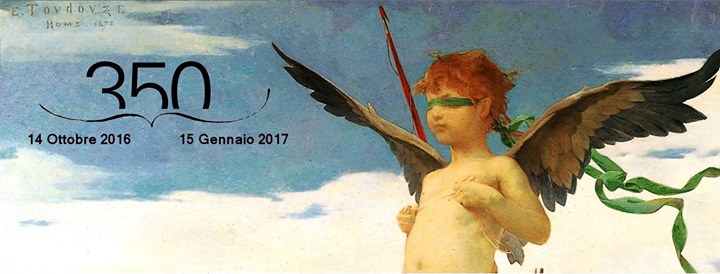
Now on view at the French Academy in Rome:
350 Years of Creativity: The Artists of the French Academy in Rome from Louis XIV to the Present
350 ans de création: Les artistes de l’Académie de France à Rome de Louis XIV à nos jours
Académie de France à Rome – Villa Medici, 14 October 2016 — 15 January 2017
Curated by Jérôme Delaplanche
Founded by Louis XIV in 1666, the Academy is celebrating its 350th anniversary this year with a special series of events retracing its history. This exhibition is one of the program’s high points and is accompanied by two others in Rome, organized by the Accademia Nazionale di San Luca and the Accademia di Belle Arti di Roma and focusing on their relationships with the French Academy. 350 Years of Creativity is a chance for the visitor to discover the creative output of artists at the Academy—both residents and directors—during their stays in Rome. It includes over a hundred works dating from 1666 to the present day, by artists including Fragonard, David, Ingres, Berlioz, Garnier, Carpeaux, Debussy, and Balthus. In the course of a fascinating journey through three and half centuries of French art, visitors are offered a closer look at the Academy and its successive generations of creators.
350 Years of Creativity illustrates the high points of the Academy’s long life with works by its leading artists presented under the following headings: the ancient and modern quest for the ideal; the discovery of picturesque reality; the relationship with the body and the nude; the significance of the move to the Villa Médicis; eclecticism and the value of originality; new life for tradition; and the Academy as a center for creative experiment. The exhibition itinerary brings together paintings, drawings, statues, prints, musical scores, and archival material as testimony to the sheer artistic variety the institution has produced. Some of these works come from the Academy’s own collection, notably portraits by residents and the plaster statues. The exhibition closes with a video of works created by residents over the last few decades. For the visitor all this adds up to an opportunity to survey the history of French art from 1666 to 2016.
 350 Years of Creativity will also be accompanied by other events—screenings, encounters, concerts—presented at the Villa Médicis as part of the series ‘Thursdays at the Villa: Art Matters’. It will conclude with a symposium on 11–13 January 2017 with the Accademia Nazionale di San Luca and the Accademia di Belle Arti di Roma, titled Art Academies: Heritage and Contemporary Art Issues.
Jerome Delaplanche, ed., 350 anni di creatività: Gli artisti dell’Accademia di Francia a Roma da Luigi XIV ai nostri giorni (Milan: Officina Libraria, 2016), 224 pages, ISBN: 978 8899765101 (Italian), ISBN: 978 8899765088 (French), 35€.
The Burlington Magazine, November 2016
The eighteenth century in The Burlington:
 The Burlington Magazine 158 (November 2016)
A R T I C L E S
• Lucia Simonato, “A New Work by Domenico Guidi: The Bust of Cardinal Gianfrancesco Albani,” pp. 885–90.
• Bent Sørensen, “The Parisian Career of Jacques François Saly, 1749–53,” pp. 891–99.
L E T T E R
• Kim Legate, “More on Chippendale at Hestercombe House,” p. 904.
R E V I E W S
• Anthony Geraghty, Review of Owen Hopkins, From the Shadows: The Architecture and Afterlife of Nicholas Hawksmoor (Rekation Books, 2015), p. 907–08.
• Tessa Murdoch, Review of Malcolm Baker, The Marble Index: Roubiliac and Sculptural Portraiture in Eighteenth-Century Britain (Paul Mellon Centre for Studies in British Art, 2015), p. 908.
• Martin Postle, Review of James Ayres, Art, Artisans, and Apprentices: Apprentice Painters and Sculptors in the Early Modern British Tradition (Oxbow Books, 2014), p. 909.
• Loyd Grossman, Review of Susan Rather, The American School: Artists and Status in the Late-Colonial and Early National Era (Yale University Press, 2016), pp. 909–10.
• François Quiviger, Review of Andrea Daninos, Una Rivoluzione di Cera: Francesco Orso e e i «cabinets de figures» in Francia (Officina Libraria, 2016), pp. 911–12.
• Philip Ward-Jackson, Review of Vanessa Brett, Bertrand’s Toyshop in Bath: Luxury Retailing, 1685–1765 (Oblong Creative, 2014), p. 912.
• Jamie Mulherron, Review of the exhibition Marseille au XVIIIe siècle: Les années de l’Académie, 1753–1793 (Le Musée des Beaux-Arts, Marseille, 2016), pp. 921–23.
• Jeremy Warren, Review of the exhibition Splendida Minima (Tesoro dei Granduchi, Palazzo Pitti, Florence, 2016), pp. 923–24. [Includes the eighteenth-century reception of these small-scale sculptures.]
New Book | The Neapolitan Crèche at the Art Institute of Chicago
Distributed by Yale University Press:
Sylvain Bellenger, Carmine Romano, and Jesse Rosenberg, with a preface by Riccardo Muti, The Neapolitan Crèche at the Art Institute of Chicago (Chicago: Art Institute of Chicago, 2016), 176 pages, ISBN: 978 0300222357, $40.
 The 18th-century Neapolitan crèche at the Art Institute of Chicago, which contains over 200 figures arranged in a panorama of street life, represents the pinnacle of a rich artistic heritage. This luxurious catalogue is the first to study the crèche in the context of art and music history. Essays explore the Neapolitan crèche tradition and examine the design of Chicago’s example with reference to other important crèches in Europe and the United States. Entries on individual figures identify the characters and types they represent, as well as their social and historical meaning and religious significance. Other entries address groups of figures, animals, and cultural themes present in the creche. Together the essays and entries highlight the astonishing realism and potent symbolism of these figures, which range from heavenly angels and the Holy Family around the manger to street vendors and revelers feasting, drinking, and dancing in a tavern. Nativity scene.
Sylvain Bellenger is director of the Museo de Capodimonte, Naples; Carmine Romano is a PhD student at Paris-Sorbonne University; and Jesse Rosenberg is clinical associate professor, musicology, at the Northwestern University Bienen School of Music.
Exhibition | Robert Adam’s London
Press release (26 October 2016) for the exhibition:
Robert Adam’s London
Sir John Soane’s Museum, 30 November 2016 — 11 March 2017
Curated by Frances Sands
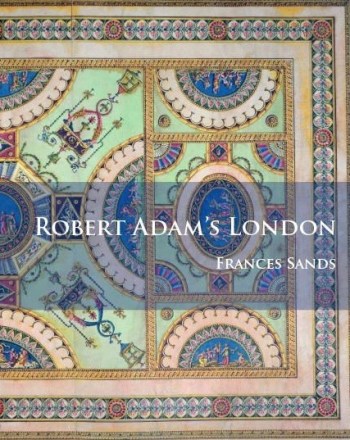 The work of one of the greatest British architects of all time is examined in a new exhibition at Sir John Soane’s Museum. Robert Adam’s London takes an in-depth look at some of the Scottish architect’s work which helped change the landscape of the capital. Some of the famous buildings looked at in the exhibition include Buckingham Palace, the Admiralty Screen on Whitehall and Portland Place. Robert Adam’s London is the first time the architect’s work across the city as a whole has been examined in a London museum. It will showcase his ground-breaking neo-classical style and his desire to unify architecture and interior design. It will also feature both completed buildings alongside those, which were never realised, offering a glimpse into the architect’s ambitious vision for London.
On display will be some of Sir John Soane’s Museum’s most beautiful, influential, and rarely seen designs of Adam’s projects in London, taken from their 9,000-strong Adam drawing collection. The Museum holds 80% of the world’s surviving Adam drawings which are of huge international-significance for our understanding of Georgian architecture and interior design. Projects on show include the famous Admiralty Screen on Whitehall, Portland Place, and six monuments for Westminster Abbey, as well as projects subsequently demolished or never realised, such as the interiors of Buckingham House (before it became Buckingham Palace), 15 Downing Street, Lansdowne House, and Adelphi. A large-scale facsimile of an eighteenth-century map of London will form the centrepiece of the show, plotting Adam’s various projects across the city, creating an ‘in-exhibition’ trail for visitors. Alongside this will be a portrait of Robert Adam by George Williamson, on loan from the National Portrait Gallery, and a pedestal designed by Adam from Kenwood House.
Robert Adam had a long and enduring connection to London, establishing his London practice in 1758 and remaining in the city until his death in 1792. There is a greater density of his work for this city than anywhere else, as he focused on designing complete schemes for the decoration of domestic, public, commercial, speculative and commemorative buildings. His work in London demonstrates how his style evolved past the fashionable Palladian design of the time, into a new, more flexible style, incorporating influences from Roman, Etruscan, and Baroque styles. Adam’s radical style was often attributed to a desire to design everything down to the smallest detail.
Adam regularly favoured large-scale and grandiose designs, many of which remained purely speculative as their ambitions—and cost—were often prohibitive. One such project examined in the exhibition in detail is for Portland Place, where he hoped to construct detached aristocratic palaces which might rival noblemen’s urban homes in Europe. Palaces for the Earls of Kerry and Findlater were designed, but never came to fruition. If they had, central London would have looked significantly different to how it is today.
Bruce Boucher, Director of Sir John Soane’s Museum says: “The Adam Drawings at the Soane Museum is one of our most important collections. Not only is it an invaluable record of the work of one of this country’s most innovative architects, but also a fascinating glimpse into what London could have been had all his projects survived or come to fruition. People have always cared passionately about the architecture of London, as today’s fierce debates testify, so it is wonderful to be able to examine this fascinating chapter in the architectural history of this great city, right in the heart of the city itself.”
Dr Frances Sands, Curator of Drawings and Books at Sir John Soane’s Museum comments: “The Adam office provided designs in deliberate contrast to the more severe neo-Palladian style that had dominated Britain in earlier decades. Adam instigated a fashion for his own recognisable and characteristic style, one not based on dogmatic archaeological accuracy, but rather a creative fusion of all that he had seen abroad. With his distinctive, delicate interior decorative style and bold, rippling architecture, Adam became enormously successful; his practice catered to clients across Britain—and occasionally beyond—but nowhere more heavily than in London. Often remembered as an architect of great country houses, this exhibition celebrates the skill and dexterity of his numerous works here in town.”
◊ ◊ ◊ ◊ ◊
Frances Sands, Robert Adam’s London (Oxford: Archaeopress, 2017), 142 pages, ISBN: 978-1784914622, £18.
The iconic eighteenth-century architect Robert Adam was based in London for more than half of his life and made more designs for this one city than anywhere else in the world. This book reviews a wide variety of his designs for London, highlighting lesser known buildings as well as familiar ones. Each of Adam’s projects explored in this book is plotted on Horwood’s map of London (1792–99), enabling readers to recognise Adam’s work as they move around the city, as well as to envisage London as if more of his ingenious designs had been executed or survived demolition.
Frances Sands is Curator of Drawings and Books at Sir John Soane’s Museum.
New Book | The Prints of Paul Sandby: A Catalogue Raisonné
From Brepols:
Ann Gunn, The Prints of Paul Sandby (1731–1809): A Catalogue Raisonné (Turnhout: Brepols, 2016), 339 pages, ISBN: 978-1909400160, £127 / $195.
 Born in Nottingham, Paul Sandby (1731–1809) is best known as a founder member of the Royal Academy and a prominent figure in the development of British watercolour painting. However, he was also one of the most prolific and inventive printmakers in eighteenth-century Britain. From his early years as a draughtsman for the military survey of Scotland, and later from his extensive tours throughout England and Wales, he depicted the people, towns, castles, and landscapes of the nation. He provided the public with images of their country which contributed to the emerging appreciation of native landscape, to antiquarian interests, and to the development of picturesque tours within the British Isles. Although he never travelled abroad, he reproduced the work of fellow artists who had, tapping into the Grand Tour market with prints of Ionian antiquities, Neapolitan landscapes, and the Roman carnival. But his work encompassed more than landscape; he could move from the pastoral humour of illustrations to Allan Ramsay’s poem The Gentle Shepherd, through the urban realism of his Cries of London to the merciless satire of his attacks on William Hogarth. From the 1740s to the 1780s, he made over 380 prints: engravings, etchings, soft ground etchings, and finally aquatints, a medium in which he was a pioneer. Aquatint enabled printmakers to reproduce the effects of watercolour paintings; Sandby gave the process its name and developed varied techniques which allowed the exact reproduction of the artist’s brush strokes, producing some of the most beautiful prints ever made in this medium.
Ann V. Gunn, a lecturer at the University of St Andrews, has worked as Keeper of Art at Nottingham City Museums, Assistant Registrar at Princeton Art Museum, and Registrar of the University of St Andrews Art Collection. She also ran her own gallery, which specialised in contemporary Scottish art. She is Honorary Curator of the University’s Fine Art Collection. She is also Chair of Fife Contemporary Art & Craft and a member of the Fife Committee of the Art Fund. She is the author of The Prints of Wilhelmina Barns-Graham: A Complete Catalogue (2007).
New Book | Hyacinthe Rigaud: Le Catalogue Raisonné
Published by Faton and available from Artbooks.com:
Ariane James-Sarazin, Hyacinthe Rigaud (1659–1743): Le Catalogue Raisonné, 2 volumes (Dijon: Faton, 2016), 1408 pages, ISBN: 978-2878441734, 320€ / $395.
 Fruit d’années de recherches, l’ouvrage en deux volumes d’Ariane James-Sarazin, archiviste, conservateur en chef du patrimoine et directrice des musées d’Angers, s’impose comme une étape décisive dans l’histoire de l’art moderne. Pour la première fois, l’auteur propose le catalogue exhaustif des oeuvres du grand peintre français Hyacinthe Rigaud (Perpignan, 1659 – Paris, 1743) : plus d’un millier de numéros organisés chronologiquement, tous rigoureusement étudiés, dévoilent bien des aspects méconnus du portraitiste des élites européennes, à travers peintures, dessins, répliques, copies et gravures. Les amateurs d’art exigeants et passionnés y trouveront l’étude la plus complète jamais publiée sur le peintre et son oeuvre, et une analyse inédite de la peinture, de la société au tournant du Grand Siècle et du siècle des Lumières. Le catalogue est précédé d’une biographie complète du peintre, établie avec une méthodologie rigoureuse, déjà saluée par les spécialistes pour les précédents travaux d’Ariane James-Sarazin sur l’artiste, ainsi que d’une étude fouillée sur la clientèle, le processus de création, l’oeuvre et son évolution. De nombreuses annexes complètent cette somme d’érudition : iconographie du peintre, chronologie raisonnée, généalogies, dictionnaire inédit des élèves et collaborateurs, aperçu de la fortune critique, table de concordances avec l’édition des livres de comptes de Joseph Roman en 1919, sources commentées, bibliographie, pièces justificatives et plusieurs index. Marqueur de l’évolution de la mode et des textiles, révélateur des intrigues de Cour, objet du paraître social, symbole de l’image royale, le portrait, miroir des enjeux d’une époque, offre une mine d’informations aux disciplines connexes de l’histoire de l’art.
Exhibition | Antonio Balestra: Nel Segno della Grazia
Now on view in Verona:
Antonio Balestra: Nel Segno della Grazia / In the Sign of Grace
Museo di Castelvecchio, Verona, 19 November 2016 — 19 February 2017
 Il Comune di Verona, Direzione Musei d’Arte e Monumenti honors the painter Antonio Balestra (1666–1740) on the occasion of the 350th anniversary of the artist’s birth with the exhibition Antonio Balestra: In the Sign of Grace, staged in the Castelvecchio Museum. The exhibition presents over sixty works: paintings, drawings, etchings, and volumes of prints, coming from public and private lenders.
Andrea Tomezzoli, Antonio Balestra: Nel Segno della Grazia (Verona: Scripta Edizioni, 2016), 208 pages, ISBN: 978-8898877690, $38.
New Book | Women Artists in Early Modern Italy
From Brepols:
Sheila Barker, ed., Women Artists in Early Modern Italy: Careers, Fame, and Collectors (Turnhout: Harvey Miller, 2016), 181 pages, ISBN: 978-1909400351, $125.
 Enhancing our understanding of early Italian female painters including Sofonisba Anguissola and introducing new ones such as Costanza Francini and Lucrezia Quistelli, this volume studies women artists, their patrons, and their collectors, in order to trace the rise of the social phenomenon of the woman artist.
In ten chapters spanning two centuries, this collection of essays examines the relationships between women artists and their publics, both in early modern Italy and across Europe. Drawing upon archival evidence, these essays afford abundant documentary evidence about the diverse strategies that women utilized in order to carry out artistic careers, from Sofonisba Anguissola’s role as a lady-in-waiting at the court of Philip II of Spain, to Lucrezia Quistelli’s avoidance of the Florentine market in favor of upholding the prestige of her family, to Costanza Francini’s preference for the steady but humble work of candle painting for a Florentine confraternity. Their unusual life stories along with their outstanding talents brought fame to a number of women artists even in their own lifetimes—so much fame, in fact, that Giorgio Vasari included several women artists in his 1568 edition of artists’ biographies. Notably, this visibility also subjected women artists to moral scrutiny, with consequences for their patronage opportunities. Because of their fame and their extraordinary (and often exemplary) lives, works made by women artists held a special allure for early generations of Italian collectors, including Grand Duke Cosimo III de’ Medici (1642–1723), who made a point of collecting women’s self-portraits. In the eighteenth century, British collectors wishing to model themselves after the Italian virtuosi exhibited an undeniable penchant for the Italian women artists of a bygone era, even though they largely ignored the contemporary women artists in their midst.
Sheila Barker directs the Jane Fortune Research Program on Women Artists at the Medici Archive Project, the first archival program of its kind. Her publications of documentation on women artists have shed light on Lucrezia Quistelli, Artemisia Gentileschi, Irene Parenti Duclos, and the phenomenon of female copyists.
◊ ◊ ◊ ◊ ◊
C O N T E N T S
1 Editor’s Preface, Sheila Barker (The Medici Archive Project)
2 ‘Piu che famose’: Some Thoughts on Women Artists in Early Modern Europe, Sheila ffolliott (George Mason University, emerita)
3 Sofonisba Anguissola at the Court of Philip II, Cecilia Gamberini (Universidad Autonoma de Madrid Felsina Cattòlica)
4 Sofonisba Anguissola, ‘Pittora de Natura’: A Page from Van Dyck’s Italian Sketchbook, Barbara Tramelli (Max Planck Institute, Berlin)
5 Lucrezia Quistelli (1541–1594): A Noblewoman and Artist in Vasari’s Florence, Sheila Barker (The Medici Archive Project)
6 Arcangela Paladini and the Medici, Lisa Goldenberg Stoppato (Independent Scholar)
7 Costanza Francini. A Painter in the Shadow of Artemisia Gentileschi, Julia Vicioso (Archivio Storico dell’Arciconfraternita dei Fiorentini)
8 A Newly Discovered Late Work by Artemisia Gentileschi: Susanna and the Elders of 1652, Adelina Modesti (La Trobe University)
9 The Medici’s First Woman Court Artist: The Life and Career of Camilla Guerrieri Nati, Eve Straussman-Pflanzer (The Davis Museum, Wellesley College)
10 Female Painters and Cosimo III de’ Medici’s Art Collecting Project, Roberta Piccinelli (Univerity of Teramo)
11 The English Collectors of Italy’s Female Old Masters, 1700–1824, Nicole Escobedo (Independent Scholar)
Exhibition | The Artist
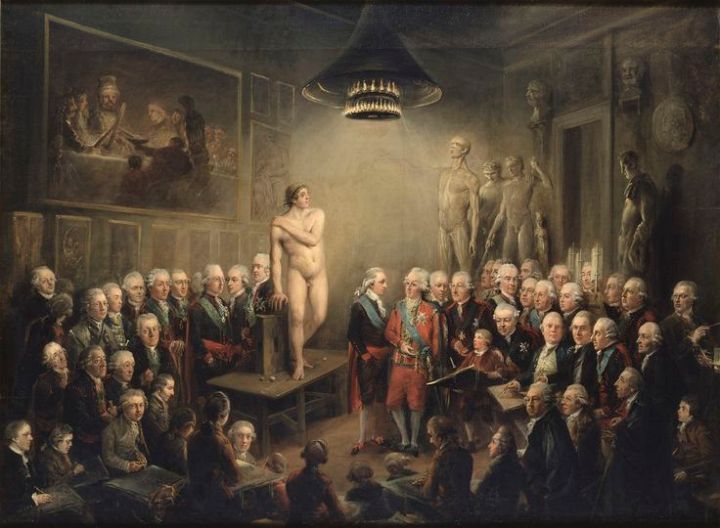
Elias Martin, King Gustav III Visits the Academy of Fine Arts in 1780, 1782, oil on canvas, 99 × 135 cm
(Stockholm: Nationalmuseum)
◊ ◊ ◊ ◊ ◊
Now on view at the Moderna Museet in Malmo:
The Artist / Konstnären
Konstakademien (Royal Academy of Fine Arts), Stockholm, 11 February — 11 September 2016
Moderna Museet, Malmö, 24 September 2016 — 19 February 2017
Throughout history, artists have played a wide variety of different roles. It’s a huge leap from the courtly painter who works on commission to the bohemian who refuses to rely on the approval of high society. This exhibition explores a number of different roles for artists, and also uncovers some of the myths that surround them.
How independent was the bohemian really? What kinds of new standards and rules have emerged within the avant-garde of modern art? And where did the idea of the free, creative, male genius come from? Women artists have often been portrayed as ‘exceptional anomalies’ in the history of art, but this exhibition shows just how numerous and how influential they have been, and how in the 1870s and 80s they shook up the preconception of the artist as a role for men.

Alexander Roslin, The Artist and His Wife Marie Suzanne Giroust Painting the Portrait of Wilhelm Peill, 1767, oil on canvas 131 × 98.5 cm (Stockholm: Nationalmuseum).
In more recent times, many artists have played the role of entrepreneur. Jeff Koons and Ernst Billgren work as modern businessmen in a commercial market economy. But the entrepreneurial artist has historical roots. Rosa Bonheur and Anders Zorn were both skilled painters as well as extremely competent when it came to building up their own personal brands, which helped them achieve great success in the international art market at the end of the nineteenth century. Entrepreneurial artists played an important role in seventeenth-century Holland as well.
During the eighteenth and nineteenth centuries, it was the values of the art academies of Europe that set the standard in the art world. Artists in these academies were trained in reproducing the classical ideals. Today the research conducted in university art schools is an example of a new form of academic work for artists.
This exhibition illuminates how artists relate to travel and to encounters with other cultures. In some cases an artist’s view of foreign cultures may be full of clichés and stereotypes. But there are also plenty of examples of artists who have worked to expose underlying power structures and standards in their encounters with other cultures.
Many artists throughout history have seen themselves as visionaries or prophets. Feminist artists such as Siri Derkert and Gittan Jönsson have worked both with criticism of contemporary society and with politically charged visions of the future. Other artists have been preoccupied with visions of a more spiritual nature, including Hilma af Klint and Vassilij Kandinskij.
This exhibition is a collaboration between Moderna Museet, the Royal Academy of Fine Arts, and the National Museum of Fine Arts. We want to show how powerful it is when we allow our collections from different eras to meet, and then complement that mix with a number of key works on loan.
Anne Dahlström, Margareta Gynning, Per Hedström, Carl-Johan Olsson, Andreas Nilsson, John Peter Nilsson, and Eva-Lena Bengtsson, Konstnären / The Artist (Stockholm: Nationalmuseum, 2016), 130 pages, ISBN: 978–9171008626, SEK149.
Exhibition | Portrait of the Artist

Press release (6 September 2016) from the Royal Collection Trust:
Portrait of the Artist
The Queen’s Gallery, Buckingham Palace, London, 4 November 2016 — 17 April 2017
The Queen’s Gallery, Palace of Holyroodhouse, Edinburgh, TBA
The first-ever exhibition of portraits of artists in the Royal Collection examines the changing image of the creative genius through more than 150 paintings, drawings, prints, photographs and decorative arts. Portrait of the Artist explores themes such as the cult of the artistic personality, the artist at work, and artists’ self-portraits.
From the 16th century, artists rose from the ranks of skilled artisans to a more elevated social status, a change in part influenced by royal patronage. The medieval tradesmen’s guilds were replaced first by workshops run by a master and subsequently by the first art academies. The lives of the most successful artists were recorded for posterity in the new literary genre of artists’ biographies. One of the most important collections of biographies from this period was Giorgio Vasari’s Delle vite de’ piu eccellenti pittori, scultori et architettori (1568), which described the lives of over 150 artists including that of the author. As artists became more prominent in society, a market developed for images of those deemed to be exceptional by virtue of their artistic talent. At the same time, artists increasingly saw self-portraiture as a way of demonstrating their skills to potential collectors and asserting their new standing in the world.
Images of artists became a valuable commodity, keenly acquired by monarchs and other influential patrons. The inventory compiled by Charles I’s Surveyor of Pictures in the late 1630s shows that three of the most important artists’ portraits owned by the monarch, including self-portraits by Daniel Mytens (c.1630) and Sir Peter Paul Rubens (1623), hung outside the King’s Withdrawing Room at Whitehall Palace. The 1666 inventory of Charles II’s collection lists 24 portraits of artists in “the Pafsage betweene ye Greene Roome and ye Clofet.” In this most intimate part of the royal apartments, accessible only to the King’s closest acquaintances and family, were Artemisia Gentileschi’s Self-portrait as the Allegory of Painting (La Pittura) (c.1638–39), Rubens’s self-portrait (1623) and portrait of his former assistant Anthony van Dyck (c.1627–28).
During the 17th century, general advancements in optics and practical developments in the production of mirrors enabled artists to be increasingly experimental and ambitious in their self-portraits. Artemisia Gentileschi used two mirrors to capture herself from an unusual angle for her powerful self-portrait as the personification of Painting, a remarkably unorthodox representation of a woman at this early date.
Artists frequently incorporated their own image into their works, as major players in historical and mythological narratives or through more subtle means. In Judith with the Head of Holofernes (1613), the painter Cristofano Allori appears as the decapitated Holofernes, his former lover Maria di Giovanni Mazzafiri is the murderous Judith, and her mother is Judith’s maidservant. Jan de Bray’s The Banquet of Cleopatra (1652) is a thinly disguised family portrait in which the artist casts his father Salomon de Bray, also a successful painter, in the role of Mark Antony.

Jean-Étienne Liotard, Self-Portrait, ca. 1753, enamel (London: Royal Collection Trust, RCIN 421436).
Through the choice of costume, gesture, props and setting, a self-portrait enabled an artist to take on a variety of roles. After visiting the Levant in 1738–43, the painter Jean-Étienne Liotard adopted a style of clothing for which he was to become known as ‘Le Peintre Turc’. His unconventional appearance—the Moldavian fur headdress and long beard seen in his self-portrait miniature of 1753—was thought by some to have contributed to his commercial success.
For young artists without the funds to pay a professional model, self-portraiture was a convenient way to practice their drawing skills. Annibale and Agostino Carracci’s self-portraits of c.1575–80 were probably produced by the teenage artists to hone their talents in this way. Some self-portraits appear to have been produced solely for the purpose of self-scrutiny. In a chalk drawing, possibly executed at the age of 80 in the final year of his life, Gianlorenzo Bernini records his hooded eyes and sunken cheeks with unflinching honesty.
The relationship between contemporaries in the art world is explored in the exhibition through representations of artists by their friends, admirers and pupils. Francesco Melzi’s chalk drawing of the aged Leonardo da Vinci (c.1515) is thought to be the most reliable surviving likeness of his teacher. Rubens’s portrait of his former assistant and lifelong friend Van Dyck shows the artist in three-quarter profile, his gaze averted to make him appear reflective, in contrast to the confident figure presented in Van Dyck’s self-portraits. The friendship between the engraver Francesco Bartolozzi and the painter Giovanni Battista Cipriani, Italian artists working in London, is recorded in charming pencil sketches that the pair made of each other in 1770—one painting, the other dozing in a chair.
In the 19th century, romanticised episodes from the lives of famous artists from the past were popular subject-matter. Johann Michael Wittmer’s Raphael’s First Sketch of the ‘Madonna della Sedia’ (c.1853) depicts the fable of how the Renaissance master came to create one of his best-known works on the base of a wine barrel. Frederick Leighton’s monumental work Cimabue’s Madonna Carried in Procession (1855) encapsulates the Victorian artist’s belief that, during the Renaissance, great art was appreciated at all levels of society and artists were held in high esteem, their genius widely acknowledged.
◊ ◊ ◊ ◊ ◊
In the US and Canada, the catalogue is distributed by The University of Chicago Press:
Anna Reynolds, Lucy Peter, and Martin Clayton, Portrait of the Artist (London: Royal Collection Trust, 2016), 240 pages, ISBN: 978-1909741324, $48.
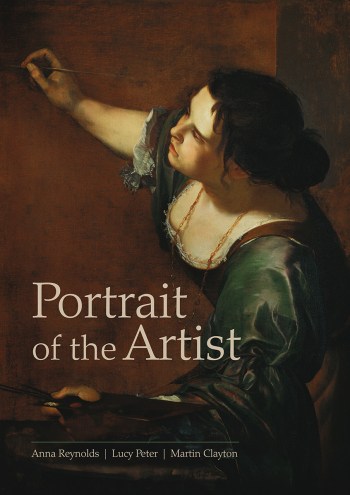 Dürer’s Self-Portrait at Age Twenty-Eight. Hockney’s Self-Portrait with Cigarette. Melzi’s drawing of Leonardo da Vinci, widely regarded as the most reliable surviving likeness of this most famous Old Master. Throughout history, many of the world’s most renowned artists have made portraits to represent themselves and others.
The first book to focus on images of artists from within the Royal Collection, Portrait of the Artist brings together paintings, drawings, prints, and photographs by artists from across the centuries, including works by Rembrandt van Rijn, Peter Paul Rubens, David Hockney, and Lucian Freud. While some of the portraits included in this book were created to showcase the artist’s talent, others were motivated by more personal reasons, to preserve the images of cherished friends. Anna Reynolds, Lucy Peter, and Martin Clayton explore the miscellany of themes running throughout the discipline of portraiture, from the rich symbolism found in images of the artist’s studio to the transformation of styles with which artists depicted themselves, changing their portrayals to align with their changing status. They also explore the relationships between artists and patrons, including the important role of the monarchy in commissioning and collecting portraits of artists.










 Enfilade
leave a comment