New Book | The English Landscape Garden in Europe
From Historic England:
Michael Symes, The English Landscape Garden in Europe (London: Historic England, 2016), 136 pages, ISBN: 978-1848023574, £25.
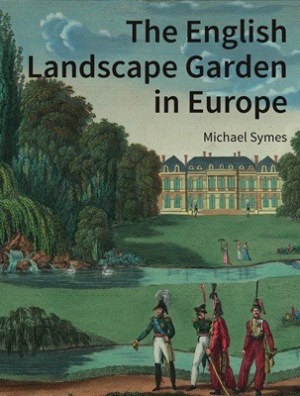 This book provides an overview of the extent to which the 18th-century English landscape garden spread through Europe and Russia. While this type of garden acted widely as an inspiration, it was not slavishly copied but adapted to local conditions, circumstances and agendas.
A garden ‘in the English style’ is commonly used to denote a landscape garden in Europe, while the term ‘landscape garden’ is used for layouts that are naturalistic in plan and resemble natural scenery, though they might be highly contrived and usually large in scale.
The landscape garden took hold in mainland Europe from about 1760. Due to the differing geopolitical character of several of the countries, and a distinct division between Catholic and Protestant, the notion of the landscape garden held different significance and was interpreted and applied variously in those countries: in other words, they found it a very flexible medium.
Each country is considered individually, with a special chapter devoted to ‘Le Jardin Anglo-Chinois’, since that constitutes a major issue of its own. The gardens have been chosen to illustrate the range and variety of applications of the landscape garden, though they are also those about which most is known in English.
C O N T E N T S
The Many Faces of the Landscape Garden
Exporting the English Garden
Le Jardin Anglo-Chinois
France
Germany
Russia
Poland
The Czech Republic
Sweden
Hungary
Italy
Other Countries
Exhibition | Fragonard: Un Provençal aux Pays-Bas
Now on view at the Villa-Musée Fragonard:
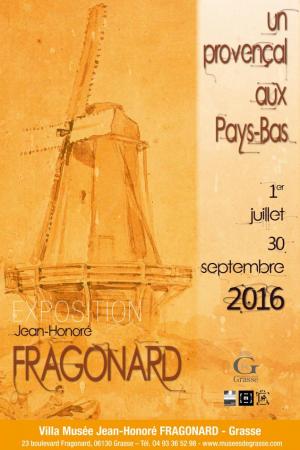
Fragonard: Un Provençal aux Pays-Bas
Villa-Musée Jean-Honoré Fragonard, Grasse, 1 July — 30 September 2016
 Grasse et Fragonard, l’association semble évidente et pourtant la réalité est plus complexe. Certes Jean-Honoré Fragonard naît à Grasse en 1732 dans une famille modeste d’ouvriers gantiers, cet artisanat grassois qui, depuis le XVIIe siècle, accompagne et est aussi pour partie à l’origine du développement de l’activité liée au parfum dans la ville. Mais dès ses six ans, en 1738, toute la famille quitte la ville pour s’installer à Paris. Par la suite nous n’avons ni témoignages ni documents écrits qui pourraient faire supposer un retour ou un séjour du peintre dans sa ville natale. Cela jusqu’en février 1790, où Alexandre Maubert, son cousin, consigne, avec précision dans son livre de compte, un loyer mensuel que Fragonard lui verse pour loger avec sa femme et sa belle-soeur, Marguerite Gérard, dans sa bastide à un jet de pierre de l’entrée de Grasse. L’année suivante les Fragonard retournent à Paris, leur présence est confirmée dans la capitale en août 1793 par un document bancaire. Rien n’établit ensuite que le peintre revienne à Grasse. Il meurt le 22 août 1806 après une promenade sur le Champs de Mars à Paris. Six ans puis une grosse année : certes deux périodes cruciales dans la vie du peintre, mais c’est au final assez peu.
Ajoutons à cela la théorie, paradoxalement uniquement défendue localement, avec aplomb, depuis les années 1980, que les travaux de décoration de la cage d’escalier de la Villa Maubert n’étaient pas de la main de Jean-Honoré mais de son fils, le musée Fragonard rebaptisé Musée d’Art et d’Histoire de Provence en 1977, de trop rares expositions consacrées au peintre, une en 1957, une autre en 2006, voilà que progressivement semble s’éloigner la présence du peintre à Grasse. Pourtant la Villa Maubert, transformée en Villa Musée Fragonard par la ville, conserve un trésor. En ses murs ce sont les derniers feux créateurs du peintre en cette fin du XVIIIe siècle que l’on peut encore admirer aujourd’hui. Ce patrimoine, dont l’histoire est complexe et mal documentée, est unique et original, il justifie pleinement de mettre en lumière Jean- Honoré Fragonard dans la capitale des parfums.
Avec cette première exposition d’été, Un Provencal aux Pays-Bas, c’est ce que les musées de Grasse veulent réaffirmer en s’efforçant d’initier un nouveau cycle de travaux et de recherches consacré à cet enfant du pays grassois.
◊ ◊ ◊ ◊ ◊
The catalogue is available from Artbooks.com:
Marie-Anne Dupuy-Vachey, Fragonard: Un Provençal aux Pays-Bas (Milan: Silvana, 2016), 32 pages, ISBN: 978-8836633388, $23.
 Né à Grasse en 1732, à quelques lieues de la frontière italienne, Fragonard ne pouvait qu’être séduit par les paysages méditerranéens comme ses deux séjours dans la péninsule en témoignent. Mais le peintre a aussi exploré des territoires plus septentrionaux. A l’instar des amateurs de son temps, Fragonard fut très attiré par la peinture flamande et hollandaise du XVIIème siècle. Tout au long de sa carrière il entretint un dialogue fructueux avec les maîtres du passé, étudiant et copiant les toiles de Rembrandt et de Rubens, les paysages de Ruysdael. Il en vint même à absorber leur style et leur technique au point de les pasticher tout en restant lui-même. Cette pratique fut stimulée par des voyages, dont un documenté en 1773, qui le mena de Paris à Amsterdam en passant par Bruxelles, Malines, Anvers et La Haye. Les collections de la ville de Grasse, complétées par des prêts de collections publiques et privées, offrent l’occasion de se pencher sur cet aspect moins connu de l’auteur du Verrou et des Hasards heureux de l’escarpolette.
Exhibition | Fragonard: Drawing Triumphant

Jean Honoré Fragonard, Rinaldo in the Enchanted Forest, ca. 1763; brown wash over very light black chalk underdrawing; 33.5 × 45.7 cm
(New York: The Metropolitan Museum of Art, 2009.236).
◊ ◊ ◊ ◊ ◊
Press release (2 August 2016) from The Met:
Fragonard: Drawing Triumphant—Works from New York Collections
The Metroplitan Museum of Art, New York, 6 October 2016 — 8 January 2017
Curated by Perrin Stein
Jean Honoré Fragonard (French, 1732–1806)—one of the most forward-looking and inventive artists of the 18th century—was equally skilled in painting, drawing, and etching. Yet, unlike many old masters for whom drawing was a preparatory tool, Fragonard explored the potential of chalk, ink, and wash to create sheets that were works of art in their own right. As displays of virtuosity and an imaginative spirit, his drawings were highly prized from his own day to the present, and New York has long been a center for collecting these works.
The exhibition Fragonard: Drawing Triumphant—Works from New York Collections, opening October 6 at The Metropolitan Museum of Art, will celebrate the artist’s achievements as a master draftsman. A similar brio and inventiveness mark the artist’s etchings, and examples of these will also be featured. Among the 100 works on paper on view, nearly half are from private collections, some of which will be shown publicly for the first time. The exhibition will thus provide a rare opportunity to see well-loved masterpieces alongside new discoveries and works that have long been out of the public eye.
Fragonard’s career took place in the later 18th century when the role of drawing was undergoing a critical transformation. No longer regarded solely as a step in the genesis of another work, drawings were appreciated by a growing audience as original works by the artist’s hand, precious manifestations of creative inspiration. As the century progressed, sheets by living artists appeared at public auctions with growing frequency, suggesting either that they were made for the market as independent works of art or that the value assigned to such works provided an incentive for artists to part with them.
The freedom and speed afforded by chalk or wash on paper were particularly suited to Fragonard’s improvisational talents and allowed his creative genius to shine. Among the subjects for which he is best known are joyful images of daily life, portraits, and landscapes, as well as episodes from the Bible and from diverse works of literature, ranging from the fantastic to the licentious. The frolicking children, young lovers, and sunlit gardens that sprang from his imagination are not weighed down by specificity or detail, but rather speak to the universality of such themes.
By uniting works in The Met collection with loans from other New York City museums and private collections, the exhibition will represent Fragonard’s entire range and achievement as a draftsman at the highest level. The selection will embrace the full spectrum of his career as well as all the genres in which he worked. In technique, they range from the most spontaneous sketches to highly worked studio pieces, intended to be framed and displayed.
The exhibition will follow the chronology of the artist’s life, from his early training in Paris in the studio of François Boucher, to his training at the French Academy in Rome, to his return to the French capital, and ultimately to his break with the official arts establishment. By spurning royal patronage in order to work for private clients, Fragonard gained the freedom to choose his own subjects and formats, thus contributing to our modern view of the artist as innovative and independent. Groupings within this chronological framework will illuminate Fragonard’s practice of revisiting themes and compositions he had already explored to create new works in a different medium or technique. Cross-fertilization and play between media were central to his working method.
A highlight will be the display of all five of the works on paper—three drawings, an etching, and a gouache—related to his famous composition The Little Park (Le petit parc). The constellation of works on this subject will be reunited for the first time since the artist’s lifetime, providing important insight into his working methods. Also on view will be many pairs of works whose compositions echo one another, experimental variations on themes, often in different media.

Jean Honoré Fragonard, A Gathering at Wood’s Edge, ca. 1770–73; red chalk, 37.5 × 49.2 cm
(New York: The Metropolitan Museum of Art, 1995.101).
◊ ◊ ◊ ◊ ◊
Four major sheets acquired by The Met in recent years will also be featured. A Gathering at Woods’ Edge depicts a lush scene of well-dressed visitors finding respite at the shady entrance of a sunlit grove of trees, rendered in a vibrant yet precise manner in red chalk, also called sanguine. Later and equally masterful are two large-scale studies of fishermen drawn at the edge of the sea in Naples, where Fragonard visited in 1774. Acquired in 2009, Rinaldo in the Enchanted Forest is fueled more by imagination than by observation, as Fragonard used layers of fluidly applied gold-brown wash to produce, seemingly effortlessly, the dramatic tenor of a brave warrior battling magical creatures.
The exhibition is organized by Perrin Stein, Curator in the Department of Drawings and Prints. Exhibition design is by Brian Oliver Butterfield, Senior Exhibition Designer; graphics are by Chelsea Amato, Graphic Designer; lighting is by Amy Nelson, Lighting Designer, all of the Museum’s Design Department.
Fragonard: Drawings Triumphant—Works from New York Collections is one of a series of exhibitions and programs organized to celebrate the centennial of the Department of Prints and Drawings at The Met, one of the most comprehensive and distinguished collections of works of art on paper in the world. The centennial began in January 2016.
◊ ◊ ◊ ◊ ◊
Distributed by Yale UP:
Perrin Stein, with contributions by Marie-Anne Dupuy-Vachey, Eunice Williams, and Kelsey Brosnan, Fragonard: Drawing Triumphant (New York: The Metropolitan Museum of Art, 2016), 320 pages, ISBN: 978-1588396013, $65.
One of the most forward-looking artists in 18th-century France, Jean-Honoré Fragonard (1732–1806) is considered the preeminent draftsman of his time. This fresh assessment of the artist focuses on the role of drawing in his creative process and showcases Fragonard’s mastery and experimentation with drawing in a range of media, from vivid red chalk to luminous brown wash, as well as etching, watercolor, and gouache. Unlike many old master painters, Fragonard explored the potential of drawings as works of art in their own right, ones that permitted him to work with great freedom and allowed his genius to shine. The drawings featured here come from public and private collections in New York, balancing a mix of well-loved masterpieces, new discoveries, and works that have long been out of the public eye.
Perrin Stein is a curator, Department of Drawings and Prints, The Metropolitan Museum of Art. Marie-Anne Dupuy-Vachey is an independent art historian based in Paris. Eunice Williams is an independent scholar. Kelsey Brosnan is research assistant, Department of Drawings and Prints, The Metropolitan Museum of Art.
New Book | Paul Revere: Sons of Liberty Bowl
One of the latest installments in the MFA Spotlight series, from Distributed Art Publishers:
Gerald W. R. Ward, Paul Revere: Sons of Liberty Bowl (Boston: MFA Publications, 2016), 56 pages, ISBN: 978-0878468324, $10.
 American patriot Paul Revere is wrapped in the swirling mixture of myth and poetry through which history often descends, but as a craftsman and artist, he left behind more tangible traces as well. In this volume, esteemed art historian Gerald W.R. Ward tells the true story of Revere’s most iconic creation, the Sons of Liberty bowl, bravely made and marked by the rebel and silversmith on the threshold of the Revolutionary War. John Singleton Copley’s portrait of Revere, created the same year, 1768, helps introduce the man he was and the legend he became. The painting and the silver bowl are both popularly reproduced and have joined retellings of his Midnight Ride to define Revere in the American imagination, in turn signifying the Revolution and the young country’s values.
Exhibition | Fiji: Art and Life in the Pacific

Double-hulled Fijian Canoe (drua), Suva Harbour, August 2015.
Photo: Steven Hooper.
◊ ◊ ◊ ◊ ◊
Press release for the exhibition:
Fiji: Art and Life in the Pacific
Sainsbury Centre, University of East Anglia, Norwich, 15 October 2016 – 12 February 2017
Curated by Steven Hooper with Katrina Igglesden and Karen Jacobs
Revealing stunning sculptures, textiles, ceramics, and ivory and shell regalia, Fiji: Art and Life in the Pacific opens in October 2016 at the Sainsbury Centre, Norwich. The largest and most comprehensive exhibition about Fiji ever assembled, it will take the visitor on a journey through the art and cultural history of Fiji since the late 18th century. A highlight of the exhibition will be a beautiful, newly commissioned, eight metre-long double-hulled sailing canoe that has been built in Fiji and shipped to Norwich for display. Made entirely of wood and coir cord, with no metal components, the canoe results from a project to encourage canoe-building skills and is a small version of the great 30-metre- long vessels of the 19th century, the biggest canoes ever built.
Over 270 works of art, including European paintings and historic photographs, are being loaned by exhibition partner the Museum of Archaeology & Anthropology at Cambridge, and by the Fiji Museum, the British Museum, the Pitt Rivers Museum (Oxford) and museums in Aberdeen, Birmingham, Exeter, London, Maidstone, as well as Dresden and Leipzig in Germany.
This exhibition results from a three-year Arts & Humanities Research Council-funded project which examined the extensive but little-known Fijian collections in the UK and overseas and uncovered some significant treasures. Research project leader and exhibition curator Professor Steven Hooper says, “An important aspect of this exhibition is that the many examples of exceptional Fijian creativity on display are not presented as ethnographic specimens or illustrations of Fijian culture, but as works of art in their own right, as worthy of attention as any art tradition in the world, including Modernism. Remarkable creative imagination is applied to the making of ancestral god images, ritual dishes and regalia, and to the decoration of enormous barkcloths.”
Paintings, drawings and photographs of the 19th and 20th century provide context for the artworks. These include exquisite watercolours by the intrepid Victorian travel writer and artist Constance Gordon Cumming and by naval artist James Glen Wilson, who was in Fiji in the 1850s.
Fiji has always been a dynamic place of cultural interactions and exchanges. Since 1000 BC voyaging canoes have transported people and objects around the region, including to Tonga, Samoa and other neighbouring Pacific islands. In the 19th century new voyagers arrived—Europeans—with their new technologies, metal, guns, and Christian religion. Sophisticated strategists, Fijian chiefs twice asked to join the British Empire, and a colonial government was established in 1874. Fiji became independent in 1970. Fiji managed the British colonial administration quite effectively, establishing a particularly close relationship with the British royal family, notably with Her Majesty the Queen.
Fiji has also succeeded in maintaining and adapting many of its proud cultural traditions, and today woodcarvers and textile artists continue to produce sailing canoes, kava bowls (for the preparation of the important ritual drink), and impressive decorated barkcloths—some over 60m long, for weddings and mortuary rituals. In the vibrant Pacific fashion scene designers are using barkcloth and other local materials to make gowns and wedding dresses, showing their creations in London and Los Angeles.
The Sainsbury Centre’s large 900m suite of galleries will be used to present Fiji’s rich cultural past and its important relationship with Britain. Despite a population below one million, Fiji is known globally as a major rugby nation (they are currently World Champions at Rugby 7s) and as an alluring destination for travellers, for whom Fijian hospitality is legendary. The Sainsbury Collection, housed at the Sainsbury Centre, Norwich is world renowned for its works of art from the Pacific, the Americas, Africa, and Asia, as well as for its antiquities and modern works by Picasso, Moore, Giacometti, and Bacon. A selection of contemporary Fijian works such as painted barkcloths and small wood carvings will be stocked for sale in the Museum shop during the exhibition. A fully illustrated book by Steven Hooper will serve as a catalogue of the exhibition and an art history of Fiji.
The exhibition is curated by Professor Steven Hooper, with Katrina Igglesden and Karen Jacobs, all at the Sainsbury Research Unit at the University of East Anglia. Steven Hooper became passionate about Pacific art when growing up in his grandfather’s private museum, the Totems Museum in Arundel, Sussex. It was full of objects brought back from the Pacific as a result of Britain’s naval, missionary, and colonial past. He initially spent over two years (1977–79) doing anthropological research on Kabara, a remote island in eastern Fiji, where canoes, bowls, and barkcloths were still made and which had retained a rich traditional culture. In August 2015 he was in Fiji sailing on, and filming, the canoe that has been specially made for the exhibition. Katrina Talei Igglesden is a PhD student studying Fijian barkcloth and design/fashion. Her mother is Fijian. Karen Jacobs is Lecturer in the Arts of the Pacific specialising in clothing, missionary collections, and the arts of the Kamoro region of West Papua. In 2014 Jacobs and Igglesden co-curated the exhibition Art and the Body at the Fiji Museum.
This exhibition is one of the main outcomes of a research project Fijian Art: political power, sacred value, social transformation and collecting since the 18th century, funded by the UK s Arts and (umanities Research Council A(RC from 2011 to 2014. It was a collaborative endeavour of the Sainsbury Research Unit (SRU) at the University of East Anglia, Norwich, and the Museum of Archaeology and Anthropology (MAA) at the University of Cambridge. Led by Professor Steven Hooper (SRU) and Dr Anita Herle (MAA), project members undertook extensive research on Fijian collections in the UK and overseas, with the aim of bringing these substantial but hitherto little-known collections into the academic and public domains. Artefacts, archives, and pictorial material, including photographs, are being brought together to allow fresh perspectives on the art and history of Fiji.
The islands now called Fiji were first settled about 1000 BC by voyagers from the west, probably from Vanuatu. During the subsequent 3000 years further migrations occurred and the population had expanded to over 120,000 by the late 18th century, when Fiji was briefly visited by Captain Cook and Captain Bligh. After the mutiny on the Bounty in 1789, Bligh was chased by Fijian canoes and was fortunate to escape. The 19th century saw the arrival of European traders, missionaries and planters, and after the first request in 1859 to join the British Empire was turned down, Fiji eventually became a British colony in 1874, with Sir Arthur Gordon as first Governor. He and others based at Government House, including Baron Anatole von Hügel and the redoubtable lady traveller Constance Gordon Cumming, were avid collectors and turned it into a kind of museum. Much of this material was eventually sent back to Britain, hence the substantial collections at Cambridge, the British Museum, and elsewhere. There is also a major high-quality collection in Fiji Museum in the capital, Suva. Although pre-Christian images, ritual objects, and weapons ceased to be made after conversion to Christianity and the cessation of warfare during the 19th century, other traditions, such as canoe building and barkcloth making, have continued as part of a rich traditional cultural life.
Exhibition | Revisiting Rome: Prints of the Eighteenth Century

Giuseppe Vasi, Prospetto dell’ Alma Città di Roma visto dal Monte Gianicolo, ca. 1765, etching
(Staatliche Kunstsammlungen Dresden)
◊ ◊ ◊ ◊ ◊
Upcoming exhibition from the Staatliche Kunstsammlungen Dresden:
Revisiting Rome: Prints of the Eighteenth Century
Begegnungen mit Rom: Druckgraphik des 18. Jahrhunderts
Dresden Royal Palace, 19 October 2016 — 15 January 2017
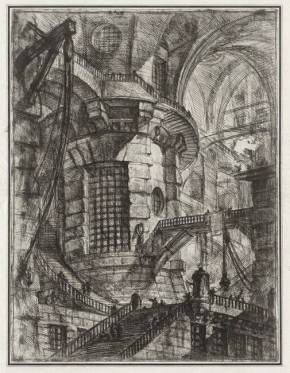
Giovanni Battista Piranesi, Carceri episode: The round tower, ca. 1749–50, etching.
In the eighteenth century Rome was a popular travel destination. Its remains of antiquity, the Renaissance, and Baroque monuments transformed the city into a laboratory of urban and aesthetic innovation. As a location with a rich publishing tradition, Rome also had the necessary infrastructure at its disposal to effectively spread the fame of local landmarks through printed images: illustrators, engravers, and etchers met here with publishers, printers, and distributors of different nationalities.
Thanks to the international circulation of the images, most visitors to Rome had already taken a visual journey through the city. Veduta, maps or panoramas, such as those from Giuseppe Vasi, provided the viewer with an overview of the monuments. Like today’s tourist guides they offered directions on how one might explore the city.
For artists, Rome was also an inexhaustible source of inspiration for architectural fantasies, which, alongside the realistic panoramas, enjoyed a growing popularity. With these inventions, Veneto-born architect Giovanni Battista Piranesi caused something of a stir. At the time, his masterly etchings were significant in establishing Rome alongside Venice as a center of Italian printmaking.

Pier Leone Ghezzi, Signor Domenico Annibali, che parla all’Eminentissimo di San Cesareo, ca. 1749
During his lifetime, almost the entire etched œuvre of the artist made its way to the Dresden Kupferstich-Kabinett. The purchase of Piranesi’s works is only one example of the extensive and selective acquisitions of Roman printmaking that were made at the time. Piranesi’s lifespan covers roughly the same time frame as the exhibited works, which concentrate on panoramas of the ancient and modern Rome as well as unreal spaces. To this day, most of these sheets are bound in so-called collector’s albums—large format volumes that were preferred in the eighteenth and nineteenth centuries for the storage and presentation of print collections.
Additionally, with caricatures by Pier Leone Ghezzi the exhibition offers insights into who populated the streets of the Eternal City in the eighteenth century. Numerous Ghezzi drawings were etched by order of the Saxon Royal Court. Today these sheets are presented as a particularly charming witness of the intensive relationship between Rome and Dresden at that time.
A catalog of the same name published by Sandstein-Verlag Dresden will accompany the exhibition.
New Book | Historical Style: Fashion and the New Mode of History
From Penn Press:
Timothy Campbell, Historical Style: Fashion and the New Mode of History, 1740–1830 (Philadelphia: University of Pennsylvania Press, 2016), 440 pages, (cloth) ISBN: 978-0812248326 / (ebook) ISBN: 978-0812293043, $65 / £42.
 Historical Style connects the birth of eighteenth-century British consumer society to the rise of historical self-consciousness. Prior to the eighteenth century, British style was slow to change and followed the cultural and economic imperatives of monarchical regimes. By the 1750s, however, a growing fashion press extolled, in writing and illustration, the new phenomenon of periodized fashion trends. As fashion fads came in and out of style, and as fashion texts circulated and obsolesced, Britons were forced to confront the material persistence of out-of-date fashions. Timothy Campbell argues that these fashion texts and objects shaped British perception of time and history by producing new curiosity about the very recent past, as well as a new self-consciousness about the means by which the past could be understood.
In a panoptic sweep, Historical Style brings together art history, philosophy, and literary history to portray an era increasingly aware of itself. Burgeoning consumer society, Campbell contends, highlighted the distinction between the past and the present, created an expectation of continual change, and forged a sense of history as something that could be tracked through material objects. Campbell assembles a wide range of writings, images, and objects to render this eighteenth-century landscape: commercial dress displays and David Hume’s ideas of novelty as historical form; popular illustrations of recent fashion trends and Sir Joshua Reynolds’s aesthetic precepts; fashion periodicals and Sir Walter Scott’s costume-saturated historical fiction. In foregrounding fashion to trace eighteenth-century historicism, Historical Style draws upon the interdisciplinary, multimedia archival impressions that fashionable dress has left behind, as well as the historical and conceptual resources within the field of fashion studies that literary and cultural historians of eighteenth-century and Romantic Britain have often neglected.
Timothy Campbell teaches English at the University of Chicago.
◊ ◊ ◊ ◊ ◊
C O N T E N T S
List of Abbreviations
Introduction: Fashions Past
I | The Dress of the Year
1 Modern Fashion and Comparative Contemporaneity
2 Portrait Historicism and the Dress of the Times
II | The Fictions of Serial History
3 Hume, Historical Succession, and the Dress of Rousseau
4 Historical Novelty and Serial Form
5 Walter Scott’s Fashion Systems
6 William Godwin and the Objects of Historical Fiction
Coda
Notes
Bibliography
Index
Acknowledgments
New Book | Ancients and Moderns in Europe
From the Voltaire Foundation:
Paddy Bullard and Alexis Tadié, eds., Ancients and Moderns in Europe: Comparative Perspectives (Oxford: Oxford University Studies in the Enlightenment, 2016), 328 pages, ISBN: 978-0729411776, £60 / €74 / $85.
The Querelle des Anciens et des Modernes, or Battle of the Books as it was known in England, famously pitted the Ancients on the one side and the Moderns on the other. This book presents a new intellectual history of the dispute, in which authors explore its manifestations across Europe in the arts and sciences, from the sixteenth to the eighteenth centuries. By paying close attention to local institutional contexts for the Querelle, contributors yield a complex picture of the larger debate. In intellectual life, authors uncover how the debate affected the publication of antiquarian scholarship, and how it became part of discussions in London coffee houses and the periodical press. Authors also position the Low Countries as the true pivot for a modernistic realignment of intellectual method, with concomitant rather than centralised developments in England and France. The volume is particularly concerned with the realisation of the Querelle in the realm of artistic and technical practice. Marrying modern approaches with ancient sympathies was fraught with difficulties, as contributors attest in analyses on musical writing, painting and the querelle du coloris, architectural practice and medical rhetorics. Tracing the deeper cultural resonances of the dispute, authors conclude by revealing how it fostered a new tendency to cultural self-reflection throughout Europe. Together, these contributions demonstrate how the Querelle acted as a leading principle for the configuration of knowledge across the arts and sciences throughout the early modern period, and also emphasise the links between historical debates and our contemporary understanding of what it means to be ‘modern’.
Paddy Bullard is Associate Professor of English literature and book history at the University of Reading. He has published books on Burke and Swift, and his research encompasses material culture studies, intellectual history and political thought.
Alexis Tadié is Professor of English literature, University of Paris-Sorbonne and Senior Research Fellow at the Institut Universitaire de France. He works on eighteenth-century literature and intellectual history, and has published books on Bacon, Locke, and Sterne.
◊ ◊ ◊ ◊ ◊
C O N T E N T S
Paddy Bullard and Alexis Tadié, Introduction
I | Ancient Knowledge and Modern Mediations
1 Vittoria Feola, The Ancients with the Moderns: Oxford’s Approaches to Publishing Ancient Science
2 Alexis Tadié, Ancients, Moderns, and the Language of Criticism
3 Stéphane Van Damme, Digging Authority: Archaeological Controversies and the Recognition of the Metropolitan Past in Early Eighteenth-Century Paris
II | Logic and Criticism across Borders
4 Martine Pécharman, From Lockean Logic to Cartesian(ised) Logic: The Case of Locke’s Essay and Its Contemporary Controversial Reception
5 Marcus Walsh, Scholarly Documentation in the Enlightenment: Validation and Interpretation
6 Karen Collis, Reading the Ancients at the Turn of the Century: The Third Earl of Shaftesbury (1671–1713) and Jean Le Clerc (1657–1736)
III | Conversing with the Ancients: Arts and Practices
7 Théodora Psychoyou, Ancients and Moderns, Italians and French: The Seventeenth-Century Quarrel over Music, Its Status, and Transformations
8 Elisabeth Lavezzi, Painting and the Tripartite Model in Charles Perrault’s Parallèle des Anciens et des Modernes
9 Paddy Bullard, John Evelyn as Modern Architect and Ancient Gardener: ‘Lessons of Perpetual Practice’
10 Sylvie Kleiman-Lafon, Ancient Medicine, Modern Quackery: Bernard Mandeville and the Rhetoric of Healing
IV | The Persistence of the Quarrel
11 Amedeo Quondam, Petrarch and the Invention of Synchrony
12 Karin Kukkonen, Samuel Richardson among the Ancients and Moderns
13 Ourida Mostefai, Finding Ancient Men in Modern Times: Anachronism and the Critique of Modernity in Rousseau
14 Ritchie Robertson, Ancients, Moderns, and the Future: The Querelle in Germany from Winckelmann to Schiller
Summaries
Biographies of contributors
Bibliography
Index
Exhibition | Shakespeare in Soane’s Architectural Imagination
Press release for the exhibition on view now at Sir John Soane’s Museum:
‘The Cloud-Capped Towers’: Shakespeare in Soane’s Architectural Imagination
Sir John Soane’s Museum, London, 21 April – 8 October 2016
Curated by Alison Shell
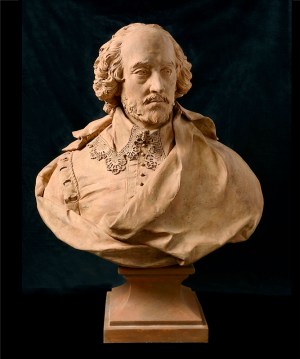
Louis-François Roubiliac, Bust of William Shakespeare (modern replica), 1742 (London: The Garrick Club).
A new exhibition coinciding with the 400th anniversary of the death of William Shakespeare will open at Sir John Soane’s Museum on 21st April. ‘The Cloud-Capped Towers’: Shakespeare in Soane’s Architectural Imagination focuses on Soane’s extensive Shakespeare collections, including his ownership of the first four Folios of Shakespeare’s collected works, the way Soane and his family participated in the eighteenth-century Shakespearean revival, and the influence of the Bard on Soane’s architecture. Guest-curated by Dr Alison Shell of UCL, the exhibition will largely consist of Soane’s own collection, supplemented by important loans from The Garrick Club. Whilst Soane’s fascination with Shakespeare is evident throughout his house-museum, this is the first time the elements have been drawn together to provide a cohesive study of the way Shakespeare influenced Soane. It is also a rare opportunity to see Shakespeare’s first our Folios displayed together in one exhibition.

Robert Adam, Adam’s interior of the Drury Lane Theatre from Works in Architecture of Robert and James Adam, 1779.
The first room of the exhibition introduces the 400th anniversary of Shakespeare’s death, setting it in the context of the 200th anniversary celebrations in 1816, and discusses the intersection between literature and architecture with a particular focus on David Garrick, the celebrated actor-manager of the Drury Lane Theatre who was so instrumental in the popularisation of Shakespeare in Georgian London.
The Garrick Club has loaned two paintings: David Garrick between the Muses of Tragedy and Comedy, after Sir Joshua Reynolds, and John Philip Kemble as Hamlet, from the studio of Sir Thomas Lawrence. These are instantly recognisable portraits of two of the greatest actors of the eighteenth century, famed for their interpretations of Shakespeare. The Adam brothers’ designs for Drury Lane Theatre will also be on display, as well as a rare coloured edition of The Works in Architecture of Robert and James Adam.
The second room in the gallery goes on to consider Shakespeare in Soane’s architectural imagination. In 1788–89 ‘The Shakespeare Gallery’, only the second purpose-built art gallery in England, was built in Pall Mall to designs by George Dance the Younger, Soane’s first architectural teacher and mentor. These in turn influenced Soane’s later designs for the Dulwich Picture Gallery—itself the first public art gallery in Britain.
The exhibition closes with a selection of Soane’s large-scale Royal Academy lecture drawings, allowing access to these appealing and striking images which can usually be viewed only by appointment.
◊ ◊ ◊ ◊ ◊
Catalogue available through Sir John Soane’s Museum:
Frances Sands, Alison Shell, Stephanie Coane, and Emmeline Leary, ‘The Cloud-Capped Towers’: Shakespeare in Soane’s Architectural Imagination (London: Sir John Soane’s Museum, 2016), 48 pages, ISBN: 978-0993204128, £10.
 This book of essays, ‘The cloud-capped towers:’ Shakespeare in Soane’s Architectural Imagination, is published to coincide with an exhibition with the same title to be shown at Sir John Soane’s Museum in 2016 as part of the nationwide commemoration of the 400th anniversary of the death of the great English playwright William Shakespeare.
Sir John Soane (1753–1837) was a highly literary architect, who appears to have valued Shakespeare for the architectural pictures he conjured up, and also as a moral teacher. He had a deep knowledge of Shakespeare’s work, quoting (and misquoting) it often, notably in his Royal Academy lectures. His fascination with Shakespeare is evident both in his library and in the Shakespearian references throughout his house-museum, the most obvious being the Shakespeare Recess, a shrine to the Bard on the staircase.
The four essays in this volume look at the influence of Shakespeare on Soane’s architecture, against the wider background of the eighteenth-century Shakespearean revival; at Soane as a ‘bardolator’ and bibliophile; and at contemporary performance and theatre-going, with a particular focus on the plays seen by Soane and his wife Eliza. The essays are illustrated by a number of illustrations in full colour, the majority drawn from Soane’s own collection.
Frances Sands is Curator of Drawings and Books at Sir John Soane’s Museum. Alison Shell is a professor in the Department of English, University College London. Emmeline Leary is an independent scholar. Stephanie Coane is Senior Librarian is Senior Librarian, College Library, Eton College and Honorary Librarian to Sir John Soane’s Museum.
Exhibition | Noble Prospects: Capability Brown and Yorkshire
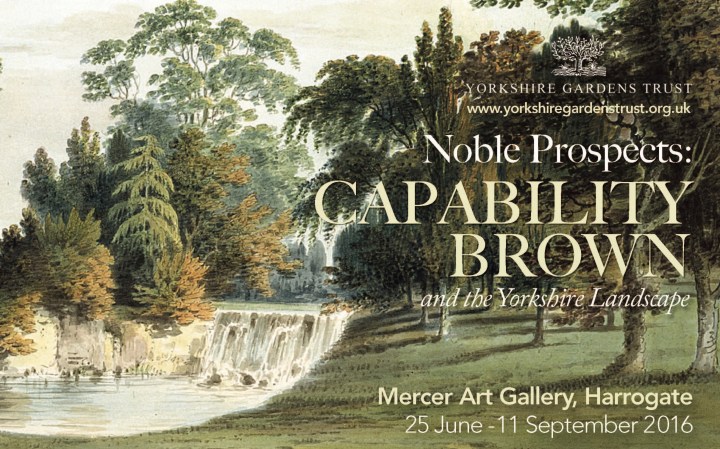
Now on view at The Mercer Art Gallery, with more information from the Capability Brown Festival:
Noble Prospects: Capability Brown and the Yorkshire Landscape
The Mercer Art Gallery, Harrogate, North Yorkshire, 25 June — 11 September 2016
The great landscape gardener Lancelot ‘Capability’ Brown (1716–1783) changed the face of eighteenth-century English parkland, creating a magical world of woods, water and swathes of green that lives on until this day in Yorkshire. This Mercer Art Gallery exhibition is the first ever dedicated to the Yorkshire landscapes of this legendary designer to mark the 300th anniversary of his birth, devised in partnership with the Yorkshire Gardens Trust.
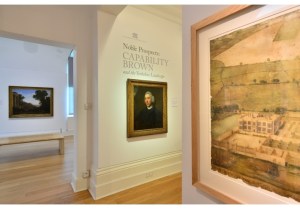
Installation view of the exhibition “Noble Prospects: Capability Brown and the Yorkshire Landscape,” The Mercer Art Gallery, Harrogate, North Yorkshire, 2016. Photo by Simon Miles.
Capability Brown is the creator of some of Yorkshire’s most admired landscapes, which include Burton Constable, Harewood, Roche Abbey, Scampston, Sledmere and Temple Newsam. This unique exhibition brings together an intriguing collection of artworks, which reveal more about the designer and his designs. Drawn largely from Yorkshire collections the show features portraits of Capability Brown and his Yorkshire clients, original plans, drawings and documents by Brown, paintings of his creations as well as works of art that inspired his landscapes.
Capability Brown was the leading landscape designer of the second-half of the eighteenth century and there are thought to be 20 sites in Yorkshire associated with him. He rejected the very formal geometric French style of gardening and concentrated on echoing the natural undulations of the English landscape in his plans. The landscape garden is recognised as one of Britain’s greatest artistic achievements and the designs of Brown and his contemporaries have influenced gardens across the world.
Noble Prospects: Capability Brown and the Yorkshire Landscape is supported by The Landscape Agency, Saffery Champness, Savills, Coutts, Harrogate Borough Council, The Capability Brown Festival 2016, Art Fund, Natural England, The Calmcott Trust, The Friends of the Mercer Art Gallery, Leeds Philosophical and Literary Society, Historic Houses Associations Yorkshire Friends, Mr and Mrs J. Samuel and private donors. The Yorkshire Gardens Trust, an educational charity founded in 1996, works to help conserve, protect and promote Yorkshire’s rich heritage of parks, gardens and designed landscapes.
◊ ◊ ◊ ◊ ◊
From the Yorkshire Gardens Trust:
Karen Lynch, Noble Prospects: Capability Brown and the Yorkshire Landscape (Yorkshire Gardens Trust, 2016), 72 pages, £12.
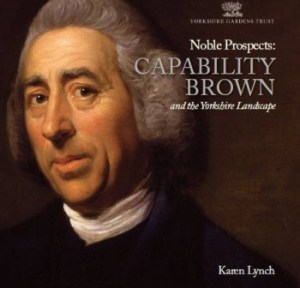 The development of a new natural style of laying out parks in the eighteenth century is acknowledged to be one of the greatest artistic achievements in British history. One man’s name is indelibly linked with the profession of landscape gardening: Lancelot Brown. Achieving great renown in his own lifetime he became universally known by his affectionate nickname ‘Capability’, and whilst fashions in design have come and gone, his fame remains great three hundred years after his birth. This new publication celebrates Capability Brown’s work in Yorkshire and is the culmination of two years of research to identify just what Brown did in this vast county. It features contemporary views by artists such as J.M.W. Turner and Paul Sandby as well as works by amateur artists who admired the landscapes they visited. Also illustrated are designs by Brown and portraits of the man and his Yorkshire clients. Stunning newly commissioned photography by artist Simon Warner shows the parks as they look today.










leave a comment