Call for Nominations | Top 100 British Art Books, 1600–1850

John Carter, View of the Library at Strawberry Hill, watercolour, 23.7 × 28.8 cm, from Horace Walpole, A Description of the Villa … at Strawberry-Hill (Strawberry Hill, 1784). The Lewis Walpole Library, Yale University.
◊ ◊ ◊ ◊ ◊
The 100 Most Important Books for Understanding British Art, 1600–1850
Nominations due by 1 June 2016
As a cooperative initiative with Choice Magazine, the Historians of British Art (HBA) is working to assemble a list of the most important books for understanding British art produced between 1600 and 1850. The project, which will result in a bibliographic review essay for Choice, is particularly aimed at strengthening library holdings, and so nominations of studies broad in scope or significance are especially encouraged. In addition to studies of paintings, sculpture, and print culture, scholarship addressing country houses, gardens, decorative arts, patronage, and the history of exhibitions and collections for the period are welcome. Exhibition catalogues, historiographical studies, and works that situate British art within international contexts are also welcome. Books published within the past 10–20 years will anchor the final list, but nominations of titles from any period are eligible. Self-nominations are entirely appropriate. Don’t be shy. Nominate early and often!
Nominations may be submitted at the HBA website or emailed directly to HBA president, Craig Hanson, Top100BritishArtBooks@gmail.com. Nominations due by June 1.
New Book | Órdenes y espacio: sistemas de expresion
From Artbooks.com:
Esther Alegre Carvajal and Consuelo Gómez López, Ordenes y espacio: sistemas de expresion de la arquitectura moderna, siglos XV–XVIII (Madrid: UNED, 2016), 311 pages, ISBN: 978-8436269970, 30€ / $58.
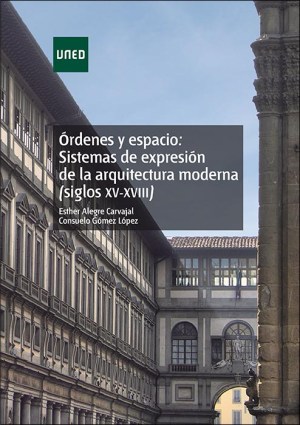 Un recorrido por la arquitectura y el urbanismo europeos de la Edad Moderna nos muestra un lenguaje arquitectónico vinculado al Clasicismo, que con la articulación de los órdenes clásicos, sus normas y sus proporciones crea espacios arquitectónicos y urbanos para los usos culturales, ideológicos y políticos del momento. Con este encuadre es necesario centrarse en el estudio del lenguaje de los órdenes arquitectónicos y los debates teóricos que surgieron durante los siglos XV al XVIII; el proceso de configuración formal y simbólico del espacio arquitectónico y su interpretación historiográfica; la creación de tipologías arquitectónicas, la relación entre el edificio y su espacio urbano; cómo influyeron las fuentes impresas y su circulación en la configuración de tipologías y modelos espaciales, o la recepción y aplicación que tuvo el Clasicismo como un sistema arquitectónico válido en los diferentes territorios europeos.
Exhibition | Freemasonry
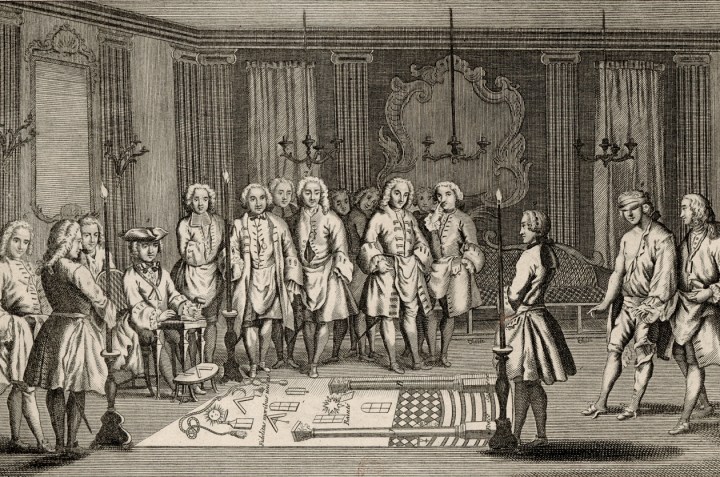
Assemblée de Francs-Maçons pour la réception des Maîtres, 1745
◊ ◊ ◊ ◊ ◊
Now on view at the BnF:
Freemasonry
Bibliothèque Nationale de France, Paris, 12 April — 24 July 2016
Curated by Pierre Mollier, Sylvie Bourel, and Laurent Portes
The Bibliothèque nationale de France, which houses one of the most important Masonic collections in the world, organizes a major exhibition dedicated to French freemasonry, in partnership with the Musée de la franc-maçonnerie. Over 450 pieces are presented, some of them for the first time ever. Some of these pieces belong either to the library’s collections or to major French obediences. Others were exceptionally lent by foreign owners. The exhibition focuses on the following issues: the origins of freemasonry, how it was founded in France, its symbols and rituals, its involvement in the political, religious, artistic and philosophical fields, the variety of associated legends… Its aim is to present freemasonry as an accessible issue.
The exhibition website is available here»
◊ ◊ ◊ ◊ ◊
Pierre Mollier, Sylvie Bourel, et Laurent Portes, La franc-maçonnerie (Paris: Bibliothèque Nationale de France, 2016), 344 pages, ISBN: 978-2717726992, 45€.
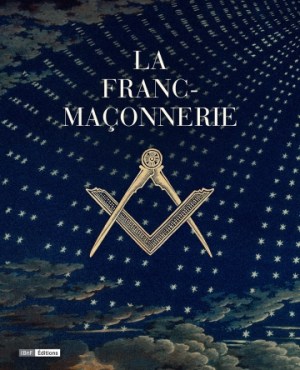 À partir du XVIIIe siècle, la franc-maçonnerie s’implante aussi profondément que durablement dans la société française. Si, de nos jours, celle-ci fait régulièrement la une des journaux, elle n’en demeure pas moins mal connue—quand elle ne nourrit pas encore d’obscurs soupçons de trafic d’influence, de complot ou d’occultisme. Publié à l’occasion de l’exposition d’une envergure sans précédent que la Bibliothèque nationale de France consacre à la franc‑maçonnerie, cet ouvrage est appelé à devenir l’une des références incontournables du domaine. Réunissant les contributions des plus grands spécialistes, il répond à la légitime curiosité dont la maçonnerie fait l’objet.
Des origines légendaires à la franc-maçonnerie moderne, dite spéculative, il retrace l’histoire de la franc-maçonnerie en faisant la part du fantasme et de la réalité. Il présente le corpus symbolique et les rites maçonniques associés à la notion, ici centrale, d’initiation. Excluant tout esprit polémique, il répertorie les réalisations politiques et sociétales de l’histoire moderne qui puisent leurs sources dans l’engagement philanthropique des maçons : les lois sur la liberté de la presse, la liberté d’association, la laïcité, l’école gratuite et obligatoire ou encore les premières bases de la protection sociale. Il relève également les inspirations maçonniques variées qui, depuis trois siècles, irriguent les arts et les lettres, de La Flûte enchantée de Mozart à Léon Tolstoï ou Rudyard Kipling, en passant, aujourd’hui, par la bande dessinée ou le roman policier. Riche par la diversité des thèmes abordés, cet ouvrage l’est enfin par son iconographie. La Bibliothèque nationale de France abrite l’un des plus importants dépôts de documents maçonniques au monde : manuscrits, estampes, livres rares y sont à la fois nombreux et d’une qualité remarquable. Ces collections exceptionnelles méritaient d’être connues et admirées au-delà du monde des chercheurs et des spécialistes ; reproduites ici, parfois pour la toute première fois, elles contribueront désormais, de manière aussi spectaculaire que documentée, à la meilleure compréhension d’une société dont les adeptes eux-mêmes reconnaissent la complexité.
Cet ouvrage est publié à l’occasion de l’exposition «La franc-maçonnerie», organisée par la Bibliothèque nationale de France et présentée sur le site François-Mitterrand, du 12 avril au 24 juillet 2016.
New Book | Elegantiores statuae antiquae: Parole e immagini
From Artbooks.com:
Leonarda Di Cosmo and Lorenzo Fatticcioni, Elegantiores statuae antiquae: Parole e immagini per una fruizione ‘turistica’ dell’Antico nella Roma del Settecento (Rome: Bentivoglio, 2016), 350 pages, ISBN: 978-8898158553, 40€ / $70.
 Legato al genere degli ‘atlanti’ statuari, il volumetto Elegantiores statuae antiquae in variis romanorum palatiis asservatae di Dominique Magnan (1731–1796), offrendo una selezione aggiornata delle più apprezzate statue antiche, si connota come uno dei numerosi canali di divulgazione della cultura antiquaria operativi nel secondo Settecento. Organizzando il testo secondo strategie comunicative mutuate dalle più aggiornate ‘guide di Roma’ e coniugando nell’apparato iconografico le immagini di consolidate e nuovissime eccellenze statuarie, Magnan realizza un prodotto editoriale nuovo e di sicuro impatto commerciale. Configurate dunque come un’antologia del ‘più bello’ delle collezioni romane di antichità e quasi anticipando le rubriche ‘da non perdere’ o ‘vale il viaggio’ delle guide turistiche a noi contemporanee, le Elegantiores si proponevano come un agile prontuario che poteva essere acquistato ad accompagnamento di altri prodotti dell’ ‘industria’ culturale basata sull’Antico.
Leonarda Di Cosmo e Lorenzo Fatticcioni, studiosi di Storia dell’Archeologia Classica, svolgono la loro attività di ricerca presso la Scuola Normale Superiore di Pisa. Si occupano in particolare di antiquaria e di ‘fortuna dell’Antico’, di Storia del Collezionismo e, in parallelo, di Metodologie Informatiche applicate ai Beni Culturali. In quest’ultimo settore si dedicano alla progettazione di banche dati per la gestione di fonti storico-artistiche e documentarie e di siti web per la Museologia e la Comunicazione del Patrimonio Culturale. Hanno coordinato, tra l’altro, i progetti Monumenta Rariora. Metamorfosi dell’Antico, sulla fortuna della statuaria antica in età moderna e Arretinum Museum, sulla storia del collezionismo di antichità in territorio aretino. Tra le loro pubblicazioni più recenti si segnalano i volumi Le componenti del classicismo secentesco: Lo statuto della scultura antica e Le regole della bellezza: Saperi antiquari e teorie dell’arte nei ‘Segmenta nobilium signorum et statuarum’ di François Perrier.
New Book | The Mansion House, Dublin
Published by Four Courts Press:
Mary Clark, ed., The Mansion House, Dublin: 300 Years of History and Hospitality (Dublin: Four Courts Press, 2015), 180 pages, ISBN: 978-1907002199, €25 / $65.
 Dublin’s Mansion House is the only mayoral residence in Ireland and is older than any surviving in Great Britain. Originally the town house of merchant and property developer Joshua Dawson, it was purchased by the Dublin City Assembly in April 1715 and since then has been the home of each lord mayor during their term of office. This is the first major work on the Mansion House and includes essays on its history, architecture, and antique furnishings, along with an account of one year in the residence, which gives a vivid picture of how the building is used.
Mary Clark is the Dublin City Archivist and is curator of the Dublin Civic Portrait Collection. Fanchea Gibson is the Administrator of the Mansion House and oversees the day-to-day running of the mayoral residence. Nicola Matthews is architectural Conservation Officer with Dublin City Council and her research interests include the historic fabric of Merrion Square. Susan Roundtree was Senior Executive Architect with Dublin City Council and was responsible for the care and conservation of the Mansion House. Patricia Wrafter is Senior Executive Council and is responsible for the historic furnishings of the Mansion House.
New Book | Frederick de Wit and the First Concise Reference Atlas
From Brill:
George Carhart, Frederick de Wit and the First Concise Reference Atlas (Leiden: Brill, 2016), 600 pages, ISBN: 978-9004299030, 125€ / $162.
 This book is about the life and work of Frederick de Wit (1629–1706), one of the most famous dealers of maps, prints and art during the Dutch Golden Age, and his contribution to the dissemination of the knowledge of cartography. The Amsterdam firm of Frederick de Wit operated under the name ‘De Witte Pascaert’ (‘The White Chart’) from 1654 to 1710. It offered all kinds of printing and was one of the most successful publishers of maps and prints in the second half of the seventeenth century. The description of De Wit’s life and work is followed by an in-depth analysis and dating of the atlases and maps issued under his name.
After a career in yacht, boat, and historic building restoration and a stint in the army, George Carhart began his second career in academia with a BA in history from the University of Southern Maine. The history of cartography has been a central point of his interests. After receiving his BA in 1998 he joined the staff at the Osher Map Library and Smith Center for Cartographic Education, working there as the assistant curator. After leaving the Osher Map Library in 2006 to complete his doctoral work, he has continued to research, publish, and teach in the field of cartographic history. Since receiving his PhD from the University of Passau in 2011, he has worked on projects at several universities including Dresden University of Technology and Trinity College Dublin.
C O N T E N T S
Acknowledgments
Introduction
1 Frederick de Wit’s Biography and His Business
2 The First Modern World Atlas
3 Frederick de Wit’s New Concise Reference Atlas
4 Today’s Bibliographic Methods Collide with Printing and Publishing Methods of the Early Modern World, 1577–1800
5 Dating De Wit’s Maps and Atlases
6 De Wit’s Legacy
7 The Cartographic Origins of De Wit’s Maps
8 Conclusion
Overview of the atlases published by De Wit
Cartobibliography of maps in De Wit’s atlases
List of consulted libraries
Acknowledgement of the illustrations
A fully detailed table of contents is available here»
New Book | The Russian Canvas: Painting in Imperial Russia
From Yale UP:
Rosalind P. Blakesley, The Russian Canvas: Painting in Imperial Russia, 1757–1881 (New Haven: Yale University Press, 2016), 380 pages, ISBN: 978-0300184372, $75.
 The Russian Canvas charts the remarkable rise of Russian painting in the 18th and 19th centuries, and the nature of its relationship with other European schools. Starting with the foundation of the Imperial Academy of the Arts in 1757 and culminating with the assassination of Tsar Alexander II in 1881, it details the professionalization and wide-ranging activities of painters against a backdrop of dramatic social and political change. The Imperial Academy formalized artistic training but later became a foil for dissent, as successive generations of painters negotiated their own positions between pan-European engagement and local and national identities. Drawing on original archival research, this groundbreaking book recontextualizes the work of major artists, revives the reputations of others, and explores the complex developments that took Russian painters from provincial anonymity to international acclaim.
Rosalind P. Blakesley is reader in Russian and European art at the University of Cambridge.
Blakesley is also the curator of the exhibition now on view at London’s National Portrait Gallery Russia and the Arts: The Age of Tolstoy and Tchaikovsky (17 March — 26 June), which addresses the period from 1867 to 1914.
Exhibition | Three Centuries of American Prints
From the press release (3 February 2016) for the exhibition:
Three Centuries of American Prints from the National Gallery of Art
National Gallery of Art, Washington, D.C., 3 April 3 — 24 July 2016
National Gallery, Prague, 4 October 2016 — 5 January 2017
Antiguo Colegio de San Ildefonso, Mexico City, 7 February — 30 April 2017
Curated by Amy Johnston and Judith Brodie

John Simon after John Verelst, Sa Ga Yeath Qua Pieth Tow, King of the Maquas, after 1710 (Washington, D.C.: National Gallery of Art, Paul Mellon Fund)
A new international traveling exhibition will explore major events and movements in American art through some 150 outstanding prints from the Colonial era to the present. Three Centuries of American Prints from the National Gallery of Art is the first major museum survey of American prints in more than 30 years. Timed to coincide with the National Gallery of Art’s 75th anniversary, the exhibition is drawn from the Gallery’s renowned holdings of works on paper, and features more than 100 artists such as Paul Revere, James McNeill Whistler, Mary Cassatt, Winslow Homer, George Bellows, John Marin, Jackson Pollock, Louise Nevelson, Romare Bearden, Andy Warhol, Robert Rauschenberg, Chuck Close, Jenny Holzer, and Kara Walker.
Organized chronologically and thematically through nine galleries, Three Centuries of American Prints reveals the breadth and excellence of the Gallery’s collection while showcasing some of the standouts: exquisite, rare impressions of James McNeill Whistler’s Nocturne (1879/1880), captivating prints by Mary Cassatt, a singularly stunning impression of John Marin’s Woolworth Building, No. 1 (1913), and Robert Rauschenberg’s pioneering Booster (1967).
The exhibition is bracketed by John Simon’s Four Indian Kings (1710)—stately portraits of four Native American leaders who traveled to London to meet Queen Anne—and Kara Walker’s no world (2010), which recalls the disastrous impact of European settlement in the New World. Both prints address the subject of transnational contact, a theme that runs through the history of American art.

Paul Revere, The Boston Massacre, 1770, hand-colored engraving (Washington, D.C.: National Gallery of Art, Rosenwald Collection)
Three Centuries of American Prints features works intended to provoke action, such as Paul Revere’s call for moral outrage in The Bloody Massacre (1770) and Jenny Holzer’s appeal to “Raise Boys and Girls the Same Way” in her Truisms (1977). Others lean more strongly toward visual concerns, such as Stuart Davis’s striking black-and-white lithograph, Barber Shop Chord (1931), and Richard Diebenkorn’s resplendent Green (1986). This duality between prints designed to exhort or teach and ones more weighted to artistic matters is an undercurrent of both the exhibition and the history of American prints.
Since its opening in 1941, the National Gallery of Art has assiduously collected American prints with the help of many generous donors. The Gallery’s American print collection has grown from nearly 1,900 prints in 1950 to some 22,500 prints in 2015. The collection was transformed in recent years by the acquisition of the Reba and Dave Williams Collection, the personal print archive of Jasper Johns, and some 2,300 American prints from the Corcoran Gallery of Art, along with a gift and pledge of 18th- and early 19th-century prints from Harry W. Havemeyer.
“In the past few decades the American collections at the National Gallery of Art have grown vastly in quality and scale. From 2000 until today—thanks to generous donors and acquisitions from the Corcoran Gallery of Art—the collection of American prints has almost doubled and now numbers some 22,500 works,” said Earl A. Powell III, Director, National Gallery of Art. “We are tremendously grateful to hundreds of donors, foremost among them Lessing J. Rosenwald and Reba and Dave Williams, as well as grateful to Altria Group, the Terra Foundation for American Art, and The Exhibition Circle of the National Gallery of Art for their vital support.”
The exhibition is made possible by Altria Group in celebration of the 75th Anniversary of the National Gallery of Art. This is the twelfth exhibition sponsorship by Altria Group at the Gallery. “For more than 50 years, Altria and its companies have supported visual and performing arts. Our partnership with the National Gallery of Art to share Three Centuries of American Prints is an important way that we’re bringing world-class cultural experiences to our communities,” said Bruce Gates, Senior Vice President of External Affairs for Altria Client Services. The international tour of the exhibition is sponsored by the Terra Foundation for American Art. Additional support is provided by The Exhibition Circle of the National Gallery of Art.
The curators of the exhibition are Amy Johnston, assistant curator of prints and drawings, and Judith Brodie, curator and head of the department of modern prints and drawings, both at the National Gallery of Art. The exhibition catalog is conceived and edited by Judith Brodie, with coauthors Amy Johnston and Michael J. Lewis, the Faison-Pierson-Stoddard Professor of Art History at Williams College. The Terra Foundation for American Art provided additional funding for the exhibition catalog.
Judith Brodie, Amy Johnston, and Michael J. Lewis, Three Centuries of American Prints (New York: Thames & Hudson, 2016), 306 pages, ISBN: 978-0500239520, $60.
New Book | The Mind Is a Collection
From Penn Press:
Sean Silver, The Mind Is a Collection: Case Studies in Eighteenth-Century Thought (Philadelphia: University of Pennsylvania Press, 2015), 384 pages, ISBN: 978-0812247268, $65 / £42.
 John Locke described the mind as a cabinet; Robert Hooke called it a repository; Joseph Addison imagined a drawer of medals. Each of these philosophers was an avid collector and curator of books, coins, and cultural artifacts. It is therefore no coincidence that when they wrote about the mental work of reason and imagination, they modeled their powers of intellect in terms of collecting, cataloging, and classification.
The Mind Is a Collection approaches seventeenth- and eighteenth-century metaphors of the mind from a material point of view. Each of the book’s six chapters is organized as a series of linked exhibits that speak to a single aspect of Enlightenment philosophies of mind. From his first chapter, on metaphor, to the last one, on dispossession, Sean Silver looks at ways that abstract theories referred to cognitive ecologies—systems crafted to enable certain kinds of thinking, such as libraries, workshops, notebooks, collections, and gardens. In doing so, he demonstrates the crossings-over of material into ideal, ideal into material, and the ways in which an idea might repeatedly turn up in an object, or a range of objects might repeatedly stand for an idea. A brief conclusion examines the afterlife of the metaphor of mind as collection, as it turns up in present-day cognitive studies. Modern cognitive theory has been applied to the microcomputer, and while the object is new, the habit is as old as the Enlightenment.
By examining lived environments and embodied habits from 1660 to 1800, Silver demonstrates that the philosophical dualism that separated mind from body and idea from thing was inextricably established through active engagement with crafted ecologies.
Sean Silver teaches literature at the University of Michigan. Sean Silver’s The Mind is a Collection is a two-part intellectual project featuring a virtual museum (about museums) along with his book, The Mind is a Collection, which serves as both scholarly study and an exhibit catalogue.
◊ ◊ ◊ ◊ ◊
C O N T E N T S
Preface: Welcome to the Museum
Introduction
Case 1. Metaphor
1 John Locke’s Commonplace Book
2 John Milton’s Bed
3 Mark Akenside’s Museum
Case 2. Design
4 Robert Hooke’s Camera Obscura
5 Raphael’s Judgment of Paris
6 A Gritty Pebble
7 An Oval Portrait of John Woodward
8 A Stone from the Grotto of Egeria
9 Venus at Her Toilet
Case 3. Digression
10 The Iliad in a Nutshell
11 A Full Stop
12 A Conical Roman Tumulus
13 The Reception of Claudius
14 Addison’s Walk
Case 4. Inwardness
15 William Hay’s Stone
16 Two Calculi Cut and Mounted in a Small Showcase
17 An Ampulla of the Blood of Thomas Becket
18 A Blue-Bound Copy of The Mysterious Mother
Case 5. Conception
19 A Blank Sheet of Paper (1)
20 A Folio Sheet with Two Sketches of a Single Conception
21 A Triumph of Galatea
22 Joshua Reynolds, William Hunter
Case 6. Dispossession
23 A Shilling
24 A Book of Accounts
25 A Blank Sheet of Paper (2)
26 A Ring Containing a Lock of Hair
27 The Lost Property Office
28 The Skeleton of Jonathan Wild
Conclusion
Notes
Index
Acknowledgments
Exhibition | I Am Here! Self-Portraits
Now on view at the Musée des Beaux-Arts de Lyon:
I Am Here! / Autoportraits: De Rembrandt du Selfie / Facing the World
Staatliche Kunsthalle Karlsruhe, 31 October 2015 — 31 January 2016
Musée des Beaux-Arts de Lyon, 26 March — 26 June 2016
Scottish National Portrait Gallery, Edinburgh, 16 July — 16 October 2016
Curated by Dorit Schäfer, Stéphane Paccoud, and Imogen Gibbon

Joseph Vivien, Self-portrait with Palette, 1715–20
The Staatliche Kunsthalle of Karlsruhe, the National Galleries of Scotland in Edinburgh, and the Museum of Fine Arts of Lyon established a partnership in 2011. The first exhibition to be created within this frame is on the theme of self-portraits and it will open in Lyon in spring of 2016.
The exhibition contains over 130 works from three major European museums, from the Renaissance period up to the 21st century, including paintings, drawings, prints, sculptures, photographs and videos. A specific genre in itself, self-portraits contain much information about their creators as well as their historical and social environment. At a time when selfies have become a true societal phenomenon, one that characterizes the digital era, the study of the traditions and usage of self portraits is more pertinent than it has ever been.
The exhibition offers a major chance to study the practice of self-portraits by artists in various forms that will be exhibited in seven sections
• The artist’s gaze
• the artist as a nobleman
• the artist at work
• the artist and his circle
• role-play
• the artist in his time
• the artist’s body
 Ich Bien Hier! Von Rembrandt zum Selfie (Cologne: Snoeck, 2016), 284 pages, ISBN: 978-3864421389. French and English editions will also be available.
Staatliche Kunsthalle de Karlsruhe
Pia Müller-Tamm, Director
Alexander Eiling, Curator
Dorit Schäfer, Curator, Drawings and Prints
Musée des Beaux-Arts de Lyon
Stéphane Paccoud, Chief Curator, Nineteenth-Century Paintings and Sculptures
Ludmila Virassamynaïken, Curator, Old Masters Paintings and Sculptures
National Galleries of Scotland
Michael Clarke, Director General
Imogen Gibbon, Curator










 Enfilade
leave a comment