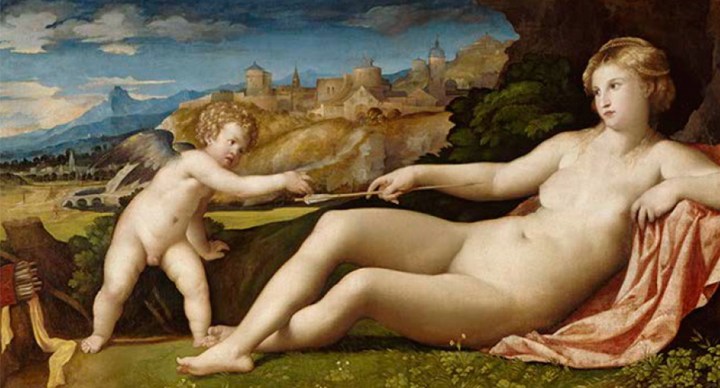
Palma Vecchio, Venus and Cupid, 1523–24 (Cambridge: The Fitzwilliam Museum). The painting was purchased by Lord Fitzwilliam from the London sale of the Duc d’Orléans collection in 1798. He first saw the collection at the Palais Royale during his visits to Paris.
◊ ◊ ◊ ◊ ◊
Press release from The Fitzwilliam:
Today (Thursday, 4 February 2016) one of the great collections of art in the UK celebrates its bicentenary. 200 years to the day of his death, the Fitzwilliam Museum has revealed previously unknown details of the life of its mysterious founder, Richard 7th Viscount Fitzwilliam of Merrion. Research for a new book has shown how his beloved library may have contributed to his death, and how his passion for music led him to the love of his life: a French dancer with whom he had two children, Fitz and Billy.
The Fitzwilliam Museum: A History is written by Lucilla Burn, Assistant Director for Collections at the Fitzwilliam. The book explores the full 200 year story of the Museum and the first chapter focuses on the founder. She comments: “Lord Fitzwilliam’s life has been described as ‘deeply obscure’. Many men of his class and period, who sought neither fame nor notoriety, nor wrote copious letters or diaries, do not leave a conspicuous record. But by going through the archives and letters that relate to him, for the first time we can paint a fuller picture of his history, including aspects of his life that have previously been unknown, even to staff here at the Fitzwilliam.”
Lord Fitzwilliam died on the 4th of February 1816, and founded the Fitzwilliam Museum through the bequest to the University of Cambridge of his splendid collection of art, books and manuscripts, along with £100,000 to build the Museum. This generous gift began the story of one of the finest museums in Britain, which now houses over half a million artworks and antiquities. Other than his close connection to Cambridge and his love of art and books, a motivation for Fitzwilliam’s bequest may have been his lack of legitimate heirs. The new details of his mistress help to explain why he never married.

Joseph Wright, The Hon. Richard Fitzwilliam, 7th Viscount Fitzwilliam of Merrion, 1764 (Cambridge: The Fitzwilliam Museum)
In 1761 Richard Fitzwilliam entered Trinity Hall, Cambridge, and in 1763 his Latin ode, ‘Ad Pacem’, was published in a volume of loyal addresses to George III printed by the University of Cambridge. He made a strong impression on his tutor, the fiercely ambitious Samuel Hallifax, who commissioned Joseph Wright of Derby to paint a fine portrait of Fitzwilliam on his graduation with an MA degree in 1764. Fitzwilliam’s studies continued after Cambridge; he travelled widely on the continent, perfecting his harpsichord technique in Paris with Jacques Duphly, an eminent composer, teacher and performer. A number of Fitzwilliam’s own harpsichord compositions have survived, indicating he was a gifted musician.
But from 1784 he was also drawn to Paris by his passionate attachment to Marie Anne Bernard, a dancer at the Opéra whose stage name was Zacharie. With Zacharie, Fitzwilliam fathered three children, two of whom survived infancy—little boys known to their parents as ‘Fitz’ and ‘Billy’. How the love affair ended is unknown, but its fate was clouded, if not doomed, by the French Revolution. We do not know what happened to Zacharie after her last surviving letter, written to Lord Fitzwilliam late in December 1790. Her health was poor, so it is possible that she died in France. However, the elder son, Fitz (Henry Fitzwilliam Bernard), his wife Frances, and their daughter Catherine were living in Richmond with Lord Fitzwilliam at the time of the latter’s death in 1816. It is not known what happened to Billy.
At the age of seventy, early in August 1815, Lord Fitzwilliam fell from a ladder in his library and broke his knee. This accident may have contributed to his death the following spring, and on 18 August that year Fitzwilliam drew up his last will and testament. Over the course of his life he had travelled extensively in Europe. By the time of his death he had amassed around 144 paintings (including masterpieces by Titian, Veronese, and Palma Vecchio), 300 carefully ordered albums of Old Master prints, and a magnificent library containing illuminated manuscripts, musical autographs by Europe’s greatest composers, and 10,000 fine printed books.
His estates were left to his cousin’s son, George Augustus Herbert, eleventh Earl of Pembroke and eighth Earl of Montgomery. But he also carefully provided for his relatives and dearest friends. The family of Fitzwilliam’s illegitimate son, Henry Fitzwilliam Bernard (‘Fitz’)—including Fitz’s wife and daughter—received annuities for life totalling £2,100 a year. On Fitzwilliam’s motivation for leaving all his works of art to the University, he wrote: “And I do hereby declare that the bequests so by me made to the said Chancellor Masters and Scholars of the said University are so made to them for the purpose of promoting the Increase of Learning and the other great objects of that Noble Foundation.”
Director of the Fitzwilliam Museum, Tim Knox commented: “The gift Viscount Fitzwilliam left to the nation was one of the most important of his age. This was the period when public museums were just beginning to emerge. Being a connoisseur of art, books and music, our founder saw the importance of public collections for the benefit of all. But we are also lucky that his life circumstances enabled him to do so—had there been a legitimate heir, he might not have been able to give with such liberality. From the records we have discovered, he appears to have been as generous as he was learned: he arranged music concerts to raise funds for charity and helped many people escaping the bloodiest moments of the French Revolution. We are delighted to commemorate our founder in our bicentenary year.”
◊ ◊ ◊ ◊ ◊
Celebrating the First 200 Years: The Fitzwilliam Museum, 1816–2016
The Fitzwilliam Museum, Cambridge, 4 February — 30 December 2016
Running throughout 2016, this exhibition will explore the Fitzwilliam’s past, present and future. A timeline of the first 200 years will introduce key themes and characters, while displays of objects will show how the collections have developed over two centuries. The exhibition runs alongside a new book The Fitzwilliam Museum: A History. For the very first time, this will tell the full 200 year story of the Museum. The triumphs and challenges of successive Directors, the changing nature of the Museum’s relationship with its parent University, and its dogged survival through the two World Wars. It will also shed light on the colourful, but previously little-known, personal life of Viscount Fitzwilliam himself.
◊ ◊ ◊ ◊ ◊
Lucilla Burn, The Fitzwilliam Museum: A History (London: Philip Wilson Publishers, 2016), 224 pages, ISBN: 978-1781300343, £25.
 The Fitzwilliam Museum: A History traces the full story from the Museum’s origins in the 1816 bequest of Richard, 7th Viscount Fitzwilliam of Merrion, up to the present day. It sets the Fitzwilliam’s individual story against the larger context of the growth and development of museums and galleries in the UK and further afield. The text and illustrations draw primarily on the rich and largely unpublished archives of the Fitzwilliam Museum, including the Syndicate Minutes, the reports of University debates published in the Cambridge University Reporter from 1870 onwards, compilations of earlier nineteenth-century documents, architectural plans and drawings, newspaper reports, letters, diaries, exhibition catalogues, photographs and other miscellaneous documents. With this material a substantial proportion of the narrative is told through contemporary voices, not least those of the Museum’s thirteen directors to date, each one a strong and influential character.
Starting with the obscure life of the 7th Viscount and concluding with a portrait of the Museum today, the narrative explores not just the Fitzwilliam’s own establishment and development, but also such wider issues as the changing purpose and character of museums and collections over the last 200 years, and in particular the role of the university museum. Many of the illustrations appear in the book for the first time, and include views of the galleries over the centuries as well as portraits of members of staff.
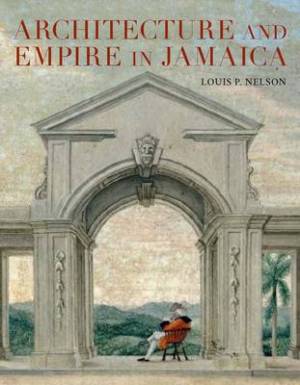 Through Creole houses and merchant stores to sugar fields and boiling houses, Jamaica played a leading role in the formation of both the early modern Atlantic world and the British Empire. Architecture and Empire in Jamaica offers the first scholarly analysis of Jamaican architecture in the long 18th century, spanning roughly from the Port Royal earthquake of 1692 to Emancipation in 1838. In this richly illustrated study, which includes hundreds of the author’s own photographs and drawings, Louis P. Nelson examines surviving buildings and archival records to write a social history of architecture.
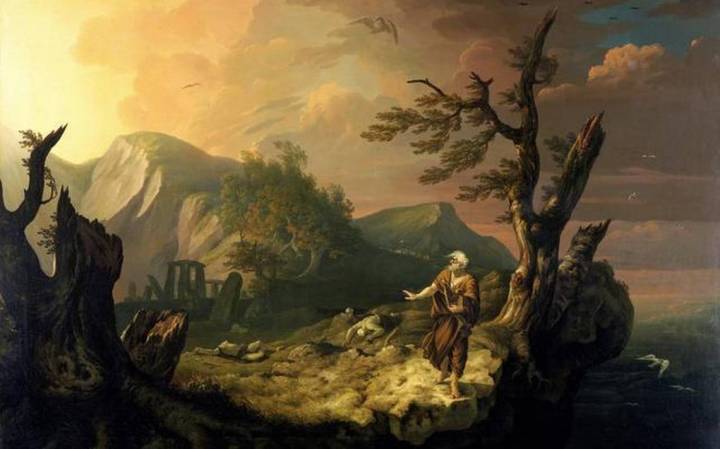
 Pastures Green & Dark Satanic Mills recounts the story of British landscape painting from the Industrial Revolution in the late 18th century to the present day. Examining 88 paintings from the National Museum of Wales, this volume traces the history of landscape art through romanticism, impressionism and modernism right up to the postindustrial imagery of the 21st century.
 Rediscovering a Baroque Villa in Rome: Cardinal Patrizi and the Villa Patrizi, 1715–1909 draws on a large body of archival material to reconstruct in detail the creation of the Villa Patrizi outside Porta Pia from 1715 to 1727 and its afterlife. This material includes building documentation, inventories, and above all the letters written by Cardinal Giovanni Batista Patrizi, papal legate in Ferrara, to his brothers in Rome, both dilettante artist-architects. These letters provide a unique insight into the decision-making processes involved in such a large-scale enterprise, in particular the hiring of artists and the decoration of individual rooms. These rooms included a Gallery inspired by the Galleria Colonna, a romitorio, or fictive hermitage, a Mirror Room anticipating those created later in the century, and one of the first Chinoiserie interiors in Rome.
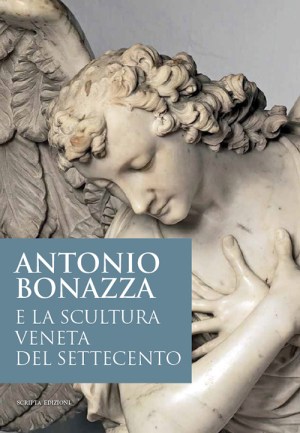 Antonio Bonazza è esponente di spicco di una delle più operose famigliedi scultori del Settecento veneto: insieme al padre Giovanni eai fratelli Francesco e Tommaso ha lavorato in moltissime chiese diPadova e del territorio, oltre che nei giardini delle ville di campagna dinobili famiglie veneziane.Le sue opere si collocano spesso ben al di sopra del livello di quelle deisuoi contemporanei, e raggiungono esiti di eleganza e leggerezza tra ipiù alti della scultura veneta del Settecento.La giornata di studi, organizzata dal Museo Diocesano di Padova inoccasione dei 250 anni dalla morte dell’artista (12 gennaio 1763), è stata occasione per aggiornare il catalogo delle opere, precisare la cronologia, mettere a fuoco la personalità umana e artistica di Antonio e i suoi rapporti con quella del padre Giovanni e dei fratelli Francesco e Tommaso, indagare modelli e fonti visive ed esplorare le relazioni tra la sua arte e quella dei suoi contemporanei.
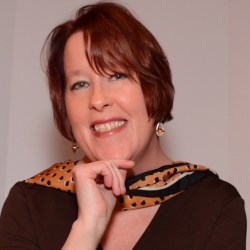 Having worked at Ashgate Publishing since 2011, Margaret Michniewicz recently joined Bloomsbury’s New York office as Visual Arts Acquisition Editor. In addition to welcoming proposals for book projects, she is currently focused on launching new series and invites inquiries and ideas from prospective series editors. Open to a wide array of subject matter, including interdisciplinary approaches and work addressing issues of gender and race, Michniewicz will be commissioning projects in art history and visual culture from the eighteenth century onward.
 Although he belonged to an important line of 18th-century artists, Jean-Baptiste Huet (1745–1811) has never before been the subject of a monographic exhibition. The Cognacq-Jay Museum will pay tribute to his alluring talent through a selection of paintings and graphic works. Jean-Baptiste Huet, who spent the majority of his career in Paris, was first trained in his family environment. He then received instruction from the animal painter Charles Dagomer and encouragement from Jean-Baptiste Le Prince, a talented student of Boucher. Benefitting from these influences, Huet developed a naturalistic and graceful style. He excelled in works of pastoral scenery depicting tales of the tender romances of shepherds, painted rustic landscapes with poetic notes and depicted the animal world with frankness and sympathy. He was admitted to the Académie in 1769, had regular exhibitions at the Paris Salon and was entrusted with decorative cycles. Huet’s art met with great success in various mediums. In 1783, Oberkampf, founder of the royal manufacture of Jouy-en-Josas, requested his services in creating printed patterns. His early creations were light, still in the Rococo style, then later gave way to straighter and more orderly shapes in the wake of Neoclassicism. Even up to his very last expressions, Huet’s work constitutes a tremendous tribute to the beauty of nature, with aspects of both reverie and fascination.
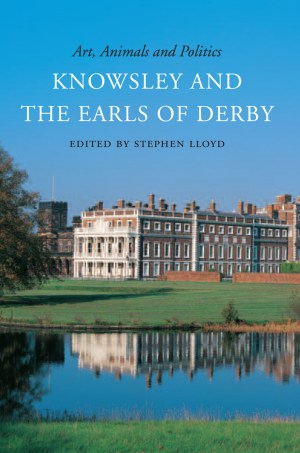 Thomas, Lord Stanley, was created Earl of Derby in 1485 after the Battle of Bosworth Field. Since that time the Stanleys—a great Lancastrian family, whose seat, Knowsley Hall, is near Liverpool—have been significant in the life of the nation as patrons and collectors, sportsmen and politicians. These absorbing essays by a distinguished cast of contributors led by historian David Starkey, writing about the political significance of Lady Margaret Beaufort, the first Countess of Derby, and broadcaster Sir David Attenborough, on Edward Lear’s zoological watercolours (many of which were done at Knowsley), cover key facets of the family’s diverse achievements
 Medieval Institute Publications (MIP) and Arc Medieval Press, together with its partner, Amsterdam University Press (AUP), are









 Enfilade
leave a comment