Exhibition | 1725: Native American Allies at the Court of Louis XV
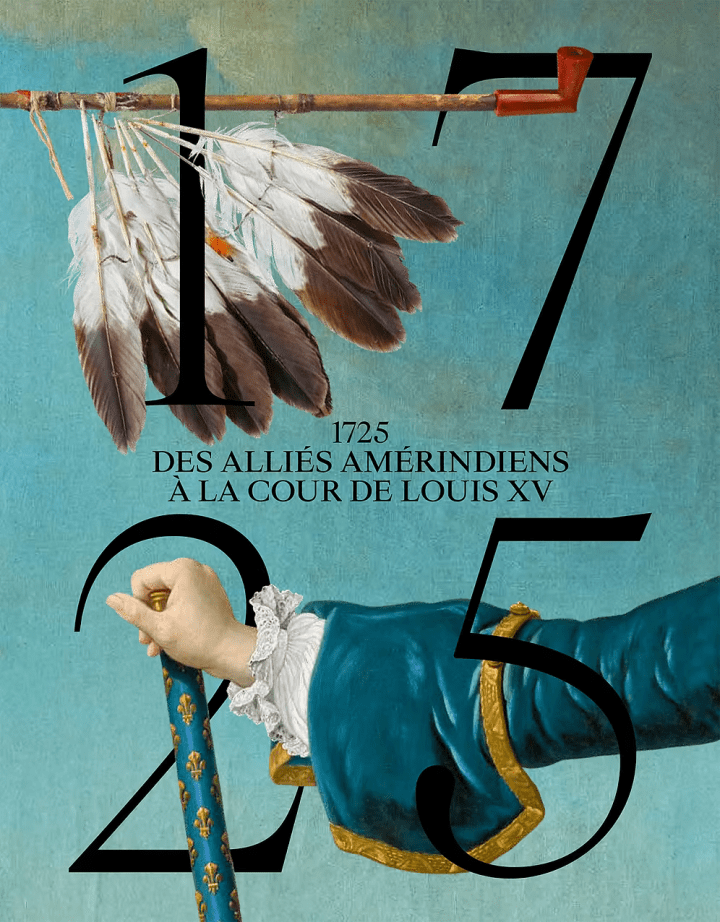
1725: Native American Allies at the Court of Louis XV
1725: Des alliés amérindiens à la cour de Louis XV
Château de Versailles, 25 November 2025 — 3 May 2026
Curated by Jonas Musco, Paz Núñez-Regueiro, and Bertrand Rondot
In 1725, four Native American chiefs and a Native American woman from the Mississippi Valley were received in France as part of an unprecedented diplomatic mission. The event marked the climax of efforts by the French crown to build relationships with Indigenous nations in North America, amidst ongoing conflicts between European colonial powers and the Indigenous allies. This exhibition offers a rare opportunity to explore the history and lives of the Native American nations of the Mississippi Valley in the 18th century, their connections with France, the extraordinary Atlantic crossing undertaken by their leaders, and their meeting with Louis XV, the royal court, and the capital.
The Indigenous Mississippi Valley in the 18th Century
 The first section of the exhibition immerses visitors in the complex world of Native American societies of the Mississippi Valley at the time the French began exploring and settling the area. The encounter between these two civilizations soon led to a lasting alliance based on close diplomatic ties. The exhibition introduces the major Indigenous nations at the heart of this story through a contemporary map specially created for the show, alongside rare 18th-century maps. Some of these nations were already allied with the French through earlier treaties, notably reinforced in 1701 by the Great Peace of Montreal, a historic treaty exceptionally presented to the public.
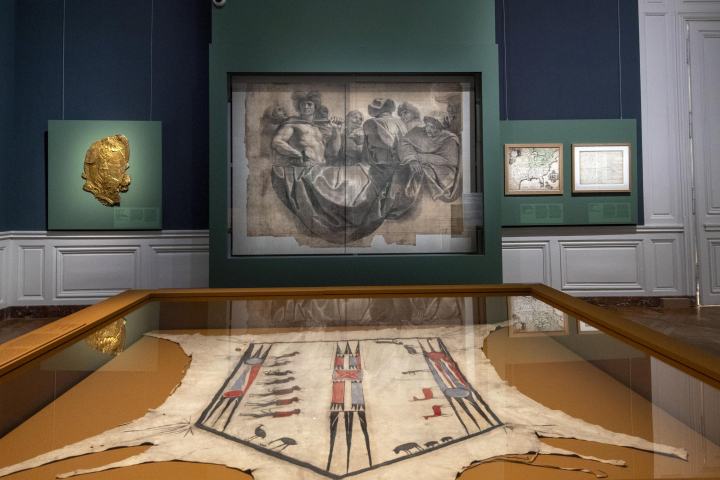
Through a series of rare portraits—some of the only surviving from that period—a different image of Native societies emerges, far from the 19th-century Plains stereotypes. The selection of artefacts includes a remarkable feathered headdress made in the 18th century for a high-ranking chief, likely the oldest of this type known in the world. The presentation continues with a glimpse into their seasonal way of life, alternating between farming and hunting. Their relationship with the living world is also spiritual, involving social connections with more-than-human beings, such as the thunderbirds—powerful spirits often depicted on hides presented to the French as diplomatic gifts.
The Founding of a French Colony: Louisiana
The second section focuses on the close ties developed between the French and their Indigenous allies after the founding of the Louisiana colony. A selection of objects illustrates the cultural blending that emerged in the early 18th century: war clubs decorated with fleur-de-lis, necklaces made of imported beads, and European knives sheated in Native-style scabbards. The most emblematic items are a peace pipe richly decorated with feathers and a painted hide depicting it.
In 1724, to strengthen the alliance, the Compagnie des Indes proposed inviting the Native leaders to the court of young Louis XV. Étienne Véniard de Bourgmont, commander of the Missouri post, contacted the Otoe, Osage, and Missouria nations—their responses, transcribed in diplomatic correspondence, will be featured in the exhibition—while the Illinois sent Chicagou, the Michigamea chief and conveyed the words of Mamantouensa, chief of the Kaskadia, through Jesuit missionary Nicolas Ignace de Beaubois.
Forming the delegation was not without difficulty. Several other nations planned to send representatives, but the shipwreck of the vessel meant to transport them to France discouraged many from continuing. Ultimately, the delegation consisted of four chiefs and the daughter of a Missouri chief. They set sail in the spring of 1725. From that moment, the delegates were treated as international ambassadors, and a document reveals they were served ‘at the captain’s table’, an honor reserved for elite guests.
The Delegation’s Reception at Court
The final section traces the steps of the Native American chiefs’ visit to France—Paris, Versailles, and Fontainebleau—and details the royal court’s diplomatic protocol for receiving foreign embassies. Thanks to invaluable accounts from the Mercure de France, we follow their movements: meetings with the directors of the Compagnie des Indes, the organizers of the journey, and with princes and princesses of the royal blood.
The exhibition highlights the audience granted by Louis XV to the chiefs on November 25, 1725, at Fontainebleau. This was the most symbolic moment of the visit, during which the chiefs gave speeches to the king, who responded with marked interest in his guests. After touring Versailles, Marly, and Trianon, the delegates were honored with an invitation to hunt alongside with the king at Fontainebleau. They gladly accepted and participated ‘in their own way’—on foot and armed with bows.
The exhibition pathway, punctuated with excerpts from the Mercure de France, presents gifts similar to those exchanged between the Native delegates, the king and the government: prestigious headdresses, bows, and a peace pipe for the Native visitors, and a gold medal and other precious artifacts for the French. Portraits of the main French figures and, for the first time in France, a portrait of a Miami Native American will bring this historic meeting to life.
The exhibition concludes with a reference to the ‘Danse des Sauvages’, a famous piece by Jean-Philippe Rameau added to his opera Les Indes galantes. Inspired by the dance of two Native chiefs at the Comédie-Italienne, this rarely discussed source of inspiration reveals the enduring cultural impact of the 1725 delegation in France.
A special visitor program will allow guests to hear from Native members of the exhibition’s scientific committee as they reflect on the modern-day relationship between their nations and France, echoing this long-shared history.
Curators
• Jonas Musco, Historian, Research Associate
• Paz Núñez-Regueiro, Chief Curator of Heritage, Musée du quai Branly–Jacques Chirac
• Bertrand Rondot, Chief Curator of Heritage, Palace of Versailles
The exhibition is developed within the framework of the research project CRoyAN – Royal Collections of North America—coordinated by the musée du quai Branly–Jacques Chirac, in dialogue with four Native nations: the Choctaw Nation of Oklahoma, the Quapaw Nation, the Miami Tribe of Oklahoma, and the Peoria Tribe of Indians of Oklahoma. The exhibition is organized thanks to the patronage of The CORA Foundation. The exhibition is co-organized with the musée du quai Branly–Jacques Chirac.
Jonas Musco, Paz Núñez-Regueiro, and Bertrand Rondot, 1725: Des alliés amérindiens à la cour de Louis XV (Paris: Liénart, 2025), 160 pages, ISBN: 978-2359064766, €29.
New Book | Thy Will Be Done: George Washington’s Legacy of Slavery
Forthcoming from UNC Press:
John Garrison Marks, Thy Will Be Done: George Washington’s Legacy of Slavery and the Fight for American Memory (Chapel Hill: The University of North Carolina Press, 2026), 304 pages, ISBN: 978-1469693521, $35.
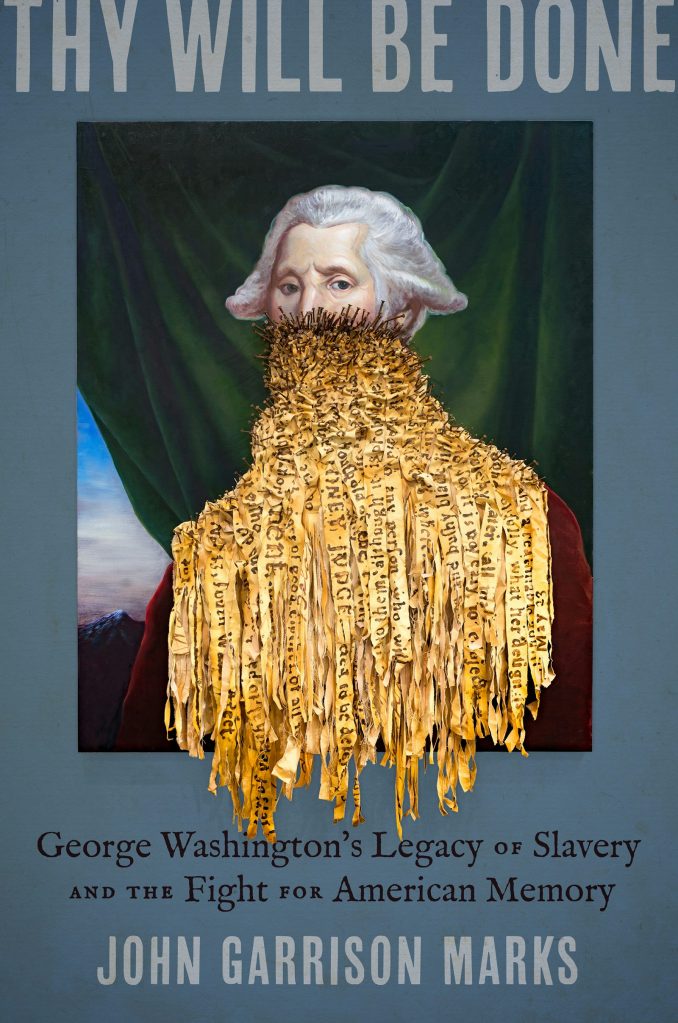 How should we remember George Washington’s entanglement in slavery? Americans have argued over that question for nearly 250 years. More than any other Founding Father, Washington’s ties to slavery have vexed us. He enslaved more people than any of his fellow founders, yet he was the only one of them to emancipate the people he held in bondage. Since his death, Americans have grappled with this contradiction, shaping and reshaping our collective memory of Washington and slavery—along with our understanding of the nation.
In Thy Will Be Done, historian John Garrison Marks tells the story of Americans’ long, fraught struggle to come to terms with Washington’s legacy of slavery. He traces how politicians, abolitionists, educators, activists, Washington’s former slaves and their descendants, and others have remembered, forgotten, and manipulated slavery’s place in Washington’s story, and how they have wielded versions of that story in the political and cultural fights of their time. Marks shows how generational struggles over our collective memory of Washington and slavery have always been part of a bigger conversation about defining the United States and its people. As debates about the founders’ participation in the system of slavery continue to roil public discourse, Marks shows with new clarity that Americans have never collectively reconciled Washington’s conflicted legacy. By truly grappling with Washington’s role as enslaver and emancipator, we may come to better understand the nation and ourselves.
John Garrison Marks is a historian, writer, and author of Black Freedom in the Age of Slavery.
New Book | Bernardo de Gálvez
The first edition appeared in 2018; the paperback edition was just released from UNC Press:
Gonzalo Quintero Saravia, Bernardo de Gálvez: Spanish Hero of the American Revolution (Chapel Hill: The University of North Carolina Press, 2026), 616 pages, ISBN: 978-1469696126, $38.
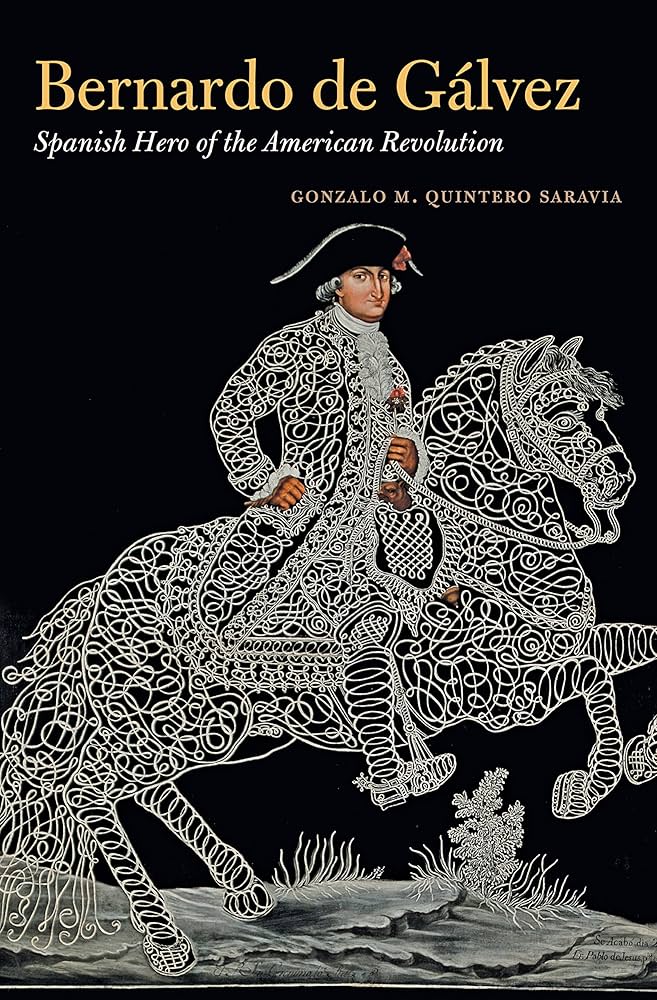 Although Spain was never a formal ally of the United States during the American Revolution, its entry into the war definitively tipped the balance against Britain. Led by Bernardo de Gálvez, supreme commander of the Spanish forces in North America, their military campaigns against British settlements on the Mississippi River—and later against Mobile and Pensacola—were crucial in preventing Britain from concentrating all its North American military and naval forces on the fight against George Washington’s Continental army. In this first comprehensive biography of Gálvez (1746–1786), Gonzalo M. Quintero Saravia assesses the commander’s considerable historical impact and expands our understanding of Spain’s contribution to the war.
A man of both empire and the Enlightenment, as viceroy of New Spain (1785–86), Gálvez was also pivotal in the design and implementation of Spanish colonial reforms, which included the reorganization of Spain’s Northern Frontier that brought peace to the region for the duration of the Spanish presence in North America. Extensively researched through Spanish, Mexican, and US archives, Quintero Saravia’s portrait of Gálvez reveals him as central to the histories of the Revolution and late eighteenth-century America and offers a reinterpretation of the international factors involved in the American War for Independence.
Gonzalo M. Quintero Saravia, SJD, PhD, is the author of several books on eighteenth-century Spanish American history and a former fellow at the Weatherhead Center for International Affairs at Harvard University.
Exhibition | Longing: Painting from the Pahari Kingdoms
From the press release (3 December 2025) for the exhibition:
Longing: Painting from the Pahari Kingdoms of the Northwest Himalayas
Cincinnati Art Museum, 6 February — 7 June 2026
Curated by Ainsley Cameron
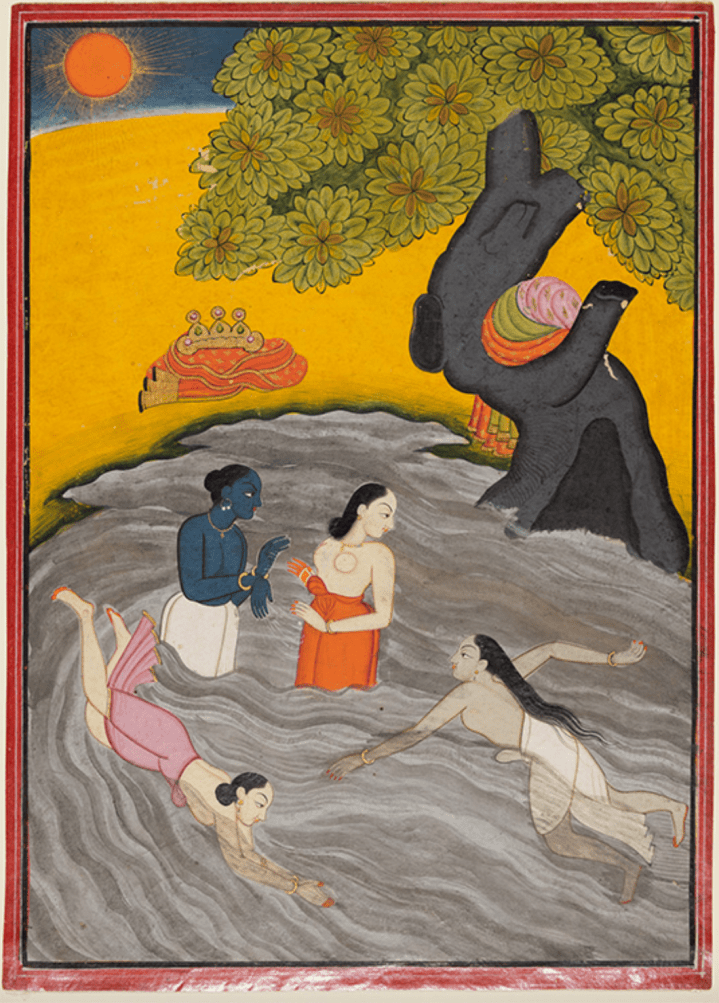
Krishna Playing with the Gopis in the Yamuna River, ca. 1770, India, Himachal Pradesh, Nurpur, opaque watercolor and gold on paper, (Cleveland Museum of Art, purchase and partial gift from the Catherine and Ralph Benkaim Collection and Millikin Purchase Fund, 2018.118).
Featuring more than 40 works of art, Longing: Painting from the Pahari Kingdoms of the Northwest Himalayas will present colorful court paintings from present-day India dating between the 17th and 19th centuries. Practicing unique techniques, artists produced these small, portable paintings primarily for royal, noble, and priestly patronage. The paintings were often given as gifts between regional nobility, families, and political allies creating large networks of artistic exchange.
Influenced by the region’s culture and politics, the artworks portray longing in several ways: through paintings of devotees who long to connect with the divine, through individuals and couples who yearn for romance, and through rulers and noblemen who longed to be at the center of political control. The exhibition encourages visitors to experience art as multisensory. Select paintings will be paired with scent or touch opportunities, while others are paired with musical soundscapes, to heighten the works’ bhava (emotion or mood) and encourage multiple ways to physically, intellectually, and emotionally connect with the art.
“This exhibition explores paintings through the lens of a shared human emotion,” reflects Ainsley M. Cameron, PhD, Curator of South Asian Art, Islamic Art & Antiquities at CAM. “Through color, form, and composition, paintings that portray devotional and cultural values, amorous alliance, or political gain also reveal an emotive force reflective of the region in which they were produced. I’m excited to share the vibrant painting histories of the Pahari region with Cincinnati audiences, to encourage our visitors to actively participate in their museum experience, to interact with art in multiple ways, and to forge new connections with the works on display.”
Longing is part of a larger research project connecting the South Asian art collections at the Cincinnati Art Museum, the Cleveland Museum of Art (CMA), and the National Museum of Asian Art (NMAA) in Washington, DC. Alongside scholars based in India, curators from these three museums are working collaboratively to research, publish, and display works from the Catherine Glynn Benkaim and Ralph Benkaim Collection. Beginning in April 2026, the CMA and the NMAA will also present exhibitions of paintings from the Pahari kingdoms. These three distinct thematic exhibitions are presented in the publication Pahari Paintings: Art and Stories, a lavishly illustrated volume that foregrounds recent research in paintings from this mountainous region. Published by the Cleveland Museum of Art and Yale University Press, the volume celebrates both the Benkaim Collection and this cross-institutional collaboration.
Sonya Rhie Mace, Sarang Sharma, and Vijay Sharma, eds., Pahari Paintings: Art and Stories (New Haven: Yale University Press, 2026), 368 pages, ISBN: 978-0300286489, $65. With contributions by Catherine Glynn Benkaim, Ainsley Cameron, Debra Diamond, and Vrinda Agrawal
Exhibition | Of the Hills: Pahari Paintings
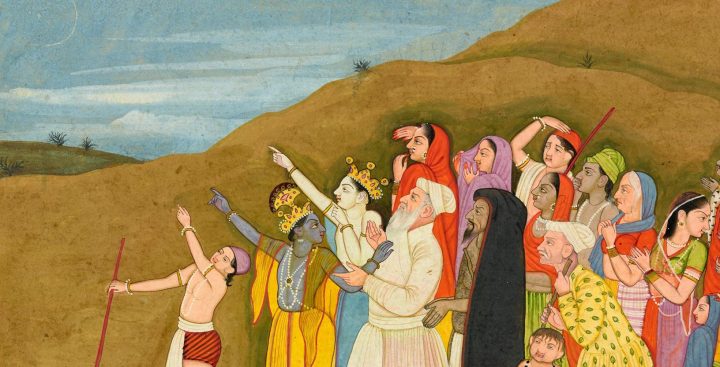
Attributed to an artist from the generation (ca. 1725–ca. 1785) after Nainsukh and Manaku, Krishna and His Family Admire a Solar Eclipse, from a Bhagavata Purana (Ancient Tales of the Lord), canto 10.82 (detail); India, Himachal Pradesh state, 1775–80; opaque watercolor on paper (Washington DC: National Museum of Asian Art, Smithsonian Institution, Freer Collection, Purchase from the Catherine and Ralph Benkaim Collection—Charles Lang Freer Endowment, F2017.13.5).
◊ ◊ ◊ ◊ ◊
Opening this spring at the National Museum of Asian Art:
Of the Hills: Pahari Paintings from India’s Himalayan Kingdoms
National Museum of Asian Art, Washington DC, 18 April — 26 July 2026
Curated by Debra Diamond
The tallest mountains on earth rise from the plains of northern India in a series of steep hills, snowy peaks, and narrow valleys. From the same Himalayan region arose some of the world’s most beautiful—yet least understood—works of art. Discover the extraordinary beauty and unique history of paintings made for Hindu kings in India’s Pahari (hill) region between the 1620s and 1830s. Pahari artists worked in radically different styles ranging from lyrical and naturalistic to boldly colored and abstracted. Of the Hills: Pahari Paintings from India’s Himalayan Kingdoms illuminates new scholarship on the collaborative artist communities in which most painters worked. Learn about the political, cultural, and religious contexts of these forty-eight exquisite works, and look closely to enter a world of fine detail that delights and astounds.
The exhibition celebrates the remarkable collection of Pahari paintings the museum acquired from renowned art historian Catherine Glynn Benkaim and Ralph Benkaim. Some of these artworks have never been exhibited publicly before. We’ve brought these rare pieces into conversation with our historic collections and paintings on loan from the Cleveland Museum of Art. Of the Hills is accompanied by the major publication Pahari Paintings: Art and Stories and runs concurrently with Pahari exhibitions at the Cleveland Museum of Art and the Cincinnati Art Museum.
Sonya Rhie Mace, Sarang Sharma, and Vijay Sharma, eds., Pahari Paintings: Art and Stories (New Haven: Yale University Press, 2026), 368 pages, ISBN: 978-0300286489, $65. With contributions by Catherine Glynn Benkaim, Ainsley Cameron, Debra Diamond, and Vrinda Agrawal
Exhibition | Epic of the Northwest Himalayas: Pahari Paintings
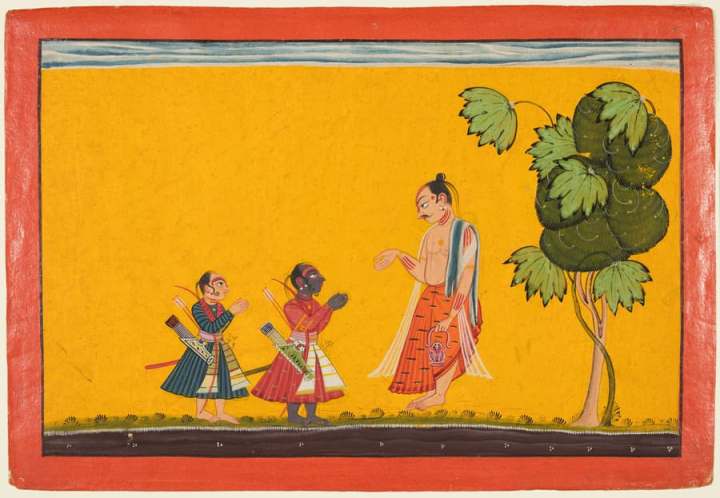
Rama and Lakshmana with the sage Vishvamitra, from the ‘Shangri’ Ramayana, ca. 1700, Northern India, Pahari kingdoms, gum tempera and ink on paper; page: 22 × 32 cm (Washington, DC: National Museum of Asian Art, Smithsonian Institution, purchase and partial gift from the Catherine and Ralph Benkaim Collection—Funds provided by the Friends of the National Museum of Asian Art, S2018.1.9).
◊ ◊ ◊ ◊ ◊
Opening this spring at The Cleveland Museum of Art:
Epic of the Northwest Himalayas: Pahari Paintings from the ‘Shangri’ Ramayana
The Cleveland Museum of Art, 19 April — 16 August 2026
Curated by Sonya Rhie Mace
Forty paintings are reunited from a widely dispersed pictorial series that presents the story of the Hindu divine hero Rama. The timeless tale, more than 2,000 years old, remains a cultural force across southern Asia. Potent themes of righteousness, vengeance, and loyalty are explored through dramatic episodes in which demons are vanquished, lovers are separated, and monkeys, bears, and a man-eagle save the day. Magic abounds, and emotions fly with warriors’ arrows. Three digital stations present more than 100 gently animated images of paintings from multiple collections reassembled into their original episodic sequences.
Created with blazing colors for a royal collection around 1700, the ‘Shangri’ Ramayana has been a beloved and enigmatic series among scholars and collectors for the past century. New evidence from previously unpublished paintings reveals many more artistic styles and triple the number of total folios than have been previously recognized. It argues in favor of a collaborative model of production involving artists from across the alpine region of Pahari India, which straddles the present-day state of Himachal Pradesh and that of Jammu and Kashmir. Twelve lenders generously contributed to this focused exhibition. The unbound pictorial series began to be divided as early as the 1760s, suggesting that its spiritual merit was intended to be shared among multiple owners. Its title derives from the kingdom of Shangri, where a member of the royal family sold his 275 folios to a dealer in Delhi, beginning in 1962. Hundreds more paintings, however, have been in other royal collections.
The exhibition celebrates the publication of the Catherine Glynn Benkaim and Ralph Benkaim Collection of Pahari paintings, which includes three pages of the ‘Shangri’ Ramayana that are on view and contextualized in Epic of the Northwest Himalayas. The exhibition runs concurrently with Pahari exhibitions at the National Museum of Asian Art in Washington, D.C. and the Cincinnati Art Museum.
Sonya Rhie Mace, Sarang Sharma, and Vijay Sharma, eds., Pahari Paintings: Art and Stories (New Haven: Yale University Press, 2026), 368 pages, ISBN: 978-0300286489, $65. With contributions by Catherine Glynn Benkaim, Ainsley Cameron, Debra Diamond, and Vrinda Agrawal
New Book | Eighteenth-Century Indian Muraqqaʿs
From Brill:
Friederike Weis, ed., Eighteenth-Century Indian Muraqqaʿs: Audiences, Artists, Patrons, and Collectors (Leiden: Brill, 2024), 442 pages, ISBN: 9789004715783, $162. Contents available digitally for free via open access.
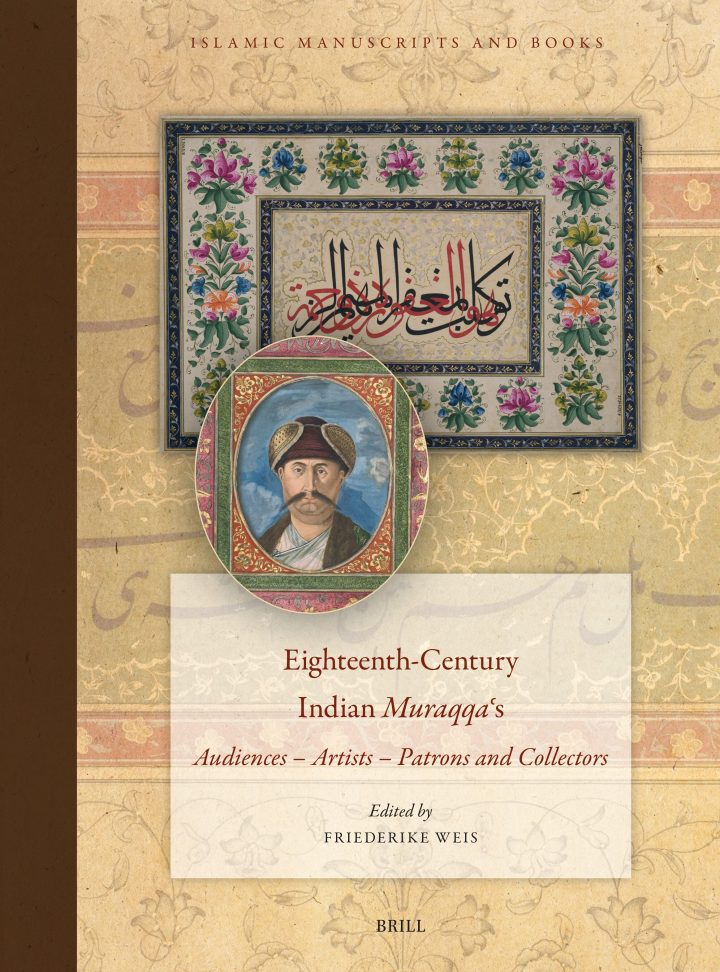 Fourteen essays and one appendix discuss numerous eighteenth-century Indo-Persianate albums (muraqqaʿs) consisting of folios with paintings, calligraphic pieces, and elaborate decorative margins. These albums—now in Berlin, Baroda, London, Paris, and Manchester—were assembled for or collected by the Mughal nawabs of Awadh (Uttar Pradesh), local elites in Bengal and Bihar, as well as Europeans. The book not only presents hitherto rarely investigated material, but also provides general information and many new discoveries based on first-hand codicological study and historical research. It will significantly expand our knowledge of the production, collecting practices, and audiences of muraqqaʿs in eighteenth-century India.
Friederike Weis (PhD, Freie Universität Berlin, 2005), is a specialist in Islamic albums and manuscripts. She has published extensively on cross-cultural exchanges in Persian and Indian art history and co-edited The Diez Albums: Contexts and Contents (Brill, 2016).
c o n t e n t s
1 Introduction: Problems and Challenges in the Study of Eighteenth-Century Indian Albums — Friederike Weis
Part 1 | Albums Commissioned by Mughal Elites: Contents and Compilation Strategies
2 The Indian Paintings from the Collection of Archibald Swinton, Formerly at Kimmerghame House, Berwickshire — J.P. Losty, Malini Roy, and Friederike Weis
3 Obvious Narratives and Hidden Messages in the Large Clive Album — Axel Langer
4 Two Late Mughal Albums in the Royal Library at Windsor Castle: Further Evidence for the Collections of Nawab Asaf al-Dawla — Emily Hannam
5 Mughal Art on Its own Terms: Reflections on an Album Folio — Laura E. Parodi
Part 2 | Albums of Foreign Elites: Changes and Challenges
6 Three Albums of Seigneur Gentil and Colonel Polier: Cultural Exchanges in Late Eighteenth-Century India — Susan Stronge
7 To Be Viewed from Both Ends: The Surviving Polier Albums —Friederike Weis
8 A Newly Identified Muraqqaʿ Assembled for Antoine-Louis-Henri Polier in the British Museum — Malini Roy and Jake Benson
9 Like a Garden Bedecked: Floral Margins in the Muraqqaʿs of Antoine Polier — Isabelle Imbert
Part 3 | Masters of Calligraphy and Painting: Between Historicism and Innovation
10 The Earlier Calligraphies in the Berlin Albums: Reflections on their Origins and Purpose in a Muraqqaʿ — Claus-Peter Haase
11 Polier’s Posterior Album: Rylands Persian MS 10 — Jake Benson
12 Expanding the Canon: Mir Muhammad Husayn ʿAta Khan and the Polier Albums — Will Kwiatkowski
13 Mihr Chand’s Copies and Adaptations of Earlier Mughal Paintings — John Seyller
Part 4 | Spaces and Gazes: Reading Imagined Worlds
14 The Spaces in Between: A Yogini of Lucknow for Antoine Polier —Molly Aitken
15 Building Worlds: Reading Spatiality, Power, and Gaze in Eighteenth-Century Paintings — Parul Singh
Appendix | Inscriptions and Seal Impressions in the Berlin Albums I. 4589, I. 4591, I. 4592, I 5001, and I. 4600 — Will Kwiatkowski and Friederike Weis
Credits
Bibliography
Indexes
Online Conversation | Architecture’s Archive, 1400–1800
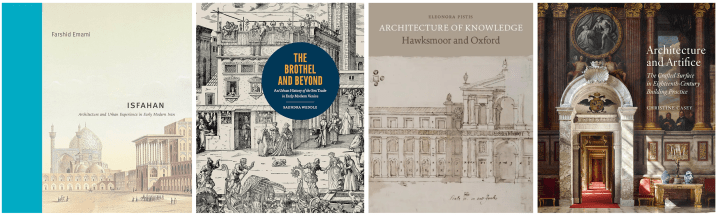
From the Society of Architectural Historians:
Architecture’s Archive: Paperwork in Early Modern Practice, 1400–1800
With Christine Casey, Farshid Emami, Eleonora Pistis, and Saundra Weddle
Online, An SAH Connects Session, Friday, 20 March 2026, noon EST
From drawings and invoices to maps, inventories, and account books, early modern architectural practice abounded with paperwork. These documents emerged from a historical moment beginning around 1400 that witnessed the rise of new technologies and regimes for the management of information. While essential to historical scholarship, documents have long been taken for granted merely as sources to mine for data. Towards a fuller view of paperwork, this SAH Connects event invites a reframing of documents as spatial objects whose form, use, content, and production merit critical consideration.
Documents call attention to questions of process but also, more generally, the material realities of building in the early modern world. Panelists will speak about the historiographic and methodological stakes of a document that has animated their scholarship. Among the questions to be considered are: What do documents clarify or obscure? How did documents serve institutions, particular those that oversaw building activity? How did architectural documents circulate? What new possibilities do documents provide for uncovering non-elite figures or extra-architectural actors who shaped the built environment? Who is absent from documents? What temporal, material, or scalar slippages exist between documents and buildings? How do we wrestle with fragmentary or compromised documentary evidence? While anchored in the early modern world, this conversation will invite broad critical reflection on the documentary sources that underpin architectural history.
With the goal of highlighting new work, we have invited authors whose recently published books engage with a variety of building cultures at a range of scales from across the early modern world. Speaking from their books, each participant will discuss a single historical document that was central to their analysis of the actors, systems and processes that shaped the built environment.
• Christine Casey, Trinity College Dublin | Architecture and Artifice: The Crafted Surface in Eighteenth-Century Building Practice (Yale University Press, 2025).
• Farshid Emami, Rice University | Isfahan: Architecture and Urban Experience in Early Modern Iran (Penn State Press, 2024).
• Eleonora Pistis, Columbia University | Architecture of Knowledge: Hawksmoor and Oxford (Harvey Miller, 2024).
• Saundra Weddle, Drury University | The Brothel and Beyond: An Urban History of the Sex Trade in Early Modern Venice (Penn State Press, 2026).
The session will be moderated by Matthew Gin (University of North Carolina, Charlotte), Ann C. Huppert (University of Washington), and Kristin Triff (Trinity College).
Registration is available here»
SAH CONNECTS, a year-round series of virtual programs related to the history of the built environment, provides a platform for the SAH community to collaborate, share their work, engage in timely discussions, and reach worldwide audiences.
Exhibition | The Myth of Rembrandt in the Century of Fragonard
Now on view at the MBA Draguignan:
Le Phare Rembrandt: Le Mythe d’un Peintre au Siècle de Fragonard
Musée des Beaux-Arts de Draguignan, 15 November 2025 — 15 March 2026
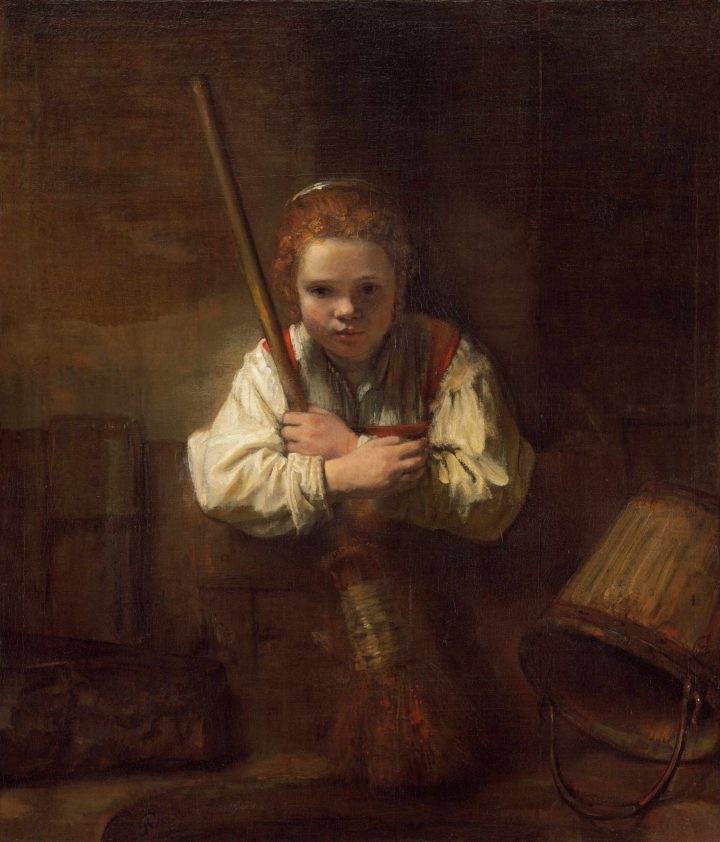
Rembrandt Workshop (possibly Carel Fabritius), A Girl with a Broom, 1646–51 (Washington DC: National Gallery of Art, 1937.1.74).
Le Phare Rembrandt invite le public à plonger dans l’univers de Rembrandt à un moment crucial : un demi-siècle après sa mort (en 1669), son nom devient un véritable mythe en Europe, et particulièrement à Paris, devenue capitale du marché de l’art. De plus en plus de tableaux du maître hollandais y sont importés, pour ensuite être exportés vers l’Allemagne, l’Angleterre ou la Russie.
L’originalité de l’exposition réside dans sa volonté de faire découvrir comment l’art de Rembrandt a été perçu au XVIIIe siècle en France, où ses œuvres influencent profondément les artistes et collectionneurs. À travers une sélection de cinquante œuvres visibles à l’époque, dont des peintures attribuées à Rembrandt ou réalisées par des artistes ayant étudié ou collectionné son travail tels que Chardin ou Fragonard, l’exposition explore les thèmes de l’imitation et de l’appropriation de son art.
Le Phare Rembrandt: Le Mythe d’un Peintre au Siècle de Fragonard (Paris: In Fine éditions d’art, 2025), 304 pages, ISBN: 978-2382032343, €35. With contributions by Jaco Rutgers, Jacqueline Carroy, Isabelle Arnulf, Jean-Pierre Maranci, Ivan Alexandre, Dominique Païni, Érick Desmazières, Gaëtane Maës, Anna Tummers, Jan Blanc, Quentin Buvelot, Dominique Brême, Ariane James-Sarazin, Yohan Rimaud, Laura Bossi.
From the CODART announcement:
This ambitious exhibition explores the undiminished aura of the Dutch master, focusing on two fascinating portraits seized during revolutionary confiscations and attributed to Rembrandt in the eighteenth century. . . .
Exhibition | Dealing in Splendour
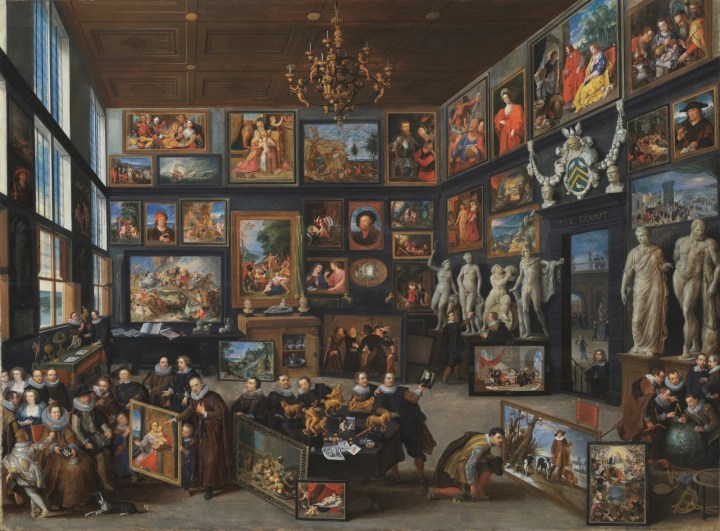
Willem van Haecht, The Gallery of Cornelis van der Geest, 1628, oil on panel
(Antwerp, Rubenshuis, City of Antwerp Collection, Rubenshuis)
◊ ◊ ◊ ◊ ◊
Now on view in Vienna at the Liechtenstein Garden Palace:
Dealing in Splendour: A History of the European Art Market
Noble Begierden: Eine Geschichte des Europäischen Kunstmarkts
Gartenpalais Liechtenstein, Wien, 30 January — 6 April 2026
Curated by Stephan Koja, Christian Huemer, and Yvonne Wagner
With a history reaching back over four centuries, the Collections of the Princely Family of Liechtenstein are part of a long tradition of collecting that spans many generations. Essential to this at all times has been a policy of active collecting. In the past as in the present, new acquisitions shaped the appearance of the galleries. The art collection has thus been formed not only by the personal tastes of the various princes but also by the art market with its changing sales strategies, trend-setting individuals, and economic factors.
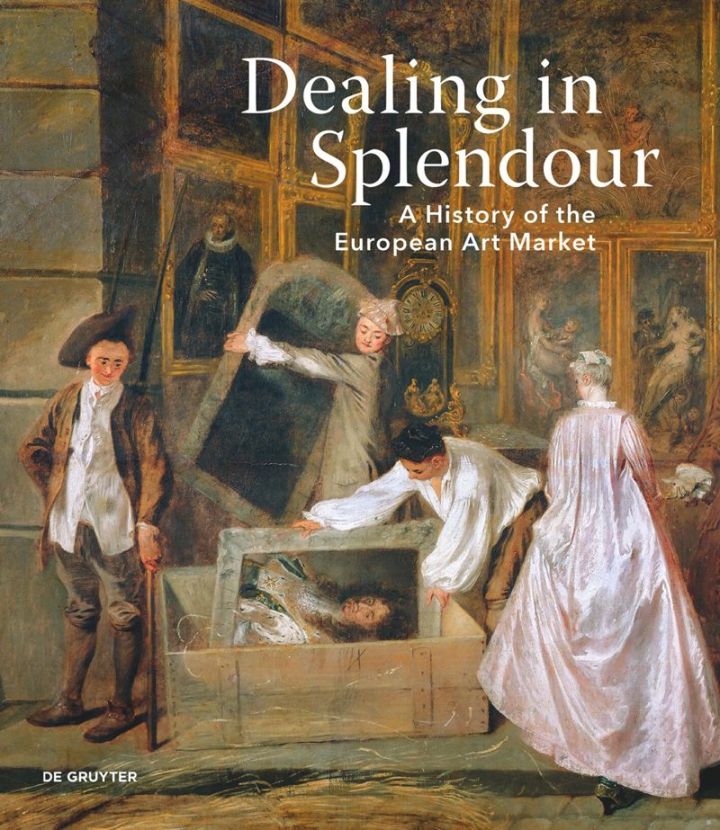 Against this background, Dealing in Splendor addresses the fascinating history of the European art market. Spotlights will be shone on structures, centres of innovation, influential personalities, and marketing methods from antiquity to the nineteenth century, revealing that many of these methods have changed very little up to the present day. Auctions were held in ancient imperial Rome. In Antwerp, art trade fairs were already attracting an international clientele in the sixteenth century, and the first catalogues raisonnés of Old Masters were compiled by art dealers in the eighteenth century.
These and other enthralling insights into the history of the European art market await you at the Liechtenstein Garden Palace in Vienna, with major works from the Princely Collections appearing alongside sensational loans in the largest annual temporary exhibition we have mounted to date. The extensive catalogue will boast essays by leading experts in the field of art market scholarship, bringing interdisciplinary approaches to bear in a volume that will provide a comprehensive overview of the subject.
Art as a Commodity: The Flourishing Art Market of Antiquity
Even in ancient Roman times, there was a flourishing art market, sustained by a network of collectors, connoisseurs, buyers, and agents. Early forms of serial production and market adjustment were already developed and continued to have an effect into the early modern age. The great demand for classical Greek works led to a burgeoning production of replicas, variations, and reduced-size copies, which Roman collectors acquired specifically for particular rooms and functions. Workshops all over the Mediterranean specialized in reproducing famous representational formulas in order to provide objects in various price ranges—from monumental copies in marble to small bronze statuettes.
International Trade: Forchondt
Prince Karl Eusebius I von Liechtenstein had a particularly long and intensive connection with the Forchondt family of dealers. They had an international presence with branches in Antwerp, Vienna, and the Iberian Peninsula, shipping works of art and furniture in all price categories to destinations as far afield as South America. Karl Eusebius’s son, Prince Johann Adam Andreas I, was likewise a client of the Forchondts, from whom he purchased many of his most important acquisitions, including paintings by Rubens and van Dyck. This business relationship with the Forchondts, holders of an imperial privilege as jewellers to the imperial court, lasted until the reign of Prince Joseph Wenzel I.
Serial Production in the Fifteenth Century
In the Italian city-states of the fifteenth century, the emergent ruling families, foremost among them the Medici in Florence, made systematic use of art patronage. By erecting imposing monuments, they shaped the appearance of the cities and demonstrated their power. They commissioned chapels and altarpieces, and alongside the Church were the most prominent and important patrons of the era. However, there were also classes of customers with smaller purses. The prices for works of art depended on the materials used, the time and labour involved, and the prestige of the masters who had made them. The workshops produced particularly popular motifs in various price ranges, some being offered for sale as ready-made works, without having been previously commissioned. Outlay and labour were reduced by turning out multiple copies of a work with just minor variations, or by serial production in suitable materials such as terracotta.
The Brueg(h)el Dynasty
Pieter Bruegel the Elder was one of the most important Flemish painters of his time. His compositions were so successful that copies of his works were made in his workshop and in those of his descendants. A whole dynasty of painters and numerous imitators drew on his works even after his death, continuing to sell them, often with only minimal changes, at a healthy profit.
The Beginnings of Large-scale Production in the Low Countries
One notable feature of Holland’s seventeenth-century Golden Age was the unusual wealth of art works, particularly paintings, in the homes of its burghers. In order to keep up with demand artists developed methods that shortened their working hours and increased their productivity. To achieve this, they specialized in particular genres, one such practitioner being Jan van Goyen, whose reduced palette both limited his material expenses and became his hallmark. His landscapes earned him international acclaim. Jan Davidsz. de Heem was famous for his opulent still lifes. Rachel Ruysch made a successful speciality of the flower still life.
Souvenirs from the Grand Tour
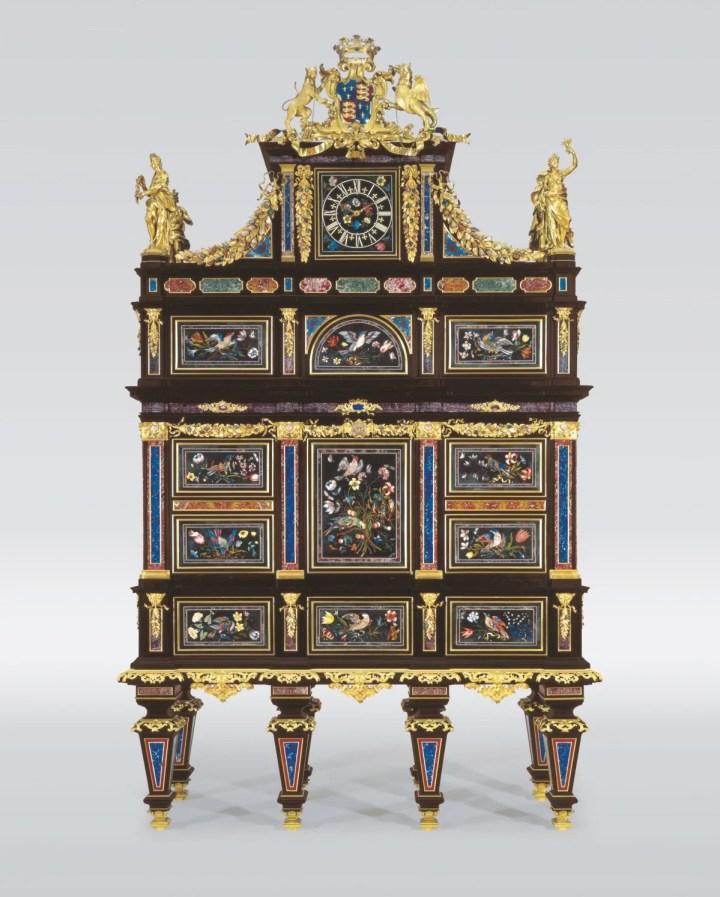
Baccio Cappelli and Girolamo Ticciati, Galleria dei Lavori, Badminton Cabinet, 1720–32 (Collection of the Princely Family of Liechtenstein, acquired in 2004 by Prince Hans-Adam II von und zu Liechtenstein).
In the seventeenth and eighteenth century, journeys taking in the centres of European culture were an important part of the education of scions of the nobility. In British society in particular, the so-called Grand Tour was regarded as the height of fashion, with the result that in the countries visited, in particular Italy with Rome as its cultural centre, a veritable industry grew up to cater for these young tourists, with accommodation, cicerones, and guidebooks to the sights—and souvenirs of the sights to take back home. The most popular of these were the views known as capricci—compositions of various statues, ruins, and edifices that in reality stood nowhere near one another. In Rome, the most successful artists in this field were Giovanni Battista Piranesi and Giovanni Paolo Pannini. It was regarded as especially prestigious to have one’s likeness painted by a well-known portraitist, or best of all by Pompeo Girolamo Batoni. The phenomenon of the souvenir was possibly carried to its greatest extreme by Henry Somerset, third duke of Beaufort, who commissioned the monumental Badminton Cabinet from the grand-ducal Galleria dei Lavori in Florence.
From Dilettante to Connoisseur: Edme-François Gersaint
During the eighteenth century, Paris and London became centres of innovation in the art market. There the auction scene was given fresh impetus with the arrival of influential experts and auctioneers, elegant auction rooms, printed sale catalogues, and exhibitions that became veritable social spectacles. A pioneering role in these developments was played by Edme-François Gersaint, who blazed new trails with his shop on the Pont Notre Dame, his auctions, and his detailed auction catalogues.
Art Historians, Expertise, and the Establishment of Canons of Works
Attributions and provenances—which had assumed increasing importance over the previous century—now lay in the hands of scholars, whose opinions as proclaimed in catalogues raisonnés influenced contemporary tastes and above all the price of works included in these publications. The value of the works increased or decreased depending on their purported authenticity (or lack of it). In many cases the criteria for authenticity were necessarily limited to stylistic characteristics. These were duly contested, in scholarly circles and elsewhere. This can be seen particularly clearly in the case of Rembrandt, whose body of works expanded or contracted depending on the scholar surveying his oeuvre.
Art for the Masses: The Revolutionary Art Market of the Nineteenth Century
In the nineteenth century the art market was revolutionized. New forms of presentation and serial production and the reproduction of images in huge numbers made art into a mass medium that circulated all over the world. Firms such as Goupil et Cie professionalized these mechanisms by systematically providing reproductions of famous works of art for various categories of buyer. At the same time dealers such as Charles Sedelmeyer established the phenomenon of the art spectacle, which—accompanied by deliberately dramatic presentation, advertising, and skilful use of media—attracted huge crowds. Thus, in the nineteenth century various innovative strategies directed at a wide sector of the public came together to shape the art market of the time, forming the basis for the present-day art business.
Curators
Stephan Koja, Director of the Princely Collections of Liechtenstein
Christian Huemer, Head of the Belvedere Research Center
Yvonne Wagner, Chief Curator of the Princely Collections of Liechtenstein
Christian Huemer and Stephan Koja, eds., Dealing in Splendour: A History of the European Art Market (Berlin: De Gruyter Brill, 2026), 448 pages, ISBN: 978-3689241063 (German) / ISBN: 978-3689241070 (English), €59 / $65.










 Enfilade
leave a comment