Exhibition | Dangerous Liaisons: The Art of the French Rococo

◊ ◊ ◊ ◊ ◊
Now on view at the Liebieghaus Skulpturensammlung:
Gefährliche Liebschaften: Die Kunst des französischen Rokoko
Dangerous Liaisons: The Art of the French Rococo
Liebieghaus Skulpturensammlung, Frankfurt, 4 November 2015 — 28 March 2016
Curated by Maraike Bückling
Featuring more than eighty outstanding works on loan, the show entitled Dangerous Liaisons focuses on the newly emerging concept of sentimental love and its preferred style of representation in French art around 1750, vividly illustrating the seductive powers of the Rococo. On view will be sculptures, biscuit-porcelain statuettes, paintings, and prints as well as arts-and-crafts objects from renowned international lenders such as the Rijksmuseum, the Musée du Louvre, the British Museum, the Victoria and Albert Museum, the Museo Thyssen-Bornemisza, the Wallraf-Richartz Museum & Fondation Corboud, and Munich’s Alte Pinakothek.
During the reign of French king Louis XV, not only art theoreticians and writers, but also visual artists began to reassess the meaning of passions and emotions. While formulaic enunciations of sentiments had still been commonplace in the seventeenth century, such preset expressions of passion lost the more of their significance in the first half of the eighteenth century, the more love came to be understood as an individual emotion that was glorified as giving meaning to life. New models of love and—along with them—nature as a courtly Arcadia informed the representational vocabulary of the fine arts. What is in the foreground of works by sculptors Étienne-Maurice Falconet (1716–1791) and Jean-Baptiste Pigalle (1714–1785) as well as painters Jean-Antoine Watteau (1684–1721), Nicolas Lancret (1690–1743), and François Boucher (1703–1770) and of porcelain sculptures by Johann Joachim Kaendler (1706–1775) is an artistic conception of naturalness. In addition, one room in the exhibition recreates, with mirrors, furniture, paintings, prints, and porcelain, the look of a typical eighteenth-century salon.
“The art of the French Rococo polarizes and enthralls. Back then, like today, it prompted widely diverse responses between fascination and repudiation, admiration and incomprehension. Thanks to noted works on loan from the most important collections of the world our large-scale exhibition at the Liebieghaus is able to convey the style-defining power of this unique epoch with its new ideas about love and the idealization of rural life by the aristocracy,” Max Hollein, director of the Liebieghaus Skulpturensammlung, explains.
“In the eighteenth century, artists like Jean-Antoine Watteau, François Boucher, Étienne-Maurice Falconet, Jean-Baptiste Pigalle, or Jean-Honoré Fragonard discovered quiet and serene loves scenes as their subject matter. Yet only a few years later, their pictures full of naturalness and the comforts of love were denounced as reprehensible, devoid of truth, and even dangerous by critics like Choderlos de Laclos. That they nevertheless count among the most beautiful works of Rococo art is what we want to show in this exhibition,” says Maraike Bückling, curator of the exhibition and head of the departments Renaissance to Neoclassicism at the Liebieghaus Skulpturensammlung.
In the early eighteenth century, love was considered to be the most common of feelings, which all people were capable of. Drawing on theater plays, fables, operas, and narratives, visual artists like Jean-Antoine Watteau or François Boucher gave pictorial expression to the new concepts of love. Love scenes no longer showed the destructive passions of gods and heroes, but depicted tender affection between individuals. By and by, the divine personages transformed into characters of the pastoral, the bucolic play. Genre scenes of shepherds and gardeners become almost paradigmatic of the portrayals of a more tranquil, tender love in the Arcadian courtly settings of the period. The aristocracy’s enthusiasm for these scenes with their leisurely casualness and naturalness also found its expression in their self-fashioning. Costume plays arranged around the shepherd and the shepherdess were highly popular. This fascination even led to the setting-up of idealized fake farmsteads, for example in the parks of Versailles, most of them lavishly furnished with exquisite wall coverings and porcelain services especially made in Sèvres. Given this enthusiasm for bucolic themes, it is quite unsurprising that they soon gained ground in all art genres. The sculptors Étienne-Maurice Falconet and Jean-Jacques Bachelier (1724–1806) also took to developing pastoral scenes, as for example in the biscuit groups Annette et Lubin (1764, Düsseldorf, Hetjens-Museum – German Museum of Ceramics) or La fée Urgèle (1767, Sèvres, Cité de la Céramique – Sèvres et Limoges, Musée national de Céramique). Like their painter colleagues, they drew on models from literature. Johann Joachim Kaendler, Laurentius Russinger (1739–1810), and Johann Peter Melchior (1747–1825) created entire countrified theme worlds for the porcelain manufactories in Meißen and Höchst. Without exception, these pastoral couples are depicted in the outdoors, in a nature that appears not at all pristine or uncultivated: rather, the lovers—always looking elegant and more like aristocratic figures in their rustic garb—are seen strolling through gardens or enchanted overgrown park landscapes.
While the Académie royale de peinture et de sculpture, founded in 1648, still only knew formulaic patterns for the representation of emotions, artists eventually discarded the seventeenth-century rulebook in turning toward spheres of more individualized emotions. The fact that the viewer’s gusto was increasingly seen as a valid critical category finally led to the abandonment of traditional precepts and guidelines. The goal was to move viewers. And this was to be effectuated through works that tapped into their own world, their living environment and emotional sphere. Rococo painting and porcelain sculpture did not depict high-flown ideals of virtue or admirable heroic exploits. Rather, the figures are characterized by mild manners and tenderness and, whether it is pastoral themes or scenes from ancient mythology, appear in graceful everyday postures.
 In the opening section of the exhibition Dangerous Liaisons: The Art of the French Rococo viewers are given an idea of the character of a Rococo salon. The first room shows a set of furnishings, as is typical of the time around 1750. Wall coverings, paintings, armchairs, chests of drawers, mirrors, candelabra, porcelain, tapestries—all details were carefully matched with one another so as to create a harmonious overall picture at that time. Following the model of literature and painting, different artisans also devoted themselves to genre scenes. This connection is illustrated by the coverings of two armchairs from the Munich Residency which were made after children’s portraits of François Boucher. These ‘Enfants Boucher’ were very popular in the mid-eighteenth century, also as motifs of porcelain groups.
Costumes are shown in the passageway from the first room to Villa Liebieg. These are garments made for a production of Un ballo in maschera by Guiseppe Verdi (1813–1901) at the Frankfurt Opera House. They correspond to historical Rococo attire and convey a specific idea of the life-world of the period. French Rococo fashion was informed by courtly taste. One type of gown that was particularly in vogue was the ‘Robe à la française’ which accentuated the female back with full-length pleats from the neckline down to the floor; a fashion detail that was given special attention by Jean-Antoine Watteau and his successors, so that it later came to be known as ‘Watteau pleat’.
After the prologue introducing visitors to the Rococo lifestyle, the adjoining room features one of the most celebrated works by sculptor Étienne-Maurice Falconet. His Menacing Love (Amour menaçant) of 1757 (Rijksmuseum, Amsterdam), created for Madame de Pompadour (1721–1764), ushers in the theme of love in the presentation. The marble sculpture marks a change of style in Falconet’s oeuvre, as the Seated Cupid, as its also called, is the first instance that he addresses what appears to be a lighter, less grave theme. The secretive look and the raised finger commanding silence make the viewer a confidant let in on the love god’s secret plans. With his other hand, the little boy is already pulling an arrow from his quiver. The poignancy with which Falconet engages the viewer in the work is reminiscent of the dramatic and theatrical stylistic devices of Roman Baroque.
 In the subsequent rooms the presentation is continued with a number of paraphrases and variants of sentimental love. An extraordinary couple of lovers Pygmalion and Galathea (1763, Paris, Musée du Louvre) by Falconet is juxtaposed with suggestive scenes such as The See-Saw (around 1755, Madrid, Museo Thyssen-Bornemisza) by Jean-Honoré Fragonard (1732–1806), Falconet’s biscuit pieces The Kiss (1765, London, British Museum) and La Feuille à l’envers (1760, Sévres, Cité de la Céramique-Sèvres et Limoges) or Les Trois Contents (1765, Munich, Bavarian National Museum).
Around the mid-eighteenth century, visual artists frequently took the inspiration for their modern ideas of naturalness and love from fables and theater plays. The pastoral works of, for example, François Boucher enjoyed such popularity that his compositions were mass-reproduced as prints and disseminated throughout Europe. So, eventually, Boucher’s renditions of motifs from popular tales, plays, or operas came to grace tableware services, tapestries, furniture, and porcelain statuettes. The exhibition juxtaposes a number of etchings illustrating a play entitled Grape Harvest in the Vale of Tempe with pastoral porcelain statuettes, including, for example, The Flute Lesson (c. 1752, Paris, Musée Jacquemart-André) after René Gaillard (c. 1719–1790) and The Grape Eaters (c. 1766–1772, Hamburg, Museum of Arts and Crafts) by Jean-Jacques Bachelier, both after François Boucher.
The predilection for the cutely small and intimate inherent in those pastoral motifs is carried on in Boucher’s work in a turn toward children’s figures, which is illustrated in the final section of the exhibition. Sculptors like Falconet and Bachelier soon followed the example of the painter and also produced children’s statuettes. Mostly acting like grown-ups, these children appear as street musicians, macaroon sellers, milkmaids, or organ grinders.
A different matter are the almost life-size marble statues created by both Pigalle and Falconet. The sculpture Boy with a Birdcage (1749, Musée du Louvre) is a much closer rendering of childlike physiognomy and agility. Pigalle very precisely brings out the fleshiness of the child, which gives the piece an appearance somewhere between putto, allegory, and portrait.
Dangerous Liaisons: The Art of the French Rococo is supported by Kulturfonds Frankfurt RheinMain gGmbH and the Georg und Franziska Speyer’sche Hochschulstiftung.
Mareike Bückling, ed., Gefährliche Liebschaften: Die Kunst des französischen Rokoko (Munich: Hirmer, 2015), 280 pages, ISBN: 978-3777424637, 45€.
Exhibition | Georgia’s Girlhood Embroidery
Press release (21 September 2015) from the Georgia Museum of Art:
Georgia’s Girlhood Embroidery: ‘Crowned with Glory and Immortality’
Georgia Museum of Art, University of Georgia, Athens, 31 October 2015 — 28 February 2016
Curated by Kathleen Staples and Dale Couch

Frances Roe (Savannah, Georgia), Sampler, ca. 1815 (Georgia Museum of Art, University of Georgia)
The Georgia Museum of Art at the University of Georgia will present the exhibition Georgia’s Girlhood Embroidery: ‘Crowned with Glory and Immortality’ October 31, 2015, through February 28, 2016. Organized by curators Kathleen Staples, independent scholar, and Dale Couch, curator of decorative arts at the museum, it focuses on ornamental needlework created in Georgia and is the first comprehensive exhibition of Georgia samplers.
Girls between the ages of 8 and 12 created embroidered samplers during the 18th and 19th centuries in Georgia as an exercise to gain skills in sewing, needlework and embroidery. Wealthier girls were expected to possess such skills as part of their participation in polite society. Girls from humbler backgrounds and free African Americans could use their skills to find paid employment. The samplers include rows of alphabets, quotations in prose and verse, images of architecture and embellished floral borders. Written documents from the period show that needlework took part in many different settings: public and private, elective and required, urban and rural.
Couch said, “The Henry D. Green Center for the Study of the Decorative Arts, at the Georgia Museum of Art, is keen to examine and present the art of all groups of people who were present in Georgia’s history. My predecessor Ashley Callahan and I searched for embroidery examples that represented the work of Georgia’s women for more than a decade. With the help of textile specialist Kathy Staples, we have been able to decipher the needlework done by elite women in early Georgia. These women were literate and educated, which provided them with the means of creating such ornamental needlework. In spite of the elite nature of embroidery, Staples has touched on many important tangents of Georgia experience, including African American sewing and girlhood education.”
The exhibition includes about two dozen samplers created in Georgia or by Georgians between the mid-18th century and about 1860, on loan from public and private collections, including those of the Museum of Early Southern Decorative Arts (MESDA), the Midway Museum, the Charleston Museum, the Telfair Museums, St. Vincent’s Academy (Savannah, Georgia) and the President James K. Polk Home and Museum. It will be accompanied by a fully illustrated catalogue published by the museum and for sale through the Museum Shop.
One example, worked by Martha ‘Patsey’ Bonner McKenzie (1775–1851), was used as evidence by its maker to claim a Revolutionary War widow’s pension. Another, by Eliza S. Blunt, consisted of architectural embroideries, which were very uncommon in Georgia at the time. Blunt’s needlework probably shows the Eatonton Academy, built ca. 1807.
Associated museum events include a public tour at 2 p.m. on November 11; a Family Day focusing on embroidered holiday ornaments at 10 a.m. on December 5; and the eighth biennial Henry D. Green Symposium of the Decorative Arts, organized by the museum and held at the UGA Hotel and Conference Center February 2–4, 2016. The museum will also host and co-organize this year’s MESDA Textile Seminar, Interwoven Georgia: Three Centuries of Textile Traditions, to be held January 14–16, 2016.
The exhibition is sponsored by the National Endowment for the Arts, the W. Newton Morris Charitable Foundation and the Friends of the Georgia Museum of Art.
New Book | Visual Cultures of Death in Central Europe
From Brill:
Aleksandra Koutny-Jones, Visual Cultures of Death in Central Europe: Contemplation and Commemoration in Early Modern Poland-Lithuania (Leiden: Brill, 2015), 256 pages, ISBN: 978-9004305076, 110€ / $142.
 In Visual Cultures of Death in Central Europe, Aleksandra Koutny-Jones explores the emergence of a remarkable cultural preoccupation with death in Poland-Lithuania (1569–1795). Examining why such interests resonated so strongly in the Baroque art of this Commonwealth, she argues that the printing revolution, the impact of the Counter-Reformation, and multiple afflictions suffered by Poland-Lithuania all contributed to a deep cultural concern with mortality.
Introducing readers to a range of art, architecture and material culture, this study considers various visual evocations of death including ‘Dance of Death’ imagery, funerary decorations, coffin portraiture, tomb chapels and religious landscapes. These, Koutny-Jones argues, engaged with wider European cultures of contemplation and commemoration, while also being critically adapted to the specific context of Poland-Lithuania.
Aleksandra Koutny-Jones, Ph.D. (2007), University of Cambridge, is an art historian of early modern Central Europe. She has published on artistic and cultural transmission within Europe, dealing especially with macabre art, orientalising portraiture, and the impact of the printed image.
Exhibition | Ceci n’est pas un portrait: Figures de fantaisie
Opening next month at the Musée des Augustins in Toulouse:
Ceci n’est pas un portrait: Figures de fantaisie de Murillo, Fragonard, Tiepolo…
Musée des Augustins, Toulouse, 21 November 2015 — 28 February 2016
Curated by Melissa Percival and Axel Hémery
Le Musée des Augustins, musée des beaux arts de Toulouse présentera, à partir du 21 novembre 2015, une exposition totalement inédite sur les figures de fantaisie en Europe du XVIe au XVIIIe siècle. Encore peu étudiées comme un sujet à part entière dans l’histoire de l’art, les figures de fantaisie regroupent des peintures illustrant la fascination qu’ont pu exercer la figure et le corps humains sur l’art européen pendant plus de deux siècles.

Jean-Honoré Fragonard, Cavalier assis près d’une fontaine, ca. 1769 (Barcelone, MNAC, Museu Nacional d’Art de Catalunya de Bellas Artes)
Centrées sur les émotions et les passions humaines, elles offrent au regard une intimité au plus près du sujet et abordent des thèmes universels, toujours étonnement modernes, comme l’apparence des sentiments, l’ambivalence des êtres humains ou la question du genre. Loin de l’art du portrait contraint par la commande ou la mode, cette exposition est un véritable éloge à la liberté, à l’invention et à la virtuosité en peinture.
Quatre-vingt tableaux provenant de musées français et européens seront réunis au musée des Augustins pour évoquer cet art intemporel en marge des traditionnelles classifications et mouvements de l’histoire de l’art. Les plus grands comme les plus attachants des peintres y seront représentés comme Annibal Carrache, Van Dyck, Jordaens, Hals, Murillo, Fragonard, Greuze, Tiepolo, mais aussi Dosso Dossi, Sweerts, Schalcken, Giordano, Piazzetta, Grimou, Ceruti, Morland… Cette sélection d’œuvres exceptionnelles sera présentée sous un angle inhabituel mélangeant provenances, époques et écoles pour se concentrer sur des sections dynamiques.
Les thèmes développés par le parcours de l’exposition seront les suivants : Jeux de regards ; Musiciens ; Vies intérieures ; Dormeurs ; Rires et sarcasmes ; Le laboratoire du visage ; L’atelier du costume. Tous ces sujets permettront de mettre en valeur l’originalité profonde de cette peinture et la cohérence de ces œuvres à travers le temps et l’espace.
Commissariat de l’exposition
Melissa Percival : professeur d’histoire de l’art et de français à l’université d’Exeter, auteur de Fragonard and the Fantasy Figure (auteur pour le catalogue qui accompagnera cette exposition de l’essai principal et des notices sur le XVIIIème siècle)
Axel Hémery, Co-commissaire : Directeur du musée des Augustins de Toulouse, conservateur en chef du patrimoine spécialiste de peinture du XVIIème siècle (auteur pour le catalogue d’un avant-propos et des notices XVIème et XVIIème).
Pour plus d’information, téléchargez le communiqué de presse.
◊ ◊ ◊ ◊ ◊
The catalogue is published by Somogy:
Melissa Percival and Axel Hémery, ed., Figures de fantaisie du XVIe au XVIIIe siècle (Paris, Somogy éditions d’Art, 2015), 288 pages, ISBN: 978-2757209981, 35€.
 Figures de fantaisie du XVIe au XVIIIe siècle explore les recherches et inventions des artistes européens autour de la figure humaine, sur presque trois siècles. Le rapprochement d’œuvres jusque-là rattachées aux catégories usuelles de l’histoire de l’art (peinture d’histoire, portrait, scène de genre, etc.) éclaire de façon saisissante la récurrence de certains types de figures, dans différents pays et à différentes périodes de l’histoire : ici, les mendiants italiens se comparent aux vagabonds d’Espagne, les courtisanes de la Renaissance rencontrent les bergères du Nord du XVIIe siècle, les tronies nordiques renvoient aux figures caravagesques, les têtes d’expression de Tiepolo, aux figures de fantaisie de Fragonard, et Greuze répond aux fancy pictures anglaises. Il s’en dégage un ensemble d’une cohérence inattendue, véritable éloge de la liberté et de la virtuosité en peinture.
S O M M A I R E
Avant-propos
• Les figures de fantaisie. Un phénomène européen / Melissa Percival
• Sensualité des figures à mi-corps et théâtralité de la peinture / Bronwen Wilson
• Pathos et mystère : la figure de fantaisie endormie / Petra ten-Doesschate Chu
• La tête de vieillard dans l’art européen : sacrée et profane / Martin Postle
• Les fenêtres du possible : la figure de fantaisie et l’esprit d’entreprise au début du XVIIIe siècle / John Chu
Œuvres exposées
Jeux de regards, cat. 1–15
Musiciens, cat. 16–22
Vies intérieures, cat. 23–34
Dormeurs, cat. 35–41
Rires et sarcasmes, cat. 42–55
Le laboratoire du visage, cat. 56–69
L’atelier du costume, cat. 70–83
Annexes
Index des artistes exposés
Bibliographie
New Book | From the Shadows: Nicholas Hawksmoor
Published by Reaktion and distributed by The University of Chicago Press:
Owen Hopkins, From the Shadows: The Architecture and Afterlife of Nicholas Hawksmoor (London: Reaktion Books, 2015), 304 pages, ISBN: 9781780235158, £25 / $40.
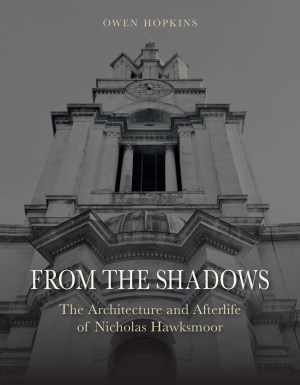 Nicholas Hawksmoor (1662–1736) is considered one of Britain’s greatest architects. He was involved in the grandest architectural projects of his age and today is best known for his London churches: six idiosyncratic edifices of white Portland stone that remain standing today, proud and tall in the otherwise radically changed cityscape. Until comparatively recently, however, Hawksmoor was thought to be, at best, a second-rate talent—merely Sir Christopher Wren’s slightly odd apprentice, or the practically minded assistant to Sir John Vanbrugh. This book brings to life the dramatic story of Hawksmoor’s resurrection from the margins of history.
Charting Hawksmoor’s career and the decline of his reputation, Owen Hopkins offers fresh interpretations of many of his famous works—notably his three East End churches—and shows how over their history Hawksmoor’s buildings have been ignored, abused, altered, recovered and celebrated. Hopkins also charts how, as Hawksmoor returned to prominence during the twentieth century, his work caught the eye of observers as diverse as T. S. Eliot, James Stirling, Robert Venturi and, most famously, Peter Ackroyd, whose novel Hawksmoor (1985) popularized the mythical association of his work with the occult. Meanwhile, passionate campaigns were mounted to save and restore Hawksmoor’s churches, reflecting the strange hold his architecture can have over observers. There is surely no other body of work in British architectural history with the same capacity to intrigue and inspire, perplex and provoke as Hawksmoor’s has done for nearly three centuries.
Owen Hopkins is a writer, historian and Architecture Programme Curator at the Royal Academy of Arts. He is the author of Reading Architecture: A Visual Lexicon (2012) and Architectural Styles: A Visual Guide (2014) and regularly leads a variety of walking tours of London architecture.
◊ ◊ ◊ ◊ ◊
C O N T E N T S
Introduction: The Man and the Myth
1 Emergence
2 Achievement
3 Falling into Shadow
4 Neglect and Rehabilitation
5 Into the Light
6 Rebirth
7 Hawksmoor Today
References
Select Bibliography
Acknowledgements
Photo Acknowledgements
Index
Exhibition | Watteau’s Soldiers: Scenes of Military Life
Press release (23 October 2015) from The Frick:
Watteau’s Soldiers: Scenes of Military Life in Eighteenth-Century France
The Frick Collection, New York, 12 July — 2 October 2016
Curated by Aaron Wile
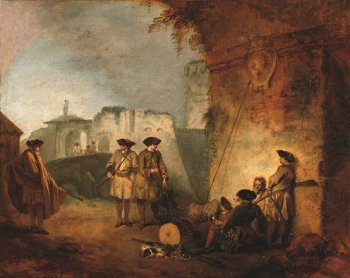
Jean-Antoine Watteau, The Portal of Valenciennes (La Porte de Valenciennes), ca. 1711−12, oil on canvas, 12 3/4 x 16 inches (New York: The Frick Collection; photo by Michael Bodycomb)
It would be difficult to think of an artist further removed from the muck and misery of the battlefield than Jean-Antoine Watteau (1684–1721), who is known as a painter of amorous aristocrats and melancholy actors, a dreamer of exquisite parklands and impossibly refined fêtes. And yet, early in his career, Watteau painted a number of scenes of military life, remarkable for their deeply felt humanity and intimacy. These pictures were produced during one of the darkest chapters of France’s history, the War of the Spanish Succession (1701–14). But the martial glory on which most military painters of the time trained their gaze—the fearsome arms, snarling horses, and splendid uniforms of generals glittering amid the smoke of cannon fire—held no interest for Watteau, who focused instead on the most prosaic aspects of war: the marches, halts, encampments, and bivouacs that defined the larger part of military life. Inspired by seventeenth-century Dutch and Flemish genre scenes, the resulting works show the quiet moments between the fighting, when soldiers could rest and daydream, smoke pipes and play cards.
Watteau produced about a dozen of these military scenes, but only seven survive. Though known primarily only to specialists, they were once counted among the artist’s most admired works and owned by such prominent figures as Catherine the Great and the Prince of Conti. Presented exclusively at The Frick Collection in the summer of 2016, Watteau’s Soldiers is the first exhibition devoted solely to these captivating pictures, introducing the artist’s engagement with military life to a larger audience while offering a fresh perspective on the subject. Among the paintings, drawings, and prints are four of the seven known paintings—with the Frick’s own Portal of Valenciennes as the centerpiece—as well as the recently rediscovered Supply Train, which has never before been exhibited publicly in a museum. Also featured are about twelve studies of soldiers in red chalk, many directly related to the paintings on view.
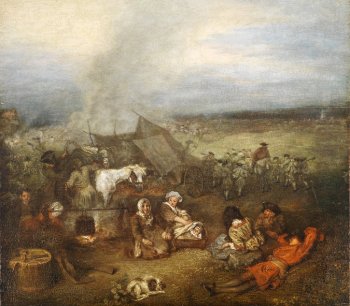
Jean-Antoine Watteau, The Supply Train (Escorte d’équipages), ca. 1715, oil on panel, 11 1/8 x 12 3/8 inches (Private collection)
The works on display offer a rare opportunity to study the drawings and paintings together and probe Watteau’s complex and remarkable working methods. Unlike most of his contemporaries, Watteau did not proceed methodically from compositional sketches, studies, and full-scale models to the final painting. Instead, his process followed the whims of his imagination and the demands of the moment. He began by drawing soldiers from life, without a predetermined end in mind. These drawings provided him with a stock of figures, often used multiple times, that he would arrange in an almost spontaneous fashion on the canvas. As a result, figures previously isolated in his sketchbook were brought together and juxtaposed in new social relationships on the canvas, producing the ambiguous, dreamlike effects that make his paintings so intriguing.
The exhibition is rounded out by a selection of works by Watteau’s predecessors and followers: the Frick’s Calvary Camp by Philips Wouwerman, a typical example of the seventeenth-century Dutch paintings after which Watteau modeled his own; a study of a soldier by Watteau’s follower Jean-Baptiste Pater, from the Fondation Custodia, Paris; and a painting of a military camp by his other great follower, Nicolas Lancret, from a private collection. These works shed light on the ways in which Watteau transformed the painting of military life in Europe, demonstrating his pivotal influence on the genre.
Aaron Wile, Watteau’s Soldiers: Scenes of Military Life in Eighteenth-Century France (London: D. Giles, 2016), 112 pages, ISBN: 978-1907804793, £25 / $40.
Published by The Frick Collection in association with D Giles, Ltd., London, the book accompanying the exhibition is the first illustrated catalogue of all Watteau’s works related to military subjects.
Additional works included in the exhibition are illustrated here»
New Essays | Corrélations: les objets du décor au siècle des Lumières
A presentation of the book is scheduled for Wednesday, November 18, in Paris at the Institut national d’histoire de l’art (INHA) in conjunction with the seminar Penser le décor : quelques hypothèses sur ses fonctions dans l’histoire de l’art, which will run from noon to 4:00. From the book flyer and Éditions de l’Université de Bruxelles:
Anne Perrin Khelissa, ed., Corrélations: les objets du décor au siècle des Lumières (2015), 264 pages, ISBN 978-2800415857, 28€ [Études sur le XVIIIe siècle 43 (Octobre 2015)].

D’après Jean-Baptiste Oudry, La jeune veuve. Fable cxxiv, gravure illustrant Jean de La Fontaine, Fables choisies, Paris, chez Desaint et Saillant, 1755, t. ii, Bibliothèque municipale de Toulouse, Res A xviii 1(2) (Bibliothèque municipale de Toulouse)
Expositions, nouvelles présentations muséographiques, colloques internationaux, programmes de recherche, travaux universitaires, publications : les arts du décor connaissent ces dernières années un vaste regain d’intérêt. Le présent volume répond à une actualité. Il entend également porter un regard renouvelé sur l’ameublement des demeures, en interrogeant la qualité artistique et technique des objets, mais aussi leurs significations sociales et culturelles. Autour d’une réflexion commune, professeurs des universités et jeunes chercheurs, conservateurs, spécialistes des arts décoratifs, de peinture, d’architecture, de littérature et d’histoire du genre font le point sur les mutations épistémologiques récentes et ouvrent la discussion.
Loin d’être un amas désaccordé de bibelots, les intérieurs du xviiie siècle proposent un système unitaire co- hérent, où arts manufacturés et beaux-arts cohabitent. Quels liens ces artefacts de nature et de statut hétérogènes entretiennent-ils entre eux et avec leur environ- nement ? Comment le principe d’harmonie fonctionne- t-il et s’adapte-t-il à la variété des aménagements et à la succession rapide des goûts ? Quel écart existe-t-il entre ce que les traités et la critique esthétique du temps préconisent et ce qu’attendent les commanditaires et les acheteurs ? Telles sont les questions que soulèvent les auteurs du recueil, à partir d’exemples célèbres ou méconnus de décors réalisés en France, en Grande-Bretagne, en Italie et en Suisse, entre la fin du xviie siècle et le début du xixe siècle.
◊ ◊ ◊ ◊ ◊
T A B L E D E S M A T I È R E S
 • Roland Mortier et les Études, Hervé Hasquin
• Pour une mise en corrélation des arts et des savoirs : introduction à l’étude des intérieurs domestiques, Anne Perrin Khelissa
I Principes et logiques structurants
• Le système d’ameublement des élites françaises au xviiie siècle, Christian Michel
• Decorated Interiors : Gender, Ornament, and Moral Values, Mary Sheriff
• L’appartement au xviiie siècle : un espace diversifié au service d’une convivialité nouvelle, Claire Ollagnier
II Normes et pratiques sociales
• Une application de la théorie du décorum : le décor textile de la chambre du roi au palais de l’archevêché de Reims, le jour du sacre de Louis xv, Pascal-François Bertrand
• Declaring an interest : the decoration of Norfolk House, London (1748–1756), Sarah Medlam
• « Trop doré pour la Suisse » : canon parisien et convenance neuchâteloise, Carl Magnusson
III Dispositions et assemblages plastiques
• Le cabinet du Régent au château de Saint-Cloud : un décor pour une collection de petits bronzes. Essai de reconstitution, Michaël Decrossas
• Du « tact flou et séduisant des couleurs » chez Jullienne ou l’art de marier tableaux, porcelaines, laques, statuettes, meubles, et autres effets, Isabelle Tillerot
• La rencontre des matériaux au service de l’harmonie du décor ? L’exemple du salon Martorana du palais Comitini à Palerme (1765–1770), Sandra Bazin-Henry
IV Imaginaires et incarnations sensuels
• « L’amour égalisait tout » : l’unité du décor des intérieurs libertins du roman des Lumières, Fabrice Moulin
• Le succès du boudoir au xviiie siècle ou les prestiges de l’intime, Alexia Lebeurre
• La nature dans le boudoir, Bérangère Poulain
Bibliographie générale
Notices biographiques des auteurs
◊ ◊ ◊ ◊ ◊
Une présentation du livre est organisée le mercredi 18 novembre à l’INHA (salle Walter Benjamin) dans le cadre du séminaire « Penser le décor : quelques hypothèses sur ses fonctions dans l’histoire de l’art » qui se déroulera de 12 h à 16 h.
Exhibition | Wicked Wit: Darly’s Comic Prints
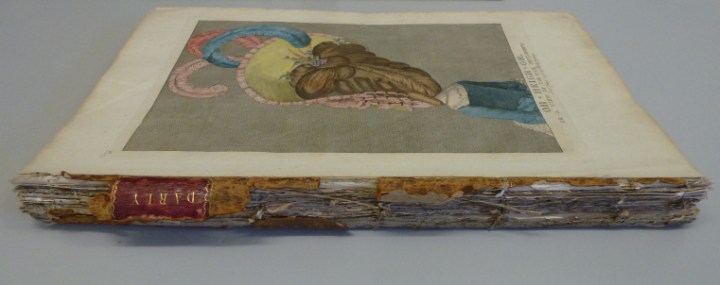
Album of Darly prints in the Chester Beatty Collection (Wep 0494), with its much deteriorated eighteenth-century binding, as photographed in the Library’s conservation studio in 2015. More information is available at the Chester Beatty Conservation Blog.
◊ ◊ ◊ ◊ ◊
Now on view at the Chester Beatty Library:
Wicked Wit: Darly’s Comic Prints
Chester Beatty Library, Dublin Castle, Dublin, 11 September 2015 — 14 February 2016
Curated by Jill Unkel
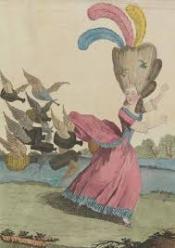 Drawing on the Library’s own collections, this exhibition features over 100 hand-coloured, eighteenth-century etchings by the husband and wife team, Mary and Matthew Darly. From the time of their marriage, they worked in tandem designing, engraving and publishing prints using the signature, MD or MDarly.
This printer-publisher team produced well over 500 comic images of Caricatures, Macaronies, and Characters from no. 39 Strand (London) between 1770 and 1780. At the height of their fame, carriages lined the streets so their occupants could titter at the images on display in Darly’s Comic Exhibitions, held every spring from 1773 to 1778. By the end of the decade, they had become so popular that their publications were available throughout Great Britain and Ireland, Europe and even America. The name Darly became synonymous with the humorous images they produced.
◊ ◊ ◊ ◊ ◊
The catalogue is available for purchase through the Beatty Library’s shop:
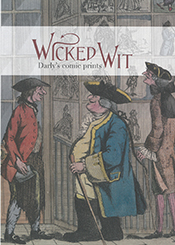 Jill Unkel, Wicked Wit: Darly’s Comic Prints (Dublin: Chester Beatty Library, 2015), 80 pages, ISBN: 978-0957399822, 20€.
This fully illustrated catalogue is divided into a number of themes and opens with a general introduction to Mary and Matthew Darly. It then examines more specifically their comic prints, publications, and exhibitions. This is followed by a more detailed exploration of the various subjects presented in their comic images: stereotyped characters (and their relation to theatre), caricatures of notable contemporaries, satires of the dress of young macaroni (akin to a dandy or fop) men and their feathered-feminine counterparts, and finally the impolitical satires related to the war with the American Colonies.
Exhibition | Dutch Dining: Four Centuries of Table Settings
Thanks to Hélène Bremer for noting this exhibition (along with installation by Bouke de Vries). . .
Nederland Dineert: Vier Eeuwen Tafelcultuur
Dutch Dining: Four Centuries of Table Settings
Gemeentemuseum, The Hague, 28 February 2016
Fine dining is a form of sensory seduction. It operates not only via the taste buds, but also via the visual appeal of the food and table setting. Beautiful porcelain and silverware, glittering crystal, fine damask and extravagant sugarwork table ornaments all have a part to play. This exhibition at the Gemeentemuseum Den Haag uses a spectacular display of complete table settings, complemented by drawings, paintings and liveries, to bring the history of formal dining among the Netherlands’ wealthy elite, ruling class and royal house to vivid life. The perfect place to find inspiration for that very special Christmas dinner table!
 Dutch Dining paints a fascinating picture of the way people in the top echelons of Dutch society were once accustomed to dine together. At tables laden with exquisite culinary delights and surrounded by an army of liveried footmen. The show is both a feast for the eye and a unique insight into the past. All of the objects in the reconstructed table settings are completely authentic—from the tableware to the ornaments, and even the furniture. The table linen comes from the very linen cupboard in which it has lain ever since the 18th century.
No table setting would be complete without meticulously folded napkins. The European fashion for the decorative use of table linen dates back to the Renaissance. In our own day, Catalan artist Joan Sallas is reviving this ‘forgotten art’ with his astonishingly skilful birds, fish and rabbits. The exhibition will feature ten such virtuoso constructions, all specially folded for the occasion.
An exclusive peek inside the royal porcelain and silverware cabinet will transport visitors right to the heart of the Noordeinde Palace. Stars of the show are two complete table services—a silver one of modern design and its more traditional porcelain counterpart—on loan from the collection of the Dutch Royal House. Both services were presented to Queen Wilhelmina and Prince Hendrik on the occasion of their marriage in 1901 and the exhibition discloses which of the two found most favour with the royal couple.
The design of the exhibition is by Maarten Spruyt and Tsur Reshef. The lavishly illustrated Dutch-language catalogue, Nederland dineert. Vier eeuwen tafelcultuur, offers the first ever reliable survey of four centuries of Dutch table settings and contains historical essays. For the museum’s youngest visitors there is also a children’s picture book and a related exhibition in the children’s gallery. The Gemeentemuseum Den Haag and the Netherlands Nutrition Centre (Voedingscentrum) are joining forces to organize a range of activities during the Dutch Dining exhibition.
The exhibition includes items generously loaned by the Rijksmuseum, Amsterdam Museum, Museum Van Loon, Kastelen Middachten, Amerongen, Twickel and de Haar, Fundatie van Renswoude Utrecht, Koninklijke Verzamelingen Den Haag, RCE/Jachthuis St. Hubertus, Huis der Provincie Arnhem and private collections.
Nederland Dineert: Vier Eeuwen Tafelcultuur (Zwolle: Waanders, 2015), 320 pages, ISBN: 978-9462620575, €34.50.
Koken en eten hoort als vanzelfsprekend bij het leven. Veel esthetiek komt hier in eerste instantie niet bij kijken. Maar zodra gezamenlijk wordt gegeten, wordt eten een sociale bezigheid, een middel tot communicatie, tot representatie, tot onderscheid. Voor dit boek is een keur aan specialisten op zoek gegaan naar de specifieke eetcultuur van Nederland. Aan de hand van een tiental authentieke ensembles van eetvertrekken van verschillende landgoederen en paleizen met daarbij bewaard gebleven voorwerpen, wordt het dineren in de afgelopen vier eeuwen geïllustreerd. Laat u betoveren door de verhalen rond de maaltijd en de uitstraling van volledig opgetuigde tafels, gedekt met tafellinnen, porselein en zilver, decoraties van suikerwerk en bloemen, van de bijbehorende meubels en het dienstpersoneel in livrei.
Exhibition | Following Hercules: The Story of Classical Art
◊ ◊ ◊ ◊ ◊
Press release (11 September 2015) from The Fitzwilliam:
Following Hercules: The Story of Classical Art
The Fitzwilliam Museum, Cambridge, 25 September — 6 December 2015
Curated by Caroline Vout
A colossal polystyrene statue of Hercules by contemporary artist Matt Darbyshire will be the star exhibit in a new exhibition at the Fitzwilliam Museum exploring the story of classical art. How did artefacts made in the Mediterranean millennia ago come to define western art? To show us how Greece and Rome’s gods and heroes came to inhabit post-antique painting and sculpture, the Fitzwilliam Museum has called upon one of them to act as a guide: Hercules.

Hercules and the Erymanthian Boar, ca. 1790, Wedgwood, Etruria, Staffordshire, Jasperware plaque, h. 212 mm (Cambridge: Fitzwilliam Museum)
Hercules is one of the best-loved ancient heroes. Known in antiquity for completing twelve tasks or ‘labours’ that confirmed his status as a god, Hercules is today tasked with one more—to tell the story of classical art. Hercules is brought to life by each of the forty objects on display (from exquisite gems and coins, Renaissance drawings and bronzes, to eighteenth-century paintings, and Matthew Darbyshire’s giant polystyrene statue…). Their interaction also reveals how classical art was born, and gives classical art on-going relevance.
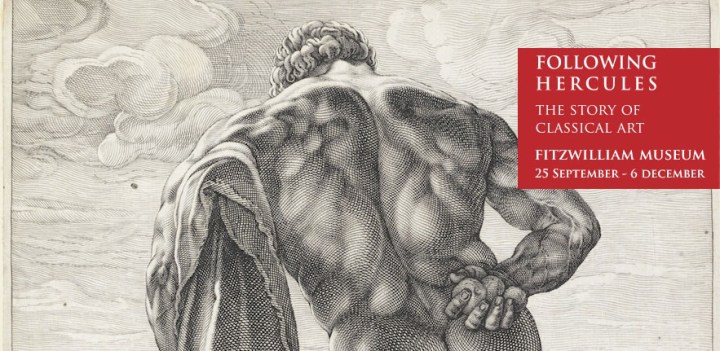
The exhibition takes its lead from its star exhibit, a colossal sculpture by Cambridge-born artist Matthew Darbyshire. Darbyshire’s intervention is a version of the Farnese Hercules, a marble statue unearthed in Rome in 1546, but is made from sheets of polystyrene—classical art for a consumerist age. Up close, its cut, crisp polystyrene layers make it appear pixelated, but step back, and the statue comes into focus, shining like marble. Back in 1850, two years after the Founder’s Building opened to the public, the Fitzwilliam Museum exhibited another Farnese Hercules, a plaster version, now in Cambridge’s Museum of Classical Archaeology. Before being given to the Fitzwilliam, it stood in a private house in Battersea, where it moved London’s artists to tears. The Fitzwilliam Museum’s own collection is well equipped with prototypes and later versions of the Farnese Hercules: from a bronze statuette of the first century BCE, through Hendrick Goltzius’s sixteenth-century engraving of the Farnese statue’s rear view, Wedgwood’s white on blue cameo plaque, and William Blake’s illustration of the statue for Abraham Rees’s The Cyclopædia, or, Universal Dictionary of Arts, Sciences, and Literature. The Museum’s collection also provides competing images of Hercules—images of Hercules young, drunk, or dressed as a woman, in bronze, wood and painted porcelain. These give context to Darbyshire’s sculpture, underlining that classicism and modernism are not opposites. In the fast moving, digital age in which we live, we perhaps need tradition more than ever.
The exhibition is curated by Dr Caroline Vout, Reader in Classics in the University of Cambridge and Fellow of Christ’s College, and is part of her British-Academy funded research project entitled Classical Art: A Life History.
Caroline Vout, Following Hercules: The Story of Classical Art (Cambridge: The Fitzwilliam Museum, 2015), 48 pages, ISBN: 978-1910731024, £5.
◊ ◊ ◊ ◊ ◊
Note (added 2 December 2018) — The posting was updated to include information about the catalogue.










 Enfilade
leave a comment