Study Day | Maria Hadfield Cosway
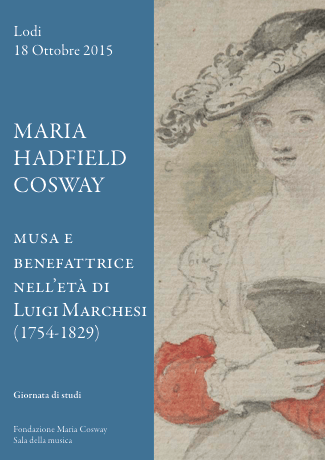
This colloquium accompanies a two-day conference (16-17 October) held in Bergamo on Luigi Marchesi, the international castrato singing superstar, who was portrayed by Richard Cosway in London and who had a close musical friendship with Maria Cosway in both London dung the late 1780s and in northern Italy during the early 1790s. From the flyer:
Maria Hadfield Cosway: Musa e benefattrice nell’età di Luigi Marchesi (1754–1829)
Fondazione Maria Cosway, Lodi, 18 October 2015
 10.00 Saluti istituzionali: Francesco Chiodaroli (Fondazione Maria Cosway, Lodi), Angelo Bianchi (Università Cattolica del Sacro Cuore, Milano), Gabriella Molina (Fondazione Ospedale Marchesi, Inzago)
• Riccardo Benzoni, Napoleone a scuola: rinnovamento dell’istruzione e celebrazione del potere negli anni del Primo Impero (1804–1814)
• Cristina Cenadella, «Figlie di tutti sono le figlie di nessuno». L’orfanotrofio della Stella di Milano e le scuole di formazione interne
• Laura Giuliacci, Donne e società in Italia e in Francia ai tempi di Maria Cosway: l’educazione distinta
• Giliola Barbero, L’Europa di Maria Cosway nella sua biblioteca.
13.00 Pausa pranzo
14.30 Sessione pomeridiana
• Rosa Cafiero, L’insegnamento della musica nel Collegio delle dame inglesi: modelli europei per Maria Cosway
• Stephen Lloyd, ‘Wonderment for the table-talk of the town’: Regency London’s social and artistic context for Richard Cosway’s portrait of Luigi Marchesi (1790)
• Stefano Aresi, «If you want to hear what Italian Singing is, come to London»: Marchesi, Londra e il rapporto con Maria Cosway
16.00 Presentazione volume
Gian Carlo Sciolla presenta il nuovo volume di Tino Gipponi, La veridica storia di Maria Hadfield Cosway e il ritratto ritrovato (Lodi: PMP Editore, 2015).
New Book | The Hanoverian Succession
From Ashgate:
Andreas Gestrich and Michael Schaich, eds., The Hanoverian Succession: Dynastic Politics and Monarchical Culture (Farnham: Ashgate, 2015), 304 pages, ISBN: 978-1472437655, $135.
 The Hanoverian succession of 1714 brought about a 123-year union between Britain and the German electorate of Hanover, ushering in a distinct new period in British history. Under the four Georges and William IV Britain became arguably the most powerful nation in the world with a growing colonial Empire, a muscular economy and an effervescent artistic, social and scientific culture. And yet history has not tended to be kind to the Hanoverians, frequently portraying them as petty-minded and boring monarchs presiding over a dull and inconsequential court, merely the puppets of parliament and powerful ministers. In order both to explain and to challenge such a paradox, this collection looks afresh at the Georgian monarchs and their role, influence and legacy within Britain, Hanover and beyond.
Concentrating on the self-representation and the perception of the Hanoverians in their various dominions, each chapter shines new light on important topics: from rivalling concepts of monarchical legitimacy and court culture during the eighteenth century to the multi-confessional set-up of the British composite monarchy and the role of social groups such as the military, the Anglican Church and the aristocracy in defining and challenging the political order. As a result, the volume uncovers a clearly defined new style of Hanoverian kingship, one that emphasized the Protestantism of the dynasty, laid great store by rational government in close collaboration with traditional political powers, embraced army and navy to an unheard of extent and projected this image to audiences on the British Isles, in the German territories and in the colonies alike. Three hundred years after the succession of the first Hanoverian king, an intriguing new perspective of a dynasty emerges, challenging long held assumptions and prejudices.
Andreas Gestrich is Director of the German Historical Institute London. His present research interests comprise the history of family, childhood and youth, the history of poverty and poor relief, media history and the social history of religious groups. His publications include, among others, Absolutismus und Öffentlichkeit: Politische Kommunikation in Deutschland zu Beginn des 18. Jahrhunderts (1994), Familie im 19. und 20. Jahrhundert (1999) and (ed. with Christiane Eisenberg) Cultural Industries in Britain and Germany: Sport, Music and Entertainment from the Eighteenth to the Twentieth Century (2012).
Michael Schaich is Deputy Director of the German Historical Institute London. His current research focuses on the symbolic representation of the British monarchy and state during the seventeenth and eighteenth centuries. His publications include Staat und Öffentlichkeit im Kurfürstentum Bayern der Spätaufklärung (2001), (ed.) Monarchy and Religion: The Transformation of Royal Culture in Eighteenth-Century Europe (2007) and (ed. with R.J.W. Evans and Peter H. Wilson) The Holy Roman Empire, 1495–1806 (2011).
◊ ◊ ◊ ◊ ◊
C O N T E N T S
1 Introduction, Michael Schaich
I. Dynastic Legacies
2 The Hanoverian Monarchy and the Legacy of Late Stuart Kingship, Ronald G. Asch
3 The House of Brunswick-Lüneburg and the Holy Roman Empire: The Making of a Patriotic Dynasty, 1648–1714?, Martin Wrede.
II. Representing Protestantism
4 George I, the Hanoverian Succession, and Religious Dissent, David Wykes
5 Hanover-Britain and the Protestant cause, 1714–1760, Andrew C. Thompson
6 The Hanoverians and the Colonial Churches, Jeremy Gregory
III. Image Policies
7 The Hanoverian Monarchy and the Culture of Representation, Tim Blanning
8 ‘Every Inch Not a King’: The Bodies of the (First Two) Hanoverians, Robert Bucholz
9 Monarchy, Affection and Empire: The Hanoverian Dynasty in Eighteenth-Century America, Brendan McConville
10 Visions of Kingship in Britain under George III and George IV, G.M. Ditchfield
IV. Contested Loyalties
11 The Hanoverian Succession and the Politicisation of the British army, Hannah Smith
12 Jacobitism and the Hanoverian Monarchy, Gabriel Glickman
13 The Alternative to the House of Hanover: The Stuarts in Exile, 1714–1745, Edward Corp
14 Radical Popular Attitudes to the Monarchy in Britain during the French Revolution, Amanda Goodrich
Index
New Book | Scenes of Projection: Recasting the Enlightenment Subject
From the University of Minnesota Press:
Jill H. Casid, Scenes of Projection: Recasting the Enlightenment Subject (Minneapolis: University of Minnesota Press, 2014), 328 pages, ISBN: 978-0816646692 (cloth), $83 / ISBN: 978-0816646708 (paper), $28.
 Theorizing vision and power at the intersections of the histories of psychoanalysis, media, scientific method, and colonization, Scenes of Projection poaches the prized instruments at the heart of the so-called scientific revolution: the projecting telescope, camera obscura, magic lantern, solar microscope, and prism. From the beginnings of what is retrospectively enshrined as the origins of the Enlightenment and in the wake of colonization, the scene of projection has functioned as a contraption for creating a fantasy subject of discarnate vision for the exercise of ‘reason’.
Jill H. Casid demonstrates across a range of sites that the scene of projection is neither a static diagram of power nor a fixed architecture but rather a pedagogical setup that operates as an influencing machine of persistent training. Thinking with queer and feminist art projects that take up old devices for casting an image to reorient this apparatus of power that produces its subject, Scenes of Projection offers a set of theses on the possibilities for felt embodiment out of the damaged and difficult pasts that haunt our present.
Jill H. Casid is professor of visual studies at the University of Wisconsin–Madison. She is the author of Sowing Empire:
Landscape and Colonization (Minnesota, 2005).
◊ ◊ ◊ ◊ ◊
C O N T E N T S
Introduction: Shadows of Enlightenment
1 Paranoid Projection and the Phantom Subject of Reason
2 Empire through the Magic Lantern
3 Empire Bites Back
4 Along Enlightenment’s Cast Shadows
5 Following the Rainbow
Conclusion: Queer Projection, Theses on the ‘Future of an Illusion’
Acknowledgments
Notes
Index
Exhibition | The Italian Travels of Louis-François Cassas
Opening in November at the Musée des Beaux-Arts:
Voyages en Italie de Louis-François Cassas (1756–1827)
Musée des Beaux-Arts, Tours, 21 November 2015 — 22 February 2016
 Louis-François Cassas compte parmi les grands artistes voyageurs du XVIIIe siècle. L’exposition dévoile ici les dessins de l’artiste réalisés lors de son Grand Tour en Italie. Cette manifestation s’inscrit dans le thème transversal et séduisant du voyage et de l’Italie dans toute sa diversité archéologique, urbaine, insulaire… à la fin du Siècle des Lumières. La découverte récente de nombreux dessins inédits en Angleterre est venue confirmer l’opportunité de cette exposition : cinquante dessins prêtés par le National Trust et provenant de la collection du marquis de Bristol à Ickworth (Suffolk) seront montrés pour la première fois en France.
L’exposition s’articulera autour des deux grands voyages en Italie de L.-F. Cassas et de ses différents mécènes tous grands amateurs et collectionneurs, à l’origine de l’évolution de la carrière de l’artiste. Parmi les 116 œuvres exposées figurent des prêts de musées français et étrangers prestigieux : Paris : Bibliothèque Mazarine, Bibliothèque Nationale, Ecole Nationale Supérieure des Beaux-Arts, Fondation Custodia / New-York : Metropolitan Museum of Art / Londres : Victoria and Albert Museum, The National Trust : Ickworth (Suffolk), The Bristol Collection / Cologne : Wallraf-Richartz Museum / Vienne : Albertina Museum, et de collections privées.
Le premier voyage en Italie, 1778–83
Le Grand Tour pour le plaisir de dessiner
Grâce au mécénat du duc de Chabot, Cassas découvre l’Italie et peut obtenir une chambre d’externe à l’Académie de France à Rome. Seront évoquées les grandes étapes de cette pérégrination : Lyon, Genève, les Alpes, Bologne, Parme, Rome, Naples, Paestum… Invité à Venise au printemps 1782, puis à Trieste par le Baron Pittoni, Cassas travaille alors pour l’Empereur Joseph II jusqu’aux frontières de l’Empire ottoman. À l’automne 1782, Cassas part en Sicile travailler pour l’abbé de Saint-Non. Ses vues de Messine, de Catane, du Val di Noto… seront particulièrement remarquées.
Le second voyage en Italie, 1787–92
Les années romaines d’un artiste indépendant
Le nouveau mécène de Cassas, le comte de Choiseul- Gouffier (1752–1817), ambassadeur de France à Constantinople, permit à l’artiste de découvrir les provinces de l’Empire ottoman de 1784 à 1786. Désormais c’est dans son atelier à Rome, Piazza di Spagna, que Cassas accroche ses aquarelles de Palmyre, du Caire, de la Corne d’Or, de Chypre… qui suscitent l’admiration, notamment celle de Goethe, et des amateurs qui font le Grand Tour. Trois maquettes de monuments romains, provenant de la collection de Cassas, restaurées pour l’exposition : le Temple de la Fortune Virile, le Temple de Tivoli et l’Arc de Constantin, seront exceptionnellement présentées.
The catalogue will be available from Artbooks.com:
Sophie Join-Lambert, Louis-François Cassas (1756–1827): Ses Voyages en Italie et Ses Mécènes (Milan: Silvana Editoriale, 2015), 280 pages, ISBN: 978-8836631636, $65.
New Book | Figures Publiques: L’invention de la Célébrité, 1750–1850
From Fayard:
Antoine Lilti, Figures Publiques: L’invention de la Célébrité, 1750–1850 (Paris: Fayard, 2014), 436 pages, ISBN: 978-2213682389, 24€.
 Bien avant le cinéma, la presse à scandale et la télévision, les mécanismes de la célébrité se sont développés dans l’Europe des Lumières, puis épanouis à l’époque romantique sur les deux rives de l’Atlantique. Des écrivains comme Voltaire, des comédiens comme Garrick, des musiciens comme Liszt furent de véritables célébrités, suscitant la curiosité et l’attachement passionné de leurs « fans ». À Paris comme à Londres, puis à Berlin et New York, l’essor de la presse, les nouvelles techniques publicitaires et la commercialisation des loisirs entraînèrent une profonde transformation de la visibilité des personnes célèbres. On pouvait désormais acheter le portrait de chanteurs d’opéra et la biographie de courtisanes, dont les vies privées devenaient un spectacle public. La politique ne resta pas à l’écart de ce bouleversement culturel : Marie-Antoinette comme George Washington ou Napoléon furent les témoins d’un monde politique transformé par les nouvelles exigences de la célébrité. Lorsque le peuple surgit sur la scène révolutionnaire, il ne suffit plus d’être légitime, il importe désormais d’être populaire.
À travers cette histoire de la célébrité, Antoine Lilti retrace les profondes mutations de la société des Lumières et révèle les ambivalences de l’espace public. La trajectoire de Jean-Jacques Rousseau en témoigne de façon exemplaire. Écrivain célèbre et adulé, celui-ci finit pourtant par maudire les effets de sa « funeste célébrité », miné par le sentiment d’être devenu une figure publique que chacun pouvait façonner à sa guise. À la fois désirée et dénoncée, la célébrité apparaît comme la forme moderne du prestige personnel, adaptée aux sociétés démocratiques et médiatiques, comme la gloire était celle des sociétés aristocratiques. C’est pourtant une grandeur toujours contestée, dont l’histoire éclaire les contradictions de notre modernité.
Antoine Lilti est directeur d’études à l’École des hautes études en sciences sociales. Ses travaux portent sur l’histoire sociale et culturelle des Lumières. Il a notamment publié Le Monde des salons. Sociabilité et mondanité à Paris au xviiie siècle (Fayard, 2005).
For a review of the book, see Jessica Goodman, French Studies 69 (2015): 535–36.
Exhibition | Aristocratic Life in the Eighteenth Century
From the Musée National de la Renaissance:
Être et paraître, la vie aristocratique au XVIIIe siècle:
Trésors cachés du Musée national de la Renaissance
Château de La Roche Guyon, 11 April — 29 November 2015
Curated by Muriel Barbier
 Sortis exceptionnellement des réserves du musée national de la Renaissance, des objets d’art du XVIIIe siècle retracent en dix tableaux les thèmes majeurs de la vie aristocratique à l’époque des Lumières. Au travers de quatre-vingt-cinq oeuvres, le quotidien de l’aristocratie du XVIIIe siècle revit dans les grands salons du château de La Roche Guyon ornés de leurs lambris d’époque et dépourvus de mobilier.
Une journée ordinaire dans une demeure seigneuriale au siècle des Lumières. L’exposition, articulée en dix vitrines, suit le déroulement d’une journée de la haute société des Lumières, en abordant les thèmes suivants : toilette et soins, parure et élégance, arts de la table, lecture et écriture, jeux et divertissements, priser et fumer, ouvrages de dames, prières et dévotions, armes d’apparât et chasse. Cette présentation, entend faire comprendre la fonction de ces objets, la préciosité de leur décor et leur utilisation. Elle propose une autre approche des arts décoratifs non fondée sur l’évolution des stymes et des techniques mais sur l’histoire des civilisations et des moeurs.
Muriel Barbier, Être et paraître: La vie aristocratique au XVIIIe siècle (Artlys, 2015), 142 pages, ISBN: 978-2854956108, 18€.
Bénédicte Bonnet Saint-Georges reviewed the exhibition for La Tribune de l’Art (21 August 2015).
New Book | Studying 18th-Century Paintings and Works of Art on Paper
From Archetype Publications:
Helen Evans and Kimberley Muir, eds., Studying 18th-Century Paintings and Works of Art on Paper (London: Archetype Publications, 2015), 172 pages, ISBN: 978-1909492233, £45 / $95.
Pre-Publication Discount Price: £35 + postage when ordered using a Visa/MasterCard from Archetype’s London office by sending an email by 22nd September 2015 to info@archetype.co.uk
 This is the second CATS Conference Proceedings with papers from the international conference Technology & Practice: Studying 18th-Century Paintings & Art on Paper. The conference was organised by CATS in collaboration with Helsinki Metropolia University of Applied Science in Helsinki, Finland; Nationalmuseum in Stockholm, Sweden; and University of Oslo, Norway. The conference focused on artists’ techniques and materials, source research, conservation science, the history of science and technology, trade and pharmacy during the 18th century. Speakers explored tradition and changes in artistic practices in the light of the establishment of a series of national Art Academies in Europe throughout the century. Papers include topics such as workshop practice and materials, art historical and technical approaches to documentary evidence and technical examination and the analysis of paintings and drawings. Also issues of trade, supply and questions concerning the demand for materials for diverse artistic expressions are analysed and discussed.
C O N T E N T S
Foreword
• Mikkel Bogh, Discipline and wonder: The 18th-century art academy and the invention of the artist as a free practitioner
• Loa Ludvigsen, Mikala Bagge and Vibeke Rask, The effect of Prussian blue on the technique of the Danish court painters Hendrik Krock and Benoît le Coffre
• Carol Pottasch, Susan Smelt and Ralph Haswell, Breaking new ground: Investigating Pellegrini’s use of ground in the Golden Room of the Mauritshuis,
• Leila Sauvage and Cécile Gombaud, Liotard’s pastels: Techniques of an 18th-century pastellist
• Tine Louise Slotsgaard, An investigation of the painting technique in portraits by Jens Juel
• Andreas Burmester and Stefanie Correll, 72 florin for colours, white and glue: The Tiepolos, the Veninos and Würzburg
• Piet Bakker, Margriet van Eikema Hommes and Katrien Keune, The coarse painter and his position in 17th- and 18th-century Dutch decorative painting
• Ige Verslype, Johanneke Verhave, Susan Smelt, Katrien Keune, Hinke Sigmond and Margriet van Eikema Hommes, A ‘painted chamber’ in Beverwijk by Jacobus Luberti Augustini: Novel insights into the working methods and painting practices in a painted wall-hanging factory
• Clara de la Peña Mc Tigue, 18th-century practices in the art academies in Spain: The use of paper in prints and drawings
• Ingelise Nielsen and Niels Borring, Nicolai Abildgaard: An 18th-century Danish artist and his paper
• Niels Borring, Semi-mechanical transfer methods in Nicolai Abildgaard’s drawings
• Troels Filtenborg, Canvas supports in paintings by Nicolai Abildgaard: Fabrics and formats
• Alexandra Gent, Rachel Morrison and Nelly von Aderkas, ‘1st olio after Capivi’: Copaiba balsam in the paintings of Sir Joshua Reynolds
• Richard Mulholland, Ferdinand Bauer’s Flora Graeca colour code
New Book | Antiquarianism and the Visual Histories of Louis XIV
From Ashgate:
Robert Wellington, Antiquarianism and the Visual Histories of Louis XIV: Artifacts for a Future Past (Farnham: Ashgate, 2015), 286 pages, ISBN: 978-1472460332, $110.
 Antiquarianism and the Visual Histories of Louis XIV: Artifacts for a Future Past provides a new interpretation of objects and images commissioned by Louis XIV (1638–1715) to document his reign for posterity. The Sun King’s image-makers based their prediction of how future historians would interpret the material remains of their culture on contemporary antiquarian methods, creating new works of art as artifacts for a future time. The need for such items to function as historical evidence led to many pictorial developments, and medals played a central role in this. Coin-like in form but not currency, the medal was the consummate antiquarian object, made in imitation of ancient coins used to study the past. Yet medals are often elided from the narrative of the arts of ancien régime France, their neglect wholly disproportionate to the cultural status that they once held. This revisionary study uncovers a numismatic sensibility throughout the iconography of Louis XIV, and in the defining monuments of his age. It looks beyond the standard political reading of the works of art made to document Louis XIV’s history, to argue that they are the results of a creative process wedded to antiquarianism, an intellectual culture that provided a model for the production of history in the grand siècle.
Robert Wellington is a lecturer at the Centre for Art History and Art Theory, Australian National University.
◊ ◊ ◊ ◊ ◊
C O N T E N T S
Introduction: Medals and the Material Turn in the King’s History
1 Antiquarianism at Court
2 The Petite Académie and the histoire métallique of Louis XIV
3 The Cabinet des Médailles at Versailles
4 Images Inscribed and Described by the Petite Académie
5 The Antiquarian Origins of Louis XIV’s Medals Books
6 Portraiture, Physiognomy, and the Numismatic Sensibility
7 Numismatic Resonances: Le Brun’s Cycle for the Hall of Mirrors at Versailles
Epilogue
Bibliography
Index
New Book | Pompeo Batoni: A Complete Catalogue of His Paintings
Scheduled for publication next month from Yale UP:
Edgar Peters Bowron, Pompeo Batoni: A Complete Catalogue of His Paintings (London: The Paul Mellon Centre for Studies in British Art in association with the Museum of Fine Arts, Houston, 2015), 2-volume boxed set, 750 pages, ISBN: 978-0300148169, $300.
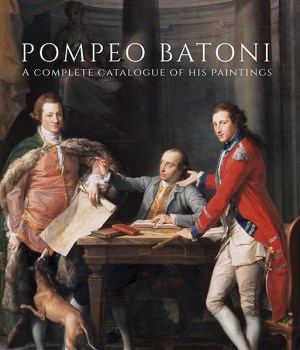 This meticulously researched catalogue presents an authoritative assessment of the works of Pompeo Batoni (1708–1787), one of the 18th century’s most celebrated painters. Born in Lucca, Batoni established himself in Rome and received commissions from popes, princes, and British aristocrats on the Grand Tour. Batoni was highly sought after for his theatrical yet incisive—and often flattering—portraits. Connoisseurs and cognoscenti also prized his learned and technically brilliant allegorical, religious, and mythological compositions.
With entries on more than 480 paintings and 250 drawings, this magnificent two-volume set provides the most complete examination to date of Batoni’s entire oeuvre. Featuring beautiful, high-quality reproductions, the book provides thorough details on provenance and exhibition history as well as biographies of the portrait sitters. New analysis of the works, resulting from decades of research, reinterprets some of Batoni’s iconography, identifies new textual and visual sources of his imagery, and reveals insights gleaned from unpublished archival materials.
Edgar Peters Bowron is the former Audrey Jones Beck Curator of European Art at the Museum of Fine Arts, Houston.
New Book | Ruins and Fragments: Tales of Loss and Rediscovery
Distributed by The University of Chicago Press:
Robert Harbison, Ruins and Fragments: Tales of Loss and Rediscovery (London: Reaktion Books, 2015), 208 pages, ISBN: 978-1780234472, $35.
 What is it about ruins that are so alluring, so puzzling, that they can hold some of us in endless wonder over the half-erased story they tell? In this elegant book, Robert Harbison explores the captivating hold these remains and broken pieces—from architecture, art, and literature—have on us. Why are we, he asks, so suspicious of things that are too smooth, too continuous? What makes us feel, when we look upon a fragment, that its very incompletion has a kind of meaning in itself? Is it that our experience on earth is inherently discontinuous, or that we are simply unable to believe in anything whole?
Harbison guides us through ruins and fragments, both ancient and modern, visual and textual, showing us how they are crucial to understanding our current mindset and how we arrived here. First looking at ancient fragments, he examines the ways we have recovered, restored, and exhibited them as artworks. Then he moves on to modernist architecture and the ways that it seeks a fragmentary form, examining modern projects that have been designed into existing ruins, such as the Castelvecchio in Verona, Italy and the reconstruction of the Neues Museum in Berlin. From there he explores literature and the works of T. S. Eliot, Montaigne, Coleridge, Joyce, and Sterne, and how they have used fragments as the foundation for creating new work. Likewise he examines the visual arts, from Schwitters’ collages to Ruskin’s drawings, as well as cinematic works from Sergei Eisenstein to Julien Temple, never shying from more deliberate creators of ruin, from Gordon Matta-Clark to countless graffiti artists.
From ancient to modern times and across every imaginable form of art, Harbison takes a poetic look at how ruins have offered us a way of understanding history and how they have enabled us to create the new.
Until his retirement, Robert Harbison was professor of architecture at London Metropolitan University. He is the author of many books, including Reflections on Baroque and Travels in the History of Architecture, both also published by Reaktion Books.
C O N T E N T S
Prologue
1 Rough Edges
2 Fragmented Wholes
3 Modernist Ruin
4 Interrupted Texts
5 Ruined Narratives
6 Art and Destruction
7 Dreams of Recovery
Epilogue: Remembering and Forgetting
Notes
Acknowledgements
Photo Acknowledgements
Index










 Enfilade
leave a comment