New Book | The Gardens of Venice and the Veneto
The particular appeal of this book lies in the fact that the gardens included are accessible to the public. From Frances Lincoln:
Jenny Condie, with photographs by Alex Ramsay, The Gardens of Venice and the Veneto (London: Frances Lincoln, 2013), 224 pages, ISBN: 978-0711234048, £35 / $60.
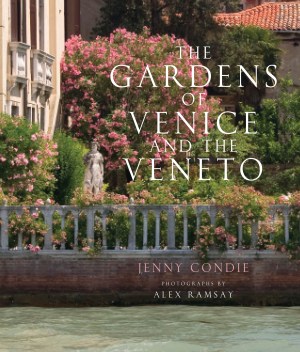 The Gardens of Venice and the Veneto draws together an amazing variety of 22 spellbinding garden retreats, from monastery gardens quietly cultivated in the islands of the lagoon to magnificent villas on the Brenta Canal, and baroque masterpieces in the hills beyond. Highlights include an eerie Masonic garden complete with gothic chapel and cavernous grottoes, a pleasure garden made for his workers by a benevolent nineteenth-century industrialist, and a flower-filled delight by the banks of the Grand Canal.
This is a book of ravishing images and intriguing stories. The garden behind Henry James’s Aspern Papers is here, along with the garden which so beguiled Margaret Symonds, the young English author of Days Spent on a Doge’s Farm. With an emphasis on gardens that can be visited, longtime resident Jenny Condie elucidates the dynastic triumphs, the reversals of fortune, and the shifts in taste and influence which have shaped these
extraordinary places.
Jenny Condie was born in Edinburgh and took a degree in Italian and History of Art at UCL. She has translated a number of substantial works in the area of art and literary history and criticism, and she has also written in Italian as a journalist. More recently she has worked with the Fondazione di Venezia to originate and run workshops on English Literature for children in local schools. Jenny Condie has lived in Venice since 2002 with her husband, the novelist Enrico Palandri, and their three children.
Alex Ramsay lives in the Welsh Marches. He is a photographer of international repute whose work has appeared in many books published by Frances Lincoln, including Italian Gardens: A Cultural History (recently reissued in paperback) and Italy’s Private Gardens: An Inside View, both written by his wife, the garden historian Helena Attlee.
◊ ◊ ◊ ◊ ◊
C O N T E N T S
 The Gardens of Venice
Island gardens
• The Giudecca
Religious gardens
• San Francesco della Vigna
• Ca’ Morosini del Giardin
Palazzi gardens
• Ca’ Rezzonico
• Ca’ Tron
• Ca’ Zenobio
• Palazzo Cappello Malipiero Barnabò
• Palazzo Contarini Dal Zaffo
• Palazzo Rizzo Patarol
• Palazzo Soranzo Cappello
• Querini Stampaglia
The Gardens of the Brenta Canal
•Villa Brusoni Scalella, Dolo
• Villa Pisani, Stra
The Gardens of Padua
• Orto botanico, Padua
• Ca’ Marcello, Levada di Piombino Dese
• Villa Barbarigo Pizzoni-Ardemani, Valsanzibio
• Villa Ca’ Dolfin, Marchiori, Lendinara s
• Villa Emo, Rivella di Monselice
• Villa Pisani Bolognesi Scalabrin, Vescovana
• Villa Valmarana a Citadella Vigodarzere, Saonara
The Gardens of Treviso
• Villa Barbaro di Maser
The Gardens of Verona
• Giardino Giusti, Verona
• Giardino di Pojega, Villa Rizzardi, Negrar
• Villa Allegri Arvedi, Cuzzano s
• Villa della Torre, Fumane
• Villa Trissino Marzotto, Trissino
The Gardens of Vicenza
• Villa Fracanzan Piovene, Orgiana
• Villa Godi Malinverni and Villa Piovene Porto-Godi, Lonedo di Lugo Vicentino
• Villa da Schio , Costozza
• Villa Valmarana ai Nani
Visiting the gardens
Books to read
A. Boogert’s 1692 Treatise on Colors

The Leiden-based, medieval book historian Erik Kwakkel posted notice of this 1692 manuscript at his blog, which was then picked up by Colossal and Gizmodo. From Colossal (5 May 2014):
A. Boogert, Traité des couleurs servant à la peinture à l’eau, Aix-en-Provence, Bibliothèque municipale/Bibliothèque Méjanes, MS 1389 (1228). The entire book can be viewed here, in hi-resolution, zoomable images.
In 1692 an artist known only as “A. Boogert” sat down to write a book in Dutch about mixing watercolors. Not only would he begin the book with a bit about the use of color in painting, but would go on to explain how to create certain hues and change the tone by adding one, two, or three parts of water. The premise sounds simple enough, but the final product is almost unfathomable in its detail and scope.
Spanning nearly 800 completely handwritten (and painted) pages, Traité des couleurs servant à la peinture à l’eau, was probably the most comprehensive guide to paint and color of its time. According to Medieval book historian Erik Kwakkel who translated part of the introduction, the color book was intended as an educational guide. The irony being there was only a single copy that was probably seen by very few eyes. . .
The full posting is available here»

◊ ◊ ◊ ◊ ◊
Kwakkel followed up with this note:
Full disclosure (6 May, 2014): While this colourful book is first presented to a larger audience in this post and there are no Dutch publications devoted to it, I have since posting discovered that it is known by at least one other Dutch scholar. It is currently being studied and will be included in a PhD study to be completed in 2015 at the University of Amsterdam. While it is great that blogs such as The Colossal (here) and Gizmodo (here) have picked it up, it is important to know that I was not the one “discovering” the manuscript. I merely put it on the bigger podium it deserves, via this blog.
New Book | Chinese Wallpaper in National Trust Houses
I’m republishing this posting, which first appeared in March, since copies are now available from the National Trust website. -CH
From The East India Company at Home, 1757–1857 Newsletter (March 2014); note that the booklet is available for free download as a PDF file.
Emile de Bruijn, Andrew Bush, and Helen Clifford, Chinese Wallpaper in National Trust Houses (Newcastle upon Tyne: National Trust, 2014), 50 pages, ISBN: 978-0707804286, £10.
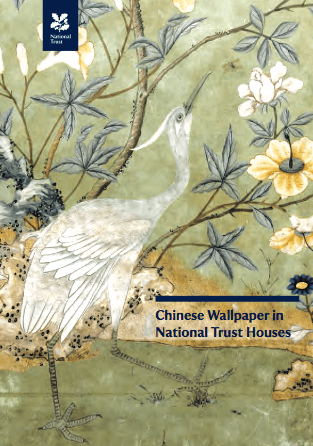 On the evening of 20 March Emile de Bruijn, Andrew Bush and Helen Clifford were delighted to celebrate the publication of Chinese Wallpaper in National Trust Houses, at the China Tang Suite at the Dorchester Hotel, London, providing the opportunity to thank the contributing team of collaborators including curators, conservators, entrepreneurs and scholars. Special thanks go to the hosts who made this venue possible. Copies of the National Trust’s catalogue of a group of historic Chinese wallpapers based on the latest research and conservation can be bought from Shop.nationaltrust.org.uk. The 50-page booklet is entitled Chinese Wallpapers in National Trust Houses and includes nearly 50 colour pictures, introductory essay, location map of sites including non-NT examples and a bibliography.
The booklet is also available as a PDF file.
More information about the The East India Company at Home Project is available here»
New Book | Architecture, Art, and Identity in Venice
From Ashgate:
Nebahat Avcioglu and Emma Jones, eds., Architecture, Art, and Identity in Venice and its Territories, 1450–1750 (Aldershot: Ashgate, 2013), 326 pages, ISBN: 978-1472410825, £70.
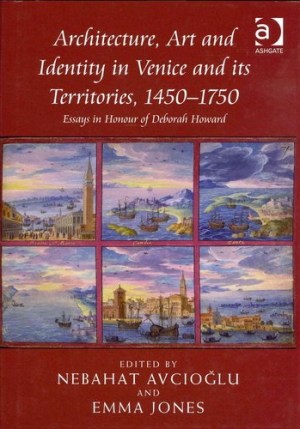 Cities are shaped as much by a repertoire of buildings, works and objects, as by cultural institutions, ideas and interactions between forms and practices entangled in identity formations. This is particularly true when seen through a city as forceful and splendid as Venice. The essays in this volume investigate these connections between art and identity, through discussions of patronage, space and the dissemination of architectural models and knowledge in Venice, its territories and beyond. They celebrate Professor Deborah Howard’s leading role in fostering a historically grounded and interdisciplinary approach to the art and architecture of Venice.
Based on an examination and re-interpretation of a wide range of archival material and primary sources, the contributing authors approach the notion of identity in its many guises: as self-representation, as strong sub-currents of spatial strategies, as visual and semantic discourses, and as political and imperial aspirations. Employing interdisciplinary modes of interpretation, these studies offer ground-breaking analyses of canonical sites and works of art, diverse groups of patrons, as well as the life and oeuvre of leading architects such as Jacopo Sansovino and Andrea Palladio. In so doing, they link together citizens and nobles, past and present, the real and the symbolic, space and sound, religion and power, the city and its parts, Venice and the Stato da Mar, the Serenissima and the Sublime Port.
Nebahat Avcioglu is Associate Professor of Art History at Hunter College, CUNY. Emma Jones is a PhD Candidate in the Department of History of Art at the University of Cambridge.
◊ ◊ ◊ ◊ ◊
C O N T E N T S
Introduction, Nebahat Avcioglu and Emma Jones
Section 1: Identity, Space and the City
1. ‘Soli deo honor et gloria’? Cittadino lay procurator patronage and the art of identity formation in Renaissance Venice, Allison Sherman
2. The Sisters Sagredo: Passion and patronage in eighteenth-century Venice, Esther Gabel
Section 2: Drawing, Mapping and Translating Venice
3. The early history of Jacopo Sansovino’s scheme for Piazza San Marco: A proposal, Paul Davies
4. Venice 1557: Sabbadino’s city plan, Elena Svalduz
5. Translatio Longhena Salute: Drawings and patrons in pilgrimage between Venice, Rome, and Gostyn, Andrew Hopkins
Section 3: Palladio’s Creations and Creating Palladio
6. The twin sacristy arrangement of Palladio’s Venice: origins and adaptations, Lydia Hamlett
7. Palladio’s patrons and music: Connections between cultural interests and architecture: The Villa Pisani at Bagnolo, Laura Moretti
8. How Palladio became famous: Paolo Gualdo and the Republic of Letters, Tracy E. Cooper
Section 4: The Production of Sacred Space
9. The seventeenth-century project for the church of San Nicolò del Lido in Venice: Liturgical problems and new architectural models in the counter-Reformation, Massimo Bisson
10. Innovation or afterthought? Dating the San Giobbe retrochoir, Joanne Allen
11. Venice’s cathedral of San Pietro di Castello, 1451–1630, Gianmario Guidarelli
Section 5: Time and Place in the Stato da Mar
12. The topography of antiquity in descriptions of Venetian Crete, Johanna D. Heinrichs
13. Jacopo Foscarini, Francesco Barozzi and the oracles of Leo the Wise, Blake de Maria
14. Becoming a man of empire: The construction of patrician identity in a republic of equals, Patricia Fortini Brown
Exhibition | Goya and the Altamira Family
Press release (10 April 2014) from The Met:
Goya and the Altamira Family
The Metropolitan Museum of Art, New York, 22 April — 3 August 2014
Curated by y Xavier F. Salomon
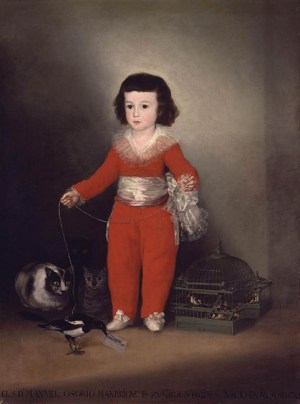
Goya, Manuel Osorio Manrique de Zuñiga, 1787–88
50 x 40 inches (NY: The Metropolitan Museum of Art)
By special arrangement with the Banco de España, from April 22 through August 3, The Metropolitan Museum of Art will reunite for the first time four portraits painted by Francisco de Goya (1746–1828) that were commissioned by the Count of Altamira, who was a director of the bank. Goya and the Altamira Family will consist of
• Banco de España’s Portrait of the Count of Altamira
• the Metropolitan’s beloved Manuel Osorio Manrique de Zuñiga, the so-called ‘Red Boy’
• the beautiful portrait of Manuel’s mother and sister, Condesa de Altamira and Her Daughter, María Agustina, from the Metropolitan Museum’s Robert Lehman Collection
• and a portrait of Manuel Osorio’s brother Vicente Joaquin de Toledo, from a private collection.
All four portraits were painted between 1786 and 1788 when Goya was beginning to experiment with aristocratic portraiture. A fifth portrait depicting Count Altamira’s middle son, Juan María Osorio, was painted around the same time by Agustín Esteve, one of Goya’s pupils, and will be lent by the Cleveland Museum of Art.
The Banco de San Carlos (the present-day Banco de España) commissioned Goya to create a series of portraits of the directors of the bank in Madrid, including the full-length depiction of Vicente Joaquín Osorio Moscoso y Guzmán, Count of Altamira. It was the success of this portrait that led to the subsequent commission to Goya for three portraits of members of the count’s family.
The exhibition is organized by Xavier F. Salomon, Peter Jay Sharp Chief Curator, The Frick Collection, New York. The exhibition is made possible by the Placido Arango Fund. It was organized by The Metropolitan Museum of Art with the assistance of the Consulate of Spain in New York.
◊ ◊ ◊ ◊ ◊
From the museum’s shop:
Xavier F. Salomon, Goya and the Altamira Family, Metropolitan Museum of Art Bulletin (Spring 2014), 48 pages, $15.
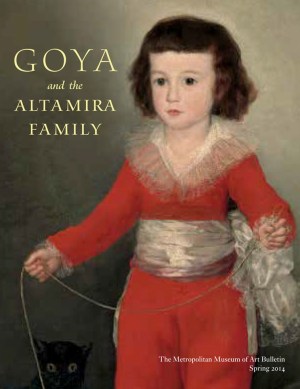 Ever since its arrival at the Metropolitan as part of the outstanding collection of Old Master paintings bequeathed by New York financier and philanthropist Jules Bache, Goya’s portrait of Don Manuel Osorio, the three- or four-year-old son of the conde de Altamira, has ranked as one of the museum’s most popular paintings. In celebration of the reinstallation of the Metropolitan’s European Paintings galleries, inaugurated last May, the condesa de Altamira and her son have been temporarily reunited in a gallery devoted to Goya and his contemporaries in Spain. But from the outset this move was planned as just the first stage of a more eventful family reunion that would also include Don Manuel’s older brother, Vicente Osorio, and their father, Vicente Joaquín Osorio de Moscoso y Guzmán, conde de Altamira: all four pictures outstanding works by Goya.
The publication is made possible through the generosity of the Lila Acheson Wallace Fund for The Metropolitan Museum of Art, established by the cofounder of Reader’s Digest.
New Book | Spanish Drawings in the Princeton University Art Museum
This critical catalogue of Princeton’s Spanish drawings was reviewed by Zahira Véliz Bomford for The Burlington Magazine 156 (April 2014): 244–45. From Yale UP:
Lisa A. Banner with contributions by Jonathan Brown, Robert S. Lubar, and Pierre Rosenberg, Spanish Drawings in the Princeton University Art Museum (New Haven: Yale University Press, 2013), 192 pages, ISBN: 978-0300149319, $40.
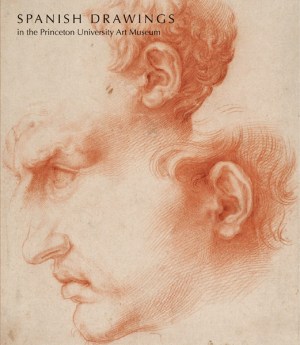 The Princeton University Art Museum’s collection of Spanish drawings includes masterworks by artists such as Jusepe de Ribera (1591–1652), Bartolomé Esteban Murillo (1617–1682), Francisco Goya (1746–1828), Pablo Picasso (1881–1973), and Salvador Dalí (1904–1989). Although many of the drawings in the collection relate to celebrated paintings, commissions, and other works by these artists, they remain largely unknown. Most have not been published previously and many are attributed here for the first time.
In Spanish Drawings in the Princeton University Art Museum, preeminent scholars enrich the growing corpus of work on Spanish drawings with original research. Each of the 95 drawings is reproduced in color, often accompanied by comparative illustrations. Watermarks have been documented with beta radiography and are included in an appendix. Provenances and
artist biographies round out this detailed record of one of the
most important collections of its kind.
Lisa A. Banner has written extensively on Spanish baroque art and has contributed to exhibition catalogues, symposia, and conferences throughout the world, most recently co-curating The Spanish Manner at The Frick Collection (2010–11).
New Book | The Colours of Rome
From The Old School Press:
John Sutcliffe, The Colours of Rome: An Examination of the Use of Colour on the Façades of Today’s Rome, with Historical and Other Notes, and a Selection of Colours Copied on Site (Bath: The Old School Press, 2013), 32 pages, ISBN: 978-1899933334 (standard edition), £185 / $350.
 John’s vision for this book was a survey of the city’s colourscape, a palette of colours so different from that of, say, Venice, Tuscany, or Palermo, and a palette that is today in a period of great change. His new essay traces the history of that palette and the influences that have led it to its state today.
To illustrate the essay John made several trips to Rome, returning finally with twenty sheets of colours copied directly from the buildings themselves. His carefully chosen selection is designed to demonstrate the diversity of the palette and also to draw together two very different strands of tradition that have created the appearance of the streets of Rome today. Each of the twenty colours is illustrated with a large painted patch applied directly onto its own sheet of Magnani wove using water-based paints. These sheets are loose in a wallet within the cased sleeve that holds the book, thus making it possible for the reader to explore the colours in different combinations just as they appear in Rome. A swatch card of chips of the twenty colours is also included in the wallet.

The wallet in the sleeve contains the paint-outs for the twenty colours that John Sutcliffe has chosen as representative of the colours of Rome. They are accompanied by a swatch card summarising the full set.
The text is printed in 14pt Dante on a large page of Magnani hand-made laid paper, with headings printed from wood-letter. The book is bound in full cloth and is protected by the sleeve inside which the wallet of paint patches is attached. In addition to the standard edition of ninety-nine copies there were twenty-five de luxe copies (ALL SOLD) that take the form of a solander box containing, as well as the standard edition book, bottled samples of nine of the most important pigments, mostly earths, in powdered form. The book is 323mm by 235mm (about 12.75 inches by 9.25 inches); the solander box is slightly larger and 92mm deep (3.75 inches). The price is £185 (euro235, US$350) for a standard copy (and was £350 (euro435, US$580) for a de luxe copy). Trade discount is one quarter. Postage and packing are charged as usual at cost.
If you know our books you will know we love colour, so this was a project that appealed from the outset. If Rome, architecture, and the way our cities change interest you, this book will appeal, and we hope that the production qualities will enhance your enjoyment. Uniquely, it is the only record of the most characteristic colours to be seen in Rome today, perhaps the only such survey of any city.
John Sutcliffe knows about colour. A former regional curator at the National Trust and now active as a decorative painter, his expertise in the topic, in particular in an architectural setting, was extensively used by Farrow & Ball, a company that will surely be known to many, at the time when they were first building up their reputation for traditional paints and hand-produced wallpapers. For many years John’s interest in colour has taken him to the Mediterranean, to Italy, and in particular to Rome. The buildings of Rome’s centro storico carry on their walls many layers of coloured limewash and distemper, layers that have both accumulated and decayed over time, thereby capturing the changing fashions in colour.
More information is available here»
◊ ◊ ◊ ◊ ◊
As described by Martin Gayford for The World of Interiors (May 2014), p. 50:
 [The book] is a work of decorative art in itself, elegantly printed and bound by a private press in a limited edition. . . . In the course of his investigations, Sutcliffe made a discovery. His initial assumption was that the shades he saw had been used since the days of ancient Rome. This turned out to be completely wrong. . . . Tastes in colour in the age of Michelangelo, Bernini, and the Grand Tour were all different, both from each other and from what can be seen today. In earlier centuries, Rome would have looked lighter and bluer. . . . The dramatically dark walls Sutcliffe loves date back only to the late 19th century and the Mussolini regime. In recent decades, these have begun to be replaced by a new fashion for ‘old colours’—that is, 17th- and 18th-century hues rediscovered by careful scraping of old paintwork. The colours of cities seem, like most things, to fluctuate through time.
David Watkin likewise praises the “beautifully produced book,” in his review for TLS, “Raw and Burnt,” (7 March 2014): 22.
New Book | Elihu Yale: Merchant, Collector & Patron
From Thames & Hudson:
Diana Scarisbrick and Benjamin Zucker, Elihu Yale: Merchant, Collector & Patron (London: Thames & Hudson, 2014), 288 pages, ISBN 978-0500517260, £25.
 There can be few educational institutions named after a man with the force of character, powers of leadership, business acumen, and variety of intellectual and spiritual interests of Elihu Yale. His career, which spans Puritan New England, Mughal India, and the London of the English Enlightenment, throws light on the religious, political, social, commercial, scientific, and cultural circumstances of the world of the later Stuarts and early Hanoverians.
Elihu Yale (1649–1721) is famous for the name of Yale University, of which he was an early benefactor. He made his fortune in India, trading in diamonds. Arriving there in 1672, he rose through the East India Company from clerk to governor. When he returned to London in 1699 he brought with him gems, furniture and textiles. In the milieu of portrait painter Sir Godfrey Kneller and physician Sir Hans Sloane he established a fashionable household where he had assembled some ten thousand items.
Yale’s collection was dispersed after his death and the catalogues of the sales survive, providing information about the 18th-century London art market. The Yale sales prove to be a landmark in the history both of collecting and of auctioneering. Analyses of the categories throw light on Yale’s personality and interests: he is revealed as a Fellow of the Royal Society, churchman and a philanthropist, totally in tune with the English Enlightenment.
The authors explore Yale’s life in Madras and London and his interests, including musical and scientific instruments and books, and then turn to Yale as a dealer and a collector of diamonds and jewelry and works of art. The story is one with many appeals: the East India Company and early 18th-century London; furniture, both Indian and English; the fashion for things Oriental in the West; gemstones and jewelry; and collecting works of art.
Diana Scarisbrick is a historian specializing in jewelry and engraved gems. She has curated exhibitions in the UK and abroad and has written many books, including Rings: Jewelry of Power, Love and Loyalty and Portrait Jewels: Opulence and Intimacy from the Medici to the Romanovs. She is a Research Associate at the Beazley Archive, Oxford, and recently collaborated with Professor Sir John Boardman on The Marlborough Gems.
Benjamin Zucker, a graduate of Yale University and Harvard Law School, is one of the world’s leading gem dealers, based in New York. He has written extensively on gemstones, coloured stones and the history of ring collecting
New Book | The Art of Professing in Bourbon Mexico
From the University of Texas Press:
James M. Córdova, The Art of Professing in Bourbon Mexico: Crowned-Nun Portraits and Reform in the Convent (Austin: University of Texas Press, 2014), 288 pages, ISBN: 978-0292753150, $55.
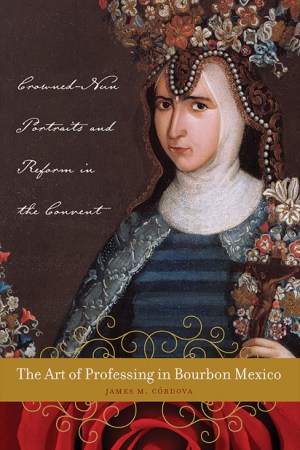 In the eighteenth century, New Spaniards (colonial Mexicans) so lauded their nuns that they developed a local tradition of visually opulent portraits, called monjas coronadas or ‘crowned nuns’, that picture their subjects in regal trappings at the moment of their religious profession and in death. This study identifies these portraits as markers of a vibrant and changing society that fused together indigenous and Euro-Christian traditions and ritual practices to construct a new and complex religious identity that was unique to New Spain.
To discover why crowned-nun portraits, and especially the profession portrait, were in such demand in New Spain, this book offers a pioneering interpretation of these works as significant visual contributions to a local counter-colonial discourse. James M. Córdova demonstrates that the portraits were a response to the Spanish crown’s project to modify and modernize colonial society—a series of reforms instituted by the Bourbon monarchs that threatened many nuns’ religious identities in New Spain. His analysis of the portraits’ rhetorical devices, which visually combined Euro-Christian and Mesoamerican notions of the sacred, shows how they promoted local religious and cultural values as well as client-patron relations, all of which were under scrutiny by the colonial Church. Combining visual evidence from images of the ‘crowned nun’ with a discussion of the nuns’ actual roles in society, Córdova reveals that nuns found their greatest agency as Christ’s brides, a title through which they could, and did, challenge the Church’s authority when they found it intolerable.
James M. Córdova is Assistant Professor of Art History at the University of Colorado at Boulder, where he teaches pre-Columbian and colonial Latin American art.
◊ ◊ ◊ ◊ ◊
C O N T E N T S
Introduction
1. Women’s Religious Pathways in New Spain
2. New Spanish Portraiture and Portraits of Nuns
3. Euro-Christian Precedents in the Crowned-Nun Image
4. Indigenous Contributions to Convent Arts and Culture
5. The Profession Portrait in a Time of Crisis
6. Colonial Identity Rhetorics
Epilogue
Notes
Glossary
Bibliography
Exhibition | Lost Treasures of the Jewish Ghetto of Venice
Press release for the exhibition now on at the Winter Palace in Vienna:
Lost Treasures of the Jewish Ghetto / Schätze des Jüdischen Ghettos in Venedig
The Museum of Fine Arts, Houston, 21 February — 28 April 2013
Ca’ d’Oro, Venice, 1 June — 29 September 2013
Winter Palace, Vienna, 28 April — 6 July 2014

Torah Crown, 1796. Parcel-gilt silver
(Collection of the Comunità Ebraica di Venezia)
◊ ◊ ◊ ◊ ◊
In 2016, the Jewish Ghetto of Venice will celebrate its 500th anniversary. Venice was considered a hub of Jewish culture over the centuries, with its ghetto being home to a flourishing international Jewish community. In order to properly mark this anniversary, the international organisation Venetian Heritage, in cooperation with Maison Vhernier, has organised the temporary exhibition Treasures of the Jewish Ghetto of Venice, which is being presented at the Winter Palace from 28 April to 6 July 2014. Although created as a site of segregation, the Venice ghetto developed into a place of encounter for numerous groups of Jews from different countries and into an important source of inspiration for Jewish culture in many other regions around the globe. From 1516 to 1797—almost over three centuries—a community of various ethnical backgrounds (Germans, Italians, Jews from East and West) coexisted in Europe’s most tolerant town. In 1943, a number of precious objects were hidden by the Nazis. These valuables had then fallen into oblivion, until they were unearthed during the restoration of the Scola Spagnola several years ago. The show illustrates the richness and beauty of practiced Jewry until destroyed by National Socialism; it also keeps track of the conservation of the objects before they were stolen and their recent rediscovery.
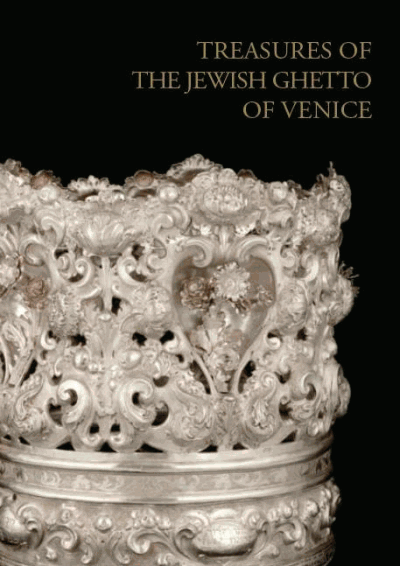 The decorative art objects created by Venetian artisans between the 17th and early 20th centuries belong to a heritage that vividly demonstrates how Venetian culture, with its wide ethnic spectrum and multicultural feel, provided a role model for the rest of Europe. The former Winter Palace of Prince Eugene, who was known for his open-mindedness and far-reaching interests, offers itself as an ideal exhibition venue. The cult objects, which were in a deplorable state when they were found and have now been restored to their former splendour, represent a small part of the collections of the Jewish Museum in Venice and impressively attest to the great significance of the Venetian art of goldsmithing.
Most of the silver and bronze objects on display were used in rituals in Venetian synagogues during mass and on special occasions and holidays. Such liturgical pieces include, for example, the wooden tikim (Torah cases) in which the Torah scrolls are kept when not in use, and the magnificent Thora crowns and pairs of rimmonim adorning the scrolls or the tikim. Hanging above each tik is a lamp called a ner tamid (eternal light) that illuminates the tik or a larger ark in a synagogue. Two spice containers, used in the Havdallah service at the closing of Sabbath to bring worshipers back to reality from the ecstasy of Sabbath, are also on view, along with two yads (pointers helping readers follow a text) used during services. Utensils associated with traditional dietary include, among other things, the jug and bowl for washing one’s hands before meals, and the two Seder plates that were used on the evening of the Seder.
When Italy was occupied by the Nazis in September 1943, these objects were hidden and only surfaced several years ago. Thanks to an initiative by Venetian Heritage and Maison Vhernier, it was possible to restore them and present them to the public. From now on, they will form the heart of the Museo Ebraico di Venezia, which will be reopened on the occasion of the 500th anniversary celebrations of the Venetian ghetto.
Venice in the 18th Century
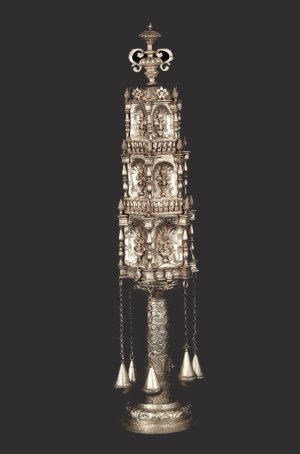
Rimmonim, Italian, silver, 48 x 10 cm, 1747 (Collection of the Comunità Ebraica di Venezia)
In 18th-century Venice, tourism became a booming branch of the economy. The charm of Venice depended not least on the cosmopolitan atmosphere of the town. Vedutists captured its enchanted atmosphere and sights, such as the church of Santa Maria della Salute, the Rialto Bridge, and the Doge’s Palace, their works serving as coveted souvenirs for visitors. The paintings were destined to be prominently installed in drawing rooms as status symbols proving that their owners were among those privileged citizens who could afford to undertake a Grand Tour through Italy.
The Jewish Ghetto of Venice
As Christians were not permitted to lend money to other Christians for interest, Jews played an important role in Venetian society as moneylenders, pawnbrokers, and merchants in second-hand articles. Whereas in earlier days Jews had only been allowed to stay in Venice for a maximum of 15 days a year, they were eventually allowed to settle in the town from 1509 on, if only under strict reservations. They were forbidden to openly practice their religion, purchase land, entertain sexual relationships with Christians, and wear ostentatious yellow or red hats. In 1516, the Senate of Venice declared the premises of a former foundry (geto) as a dwelling zone for Jews, arguing that Jews could impossibly be allowed to live in the city and move around freely. The ghetto was completely secluded: two gates were built that remained blocked for Jews during the dusk-to-dawn curfew. The area was extremely densely populated, with several thousand residents living on 2.4 hectares and five large synagogues accommodating various ethnic groups. In spite of these severe restrictions, Venice was considered one of the best places for Jews to live. In 1797, the Council of Venice handed the town over to Napoleon, and the gates to the Jewish ghetto were demolished to loud calls for freedom. The Jews of Venice were still years away from full equality, but they were no longer locked up in the ghetto.
Venetian Heritage
Venetian Heritage is an international non-profit organisation located in New York and Venice and is part of the UNESCO Private Committees Programme for the Safeguarding of Venice. Venetian Heritage supports cultural initiatives through restoration projects, exhibitions, publications, lectures, studies, and research programmes aimed at raising global awareness of the rich cultural heritage of the Veneto region in Italy and areas once belonging to the Republic of Venice, known as La Serenissima.
Catalogue: Agnes Husslein-Arco and Georg Muzicant, Treasures of the Jewish Ghetto of Venice (Vienna: Belvedere, 2014), 104 pages, ISBN 978-3902805454 (German/English/Italian), €19.










leave a comment