New Book | Livio Pestilli’s ‘Paolo de Matteis’
From Ashgate:
Livio Pestilli, Paolo de Matteis: Neapolitan Painting and Cultural History in Baroque Europe (Aldershote: Asghate, 2013), 502 pages, ISBN: 978-1409446200, $125.
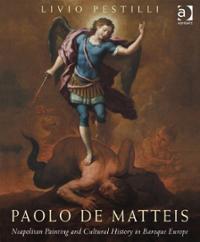 This volume represents a long overdue reassessment of the Neapolitan painter Paolo de Matteis (1662-1728), an artist largely overlooked in English language scholarly publications, but one who merits our attention for the quality of his work and the originality of its iconography, as well as for his remarkable ability to respond creatively to his patrons’ aesthetic ideals and agendas.
Following a meticulous examination of the ways in which posterity’s impression of de Matteis has been conditioned by a biased biographical and literary tradition, Livio Pestilli devotes rich, detailed analyses to the artist’s most significant paintings and drawings. More than just a novel approach to de Matteis and the Neapolitan Baroque, however, the book makes a significant contribution to the study and understanding of early eighteenth-century European art and cultural
history in general, not only in Naples but in other major European centers,
including Paris, Vienna, Genoa, and Rome.
Livio Pestilli is Director and Professor of Art History at Trinity College–Rome Campus.
C O N T E N T S
Introduction
Part I
Framing the Artist: A fabricated life
Enter the critic
Part II Paintings
‘Napoli nobilissima’
Circa 1700
Naples again
A Herculean feat
The celebratory self
Supporting authorship
The skill of a ‘Valentuomo’
Portraying Carthusian values
Campanian connections
The remains of the day
Part III Drawings
‘And truly Paolo was a great draftsman…’
Epilogue; Appendices; Index.
Exhibition | Mengs & Azara: Portrait of a Friendship
Press release (3 July 2013) from The Prado:
Mengs & Azara: Portrait of a Friendship / El Retrato de una Amistad
Museo Nacional del Prado, Madrid, 3 July — 13 October 2013
Curated by Stephen Schröder and Gudrun Maurer
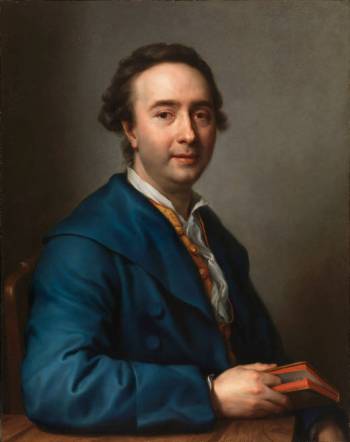
Rafael Mengs, José Nicolás de Azara, oil on panel, 77 x 61.5 cm, 1774 (Madrid, Museo Nacional del Prado)
To mark the Museum’s recent acquisition of one of Mengs’s finest portraits, his Portrait of José Nicolás de Azara, the Prado has recreated the friendship and close collaboration between the Neo-classical painter and his sitter, a leading exponent of the Spanish Enlightenment. This small exhibition, on display in Room 38 of the Villanueva Building until 13 October, consists of 24 works – paintings, sculptures, prints, medals and books – from the Museum’s own holdings or loaned from private collections. The addition of this work to the Prado’s collections will enrich the Museum’s holdings of 18th-century paintings and add to its group of portraits by Mengs.
The recent acquisition by the State and its entry into the Prado of the remarkable Portrait of José Nicolás de Azara, painted in 1774 by Anton Raphael Mengs, has led to the organisation of this small exhibition, which evokes the friendship and close collaboration that existed between the two men: Mengs, the
Neoclassical painter from Bohemia, and Azara, one of
the leading names of the Spanish Enlightenment.
Portrait of José Nicolás de Azara by Mengs
This intimate and strikingly simple image, painted in Florence in early 1774, is an outstanding example of Mengs’s particular classicism and is considered one of his finest portraits. It is also important due to the identity of the sitter, who was one of the most prominent representatives of the Spanish Enlightenment.
Mengs’s portrait conforms to the taste of the time in its use of a pure Neo-classical mode, of which the artist was one of the principal exponents. Azara is depicted with a sublime dignity and naturalness that suggest his intellectual integrity. He has none of the accessories normally used to evoke power and authority but is portrayed with a psychological depth that reveals his character. Particularly striking is his lyrical expression, with its slight smile conveyed through the “gentle movement of the mouth and eyes” that Azara considered the Ancient Greeks to have used to represent the movements of the soul. His expression transmits his friendship with Mengs, his sensibility and his passion for literature. The latter is also indicated by the book that he holds, which he momentarily sets aside in order to focus on the artist with a spontaneity of the kind newly fashionable in 18th-century portraits.
The Exhibition
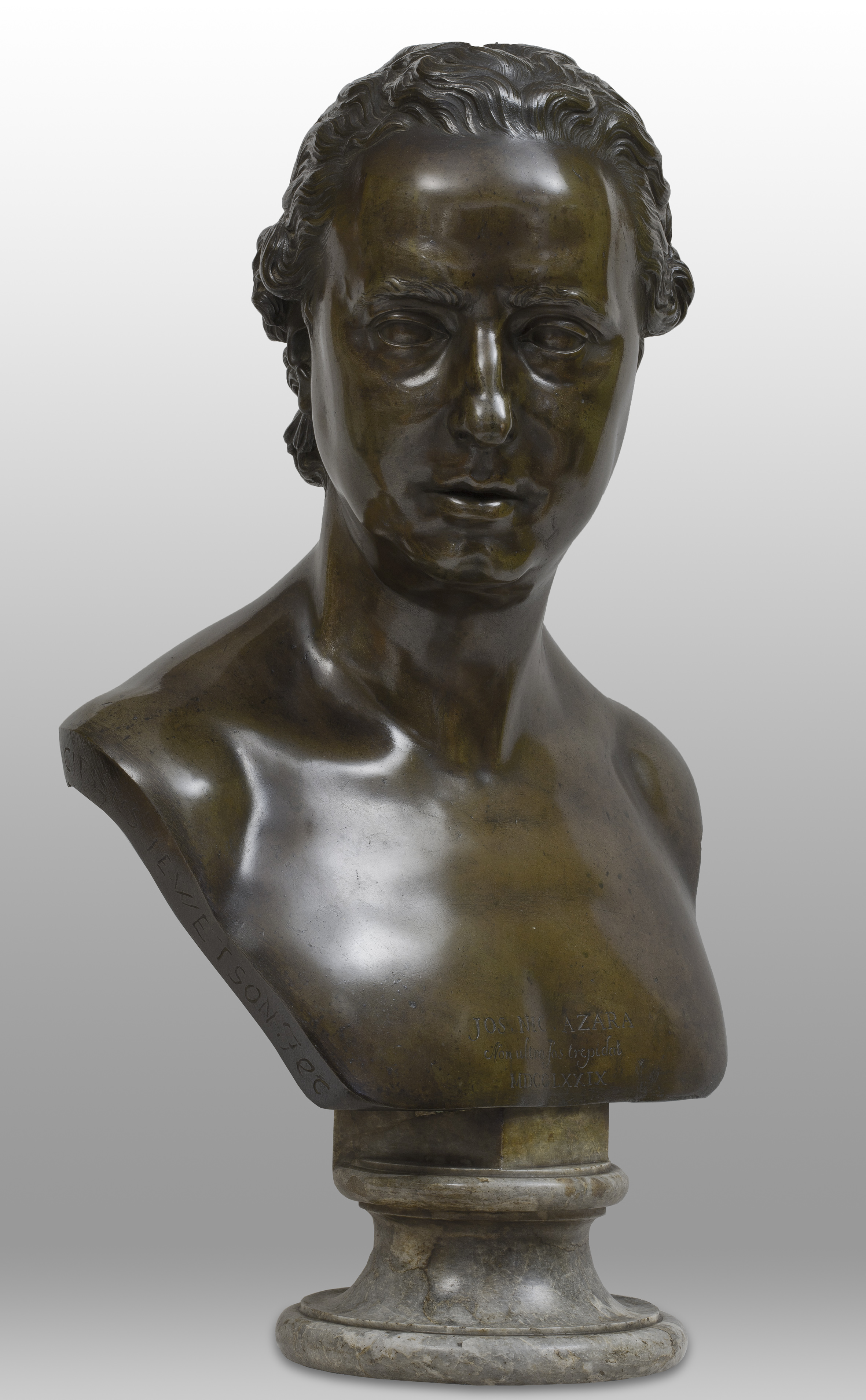
Christopher Hewetson, José Nicolás de Azara, bronze, 52 x 39 x 29 cm, 1779 (Private collection)
The exhibition focuses on the friendship between Mengs and Azara, the affinities between their aesthetic ideas and their close artistic collaboration. It also looks at the way they were depicted in portraits, Azara’s collecting activities, and his role in the promotion and dissemination of Mengs’s works.
In addition to the recently acquired painting, other eloquent proofs of the friendship between the artist and his patron are the two bronze busts of Azara and Mengs of 1779 by the Irish sculptor Christopher Hewetson. The exhibition also includes a Self-portrait by Mengs (ca.1761–1765) dating from the time he first met Azara and their collaboration on the production of a medal to commemorate the marriage of the Prince and Princess of Asturias, which is also on display. Another later Self-portrait of around 1774–1776 was the primary model for the dissemination of the artist’s image in Spain. It is present here through a copy in pastel by Mengs’s daughter, Ana María, and a print after it by Ana María’s husband, Manuel Salvador Carmona.
As examples of the affinity between the two men’s aesthetic ideas, the exhibition includes a drawing by Mengs of the classical sculpture of Antinous as Osiris (original in the Vatican Museums), and a print after a drawing by Mengs of one of the mural paintings in the
Villa Negroni.

Christopher Hewetson, Anton Raphael Mengs, bronze, 51 x 38 x 26 cm, 1779 (Madrid, Museo Nacional de Artes Decorativas)
In 1779 Azara initiated an excavation project in Tivoli near Rome. Following the discovery of fifteen portraits of Greek philosophers and poets and other small sculptures in the so-called Villa dei Pisoni, Azara began to collect classical portraits and sculptures, possessing around 70 examples by the end of his life. His collection, which is now divided between the Real Casa del Labrador in Aranjuez and the Museo del Prado, is represented here by sculpted portraits of the poets Homer and Menander, the Epicurian philosopher Hermarcus and the Attic general Miltiades, in addition to a statue of a Dacian from Trajan’s Forum in Rome and one of Fortuna.
Also on display is a copy of the Life of Cicero by Conyers Middleton, edited and translated by Azara and illustrated with prints of sculptures from his own collection. Azara’s role in protecting and disseminating Mengs’s artistic legacy is conveyed in the exhibition through a print of his portrait by Mengs, engraved by Domenico Cunego; a commemorative medal of the “philosopher painter” by Caspar Joseph Schwendimann, in which Azara included his own image; Las Obras de D. Antonio Rafael Mengs, edited and with commentaries by Azara, published in Parma and Madrid in 1780; and the first biography of the artist written in 1780 by Ludovico Bianconi and illustrated with a print relating to Azara’s homage to Mengs after his death when he installed a bust of him by Hewetson in the Pantheon in Rome.
Finally, Azara’s friendship with Napoleon arising from his diplomatic mission of 1796 is documented through two works: a commemorative gold medal issued that year by the Senate in Rome in honour of Azara and his negotiation of the Armistice of Bologna; and a medal with a portrait of Napoleon that commemorates the Peace of Amiens, which Azara signed in 1802 as the representative of the Spanish monarch.
Stephen Schröder and Gudrun Maurer, Mengs & Azara: El Retrato de una Amistad (Madrid: Museo Nacional del Prado, 2013), 48 pages, ISBN: 978-8484802648, 10€.
The exhibition is accompanied by an essay-catalogue written by the curators, Stephen Schröder, Head of the Department of Classical and Renaissance Sculpture, and Gudrun Maurer, Curator in the Department of 18th-century Spanish Painting and Goya, both at the Museo del Prado.
Azara and Mengs
The relationship between the two men yielded its first artistic results in 1765 when Azara requested the collaboration of Mengs in the design of a medal to commemorate the marriage of the Prince and Princess of Asturias.
José Nicolás de Azara (Barbuñales, 1730 – Paris, 1804) became widely known in Spain from the time of his first appointment as a civil servant in the Government Office in 1760. He subsequently achieved international renown through his diplomatic post in Rome, where he remained for more than thirty years, followed by Paris from 1798 to 1803 as Spanish ambassador at a delicate period in the last decade of the 18th century and early years of the following century. Among Azara’s numerous friendships with leading cultural and political figures were those with Winckelmann, the theoretician of classical art, the famous typographer Bodoni, Pope Pius VI and politicians such as Godoy in Spain and Napoleon and Talleyrand in France.
Anton Raphael Mengs (Aussig, 1728 – Rome, 1779) initially trained with his father Ismael Mengs in Dresden then went to Italy to study the works of the Italian masters including Raphael, Michelangelo, Carlo Maratti, Correggio, the Carracci, and Titian. In 1751 he was appointed painter to the privy chamber by the Elector of Saxony, Frederick August II. During his time in Rome from 1752 to 1761, where he met the German archaeologist Johann Joachim Winckelmann, Mengs evolved the theories that formed the basis of his writings on ideal beauty and the recovery of the perfection of art through the study of the great models of the ideale classico. After painting the fresco of the Parnassus in the Villa Albani, which can be considered the embodiment of Neo-classical art, Mengs was summoned to Madrid by Charles III, the Elector of Saxony’s son-in-law, to supervise the decoration of the Royal Palace.
Appointed painter to the privy chamber in 1766, he introduced the new artistic trends into Spain and supported Spanish painters such as Maella, the Bayeu brothers and Goya. Due to poor health, Mengs returned to Rome in 1769. As a commission from Charles III, in 1770 in Florence he painted the portraits of the families of the Grand Dukes of Tuscany (Museo Nacional del Prado), at which point he made plaster casts of the most important classical and Renaissance sculptures in their collection, which he used for teaching purposes. In Rome the artist was appointed director of the Academy of Saint Luke and received important commissions for paintings for the Museo Clementino and the basilica of Saint Peter’s. Having returned to Madrid in 1774 he went to Rome again in 1776, where he died of tuberculosis in 1779. Mengs’s output encompasses history paintings, religious works, frescoes on religious, mythological and allegorical subjects, and an important group of portraits.
A checklist of the 24 works on display is available at the end of the press release.
The Slave Owner, the Cook, His Sister, and Her Lover
Published last September, Craughwell’s book underscores Jefferson’s complicated attitudes and debts to slavery. On, this, the day of the United State’s birth and Jefferson’s death, that strikes me as useful. It’s certainly fascinating to see the American introduction of macaroni and cheese as part of a trans-Atlantic story involving both Europe and Africa. Happy Independence Day. –CH
◊ ◊ ◊ ◊ ◊
From Quirk Books:
Thomas J. Craughwell, Thomas Jefferson’s Crème Brûlée: How a Founding Father and His Slave James Hemings Introduced French Cuisine to America (Philadelphia: Quirk Books, 2012), 256 pages, ISBN: 978-1594745782, $20.
 This culinary biography recounts the 1784 deal that Thomas Jefferson struck with his slaves, James Hemings [brother of Sally Hemings]. The founding father was traveling to Paris and wanted to bring James along “for a particular purpose”— to master the art of French cooking. In exchange for James’s cooperation, Jefferson would grant his freedom.
Thus began one of the strangest partnerships in United States history. As Hemings apprenticed under master French chefs, Jefferson studied the cultivation of French crops (especially grapes for winemaking) so the might be replicated in American agriculture. The two men returned home with such marvels as pasta, French fries, Champagne, macaroni and cheese, crème brûlée, and a host of other treats. This narrative history tells the story of their remarkable adventure—and even includes a few of their favorite recipes.
Abram Barkshian reviewed the book for The Wall Street Journal (14 September 2012).
New Book | Men from the Ministry: How Britain Saved Its Heritage
Available in August from Yale UP:
Simon Thurley, Men from the Ministry: How Britain Saved Its Heritage (New Haven: Yale University Press, 2013), 224 pages, ISBN: 978-0300195729, $45.
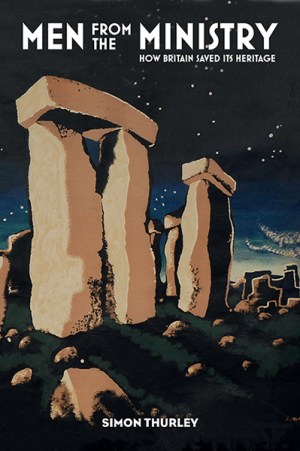 Between 1900 and 1950 the British state amassed a huge collection of over 800 historic buildings, monuments, and sites and opened them to the public. This engaging book explains why the extraordinary collecting frenzy took place, locating it in the fragile and nostalgic atmosphere of the interwar years, dominated by neo-romanticism and cultural protectionism. The government’s activities were mirrored by the establishment of dozens of voluntary bodies, including the Council for the Protection of Rural England, the Society for the Protection of Ancient Buildings, and the National Trust. Men from the Ministry sets all this activity, for the first time, in its political, economic and cultural contexts, painting a picture of a country traumatized by war, fearful of losing what was left of its history, and a government that actively set out to protect them. It dissects a government program that established a modern state on deep historical and rural roots.
Simon Thurley is the Chief Executive of English Heritage. He was formerly the Director of the Museum of London, and the Curator of Historic Royal Palaces.
New Book | Speaking Ruins: Piranesi, Architects, and Antiquity
From the University of Michigan Press:
John A. Pinto, Speaking Ruins: Piranesi, Architects, and Antiquity in Eighteenth-Century Rome (Ann Arbor: University of Michigan Press, 2012), 352 pages, ISBN: 978-0472118212, $65.
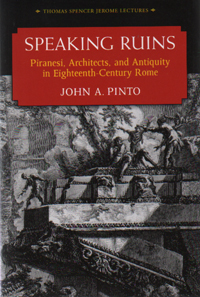 As they had during the Renaissance, ruins in the eighteenth century continued to serve as places of exchange between antiquity and modern times and between one architect and another. Rome functioned as a cultural entrepôt, drawing to it architects of the caliber of Filippo Juvarra, Robert Adam, Charles-Louis Clérisseau, and Giovanni Battista Piranesi. Through their collaboration, on-site exchanges, publications, and polemics, architects contributed notably to fashioning a more critical and sophisticated view of the material heritage of classical antiquity, one that we associate with the Enlightenment and the origins of modern archaeology. In this lavishly illustrated volume stemming from his Thomas Spencer Jerome Lectures at the University of Michigan and the American Academy in Rome, distinguished architectural historian John A. Pinto traces an extraordinary path through the development of European architecture. This period saw the transformation of history and archaeology. Texts were treated more skeptically as scholars placed greater reliance on artifacts as sources of information, and architects such as Giovanni Battista Piranesi increasingly played a crucial role in the recording and visual presentation of ancient art and architecture.
Piranesi and other eighteenth-century architects active in Rome explored the full creative potential of ancient architecture, its dual metaphorical function as both palimpsest and template. Their responses to the ruins of Rome, as well as other parts of the classical world, created a significant body of historical knowledge, but also propelled them to create new and dazzling designs, such as the Trevi Fountain, Santa Maria del Priorato, and Syon House. Their elaborate study and accurate renderings of ancient sites enriched contemporary understanding of the material heritage of classical antiquity; their informed conjectures and flights of fancy gave it wings. Their encounters on sites such as Hadrian’s Villa and Pompeii, where the ruins spoke with great eloquence, greatly enriched the architectural discourse of the Enlightenment. Speaking Ruins emphasizes the close relationship between the intensifying archaeological explorations in this period especially in Rome and vicinity, but also in Greece and the Levant, and the development of post-Baroque styles in architecture, shading gradually into romanticism and neoclassicism.
Speaking Ruins is an investigation of the legacy of classical antiquity. As a study of the classical tradition, it should be of particular interest to classicists and archaeologists, while its argument that eighteenth-century Rome provided a crucible for the developing disciplines of archaeology and art history will engage the interest of a wide range of humanistic scholars. Speaking Ruins tells a fascinating story, with Piranesi and his works centrally involved.
Jacket image: G. B. Piranesi, Fragments of the Temple of the Sun on the Quirinal, from Campus Martius (1762), courtesy of the Department of Rare Books and Special Collections, Princeton University Library.
Exhibition | Anton Graff: Faces of an Era
The exhibition opened last weekend on the two-hundredth anniversary of the artist’s death (22 June 1813). From the Museum Oskar Reinhart:
Anton Graff: Gesichter einer Epoche
Museum Oskar Reinhart, Winterthur, 22 June — 29 September 2013
National Gallery in Berlin, 25 October 2013 — 23 February 2014
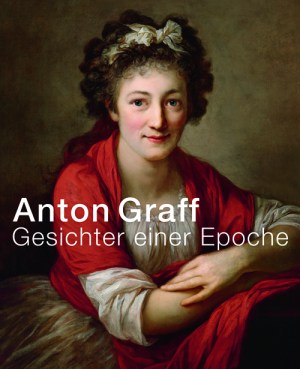 Anton Graff, who was born in Winterthur, was the most important portrait painter in the German-speaking world around 1800. He influenced the image of the bourgeoisie and nobility and the image of poets and thinkers on the brink of Modernism like no other. When he died in 1813, he left behind around 1800 portraits depicting a panorama of transitioning European society.
In celebration of the 200th anniversary of his death, the Museum Oskar Reinhart in Winterthur and the National Gallery in Berlin are honouring the work of Anton Graff in a comprehensive exhibition for the first time in 50 years. After a first stop at the Museum Oskar Reinhart from 22 June to 29 September 2013, the exhibition will be able to be seen in the National Gallery in Berlin between 25 October 2013 and 23 February 2014. The exhibition and the richly illustrated catalogue, which will be published by the Munich-based Hirmer Publishers, came about thanks to the cooperation of both institutions.
Marc Fehlmann and Birgit Verwiebe, eds., Anton Graff: Gesichter einer Epoche (Munich: Hirmer Publishers, 2013), 336 pages, ISBN: 978-3777420509, 40€.
◊ ◊ ◊ ◊ ◊
From Berlin’s Alte Nationalgalerie:
Bis in das Innere der Seele“ zu schauen, darin bestand, den Worten des Philosophen Johann Georg Sulzer zufolge, die Meisterschaft des großen Porträtisten Anton Graff. Der überaus produktive Künstler zählt zu den herausragenden Bildnismalern des späten 18. und frühen 19. Jahrhunderts. Sein größtes Verdienst war, die Berühmtheiten seiner Epoche zu porträtieren. Ihm ist das Panorama des deutschen Geistes zu danken, das die Bildnisse der bedeutendsten Dichter und Denker umfasst, wie etwa Lessing, Nicolai, Mendelssohn, Sulzer, Wieland, Gellert, Herder und Schiller.
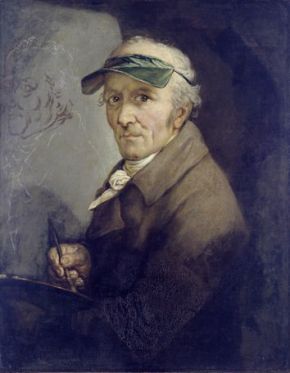
Anton Graff, Self-portrait with the Green Eye-shade, 1813 (Staatliche Museen zu Berlin, Nationalgalerie)
Graff wurde 1736 in Winterthur geboren und nahm dort seinen ersten Kunstunterricht. In Augsburg, Ansbach und Regensburg bildete er sich weiter. 1766 – 30jährig – wurde er in Dresden kurfürstlich-sächsischer Hofmaler und Mitglied der Akademie. Regelmäßig führten ihn Reisen nach Berlin, Leipzig und in die Schweiz. Gegen Ende seines Lebens wurde Graff gleichsam zu einer Symbolfigur für den Kreis junger Romantiker in Dresden. 1813, mit 76 Jahren, starb der Maler.
Graff hat seine Zeitgenossen nicht im Gestus der Repräsentation festgehalten. Vielmehr lag ihm daran, das Wesen des Einzelnen auszuloten, seine Individualität zu entdecken, seine seelischen und geistigen Qualitäten wiederzugeben. Auch heute noch spricht die innere Gestimmtheit der aufgeklärten geistigen Elite in Deutschland unmittelbar aus Graffs meisterhaften Werken. Mit Bildnissen von Königen und Fürsten, vom aufstrebenden Bürgertum, von Staatsmännern, Gelehrten, Künstlern, Kaufleuten, Geistlichen schuf er eine Galerie der deutschen Gesellschaft an der Schwelle zur Moderne.
Ein halbes Jahrhundert hat es keine Ausstellung zum Werk Graffs gegeben. Nun, anlässlich des 200. Todestages, wird sein Werk wieder umfassend präsentiert.
Die Retrospektive „Anton Graff. Gesichter einer Epoche“ entstand in Kooperation mit dem Museum Oskar Reinhart, Winterthur. Dort sind rund 80 Werke vom 22. Juni bis 29. September 2013 zu sehen. In der Alten Nationalgalerie Berlin wird die Ausstellung anschließend in erweiterter Form mit rund 140 Werken vom 25. Oktober 2013 bis 23. Februar 2014 gezeigt.
New Book | Funerary Sculpture in St Patrick’s Cathedral, Armagh
From the author’s website:
James Stevens Curl, Funerary Monuments and Memorials in St Patrick’s Cathedral, Armagh (Whitstable: Historical Publications, 2013), 164 pages, ISBN: 978-1905286492, £40 (hardcover) / ISBN: 978-1905286485, £20 (softcover) — ordering information is available here»
 The funerary monuments and memorials in the Church of Ireland (Anglican) Cathedral Church of St Patrick, Armagh, include fine works by celebrated sculptors including Bacon, Chantrey, Farrell, Marochetti, Nollekens, Roubiliac, Rysbrack, and others, yet are not widely known.
Professor Stevens Curl’s comprehensively illustrated book describes and shows all of them, as well as giving details of the artists and their subjects, thereby filling an unaccountable gap in the literature. It is published in two versions; a hardback, limited edition of only 250 numbered signed copies with dust-jacket at £40, and a softback edition at £20 per copy.
James Stevens Curl has held Chairs in Architectural History at two Universities. He is Professor of Architecture at the School of Architecture and Design, University of Ulster. He read for his Doctorate at University College London, and in 1991-2 and 2002 was Visiting Fellow at Peterhouse, University of Cambridge.
New Book | Les Biscuits de Porcelaine de Paris
Available from Artbooks.com:
Régine de Plinval de Guillebon, Les Biscuits de porcelaine de Paris : XVIIIe-XIXe siècles (Dijon: Faton, 2012), 331 pages, ISBN: 978-2878441628, 68€ / $125.
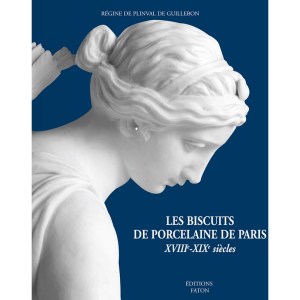 Aux biscuits de porcelaine de Paris sont souvent associés de grands noms de porcelainiers, tels Guérhard, Dihl, Gille jeune, Desprez et Nast. Pendules spectaculaires, statues gigantesques, ou bustes à taille humaine, ces figures ou groupes en porcelaine non émaillée sont pourtant assez méconnus ; on les imagine blancs, mais ils peuvent être bleus, noirs, polychromes ou dorés. Le biscuit parisien est de tout son temps très prisé par des amateurs aussi prestigieux que George Washington et le prince-régent d’Angleterre.
Après une présentation des origines de la porcelaine et des techniques de fabrication, Régine de Plinval de Guillebon nous entraîne au cœur de la vie mouvementée de 31 manufactures des XVIIIe et XIXe siècles, s’intéressant de près au travail des ouvriers, des artistes et des investisseurs, ainsi qu’au contexte économique général. Une analyse approfondie des formes, des couleurs, ainsi que de l’association du biscuit avec le bronze, l’orfèvrerie et le cristal, permet d’envisager l’évolution du style des biscuits, dont deux cents illustrent cet ouvrage. Un catalogue raisonné des manufactures parisiennes vient compléter cette remarquable étude.
Enfilade Turns Four! Buy an Art Book!
To celebrate Enfilade’s fourth birthday (22 June), I’m encouraging readers to participate in the second annual Buy-an-Art-Book Day! This year I’m happy to announce a special, one-day discount from Ashgate. Many thanks for the kind support. — Craig Hanson

 At Ashgate or Lund Humphries, use the promotion code 287Y for a 20% discount on Saturday, June 22. The offer should work internationally, though please bear in mind U.S. timezones.
New Book | Architecture and Statecraft: Charles of Bourbon’s Naples
From Penn State University Press:
Robin L. Thomas, Architecture and Statecraft: Charles of Bourbon’s Naples, 1734–1759 (University Park: Penn State University Press, 2013), 248 pages, ISBN: 978-0271056395, $90.
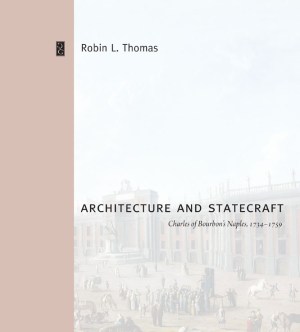 The eighteenth century was a golden age of public building. Governments constructed theaters, museums, hospices, asylums, and marketplaces to forge a new type of city, one that is recognizably modern. Yet the dawn of this urban development remains obscure. In Architecture and Statecraft, Robin Thomas seeks to explain the origins of the modern capital by examining one of the earliest of these transformed cities. In 1737 King Charles Bourbon of Spain embarked upon the most extensive architectural and urban program of the entire century. A comprehensive study of these Neapolitan buildings does not exist, and thus Caroline contributions to this new type of city remain undervalued. This book fills an important gap in the scholarship and connects Charles’s urban improvements to his consolidation of the monarchy. By intertwining architecture and sovereignty, Thomas provides a framework for understanding
how politics created the eighteenth-century capital.
Robin L. Thomas is Assistant Professor of Art History at The
Pennsylvania State University. (more…)










 Enfilade
leave a comment