Reviewed | Extravagant Inventions
Recently added to caa.reviews:
Wolfram Koeppe, Extravagant Inventions: The Princely Furniture of the Roentgens (New York: Metropolitan Museum of Art, 2012), 304 pages, ISBN: 978-0300185027, $75.
Reviewed by Michael Yonan; Department of Art History & Archaeology, University of Missouri; posted 6 June 2013.
Once in a while an exhibition comes along that achieves many things. It illuminates past and present, and does so by creating a viewing experience both beautiful and instructive. All the better when such an exhibition also brightens up a blind spot in the history of art. The exhibition at the Metropolitan Museum of Art entitled ‘Extravagant Inventions: The Princely Furniture of the Roentgens’ achieved this. Curated by Wolfram Koeppe, Maria Kellen French Curator of European Decorative Arts, the show was a monographic investigation of father-and-son furniture makers Abraham (1711–1793) and David Roentgen (1743–1807), whose workshop in the German town of Neuwied produced furniture for the European elite between 1743 and 1800. By my estimation this was the decorative arts show of the decade, an educationally illuminating and utterly enjoyable museum experience whose rewards far
exceeded, in the words of a colleague of mine, the
opportunity to look at ‘old desks’. . . .
The full review is available here» (CAA membership required)
Exhibition and Book | The Art of Living, Augsburg ca. 1780
The June 2013 issue of The World of Interiors features a remarkable album from the 1780s, believed to the the work of Balthasar Cornelius Koch. It was the subject of a 2010-11 exhibition in Augsburg; the catalogue is available in German.
◊ ◊ ◊ ◊ ◊
Michael Huey, “A Cabinet Curiosity,” The World of Interiors (June 2013): 150-57. The stuff of life, c1780, is laid bare in a handmade album documenting the décor and possessions of a prosperous goldsmith, and his family of servants, in 18th-century Augsburg. From watercolour to scraps of fabric, the enchanting tour, from pantry to salon, literally opens the doors on inner courtyards and armouries. The June issue of The World of Interiors uncovers shoes, nightcaps and lace — but no skeletons — in the closets.
. . . Part pen/ink and watercolour, part découpage (it incorporates copperplate engravings), part scrapbook (it also uses real historical fabrics and papers) and, in a sense, part diary, it records the everyday functions of the rooms of the house in full colour and significant detail. Included are a dining room; five salons (chose from green, white, ladies’, music and tea); five bedrooms (including those for the maids, the maternity room and one for a child); and five public or service spaces (halls, kitchen, pantry), with all their particular floorings, textiles, furnishings and other accoutrements. . . (156).

◊ ◊ ◊ ◊ ◊
From the museum’s website:
Die Kunst zu Wohnen: Ein Augsburger Klebealbum des 18. Jahrhunderts
Deutsche Barockgalerie im Schaezlerpalais, Augsburg, 24 November 2010 — 20 February 2011
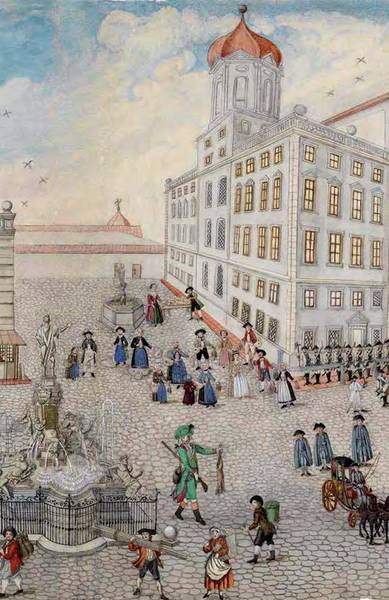 Augsburg war seit dem 16. Jahrhundert nicht nur eine Hochburg für den Buchdruck und die grafischeProduktion, hier entstanden ebenfalls sogenannte “Klebealben”. Diese wurden angelegt, um Kindern und Heranwachsenden aus bürgerlichen Familien die Welt zu erklären.
Die Jugendlichen schnitten aus eigens zu diesem Zweck herausgegebenen Bögen historische oder biblische Figuren, Tiere oderberühmte Bauwerke aus und klebten sie in gedruckte Vorlagen ein. Auch andere Druckgrafiken, Buntpapiere oder sogar Stoffe wurden zerschnitten und in die Klebealben eingefügt.
Das hier ausgestellte Klebealbum wurde nach 1780 für die Juwelierstochter Regina Barbara Waltherangelegt. Teile des Albums wie gezeichnete und kolorierte Figuren und Raumsituationen wurdenvermutlich bei dem Zimmerpolier Balthasar Cornelius Koch in Auftrag gegeben. Auf den Seiten blieb aber genügend Platz, so dass Regina Barbara selbst Figuren ausschneiden und einkleben konnte. Das Album stellt “die Kunst zu Wohnen” vor und verschafft den Betrachtern so bis heute einen Einblick in das Leben des Augsburger Bürgertums im
18. Jahrhundert. . .
More from the museum’s website»
◊ ◊ ◊ ◊ ◊
From the publisher:
Georg Haindl, Die Kunst zu Wohnen: Ein Augsburger Klebealbum des 18. Jahrhunderts (Berlin: Deutscher Kunstverlag, 2010), 240 pages, ISBN: 978-3422070400, 40€.
 Als beliebte Alternativen zu den Puppenhäusern wurden in Augsburg als wichtiger Verlagsstadt des 18. Jahrhunderts so genannte „Klebealben” von liebenden Eltern für ihre Kinder angelegt. Sie zeigen neben zentralen Plätzen Augsburgs auch die Räume idealtypischer Bürgerhäuser, in die ausgeschnittene Darstellungen von Figuren, Möbeln oder Geschirren eingeklebt werden konnten. Als Ressource hierfür dienten nicht nur die Augsburger „Ausschneidebögen”, wie sie von den Verlagen Johann Martin Wills oder Martin Engelbrechts extra für diesen Zweck herausgegeben wurden, sondern auch Modejournale, Buntpapiere, Textilien oder alte Bücher, die zerschnitten wurden.
In der Publikation widmen sich mehrere Autoren einem besonders qualitätsvollen und gut erhaltenen Album, bei dem nicht Kinder, sondern Heranwachsende die Adressaten waren, um ihnen einen perfekt funktionierenden Haushalt vor Augen zu führen. Das Album wurde in den 1780er Jahren vermutlich von dem Zimmerpolier Balthasar Kornelius Koch gefertigt und zeigt durch seine additive Darstellungsweise wichtige Aspekte des bürgerlichen Lebens dieser Zeit in Augsburg – eine unschätzbare kulturhistorische Quelle.
New Book | Gainsborough’s Cottage Doors
From Paul Holberton:
Hugh Belsey, Gainsborough’s Cottage Doors: An Insight into the Artist’s Last Decade (London: Paul Holberton, 2013), 120 pages, ISBN: 978-1907372506, £25 / $40.
 The work of Thomas Gainsborough is characterized by a series of subjects that preoccupied him, which with time he was able to hone and define more clearly. Inspired by the recent identification of a third autograph version of his masterpiece The Cottage Door, this book examines the significance of the multiple versions of designs that the artist produced during the 1780s. It demonstrates that without the pressure of exhibiting his work annually at the Academy and without a string of sitters waiting for their finished portraits, Gainsborough’s work became more personal, more thoughtful and searching.
A study of his unconventional background, training and early development as an artist provides some clues as to why Gainsborough came to use painting in this very personal way. It was not until the 1780s, however, that his creative energies really changed in this direction. He had never been happy with the constraints of the Royal Academy and he was at odds with the dictatorial opinions promoted by its president, Sir Joshua Reynolds. In removing himself from the Academy he cast off the shackles of producing paintings, competitive in their design and colouring, which inhibited the artist’s natural goals of likeness, subtlety and balanced tonality. He could now be choosey about the commissions he accepted, paint for his own pleasure and satisfy his own curiosity. He began to turn to portrait compositions that he had developed and refined over a number of years. With subtle alterations they could be made suitable for a variety of sitters. The margin between ‘fancy’ pictures and portraits became blurred and the categorization of some of these paintings changed while they were on the easel. Always finding composition difficult, rather than begin something new he often revisited earlier designs that had pleased him. He would paint them again and make slight changes of tone and emphasis that would radically change the concept and intention of the design.
Richly illustrated with beautiful new photography, this study of the last phase of the artist’s work is a totally fresh interpretation of not only the Cottage Door theme, which Gainsborough revisited over nearly 20 years, but other key late works such as Mrs Sheridan and Diana and Acteon. The subject matter in some of these late work veers towards the autobiographical and provides an invaluable insight into the artist’s personality and his very worrying concerns.
Hugh Belsey is currently Senior Research Fellow at the Paul Mellon Centre for Studies in British Art with the task of writing the definitive catalogue of portraits by Thomas Gainsborough.
Exhibition | Revisiting The Cottage Door: Gainsborough’s Masterpiece
From The Huntington:
Revisiting The Cottage Door: Gainsborough’s Masterpiece in Focus
The Huntington Library, San Marino, 1 June — 2 December 2013
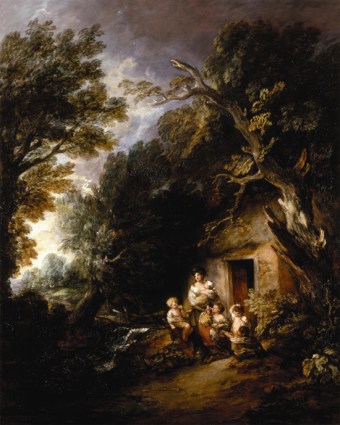
Thomas Gainsborough, The Cottage Door, ca. 1780
(San Marino: The Huntington)
The Cottage Door (ca. 1780), one of the treasures of The Huntington’s collections, is among Thomas Gainsborough’s most famous paintings. The idealized scene of rustic country life was exhibited at the Royal Academy in 1780, but both the subject and the composition continued to haunt the artist, and he repeated the design twice during the course of the decade. All three paintings are shown together for the first time in this special display, providing a unique opportunity to compare the subtle differences among them. Both of the later versions, on loan from private collections, are less finished than The Huntington’s canvas, and there are variations in tone and detail that give each a particular mood and a different emphasis.
A new book by Gainsborough specialist Hugh Belsey, Gainsborough’s Cottage Doors: An Insight into the Artist’s Last Decade, complements the installation. Inspired by the recent attribution of the third version, it examines how Gainsborough freed himself from the constraints of the Royal Academy and was able to make radical changes to his work during the last years of his
life.
New Book | Il Disegno nell’Europa del Settecento
Available from Artbooks.com:
Piera Giovanna Tordella, Il disegno nell’Europa del Settecento: Regioni teoriche ragioni critiche (Florence: Olschki, 2012), 284 pages, ISBN: 978-8822262332, $65.
 The book follows the theoretic and critical evolution of European drawing and of its complex configuration in the eighteenth century, with the aid of texts by German, French, English, Dutch and Italian authors. The theme is naturally variegated and connects the activity of intellectuals, philosophers, writers, poets, artists, connoisseurs and collectors. The scene is often animated by original interpreters that crossed conceptual and aesthetic horizons populated by acclaim and disapproval.
Exibition | Allan Ramsay: Portraits of the Enlightenment
From The Hunterian:
Allan Ramsay: Portraits of the Enlightenment
The Hunterian Art Gallery, Glasgow, 13 September 2013 — 5 January 2014
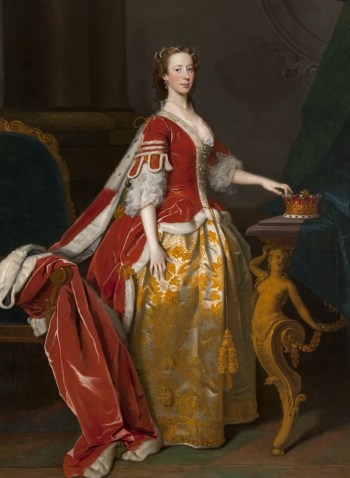
Allan Ramsay, Lady Anne Campbell, Countess of Strafford, 1743 (Glasgow: The Hunterian)
In 2013 The Hunterian will stage a major new exhibition dedicated to one of Britain’s most accomplished 18th-century painters. Allan Ramsay (1713-1784) is best known as a portrait painter whose elegant style set him apart from other portraitists of the time. Born in Edinburgh, his career took him from a small Scottish clientele to the Hanoverian court of King George III. Away from his studio, Ramsay was in close contact with a number of influential figures, and his published writing includes works on taste, politics and archaeology. The exhibition centres on a selection of portraits from across Ramsay’s thirty years as a painter and also features drawings, watercolours, published books, pamphlets, letters and other materials which demonstrate Ramsay’s fascinating place in the intellectual and cultural life of Edinburgh, London, Paris and Rome in the mid 18th century. The exhibition also includes key loans from UK public and private collections and new research, examining the intellectual context in which Ramsay painted a number of his most important portraits, including that of Hunterian founder Dr William Hunter.
◊ ◊ ◊ ◊ ◊
From ArtBooks.com:
Mungo Campbell, ed., Allan Ramsay: Portraits of the Enlightenment (New York: Prestel, 2013), 200 pages, ISBN: 978-3791348780, $60.
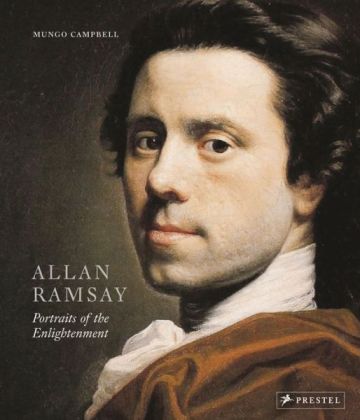 Allan Ramsay’s accomplished canvases and refined drawings offer us some of the defining portraits of the Enlightenment. He was as well equipped to offer a deep sense of engagement with his Enlightenment sitters through his intellectual and cultural upbringing as he was trained to create elegantly constructed paintings through his extended education as a painter in Italy. Establishing himself in London and Edinburgh, Ramsay was admired for his understanding of contemporary political, cultural, and intellectual issues, as well as for his portraits of key protagonists in these debates. This beautiful volume brings together Ramsay’s most celebrated sitters, such as Rousseau, Hume, and William Hunter, along with numerous drawings and prints to consider his critical role in the British Enlightenment. Many of the artist’s rarely seen portraits of women are included. Alongside exquisite reproductions, the volume presents fascinating new research exploring the unique sensitivity of Ramsay’s
painting, the development of his technique, and
familial influences on his work.
New Book | Delftware in the Fitzwilliam Museum
From Philip Wilson’s current catalogue:
Michael Archer, Delftware in the Fitzwilliam Museum (London: Philip Wilson Publishers, 2012), 464 pages, ISBN: 978-1781300022, £55 / $95.
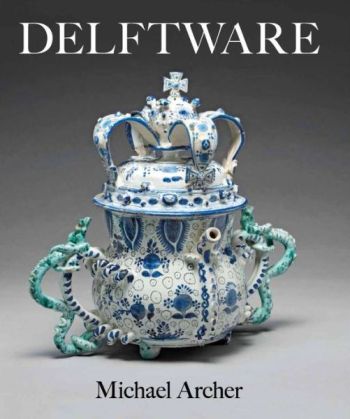 This complete catalogue of the English and Irish delftware in the Fitzwilliam Museum, Cambridge, reveals much that is beautiful and unusual. The greater part of the collection was bequeathed by Dr J.W.L. Glaisher in 1928, and much of it is little known. A detailed publication has long been overdue, and 588 items are illustrated here in colour, many with multiple views. The strength of Dr Glaisher’s collection is the English earthenware of the seventeenth and eighteenth centuries, particularly delftware: no better assemblage has ever been made by a single collector. He amassed objects with great academic rigour over a period of more than thirty years, concentrating particularly on dated pieces while always exercising a discriminating and aesthetical eye. Michael Archer’s catalogue provides details of date and place of manufacture, size, body, glaze, decoration and provenance with a full discussion where appropriate.
Julia Poole has contributed a fascinating chapter with much new material on Dr Glaisher’s life and the extraordinary breadth of his collecting interests. There is also a general introduction to delftware, including a description of the manufacturing process; further sections give indexes and exhaustive information on all the works. This book is an essential addition to the library of all scholars, collectors,auction rooms and dealers in the field and invaluable to those members of the public with an interest in the history of English pottery generally and delftware in particular.
Michael Archer, O.B.E, M.A., F.S.A. is a former Keeper of the Ceramics Department of the Victoria and Albert Museum where he becamethe acknowledged expert on English delftware. He has written numerous articles and books on ceramics, culminating in Delftware: The Tin-Glazed Earthenware of the British Isles, a catalogue of the collections inthe Victoria and Albert Museum, published in 1997.
New Book | The Diary of Constantijn Huygens
From Brill (with thanks to Hélène Bremer for noting it — chapter 7 addresses Huygens as an art connoisseur) . . .
Rudolf Dekker, Family, Culture, and Society in the Diary of Constantijn Huygens Jr, Secretary to Stadholder-King William of Orange (Leiden: Brill, 2013), 195 pages, ISBN: 978-9004250949. €98 / $136.
 Based on analysis of a diary kept by Constantijn Huygens Jr, the secretary to Stadholder-King William of Orange, this book proposes a new explanation for the invention of the modern, private diary in the 17th century. At the same time it sketches a panoramic view of Europe at the time of the Glorious Revolution and the Nine Years’ War, recorded by an eyewitness. The book includes chapters on such subjects as the changing perception of time, book collecting, Huygens’s role as connoisseur of art, belief in magic and witchcraft, and gossip and sexuality at the court of William and Mary. Finally this study shows how modern scientific ideas, developed by Huygens’s brother Christiaan Huygens, changed our way of looking at the world around us.
Rudolf Dekker taught history at Erasmus University Rotterdam and directs the Institute for the Study of Egodocuments and History, Amsterdam. He is the author of several books, including Humour in Dutch Culture of the Golden Age (Palgrave 2001). With Arianne Baggerman he wrote Child of the Enlightenment: Revolutionary Europe Reflected in a Boyhood Diary (Brill 2005).
New Book | Newton and the Netherlands
From The University of Chicago Press (with thanks to Hélène Bremer for noting it) . . .
Eric Jorink and Ad Maas, eds., Newton and the Netherlands: How Isaac Newton was Fashioned in the Dutch Republic (Leiden: Leiden University Press, 2012), 256 pages, ISBN: 978-9087281373, $37.
 The Dutch Republic proved to be extremely receptive to the groundbreaking ideas of Isaac Newton (1643-1727). Dutch scholars such as Willem Jacob Gravesande and Petrus van Musschenbroek played a crucial role in the dissemination of Newton’s work, not only in the Netherlands, but also in the rest of Europe. With Newton and the Netherlands, editors Eric Jorink and Ad Maas collect a variety of essays that seek to contextualize Newtonian ideas within Dutch intellectual history and examine Newton’s powerful influence on his contemporaries in the Netherlands.
Eric Jorink is researcher at the Huygens Institute for Netherlands History (Royal Dutch Academy of Arts and Sciences). He is the author of Reading the Book of Nature in the Dutch Golden Age, 1575-1715 (Leiden 2010). Ad Maas is curator at the Museum Boerhaave, Leiden.
Exhibitions | Edward Harley: The Great Collector
Press release from The Harley Gallery:
Edward Harley: The Great Collector
The Harley Gallery, Welbeck, Nottinghamshire, 25 May 2013 — May 2014

From opulence and obsession to debt and despair, the exhibition Edward Harley: The Great Collector follows the fortunes of the 2nd Earl of Oxford (1689-1741). Showing at The Harley Gallery from 25 May 2013, it explores Edward Harley’s background, family and marriage through his spectacular collections of fine and decorative art and books.
Lord Edward Harley was a dedicated but extravagant collector. He bought at inflated prices when the desire to possess overrode any sense of the value of the piece or the extent of his resources. In 1738 he found himself in great debt and had to sell his family home and his collections.
The son of Robert Harley, one of the most powerful politicians in the country, Edward Harley married Henrietta Cavendish-Holles – the wealthiest heiress in Britain. Harley filled his family home at Wimpole Hall with a hubbub of activity – writers, poets, artists, bibliophiles would be regular visitors. He was a dedicated collector; his collections were extensive and extravagant as he passionately sourced the rarest and most beautiful things. Harley was surrounded by the finest thinkers and the finest things.
Besides magnificent silver, curios, paintings, and other works of art, he collected English miniature portraits dating from the early 1500s to his own time. These likenesses were intended as precious, jewel-like treasures to be kept in cabinets, brought out to be admired, and then returned to safety. They could be love tokens and gifts, souvenirs between friends and family members. Being so small, they were easily portable. Some were to be designed to be worn by a loved one as a pendant or bracelet. Many of Harley’s miniatures came from branches of his and his wife’s families; others were purchased because of the distinction of the artist or the importance of the sitter. They are the work of the greatest masters in the medium.
Harley rapidly added to the library started by his father, and his collection included pivotal works such as Shakespeare’s Second Folio and Jonathan Swift’s Gulliver’s Travels. Through Harley’s dedication, the library at Wimpole Hall grew at an astonishing rate, with some 12,000 books in the collection by September 1717. By the beginning of the eighteenth century, books and pictures were needing special accommodation in more and more houses. They were to become an essential part of country-house life. It was not until the second half of the seventeenth century that rooms called libraries became more common in country houses. Informed buying of art and literature was virtually non-existent until Charles I and other members of the court circle built up their collections in the 1620s and 30s. It required leisure, knowledge and money and house design grew to accommodate the collections with libraries, picture galleries and cabinet rooms. By the end of his life in 1741 Edward Harley had amassed the largest private library in Britain, but his passion for collecting ranged far beyond books and manuscripts. Edward Harley’s library contained 50,000 printed books, 7,639 manuscripts, 14,236 rolls and legal documents, 350,000 pamphlets, 41,000 prints: “the most choice and magnificent that were ever collected” (Collins).
His wealth gradually dwindled, yet Harley continued to add to his collections, often driving up the price of objects in his lust for ownership. In this obsessive collecting, Harley bankrupted himself and spent much of his wife’s fortune, eventually selling his family home and his collections to pay his debts. The great library, started by his father and described by Dr Johnson as excelling any offered for sale, was dispersed in 1742, but the celebrated Harleian collection of manuscripts was one of the founding collections of the British Library. Harley was also a patron of contemporary writers, including Alexander Pope and Jonathon Swift and of artists and architects.
The Harley Gallery is situated in the countryside of Welbeck, a ducal estate which has been home to the Cavendish-Bentinck family for more than 400 years. Edward Harley, 2nd Earl of Oxford (1689-1741) married into this family around 1713, when he wed Lady Henrietta Cavendish–Holles, uniting one of the most politically powerful families in the country with one of the richest. Edward Harley: The Great Collector will be accompanied by a full colour publication written by Curator Derek Adlam.
The Harley Gallery has recently announced plans to build a new Gallery which will show objects from The Portland Collections, the fine and decorative art collected by this family over the centuries. These collections include many objects purchased by Edward Harley, 2nd Earl of Oxford.










 Enfilade
2 comments