New Book | The English Landscape Garden: Dreaming of Arcadia
From Frances Lincoln:
Tim Richardson, with photographs by Clive Boursnell, The English Landscape Garden: Dreaming of Arcadia (London: Frances Lincoln, 2024), 320 pages, ISBN: 978-0711290921, £40 / $60.

Smooth lawns, glassy pools, cool garden temples, mysterious woodland glades, evocative statuary … the 18th-century English landscape garden offers a transcendent vision of Arcadia, a world of rich escapism peopled by gods and goddesses, young lovers and dairymaids, poets and philosophers.
This sumptuous, beautifully photographed volume celebrates this quintessentially British creation, arguably its greatest artform, taking you on a tour of 20 of the finest surviving gardens, including:
• Studley Royal (Yorkshire), a dreamy valley garden which culminates with a view down and across the ruins of a Cistercian abbey
• Stowe (Buckinghamshire), the great politically motivated garden of its day, boasting the ensemble masterpiece that is William Kent’s Elysian Fields
• Chiswick House (London), Lord Burlington’s experiment in neoclassical architecture
• Petworth (Sussex) of ‘Capability’ Brown, who eschewed the symbolism of earlier generations but created instead his own powerful vision of pastoral Arcadia
• Hawkstone Park (Shropshire), designed to elicit a thrill of fear in visitors as they traverse rocky precipices and encounter live hermits
Tim Richardson is a writer who specializes in garden and landscape design and history. He has been gardens editor at Country Life and landscape editor at Wallpaper* magazine, and was founding editor of both the award-winning gardens magazine New Eden and Country Life Gardens. He contributes to The Daily Telegraph, House and Garden, Gardens Illustrated, and Country Life. He is the author of Phaidon’s The Garden Book, Vanguard Landscapes Gardens of Martha Schwartz, English Gardens of the 20th Century, and Arcadian Friends: The Makers of the English Landscape Garden. He is also the author of The New English Garden (Frances Lincoln).
New Book | The English Garden
First published in 2010, The English Garden has been reissued by Haus Publishing, with distribution by The University of Chicago Press:
Hans von Trotha, The English Garden, translated by John Brownjohn (London: Haus Publishing, 2024), 104 pages, ISBN: 978-1914982095, £10 / $17.
 Garden design in England was entirely reinvented during the eighteenth century. The strictly symmetrical gardens of the French Baroque were replaced by artificial landscapes almost indistinguishable from natural scenery. What continues to govern our notions of a beautiful landscape, even today, is the ideal image of nature conceived by eighteenth-century English landscape gardeners. Hans von Trotha’s journey through the history of the English garden introduces us to twelve of the most important, original, and beautiful parks in Britain, all of which can be visited today. On the way, we learn how the new landscape garden was born of the spirit of political opposition. We also learn the significance of imitation Greek temples and Gothic ruins. The foreword presents a historical outline of the origins of the English garden.
Hans von Trotha studied literature in Heidelberg and Berlin, completing his PhD in eighteenth-century gardens. He became a radio journalist and later a university lecturer. He spent ten years as the editorial director at Nicolai Verlag in Berlin and is the author of a novel, Pollak’s Arm (2019).
John Brownjohn is an experienced and versatile literary translator with almost 200 books to his credit. His work has won him critical acclaim and numerous awards on both sides of the Atlantic, including the Schlegel-Tieck Prize (three times), the US PEN, and the Helen and Kurt Wolff Prize for Marcel Beyer’s The Karnau Tapes and Thomas Brussig’s Heroes Like Us.
Exhibition and Book | Lost Gardens of London
Now on view at London’s Garden Museum:
Lost Gardens of London
Garden Museum, London, 23 October 2024 — 2 March 2025
Curated by Todd Longstaffe-Gowan
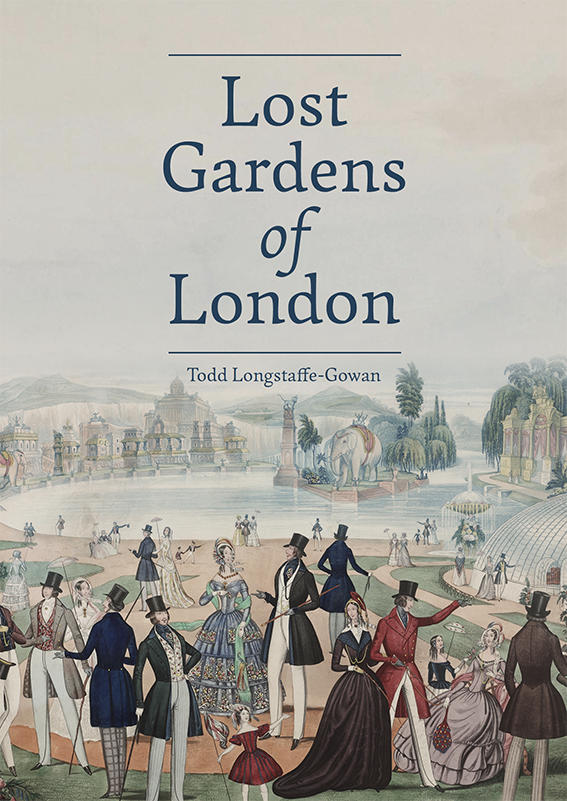 Did you know that Southwark once had a zoo? That for a short spell Britain’s first ecological park was built within a stone’s throw of Tower Bridge? Or that one of the capital’s most celebrated botanical gardens now lies beneath the platforms of Waterloo station? The exhibition Lost Gardens of London reveals the secret history of some of London’s most beguiling forgotten gardens.
Thousands of gardens have vanished across London over the past five hundred years—ranging from princely pleasure grounds and private botanical gardens, to humble allotments and defunct squares, artists’ gardens, eccentric private menageries, and the ecological parks of the twentieth century. Guest curated by landscape architect and historian Dr Todd Longstaffe-Gowan, Lost Gardens of London will explore this legacy and reveal tantalising glimpses of some of the rich and varied gardens that once embellished the metropolis. Paintings, prints, drawings, photographs, and maps bring these lost gardens to life, depicting changing trends and fashions in garden design while exploring London’s enduring love affair with nature, and how green spaces have always been a vital part of life in the capital.
In every borough, parks, gardens, and green open spaces have succumbed to new roads, street-widenings, railway encroachments and new buildings, or have simply been swallowed up by suburbia. Accompanying public programmes will explore how the remaining green spaces that may be taken for granted in London today have survived thanks to protests, community action, and legal protections being put in place. The exhibition is a timely reminder of the vulnerability of urban gardens and access to nature.
Lost Gardens of London coincides with a new book by Longstaffe-Gowan of the same name, published by the Modern Art Press (and distributed by Yale University Press).
Todd Longstaffe-Gowan, Lost Gardens of London (London: Modern Art Press, 2024), 272 pages, ISBN: 978-1738487806, £25 / $35.
New Book | Taste and the Antique
From Brepols:
Adriano Aymonino, Eloisa Dodero, Nicholas Penny, and Francis Haskell, Taste and the Antique: The Lure of Classical Sculpture, 1500–1900, revised and amplified edition (Turnhout: Harvey Miller / Brepols, 2024), 3 volumes, approximately 1684 pages, ISBN: 978-1909400252, €395.
 Indispensable for historians of taste and for art historians concerned with the debt owed by artists from the Renaissance onwards to the art of ancient Greece and Rome, as well as for students and collectors of the many surviving copies of the sculptures discussed.
For several hundred years, until about 1900, a limited number of antique sculptures were as much admired as are the Mona Lisa, Botticelli’s Birth of Venus or Michelangelo’s David today. They were reproduced in marble, bronze, and lead, as plaster casts in academies and art schools, as porcelain figurines for chimneypieces and as cameos for bracelets and snuffboxes. They were celebrated by poets from Du Bellay and Marino to Byron and D’Annunzio, and memorably evoked by novelists as diverse as Marcel Proust and Nathaniel Hawthorne, George Eliot and Charles Dickens. Copies of some of these statues can be seen at Pavlosk and Madrid, at Stourhead, Charlottenburg, Malibu and Versailles, and in countless gardens, houses, and museums throughout the world.
How and when did these particular sculptures achieve such a special status? Who were the collectors, restorers, dealers, artists, dilettanti, scholars and archaeologists who created their reputations? Under what names (often wildly fanciful) did they first become famous? How were they interpreted, and how and when and why did their glamour begin to wane? These are some of the problems that are confronted in Taste and the Antique.
 Taste and the Antique has become a classic of art history since its original publication in 1981. Now expanded into three volumes, this revised and amplified edition significantly updates the information based on new research undertaken in the last several decades, as well as expanding examples of the reception and influence of these works by artists and collectors from the Renaissance through to contemporary art.
When Taste and the Antique was published in 1981, Francis Haskell (1928–2000) was established as one of the most influential historians of art, not only in the English-speaking world but throughout Europe, chiefly on account of his first book, Patrons and Painters (1963), a highly original account of Baroque art in Italy. Since his appointment as professor of art history in Oxford in 1967, he had turned his attention from Italy in the seventeenth and eighteenth centuries to France in the eighteenth and nineteenth, and had begun his investigations of collecting, historiography, and the role of the museum and of the art critic, eventually published as Rediscoveries in Art (1976) and Past and Present in Art and Taste (1987). Taste and the Antique identified the models for art education and criticism during the four centuries with which Haskell was chiefly preoccupied, providing a series of individual case studies for the works upon which orthodox taste was founded. The book had a central place in his oeuvre, prompting preoccupations which persist in the last book that he published in his lifetime, History and Its Images (1993), as well as in The Emphemeral Museum, published posthumously in 2000.
 When he began to work with Francis Haskell on Taste and the Antique, Nicholas Penny was teaching art history at the University of Manchester. His first book, Church Monuments in Romantic England (1977), had attracted Haskell’s attention and subsequently they discovered and developed many mutual interests. Penny went on to occupy curational positions in the Ashmolean Museum in Oxford, the National Gallery in London, and the National Gallery of Art in Washington, D.C. From 2008 to 2015 he was director of the National Gallery. He is now a visiting professor at the National Academy of Fine Art in Hangzhou. Among his other books are Raphael (1983), written with the late Roger Jones, and The Materials of Sculpture (1993), as well as catalogues of the sculpture in the Ashmolean Museum (3 volumes, 1992) and of the sixteenth-century Italian paintings in the National Gallery (2004, 2008, 2016). He is currently cataloguing the Italian paintings in the Norton Simon Museum in Pasadena, of which one volume was published in 2021 and the other, written with Imogen Tedbury, is approaching completion.
Adriano Aymonino is the director of the MA in Art Market, Provenance and History of Collecting at the University of Buckingham. He is the author of Paper Palaces (2013); Drawn from the Antique: Artists and the Classical Ideal (with Anne Varick Lauder, 2015); and, most recently, Enlightened Eclecticism. The Grand Design of the 1st Duke and Duchess of Northumberland (2021), winner of the 2022 William MB Berger Prize.
Eloisa Dodero is archaeological curator at the Capitoline Museums in Rome. She is the author of Il Tesoro di Antichità. Winckelmann e il Museo Capitolino nella Roma del Settecento (with Claudio Parisi Presicce, 2017); Ancient Marbles in Naples in the Eighteenth Century (2019); and co-author, with Amanda Claridge, of The Paper Museum of Cassiano dal Pozzo. Sarcophagi and other Reliefs (four volumes, 2022) and, within the same series, of Statues and Busts (2023).
c o n t e n t s
Volume I | Text
A revised and amplified version of the 1981 edition. Fifteen chapters trace in narrative form, with the support of a wide variety of plates, the rise and decline of this highly important episode in the history of taste. These chapters are followed by catalogue entries for 95 of the most celebrated sculptures, all of them illustrated, which provide information on when and where they were discovered, changes of ownership and nomenclature, as well as a record of varying critical fortunes designed to complement the more general discussion in the earlier chapters.
Preface to the Revised and Amplified Edition
An Updated Note on the Presentation of the Essay and Catalogue
Introduction
1 ‘A New Rome’
2 The Public and Private Collections of Rome
3 Plaster Casts and Prints
4 Control and Codification
5 Casts and Copies in Seventeenth-Century Courts
6 ‘Tout ce qu’il y a de beau en Italie’
7 Erudite Interests
8 Florence: The Impact of the Tribuna
9 Museums in Eighteenth-Century Rome
10 The New Importance of Naples
11 The Proliferation of Casts and Copies
12 New Fashions in the Copying of Antiquities
13 Reinterpretations of Antiquity
14 The Last Dispersals
15 Epilogue
Notes to the Text
Updated Bibliography
Catalogue
Appendix
Bibliography
Index
Volume II | Originals
Contains especially commissioned new photography of over 90 statues catalogued in Volume I.
Volume III |Replicas and Adaptations
Devoted to a visual survey of the full range of replicas and adaptations of the works catalogued and illustrated in the previous volumes.
Exhibition | Sculpture and Colour in the Spanish Golden Age

Luisa Roldán, known as La Roldana, The First Steps of Jesus, ca. 1692–1706, polychrome terracota
(Museo de Guadalajara)
◊ ◊ ◊ ◊ ◊
From the press release for the exhibition:
Hand in Hand: Sculpture and Colour in the Spanish Golden Age
Darse la mano: Escultura y color en el Siglo de Oro
Museo Nacional del Prado, Madrid, 19 November — 2 March 2025
Curated by Manuel Arias Martínez
When praising the wood sculpture of Christ of Forgiveness, carved by Manuel Pereira and polychromed by Francisco Camilo, the writer on art Antonio Palomino (1655–1726) concluded with the following opinion: “Thus painting and sculpture, hand in hand, create a prodigious spectacle.” The unique importance achieved by the synthesis of volume and colour in sculpture of the early modern period can be explained only by the role it played as an instrument of persuasion.
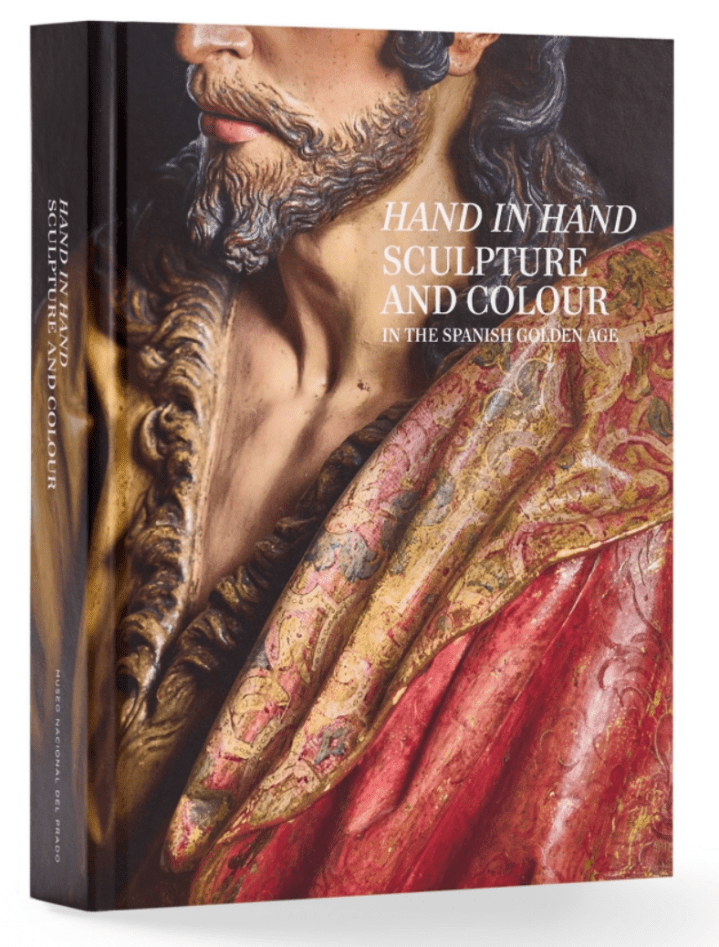 From the Graeco-Roman world onwards, sculptural representation was seen as a necessity. Divinity was present through its corporeal, protective, and healing image, which became more lifelike when covered with colour, an essential attribute of life in contrast to the inanimate pallor of death. In the words of the Benedictine monk Gregorio de Argaiz in 1677: “Each figure, no matter how perfect it may be in sculpture, is a corpse; what gives it life, soul, and spirit is the brush, which represents the affections of the soul. Sculpture forms the tangible and palpable man […], but painting gives him life.”
Religious sculpture existed in a context of supernatural connotations from the time of its execution. It was thus associated with miracles and divine interventions, with angelic workshops, and with craftsmen who had to be in a morally acceptable state in order to undertake a task that went beyond a mere artistic exercise, given that what was created was ultimately an imitation of the divine.
The exhibition now presented at the Museo Nacional del Prado offers an analysis of the phenomenon and success of polychrome sculpture, which filled churches and convents in the 17th century and played a key role as a support for preaching. The close and ideal collaboration between sculptors and painters is revealing with regard to the esteem in which colour was held, not merely as a superficial finish to the work but rather an essential element without which it could not be considered finished. Colour also made a decisive contribution to emphasising the dramatic values of these sculptures, both those made for altarpieces and for processional images. Theatrical gesturalism, together with the sumptuous nature of the clothing—whether sculpted, glued fabric, or real textiles—transformed these sculptures into dramatic objects filled with meaning.
Finally, the exhibition looks at other examples of the interrelationship between the arts in relation to polychrome sculpture, from the prints that helped disseminate the most popular devotional images to the Veils of the Passion [painted altarcloths of devotional images] which simulated altarpieces, and paintings that made use of striking illusionism to faithfully reproduce the sculptural images on their respective altars.
More information is available here»
Manuel Arias Martínez, Hand in Hand: Sculpture and Colour in the Spanish Golden Age (Madrid: Museo Nacional del Prado, 2024), 424 pages, ISBN: 978-8484806288 (English edition) / ISBN: 978-848480-6271 (Spanish edition) €37.
New Book | Every Valley
From Penguin Random House:
Charles King, Every Valley: The Desperate Lives and Troubled Times That Made Handel’s Messiah (New York: Doubledy, 2024), 352 pages, ISBN: 978-0385548267, $32.
 George Frideric Handel’s Messiah is arguably the greatest piece of participatory art ever created. Adored by millions, it is performed each year by renowned choirs and orchestras, as well as by audiences singing along with the words on their cell phones. But this work of triumphant joy was born in a worried age. Britain in the early Enlightenment was a place of astonishing creativity but also the seat of an empire mired in war, enslavement, and conflicts over everything from the legitimacy of government to the meaning of truth. Against this turbulent background, prize-winning author Charles King has crafted a cinematic drama of the troubled lives that shaped a masterpiece of hope. Every Valley presents a depressive dissenter stirred to action by an ancient prophecy; an actress plagued by an abusive husband and public scorn; an Atlantic sea captain and penniless philanthropist; and an African Muslim man held captive in the American colonies and hatching a dangerous plan for getting back home. At center stage is Handel himself, composer to kings but, at midlife, in ill health and straining to keep an audience’s attention. Set amid royal intrigue, theater scandals, and political conspiracy, Every Valley is entertaining, inspiring, unforgettable.
Charles King is the author of eight books, most recently Gods of the Upper Air, a New York Times bestseller, a finalist for the National Book Critics Circle award, and winner of the Francis Parkman Prize. His Odessa won a National Jewish Book Award. He is a professor of international affairs and government at Georgetown University.
Exhibition | Sketching Splendor: American Natural History, 1750–1850
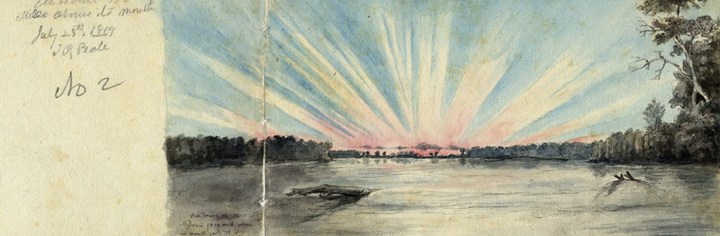
Titian Ramsay Peale, Sunset on Missouri, July 1819
(Philadelphia: American Philosophical Society, NH121 TRP, MSS.B.P31.15d)
◊ ◊ ◊ ◊ ◊
Now on view at the American Philosophical Society Museum:
Sketching Splendor: American Natural History, 1750–1850
American Philosophical Society Museum, Philadelphia, 12 April — 29 December 2024
Sketching Splendor: American Natural History, 1750–1850 explores how William Bartram, Titian Ramsay Peale, and John James Audubon made sense of nature’s complexities through their writings, drawings, and watercolors. It highlights their approaches to capturing the natural world during a time of rapid intellectual, social, and political change.
 Bartram, Peale, and Audubon relied on natural knowledge established by European, Euro-American, and Native American experts while balancing changing ideas of how reason and emotion impacted science. As both artists and naturalists, they freely expressed their ideas using science, art, and literature. Through a potent mix of scientific ideas, shifting worldviews, and professional freedom, their works embodied both experimentation and certainty. However, their interpretation of the natural world has also raised questions of national importance. Their world was not just one of intellectual excitement, but one of systematic injustice and a complex national history become visible as we peel back the layers. Sketching Splendor draws on the APS’s extensive holdings. Highlights of the exhibition include William Bartram’s map of the Alachua Savanna, Benjamin Henry Latrobe’s Rattlesnake Skeleton, Titian Ramsay Peale’s watercolors from the Long Expedition, and one volume of John James Audubon’s original Birds of America.
Anna Majeski and Michelle Craig McDonald, Sketching Splendor: American Natural History, 1750–1850 (Philadelphia: University of Pennsylvania Press, 2024), 112 pages, ISBN: 978-1606180402, $30.
Anna Majeski received a PhD in art history from the Institute of Fine Arts, New York University in 2022, where she completed a doctoral dissertation on a remarkable series of astrological fresco cycles completed in Padua between 1300 and 1440. Her research focuses on the intersections of art and science, image and knowledge in the early modern world, and has been supported by pre- and postdoctoral fellowships from the American Academy in Rome and the Harvard Center for Renaissance Studies, Villa I Tatti. She joined the American Philosophical Society, Library & Museum, as Mellon Foundation Postdoctoral Natural History Exhibition Research Fellow in October 2022.
Michelle Craig McDonald is the Librarian/Director of the Library and Museum at the American Philosophical Society, founded in 1743 and the oldest learned society in North America. The APS has more than 14 million pages of manuscripts and 300,000 printed volumes, with particular strengths in early American history, the history of science, and Native American and Indigenous cultures. McDonald earned her PhD in history from the University of Michigan where she focused on business relationships and consumer behavior between North America and the Caribbean during the 18th and 19th centuries. She is the co-author of Public Drinking in the Early Modern World: Voices from the Tavern (Pickering & Chatto/Routledge Press, 2011), and her current monograph, Coffee Nation: How One Commodity Transformed the Early United States, will be published by the University of Pennsylvania Press in spring 2025.
New Book | The Gardens of Venice
From Marsilio Arte:
Toto Bergamo Rossi and Marco Bay, with photographs by Marco Valmarana, The Gardens of Venice (Venice: Marsilio Arte, 2024), 296 pages, ISBN: 979-1254631973, €65 / $70.
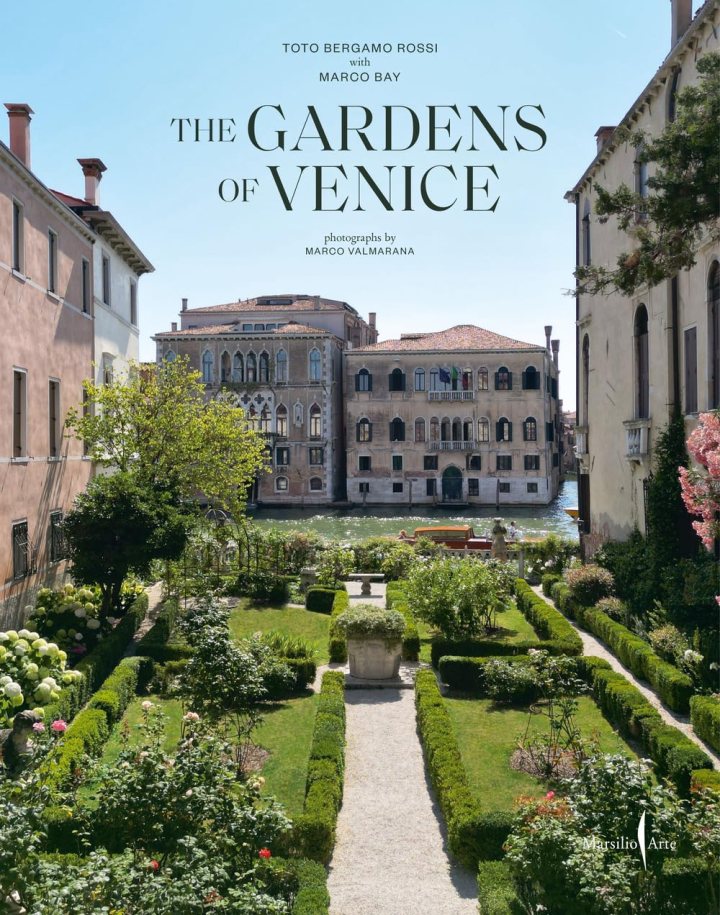
A lush look into Venice’s verdant gardens, photographed in every season of the year.
Turquoise lagoons and crystalline canals, criss-crossed by romantic bridges and traversed by singing gondoliers on their gondolas: water is considered by many to be Venice’s most enchanting feature. Yet on the little land that constitutes this ancient city, secret and sumptuous gardens lie waiting to cast their captivating spell. This lushly illustrated volume takes readers inside Venice’s most undiscovered and most exclusive green spaces across the city. The gardens of the palazzi that overlook the Grand Canal, along with the more vernacular ones of the lagoon islands, are captured throughout the seasons: the flowering in spring, the opulence of summer, the colors of fall and the frost of winter. Photographer Marco Valmarana’s exquisite images evoke a sense of wanderlust enough to inspire even the most jaded traveler. To walk the reader through the legacy of these special spaces, author Toto Bergamo Rossi recounts the evolution and history of the Venetian garden alongside a glossary of commonly used plants. The Gardens of Venice also includes a special foreword by designer Diane von Furstenberg.
Toto Bergamo Rossi, formerly a specialist in the conservation of stone materials, has restored a number of important monuments in Italy. Since 2010 he has served as the director of Venetian Heritage. He is the author of Inside Venice (Rizzoli, 2016) and Venice and Its Doges (Rizzoli, 2023).
New Book | Blue Guide: Venice, 10th Edition
The tenth edition for Venice appeared last year. While I’ve always thought of Blue Guides as reliably informative, this updated edition is also engaging, fun to read, and handsomely designed. If you’ve not tried a Blue Guide recently, it’s worth another look. –CH
Alta Macadam, Blue Guide Venice: Tenth Edition (London: Somerset Books, 2024), 495 pages, ISBN: 978-1905131945, $25.
 Full color throughout, with photographs, diagrams, site plans, and detailed maps.
The 10th edition of this accessible, detailed guide to Venice is an essential handbook for any traveler who wants to fully understand the existence and future challenges of this unique and extraordinary city, as well as its history, art, architecture, cuisine, and culture.
Completely updated, this new edition is in full colour, with photographs, plans, and illustrations, as well as detailed and accurate maps of the labyrinthine streets and canals. There is also a section of practical tips, ideas on food and wine, and how to navigate the transportation system. The depth of information and quality of research make this book the very best guide for the independent cultural traveler, as well as for all students of art history, architecture, and Italian culture. Ideal as an on-site guide or as a desk resource.
Art historian Alta Macadam lives in Fiesole, on the hillside above Florence.
New Book | The Venetian Façade
From ORO Editions:
Michael Dennis, The Venetian Façade (South Bend: Notre Dame School of Architecture / ORO Editions, 2024), 160 pages, ISBN: 978-1961856356, $40.

There are no books that focus on the unique artistic characteristics of the Venetian facade and its potential relevance to contemporary architectural and urban issues, as this book intends.
This book is about architecture. It is not about history, although a bit of history is necessary to set the context. It is not about theory, although, again, a bit is necessary to connect the facade with urbanism. It is also not about structure and technology. And, most definitely, it is not about the plan. All of these topics are well-covered elsewhere. This book is about the facade. It explores the art and typology of the Venetian facade, not only as a high point of architectural literacy and achievement, but as a potentially useful contemporary stimulant.
Michael Dennis is the principal of Michael Dennis & Associates in Boston, and Professor of Architecture Emeritus at MIT. 1986 Thomas Jefferson Professor of Architecture, University of Virginia; 1988 Eero Saarinen Professor of Architecture, Yale University; 2006 Charles Moore Professor of Architecture, University of Michigan.










 Enfilade
leave a comment