Art History 48 (February 2025)
The 18th century in the latest issue of Art History:
Art History 48 (February 2025)
a r t i c l e s
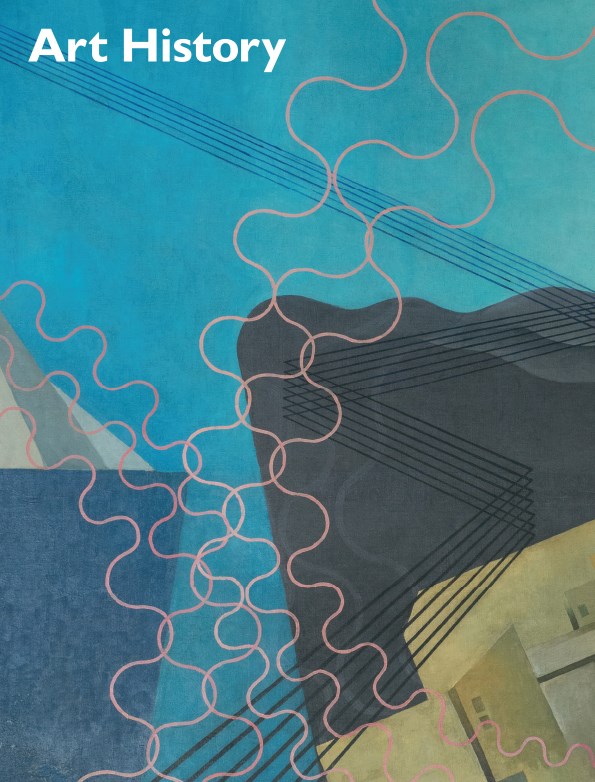 • Oliver Wunsch, “The Aesthetic Redemption of the Black Body in Eighteenth-Century France,” pp. 14–44.
Audiences in eighteenth-century France felt little compunction about admiring African people in art while denigrating them in life. They reconciled this apparent contradiction through a belief in the ameliorative effects of art, yielding what is described here as a theory of aesthetic redemption. This essay argues that the theory of aesthetic redemption that developed in eighteenth-century France gave art a unique position in the construction of race. Because those who believed in the possibility of aesthetic redemption distinguished between art’s content and its manner of representation, they created the conditions for artists to depict people of colour using materials, techniques, and formal structures whose qualities would otherwise be considered at odds with the subject. The resulting art often strikes audiences today as progressive, yet it did little to challenge the biases of the original viewers, who admired aesthetic departures from stereotypes precisely because they took those stereotypes for granted.
• Diarmuid Costello, “Die Schönheit des Mittelmenschen: Stephan Balkenhol’s ‘Everyday Beauty’,” pp. 132–61.
This essay considers Stephan Balkenhol’s ‘everyman and woman’ sculptures through the optic of Kant’s ‘ideal of beauty’ (§17, Critique of Aesthetic Judgement, 1790). I take a pair of miniature figures as my test case. Despite minor variations, all these sculptures depict the same generic man and woman, a man or woman who average or middling in every way. What could make depictions of average everydayness so compelling? For a clue, I turn to Kant’s ‘ideal of beauty’. This comprises a ‘standard aesthetic idea’ and an ‘idea of reason’: the former is a (culturally specific) ‘model image’ of the human being; the latter implicates Kant’s (universal) conception of ‘humanity in the person’, where the latter manifests itself through the former. I ask whether this illuminates Balkenhol’s work, suggesting that although the relevance of the former is clear, and the latter less so, there is reason not to rule it out.
• Viccy Coltman, “Travelling Knick-Knacks and Picturesque Points of View: Reverend James Plumptre’s Narrative of a Pedestrian Journey … to the Highlands of Scotland … in the Summer of the Year 1799,” pp. 162–84.
This essay revisits later eighteenth-century picturesque aesthetics in Britain as they were articulated in theory, applied in practice, and reproduced in travel literature and art. It considers the sometimes congruent, at other times contested, relationship between the natural landscape, written descriptions of that landscape, and its pictorial representation. Focusing on unpublished extracts from Reverend James Plumptre’s manuscript travel journal, Narrative of a Pedestrian Journey […] to the Highlands of Scotland […] in the Summer of the Year 1799, it argues for an original interpretation of the pedestrian picturesque as a suite of practices which entailed travelling by foot, viewing the landscape with a range of hand-held implements or ‘knick-knacks’, and representing nature ‘as seen’ without remedial artistic correction or improvement. According to this account, ‘people, places, and things’ becomes a useful rubric for conceptualising Plumptre’s 1799 pedestrian tour of Scotland which included visits to the Edinburgh studios of artists Alexander Nasmyth, Henry Raeburn, and Hugh William Williams.
r e v i e w s
• Brigid von Preussen, “A Woman’s Work,” Review of Paris Spies-Gans, A Revolution on Canvas: The Rise of Women Artists in Britain and France, 1760–1830 (Yale UP, 2022) and Rosalind Blakesley, Women Artists in the Reign of Catherine the Great (Lund Humphries, 2023), pp. 186–92.
The Burlington Magazine, March 2025
The long 18th century in the March issue of The Burlington:
The Burlington Magazine 167 (March 2025)
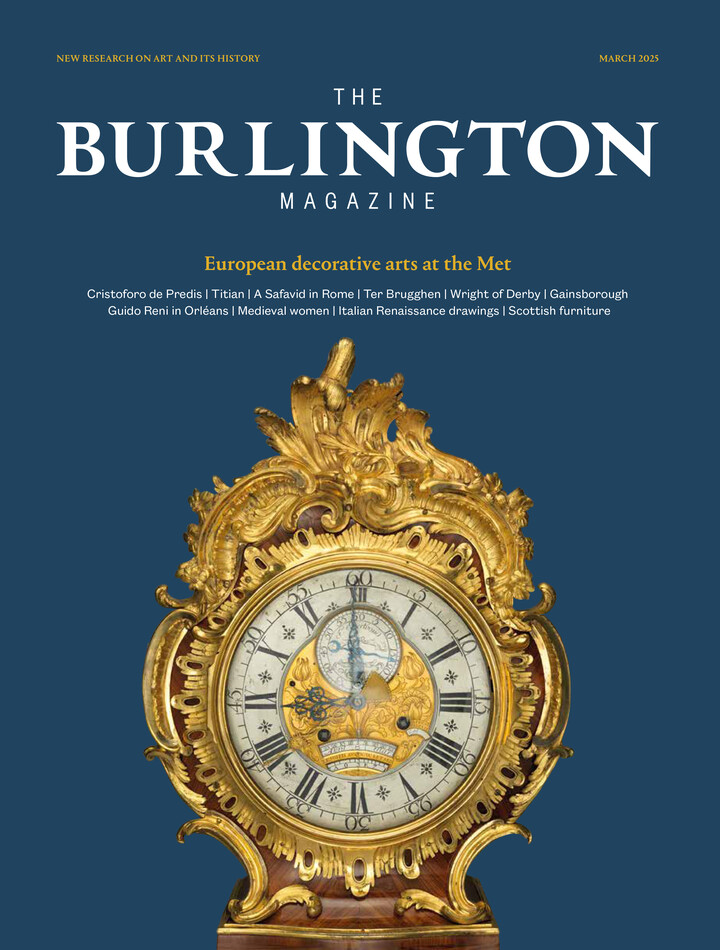
Cover of The Burlington Magazine with a recent acquisition at The Met: Longcase equation regulator, clockmaker: Ferdinand Berthoud, case maker: Balthazar Lieutaud, ca. 1752 (New York: The Metropolitan Museum of Art, 2016.28a–e).
e d i t o r i a l
• “A Frick Renaissance,” p. 203–05.
On 17th April 2025 the Frick Collection on Fifth Avenue re-opens after a long period of redevelopment. When an old friend has a face lift, the results can be disconcerting. Happily, the impact here is, however, reassuringly subtle—as the splendid Gilded-age character of one of New York’s iconic cultural institutions has been retained, while elegant new facilities have been deftly integrated.
a r t i c l e s
• Julia Seimon, “Two Boys with a Bladder in the J. Paul Getty Museum and Joseph Wright of Derby’s Early Candlelights,” pp. 242–57.
A careful re-assessment of Joseph Wright of Derby’s painting of Two Boys with a Bladder in the Getty’s collection, supported by documentary discoveries, clarifies the circumstances of the painting’s creation and first exhibition and has significant implications for dating several of the artist’s other painted and drawn works.
s h o r t e r n o t i c e s
• Oliver Fairclough, “Paul Sandby and Sir Watkin Williams-Wynn Revisited,” pp. 258–61.
• Christina Milton O’Connell, “Observations about the Abandoned Portrait beneath Gainsborough’s Blue Boy,” pp. 26–65.
r e v i e w s
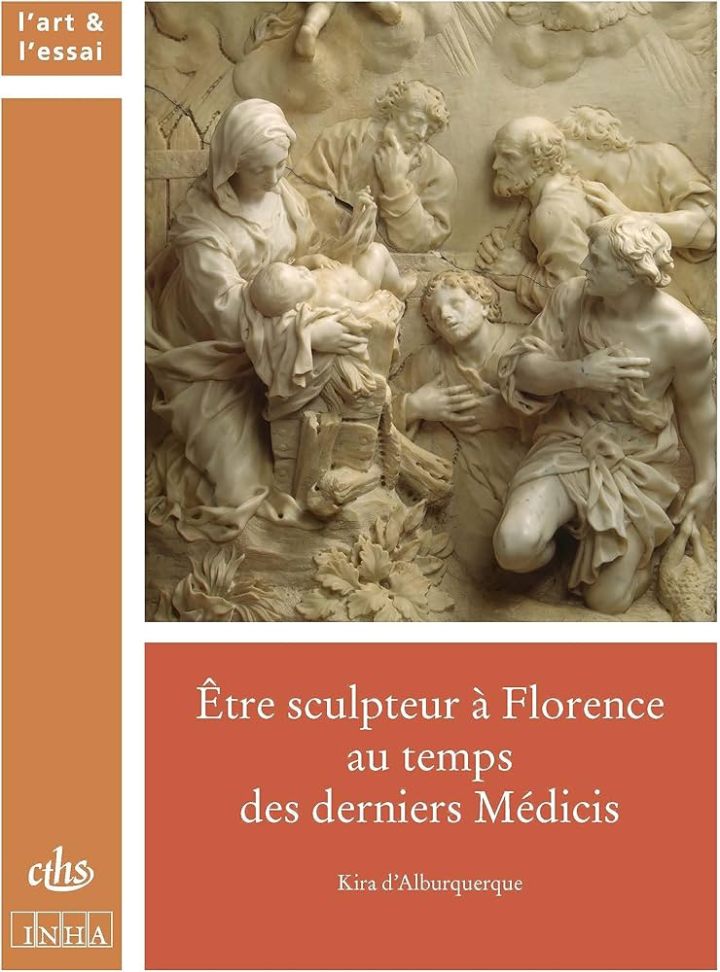
Cover of Être sculpteur à Florence au temps des derniers Médicis, featuring a photograph of Giovanni Battista Foggini’s Adoration of the Shepherds, ca. 1675, marble (Saint Petersburg: Hermitage).
• Nicola Ciarlo, Review of Kira d’Alburquerque, Être sculpteur à Florence au temps des derniers Médicis (CTHS, 2023), pp. 292–94.
• Adam Bowett, Review of Stephen Jackson, Scottish Furniture 1500–1914 (NMS Publishing, 2024), pp. 296–98.
• Penelope Curtis, Review of the exhibition catalogue Souvenirs de jeunesse: Entrer aux Beaux-Arts de Paris 1780–1980, edited by Alice Thomine-Berrada (Beaux-Arts de Paris, 2024), pp. 298–99.
• Alan Powers, Review of Edward McParland, The Language of Architectural Classicism: From Looking to Seeing (Lund Humphries Publishers, 2025), pp. 299–300.
• Max Marmor, Review of Julius von Schlosser, The Literature of Art: A Manual for Source Work in the History of Early Modern European Art Theory, translated by Karl Johns (Ariadne Press, 2023), p. 303.
s u p p l e m e n t
• Sarah Lawrence, “Recent Acquisitions (2014–24) of European Decorative Arts at The Metropolitan Museum of Art,” pp. 305–24.
New Book | Giovanni Battista Maini (1690–1752)
Distributed by Yale UP:
Jennifer Montagu, Giovanni Battista Maini (1690–1752) and Roman Sculpture of His Time (London: Burlington Press, 2025), 302 pages, ISBN: 978-1916237858, $125.
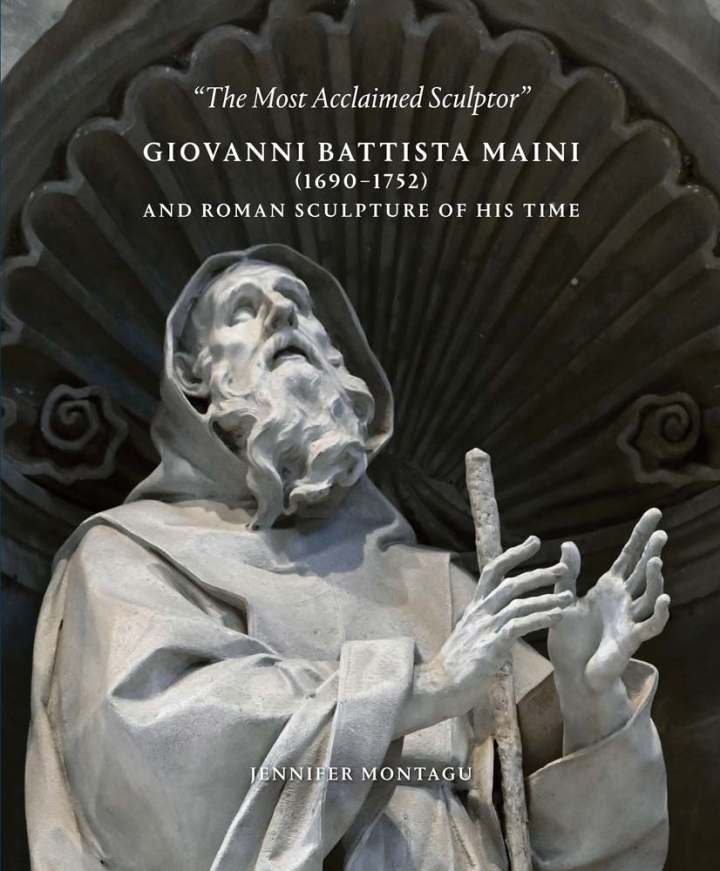 Giovanni Battista Maini is one of the most important and accomplished—although least known and appreciated—of late Baroque sculptors. This new monograph provides an authoritative, scholarly, and beautifully illustrated survey of all his principal commissions. Maini was born in Lombardy and had moved to Rome by 1710. His prestigious projects in the city included the funerary monument for Pope Innocent X in Sant’Agnese in Agone and the two majestic tombs in the family chapel of Pope Clement XII in San Giovanni in Laterano. Maini also worked in Santa Maria Maggiore and was involved in the design for the iconic Fontana di Trevi. These works are set in the context of the Roman art scene: the struggle for commissions, payment, and reputation.
Jennifer Montagu is a distinguished art historian who specialises in Roman Baroque sculpture. Her monograph on Alessandro Algardi was published in 1985 to great acclaim. Montagu worked as Curator of the Photographic Collection of the Warburg Institute, London, and has been both the Slade Professor of Fine Art at Oxford and the Andrew W. Mellon Lecturer at the National Gallery of Art, Washington. She has also served as a Trustee of the Wallace Collection and British Museum, London, and is an Officer of the Order of Merit of the Italian Republic.
New Book | The Language of Architectural Classicism
From Lund Humphries:
Edward McParland, The Language of Architectural Classicism: From Looking to Seeing (London: Lund Humphries Publishers, 2025), 288 pages, ISBN: 978-1848226593, £35 / $70.
 Classicism is ubiquitous, from the facade of Selfridges to the letterhead of The Times, to the pedimented porches of neo-Georgian housing estates. This book invites readers to discover in their surroundings a rich language of form which is there to be revealed. It discusses the pleasures and problems of post-medieval architectural classicism, both its rigour and flexibility, its perfections and incompleteness, its continuities and innovations, and its expressiveness—from the camp to the sublime, and from originality to plagiarism. Abandoning conventional chronological, biographical, or stylistic arrangements, the book makes connections between familiar art historical periods, focusing on looking closely at the buildings and their details, from which useful generalisations emerge.
The book discusses how Renaissance architects, when faced with the bewildering variety of classical antiquity, produced canonical versions of the orders and thus a systematic method of designing in the antique manner. It asks how the highly regulated language of classicism can sustain the originality of a Michelangelo, a Soane or a John Simpson and looks at the human body in relation to classical architecture. It examines the various treatments of the wall and of lettering on classical buildings, before concluding with a chapter on architectural backgrounds in Quattrocento art, revealing how this can lead to a different kind of looking at painting and sculpture.
Edward McParland is an Irish architectural historian and author of several books, including James Gandon (1985) and Public Art in Ireland, 1680–1760 (2001). He was elected as Pro-Chancellor of University of Dublin, Trinity College in 2013. McParland is the co-founder of the Irish Architectural Archive which was established in 1976, and he has contributed extensively to architectural conservation in Ireland.
c o n t e n t s
Introduction
1 The Canon
2 Imitation
3 Body and Building
4 The Wall
5 Discord
6 Lettering
7 Architectural Backgrounds, Mostly Quattrocento
Conclusion
Select Bibliography
Index
New Book | American Laughter, American Fury
From Johns Hopkins UP:
Eran Zelnik, American Laughter, American Fury: Humor and the Making of a White Man’s Democracy, 1750–1850 (Baltimore: Johns Hopkins University Press, 2025), 352 pages, ISBN: 978-1421450605, $65.
 A joke is never just a joke―not even in the eighteenth century. In American Laughter, American Fury, Eran A. Zelnik offers a cultural history of early America that shows how humor among white men served to define and construct not only whiteness and masculinity but also American political culture and democracy more generally. Zelnik traces the emerging bonds of affinity that white male settlers in North America cultivated through their shared, transformative experience of mirth. This humor―a category that includes not only jokes but also play, riot, revelry, and mimicry―shaped the democratic and anti-elitist sensibilities of Americans. It also defined the borders of who could participate in politics, notably excluding those who were not white men. While this anti-authoritarian humor transformed the early United States into a country that abhorred elitism and class hierarchies, ultimately the story is one of democratization gone awry: this same humor allowed white men to draw the borders of the new nation exclusively around themselves. Zelnik analyzes several distinct forms of humor to make his case: tall tales, ‘Indian play’, Black dialect, riot and revelry, revolutionary protests, and blackface minstrelsy. This provocative study seeks to understand the vexing, contradictory interplay among humor, democracy, and violence at the heart of American history and culture that continues today.
Eran A. Zelnik is a lecturer in the Department of History at California State University, Chico.
c o n t e n t s
Introduction
Part I | Yankees and Gentlemen
1 The Joyous Multitude: Humor and the Premodern Crowd in the Revolutionary Era
2 The Witty Few: Augustan Humor and the Politics of Exclusion
Part II | From Backcountry to Frontier
3 Laughter in the Wilderness: Transgression and Mirth in Rural America
4 The Laughter and the Fury: Terror and Masquerade on the American Frontier
5 Alligator-Horses: The Frontier Jester and the Origins of Manifest Destiny
Part III | A Tale of Two Clowns
6 A Black Clown for a White Nation: The Origins and Context of Blackface Minstrelsy
7 American Folks: Black and White Jesters in Antebelluum Popular Culture
Epilogue: Laughter and Fury from the Klan to January 6, 2021
Acknowledgments
Notes
Index
New Book | Thomas Sully’s Philadelphians
Coming in April, from Penn Press:
Peter Conn, Thomas Sully’s Philadelphians: Painting the Athens of America (Philadelphia: The American Philosophical Society Press, 2025), 216 pages, ISBN: 978-1606180495, $40. Also available as an ebook.
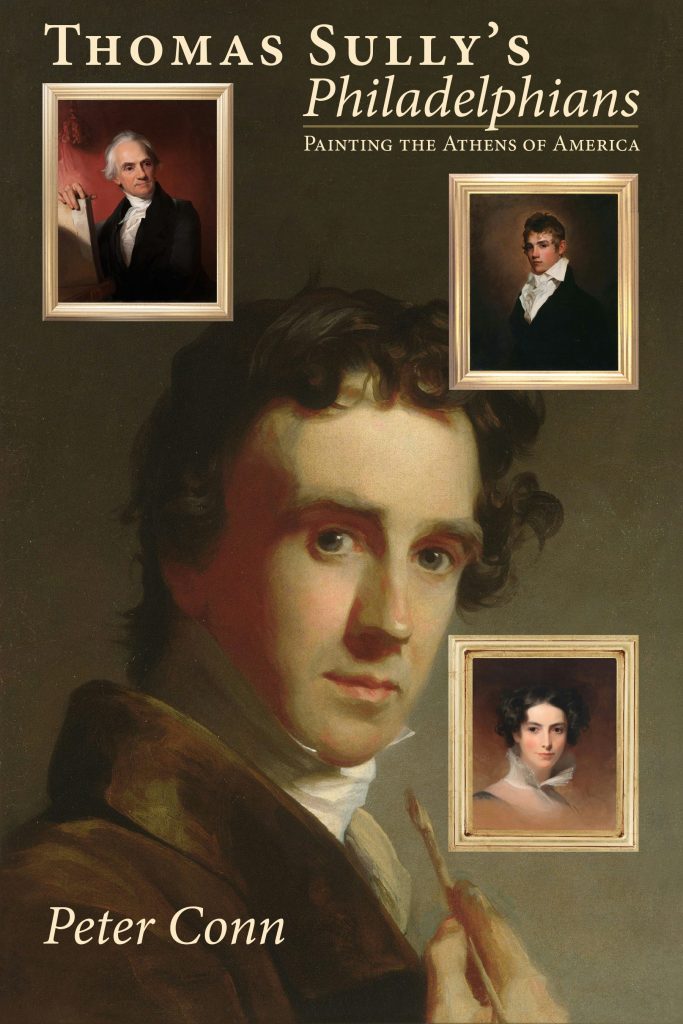 Philadelphia’s early national history represented in Thomas Sully’s portraits
Thomas Sully (1783–1872) is widely regarded as perhaps the most important portrait painter of the antebellum years. Using those portraits, Thomas Sully’s Philadelphians: Painting the Athens of America reconstructs many of the people, institutions, and events that combined to make Philadelphia—from the Revolution until the 1840s—at once the most cosmopolitan and most racially embattled city in America. The book approaches Sully’s portraits as visual documents in the history of Philadelphia in the first half of the nineteenth century. Gathered here under headings that include individuals, institutions, professions, and contemporary events, Sully’s portraits offer points of entry into much that was going on in early nineteenth-century Philadelphia. Peter Conn explores education, politics, theater, medicine, journalism, commerce, philanthropy, religion, and the fierce debate over slavery. Drawing upon wide research, including previously unpublished archival material, Thomas Sully’s Philadelphians brings to vivid life the men and women who were making the history of early national Philadelphia.
Peter Conn retired from the University of Pennsylvania as Vartan Gregorian Professor of English and Professor of Education and was a member of the graduate groups in the history of art and American civilization. His publications include The Divided Mind: Ideology and Imagination in America, 1898–1917 and Literature in America. Pearl S. Buck: A Cultural Biography was chosen as a New York Times Notable Book. The American 1930s: A Literary History was published in 2009. Conn wrote and presented a video course on American Best Sellers for the Teaching Company. He has given talks at the Brooklyn Museum of Art, the Pennsylvania Academy of Fine Arts, the Whitney Museum, the Philadelphia Museum of Art, and other institutions, on a number of American artists, including Edward Hopper, William Christenberry, Thomas Wilmer Dewing, Maxfield Parrish, Charles Sheeler, Winslow Homer, Wharton Esherick, and The Eight.
c o n t e n t s
1 Introduction
2 A Brief Biography
3 Pennsylvania Hospital
• Samuel Coates
• Benjamin Rush
4 The Second Bank of the United States
• Nicholas Biddle
5 The Theater
• George Frederick Cooke
• Fanny Kemble
• Charlotte Cushman
6 The Library Company of Philadelphia
• Zachariah Poulson
7 The Jews of Philadelphia
• Rebecca Gratz
8 The American Philosophical Society
• John Vaughan
• Peter Stephen Du Ponceau
9 Lafayette Returns to Philadelphia
10 The Historical Society of Pennsylvania
• William Rawle
11 Natural History
• William Wagner
• William Maclure
12 The University of Pennsylvania
• John Andrews
13 The Debate over Slavery
• William Henry Furness
• Benjamin Coates
• Daniel Bashiel Warner and Edward Roye
14 Epilogue: Thomas Sully and His Critics
• Jonathan Williams
• George Mifflin Dallas
Bibliography
Index
New Book | Rebellion 1776
I’m a big fan of Anderson’s Seeds of America Trilogy (Chains, Forge, and Ashes) and Fever, 1793. Her latest is set to be published April 1, from Simon and Schuster. –CH
Laurie Halse Anderson, Rebellion 1776 (New York: Atheneum/Caitlyn Dlouhy Books, 2025), 416 pages, ISBN: 978-1416968269, $19.
 From New York Times bestselling author Laurie Halse Anderson comes a “thoroughly researched, emotionally resonant” (Booklist, starred review) historical fiction middle grade adventure about a girl struggling to survive amid a smallpox epidemic, the public’s fear of inoculation, and the seething Revolutionary War.
In the spring of 1776, thirteen-year-old Elsbeth Culpepper wakes to the sound of cannons. It’s the Siege of Boston, the Patriots’ massive drive to push the Loyalists out that turns the city into a chaotic war zone. Elsbeth’s father—her only living relative—has gone missing, leaving her alone and adrift in a broken town while desperately seeking employment to avoid the orphanage. Just when things couldn’t feel worse, the smallpox epidemic sweeps across Boston. Now, Bostonians must fight for their lives against an invisible enemy in addition to the visible one. While a treatment is being frantically fine-tuned, thousands of people rush in from the countryside begging for inoculation. At the same time, others refuse protection, for the treatment is crude at best and at times more dangerous than the disease itself. Elsbeth, who had smallpox as a small child and is now immune, finds work taking care of a large, wealthy family with discord of their own as they await a turn at inoculation, but as the epidemic and the revolution rage on, will she find her father?
Laurie Halse Anderson is a New York Times bestselling author known for tackling tough subjects with humor and sensitivity. She’s twice been a National Book Award finalist, for Chains and Speak; Chains also received the 2009 Scott O’Dell Award for Historical Fiction. Laurie was chosen for the 2009 Margaret A. Edwards Award and received the Astrid Lindgren Memorial Award in 2023, presented to her by the Crown Princess of Sweden.
New Book | Beautiful Shells
From Bodleian Library Publishing, with distribution by The University of Chicago Press:
Mark Carnall, Beautiful Shells: George Perry’s Conchology (Oxford: Bodleian Library, 2025), 192 pages, ISBN: 978-1851246168, £25 / $40.
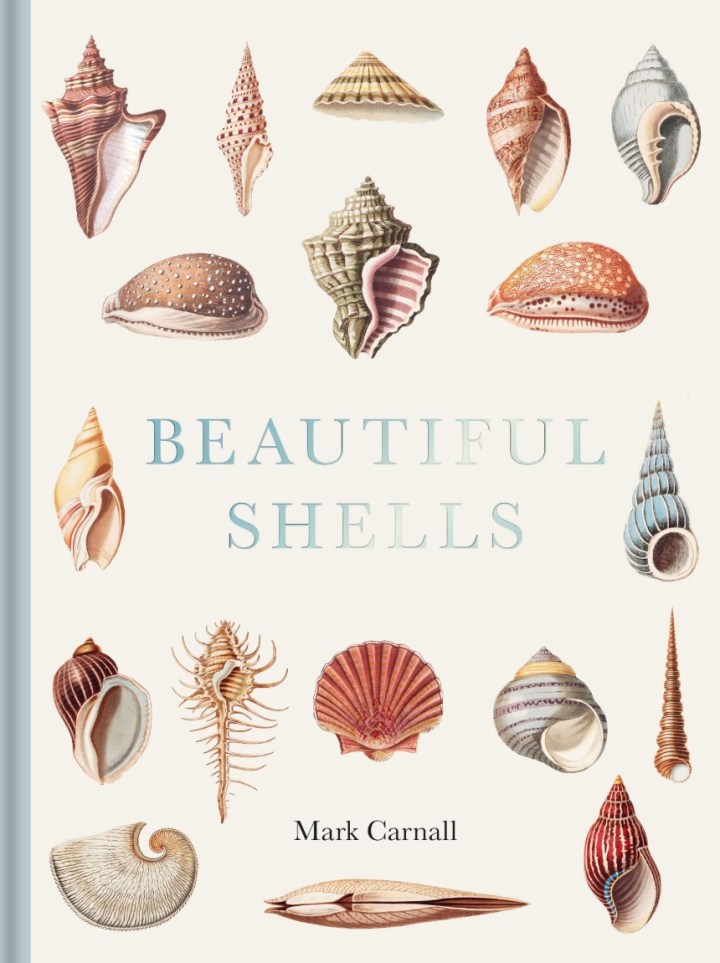 In 1811, architect, stone mason, and shell obsessive George Perry published his lavishly illustrated volume, Conchology or the Natural History of Shells. The work featured 348 beautifully illustrated mollusk shells with descriptions of species, many of which were new to science. Despite the effort that went into producing it—and at a time when conchophilia, or shell fancying, was at its height—Perry’s Conchology disappeared from scientific literature, after being suppressed by the leading conchologists of the day and then cruelly mocked for decades after. Beautiful Shells reproduces the stunning, exquisitely drawn, and sometimes fanciful shell illustrations from this extraordinary forgotten volume. Following an introduction exploring our fascination with shells and their impact on human history, culture, and science, each of the sixty-one color illustrations is included alongside a description of notable shells and what is known of the mysterious organisms that make them. From the common limpet and razor clam to the valuable cowry and spectacular divine conch, the wide range of featured shells form a treasure trove of natural beauty from our oceans and shores.
Mark Carnall is collections manager of human remains and non-insect invertebrate collections at the Oxford University Museum of Natural History.
c o n t e n t s
Introduction
The Shells
Appendix
Notes
Bibliography
Picture Credits
Index
New Book | Catesby’s Natural History
From Bodleian Library Publishing, with distribution by The University of Chicago Press:
Stephen Harris, Catesby’s Natural History (Oxford: Bodleian Library, 2024), 304 pages, ISBN: 978-1851246397, £50 / $75.
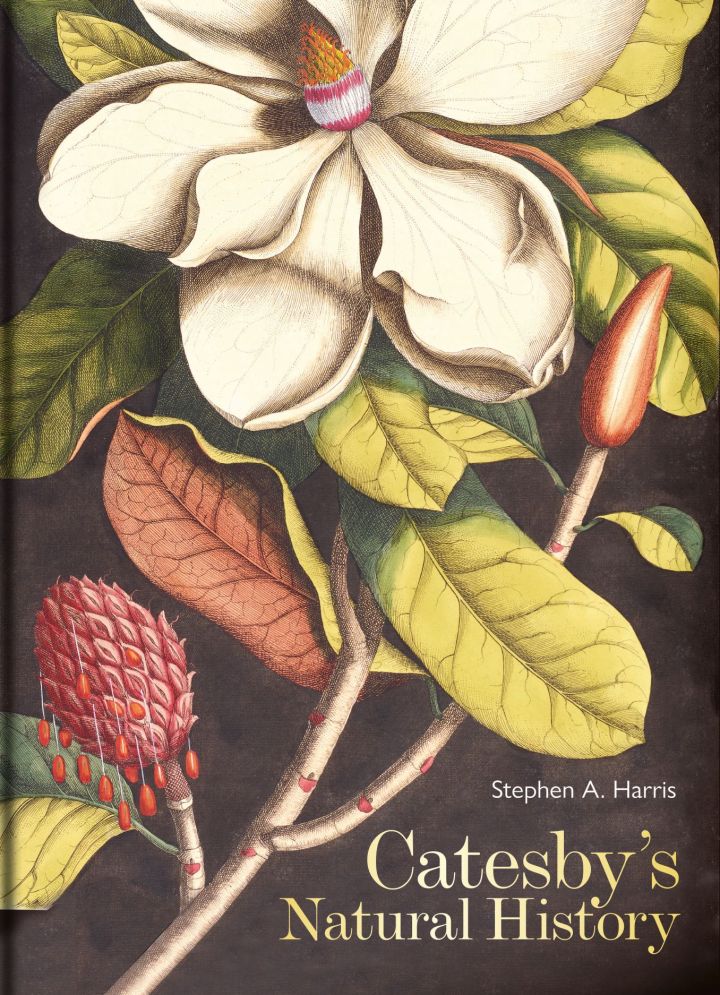 A beautiful reproduction of naturalist Mark Catesby’s flora and fauna illustrations of North America and the Caribbean.
Mark Catesby was an eighteenth-century naturalist and artist whose work on the natural history of North America and the Caribbean still resonates today. During several perilous trips, Catesby collected specimens and made extensive observations in the field, gathering material that would eventually become The Natural History of Carolina, Florida and the Bahama Islands, which featured 220 elaborate, distinctive hand-colored illustrations.
With their striking combinations of animals and plants paired together with the first-hand observations he made, Catesby’s stunning illustrations were widely appreciated in their time and catalyzed interest in the natural history of Colonial America. Ultimately, his work was established as a key reference for the scientific understanding of natural history. As an artist, Catesby meticulously recorded the environment, sifting fact from fiction about the lives of the plants and animals he observed. As a collector, he introduced many living plants to Britain, thereby changing European gardens forever. Catesby’s Natural History reproduces all the original plates and shows how Catesby’s practical field experience shaped his work in all areas. Whether through the now-extinct species he recorded or the cultural changes he witnessed, his research continues to be relevant, demonstrating the vulnerability and fragility of the natural world.
Stephen A. Harris is Druce Curator of Oxford University Herbaria.
c o n t e n t s
1 Natural History in the Thirteen Colonies
2 Who was Mark Catesby?
3 On Habitats and Uses
4 On Indigenous and Enslaved Peoples
5 On Collection and Cultivation
6 On Illustrations
7 On Publishing the Natural History
8 Legacy
Exhibition | Andrea Appiani (1754–1817)
Now on view at the Château de Bois-Préau in Rueil-Malmaison (as noted at Art History News) . . .
Andrea Appiani (1754–1817): Napoleon’s Painter in Italy
Musée national des châteaux de Malmaison et Bois-Préau, 16 March — 28 July 2025
Curated by Francesco Leone, Fernando Mazzocca, and Simone Ferraro
 Une centaine d’oeuvres—peintures, dessins, gravures, médailles appartenant à des collections européennes publiques et privées—sont réunies pour la première rétrospective organisée en France sur cet artiste, considéré comme le plus important peintre de la période néo-classique au nord de l’Italie. L’exposition révélera un portraitiste attachant et un fresquiste brillant, malgré la destruction d’une partie de ses décors peints au Palais Royal et dans certains hôtels particuliers milanais durant les bombardements de 1943.
Victorieux à la bataille du Pont de Lodi le 10 mai 1796, le général Bonaparte fait son entrée dans Milan le 15. Il y rencontre Appiani dont le talent est reconnu pour des décors de théâtre, d’hôtels particuliers et d’églises ainsi que des portraits. La manière de l’artiste a déjà perdu de la relative raideur de ses débuts et le peintre-décorateur sait combiner la précision et la fermeté du trait avec la délicatesse du modelé et la suavité de la matière. Trois ans plus tard, au retour des Français, à l’occasion de la Deuxième campagne d’Italie, Appiani se voit confier par Napoléon la charge de sélectionner les oeuvres d’art prélevées dans les églises et les couvents pour enrichir et faire rayonner les musées du Nord de la péninsule.
L’ascension d’Appiani, iconographe de la république puis du Royaume d’Italie est consacrée par le nombre important de commandes publiques et privées qu’il reçoit alors. En cinq séquences chronologiques et thématiques, l’exposition permet de montrer l’oeuvre de l’artiste à la fois fresquiste et peintre de chevalet : La carrière pré-napoléonienne, Les Fastes de Napoléon, Portraits publics et privés, Décors à fresque et, Fortune artistique d’Appiani.
Présentée dans les salons du château de Bois-Préau, l’exposition révèle au public le talent et la richesse de l’oeuvre de cet artiste au service de l’Empereur. L’exposition présente la manière sensible, monumentale ou intimiste du plus grand artiste milanais de son temps : les débuts d’un peintre formé au dix-huitième siècle, les scènes de la geste napoléonienne et de la république naissante, les effigies de Napoléon et Joséphine, les études et dessins préparatoires pour les décors des hôtels particuliers et des églises.
Exposition produite par le GrandPalaisRmn.
Rémi Cariel, ed., Andrea Appiani: Le peintre de Napoléon en Italie (Paris: Éditions Flammarion, 2025), 224 pages, ISBN: 978-2711880737, €40.
◊ ◊ ◊ ◊ ◊
At the Italian Cultural Institute in Paris:
Rémi Cariel and Alessandro Morandotti | Andrea Appiani et la tradition artistique de la Lombardie
Institut culturel italien, Paris, 31 March 2025, 6.30pm
A l’occasion de l’exposition temporaire Andrea Appiani (1754–1817): Le peintre de Napoléon en Italie, l’Institut Culturel Italien rend hommage à ce grand peintre italien avec une conférence autour de sa figure. La conférence explorera sa vie et sa carrière avec une attention particulière aux racines de sa culture. Avec Rémi Cariel, conservateur en chef du patrimoine en charge des collections de peintures, sculptures et arts graphiques du Musée Malmaison et Alessandro Morandotti, professeur d’histoire de l’art moderne et président du cursus d’Histoire de l’Art de l’Université de Turin.
Book tickets here»










leave a comment