Reviewed: ‘The Efflorescence of Caricature’
Recently added to caa.reviews:
Todd Porterfield, ed., The Efflorescence of Caricature, 1759–1838 (Burlington: Ashgate, 2011), 240 pages, ISBN: 9780754665915), $99.95.
Reviewed by Amelia Rauser, Franklin & Marshall College; posted 15 September 2011.
Caricature still has the power to inflame. In the last five years, several incidents—from the Danish satires depicting Muhammad to the racially tinged caricature of Barack Obama as a crazed chimp published by the ‘New York Post’ early in his presidency—have shown that caricature can still spark rage as well as pleasure. Developed in tandem with modern conceptions of identity, caricature is a quintessentially modern visual language. Caricature paradoxically reveals the truth of a person’s interior through the deformation of her or his exterior, thus making the invisible visible and satisfying a cultural desire for transparency and the unmasking of hypocrisy. At the same time, caricature is deeply subjective, its virtuosic linearity ostentatiously imaging the hand of the artist, and thereby providing an alibi for the truths that are unmasked: this is only my opinion, the caricature seems to say, and I’m only joking.
‘The Efflorescence of Caricature, 1759–1838‘, Todd Porterfield’s edited collection of essays on caricature’s “golden age,” is uneven, but on the whole it enriches and expands an understanding of the first flowering of caricature in the modern West. Emerging from a 2006 conference, the volume is more international than usual in two ways: the essays frequently address issues of influence, exchange, and imperialism among different nations; and the authors themselves are from several different countries, thus bringing refreshingly different approaches and concerns to bear in their contributions. Besides this internationalism, Porterfield also stresses the importance of a broad, “continental” definition of caricature in his introduction to the volume. This approach allows for a diverse array of satirical imprints to be included, including those that completely eschew bodily deformation as a means of communication. But it also invites inexactness and can lead to conceptual confusion . . .
The full review is available here» (CAA membership required)
Exhibition: Louis-Léopold Boilly (1761-1845)
From Art Media Agency:
Boilly (1761-1845)
Palais des Beaux-Arts de Lille, 4 November 2011 — 6 February 2012
 The Palais des Beaux-Arts in Lille will host the first international retrospective dedicated to Louis-Léopold Boilly (1761-1845). The event, celebrating the 250th birthday of the artist, will run from 4 November to 6 February. . . .
It is the first Boilly retrospective since the 1930s and it will feature works from numerous collections. It will underline the painter’s originality. His talent as a portraitist will also be highlighted, as well as his taste for trompe-l’œil and his role as the century’s chronicler, precursory to Daumier. The exhibition will feature more than 170 paintings, drawings, lithographs, miniatures and furniture. It will be divided into seven sections, in chronological and thematic order, recounting the painter’s itinerary.
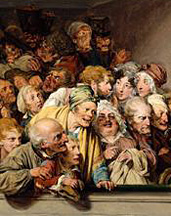
ISBN: 9782350391250
The full AMA posting is available here»
The exhibition press release (in French) is available here»
◊ ◊ ◊ ◊ ◊
Annie de Wambrechies, Louis-Leopold Boilly (1761-1845), exhibition catalogue (Paris: Chaudun, 2011), 304 pages, ISBN: 9782350391250, 42€ / $82.50 — The catalogue, scheduled for release in November, will be available from ArtBooks.com.
More New Books: Monkeys and Museum Education
Nicole Garnier-Pelle, Anne Forray-Carlier, and Marie Christine Anselm, The Monkeys of Christophe Huet: Singeries in French Decorative Arts (Los Angeles, Getty Publications, 2011), 176 pages, ISBN: 9781606060650,$50.
 Although monkeys had been used to mimic man and his foibles in the margins of medieval illuminated manuscripts, a taste for depictions of elegant monkeys developed among the French aristocracy at the end of the seventeenth century. This delightful book traces the evolution of the monkey motif into a distinct genre known as singerie (from the French word “singe” meaning monkey) during the exuberant Rococo period.
The designer and engraver Jean Bérain (1640–1711) was the first to insert monkeys into scenes of Renaissance grotesque decoration, surrounding them with scrolling foliage, fantastical creatures, and Chinese motifs. Claude Audran III (1658–1734) developed this style further with his satirical wall painting of monkeys at Louis XIV’s Château de Marly. But it was Christophe Huet (1700–1759), an acclaimed painter of animals, who produced the best-known surviving examples of singeries for the Château de Chantilly north
of Paris.
Huet’s life and work is the focus of this book. In his whimsical paintings monkeys, acting as surrogates for the château’s aristocratic occupants and guests, are shown singing and dancing, bathing, hunting boar, and sledding on the frozen lake. Huet’s work is placed in context through an examination of lesser-known interiors with singeries decoration as well as monkey motifs in the decorative arts ranging from tapestries and teapots to furniture mounts and fireplace accessories.
Nicole Garnier-Pelle is curator in charge of cultural heritage at the Condé Museum in Chantilly, France. Anne Forray-Carlier is chief curator at the Museum of Decorative Arts in Paris. Marie Christine Anselm is an art historian specializing in harpsichords and their decoration.
N.B. — Kimberly Chrisman-Campbell provides a useful review at WornThrough (added 14 October 2011).
◊ ◊ ◊ ◊ ◊
Rika Burnham and Elliott Kai-Kee, Teaching in the Art Museum: Interpretation as Experience (Los Angeles: Getty Publications, 2011), 192 pages, ISBN: 9781606060582, $30.
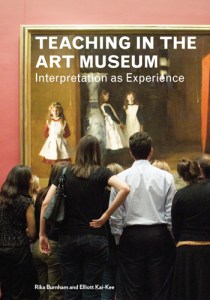 At the heart of all good art museum teaching is an effort to bring people and artworks together in meaningful ways. But what constitutes an experience of a work of art? What should be taught and why? What kinds of uniquely valuable experiences are museum educators alone equipped to provide? This book—unlike any other publication currently available—addresses these and myriad other questions and investigates the mission, history, theory, practice, and future prospects of museum education. Every critical issue that has preoccupied the profession throughout its hundred-year history is considered, including lecture- versus conversation-based formats; the place of information in gallery teaching; the relation of art museum teaching to the disciplines of art history, curation, and conservation; the use of questions to stimulate discussion; and the role of playfulness, self-awareness, and institutional context in constructing the visitor’s experience.
The book will prove invaluable for all professional museum educators and volunteer docents as well as museum studies students, art and art history teachers, curators, and museum administrators. The essays distill the authors’ decades of experience as practitioners and observers of gallery teaching across the United States and abroad. They offer a range of perspectives on which everyone involved with art museum education may reflect and in so doing, encourage education to take its proper place at the center of the twenty-first century art museum.
Rika Burnham is head of education at The Frick Collection in New York. Elliott Kai-Kee is an education specialist at the J. Paul Getty Museum.
New Title: Vauxhall Gardens
From Yale UP:
Alan Borg and David E. Coke, Vauxhall Gardens: A History (New Haven: Paul Mellon Centre for Studies in British Art, 2011), 400 pages, ISBN: 9780300173826, $95.
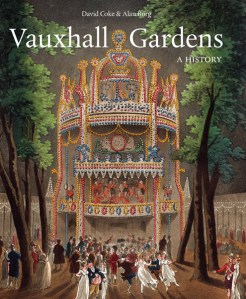 From their early beginnings in the Restoration until the final closure in Queen Victoria’s reign, Vauxhall Gardens developed from a rural tavern and place of assignation into a dream-world filled with visual arts and music, and finally into a commercial site of mass entertainment. By the 18th century, Vauxhall was crucial to the cultural and fashionable life of the country, patronized by all levels of society, from royal dukes to penurious servants.
In the first book on the subject for over fifty years, Alan Borg and David E. Coke reveal the teeming life, the spectacular art and the ever-present music of Vauxhall in fascinating detail. Borg and Coke’s historical exposition of the entire history of the gardens makes a major contribution to the study of London entertainments, art, music, sculpture, class and ideology. It reveals how Vauxhall linked high and popular culture in ways
that look forward to the manner in which both art and entertainment have
evolved in modern times.
David E. Coke was formerly the Curator of Gainsborough’s House Trust, Sudbury, Suffolk, and Director of Pallant House Gallery Trust, Chichester.
Alan Borg is a former Director of two of Britain’s national museums, the Victoria and Albert Museum and the Imperial War Museum. He lives in London.
Exhibition: French Artists in Eighteenth-Century Rome
From the exhibition website:
Drawn to Art: French Art Lovers and Artists in 18th-Century Rome
National Gallery of Canada, Ottawa, 21 October 2011 — 2 January 2012
Musée des Beaux-Arts de Caen, 4 February — 23 April 2012
Curated by Sonia Couturier

Jacques-Louis David, "St. Jerome," 1779 Musée du Séminaire, Quebec City (deposited by the Fabrique Notre-Dame, inv. PE34.984) on loan to the National Gallery of Canada, Ottawa
In the 18th century, Rome was the principal crossroads for the European community and an important source of influence for French artists who rose to prominence in the Eternal City. This exhibition highlights the flowering of French art in 18th-century Rome, focusing on some 100 works, of which many are travelling to North America for the first time.
Visitors will have the opportunity to view an exceptional selection of drawings and prints as well as a number of paintings by many important French artists of the period, including Hubert Robert, Jean-Honoré Fragonard and Jacques-Louis David. After its presentation in Ottawa, the exhibition Drawn to Art: French Artists and Art Lovers in 18th-Century Rome will be on view at the Musée des Beaux-Arts de Caen, France from 4 February to 23 April 2012.
Catalogue: Sonia Couturier, ed., Drawn to Art: French Artists and Art Lovers in 18th-Century Rome (Milan: Silvana, 2011), 216 pages, ISBN: 9788836620548, $67.50. [available from artbooks.com]
◊ ◊ ◊ ◊ ◊
Academic Training

Jean-Baptiste Frédéric Desmarais, "The Shepherd Paris," 1787–88 (Ottawa: National Gallery of Canada) Photo © NGC
The Académie de France in Rome, founded in 1666, provided training for the most talented students from the Académie royale de peinture et de sculpture in Paris, for a period of about four years. This group of artists comprised the dozen recipients of the Grand Prix de Rome, awarded for excellence in painting, sculpture and architecture.
The students made copies of antiquities in public squares, gardens and the Capitoline Museum, and they visited the churches and palazzos of Rome to study Renaissance and Baroque masters. The Académie also offered a live model class, open to these pensionnaires (as they were called), external students and foreigners. Although the nude study was part of the curriculum, many of the resulting paintings of academy figures were of exceptional quality. Students’ work was regularly dispatched to the king of France to attest to their progress.
A number of French artists went on to successful careers in Rome or submitted proposals for major Roman projects. The length of time that both pensionnaires and independent artists spent in Rome varied depending on
their financial resources and patron support.
The Landscape of Rome and its Surroundings
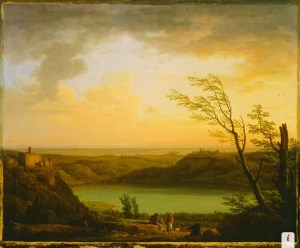
Claude-Joseph Vernet, "View of Lake Nemi," 1748 (Ottawa: National Gallery of Canada)
A revival of interest in the art of landscape was sparked in 1725 when Nicolas Vleughels, who took over as director of the Académie de France in Rome, encouraged young painters to sketch in situ. This desire to breathe new life into the landscape genre resulted in a variety of forms.
Rome and its environs provided painters and draughtsmen in search of picturesque views with a constant source of inspiration. Some artists offered an idyllic, pastoral vision, mixing imagination and reality, while others opted for a more objective portrayal of the land and its inhabitants, carefully reproducing the natural and built environment. During his Roman sojourn (1754–65), Hubert Robert made countless images of the surrounding landscape, building a vast repertoire of motifs. Like other French pensionnaires in the 1740s, he was influenced by the vedutisti Giovanni Paolo Panini and Giovanni Battista Piranesi. The masterful studies of atmospheric effects by Adrien Manglard, Claude-Joseph Vernet and Pierre-Henri de Valenciennes helped to bring landscape to the forefront in the following century.
Art Lovers, Patrons, and Artists

François-André Vincent, "Portrait of Pierre-Jacques-Onésyme Bergeret de Grancourt," 1774 (Besançon: Musée des beaux-arts et d'archéologie)
Rome was a cosmopolitan centre that attracted not only artists of diverse nationalities but also sophisticated sponsors and connoisseurs eager to hone their knowledge. A number of dilettanti emerged as key figures of this lively community, in which the most promising talents of the time flourished.
The well-established artistic relationships linking Paris and Rome were forged primarily through the directors of the Académie de France in Rome and reinforced by visiting amateurs, each with his own set of connections. The diplomatic realm also provided a fertile terrain for exchanges and development of the network.
Art tourists rarely stayed in Rome for more than a few months. They took full advantage of the resources offered by the Académie, which had available a pool of young artists keen to serve as guides. Certain visitors seem to have warranted special attention; the most important was the Marquis de Marigny, future director of the king’s buildings, who was in Rome in 1750–51 in preparation for his upcoming appointment.
Celebrations and Festivities
Jean-Marie Vien, 32 plates Illustrating the "Caravane du Sultan à la Mecque" during the Carnival in Rome, 1748, detail (Ottawa: National Gallery of Canada)
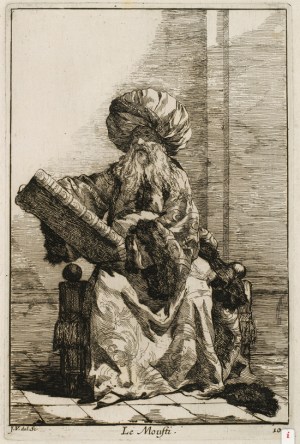
Life in Rome was punctuated by numerous celebrations and festivals, and the French artists made the most of them. Especially memorable were the extraordinary Turkish and Chinese masquerades organized by students at the Académie de France for Rome’s annual carnival. The caricatures produced offer a glimpse into a milieu full of camaraderie.
Various works illustrate the extravagant set pieces, parade floats and fireworks displays conceived for the secular celebrations and religious ceremonies that regularly transformed the city. Among the official ceremonies held to mark political events was the Chinea festival, commemorating the ceding of the kingdom of Naples by Pope Clement IV to Charles of Anjou in 1265. As the new king of Naples, Charles presented the papacy with a white mare known as a chinea (a “hackney” in English). When Naples passed into Spanish hands, the tradition was preserved. Temporary structures made of wood, canvas and stucco were built before the ambassador’s palace. These macchine, inspired by allegorical themes that glorified the kingdom of Naples, were lit up at night by fireworks.
Exhibition & Symposium: Drawings from the Louvre at the Morgan
I noted the show back in February, but I’m afraid tomorrow afternoon’s lecture series nearly slipped by me. From The Morgan:
◊ ◊ ◊ ◊ ◊
David, Delacroix, and Revolutionary France: Drawings from the Louvre
The Morgan Library and Museum, New York, 23 September — 31 December 2011
Curated by Louis-Antoine Prat and Jennifer Tonkovich with assistance from Esther Bell

ISBN: 9780875981598, $40
From the time of the French Revolution of 1789 through the reign of King Louis-Philippe and the establishment of the Second Empire in 1852, an incredible concentration of artistic talent brought its collective skill to bear on one of the most turbulent times in French history. This exhibition features some of the greatest examples of works on paper of the period from Paris’s famed Musée du Louvre. Included are eighty drawings by such noted artists as David, Prud’hon, Ingres, Géricault, Delacroix, and Corot.
Rarely does the Louvre allow such a major group of drawings, with so many iconic works, to travel. The exhibition will offer visitors a singular opportunity to experience the mastery of the era. The Morgan is the only venue for this important show.
David, Delacroix, and Revolutionary France: Drawings from the Louvre is organized by Louis-Antoine Prat, curator in the Department of Graphic Arts at the Musée du Louvre and Jennifer Tonkovich, curator in the Department of Drawings and Prints at The Morgan Library & Museum, with the assistance of Esther Bell, Moore Curatorial Fellow, The Morgan Library & Museum.
◊ ◊ ◊ ◊ ◊
Symposium — Drawing in the Age of Revolutions: New Perspectives
The Morgan Library and Museum, New York, 24 September 2011
This symposium coincides with the exhibition David, Delacroix, and Revolutionary France: Drawings from the Louvre, which offers the American public a rare opportunity to view some of the most celebrated French drawings from the Louvre. Through a series of brief talks, leading scholars will explore the diversity of draftsmanship during the period and present new research in the field. The program will conclude with a gallery conversation with curators and speakers, allowing for a closer examination of works on view.
The Art Market, Drawings Galleries, and Collectors
Louis-Antoine Prat, Curator, Department of Graphic Arts, Musée du Louvre, and Professor, Ecole du Louvre
Between Language and Painting: the Function of Drawing in the Later Work of Jacques-Louis David
Thomas Crow, Rosalie Solow Professor of Modern Art, and Associate Provost for the Arts, Institute of Fine Arts, New York University
The Louvre Drawings: A Cultural Historian’s Perspective
Stéphane Gerson, Associate Professor of French and French Studies, New York University
Drawing’s Stepchild: The Printed Image from David to Delacroix
Patricia Mainardi, Doctoral Program in Art History Graduate Center, City University of New York
In-Gallery Talks:
“Petits Souvenirs de Bonne Amitié”: Drawings and Friendship in Nineteenth-Century France
Esther Bell, Moore Curatorial Fellow, Department of Drawings and Prints, Morgan Library & Museum
Place and Memory in Nineteenth-Century French Drawings
Alison Hokanson, Research Assistant, Department of Drawings and Prints, Metropolitan Museum of Art
Early Dutch Books Online
Hélène Bremer usefully draws our attention to Early Dutch Books Online, which provides free access to more than 10,000 books from the Dutch-speaking region from 1781-1800. The website is available in English, and the texts cover not only Dutch books but also French ones as this was the language of the court. As noted at the site . . .
◊ ◊ ◊ ◊ ◊

James Cook, "Reize rondom de waereld," translated by J.D. Pasteur, 15 vols. + atlas (Leiden, Amsterdam, and The Hague: Honkoop, Allart en Van Cleef, 1799-1803)
Early Dutch Books Online gives full-text access to more than 2 million pages in 10,000 books from the Dutch-speaking region from the period 1781-1800.The project is a collaboration between the Royal Library of the Netherlands and the university libraries of Amsterdam and Leiden. Books from the Special Collections of these libraries have been digitized and made available on word level via this website.
The Amsterdam (UB UVA) and Leiden (UBL) university libraries and the Koninklijke Bibliotheek (KB) possess a large number of similar and complementary Special Collections, which partially overlap (where printed materials are concerned). The expression “Special Collections” is used for a wide variety of materials that are, for any reason whatsoever, rare, expensive and often fragile. Materials from Special Collections are kept in depots equipped with security measures and climate control. They consist of old, printed publications in a wide array of languages from various countries. In addition to printed works, there are also large collections of written materials in the libraries, varying from mediaeval manuscripts, later manuscripts, including scholars’ and artists’ archives, to over a million letters. There are also collections of maps and atlases, prints, photographs, decorated paper, bindings and typographic materials.
Online Library
The Special Collections departments of UB UVA, UBL and the KB launched the initiative “National Infrastructure for Digital Access to Special Collections” in October 2005. This is a plan for an online library for Humanities consisting of fully digitized items from the Special Collections of the institutions involved. Digitizing the various Special Collections from these three libraries, and in time also from other libraries, makes a large quantity of previously mostly inaccessible texts accessible to scholars and for education. Early Dutch Books Online is the first step toward this online library.The importance of digitization of scientific sources is evident. Without source material, research in the Humanities is impossible. Electronic access contributes to the efficiency, effectiveness and reliability of the research and provides opportunities for entirely new types of research. Digitization makes new scientific breakthroughs possible. Te availability of large text corpora is necessary for this. Early Dutch Books Online makes such large files accessible.
Selection Criteria
For Early Dutch Books Online a selection was made of old books from the period 1781 to1800. This selection has been based on the content and practical criteria. For example, books printed in Gothic letters are left out of the selection, because the Optical Character Recognition of this letter doesn’t have the desired result.When the project started, some criteria were established. Not only was the period between 1781 and 1800 very interesting from a Dutch historic standpoint, the books are also very suitable for digitization as regards to their typography. The point in time when books were no longer printed in Gothic typeface but in Roman typeface lies roughly in the final quarter of the seventeenth century for the Netherlands. In the eighteenth century, the ‘modern’ (Roman) type gradually became more predominant. Material printed in Roman is much more suitable for Optical Character Recognition (OCR) than the Gothic material. This is why material printed in the Netherlands in the eighteenth century was selected for this project. Within the eighteenth century, the project limits itself to the period 1781-1800 for the time being. The change to Roman script was as good as completed by then.
Categories
Books categorized in the Short Title Catalogue Netherlands (STCN) consist for a third of governmental publications, academic publications (mainly in Latin) and occasional poems. The interest in these categories is normally not very large. The remaining part, the so called regular works, consists of historical, political, theological, and literary works. This is where this project concentrates on. The majority of the searches by scientist in the STCN focuses on these works.
Language
The emphasis lies on ‘Dutch material’, in other words, printed in the Netherlands or treating of the Netherlands. The Dutch language cannot be employed as a strict selection criterion. Before 1800 books weren’t always printed in Dutch. Universities used Latin, the court spoke French. That is why the project includes both Dutch and French materials.
Exhibition: ‘Infinite Jest’
Now on at the Met:
Infinite Jest: Caricature and Satire from Leonardo to Levine
Metropolitan Museum of Art, New York, 13 September 2011 — 4 March 2012
Curated by Constance McPhee and Nadine Orenstein

ISBN: 9780300175813, $45
The exhibition explores caricature and satire in its many forms from the Italian Renaissance to the present, drawn primarily from the rich collection of this material in the Museum’s Department of Drawings and Prints. The show includes drawings and prints by Leonardo da Vinci, Eugène Delacroix,Francisco de Goya, Henri de Toulouse-Lautrec, and Enrique Chagoya alongside works by artists more often associated with humor, such as James Gillray, Thomas Rowlandson,Honoré Daumier, Al Hirschfeld, and David Levine. Many of these engaging caricatures and satires have never been exhibited and are little known except to specialists. . . .
The second section of the exhibition will explore social satire expressed in works devoted to eating and drinking, gambling, male and female fashion, art, and crowds. The eighteenth and nineteenth centuries are known as the golden age of caricature and satire, with William Hogarth, Gillray, Rowlandson, and George Cruikshank producing lively examples in Britain, and Honoré Daumier and Boilly doing the same in France. These artists cleverly inserted recognizable caricatures into satirical frameworks to mock contemporary society. Extreme fashion provided satirists with an ever-changing source of humor beginning in the 1760s and a selection of sartorial caricatures will be on view. . .
Carol Vogel reviewed the exhibition for The New York Times (12 May 2011).
Exhibition: ‘Capability’ Brown at Compton Verney
From Compton Verney:
‘Capability’ Brown and the Landscapes of Middle England
Compton Verney, Warwickshire, 25 June — 2 October 2011
Curated by Steven Parissien and Tim Mowl
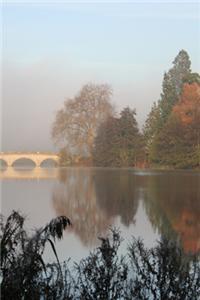 Set in its own ‘Capability’ Brown landscape, Compton Verney is the ideal location for the first-ever exhibition about internationally-renowned landscape designer Lancelot ‘Capability’ Brown (1716-83). This exhibition brings the man and his genius to life through a series of case studies of ‘Capability’ Brown landscapes from the Midlands. It looks at how Brown designed his natural, neoclassical arcadias; how his landscapes were designed to work in practice; how Brown responded to technological advances in shooting and carriage-making; and how he addressed the enormous task of moving tons of earth and creating hills, vales and lakes in an age before tractors or JCBs.
The focus is on famous ‘Capability’ Brown landscapes in the Midlands region, including Croome, Charlecote Park, Combe Abbey and of course Compton Verney itself. It will showcase the very latest research on the design and use of Georgian landscapes with paintings, maps, accounts, historic guns, manuals and specially-
commissioned photography.
The exhibition is curated by Compton Verney’s Director, Georgian expert Dr Steven Parissien, and Professor Tim Mowl, Director of the Landscape and Garden History Centre at the University of Bristol and founding author of Redcliffe Press’s county guides to the Historic Gardens of Britain.
A 27-page gallery guide is available as a PDF file here»
◊ ◊ ◊ ◊ ◊
Laura Mayer, Capability Brown and the English Landscape Garden (Oxford: Shire Publications, 2011), 64 pages, ISBN: 9780747810490, $12.95.
 Laura Mayer presents a concise and colourful introduction to Brown and other leading landscape gardeners of the eighteenth and early nineteenth centuries, such as William Kent, Richard Payne Knight and Humphry Repton. She explores how competing ideas in garden design were shaped both by changes in prevailing fashion and by the innovations of particular designers, and why Brown’s designs are currently considered to be the epitome of landscape gardening in this period.
Laura Mayer is studying for a Ph.D. in eighteenth-century gardens at the university of Bristol under the supervision of Professor Timothy Mowl. She won the 2010 Garden History Society essay prize and is working, with Mowl, on ‘The Historic Gardens of England: Northumberland’.
Reviewed: ‘Re-Reading Leaonardo’
This terrific collection of essays grew out of the 2001 conference The Fortuna of Leonardo da Vinci’s ‘Trattato della Pittura’, held at the Warburg Institute in London. I count myself lucky to have attended. Held just days after the 9/11 bombings (September 13-14), the conference was, as I recall, however, a strange affair — as so much of life was in those days immediately following the attacks — all the more reason to celebrate this accomplished volume. -CH
Recently added to caa.reviews:
Claire Farago, ed., Re-Reading Leonardo: The ‘Treatise on Painting’ across Europe, 1550–1900 (Burlington, VT: Ashgate, 2009), 652 pages, ISBN: 9780754665328, $124.95.
Reviewed by Ellen Prokop, The Frick Art Reference Library; posted 3 August 2011.
This impressive, generously illustrated collection of essays edited by Claire Farago developed from a symposium held in London in 2001 that focused on the historical reception of Leonardo da Vinci’s Trattato della pittura. Twenty-three studies, including introductory remarks and an annotated bibliography, by twenty authors (three scholars make multiple contributions) examine the transnational fortune of the treatise and consider Leonardo’s influence on the institutionalization of artistic production in early modern Europe. The focus on reception leads to consideration of fundamental issues regarding Leonardo’s legacy, such as the development of the modern conception of artistic genius, as well as broader concerns, such as the disciplinization of art history. By positing Leonardo’s influence instead of his reputation as the “historical phenomena” (3), the essays systematically problematize the constitution of that reputation. As Farago states: “An historical practice that focuses on the author’s identity without attending to the construction of identity per se, is blind to its own modes of knowledge production” (4). . . .
The full review is available here» (CAA membership required)
◊ ◊ ◊ ◊ ◊
While many of the contributions are relevant for the eighteenth century; these essays address the period directly:
•Thomas Willette, “The First Italian Publication of the Treatise on Painting: Book Culture, the History of Art, and the Naples Edition of 1733″
•Thomas Kirchner, “Between Academicism and Its Critics: Leonardo da Vinci’s Traité de la Peinture and 18th-century French Art Theory”
•Javier Navarro de Zuvillaga, “The Trattato in 17th- and 18th-century Spanish Perspective and Art Theory”
•Richard Woodfield, “The 1721 English Treatise of Painting: A Masonic Moment in the Culture of Newtonianism”
•Geoff Quilley, “The Trattato della Pittura and Leonardo’s Reputation in 18th-century British Art and Aesthetics”










leave a comment