New Historical Fiction | The Glassmaker and The Instrumentalist
From Penguin Random House:
Tracy Chevalier, The Glassmaker: A Novel (New York: Viking, 2024), 416 pages, ISBN: 978-0525558279, $32.
 From the bestselling historical novelist, a rich, transporting story that follows a family of glassmakers from the height of Renaissance-era Italy to the present day
It is 1486 and Venice is a wealthy, opulent center for trade. Orsola Rosso is the eldest daughter in a family of glassblowers on Murano, the island revered for the craft. As a woman, she is not meant to work with glass—but she has the hands for it, the heart, and a vision. When her father dies, she teaches herself to make glass beads in secret, and her work supports the Rosso family fortunes. Skipping like a stone through the centuries, in a Venice where time moves as slowly as molten glass, we follow Orsola and her family as they live through creative triumph and heartbreaking loss, from a plague devastating Venice to Continental soldiers stripping its palazzos bare, from the domination of Murano and its maestros to the transformation of the city of trade into a city of tourists. In every era, the Rosso women ensure that their work, and their bonds, endure. Chevalier is a master of her own craft, and The Glassmaker is as inventive as it is spellbinding: a mesmerizing portrait of a woman, a family, and a city as everlasting as their glass.
Tracy Chevalier is the New York Times bestselling author of ten previous novels, including Girl with a Pearl Earring, which has been translated into forty-five languages and made into an Oscar-nominated film, a play, and an opera. Born and raised in Washington, DC, she lives in London with her husband.
◊ ◊ ◊ ◊ ◊
From Simon & Schuster:
Harriet Constable, The Instrumentalist (New York: Simon & Schuster, 2024), 336 pages, ISBN: 978-1668035825, $28.
 A stunning debut novel of music, intoxication, and betrayal inspired by the true story of Anna Maria della Pietà, a Venetian orphan and violin prodigy who studied under Antonio Vivaldi and ultimately became his star musician—and his biggest muse
Anna Maria della Pietà was destined to drown in one of Venice’s canals. Instead, she became the greatest violinist of the 18th century. Anna Maria has only known life inside the Pietà, an orphanage for children born of prostitutes. But the girls of the Pietà are lucky in a sense: most babies born of their station were drowned in the city’s canals. And despite the strict rules, the girls are given singing and music lessons from an early age. The most promising musicians have the chance to escape the fate of the rest: forced marriage to anyone who will have them. Anna Maria is determined to be the best violinist there is—and whatever Anna Maria sets out to do, she achieves. After all, the stakes for Anna could not be higher. But it is 1704 and she is a girl. The pursuit of her ambition will test everything she holds dear, especially when it becomes clear that her instructor, Antonio Vivaldi, will teach Anna everything he knows—but not without taking something in return.
Harriet Constable is an award-winning journalist and filmmaker living in London. She has written for The New York Times, The Economist, and the BBC, and is a grantee of the Pulitzer Center and a fellow of the Royal Society of Arts. She grew up playing the flute and piano and singing with her mother, a classically trained pianist and singer. The Instrumentalist is her debut novel.
Écrans, 2024: William Hogarth et le cinéma
From Classiques Garnier, where individual articles are also available for purchase:
Marie Gueden and Pierre Von-Ow, ed., Écrans, Nr. 20: William Hogarth et le cinéma (Paris: Garnier, 2024), 295 pages, French and English, ISBN: 978-2406169727, €25.
 This special issue of Écrans explores the largely overlooked and unexpected connections between William Hogarth and cinema. Frequently mentioned in passing, these links are thoroughly examined here by art historians, film and literary scholars, and a filmmaker. The collection addresses various crucial themes (such as narrative serialization, visual dynamics, and socio-cultural aspects), aiming to showcase the historical significance, artistic richness, and contemporary relevance of the relationship between Hogarth and cinema.
Marie Gueden holds a PhD in film studies from Université Paris 1 Panthéon-Sorbonne. Associate researcher at the Institut ACTE (Université Paris 1 – Panthéon-Sorbonne) and Passages XX-XXI (Université Lumière Lyon 2), lecturer at ENS Lyon and Université Sorbonne Nouvelle-Paris 3, she has published several articles, including studies on Sergei M. Eisenstein and William Hogarth.
Pierre Von-Ow recently received his PhD in History of Art from Yale University. His research focuses primarily on the intersections of arts and sciences in the early modern period. Among his recent projects, he curated in 2022 the virtual exhibition William Hogarth’s Topographies for The Lewis Walpole Library.
s o m m a i r e
• Marie Gueden et Pierre Von-Ow — Introduction: William Hogarth et le cinéma
I Sérialisation narrative et genres / Narrative Serialization and Genres
• Kate Grandjouan — Virtual witnessing in A Harlot’s Progress (1732). Hogarth’s visio-crime media
• Marie Gueden — Progress hogarthien et continuité narrative et morale aux États-Unis. Du pré-cinéma au cinéma des années 1930
• Brian Meacham and Yvonne Noble — An early film adaptation of Henry Fielding’s Tom Jones at Yale University
II Image et mouvement / Image and Movement
• Marie Gueden — « Hogarthisme » outre-Atlantique. Du tournant du XXe siècle aux années 1920–1930
• Marion Sergent — Sur la serpentine. Hogarth et l’abstraction musicaliste de Janin, Béothy et Valensi
• Jordi Xifra — Luis Buñuel, cinéaste hogarthien
• Théo Esparon — Beauté, glamour, baroque dans La Femme et le pantin (1935) de Josef von Sternberg
III Revoir Hogarth / Re-Viewing Hogarth
• Jean-Loup Bourget — Hogarth au cinéma, indice d’anglicité ?
• Pierre Von-Ow — Hogarth through a camera. Bedlam from print to film
• Enrico Camporesi — De Southwark Fair à Tom, Tom, the Piper’s Son. Cinéma des origines et origines du cinéma
• Mike Leigh on Hogarth, Interview by Pierre Von-Ow
Annexes / Appendices
1 Angles and Pyramids (1936)
2 Pierre Kast — De la parodie de « Paméla » à « Tom Jones ». L’Angleterre georgienne, scénario de Henry Fielding, réalisation de Hoggarth (1948)
Filmographie
Résumés / Abstracts
New Book | Art and Its Geographies: Configuring Schools of Art
This volume of essays grew out of a June 2019 conference; from Amsterdam UP:
Ingrid Vermeulen, ed., Art and Its Geographies: Configuring Schools of Art in Europe, 1550–1815 (Amsterdam: Amsterdam University Press, 2024), 470 pages, ISBN: 978-9463728140, €159. An ebook as a PDF file is available for free.
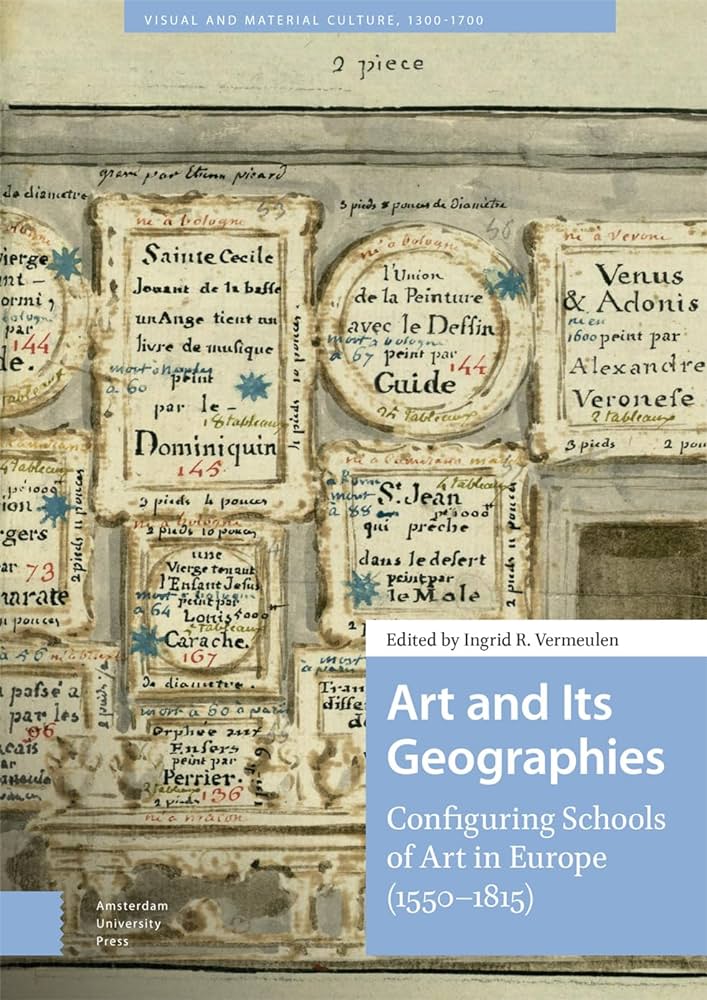 Schools of art represent one of the building blocks of art history. The notion of a school of art emerged in artistic discourse and disseminated across various countries in Europe during the early modern period. Whilst a school of art essentially denotes a group of artists or artworks, it came to be configured in multiple ways, encompassing different meanings of learning, origin, style, or nation, and mediated in various forms via academies, literature, collections, markets, and galleries. Moreover, it contributed to competitive debate around the hierarchy of art and artists in Europe. The ensuing fundamental instability of the notion of a school of art helped to create a pluriform panorama of both distinct and interconnected artistic traditions within the European art world. This edited collection brings together 20 articles devoted to selected case studies from the Italian peninsula, the Low Countries, France, Spain, England, the German Empire, and Russia.
Ingrid R. Vermeulen is Associate Professor of Early-Modern Art History at Vrije Universiteit Amsterdam. Her research focuses on the early-modern history of art history grounded in art literature, collections, and museums. It generated the book Picturing Art History (2010) and the project The Artistic Taste of Nations (2015) funded by the Dutch Research Council (NWO).
c o n t e n t s
Introduction
• Art and Its Geographies, 1550–1815: Configuring Schools of Art in Europe — Ingrid Vermeulen
Academies of Art, Churches, and Collective Artistic Identities
• Notions of Nationhood and Artistic Identity in Sixteenth- and Seventeenth-Century Rome — Susanne Kubersky-Piredda
• A Failed Attempt to Establish a Spanish Art Academy in Rome (1680): A New Reading of Archival Documents — Maria Onori
• Mantua: A School of History and Heritage (1752–1797) — Ludovica Cappelletti
Art Literature, Artists, and Transnational Identities
• Conceptualizing Schools of Art. Giovanni Battista Agucchi’s (1570–1632) Theory and Its Afterlife — Elisabeth Oy-Marra
• Claimed by All or Too Elusive to Include: The Appreciation of Mobile Artists by Netherlandish Artists’ Biographers — Marije Osnabrugge
• The Galeriewerk and the Self-Fashioning of Artists at the Dresden Court — Ewa Manikowska
Drawings, Connoisseurship, and Geography
• Padre Sebastiano Resta (1635–1714) and the Italian Schools of Design — Simonetta Prosperi Valenti Rodinò
• Connoisseurship Beyond Geography: Some Puzzling Genoese Drawings from Filippo Baldinucci’s (1624–1696) Personal Collection — Federica Mancini
• Arthur Pond’s (1705–1758) Prints in Imitations of Drawings (1734–1736): Old Masters, Copies, and the National School in Early Eighteenth-Century Britain — Sarah W. Mallory
Taste and Genius of Nations
• ‘Taste of Nations’: Roger de Piles’ (1635–1709) Diplomatic Take on the European Schools of Art — Ingrid Vermeulen
• How Do Great Geniuses Appear in a Nation? A Political Problem for the Enlightenment Period — Pascal Griener
Prints, Collecting, and Classification
• Dezallier d’Argenville’s (1680–1765) Concept of a Print Collection: by Topic or by School? – Gaëtane Maës
• Michael Huber’s (1727–1804) Notices (1787) and Manuel (1797–1808): A Comparative Analysis of the French School of the Eighteenth Century — Véronique Meyer
• Chronology and School: Questioning Two Competing Criteria for the Classification of Print Collections around 1800 — Stephan Brakensiek
Art Markets: Selling and Collecting
• The Eighteenth-Century Art Market and the Northern- and Southern-Netherlandish Schools of Painting: Together or Apart? — Everhard Korthals Altes
• The Print Collector Pieter Cornelis van Leyden (1717–1788): Literature of Art, Concepts of School, and the Genesis of a Connoisseur — Huigen Leeflang
• The Problem of European Painting Schools in the Context of the Russian Enlightenment: Alexander Stroganoff (1733–1811) and his Catalogue (1793, 1800, 1807) — Irina Emelianova
On Public Display in Picture Galleries
• Everyman’s Aesthetic Considerations on a Visible History of Art: Joseph Sebastian von Rittershausen’s (1748–1820) Betrachtungen (1785) on Christian von Mechel’s (1737–1817) Work at the Imperial Picture Gallery in Vienna — Cecilia Hurley
• An Organisation by Schools Considered Too Commercial for the Newly Founded Louvre Museum — Christine Godfroy-Gallardo
• Scuole Italiane or Scuola Italiana? Art Display, Historiography, and Cultural Nationalism in the Pinacoteca Vaticana after 1815 — Pier Paolo Racioppi
Contributors
Illustration Credits
Index
New Book | Outposts of Diplomacy
Distributed by The University of Chicago Press for Reaktion Books:
G. R. Berridge, Outposts of Diplomacy: A History of the Embassy (London: Reaktion Books, 2024), 256 pages, ISBN: 978-1789148497, £25 / $35.
 A profusely illustrated history of the diplomatic embassy, from antiquity to today.
This compelling history traces the evolution of the embassy, from its ancient origins to its enduring presence in the modern world. Beginning with its precursors in antiquity, the book explores the embassy’s emergence on the cusp of the Italian Renaissance, its pinnacle during the nineteenth century, and its navigation through the challenges of twentieth-century conference diplomacy. G. R. Berridge investigates how this European institution adapted its staffing, architecture, and communication methods to changing international landscapes, including the tumultuous wars of religion and encounters in the Far East. He also describes the expansion of the embassy’s responsibilities, such as providing diplomatic cover for intelligence operations. Infused with vibrant anecdotes of remarkable individuals and the creation of influential family dynasties, and illustrated throughout, this book offers a fascinating exploration of the embassy’s rich history.
G. R. Berridge is professor emeritus of international politics at the University of Leicester and a senior fellow of the Geneva-based DiploFoundation. He was associate editor of the Oxford Dictionary of National Biography, to which he still contributes, and his most recent book is the sixth edition of Diplomacy: Theory and Practice.
c o n t e n t s
Preface
Introduction
1 Fifteenth-Century Beginnings
2 Expanding Duties
3 Household and Buildings
4 Pre-Telegraphic Communications
5 Nineteenth-Century Highpoint
6 Enter the Americas
7 The Middle East and Africa
8 Far Eastern Compounds
9 Backseat after the First World War
10 Stubborn Institution
Epilogue
Bibliography
Acknowledgements
Photo Acknowledgements
Index
New Book | Strangers Within
From Princeton UP:
Francisco Bethencourt, Strangers Within: The Rise and Fall of the New Christian Trading Elite (Princeton: Princeton University Press, 2024), 624 pages, ISBN: 978-0691209913, $45 / £38.
A comprehensive study of the New Christian elite of Jewish origin—prominent traders, merchants, bankers, and men of letters—between the fifteenth and eighteenth centuries
 In Strangers Within, Francisco Bethencourt provides the first comprehensive history of New Christians, the descendants of Jews forced to convert to Catholicism in late medieval Spain and Portugal. Bethencourt estimates that there were around 260,000 New Christians by 1500—more than half of Iberia’s urban population. The majority stayed in Iberia but a significant number moved throughout Europe, Africa, the Middle East, coastal Asia, and the New World. They established Sephardic communities in North Africa, the Ottoman Empire, Italy, Amsterdam, Hamburg, and London. Bethencourt focuses on the elite of bankers, financiers, and merchants from the fifteenth to the eighteenth centuries and the crucial role of this group in global trade and financial services. He analyses their impact on religion (for example, Teresa de Ávila), legal and political thought (Las Casas), science (Amatus Lusitanus), philosophy (Spinoza), and literature (Enríquez Gomez).
Drawing on groundbreaking research in eighteen archives and library manuscript departments in six different countries, Bethencourt argues that the liminal position in which the New Christians found themselves explains their rise, economic prowess, and cultural innovation. The New Christians created the first coherent legal case against the discrimination of a minority singled out for systematic judicial inquiry. Cumulative inquisitorial prosecution, coupled with structural changes in international trade, led to their decline and disappearance as a recognizable ethnicity by the mid-eighteenth century. Strangers Within tells an epic story of persecution, resistance, and the making of Iberia through the oppression of one of the most powerful minorities in world history. Packed with genealogical information about families, their intercontinental networks, their power, and their suffering, it is a landmark study.
Francisco Bethencourt is the Charles Boxer Professor of History at King’s College London. He is the author of Racisms: From the Crusades to the Twentieth Century (Princeton) and The Inquisition: A Global History, 1478–1834.
New Book | An Economy of Strangers
From Penn Press:
Avinoam Yuval-Naeh, An Economy of Strangers: Jews and Finance in England, 1650–1830 (Philadelphia: University of Pennsylvania Press, 2024), 264 pages, ISBN: 978-1512825053, $65.
 One of the most persistent, powerful, and dangerous notions in the history of the Jews in the diaspora is the prodigious talent attributed to them in all things economic. From the medieval Jewish usurer through the early-modern port-Jew and court-Jew to the grand financier of the nineteenth and twentieth centuries and contemporary investors, Jews loom large in the economic imagination. For capitalists and Marxists, libertarians and radical reformers, Jews are intertwined with the economy. This association has become so natural that we often overlook the history behind the making and remaking of the complex cluster of perceptions about Jews and economy, which emerged within different historical contexts to meet a variety of personal and societal anxieties and needs.
In An Economy of Strangers, Avinoam Yuval-Naeh historicizes this association by focusing on one specific time and place—the financial revolution that England underwent from the late seventeenth century that coincided with the reestablishment of the Jewish population there for the first time in almost four hundred years. European Christian societies had to that point shunned finance and constructed a normative system to avoid it, relying on the figure of the Jew as a foil. But as the economy modernized in the seventeenth century, finance became the hinge of national power. Finance’s rise in England provoked intense national debates. Could financial economy, based on lending money on interest, be accommodated within Christian state and society when it had previously been understood as a Jewish practice?
By projecting the modern economy and the Jewish community onto each other, the Christian majority imbued them with interrelated meanings. This braiding together of parallel developments, Yuval-Naeh argues, reveals in a meaningful way how the contemporary and wide-ranging association of Jews with the modern economy could be created.
Avinoam Yuval-Naeh is a post-doctoral fellow at the University of Haifa. He is the author of articles in The Journal of Early Modern History and Historia. This is his first book.
New Book | The Art of Naval Portraiture
From Royal Museums Greenwich:
Katherine Gazzard, The Art of Naval Portraiture (Greenwich: National Maritime Museum, 2024), 224 pages, ISBN: 978-1739154202, £30 / $45.
 From elite officers to ordinary sailors, the portrayal of naval personnel has been a significant branch of British art for over 500 years. The National Maritime Museum, Greenwich holds the largest collection of naval portraits in the world, including over 600 paintings and many more prints and drawings, spanning from the sixteenth century to the present day. These portraits reveal how the Royal Navy was viewed at different moments in history and grant us access to individual stories, revealing the concerns and aspirations of people and families caught up in naval affairs. Many are also innovative and important works of art. For centuries, naval portraits have forged, reinforced, and challenged ideas of gender, heroism, and loyalty. They have functioned as icons of empire, demonstrations of professionalism, and personal mementos for loved ones. While charting the historical evolution of the Royal Navy’s image and explaining the meaning of common naval symbols—from anchors, cannons, and swords to uniforms, medals, and badges—this book also tells the stories of specific artists, sitters, and collectors, and of the places where portraits were made and displayed, from private homes to public exhibitions, and ultimately the museum itself.
Katherine Gazzard is the Curator of Art (post-1800) at Royal Museums Greenwich. She has taught courses on art history and museum studies for the University of East Anglia and Yale University. Her research focuses on eighteenth-century British art, especially portraiture and the cultural history of the Royal Navy.
New Book | Tracks on the Ocean
Coming this fall, from The University of Chicago Press:
Sara Caputo, Tracks on the Ocean: A History of Trailblazing, Maps, and Maritime Travel (Chicago: The University of Chicago Press, 2024), 352 pages, ISBN: 978-0226837925, $38.
An engaging look at ocean routes’ complicated beginnings and elusive impact.
 Sara Caputo’s Tracks on the Ocean is a sweeping history of how we have understood routes of travel over the ocean and how we came to represent that movement as a cartographical line. Focusing on the representation of sea journeys in the Western world from the early sixteenth century to the present, Caputo deftly argues that the depiction of these lines is inextricable from European imperialism, the rise of modernity, and attempts at mastery over nature. Caputo recounts the history of ocean tracks through an array of lively stories and characters, from the expeditions of Captain James Cook in the eighteenth century to tracks depicted in Moby Dick and popular culture of the nineteenth century to the use of navigational techniques by the British navy. She discusses how tracks evolved from tools of surveying into tools of surveillance and, eventually, into paths of environmental calamity. The impulse to record tracks on the ocean is, Caputo argues, reflective of an ongoing desire for order, schematization, and personal visibility, as well as occupation and permanent ownership—in this case over something that is unoccupiable and impossible to truly possess. Both beautifully written and deeply researched, Tracks on the Ocean shares how the lines drawn on maps tell the audacious and often tragic and violent stories of ocean voyages.
Sara Caputo is a senior research fellow and director of studies in history at Magdalene College, University of Cambridge. She is the author of Foreign Jack Tars: The British Navy and Transnational Seafarers during the Revolutionary and Napoleonic Wars.
New Book | Denmark Vesey’s Bible
Having first appeared from Princeton UP in 2022, the book was released in paperback this spring (the hardcover edition is included in the press’s 50% off sale, which ends May 31).
Jeremy Schipper, Denmark Vesey’s Bible: The Thwarted Revolt That Put Slavery and Scripture on Trial (Princeton: Princeton University Press, 2022), 216 pages, ISBN: 978-0691192864 (hardcover), $27 / ISBN: 978-0691259314 (paperback), $19.
 On July 2, 1822, Denmark Vesey, a formerly enslaved man, was hanged in Charleston, South Carolina. He was convicted of plotting what might have been the largest insurrection against slaveholders in US history. Witnesses claimed that Vesey appealed to numerous biblical texts to promote and justify the revolt. While sentencing Vesey to death, Lionel Henry Kennedy, a magistrate at the trial, accused Vesey not only of treason but also of “attempting to pervert the sacred words of God into a sanction for crimes of the blackest hue.” Denmark Vesey’s Bible tells the story of this momentous trial, examining the role of scriptural interpretation in the deadly struggle against American white supremacy and its brutal enforcement.
Jeremy Schipper brings the trial and its aftermath vividly to life, drawing on court documents, personal letters, sermons, speeches, and editorials. He shows how Vesey compared people of African descent with enslaved Israelites in the Bible, while his accusers portrayed plantation owners as benevolent biblical patriarchs responsible for providing religious instruction to the enslaved. What emerges is an explosive portrait of an antebellum city in the grips of racial terror, violence, and contending visions of biblical truth. Shedding light on the uses of scripture in America’s troubled racial history, Denmark Vesey’s Bible draws vital lessons from a terrible moment in the nation’s past, enabling us to confront racism and religious discord today with renewed urgency and understanding.
Jeremy Schipper is professor in the Departments for the Study of Religion and Near and Middle Eastern Civilizations at the University of Toronto. Recipient of a Guggenheim Fellowship, he is the coauthor, with Nyasha Junior, of Black Samson: The Untold Story of an American Icon and the author of Disability and Isaiah’s Suffering Servant and Parables and Conflict in the Hebrew Bible. He lives in Toronto.
Exhibition | Growing and Knowing in the Gardens of China
From the press release for the exhibition (7 March 2024) . . .
奪天工 Growing and Knowing in the Gardens of China
The Huntington Library, Art Museum, and Botanical Gardens, San Marino, 14 September 2024 — 6 January 2025
A new exhibition at The Huntington Library, Art Museum, and Botanical Gardens will explore the potential of gardens as spaces that not only delight the senses and nourish the body but also inspire the mind—both intellectually and spiritually. The literati during China’s Ming (1368–1644) and Qing (1644–1912) dynasties believed gardens resulted in more ethical connections to all living things. On view in the Chinese Garden’s Studio for Lodging the Mind from 14 September 2024 to 6 January 2025, 奪天工 Growing and Knowing in the Gardens of China will exhibit 24 objects, including hanging scrolls, hand scrolls, albums, and books from The Huntington’s collections and those throughout the United States. The exhibition will also feature a participatory artwork by contemporary Chinese artist Zheng Bo that was commissioned by The Huntington.
Growing and Knowing and the Huntington exhibition Storm Cloud: Picturing the Origins of Our Climate Crisis will run concurrently as part of PST ART: Art & Science Collide, a regional event presented by Getty featuring more than 60 exhibitions and programs that explore the intersections of art and science, both past and present.
Growing and Knowing will present three key themes: ‘Growing’, ‘Knowing’, and ‘Being’.
Growing
The introductory section to the exhibition, ‘Growing’, will focus on historical horticultural practices in China, many of which are still practiced today. Chinese scholars and gardeners experimented with domestication, grafting, and hybridization to create unusual cultivars (new varieties of plants developed through human intervention). Throughout the Ming and Qing dynasties, these techniques were well documented in horticultural manuals. Some of these books—such as The Secretly Transmitted Mirror of Flowers, completed by Chen Hao 陳淏 (1615–1703) in 1688—remained popular instructional guides in China into the 20th century. The well-known chrysanthemum flower exists as a result of hybridization experiments conducted by scholars and gardeners. Visitors will have the opportunity to view chrysanthemums in full bloom just outside of the exhibition walls in The Huntington’s Chinese Garden. Reproductions of gardening tools from the period will also be displayed.
Knowing
The second section, ‘Knowing’, will present a diverse selection of books and paintings from the Ming and Qing dynasties, showcasing the multiple ways that scholars thought about the plants they cultivated. “The works selected for ‘Knowing’ specifically highlight scholars’ understanding of plants as food, sources of emergency sustenance and pharmaceuticals, and keys to classical literature,” said exhibition curator Phillip E. Bloom, The Huntington’s June and Simon K.C. Li Curator of the Chinese Garden and Director of the Center for East Asian Garden Studies. A subtheme of the section will touch on the era’s hierarchies of knowledge—specifically how scholars’ intellectual knowledge of plants was valued over gardeners’ direct, physical knowledge. Gardeners’ bodily insights were largely ignored in historical texts, but they were revealed in visual sources. For example, the Ming dynasty painting Garden for Solitary Pleasure (17th century) shows a scholar lying deep in thought among bamboo and other trees, as nearby laborers bend over plants and carry tools to cultivate the scholar’s garden.
Being
Chinese scholars did not grow and learn about plants just for knowledge’s sake. Growing and knowing were means for them to better understand their place in the world and learn to interact more ethically with other creatures. The last section of the exhibition, ‘Being’, will explore these practices of self-cultivation. “In order to truly understand how nature works, scholars not only contemplated plants but also engaged with and learned from them,” Bloom said. “Caring for plants, observing their habits, taking pleasure in their forms, and ultimately recognizing their commonalities with humans were, in essence, practices whereby people may perfect themselves.” Pursuits of a Scholar, an 18th-century Qing dynasty painting album, dedicates several leaves to the different ways that scholars interacted with plants. One leaf shows a scholar writing observations of a bamboo plant in his study, while another depicts a scholar caring for chrysanthemums.
Ecosensibility Exercise: Fragrant Eight-Section Brocade 生態感悟練習: 聞香八段錦 by Zheng Bo
To invite visitors to develop their own meaningful relationships with their natural surroundings, The Huntington has commissioned the participatory artwork Ecosensibility Exercise: Fragrant Eight-Section Brocade by Hong Kong–based artist Zheng Bo. Fragrant Eight-Section Brocade is inspired by the traditional Chinese mind-body practice qigong 氣功. Building on exercises that date back nearly 900 years and remain widely practiced today, Zheng’s work includes eight exercises that combine simple full-body movements and deep breathing to activate the mind and body. Each exercise is performed with a fragrant plant, encouraging the participants to develop a human-plant connection. Visitors to the exhibition can perform the exercises on their own throughout The Huntington’s gardens at marked stops chosen by the artist. A film documenting the eight exercises will be shown in the gallery. The Huntington is also planning a series of public programs in which the artist will guide visitors through his reinterpreted movements.
Exhibition Catalog
The Huntington will publish an open-access digital catalog edited by Phillip E. Bloom, Nicholas K. Menzies (research fellow in The Huntington’s Center for East Asian Garden Studies), and Michelle Bailey (assistant curator for the Center for East Asian Garden Studies). The book will include seven essays, 16 catalog entries by various scholars, and a conversation with artist Zheng Bo. A paperback version of the catalog will be available at the Huntington Store.
This exhibition is made possible with support from Getty through its PST ART: Art & Science Collide initiative.










leave a comment