New Book | Picturing Animals in Early Modern Europe
An early modern story, concluding with late 17th-century France—and entirely relevant to the 18th century. From Brepols:
Sarah Cohen, Picturing Animals in Early Modern Europe: Art and Soul (London: Harvey Miller, 2022), 296 pages, ISBN: 978-1912554324, €150.
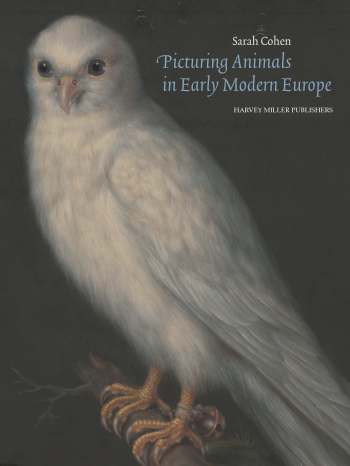 Do animals other than humans have consciousness? Do they knowingly feel and think, rather than simply respond to stimuli? Can they be said to have their own subjectivity? These questions, which are still debated today, arose forcefully in Europe during the sixteenth and seventeenth centuries, when empirical approaches to defining and studying the natural world were coming to the fore. Philosophers, physicians and moralists debated the question of whether the immaterial ‘soul’—which in the early modern era encompassed all forms of thought and subjective experience—belonged to the human mind alone, or whether it could also exist in the material bodies of nonhuman animals.
This book argues that early modern visual art offers uniquely probing and nuanced demonstrations of animal consciousness and agency. The questions that impelled the early modern debates over animal soul are used as a guide to examine a range of works produced in different media by artists in Germany, the Netherlands, northern Italy, and France. Manipulating the matter of their respective mediums, artists emphasized animals’ substantial existence, and a number of them explicitly connected their own role as painters, sculptors, or graphic artists with the life force of animal matter. As nature’s protagonists, the animals in these artworks assume many different kinds of roles, often quite subtle and hard to construe. When studied as a group, they offer striking insight into how early moderns struggled to define and depict the animal ‘soul’.
Sarah R. Cohen is Professor of Art History and Women’s Studies and Chair of the Department of Art and Art History at the University at Albany, SUNY. Her interdisciplinary research explores the body as it has been configured, performed and understood in early modern European culture. Her books include Art, Dance and the Body in French Culture of the Ancien Régime (2000) and Enlightened Animals in Eighteenth-Century Art: Sensation, Matter, and Knowledge (2021).
c o n t e n t s
Acknowledgments
Introduction
Part I: Nature’s Protagonists
Introduction
1 The Sensitive Soul
2 Matter into Life
3 Titian’s Characters
4 Montaigne and the Earthly Paradise
Part II: Animal Drama in the Netherlands
Introduction
5 Exemplary Animal Lives
6 The Debate Over Animal Soul
7 Life and Death
Part III: The Courtly Animal
Introduction
8 Animals in the Salon
9 Animals at Versailles
10 Interspecies Transformations
Conclusion
Notes
Call for Essays | Animal Preservation before 1850
From ArtHist.net, which includes the German version of the CFP:
‘Weder Fisch noch Fleisch’: Animal Preservation before 1850 in Theory and Practice
‘Weder Fisch noch Fleisch’: Tierpräparation vor 1850 in Theorie und Praxis
Volume of essays edited by Dorothee Fischer and Robert Bauernfeind
Proposals due by 31 May 2024, with final essays due by 15 November 2024
The volume ‘Weder Fisch noch Fleisch’ will explore the theory and practice of animal preparation prior to 1850. The book project focuses thus on animal preparations made before the modernization of taxidermy around the middle of the 19th century. While taxidermied objects themselves are irritating in their semantic ambivalence of being both the animal itself and its representation, early modern animal preparation often underwent a further distortion: It was susceptible to deformation due to inadequate conservation methods and created less evidence of the animals’ appearance rather than developing its own momentum as an aesthetic object. Neglect of historical specimens in modern collections contributed to the continuation of this momentum right up to the present day. Damage, deformation, and discolouration can often be observed on the—relatively few—preserved pre-modern specimens. However, both unintentional and deliberate deformations of the specimens contributed to the idea of the ‘nature’ of the respective animals since specimens formed the basis of early modern natural history collections in the 16th century.
In line with these observations, the volume aims to interpret historical specimens not only as objects of the history of both science and collecting, but also in terms of their distinct aesthetics and as sources of insights into (historical) human-animal relationships. In this way, the topic responds to current impulses from various research discourses, promoting interdisciplinary research. While these objects have recently been increasingly addressed from the perspective of collection history, questions about the taxidermied animal as an aesthetic object and trace of the living animal, further bridges the topic to questions of Visual Studies and Human-Animal Studies. From a Human-Animal Studies perspective, deceased yet materially preserved animals still receive less attention than living ones, despite their comparable impact on the relationship between humans and non-human animals. Also, questions about the ‘biographies’ of individual specimens are often a desideratum. Moreover, the exact practices of animal preparation before 1850 have only been marginally examined. The contributions of this volume aim to fill these gaps.
Topics for contributions could encompass, for example, preparation methods, preserved specimens, and their contribution to knowledge production. How do early preparations straddle naturalist interest and artistic craftsmanship? How do these procedures differ from subsequent centuries, and what insights do these objects offer into historical and contemporary human-animal relationships? A workshop held at the University of Trier in the summer of 2022 ignited the dialogue among perspectives from the humanities and natural history museum practice. The volume positions itself as a continuation of this exchange and a deepening of the interdisciplinary examination of early animal preparation. We welcome contributions not only from scholars in cultural studies, art history, and the history of science and knowledge, but also from practitioners of the trade and museum professionals, as well as individuals from other disciplines and perspectives.
Prospective contributors are invited to submit an abstract (maximum of 350 words) and a brief biography via email to the editors, Dorothee Fischer (fischerd@uni-trier.de) and Robert Bauernfeind (robert.bauernfeind@philhist.uni-augsburg.de) by 31 May 2024. Abstracts and contributions may be presented in either English or German. Feedback on our decision will be provided by the end of June 2024. The submission date of the complete contribution (with up to 40,000 characters and 3–4 illustrations) is 15 November 2024. The publication is planned for 2025.
The Magazine of the Decorative Arts Trust, Winter 2023–24
The Decorative Arts Trust has shared select articles from the winter issue of their member magazine as online articles for all to enjoy. The following articles are related to the 18th century:
The Magazine of the Decorative Arts Trust, Winter 2023–24
 • Catherine Carlisle , “Inspiring Thomas Jefferson: Art and Architecture in France” Link»
• Matthew A. Thurlow, “Papered and Painted in Providence” Link»
• Charles Dawson, “The Finest Regency Porcelain Painter: Thomas Baxter in Worcester” Link»
• Philip D. Zimmerman, “Historic Odessa Collections Published” Link»
• Reed Gochberg, “Interwoven: Women’s Lives Written in Thread” Link»
• Kaila Temple, “‘A Place to Cultivate Her Mind in by Musing’: New Exploration of Anne Emlen’s 1757 Shellwork Grotto” Link»
• Laura Ochoa Rincon, “A Million Hidden Stories: Uncovering Materials at the New Orleans Museum of Art” Link»
• Laura C. Jenkins, “French Interiors for an American Gilded Age” Link»
• Alyse Muller, “18th-Century Marine Imagery in the Sèvres Archive” Link»
The printed Magazine of the Decorative Arts Trust is mailed to Trust members twice per year. Memberships start at $50, with $25 memberships for students.
Pictured: The magazine cover features the front parlor of the Rhode Island Historical Society’s John Brown House, which contains a Providence-made nine-shell desk and bookcase (1760–80) flanked by variants of Providence-made Neoclassical side chairs (1785–1800). The wallpaper is a 1975 reproduction by the Birge Co. of Buffalo, NY, based on a 1790s French example.
New Book | The Art of Cooking
Montiño’s cookbook appeared in new editions throughout the 17th and 18th centuries. Carolyn Nadeau’s English translation was just published in November. Her Instagram account is immense fun (and I’m grateful to Ivan Day for noting it on his account). –CH
From the University of Toronto Press:
Carolyn Nadeau, edited and translated, Francisco Martínez Montiño, The Art of Cooking, Pie Making, Pastry Making, and Preserving: Arte de cocina, pastelería, vizcochería y conservería (Toronto: University of Toronto Press, 2023), 760 pages, $150. Bilingual edition.
 In 1611 Francisco Martínez Montiño, chef to Philip II, Philip III, and Philip IV of Spain, published what would become the most recognized Spanish cookbook for centuries: Arte de cocina, pastelería, vizcochería y conservería. This first English translation of The Art of Cooking, Pie Making, Pastry Making, and Preserving will delight and surprise readers with the rich array of ingredients and techniques found in the early modern kitchen. Based on her substantial research and hands-on experimentation, Carolyn Nadeau reveals how early cookbooks were organized and read and presents an in-depth analysis of the ingredients featured in the book. She also introduces Martínez Montiño and his contributions to culinary history, and provides an assessment of taste at court and an explanation of regional, ethnic, and international foodstuffs and recipes. The 506 recipes and treatises reproduced in The Art of Cooking, Pie Making, Pastry Making, and Preserving outline everything from rules for kitchen cleanliness to abstinence foods to seasonal banquet menus, providing insight into why this cookbook, penned by the chef of kings, stayed in production for centuries.
Francisco Martínez Montiño was a Spanish cook and writer of the Golden Age.
Carolyn A. Nadeau is a Byron S. Tucci Professor of Spanish at Illinois Wesleyan University.
c o n t e n t s
List of Figures and Tables
Acknowledgments
Introduction
1 The Cookbook as Cultural Artefact
2 Martínez Montiño’s Biography and the Early Modern Spanish Kitchen
3 Cookbook Organization
4 Ingredients
5 Taste at Court and the Emergence of Spanish Cuisine
6 Curiosities of Martínez Montiño’s Cookbook
7 Martínez Montiño’s Legacy
8 Previous Editions
9 This Edition and Commentary
Arte de cocina, pastelería, vizcochería y conservería
Tasa / Certificate of Price
El Rey (Privilegio) / The King (Privilege)
Prologo al lector / Prologue for the Reader
Advertencia / Notice
Tabla de los banquetes / Table on the Banquets
Chapter 1
Chapter 2
Appendix 1: Kitchen Furnishings and Equipment
Appendix 2: On Measurements
Appendix 3: Images from Recipes Recreated
Glossary
Bibliography
Index
New Book | Bagatelle: A Princely Residence in Paris
From Rizzoli:
Nicolas Cattelain, with photographs by Bruno Ehrs, Bagatelle: A Princely Residence in Paris (Paris: Flammarion, 2023), 280 pages, ISBN: 978-2080247520, $85.
 In 1775, the Comte d’Artois, brother of Louis XVI and future King Charles X, purchased the Bagatelle estate in the Bois de Boulogne on the outskirts of Paris. The sumptuous château he constructed there—designed by François-Joseph Bélanger and modeled on a neo-Palladian villa—along with its picturesque gardens were lauded by prestigious European and American visitors, including Thomas Jefferson. Spared by the Revolution, Bagatelle became the setting for many important moments in European history and was acquired by the city of Paris in 1905. While the park with its magnificent rose garden remained open, the Mansart Foundation, with a team of experts, oversaw an extensive renovation of the château to restore the architectural jewel to its former glory. This beautifully illustrated volume recounts the fabulous history of Château de Bagatelle and its various owners, with spectacular new photography, unpublished archival documents, and insightful text.
Philanthropist and art collector Nicolas Cattelain worked in finance before dedicating himself to art, history, and heritage. He is involved with many international museums and is chairman of the Fondation du Château de Bagatelle. Bruno Ehrs is an award-winning Swedish photographer whose work has been published in Jacques Garcia: A Sicilian Dream, Villa Elena; Vaux-le-Vicomte: A Private Invitation; Château de Villette; Villa Balbiano; A Day at Château de Vaux-le-Vicomte; and Chaumet: Parisian Jeweler Since 1780, all published by Flammarion.
Exhibition | Petr Brandl: The Story of a Bohemian

Installation view of the exhibition Petr Brandl: The Story of a Bohemian, Waldstein Riding School, Prague (2023).
◊ ◊ ◊ ◊ ◊
Now on view at Národní galerie Praha (as noted at Art History News) . . .
Petr Brandl: The Story of a Bohemian / Příběh bohéma
Waldstein Riding School, National Gallery Prague, 19 October 2023 — 11 February 2024
Curated by Andrea Steckerová
After over fifty years, this exhibition presents the work of the most important Baroque artist in Bohemia, Petr Brandl (1668–1735). On display are his monumental altarpieces—specially restored for the occasion—as well as his portraits and genre paintings of very interesting subject matter. Visitors will also see newly discovered works by Brandl for the very first time. The exhibition is organized around two parallel narratives: the painter’s works and his life.
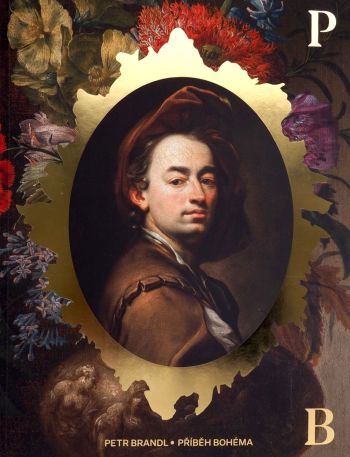 We have numerous archival documents of Brandl’s life of bohemian revolt, which is remarkable even today, offering interesting contexts for the problems of our time. Brandl was, for instance, a lifelong debtor due to his penchant for the luxury lifestyle of nobility, which he was keen to enjoy himself. It also led him to court battles with his wife Helena over alimony. In addition, Brandl was regularly in trouble with his commissioners, as he often failed to comply with the terms of his contracts. The painter’s unbound life has inspired a contemporary theatre play Three Women and a Hunter in Love, which will be staged together with the exhibition (Geisslers Hofcomoedianten).
None of this, however, changes the fact that Brandl was the highest-paid artist of his time, probably because of his very distinctive and original style of painting, in which we can trace certain parallels with Rembrandt. X-rays and macro-photographs of Brandl’s works complement the exhibition to give visitors a glimpse into the inner workings of his painting.
Andrea Steckerová, Petr Brandl: Příběh Bohéma (Prague: Národní galerie Praha, 2023), 288 pages, ISBN: 978-8070358221, 1050 Czech Koruna / $46.
New Book | Louis-François Chatard
From Éditions Faton:
Sébastien Boudry, Louis-François Chatard et les peintres doreurs du Garde-Meuble de la Couronne sous Louis XVI (Dijon: Éditions Faton, 2023), 208 pages, ISBN: 978-2878443318, €36.
 Les peintres et doreurs du Garde-Meuble de la Couronne ont participé à la création des plus beaux sièges du XVIIIe siècle. Leur production illustre la diversité et l’excellence des métiers d’art qui ont fait la réputation de Paris à la fin du XVIIIe siècle. Leur travail apporte finition et éclat au décor des bois après le travail du menuisier et du sculpteur qu’ils mettent en valeur.
Sous Louis XVI, Louis-François Chatard en devient le principal fournisseur. Peintre et doreur, il est également parfumeur. Ses confrères peintres et doreurs comme Julliac ou la famille Chaise tiennent également boutique à Paris en tant que marchands et restaurateurs de tableaux. Cet ouvrage nous fait découvrir cette profession et ce savoir-faire, ceux qui l’exercèrent avec excellence, tout en illustrant les mutations des corporations et de l’artisanat à Paris à la veille de la Révolution.
Historien de l’Art spécialisé en mobilier et objets d’art, Sébastien Boudry obtient un DEA (Master) à l’Université de Paris IV – Sorbonne en 2001. Chargé d’études au Centre des Monuments nationaux depuis 2003, il est en charge de la conservation-restauration des collections de plusieurs monuments depuis 2010. A ce titre il a participé aux projets de restauration et de présentation des collections de l’Hôtel de Sully à Paris (2012), du château de Champs-sur-Marne (2012–13), de la villa Cavrois à Croix (2014–15), du château de Voltaire à Ferney (2017–18), de l’Hôtel de la Marine à Paris (2018–2021), et du château de Bussy-Rabutin (2021–22).
New Book | The Domino and the 18th-C London Masquerade
Part of the Elements in Eighteenth-Century Connections series from Cambridge UP:
Meghan Kobza, The Domino and the Eighteenth-Century London Masquerade: A Social Biography of a Costume (New York: Cambridge University Press, 2024), 75 pages, ISBN: 978-1009468244 (hardcover), $65 / ISBN: 978-1009045551 (paperback), $22. Also available digitally through Cambridge UP.
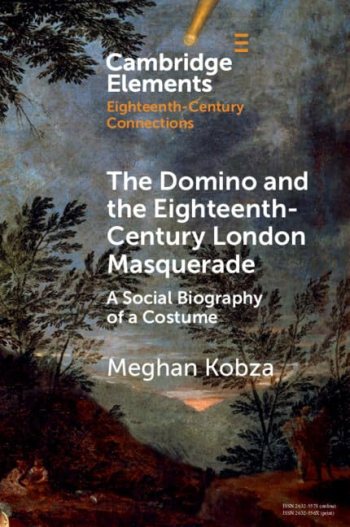 This Element presents new cultural, social, and economic perspectives on the eighteenth-century London masquerade through an in-depth analysis of the classic domino costume. Constructing the object biography of the domino through material, visual, and written sources, Meghan Kobza brings together various experiences of the masquerade and expand the existing geographical, chronological, and socio-economic scope of the entertainment beyond the masquerade event itself. The book examines the domino’s physical and figurative movements from the masquerade warehouse, through eighteenth-century fashionable society, and into print and visual culture, drawing upon masquerade warehouse records, newspapers, manuscripts, prints, and physical objects to establish a comprehensive understanding of the domino and how it reflected contemporary experiences of the real and imagined masquerade. Analysing the domino through interdisciplinary methodologies illustrates the impact material and visual sources can have on reshaping existing scholarship.
Meghan Kobza is currently a Leverhulme Early Career Fellow at Newcastle University, where she completed her PhD in 2020. As a social historian, she is particularly interested in the history of eighteenth-century leisure culture in the British Empire and transatlantic world.
c o n t e n t s
Introduction
1 The Masquerade and the Domino
2 Three Dominos
3 The Domino as a Commodity
4 Everywhere and Nowhere
Conclusion
References
New Book | Annals and Antiquities of Rajast’han
Distributed for the Royal Asiatic Society by Yale UP:
James Tod and Norbert Peabody, with contributions by Brian Cannon and Ramya Sreenivasan, Annals and Antiquities of Rajast’han (New Haven: Yale University Press, 2024), 1728 pages, ISBN: 978-0300270525, $1,000.
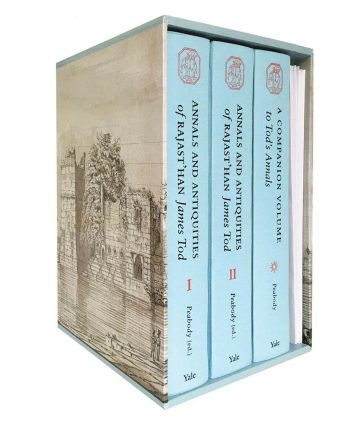 The two volumes of James Tod’s Annals and Antiquities of Rajast’han, first published in 1829–32, remain to this day the first port of call for anyone interested in the history and culture of Rajasthan and the early colonial encounter in India. Written by the first East India Company official to the region, the text was also seminal for the early figures in India’s independence movement who reworked Tod’s imagined ancient Rajput national identities into a call for India’s national liberation from British colonial rule. Now available in a numbered limited edition of 750 copies, this re-issue of the original text including over 80 original copperplate engravings, woodblock prints, and lithographs returns the text to its original state, while the accompanying companion volume critically reframes this monumental, but often misunderstood, work. The new volume shows how Tod’s Annals is not merely the product of the singular voice of a Western ‘orientalist’ imagination, instead revealing a richly complex work in which Rajasthani voices provide a ‘multi-authored’ heterogeneity to the text which is often discordant and unpredictable. Re-articulating the variety of voices that simultaneously inhabit Tod’s Annals, the revised volume argues for a more conjunctural, contingent, and open-ended reading of colonial history.
Norbert Peabody is an affiliated scholar at the Centre of South Asian Studies, University of Cambridge. Ramya Sreenivasan is associate professor of history at the University of Pennsylvania. Brian Cannon is a PhD student in South Asian history at the University of Pennsylvania.
New Book | The India Museum Revisited
This publication is one of the outcomes of the research project The India Museum Revisited, which aims to reconstruct the museum’s history (c.1800–1879) with special reference to V&A’s collection. From the V&A’s description of the project:
At the dispersal of the India Museum in 1879 the 20,000 objects transferred to the South Kensington Museum (later the V&A) were inventoried in a catalogue printed for internal use in the following year. That list forms the basis of the analysis and reconstruction presented here, augmented where appropriate by objects surviving in the collections, in order to reunite the contents and their supporting documentation in virtual form and to set them in context.
From UCL Press (and note that digital copies of the book are available free of charge) . . .
Arthur MacGregor, The India Museum Revisited (London: UCL Press, 2023), 472 pages, ISBN: 978-1800085725 (hardback), £60 / ISBN: 978-1800085718 (paperback) £45 / ISBN: 978-1800085701 (PDF file), free.
 The museum of the East India Company formed, for a large part of the nineteenth century, one of the sights of London. In recent years, little has been remembered of it beyond its mere existence, while an assumed negative role has been widely attributed to it on the basis of its position at the heart of one of Britain’s arch-colonialist enterprises. Extensively illustrated, The India Museum Revisited provides a full examination of the museum’s founding manifesto and evolving ambitions. It surveys the contents of its multi-faceted collections—with respect to materials, their manufacture and original functions on the Indian sub-continent—as well as the collectors who gathered them and the manner in which they were mobilized to various ends within the museum. From this integrated treatment of documentary and material sources, a more accurate, rounded and nuanced picture emerges of an institution that contributed in major ways, over a period of 80 years, to the representation of India for a European audience, not only in Britain but through the museum’s involvement in the international exposition movement to audiences on the continent and beyond.
Arthur MacGregor is Andrew W. Mellon Visiting Professor at the Victoria and Albert Museum’s Research Institute.
c o n t e n t s
Foreword by Tristram Hunt
Preface
Acknowledgements
The India Museum Revisited Project
Part I | Historical Introduction
1 An ‘Oriental Museum’ at the India House
2 The Objects Themselves: Restoring an Identity to the Collections
Part II | The Collections of the India Museum
3 Historical Relics: Their Role in the Collection
4 Trading with and within India: Material Culture of Commerce and Control
5 Industry and Technology: Inorganic Materials
6 Industry and Technology: Organic Materials
7 The Mirror of India: Clothing, Dress, and Ornament
8 Making War: Weapons and Defensive Armour
9 Religious Observation: Introducing Indian Devotional Practice
10 Culture and Recreation
11 Imaging India
12 Collections of Individuals and the Emergence of Ethnography
13 The India Museum (partly) Recollected
Appendix: Glossary of Indigenous Terms as Transcribed in the Catalogue of 1880
Bibliography
Index










 Enfilade
leave a comment