Exhibition | Canops: Extraordinary Furniture for Charles III of Spain
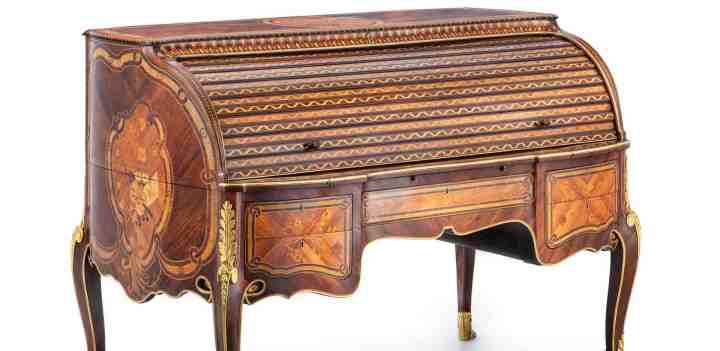
Madrid court workshop of Charles III under the direction of José Canops, Writing bureau with exotic marquetry decoration, ca. 1772–73
(Staatliche Museen zu Berlin, Kunstgewerbemuseum; photo by Stephan Klonk)
◊ ◊ ◊ ◊ ◊
Now on view at Berlin’s Museum of Decorative Arts, from the Staatliche Museen zu Berlin, with a related conference taking place 25–27 January:
Canops: Extraordinary Furniture for Charles III of Spain, 1759–1788
Kunstgewerbemuseum, Schloss Köpenick, Berlin, 12 October 2023 — 11 February 2024
Curated by Achim Stiegel
Although largely unknown today, the work of José Canops (1733–1814), an ébéniste of German descent born Joseph Cnops, and his Madrid workshop is one of the crowning achievements of European furniture-making.
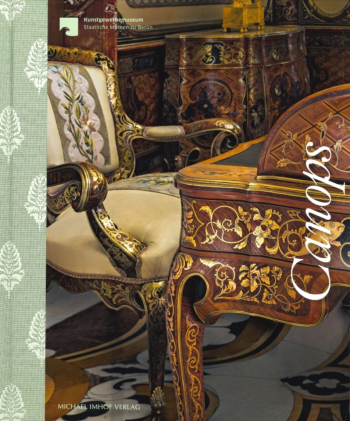 The furniture and boiseries are from the apartments of Charles III of Spain (r. 1759–1788), a Gesamtkunstwerk in exuberant rococo style conceived by the court painter and stuccoist Mattia Gasparini—a truly European creation inspired by Italian traditions, a taste for Parisian opulence, and the exotic worlds of Asia. Such elements combine in Canops’s work with the precision of German cabinetmaking and the riches of the Spanish colonies.
The starting point for the exhibition and publication was the acquisition for the Kunstgewerbemuseum of a magnificent roll-top desk by José Canops. With lavish new photography and never previously exhibited loans from the Patrimonio Nacional (the Spanish royal collections in Madrid), German and international audiences are afforded a glimpse into a hitherto hidden world.
In conjunction with the Spanish Embassy, the Ibero-Amerikanisches Institut of the Preußischer Kulturbesitz and Instituto Cervantes Berlin, the exhibition is accompanied by a programme of supporting events within the context of the 2023 Spanish presidency of the Council of the European Union.
Daniela Heinze, Achim Stiegel, et al., Canops: Möbel von Welt für Karl III. von Spanien (1759–1788), with photographs by Stephan Klonk (Petersberg: Michael Imhof Verlag, 2023), 288 pages, ISBN: 978-3731913689, €50.
The Decorative Arts Trust Announces New Publishing Grants
From the press release (11 December 2023) . . .
Publishing Grant for First-Time Authors or Recent PhD Graduates, up to $5000
Publishing Grant in Support of Catalogues and Conference Proceedings, up to $50,000
Proposals due by 31 March 2024
The Decorative Arts Trust announces the creation of a new publishing grant program. This latest expansion of the Trust’s efforts to invigorate scholarship and broaden appreciation of material culture represents a major initiative under the leadership of Brock Jobe and Margaret Pritchard, who serve as President and Vice President of the Board of Governors, respectively. The endeavor is structured to respond to the changing needs of the field and to support publishing efforts in both the print and digital sectors.
“The Trust’s Board recognizes the strong demand for and limited supply of resources focused on publishing in the art community,” according to Executive Director Matthew A. Thurlow. “The organization receives dozens of requests for funding each year for publishing-related projects through our Prize for Excellence and Innovation and Failey Grant program and has supported a variety of books through those awards. This new venture establishes a commitment to sharing important art historical research as broadly as possible.”
The Trust will allocate funding to two separate grants. Building on its long tradition of promoting emerging scholars, the Trust will award an annual grant of up to $5,000 to a first-time author or a PhD graduate who is converting their dissertation into a book-length academic publication. Academic presses are also able to apply on behalf of authors currently under contract.
The second grant line is applicable to exhibition and collections catalogues and compilations of conference papers. The Trust will provide up to $50,000 per year for this purpose, and proposals can request funding from $5,000 to the full $50,000, depending on the level of need. Both nonprofit organizations and independent scholars are welcome to apply. Project and publication teams that include early career professionals will receive preference.
To steward the program and oversee the selection of grant recipients, the Trust created a new advisory committee overseen by Pritchard. The committee consists of museum professionals and academics with broad experience in publishing. The members are eager for the opportunity to support publications tackling the broad context of the Americas and to encourage projects that advance diversity in the study of American decorative arts and material culture.
The deadline to submit proposals for the inaugural round of grants is 31 March 2024. More information and submission guidelines can be found here.
New Book | Futuristic Fiction, Utopia, and Satire
Coming in March from Brepols:
Giulia Iannuzzi, Futuristic Fiction, Utopia, and Satire in the Age of the Enlightenment: Samuel Madden’s ‘Memoirs of the Twentieth Century’ (1733) (Brepols, 2024), 460 pages, ISBN: 978-2503606026, €125.
 Published anonymously in 1733, Memoirs of the Twentieth Century is one of the earliest futuristic novels known in Anglophone and Euro-American literature. It foregrounds an acceleration of history brought about by an increasing degree of global interconnectedness and the exclusion of prophetism and astrology as credible ways to know the future. The work of Samuel Madden, an Irish writer and philanthropist of Whig sympathies, it consists of a collection of diplomatic letters composed in the 1990s, which the narrator claims were brought to him from the time to come by a supernatural entity. Through these correspondences, twentieth-century world scenarios are spread out before the reader, in which British naval power rules the waves and international commerce, while the transnational scheming of the Jesuits threatens the independence of weaker European courts.
This book—which includes a study followed by an annotated edition of the text—assesses the cultural significance of this literary work, as an apt observatory on how historical time as a cultural construction was shaped, during the eighteenth century, by new forms of transnational circulation of information, and by the dubious space carved out in European culture by seventeenth- and early eighteenth-century debates on the nature of historical knowledge. Through and by means of the Memoirs case study, this volume aims to contribute to a wider cultural history of the future and speculative fiction. The novel’s ironic distancing of beliefs considered to be superstitious and absurd—such as divination techniques and occult and magical disciplines—offers an exceptional testimony to the negotiation of the boundaries of verisimilitude and credibility within a religious enlightenment.
Giulia Iannuzzi has worked on the history of publishing and translation processes, and on the history of speculative imagination in a comparative perspective. Her articles have been published in academic journals such as History, History of Historiography, Cromohs, Perspectives, American Literary Scholarship, and Journal of Romance Studies.
c o n t e n t s
Introduction: Knowledge, Power, and Time in the Age of the Enlightenment
Part I | Samuel Madden’s Eighteenth-Century Memoirs from the Future
1 Where Was the Future?
2 When Was the Future?
3 An Irish Whig between Philanthropism and Literature
4 An Eighteenth-Century Twentieth Century
5 An (Unreliable) Historian of the Future
6 A ‘Good Genius’ and the ‘Scene of Things below’
7 Empirical Science, Global Consciousness, and ‘the History of Future Times’
8 Blurring the Dichotomy between History and Fiction
9 Satirising Past Futures
10 ‘Publishing’ the Letters
11 ‘This Prodigious Society’: Anti-Jesuit Satire
12 Whose Credulity, Whose Credibility
13 Bookish Mysteries and an ‘Alternate George VI’
14 Concluding Remarks
Part II | Memoirs of the Twentieth Century
A Note on the Text
Samuel Madden, Memoirs of the Twentieth Century
Notes to the Text
Bibliography
Index
New Book | Mozart in Italy
Published in the UK in October and coming to the American market in the spring; from Picador:
Jane Glover, Mozart in Italy: Coming of Age in the Land of Opera (London: Picador, 2023), 288 pages, ISBN: 978-1529059861, £25 / $30.
 At thirteen years old Wolfgang Amadeus Mozart was a child prodigy who had captured the hearts of northern Europe, but his father Leopold was now determined to conquer Italy. Together, they made three visits there the last when Mozart was seventeen, all vividly recounted here by acclaimed conductor Jane Glover. Father and son travelled from the theatres and concert salons of Milan to the church-filled streets of Rome to Naples, poorer and more dangerous than the prosperous north, and to Venice, the carnivalesque birthplace of public opera. All the while Mozart was absorbing Italian culture, language, style and art, and honed his craft. He met the challenge of writing Italian opera for Italian singers and audiences and provoked a variety of responses, from triumph and admiration to intrigue and hostility: in a way, these Italian years can be seen as a microcosm of his whole life. Evocative, beautifully written and with a profound understanding of eighteenth-century classical music, Mozart in Italy reveals how what he experienced during these Italian journeys changed Mozart—and his music—forever.
In Jane Glover’s long and hugely successful career as a conductor, she has been Music Director of the Glyndebourne Touring Opera, Artistic Director of The London Mozart Players, and, since 2002, is Music Director of Chicago’s Music of the Baroque. She has conducted all the major symphony and chamber orchestras in Britain, as well as many in the United States of America and across the world. She appears regularly at the BBC Proms and is a regular broadcaster, with highlights including a television series on Mozart. She is also the author of Mozart’s Women and Handel in London. She lives in London.
New Book | The Horn
From Yale UP:
Renato Meucci and Gabriele Rocchetti, The Horn (New Haven: Yale University Press, 2023), 416 pages, ISBN: 978-0300118933, $45.
 A rich and fascinating account of one of music history’s most ancient, varied, and distinctive instruments
From its origins in animal horn instruments in classical antiquity to the emergence of the modern horn in the seventeenth century, the horn appears wherever and whenever humans have made music. Its haunting, timeless presence endures in jazz and film music, as well as orchestral settings, to this day. In this welcome addition to the Yale Musical Instrument Series, Renato Meucci and Gabriele Rocchetti trace the origins of the modern horn in all its variety. From its emergence in Turin and its development of political and diplomatic functions across European courts, to the revolutionary invention of valves, the horn has presented in innumerable guises and forms. Aided by musical examples and newly discovered sources, Meucci and Rocchetti’s book offers a comprehensive account of an instrument whose history is as complex and fascinating as its music.
Renato Meucci directs the Cultural Heritage department of the celebrated Accademia Nazionale di Santa Cecilia in Rome. Gabriele Rocchetti is horn professor at the Conservatory Luca Marenzio, and a fine natural horn player.
c o n t e n t s
List of Figures
List of Musical Examples
List of Tables Abbreviations
Acknowledgments
Foreword
Part I
1 Preliminary Note on Roman Military Instruments
2 Early Horns and Calls
3 The Coiled Trompe
4 Spiral Instruments
5 Early French Hunting Fanfares
6 Hooped Models
7 Preserved Instruments
8 Von Sporck and the Trompe de Chasse
9 The Natural Hunting Horn (Jadgwaldhorn)
10 Trumpet and Horn Players
11 The Natural Horn at its Zenith (Orchesterwaldhorn)
12 Duets
13 Four Case Studies: Vivaldi, Bach, Handel, Telemann
14 Instruments’ Names in the Baroque Era
Part II
15 The Classic Era
16 New Crook Systems
17 The Classical Repertoire
18 The Heyday of the Hand Horn
19 Transitional Systems
Part III
20 Valve Horns
21 Further Valve Systems
22 Reports by Contemporaries
23 Early Music Literature
24 Valve Dissemination: A Regional Overview
25 A Few Leading Composers
26 Double Horn
27 The Horn in the Second Half of the Twentieth Century
28 The Repertoire of the Second Half of the Twentieth Century
29 The Present-Day Horn
Bibliography
Index
Appendix 1 Notation
Appendix 2 High vs. Low Horn in Haydn’s Symphonies
Appendix 3 Two Letters by Blühmel
New Book | The Recorder
From Yale UP:
David Lasocki, Robert Ehrlich, Nikolaj Tarasov, and Michala Petri, The Recorder (New Haven: Yale University Press, 2023), 392 pages, ISBN: 978-0300118704, $50.
 The fascinating story of a hugely popular instrument, detailing its rich and varied history from the Middle Ages to the present
The recorder is perhaps best known today for its educational role. Although it is frequently regarded as a stepping-stone on the path toward higher musical pursuits, this role is just one recent facet of the recorder’s fascinating history—which spans professional and amateur music-making since the Middle Ages. In this new addition to the Yale Musical Instrument Series, David Lasocki and Robert Ehrlich trace the evolution of the recorder. Emerging from a variety of flutes played by fourteenth-century soldiers, shepherds, and watchmen, the recorder swiftly became an artistic instrument for courtly and city minstrels. Featured in music by the greatest Baroque composers, including Bach and Handel, in the twentieth century it played a vital role in the Early Music Revival and achieved international popularity and notoriety in mass education. Overall, Lasocki and Ehrlich make a case for the recorder being surprisingly present, and significant, throughout Western music history.
David Lasocki, formerly head of music reference services at Indiana University Bloomington, has been a researcher of the recorder for over fifty years. Robert Ehrlich is professor of recorder at the Hochschule für Musik und Theater in Leipzig.
c o n t e n t s
List of Illustrations
Acknowledgments
Introduction — David Lasocki
1 The Era of Medieval Recorders, 1300–1500 — David Lasocki
2 The Era of Renaissance Recorders, 1501–1667 — David Lasocki
3 The Era of the Baroque Recorder, 1668–1800 — David Lasocki
4 Duct Flutes in the Nineteenth Century — Nikolaj Tarasov
5 The Recorder in the Twentieth Century — Robert Ehrlich
Epilogue — Michala Petri
Notes
Bibliography
Index
New Book | Tischbein the Elder (1722–1789)
An exhibition from 2022 that I missed, though the catalogue is still available from Michael Imhof:
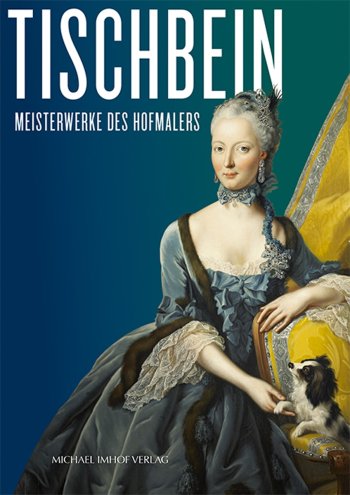
Tischbein: Meisterwerke des Hofmalers, Porträts und Landschaften von Johann Heinrich Tischbein d. Ä. (1722–1789) (Petersberg : Michael Imhof Verlag, 2022), 160 pages, ISBN: 978-3731912675, €35.
 Ausstellung im Schloss Fasanerie in Eichenzell/Fulda: 11. Juni bis 9. Oktober 2022
Am 3. Oktober 2022 jährt sich der Geburtstag Johann Heinrich Tischbeins des Älteren (1722–1789) zum 300. Mal. Den runden Geburtstag des bedeutendsten Vertreters der berühmten hessischen Malerdynastie Tischbein nimmt die Kulturstiftung des Hauses Hessen zum Anlass, dem landgräflich-hessischen Hofmaler im Museum Schloss Fasanerie bei Fulda eine monografische Ausstellung zu widmen. Ein Schwerpunkt der Ausstellung stellt die Rolle Tischbeins als Hofmaler dreier hessischer Landgrafen in Kassel dar. Im Jahr 1753 wurde Johann Heinrich d. Ä. von Landgraf Wilhelm VIII. von Hessen-Kassel zum Hofmaler ernannt und blieb es auch während der gesamten Regierungszeit Friedrichs II. (1760–1785). Obwohl Tischbein bei Regierungsantritt Wilhelms IX. bereits krank war, blieb er auch unter ihm Hofmaler, und der Landgraf richtete auf Schloss Wilhelmshöhe eine ihm posthum gewidmete Gemäldegalerie ein. Aufträge erhielt der Maler jedoch nicht allein von Mitgliedern des Kasseler Hofs, er schuf auch zahlreiche Porträts für Fürst Karl August von Waldeck und Pyrmont und stattete dessen Residenz in Bad Arolsen mit Gemälden aus. Darüber hinaus porträtierte Tischbein seine eigene Familie und war auch bei bürgerlichen Auftraggebern jenseits von Hof und Residenz gefragt. Neben Porträts zeigt der Katalog Landschaftsgemälde von Johann Heinrich Tischbein d. Ä. Darunter befinden sich wichtige Ansichten des Schlosses auf dem Weißenstein (dem Vorgängerbau von Schloss Wilhelmshöhe in Kassel) und der das Schloss umgebenden Parkanlagen des 18. Jahrhunderts.
i n h a l t
Zum Geleit Donatus Landgraf von Hessen
1 Johann Heinrich Tischbein d. Ä.: Selbstbildnisse als Inszenierungdes sich wandelnden Künstlertums — Justus Lange
Katalog
2 Die Porträts Landgraf Friedrichs II. von Hessen-Kassel — Andreas Dobler
Katalog
3 Landgräfin Philippine von Hessen-Kassel (1745–1800) im Porträt — Malena Rotter
Katalog
4 Denker und Dichterinnen: Johann Heinrich Tischbeins d. Ä. Porträtmalerei jenseits von Hof und Residenz — Andrea Linnebach
Katalog
5 Landschaftsgemälde von Johann Heinrich Tischbein d. Ä.— Markus Miller
Katalog
Literaturverzeichnis
Exhibition | Unnamed Figures: Black Presence and Absence
 Rufus Hathaway, A View of Mr. Joshua Winsor’s House &c., Duxbury, Massachusetts, ca. 1793–95, oil on canvas (New York: American Folk Art Museum, gift of Ralph Esmerian, 2013.1.19). From the museum’s Instagram account, “This iconic folk painting has typically been interpreted as its eighteenth-century patron, Joshua Winsor, would have expected: as a chronicle of his wealth and property as a merchant and shipbuilder in Duxbury, Massachusetts. Usually unremarked upon is the figure of a Black woman in the lower left-hand corner of the scene. With her back to the viewer, the woman is faceless, evoking the limited details known about early African American lives. Census records provide small clues. Was she the one free person of color recorded in the Winsor household in 1790, a few years before this painting was made? Likely attending to many aspects of the Winsors’ domestic lives, this enigmatic figure was one of the many unnamed Black residents of New England whose underrecognized labor paved the way for their employers’ or enslavers’ prosperity.”
◊ ◊ ◊ ◊ ◊
Karen Rosenberg’s review of the exhibition recently appeared in The New York Times (21 December 2023) . . . .
Unnamed Figures: Black Presence and Absence in the Early American North
American Folk Art Museum, New York, 15 November 2023 — 24 March 2024
Flynt Center of Early New England Life, Deerfield, Massachusetts, 1 May — 4 August 2024
Curated by Emelie Gevalt, RL Watson, and Sadé Ayorinde
Unnamed Figures: Black Presence and Absence in the Early American North is on view at the American Folk Art Museum until 24 March 2024. As a corrective to histories that define slavery and anti-Black racism as a largely Southern issue, this exhibition offers a new window onto Black representation in a region that is often overlooked in narratives of early African American history.
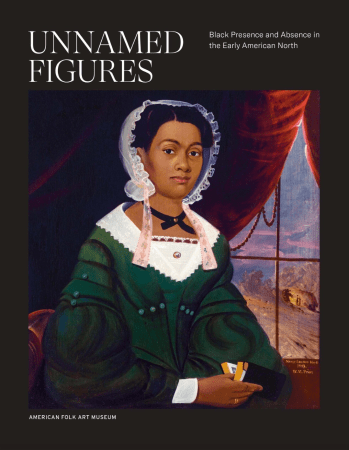 Through 125 remarkable works including paintings, needlework, and photographs, this exhibition invites visitors to focus on figures who appear in—or are omitted from—early American images and will challenge conventional narratives that have minimized early Black histories in the North, revealing the complexities and contradictions of the region’s history between the late 1600s and early 1800s. A 300-page scholarly book with contributions from Gwendolyn DuBois Shaw, Jennifer Van Horn, and several other authors, is available for purchase.
The exhibition is co-curated by Emelie Gevalt, Curatorial Chair for Collections and Curator of Folk Art, AFAM; RL Watson, Assistant Professor of English and African American Studies, Lake Forest College; and Sadé Ayorinde, Terra Foundation Predoctoral Fellow in American Art at the Smithsonian American Art Museum. A free digital guide on Bloomberg Connects is available here.
Please be advised that this exhibition contains complex, challenging, and racist imagery.
Unnamed Figures: Black Presence and Absence in the Early American North (New York: American Folk Art Museum, 2023), 300 pages, $75.
Catalogue contributors are scholars and researchers with expertise in American art history, material culture, African American history and literature, and other related topics. The book includes a foreword by Gwendolyn DuBois Shaw and Jason Busch. Contributors include the exhibition’s curators as well as Virginia Anderson, Kelli Racine Barnes, Michael Bramwell, Christy Clark-Pujara, Anne Strachan Cross, Jill Vaum Rothschild, Jonathan Michael Square, Lea Stephenson, Jennifer Van Horn, and Gordon Wilkins.
r e l a t e d p r o g r a m m i n g
7 December 2023
Virtual Insights: Reasserting Black Presence in the Early American North
11 January 2024
BlackMass Responds to Unnamed Figures: Tour with Yusuf Hassan and Kwamé Sorrell
14 February 2024
Notes on Style: A Discussion with BlackMass on Portraiture and Personhood
23 February and 28 March 2024
‘The Picture Is Still Out There’: Reframing Black Presence in the Collections of Early American Art and Material Culture | 2024 Elizabeth and Irwin Warren Folk Art Symposium
18 March 2024
Autobiographical Landscapes: Gary Tyler in Conversation with Allison Glenn
◊ ◊ ◊ ◊ ◊
Note (added 4 January 2024) — The posting was updated to include Historic Deerfield as a venue.
Vivliofika, Volume 11 (2023)
This year’s issue of Vivliofika has just been released; in addition to the articles and book reviews noted below, the issue includes sections for obituaries and debates (both in Russian).
Vivliofika: E-Journal of Russian Eighteenth-Century Studies 11 (2023)
Vivliofika (Вивлiоѳика) is the flagship online publication of the Eighteenth Century Russian Empire Studies Association (ECRESA), an affiliate group of the Association for Slavic, Eurasian, and East European Studies (ASEEES). Volume 11 of the journal includes a special forum on “Russo-European Artistic Encounters in the Eighteenth Century,” guest edited by Margaret Samu, which highlights recent research on the Russian art world and its engagement with Western Europe in the eighteenth century. It arose from an online program in September of 2021 hosted by the Historians of Eighteenth-Century Art and Architecture (HECAA).
f o r u m : r u s s o – e u r o p e a n a r t i s t i c e n c o u n t e r s

Ivan Argunov, Portrait of Anna Nikolaevna Kalmykova, 1767, oil on canvas, 62 × 50 cm (Moscow: Kuskovo Estate Museum).
• Margaret Samu, “Introduction: Russo-European Encounters in the Eighteenth Century,” pp. 1–4.
The introduction summarizes the special forum and explains the effect that Russia’s full-scale invasion of Ukraine has had on art historical research. It argues for the importance of both trans-national and post-colonial approaches to the study of eighteenth-century Imperial Russian art.
• Margaret Samu, “Andrei Matveev: Painting Allegory from Antwerp to Russia,” pp. 5–36.
Margaret Samu explores Russia’s adoption of allegorical language in art, as well as the practice of sending art students to Europe in the Petrine era, through a close examination of Andrei Matveev’s Allegory of Painting (1725).
• Anna Korndorf, “The ‘Sketes’ of Cheerful Elizabeth: Mid-Eighteenth-Century Russian Hermitages” (in Russian), pp. 37–60.
Anna Korndorf’s article looks at hermitages as intimate, informal spaces for elite sociability. Her study helps us to rediscover the hermitages of Elizabeth Petrovna (r. 1741–62) by emphasizing their personal significance to the empress and their connections to similar structures in Europe.
• Zalina Tetermazova, “Self-Portrait Prints and Portraits of Printmakers: On the Social Status and Self-Image of Printmakers in Russia in the Second Half of the Eighteenth Century” (in Russian), pp. 61–81.
Zalina Tetermazova’s work uses self-portraits by printmakers as a lens through which to investigate their social status, as well as the role of engraving in the academic hierarchy of arts during the second half of the eighteenth century.
• Alexandra Helprin, “Ivan Argunov’s Portrait of Anna Kalmykova,” pp. 82–101.
Alexandra Helprin focuses on Ivan Argunov’s portrait of Anna Nikolaevna Kalmykova (1767) to explore the relative positions of the enserfed artist and Kalmyk child in the Sheremetev family. She analyzes the ways in which European conventions of portraiture took on new meanings under Russia’s particular conditions of serfdom and colonization.
• Emily Roy, “St. Petersburg through Venetian Eyes: An Episode in Late Eighteenth-Century Book Illustration,” pp. 102–24.
Emily Roy’s article explores Venetian perceptions of Peter I’s founding of Saint Petersburg by studying an etching published by Antonio Zatta in 1797 as part of a six-volume biography of Catherine II.
a d d i t i o n a l a r t i c l e s
• Erica Camisa Morale, “In Search of Nature and Consciousness in Andrei Bialobotskii’s Pentateugum: Classical Echoes and Modern Impulses,” pp. 125–41.
• W. Forrest Holden, “Making Sense of the Empire’s Others: Mikhail Chulkov’s Dictionary of Russian Superstitions and the European Enlightenment,” pp. 142–62.
• Rodolphe Baudin, “Translation as Politics: Translating Nikolai Karamzin’s Letters of a Russian Traveler in Nineteenth-Century France,” pp. 163–84.
r e v i e w s
• Barbara Skinner, Review of Zenon Kohut, Volodymyr Sklokin, and Frank Sysyn, with Larysa Bilous, eds., Eighteenth-Century Ukraine: New Perspectives on Social, Cultural, and Intellectual History (Montreal and Kingston: McGill-Queens University Press / Edmonton and Toronto: Canadian Institute of Ukrainian Studies Press, 2023), pp. 271–75.
• Kelsey Rubin-Detlev, Review of Vera Proskurina, The Imperial Script of Catherine the Great: Governing with the Literary Pen (Boston: Academic Studies Press, 2023), pp. 276–80.
• Rodolphe Baudin, Review of S. V. Pol’skoi and V. S. Rzheutskii, eds., Laboratoriia poniatii: Perevod i iazyki politiki v Rossii XVIII veka (Moscow: Novoe literaturnoe obozrenie, 2022), pp. 281–83.
• Sara Dickinson, Review of Nikolai Karamzin, Lettres d’un voyageur russe, introduction, translation, notes, and commentary by Rodolphe Baudin (Paris: Institut d’Études Slaves, 2022), pp. 284–86.
• Brian Davies, Review of A.G. Gus’kov, K. A. Kochegarov, S. M. Shamin, Russko-turetskaia voina 1686–1700 godov (Moscow: Russkoe slovo, 2022), pp. 287–89.
New Book | Portraiture in Old Poland
From IRSA, the Institute for Art Historical Research (founded in Venice in 1979 as the Istituto per le Ricerche di Storia dell’Arte, the institute was relocated to Florence and then to Vienna, before arriving in its current home in Cracow). Orders can be placed via email, irsa@irsa.com.pl.
Jan Ostrowski, Portraiture in Old Poland, translated by Nicholas Hodge and Sabina Potaczek-Jasionowicz (Cracow: IRSA, 2023), 508 pages.
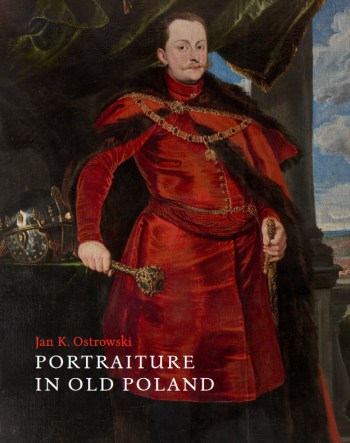 Written by one of Poland’s foremost art historians, this landmark book—the first English-language study to tackle its subject in depth—is an essential text for readers keen to look beyond the Western European art centres that have dominated art history since the discipline’s inception.
The Polish-Lithuanian Commonwealth—in spite of its flaws—was once the largest state in Europe, and it produced a distinctive culture that was often at odds with those of the absolutist monarchies of the day. The author casts his net wide, considering forms of portraiture that were widespread across the continent as well as indigenous specialities such as coffin portraits and tomb banners. He likewise demonstrates how the 18th-century Partitions of Poland affected portraiture and national identity. This book serves both as an incisive exploration of the subject and as a thought-provoking—and at times witty—resource on how to approach art in general, with the author spotlighting several pitfalls that can mislead the researcher. Finally, he shows how context and rational deduction can help solve iconographic puzzles. The English translation was made possible by a grant from the Lanckoroński Foundation.
Jan K. Ostrowski (b. 1947) grew up surrounded by family portraits at home, which sparked a fascination that stayed with him for life. He studied at Cracow’s Jagiellonian University and the University of Nancy. Later, he was a visiting scholar in Florence, Munich, and at the Institute for Advanced Study, Princeton. He taught the history of art at the Jagiellonian University from 1973 to 2018, becoming a full professor in 1992. In 1989 he was appointed director of Wawel Royal Castle in Cracow and he held this post for three decades. Since 2018, he has been president of the Polish Academy of Arts and Sciences. He conceived and directed a programme of inventorying historic sites in the Lviv region (western Ukraine; 23 vols, 1993–2015). He has extensively researched and published on late Baroque sculpture in Lviv (Johann Georg Pinsel), Polish Romantic painting (Piotr Michałowski), and Baroque painting in Flanders and Italy (Anthony van Dyck, Sinibaldo Scorza). He has been decorated both at home and abroad, including with the Order of Polonia Restituta and France’s Legion of Honour.
c o n t e n t s
Preface to the English Edition
Preface to the Polish Edition
1 Introduction
2 Paths to the Early Modern Independent Portrait
3 A Short History of Portraiture in Old Poland
4 The Portrait in Society: Function and Reception
5 Attire, Attributes, and Furnishings in Portraits: What Objects Tell Us about the Sitter and Their Time
Conclusion
Glossary
Abbreviations
Bibliography
Index of Names
List of Figures










 Enfilade
leave a comment