New Book | Portrait Miniatures
From Michael Imhof:
Bernd Pappe and Juliane Schmieglitz-Otten, eds., Portrait Miniatures: Artists, Functions, Techniques, and Collections (Petersberg: Michael Imhof Verlag, 2023), 272 pages, ISBN: 978-3731913399, €40.
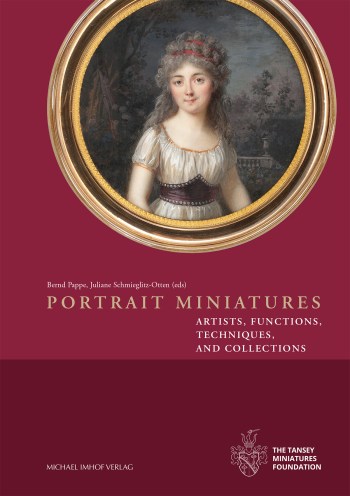 The specialist conferences on miniature portraits, organized for the past ten years by the Tansey Miniatures Foundation, have enabled an in-depth examination of this particularly intimate genre of portrait painting. In this third volume of conference proceedings, twenty-one internationally renowned experts from ten countries explore the miniature portrait from different perspectives, highlighting the private use of miniatures and contrasting it with their function in a more public context. Several authors provide new insights into important but hitherto little-known private and museum collections; others introduce specific artists. For the first time, this volume also addresses in significant depth specific technical aspects of creating and preserving portrait miniatures.
The contents can be viewed here»
Conference | Working Wood in the 18th Century: By the Book

From Colonial Williamsburg:
Working Wood in the 18th Century: By the Book
Online and in-person, Colonial Williamsburg, 25–28 January 2024
Registration due by 1 January 2024
Printed words and images: How did 18th-century craftspeople turn them into actions and objects? How did craftspeople fill in the blanks left by what was unwritten or unillustrated? And how can the ink they left on paper inform our understanding of a past in which most craft knowledge was shared orally? Join tradespeople and scholars from Colonial Williamsburg and esteemed guest presenters as they explore woodworking by the book.
All lectures will take place in the Hennage Auditorium, at the Art Museums of Colonial Williamsburg. In-person capacity is limited and those on the waitlist will be notified via email should space become available. Virtual capacity is unlimited.
Christopher Schwarz—woodworker, author, and publisher of Lost Art Press—will open the conference with a keynote on the long historical arc of woodworking books. Later, he’ll demonstrate the low workbench illustrated by M. Hulot in L’Art du Tourneur Mécanicien (1775) to explore how the design has persisted among chairmakers up to the present. Chairmaking of a different flavor will be the focus of demonstrations by master cabinetmaker and educator Dan Faia, who will explore the structure and ornament of a high-style neoclassical chair design published by George and Alice Hepplewhite in The Cabinet-maker and Upholsterer’s Guide (1789). Colonial Williamsburg cabinetmakers Bill Pavlak and John Peeler will explore how 18th-century craftspeople could use Thomas Chippendale’s elaborate published patterns as a springboard for designing and building chairs in the ’plain and neat’ manner favored by colonial Virginia’s fashion-conscious consumers.
In the realm of architectural woodworking, Colonial Williamsburg’s joiners Brian Weldy and Peter Hudson will employ a variety of 18th-century pattern books to design and build a door, its frame, and the decorative woodwork that surrounds it. In a panel moderated by supervisor-journeyman Matt Sanbury, apprentice carpenters Harold Caldwell, Mary Lawrence Herbert, and McKinley Groves will crack open Joseph Moxon’s late 17th-century work Mechanick’s Exercises to put his lessons in carpentry to the test. Does Moxon’s writing accurately reflect the practices of carpenters?
Decorative techniques are discussed at length in period writings, though usually in an incomplete manner. Conservators Chris Swan and Sarah Towers will introduce their recent exploration into traditional silvering techniques for carved picture frames. Harpsichord makers Edward Wright and Melanie Belongia will explore decorative veneering methods that are useful for furniture and musical instruments alike. In both cases, presenters will show how the written word combined with hours of experimentation at the bench led to successful results.
In addition to bringing the techniques and designs from books to life, we’ll also explore books themselves from a variety of perspectives. Whitney L.B. Miller, author of Henry Boyd’s Freedom Bed, will share how she was inspired to turn her research on Henry Boyd—a free Black furniture maker, inventor, and abolitionist who was born into enslavement—into a book for today’s children. Colonial Williamsburg’s curator of furniture Tara Chicirda will introduce the role that pattern books and price books played in the cabinetmaker’s trade. To learn about what went into making detailed printed illustrations, master engraver Lynn Zelesnikar will demonstrate her craft while reproducing a plate from Chippendale. She and Bill Pavlak will also compare notes on how to turn the same ornamental pattern into a two-dimensional engraving or a three-dimensional wood carving. Any collection of books needs shelves, and decorative arts historian Thomas Savage will deliver our banquet keynote on the acclaimed Holmes-Edwards library bookcase, a beautifully crafted home for books with a compelling story of its own.
New Book | Hidden Patrons: Women and Architectural Patronage
From Bloomsbury:
Amy Boyington, Hidden Patrons: Women and Architectural Patronage in Georgian Britain (London: Bloomsbury Visual Arts, 2023), 328 pages, ISBN: 978-1350358614 (hardcover), £65 / ISBN: 978-1350358607 (paperback), / £20.
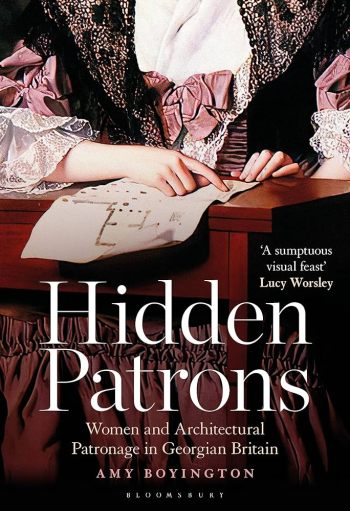 An enduring myth of Georgian architecture is that it was purely the pursuit of male architects and their wealthy male patrons. History states that it was men who owned grand estates and houses, who commissioned famous architects, and who embarked upon elaborate architectural schemes. Hidden Patrons dismantles this myth—revealing instead that women were at the heart of the architectural patronage of the day, exerting far more influence and agency than has previously been recognised. Architectural drawing and design, discourse, and patronage were interests shared by many women in the eighteenth century. Far from being the preserve of elite men, architecture was a passion shared by both sexes, intellectually and practically, as long as they possessed sufficient wealth and autonomy. In an accessible, readable account, Hidden Patrons uncovers the role of women as important patrons and designers of architecture and interiors in eighteenth-century Britain and Ireland. Exploring country houses, Georgian townhouses, villas, estates, and gardens, it analyses female patronage from across the architectural spectrum and examines the work of a range of pioneering women from grand duchesses to businesswomen to lowly courtesans. Re-examining well-known Georgian masterpieces alongside lesser-known architectural gems, Hidden Patrons unearths unseen archival material to provide a fascinating new view of the role of women in the architecture of the Georgian era.
Amy Boyington is a social and architectural historian, with a PhD from the University of Cambridge. She serves as a trustee of the Georgian Group and is a popular Instagram and TikTok historian.
c o n t e n t s
List of Illustrations
Acknowledgements
Note on Text
List of Abbreviations
Introduction
1 The Country House
2 The Town House
3 The Villa
4 The Wider Estate, Garden Design, and Ornamental Buildings
Conclusions
Bibliography
Index
New Book | Symbols and Forms in Jewish Art
From IRSA, the Institute for Art Historical Research (founded in Venice in 1979 as the Istituto per le Ricerche di Storia dell’Arte, the institute was relocated to Florence and then to Vienna, before arriving in its current home in Cracow). Orders can be placed via email, irsa@irsa.com.pl.
Rachel Wischnitzer-Bernstein, Symbols and Forms in Jewish Art, translated by Renata Stein (Cracow: IRSA, 2022), 212 pages, ISBN: 978-8389831354. With an essay on Wischnitzer’s life and work by Shalom Sabar.
 This is an English translation of a classic study on the iconography of Jewish art by Rachel Wischnitzer-Bernstein (1885–1989), originally published in Berlin in 1935 as Symbole und Gestalten der jüdischen Kunst. The outbreak of the Second World War prevented the book from spreading, and its uncirculated print-run was almost entirely destroyed by the Nazis. The few surviving copies of the book that circulated among specialists, gained this highly innovative work on Jewish iconography a position of a classic study. The present English edition makes the legendary book by Rachel Wischnitzer-Bernstein available to wider audiences of international readers for the first time.
“Against all odds, two years after the Nazi party and Hitler rose to power, Symbole und Gestalten der jüdischen Kunst appeared in Berlin in the mid-1930s. Presenting the visual art of the Jewish people as a sophisticated humanistic achievement, this handsome, beautifully produced volume illustrates the deep meanings and the powerful symbols of the Jewish people over the ages. Moreover, the book’s thesis and the materials gathered in it are underlined by an implied aspiration: to strengthen Jewish identity and make the Jews of the time conscious and proud of their rich heritage. The author of this courageous book…, Rachel Wischnitzer (1885–1989), a modest woman, small in size, …contributed more than any other scholar of the first half of the twentieth century to the establishment and development of a new field of academic study—the history of Jewish art.” —From Shalom Sabar’s biographical essay
Rachel Wischnitzer (1885–1989) during her long life produced 344 publications, including books, scholarly articles, reviews of books, and exhibitions, as well as encyclopedia items. Together with her husband Mark, she edited the literary and artistic periodicals Rimon and Milgroim. The doyenne of historians of Jewish art, she was a pioneer in the field when she published in 1913 her first article on the ancient synagogue in Lutsk. Her wide interests drove her to study and publish about Hebrew illuminated manuscripts, synagogue architecture, Jewish and general iconography. Her major contribution to Jewish iconography was a courageous attempt to find a single theme to which all the paintings in the third century Synagogue at Dura Europos would adhere.
c o n t e n t s
Foreword by Józef Grabski
Introduction
1 Divine Revelation
2 Kingdom
3 Doctrine
4 Priesthood
5 Judaism
6 Festivals and Customs
7 Messianic Hope
8 Time and the Universe
Shalom Sabar — Rachel Wischnitzer: Life and Work
Exhibition | James Gillray: Characters in Caricature
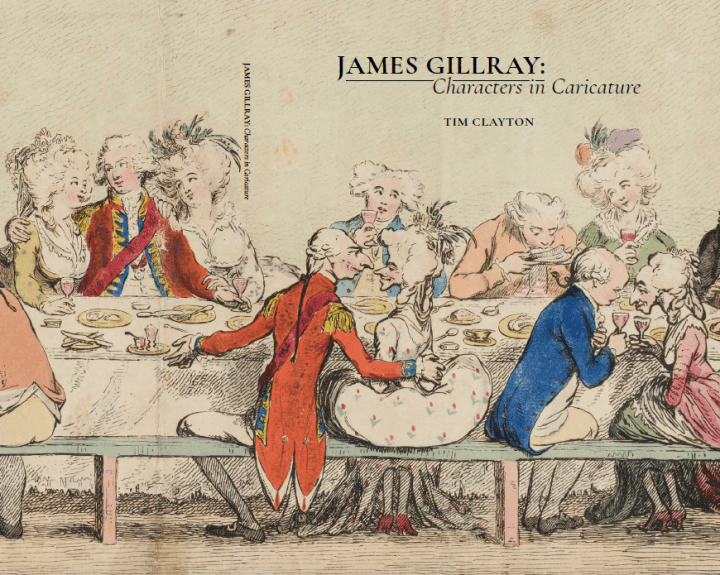
Now on view at Gainsborough’s House (which was just announced as the winner of The Georgian Group’s 2023 award for the ‘Restoration of a Georgian Building in an Urban Context’). . .
James Gillray: Characters in Caricature
Gainsborough’s House, Sudbury, 11 November 2023 — 10 March 2024
Curated by Tim Clayton
James Gillray (1756–1815) was Georgian Britain’s funniest, most inventive, and most celebrated graphic satirist. His work transcends his own time and has continued to influence his successors of the modern age, from David Low to Martin Rowson. Tim Clayton, author of 2022’s definitive biography of James Gillray, brings the master satirist to life in an astonishing, colourful, and at times salacious exhibition, James Gillray: Characters in Caricature. This lively and daring exhibition examines how Gillray exposed the most notorious scandals of his time by focusing on the artist’s principal characters—household names to which he returned to again and again, from Emma Hamilton to the Emperor Napoleon.
Tim Clayton, James Gillray: Characters in Caricature (Sudbury: Gainsborough’s House Society, 2023), ISBN: 978-0946511693, £20.
Print Quarterly, December 2023

J. J. Grandville, after Francisco de Goya, And So Was His Grandfather (‘Hasta su abuelo’), 1834, graphite, over stylus indentations, 79 × 119 mm
(Nancy: Musée des Beaux-Arts)
◊ ◊ ◊ ◊ ◊
The long eighteenth century in the latest issue of Print Quarterly:
Print Quarterly 40.4 (December 2023)
a r t i c l e s
• Thea Goldring, “Beyond Siberia: Drawings by Le Prince for the Histoire Générale des Voyages,” pp. 391–406.
This article examines two signed and dated drawings by Jean-Baptiste Le Prince (1734–1781) that were acquired by the Metropolitan Museum of Art in 2012 and identifies their origins and purpose, proving Le Prince’s hitherto unknown participation in the Histoire Générale des Voyages project. The author discusses their relationship with the commissioned illustrations to Voyage en Sibérie by Jean Chappe d’Auteroche (1728–1769), as well as Le Prince’s contribution to other illustrated books. Throughout the paper, there is a detailed analysis of his common practice to appropriate and modify visual information from earlier sources, reworking them for illustrated travel texts.

Jean-Baptiste Le Prince, Inuit Manner of Dress, 1769, pen and black ink, brush and grey wash, over black chalk, with additions in graphite, 170 × 120 mm (New York: The Metropolitan Museum of Art).
• Paula Fayos-Pérez, “La Fontaine, Goya, Grandville: A Study of Visual and Literary Sources,” pp. 406–419.
This article considers how J.J. Grandville (1803–1847) was deeply influenced by Francisco de Goya y Lucientes (1746–1828), particularly how the plates from the Caprichos inspired the former’s illustrations to Jean de la Fontaine’s Fables and other illustrated books. Incidentally, Goya had also previously derived his sources for the Caprichos and Desastres de la Guerra from earlier illustrations to La Fontaine’s 17th-century text. In doing so, the interconnection of literary and visual sources in both artists is revealed, highlighting their shared concern for public education and masked political undertones.
n o t e s a n d r e v i e w s
• Tim Clayton, Review of David Alexander, A Biographical Dictionary of British and Irish Engravers, 1714–1820 (Paul Mellon Centre for Studies in British Art and Yale University Press, 2021), pp. 442–43.
This review is just as much a praise of David Alexander’s research methods and resourcefulness as it is to the book’s groundbreaking contributions in this field. Clayton highlights the book’s revelations concerning invisible women engravers, who often worked alongside and carried on the business after their husbands had died. In keeping with Alexander’s wide area of focus, the book also includes native and foreign engravers in branches of the trade outside of fine art, leading to a far more expansive and representational dictionary than previous ones.
• Alexandra C. Axtmann, Review of Dominique Lerch, Kristina Mitalaité, Claire Rousseau and Isabelle Seruzier, eds., Les Images de Dévotion en Europe XVIe–XXIe Siècle. Une précieuse histoire (Bibliothèque Beauchesne, 2021), pp. 477–79.
This review summarises a copious book based on papers presented at a two-day conference in Paris in 2019 organized by the Dominican library of Le Saulchoir together with the Académie des Inscriptions et Belles-Lettres. The content offers a European-wide perspective on small printed devotional prints that are often considered ‘kitsch’, enabling them to be studied with a variety of approaches concerning their creation, function, and reception up to the present day.
New Book | The Art of the Chinese Picture-Scroll
Published by Reaktion and also distributed by The University of Chicago Press:
Shane McCausland, The Art of the Chinese Picture-Scroll (London: Reaktion Books, 2023), 299 pages, ISBN: 978-1789147964, £35 / $50.
 The Chinese picture-scroll, a long painting or calligraphic work held within a horizontal scrolling mount, has been China’s pre-eminent aesthetic format for the last two millennia. This first extended history of the picture-scroll explores its extraordinary longevity, and its adaptability to social, political, and technological change. The book describes what the picture-scroll demands of a viewer, how China’s artists grappled with its cultural power, and how collectors and connoisseurs have left their marks on scrolls for later generations to judge. The return to mass appeal of scrolling—a media technology that seemed long outdated yet persists in our digital age—provides urgent and fascinating context to this book.
Shane McCausland is Percival David Professor of the History of Art at SOAS University of London. His many books include The Mongol Century: Visual Cultures of Yuan China, 1271–1368 (Reaktion Books, 2014), and he has curated numerous exhibitions in Europe, North America, and China.
c o n t e n t s
Introduction
1 On Origins and Uses over the First Millennium
2 Inscribing the Artist and the Collector: The Picture-Scroll in the Song–Liao–Jin Period
3 Handscrolls in Mongol Palaces
4 Musing on Shadows: Reading the Ming Picture-Scroll
5 Qing: Reading the ‘Baroque’ Handscroll
6 Modernist Uses of the Chinese Picture-Scroll
7 The Medium of Silent Poetry in the Late Modern World
References
Further Reading
Acknowledgements
List of Illustrations
Index
New Book | East Asian Aesthetics and the Space of Painting
Isabelle Tillerot’s Orient et ornement: l’espace à l’oeuvre ou le lieu de la peinture was published in 2018; an English edition will soon be available from The Getty:
Isabelle Tillerot, East Asian Aesthetics and the Space of Painting in Eighteenth-Century Europe, translated by Chris Miller (Los Angeles: Getty Research Institute, 2024), 272 pages, ISBN: 978-1606067970 (paperback), $70.
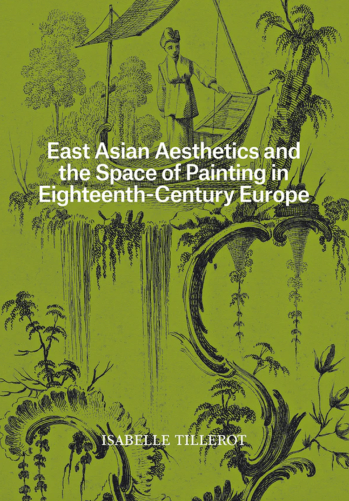 This volume offers the first critical account of how European imports of East Asian textiles, porcelain, and lacquers, along with newly published descriptions of the Chinese garden, inspired a revolution in the role of painting in early modern Europe. With particular focus on French interiors, Isabelle Tillerot reveals how a European enthusiasm for East Asian culture and a demand for novelty transformed the dynamic between painting and decor. Models of space, landscape, and horizon, as shown in Chinese and Japanese objects and their ornamentation, disrupted prevailing design concepts in Europe. With paintings no longer functioning as pictorial windows, they began to be viewed as discrete images displayed on a wall—and with that, their status changed from decorative device to autonomous work of art. This study presents a detailed history of this transformation, revealing how an aesthetic free from the constraints of symmetry and geometrized order upended paradigms of display, enabling European painting to come into its own.
Isabelle Tillerot is an independent scholar of eighteenth-century French art.
New Book | The Borders of Chinese Architecture
From Harvard UP:
Nancy Shatzman Steinhardt, The Borders of Chinese Architecture (Cambridge: Harvard University Press, 2022), 448 pages, ISBN: 978-0674241015, $57.
 An internationally acclaimed expert explains why Chinese-style architecture has remained so consistent for two thousand years, no matter where it is built.
For the last two millennia, an overwhelming number of Chinese buildings have been elevated on platforms, supported by pillars, and covered by ceramic-tile roofs. Less obvious features, like the brackets connecting the pillars to roof frames, also have been remarkably constant. What makes the shared features more significant, however, is that they are present in Buddhist, Daoist, Confucian, and Islamic milieus; residential, funerary, and garden structures; in Japan, Korea, Mongolia, and elsewhere. How did Chinese-style architecture maintain such standardization for so long, even beyond China’s borders?
Nancy Shatzman Steinhardt examines the essential features of Chinese architecture and its global transmission and translation from the predynastic age to the eighteenth century. Across myriad political, social, and cultural contexts within China and throughout East Asia, certain design and construction principles endured. Builders never abandoned perishable wood in favor of more permanent building materials, even though Chinese engineers knew how to make brick and stone structures in the last millennium BCE. Chinese architecture the world over is also distinctive in that it was invariably accomplished by anonymous craftsmen. And Chinese buildings held consistently to the plan of the four-sided enclosure, which both afforded privacy and differentiated sacred interior space from an exterior understood as the sphere of profane activity. Finally, Chinese-style buildings have always and everywhere been organized along straight lines. Taking note of these and other fascinating uniformities, The Borders of Chinese Architecture offers an accessible and authoritative overview of a tradition studiously preserved across time and space.
Nancy Shatzman Steinhardt is Professor of East Asian Art and Curator of Chinese Art at the University of Pennsylvania and the author of Chinese Architecture: A History (2019). Her work has been supported by the Guggenheim Foundation, Getty Foundation, National Endowment for the Humanities, and the American Philosophical Society.
c o n t e n t s
Preface
Introduction: The Borders Problem
1 Chinese Architecture before China
2 Han
3 Architecture before Reunification
4 Seeing the Sixth Century as the Seventh and Eighth
5 Tang Internationalism
6 Defining Chinse Architecture and Borders during Liao
7 Western Xia, Song, Japn, Jin
8 A Revisionist History of Yuan Architecture
9 Ming
10 The Long Eighteenth Century
Afterword
New Report | Survey of Asian Ceramics, National Trust for Scotland
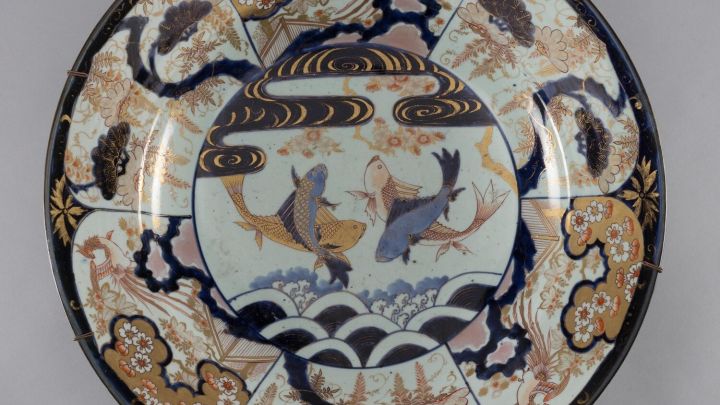
Large dish, porcelain, painted in underglaze blue, iron-red, and gold, Imari-type palette, made in Arita kilns, Japan, Edo period, c.1700–20
(National Trust for Scotland)
◊ ◊ ◊ ◊ ◊
The report was released early this year; Patricia Ferguson provides an introduction here. The full report is available (for free) as a PDF file here.
Patricia Ferguson, Survey of Asian Ceramics in the Collection of the National Trust for Scotland (National Trust for Scotland, 2023), 162 pages.
Between 2017 and 2019 the National Trust for Scotland delivered Project Reveal, a major collections project inventorying a collection of over 140,000 objects, distributed across 50 properties throughout Scotland. Encompassing major object groupings in the areas of fine and decorative art, household furniture and domestic life, these collections chart the experiences of people living in Scotland through 500 years of Scottish history, as well as demonstrating Scotland’s past relationships with the rest of the world.
This survey of Asian ceramics is a natural successor to Project Reveal. It delves deeper into the history and significance of a collection of circa 1,700 ceramic items. Undertaken by the independent researcher Patricia F. Ferguson this report sets out the survey findings, drawing together disparate existing research on the subject and contributing new collection research and knowledge. Focusing on key collections at nine different National Trust for Scotland properties, the report positions the collections within the broader context of historic ceramic production and collecting, with attention to influences such as: fashion and the role of royalty; production in and trade with China and Japan; and the growth of and changes in demand.
Patricia Ferguson is a ceramic specialist with an MA from the School of Oriental and African Studies (SOAS), London. She has worked in London at the British Museum and Victoria & Albert Museum, and as Honorary Adviser on Ceramics to the National Trust (England, Wales, and Northern Ireland). She published Ceramics: 400 Years of British Collecting in 100 Masterpieces in 2016.










 Enfilade
leave a comment