New Book | Embroidering the Landscape
Coming this fall from Lund Humphries:
Andrea Pappas, Embroidering the Landscape: Women, Art, and the Environment in British North America, 1740–1770 (London: Lund Humphries, 2023), 192 pages, ISBN: 978-1848226241, £50 / $90.
 Linking histories of women, relationships to the natural environment, material culture and art, Andrea Pappas presents a new, multi-dimensional view of eighteenth-century American culture from a unique perspective. This book investigates how and why women pictured the landscape in their needlework. It explores the ways their embroidered landscapes address the tumultuous environmental history of the period; how their depictions of nature differ from those made by men; and what women’s choices of motifs can tell us about their lives and their relationships to nature. Embroidering the Landscape situates these pastoral and georgic needleworks (c. 1740–1775) at the intersection of environmental and social histories, interpreting them through ecocritical and social lenses. Pappas’ investigation draws out connections between women’s depicted landscapes and environmental and cultural history at a time when nature itself was a charged arena for changes in agriculture, husbandry, gardening, and the emerging discourses of botany and natural history. Her insights change our understanding of the relationship between culture and the environment in this period and raise new questions about the unrecognized extent of women’s engagement with nature and natural science.
Andrea Pappas is Associate Professor at Santa Clara University. She has published on topics ranging from the Renaissance to the present and is particularly interested in the work of people on the margins or in overlooked artifacts.
c o n t e n t s
Introduction: Surveying the Field
1 The Eye of the Needle
2 Roots and Terroir
3 Greener Pastures
4 Flock, Fish, and Fowl
5 Women’s Estate
6 Women and ‘Experiential Botany’
Conclusion: Women’s Harvest
Notes
Bibliography
Illustration Credits
Index
New Book | Landscape Design & Revolution in Ireland and the U.S.
Distributed by Yale UP:
Finola O’Kane, Landscape Design & Revolution in Ireland and the United States, 1688–1815 (London: Paul Mellon Centre for Studies in British Art, 2023), 272 pages, ISBN: 978-1913107383, £45 / $65.
 Explores how revolutionary ideas were translated into landscape design, encompassing liberty, equality, improvement and colonialism.
Spanning the designed landscapes of England’s Glorious Revolution of 1688, the American Revolution of 1776, and the Irish rebellion of 1798, with some detours into revolutionary France, this book traces a comparative history of property structures and landscape design across the eighteenth-century Atlantic world and evolving concepts of plantation and improvement within imperial ideology. Revolutionaries such as Jean-Jacques Rousseau, George Washington, Arthur Young, Lord Edward FitzGerald, and Pierce Butler constructed houses, farms, and landscape gardens—many of which have since been forgotten or selectively overlooked. How did the new republics and revolutionaries, having overthrown social hierarchies, translate their principles into spatial form? As the eighteenth-century ideology of improvement was applied to a variety of transatlantic and enslaved environments, new landscape designs were created—stretching from the suburbs of Dublin to the sea islands of the state of Georgia. Yet these revolutionary ideas of equality and freedom often contradicted reality, particularly where the traditional design of the great landed estate—the building block of aristocratic power throughout Europe—intersected with that of the farm and the plantation.
Finola O’Kane is a landscape historian, architect, and professor at the School of Architecture, Planning and Environmental Policy, University College Dublin.
New Book | Drawn from Nature: The Flowering of Irish Botanical Art
The related exhibition was on view in Dublin at the National Gallery of Ireland in 2020. Forthcoming from ACC:
Patricia Butler, Drawn from Nature: The Flowering of Irish Botanical Art (Woodbridge: ACC Art Books, 2023), 256 pages, ISBN: 978-1788842365, £35 / $40.

For centuries, artists of all disciplines have expressed delight in nature through the highly skilled and captivating medium of botanical art. The distinguished contributions of Irish botanical artists include records of plants from 17th-century Ireland, early illustrated floras, and botanical art found in the field of design. Drawn from Nature: The Flowering of Irish Botanical Art also covers the importance of botanical art to the Ordnance Survey of Ireland during the 19th century, as well as the vital plant portraits produced by Irish women. These portraits assisted generations of botanists in understanding and describing the natural world but received scant recognition. Published for the first time, these outstanding examples of Irish botanical art, from both public and private collections, demonstrate a shared desire by botanical artists to observe, illuminate, and record Ireland’s unique flora. This book finally affords them the recognition they deserve.
Patricia Butler is an art historian and gardener. The author of Irish Botanical Illustrators & Flower Painters (2000), she curated the exhibition Drawn from Nature: Irish Botanical Art, on view in Dublin at the National Gallery of Ireland in 2020. She owns the historic garden at Dower House, Rossanagh, Ashford, Co Wicklow.
New Book | A Curious Herbal
From Abbeville Press (Lauren Moya Ford’s review of the book can be found at HyperAllergic). . . .
Marta McDowell and Janet Stiles Tyson, eds., A Curious Herbal: Elizabeth Blackwell’s Pioneering Masterpiece of Botanical Art (New York: Abbeville Press, 2023), 576 pages, ISBN: 978-0789214539, £60 / $75.
 A complete edition of the first herbal published by a woman artist—which has a remarkable backstory.
In the 1730s, Elizabeth Blackwell (1699–c. 1758) found herself penniless, with her ne’er-do-well husband confined to a London debtor’s prison. A talented artist, she came up with a unique and ambitious moneymaking scheme: the publication of a new illustrated guide to medicinal plants, including many New World species not depicted in earlier books. Blackwell’s Curious Herbal, published between 1737 and 1739, was hailed for its usefulness to doctors and apothecaries and met with considerable financial success. This magnificent volume—the first modern edition of Blackwell’s herbal—reproduces all five hundred of her exquisite plates. Blackwell not only made the drawings, but prepared the copper plates and personally hand-colored the prints. Her handwritten descriptions of the plants, which she creatively adapted (with permission) from Joseph Miller’s Botanicum Officinale, retain considerable interest. This book features a previously unknown preface by Blackwell, in which she reveals her passion for art and nature, and her vision for the herbal. Two introductory texts contextualize Blackwell’s achievement: the noted garden writer Marta McDowell explores the history of herbals as a genre and the state of botanical knowledge in Blackwell’s time, and the historian Janet Stiles Tyson relates the artist’s rather extraordinary biography.
Marta McDowell is a gardener, lecturer, and horticultural writer. Her books include All the Presidents’ Gardens (2016) and Beatrix Potter’s Gardening Life (2013), winner of the Gold Award from the Garden Writers Association.
Janet Stiles Tyson, an independent scholar, wrote her doctoral dissertation on Elizabeth Blackwell’s Curious Herbal.
New Book | The Turkish Boudoir of Marie-Antoinette and Joséphine
From Éditions d’art Monelle Hayot:
Vincent Cochet and Alexia Lebeurre, The Turkish Boudoir of Marie-Antoinette and Joséphine at Fontainebleau / Le Boudoir Turc de Marie-Antoinette et Joséphine à Fontainebleau (Saint-Rémy-en-l’Eau: Éditions d’art Monelle Hayot, 2023), 208 pages, ISBN: 979-1096561384 (English) / ISBN: 979-1096561407 (French), €43.
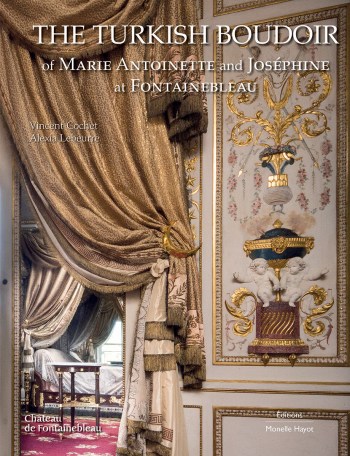 Within ten years, Marie-Antoinette ordered the achievement of two exquisite rooms in Fontainebleau: the Turkish Boudoir (1777) and the Silver Boudoir (1786). Two peaceful refuges allowing her to escape the laws of «Étiquette». When Joséphine became Empress, the craze for turqueries and chinoiseries, had not faded. Both a lover of Marie-Antoinette and of her style, she made hers the Turkish Boudoir emptied at the Revolution. She enhanced the luxury of the oriental atmosphere adding sumptuous and highly creative pieces of furniture by the finest artists of her time. Mahogany and gilt bronzes accompanied masterpieces of upholstery and curtains made of brocade, silk and gold. After a painstaking seven-year restoration completed in 2015, the graceful carved, painted, and gilded panelings of Marie Antoinette’s boudoir are once again the setting for Joséphine’s luxurious furniture in an environment of rewoven textiles.
Heritage curator Vincent Cochet devoted seven years to the restoration of the Turkish Boudoir. Alexia Lebeurre is Associate Professor in the History of Art Department at the Université Bordeaux Montaigne.
Exhibition | Seduction and Power

Now on view at Marly:
Séduction et Pouvoir: L’art de s’apprêter à la Cour
Musée du Domaine royal de Marly, 14 April — 27 August 2023
Curated by Anne Camilli and Karen Chastagnol
Une exposition consacrée à l’art du paraître aux 17e et 18e siècles.
Se vêtir et accessoiriser sa tenue révèle les usages sociaux et politiques des élites. Si l’usage de la parure et l’envie d’embellir le corps sont présents dans toutes les sociétés et à toutes les époques, il s’accompagne sous Louis XIV d’une véritable stratégie d’affirmation du pouvoir motivée par la centralisation politique. Le règne du Roi-Soleil se caractérise par un souci de l’apparence et de la représentation. L’accessoire, tout comme le vêtement, contribue à la nécessité de paraitre et de tenir son rang.
Qu’on les appelle ornements ou encore parures, les accessoires du vêtement, de la coiffure et de la beauté deviennent les outils d’une communication non verbale entre les individus et le lieu d’un investissement symbolique. Ces ornements et ces parures reflètent les courants de la mode mais témoignent également des valeurs et des préférences de la société française de l’époque.
 Chaque accessoire, chaque geste, chaque attitude répond à des normes, à des codes qui ne cessent d’évoluer attestant ainsi des changements de modes et de mœurs. Cette construction de l’apparence requiert de connaître les usages et les règles et de s’y conformer pour bénéficier de la faveur royale et attester de son identité sociale.
Aussi, cette culture du paraître s’accompagne d’une parfaite maîtrise de soi et des expressions du visage : fards, poudres, mouches et parfums concourent à une monotonie d’apparence. L’impératif de séduction s’inscrit dans un double mouvement : un mimétisme envers le roi et le pouvoir d’une part, et la nécessité de s’en affranchir pour se faire remarquer et mieux révéler son rang d’autre part. Le corps se pare alors de divers artifices : perruques, maquillage, bijoux, parfums, dentelles, et objets de poche et de galanterie. Les costumes sont complétés par différents atours : broderies, dentelles, rubans qui rivalisent de sophistication et de raffinement.
Objets luxueux, réalisés par des métiers d’art, ces accessoires subliment le vêtement, deviennent des objets de distinction et s’accompagnent pour certains d’une gestuelle propre qui révèle un langage codifié et marquent le corps modifiant la posture, le déplacement, la prestance du courtisan. Qu’elles soient rhétoriques ou esthétiques, ces armes de séduction servent l’esprit d’une société élitiste où se mêlent des enjeux amoureux, politiques et religieux.
L’exposition vous emmène à la découverte de ces objets qui participent à ce jeu de la séduction et du pouvoir à la cour. Éléments de la mise en scène du théâtre de la cour, les accessoires de mode, les produits de beauté et l’art du parfum révèlent les attentes des femmes et des hommes nobles tout au long des XVIIe et XVIIIe siècles. Le visiteur découvre les œuvres dans un parcours qui évoque de la tête au pied les différents objets auquel recourt le courtisan et reflète les évolutions de ces accessoires au cours des règnes successifs de Louis XIV, Louis XV et Louis XVI, période d’activité du château de Marly, instrument de la politique royale.
Anne Camilli and Karen Chastagnol, eds., with additional contributions by Alice Camus, Georgina Letourmy-Bordier, Grégory Maugain, and Corinne Thépaut-Cabasset, Séduction & Pouvoir: L’art de s’apprêter à la Cour (Fine éditions d’art, 2023), 104 pages, ISBN: 978-2382031179, €25.
Entre les règnes de Louis XIV et de Louis XVI, Versailles puis Paris se disputent le titre de capitale de la mode. Entre désir de séduction, affirmation du pouvoir et désir de signifier un statut social, les accessoires de mode et de beauté viennent appuyer sous l’Ancien Régime une nouvelle mise en scène de soi. Chaque parure, chaque geste, chaque attitude répond à des codes qui ne cessent d’évoluer et accompagnent ainsi les modes et les mœurs. Le corps est paré de divers artifices qui rivalisent d’audace et de distinction. Quels rôles jouent ces ornements dans le contexte de la cour ? L’exposition du Musée du Domaine royal de Marly retrace les usages de ces objets, de la tête aux pieds : coiffes, perruques, maquillage, parfums, ornements du vêtement, bijoux, objets de galanterie, chaussures.
s o m m a i r e
• Introduction — Être et paraître : Accessoires de mode, parures & ornements — Karen Chastagnol
• Boucles, dentelles, bonnets et édifices de la mode capillaire — Corinne Thépaut-Cabasset
• Mouche et rouge : Les attributs de la mode et de la beauté — Corinne Thépaut-Cabasset
• L’apparat olfactif du courtisan — Alice Camus
• Orner le vêtement et ses accessoires à la cour : Dentelles, broderies et boutons — Géraldine Bidault
• Le bijou et la montre pour briller à la cour — Anne Camilli et Grégory Maugain
• La galanterie de poche — Anne Camilli et Georgina Letourmy-Bordier
• Le soulier et ses parures — Anne Camilli
Annexes
Notices des œuvres exposées
Sources & bibliographie
Crédits photographiques
New Book | Jane Austen’s Wardrobe
From Yale UP:
Hilary Davidson, Jane Austen’s Wardrobe (New Haven: Yale University Press, 2023), 240 Pages, ISBN: 978-0300263602, $35.
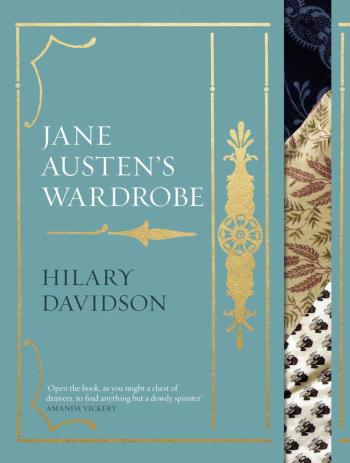 What did Jane Austen wear? Acclaimed dress historian and Austen expert Hilary Davidson reveals, for the first time, the wardrobe of one of the world’s most celebrated authors. Despite her acknowledged brilliance on the page, Jane Austen has all too often been accused of dowdiness in her appearance. Drawing on Austen’s 161 known letters, as well as her own surviving garments and accessories, this book assembles examples of the variety of clothes she would have possessed—from gowns and coats to shoes and undergarments—to tell a very different story. The Jane Austen Hilary Davidson discovers is alert to fashion trends but thrifty and eager to reuse and repurpose clothing. Her renowned irony and wit peppers her letters, describing clothes, shopping, and taste. Jane Austen’s Wardrobe offers the rare pleasure of a glimpse inside the closet of a stylish dresser and perpetually fascinating writer.
Hilary Davidson is associate professor and chair of MA Fashion and Textile Studies at the Fashion Institute of Technology, New York. She has curated, lectured, broadcast, and published extensively in her field and is author of Dress in the Age of Jane Austen: Regency Fashion.
New Book | Brittle Beauty
Published by Paul Holberton and distributed by The University of Chicago Press:
Andreina d’Angeliano, Claudia Lehner-Jobst, Errol Manners, Rosalind Savill, Selma Schwartz, and Jeffrey Munger, Brittle Beauty: Reflections on 18th-Century European Porcelain (London: Ad Ilissvm, 2023), 560 pages, ISBN: 978-1912168293, £90 / $110.
 Brittle Beauty presents a superlative private collection of European porcelain—radical, rare, and in many cases unique pieces assembled over thirty years. Lavishly illustrated and insightfully researched, the book showcases eighty vessels and sculptures and includes accounts of their patrons and former owners, many as eccentric as the works themselves.
One striking attribute of porcelain is its reflective glaze. Mirror-like in a wider sense, Brittle Beauty: Reflections on 18th-Century European Porcelain examines the context in which this porcelain was created—including cultural, political, topographical, and ceremonial aspects. It also looks at related materials such as silver, textiles, and glass.
The 18th century was the golden age of porcelain in Europe, which had previously been dependent on precious imports from the Far East. The discovery of the formula for hard-paste porcelain in Dresden in 1709 inspired the establishment of manufactories throughout the Continent. However, its popularity was not purely commercial: porcelain—with its meld of art and science, beauty and intellect, East and West—became a symbol of Enlightenment culture for every princely court. Oriental motifs and European forms were synthesised with deceptive subtlety; later, creations of pure fantasy emerged, often based on travellers’ accounts of exotic lands. Familiar Occidental themes such as nature, hunting, or archaeology were paralleled by ironic narratives of love and vanity. Porcelain, with its fragile allure, is uniquely expressive of the human comedy, yet its destiny has often been brutal and tragic. This book features essays from several eminent scholars. It also showcases a wealth of stunning imagery from Sylvain Deleu, who expertly photographed the pieces, many for the first time.
Andreina d’Agliano art historian and curator, is a specialist in porcelain from Turin and Florence and has published various private and public collections.
Claudia Lehner-Jobst is an art historian specializing in European decorative arts, notably du Paquier porcelain, and Director of the Augarten Porcelain Museum, Vienna.
Errol Manners, FSA is a dealer in antique ceramics based in London and the former Chair of The French Porcelain Society and of the Ceramics Vetting Committee at TEFAF (Maastricht) and Masterpiece (London).
Dame Rosalind Savill, DBE, FBA, FSA, worked at the Victoria and Albert Museum and at the Wallace Collection (where she was Director from 1992 until 2011), and has published widely on Sèvres porcelain.
Selma Schwartz, an independent scholar, was Deputy Keeper and Curator of Porcelain at the Rothschild Collection, Waddesdon Manor for over 25 years.
Jeffrey Munger is a former curator in the Department of European Sculpture and Decorative Arts at the Metropolitan Museum of Art, New York.
New Book | My Dark Room
From The University of Chicago Press:
For 30% off US orders, visit http://www.press.uchicago.edu and enter code MDR30 at checkout (expires 31 December 2023). For 30% off UK and European orders, call +44 (0) 1243 843291 or email chicago.csd@wiley.com and redeem with promo code MDR30 (expires 7 September 2023).
Julie Park, My Dark Room: Spaces of the Inner Self in Eighteenth-Century England (Chicago: The University of Chicago Press, 2023), 344 pages, ISBN: 978-0226824758 (cloth), $105 / ISBN: 978-0226824765 (paper), $35. Also available as a PDF.
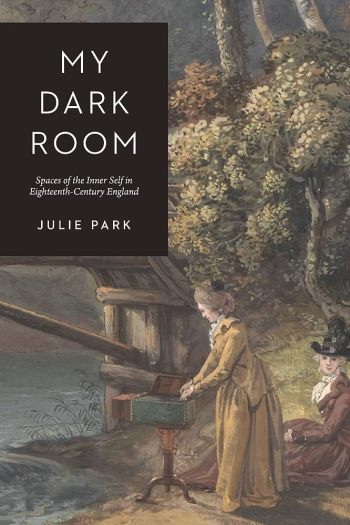 Examines spaces of inner life in eighteenth-century England to shed new light on interiority in literature and visual and material culture.
In what kinds of spaces do we become most aware of the thoughts in our own heads? In My Dark Room, Julie Park explores places of solitude and enclosure that gave eighteenth-century subjects closer access to their inner worlds: grottos, writing closets, landscape follies, and the camera obscura, that beguiling ‘dark room’ inside which the outside world in all its motion and color is projected. The camera obscura and its dreamlike projections within it served as a paradigm for the everyday spaces, whether in built environments or in imaginative writing, that generated the fleeting states of interiority eighteenth-century subjects were compelled to experience and inhabit.
My Dark Room illuminates the spatial and physical dimensions of inner life in the long eighteenth century by synthesizing material analyses of diverse media, from optical devices and landscape architecture to women’s intimate dress, with close readings of literary texts not traditionally considered together, among them Andrew Marvell’s country house poem Upon Appleton House, Margaret Cavendish’s experimental epistolary work Sociable Letters, Alexander Pope’s heroic verse epistle Eloisa to Abelard, and Samuel Richardson’s novel Pamela. Park also analyzes letters and diaries, architectural plans, prints, drawings, paintings, and more, drawing our attention to the lively interactions between spaces and psyches in private environments. Park’s innovative method of ‘spatial formalism’ reveals how physical settings enable psychic interiors to achieve vitality in lives both real and imagined.
Julie Park is Paterno Family Librarian for Literature and professor of English at the Pennsylvania State University. She is the author of The Self and It: Novel Objects in Eighteenth-Century England and coeditor of Organic Supplements: Bodies and Things of the Natural World, 1580–1790.
c o n t e n t s
Introduction
1 Country House: Making Storylines at Nun Appleton
2 Closet: Margaret Cavendish’s Writing Worlds
3 Grotto: Design and Projection in Alexander Pope’s Garden
4 Pocket: Pamela’s Mobile Settings and Spatial Forms
5 Folly: Fictions of Gothic Space in Eighteenth-Century Landscapes
Epilogue
Acknowledgments
Notes
Bibliography
Index
◊ ◊ ◊ ◊ ◊
Note (added 8 August) — The posting was updated to include the discount code.
Exhibition | UFO 1665
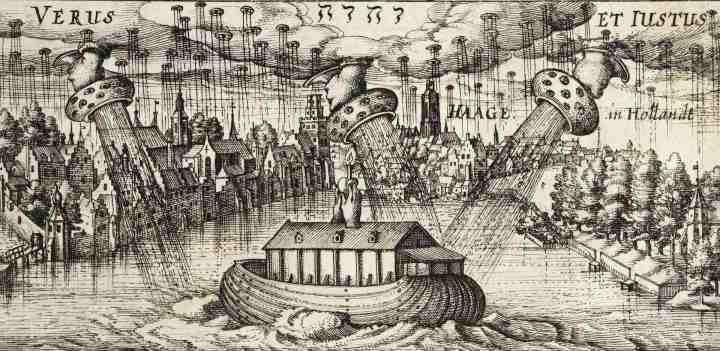
So Sehr War Nei Erzürnet Gott / Never Was God So Full of Wrath, detail, emblematic representation from Daniel Meisner, Politica – Politica, Newes Emblematisches Büchlein, I–VIII (Nürnberg, ca. 1700), engraving (Staatliche Museen zu Berlin, Kunstbibliothek).
◊ ◊ ◊ ◊ ◊
I was fortunate to see this exhibition a few weeks ago and can’t recommend it highly enough: it’s thoughtfully conceived, brilliantly installed, incredibly engaging, and deeply satisfying. It’s also just a lot of fun! A model for how to make the history of visual conventions (overlapping with history of ideas generally) broadly accessible (my thirteen-year-old daughter was riveted). It’s a reminder of how many of our categories for making sense of the world emerged in the seventeenth and eighteenth centuries. The catalogue is certainly worth ordering. –CH
UFO 1665: The Air Battle of Stralsund / Die Luftschlacht von Stralsund
Kunstbibliothek, Staatliche Museen zu Berlin, 5 May — 3 September 2023
Curated by Moritz Wullen
In April 1665, six fishermen witnessed an unexplained celestial phenomenon: an aerial battle in the skies above the Baltic Sea near Stralsund. As evening broke, a dark-grey disk appeared high above the city centre. UFO 1665 is the first exhibition of its kind to focus on this historical UFO sighting. With reference to contemporaneous visual and textual sources, the exhibition reconstructs the way this event was portrayed in the media and exposes certain paradigms and communications strategies that are still used today to determine how we report on ‘unexplained aerial phenomena’ (UAPs).
 The exhibition takes visitors on an expedition into a strange and unfamiliar world of images that otherwise remains concealed from the museum’s general audience in archives or between the pages of old books. Those who are familiar with 17th-century art only from the grand galleries of paintings may be taken aback: upon entering the exhibition space, visitors might feel they are entering a baroque parallel universe with strange symbols in the sky, airships, space rockets, and flying saucers. Everything is centred around one of the most spectacular celestial phenomena of the modern era: at 2pm on 8 April 1665, six men fishing for herring off the coast of Stralsund watch as great flocks of birds in the sky morph into warships and engage in a thunderous air battle. The decks teem with ghostly figures. When, at dusk, “a flat, round shape like a plate” appears above the St. Nicholas Church, they flee. The following day, they find that they are trembling all over and complain of pain.
Media Transformation
The media spread the news like wildfire, with the publishers of various leaflets and newspapers locked in fierce competition with each other to concoct the most colourful versions and interpretations of events. It was religious convictions in particular that were most responsible for determining how the event was transformed by the media. The general public could not have known that what had actually been witnessed was an atmospheric reflection of a sea battle that was raging just beyond the horizon. Instead, they were convinced that the universe was ruled by a god who had the power to project visions of impending disaster into the sky. The air battle was likewise perceived as a prodigium (Latin for ‘omen’ or ‘portent’).
The visual themes of the 17th century were likely also decisive in terms of determining how the media shaped depictions of the air battle, with futuristic visions of airships—which the people of the 17th century were incredibly enthusiastic about—playing a special role. More than 100 years before the first manned hot air balloon flight was conducted, Francesco Lana Terzi (1631–1687) had published his design for a flying boat borne aloft by vacuum spheres, which caused a great sensation throughout Europe. The fact that the project could never actually be realised did little to detract from the general fervour. Humankind continued to dream of conquering the skies.
The Power of Myths
Another theme of the exhibition is the power of myths: when, on 19 June 1670, lightning struck—of all places—the St. Nicholas Church, the building above which the grey disc had loomed so ominously five years earlier, the celestial phenomenon was subsequently interpreted as a sign of God’s wrath. The descriptions and accounts of the day invoked a mystical link to the destruction of Babylon at the hands of a great millstone, as it is described in the Book of Revelation. However, the popular perception of the air battle over Stralsund was not only shaped by the media, beliefs, designs, and myths of the baroque era; it also reveals the kinds of things that humans of the era were unable to envisage and comprehend. There are no 17th-century sources, for example, that mention extraterrestrials in connection with the unexplained aerial phenomena. Yet at the same time, the human imagination was already so far advanced that it could well conceive of expeditions to other inhabited planets and the kinds of propulsion systems that would be required to carry these out. Why nobody considered for a moment that extraterrestrials might appear in our skies with their own flying machines is one of the many mysteries this exhibition endeavours to solve.
An Excursion into the Present
This cultural and media-historical investigation culminates in an excursion into the present, which focuses on the videos and accounts of sightings of mysterious ‘Unidentified Aerial Phenomena’ (UAPs) made by the US military that went viral in 2019 and even made their way onto the front cover of an issue of Der Spiegel two years later. The sightings in question have given rise to a maddeningly broad spectrum of interpretations. Are they physically explicable natural phenomena, sophisticated high-tech drones made in China or Russia, extraterrestrials, or even visitors from the future? Even NASA and the Pentagon seem completely baffled. We can, however, be sure of one thing: the factors that were so crucial to the media success of the UFO of 1665 lack none of their that same potency today.
The exhibition is curated by Moritz Wullen, director of the Kunstbibliothek.
Moritz Wullen, UFO 1665: The Air Battle of Stralsund / Die Luftschlacht von Stralsund (Cologne: Wienand Verlag, 2023), 112 pages, ISBN 978-3868327502 (bilingual edition, German and English), €24.










leave a comment