New Book | Piranesi’s Candelabra and the Presence of the Past
From Oxford UP:
Caroline van Eck, Piranesi’s Candelabra and the Presence of the Past: Excessive Objects and the Emergence of a Style in the Age of Neoclassicism (Oxford: Oxford University Press, 2023), 224 pages, ISBN: 978-0192845665, £70 / $90.
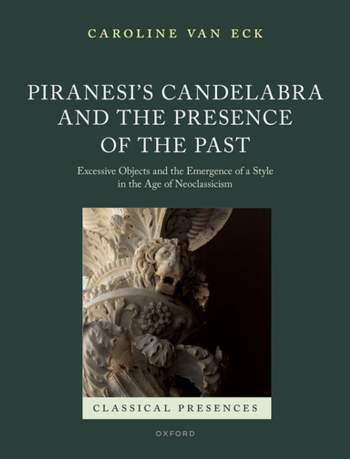 Near the end of his life, Giovanni Battista Piranesi (1720–1778) created three colossal candelabra mainly from fragments of sculpture excavated near the Villa Hadriana in Tivoli—two of which are now in the Ashmolean Museum, with the other one in the Louvre. Although these objects were among the most sought-after and prestigious of Piranesi’s works and fetched enormous prices during his lifetime, they suffered a steep decline in appreciation from the 1820s onwards, and even today they are among the least studied of the artist’s works. Piranesi’s Candelabra and the Presence of the Past uncovers the intense investment around the start of the nineteenth century—by artists, patrons, collectors, and the public—in objects that made Graeco-Roman antiquity present again. Caroline van Eck’s study examines how objects make their makers, or viewers feel that they are again in the presence of antiquity, that not only antiquity has been revived, but that classical statues become alive under viewers’ gaze. The book considers the three candelabra in depth, providing the biography of these objects, from the excavation of the Roman fragments to their entry into private and public collection. Van Eck considers the context that Piranesi gave them by including them in his Vasi, Candelabri e Cippi (1778), allowing us to rethink the processes that led to the development of neoclassicism from the perspective of the objects and objectscapes that came into being in Rome at the end of the eighteenth century.
Caroline van Eck studied art history at the Ecole du Louvre in Paris, and classics and philosophy at Leiden University. She obtained a PhD in aesthetics at the University of Amsterdam in 1994. She has held teaching positions at the Universities of Amsterdam, Groningen, and Leiden, where she was appointed Professor of Art and Architectural History in 2006. She has been a Visiting Fellow at the Warburg Institute and the Paul Mellon Centre for British Art at Yale University, a Visiting Professor in Ghent, Yale, York, and the Ecole Normale Supérieur in Paris, and in 2018 held the Panofsky Chair at the Zentralinstitut für Kunstgeschichte in Munich. In September 2016, she was appointed Professor of Art History at the University of Cambridge. She delivered the 2017 Slade Lectures in Oxford.
c o n t e n t s
List of Illustrations
Introduction
1 ‘A Neoclassical Dream and an Archaeologist’s Nightmare’: Piranesi’s Colossal Candelabra in the Louvre and Ashmolean Museum
2 Candelabra in Antiquity, Their Rediscovery, and Reception
3 Making Antiquity Materially Present
4 Animal Features
5 Animation, Immersion, and the Revival of Antiquity
6 Movement, Animation, and Intentionality
Conclusion: ‘Antiquity Is Only Now Coming into Being’. The Origins of the Style Empire and the Turn towards the Object, 1770–1820
References
Index
Exhibition | Making Her Mark
Opening this fall at the BMA:
Making Her Mark: A History of Women Artists in Europe, 1400–1800
Baltimore Museum of Art, 1 October 2023 — 7 January 2024
Art Gallery of Ontario, Toronto, 30 March — 1 July 2024
Curated by Andaleeb Badiee Banta and Alexa Greist
 For centuries, women artists in Europe were considered rare and less talented than their male counterparts. Women who achieved professional artistic careers were deemed anomalous or exceptional, while those who engaged in creative pursuits in the home were dismissed as amateurs, and their works were categorized as material culture rather than art.
Making Her Mark: A History of Women Artists in Europe, 1400–1800, the BMA’s much anticipated major exhibition opening 1 October 2023, aims to correct these broadly held but mistaken beliefs through more than 200 works of diverse media and scale. From royal portraits and devotional sculptures to embroidered objects, tapestries, costumes, wax sculptures, metalwork, ceramics, graphic arts, furniture, and more, Making Her Mark will feature objects from the 15th to 18th centuries that reflect the multifaceted and often overlooked ways that women contributed to the visual arts of Europe.
The exhibition’s focus on displaying exclusively objects made by women or toward which women contributed their labor distinguishes this project by putting women makers of all social levels in conversation with each other through their works. Examples by artistic heroines such as Sofonisba Anguissola, Artemisia Gentileschi, Judith Leyster, Luisa Roldán, Rosalba Carriera, Rachel Ruysch, and Élisabeth Vigée Le Brun will join exceptional products of female artisanal collectives and talented amateurs who operated outside of the male-dominated professional arena and often remained anonymous in the historical record. Further, sublime examples of ceramics, metalwork, and cabinetmaking from this era will reflect women’s involvement in major manufactories and workshops.
Organized by the Baltimore Museum of Art and the Art Gallery of Ontario, Making Her Mark is curated by Andaleeb Badiee Banta, Senior Curator and Department Head, Prints, Drawings & Photographs at the BMA, and Alexa Greist, Curator and R. Fraser Elliott Chair, Prints & Drawings at the AGO. The exhibition is generously supported by the National Endowment for the Humanities, The Gladys Krieble Delmas Foundation, the Samuel H. Kress Foundation, and Sheela Murthy/MurthyNAYAK Foundation.
Andaleeb Badiee Banta and Alexa Greist, with Theresa Kutasz Christensen, Making Her Mark: A History of Women Artists in Europe, 1400–1800 (Fredericton, New Brunswick: Goose Lane Editions, 2023), 264 pages, ISBN: 9781773103181, $60.
Exhibition | Ingenious Women, 16th to 18th Centuries

Angelika Kauffmann, Clio, Muse of History, detail, ca. 1770–75 (Augsburg: Schaezlerpalais–Deutsche Barockgalerie; photo by Andreas Brücklmair).
◊ ◊ ◊ ◊ ◊
Opening this fall at the the Bucerius Kunst Forum:
Ingenious Women: Women Artists and Their Companions
Geniale Frauen: Künstlerinnen und ihre Weggefährten
Bucerius Kunst Forum, Hamburg, 14 October 2023 — 28 January 2024
Kunstmuseum Basel, 2 March — 30 June 2024
With the exhibition Ingenious Women: Women Artists and Their Companions, the Bucerius Kunst Forum traces the careers of outstanding women artists (Künstlerinnen) from the sixteenth to the eighteenth century. For the first time, the family context in which the women artists pursued their careers is addressed and made visible through juxtaposition with works by their fathers, brothers, husbands, and fellow painters. Today often forgotten, female artists of their time were able to achieve extraordinary success in a wide variety of family constellations: they became court painters, teachers, entrepreneurs, and even publishers and were awarded the highest honours.
 The exhibition presents around 140 works by 26 women artists, including Sofonisba Anguissola, Judith Leyster, Marietta Robusti (Tintoretto’s daughter), and Angelika Kauffmann. Masterful portraits, still lifes, and historical scenes in painting, along with drawings and prints from across Europe, ranging from the Renaissance and Baroque periods to early Neoclassicism, will be brought together in Hamburg. For the first time, works by women artists will be juxtaposed with those of their male colleagues in such a pointed way that both formal and stylistic similarities and differences will come to the fore.
In the early modern period it was not altogether impossible for women to pursue a career as an artist, but it was definitely outside the norm and therefore always subject to special challenges. Anyone wishing to practice a freelance profession had to join a guild, but some regions denied membership to women, and in others it entailed considerable hurdles and costs. A conspicuous number of women artists of this period came from or married into artistic families. They worked for their fathers, brothers, and husbands, and often in secret. At the royal courts of Europe, the situation was different: with an open mind to artistic achievement—regardless of origin or gender—women were able to work openly as artists at court. Women such as Lavinia Fontana, Anna Dorothea Therbusch, and Rachel Ruysch asserted themselves against social norms, capturing the attention and earned the esteem of their contemporaries. The fact that they fell into oblivion is also due to the history of art scholarship, in which a male gaze dominated until the advanced twentieth century.
The exhibition shows the unique careers of these pioneering women artists and offers new insights into their lives and work, as well as thought-impulses on contemporary issues such as equality and the reconciliation of work and family.
Bodo Brinkmann and Katrin Dyballa, eds., with contributions by Beiträge von B. Brinkmann, K. Dyballa, S. Engel, A. Mensger, R. Müller, S. Salomon, A. Tacke, S. Pisot, I. Wenderholm, and S. Werthemann, Geniale Frauen: Künstlerinnen und ihre Weggefährten (Munich: Hirmer Verlag, 2023), 300 pages, ISBN: 978-3777442365, €45.
Exhibition | Out of the Shadows: Women Artists
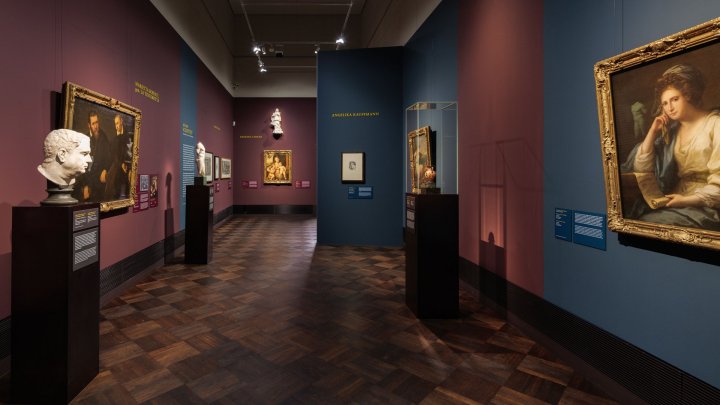
Installation view, Out of the Shadows: Women Artists from the 16th to the 18th Century, Gemäldegalerie Alte Meister at Dresden’s Zwinger, 2023.
◊ ◊ ◊ ◊ ◊
This installation on view at the Zwinger closes in a few weeks:
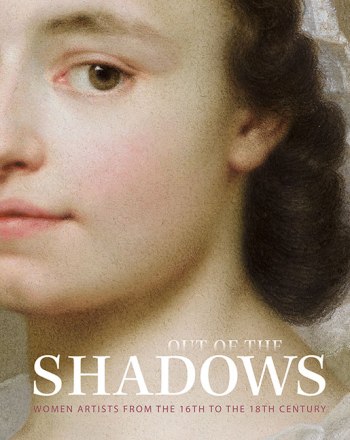
Out of the Shadows: Women Artists from the 16th to the 18th Century
Aus dem Schatten: Künstlerinnen vom 16. bis zum 18. Jahrhundert
Gemäldegalerie Alte Meister, Zwinger, Dresden, 12 May — 20 August 2023
With this cabinet exhibition, the Gemäldegalerie Alte Meister turns its attention to women artists (Künstlerinnen) from the 16th to the 18th century, who for a long time have been overshadowed by the ‘Great Masters’ of art history. With their works represented in the collection, they are a minority, and to this day their names are far less familiar than those of their male counterparts. This is not due to inability, but to a structural discrimination that is perpetuated in art historiography.
 Women generally were not allowed formal academic training nor drawing from live (nude) models. Only a few women were lucky enough to grow up and be promoted in an artistic environment, so that institutional and social structures did not necessarily hinder their advancement. In many cases, they were the daughters of artists trained in their father’s workshop.
The cosmopolite Angelika Kauffmann (1741–1807) achieved widespread recognition in her lifetime and is also represented here with five works. In a time when only men were seen as true artists and women were credited, at most, with talent but never genius, the painter managed to assert herself by also being a shrewd strategist and self-promotor. She produced numerous history paintings with references to antiquity in which women take the leading roles.
Lavinia Fontana (1552–1614) was one of the first women of the modern period to work as an independent artist. She painted numerous portraits and history paintings of mythological and biblical themes, some of them in large format. The devotional painting in Dresden, The Holy Family, is an early work by the Bolognese artist which, after undergoing restoration, will be included in the show in mid-August.
This concentrated presentation also features copperplate engravings by Diana Scultori from the holdings of the Kupferstich-Kabinett as well as paintings and prints by other noteworthy women artists such as Elisabetta Sirani, Barbara Longhi, Rachel Ruysch, Maria van Oosterwijck, and Theresa Concordia Mengs.
Stephan Koja and Iris Yvonne Wagner, Out of the Shadows: Women Artists from the 16th to the 18th Century (Dresden: Staatliche Kunstsammlungen Dresden, 2023), 144 pages, ISBN: 978-3954987559 (German edition) / ISBN: 978-3954987696 (English edition), €34.
Call for Essays | The Material History of the Visually Altered Book

Extra-illustrated copy of Johann Amos Comenius, Orbis Sensualium Pictus, translated by Charles Hoole, 12th edition, (London, 1777) in Bodleian Library, Vet.A6.e.2518.
◊ ◊ ◊ ◊ ◊
Extra Extra: The Material History of the Visually Altered Book
A collection of essays edited by Julie Park and Adam Smyth
Proposals due by 31 August 2023
Julie Park and Adam Smyth invite proposals for essays to be included in an edited collection on the long history of the extra-illustrated book. Extra-illustration had a vital flowering in late-eighteenth and nineteenth-century culture, but what are the earlier roots of this practice in medieval and early modern cultures and what are the legacies today? The editors welcome proposals by contributors from different backgrounds, career stages, disciplines, and fields (art historians, book historians, book artists, book sellers, curators and librarians, media studies scholars, and more) to consider the methods, materials, forms, and consequences of extra-illustration as a transhistorical medium and activity. Long before and well after Richard Bull’s pivotal act of reconstructing James Granger’s Biographical History of England (1769) by affixing engraved prints to illustrate its textual body, book readers and makers have added images to pre-existing works of writing, fundamentally altering their physical design and composition, and destabilizing categories of book, art and object in doing so. How might we consider, for instance, medieval books, continually modified by their owners with added images and text, or the contemporary artist’s book, frequently an alteration of a previously printed book object through added visual elements, as forms of extra-illustration?
How might we think of extra-illustration in terms of a series of tensions: between amplification (the book extrapolated) and destruction (the book blown up); between the classificatory logic of James Granger and chaos; between order and flux; between the iconophilic and the iconoclastic. Is extra-illustration an erotic, libidinal process? Is it a respectable activity for a quiet drawing room, or is it, in Holbrook Jackson’s words, “a singularly perverted idea”? What is the extra-illustrated volume’s relationship to the codex: tribute, or parody? What is the politics of extra-illustration? Is extra-illustration connected to retreat and consolation, or is it driven by a grasping, colonial ambition? Is it a radical upending of ideas of order and convention, or is it an assertion of hierarchy? How do we read—or how did readers read—these combinatory texts? And are there extra-illustrators who occupy a particularly important place in this tradition—figures like Charlotte and Alexander Sutherland, perhaps, or Richard Bull, or John Kitto?
Please submit proposals of 175–250 words, with a brief (one-page) CV, to Julie Park (jvp6261@psu.edu) and Adam Smyth (adam.smyth@ell.ox.ac.uk) by 31 August 2023.
The Burlington Magazine, June 2023
The eighteenth century in the June issue of The Burlington (with apologies for being so slow to post, –CH) . . .
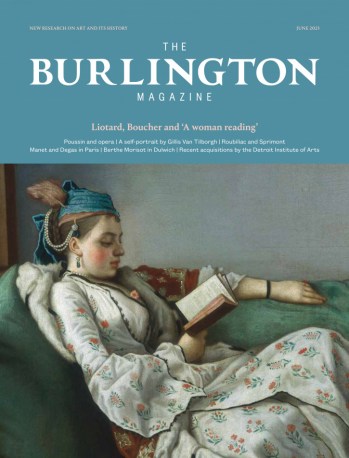
The Burlington Magazine 165 (June 2023)
 e d i t o r i a l
• “The Future of the RIBA Drawings Collection,” p. 583.
a r t i c l e s
• Tessa Murdoch, “Roubiliac and Sprimont: A Friendship Revisited,” pp. 600–11.
Recent research into the circles of Huguenot artists and craftsmen working in London in the mid-eighteenth century has provided new evidence about the friendship and working relationship between the sculptor Louis-François Roubiliac and the goldsmith Nicholas Sprimont. This lends weight to the belief that Roubiliac provided small models for casting in silver and bronze as well as for the porcelain manufactory co-founded by Sprimont in Chelsea in 1745.
• Perrin Stein, “Liotard and Boucher: A Question of Precedence,” pp. 612–19.
There has been much debate about whether Liotard or Boucher invented the motif of a woman in Turkish costume reading a book while reclining on a sofa, which appears in both their work in the 1740s. New evidence that resolves the question highlights the very different ways these two artists constructed exoticism.
• Ann Gunn, “Titian’s Perseus and Andromeda: A Missing Link in the Chain of Provenance,” pp. 620–22.
• Simon Spier and Judith Phillips, “Joséphine Bowes’s Gift to Napoleon III: Antoine-Jean Gros’s Napoleon Distributing the Cross of the Legion of Honour to Artists during His Visit to the Salon of 1808,” pp. 626–29.
r e v i e w s
• Alexandra Gajewski, “The New Museum in the Bibliothèque Nationale, Paris,” pp. 630–37.
When in 1995–98 the books of the Bibliothèque nationale, Paris, were moved to their monumental new home in the west of the city, the library’s historic collections of antiquities, coins, medals, and other precious objects remained in the original complex of buildings in central Paris where they had been shown since the eighteenth century. Their reinstallation in the library’s newly restored museum rooms was opened last year.
• Kirstin Kennedy, Review of the exhibition Treasures from Faraway: Medieval and Renaissance Objects from The Schroder Collection (Strawberry Hill, 2023), pp. 641–43.
• Aileen Dawson, Review of the exhibition English Delftware (Bristol Museum and Art Gallery (from February 2023), pp. 652–54.
• Belinda Thomson, Review of the exhibition Berthe Morisot: Shaping Impressionism (Dulwich Picture Gallery, 2023), pp. 654–57. [In Paris, the show is entitled Berthe Morisot et l’art du XVIIIe siècle: Watteau, Boucher, Fragonard, Perronneau]
• J. V. G. Mallet, Review of Lilli Hollein, Rainald Franz, and Timothy Wilson, eds., Tin-Glaze and Image Culture: The MAK Maiolica Collection in its Wider Context (Arnoldsche Art Publishers, 2022), pp. 660–62.
• Clare Hornsby, Review of Andrew Robinson, Piranesi: Earliest Drawings / I primi disegni (Artemide Edizioni, 2022), pp. 666–67.
• G. A. Bremner, Review of Gauvin Alexander Bailey, The Architecture of Empire: France in India and Southeast Asia, 1664–1962 (McGill-Queen’s University Press, 2022), pp. 667–68
o b i t u a r y
• Peter Hecht, Obituary for Ger Luijten (1956–2022), pp. 675–76.
s u p p l e m e n t
• Recent Acquisitions (2016–22) of European Works of Art at the Detroit Institute of Arts
New Book | Textile in Architecture
From Routledge:
Didem Ekici, Patricia Blessing, Basile Baudez, eds., Textile in Architecture: From the Middle Ages to Modernism (Routledge, 2023), 240 pages, ISBN: 978-1032250441 (hardback), $136 / ISBN: 978-1032250427 (paperback), $39.
 This book investigates the interconnections between textile and architecture via a variety of case studies from the Middle Ages through the twentieth century and from diverse geographic contexts.
Among the oldest human technologies, building and weaving have intertwined histories. Textile structures go back to Palaeolithic times and are still in use today and textile furnishings have long been used in interiors. Beyond its use as a material, textile has offered a captivating model and metaphor for architecture through its ability to enclose, tie together, weave, communicate, and adorn. Recently, architects have shown a renewed interest in the textile medium due to the use of computer-aided design, digital fabrication, and innovative materials and engineering. The essays edited and compiled here, work across disciplines to provide new insights into the enduring relationship between textiles and architecture. The contributors critically explore the spatial and material qualities of textiles as well as cultural and political significance of textile artifacts, patterns, and metaphors in architecture.
Textile in Architecture is organized into three sections: “Ritual Spaces,” which examines the role of textiles in the formation and performance of socio-political, religious, and civic rituals; “Public and Private Interiors” explores how textiles transformed interiors corresponding to changing aesthetics, cultural values, and material practices; and “Materiality and Material Translations,” which considers textile as metaphor and model in the materiality of built environment. Including cases from Morocco, Samoa, France, India, the UK, Spain, the Ancient Andes and the Ottoman Empire, this is essential reading for any student or researcher interested in textiles in architecture through the ages.
Didem Ekici is Assistant Professor in the Department of Architecture and Built Environment at the University of Nottingham. She is the co-editor of Housing and the City (Routledge, 2022). Healing Spaces, Modern Architecture, and the Body (Routledge, 2017) as well as the author of numerous articles on modern architecture culture. She is currently working on her monograph titled Body, Cloth, and Clothing in Architecture from the Age of Mass Manufacture to the First World War.
Patricia Blessing is Assistant Professor of Islamic Art History in the Department of Art & Archaeology at Princeton University. Her first book, Rebuilding Anatolia after the Mongol Conquest: Islamic Architecture in the Lands of Rūm, 1240–1330 (Ashgate, 2014) investigates the relationship between patronage, politics, and architectural style after the integration of the region into the Mongol empire. Her second book, Architecture and Material Politics in the Fifteenth-Century Ottoman Empire (Cambridge University Press, 2022) analyses how transregional exchange and the use of paper shaped building practices across the Ottoman realm.
Basile Baudez is Assistant Professor of architectural history in the Art & Archaeology department at Princeton University. His first book Architecture et Tradition Académique au Siècle des Lumières (2012) questions the role of architects in early modern European academies. He co-edited several volumes dedicated to French architecture and curated exhibitions on architectural drawings at the Ecole des Beaux-Arts and the Courtauld Institute of Art. His latest book, Inessential Colors: Architecture on Paper in Early Modern Europe (Princeton University Press, 2021) questions the role of color in Western architectural representation from the Renaissance to the nineteenth century. He currently works on an urban history of textiles in 18th-century Venice.
c o n t e n t s
Part 1 | Ritual Spaces
Introduction to Part One — Didem Ekici
1 The Red Tent in the Red City: The Caliphal Qubba in Almohad Marrakesh — Abbey Stockstill
2 ‘He will Lift off the Covering Which is Over All the Peoples’: Seeing Through Medieval Lenten Veils — Clare Frances Kemmerer
3 Architectural Space and Textiles: Tying Samoan Society Together — Anne E. Guernsey Allen
Part 2 | Public and Private Interiors
Introduction to Part Two — Basile Baudez
4 Le Rideau Tire: Interior Drapery, Architectural Space, and Desire in Eighteenth-Century France — Mei Mei Rado
5 The Fabric of the New: Mediating Architectural Change in Late Colonial India — Abigail McGowan
6 Contrast and Cohesion: Textiles and Architecture in 1930’s London — Emily M. Orr
Part 3 | Materiality and Material Translations
Introduction to Part Three — Patricia Blessing
7 Textiles by Other Means: Seeing and Conceptualizing Textile Representations in Early Islamic Architecture — Theodore Van Loan
8 The Textility of the Alhambra — Olga Bush
9 The Textile Foundations of Ancient Andean Architecture — Andrew James Hamilton
10 The Ruler’s Clothes and the Manifold Dimensions of Textile Patterns on Muslim Funeral Architecture in the Mausoleum of the First Crimean Khans — Nicole Kancal-Ferrari
11 A Tented Baroque: Ottoman Fabric (and) Architecture in the Long Nineteenth Century — Ashley Dimmig
New Book | Tempest
From Yale UP:
James Davey, Tempest: The Royal Navy and the Age of Revolutions (New Haven: Yale University Press, 2023), 448 pages, ISBN: 978-0300238273, $35.
 The French Revolutionary Wars catapulted Britain into a conflict against a new enemy: Republican France. Britain relied on the Royal Navy to protect its shores and empire, but as radical ideas about rights and liberty spread across the globe, it could not prevent the spirit of revolution from reaching its ships. In this insightful history, James Davey tells the story of Britain’s Royal Navy across the turbulent 1790s. As resistance and rebellion swept through the fleets, the navy itself became a political battleground. This was a conflict fought for principles as well as power. Sailors organized riots, strikes, petitions, and mutinies to achieve their goals. These shocking events dominated public discussion, prompting cynical—and sometimes brutal—responses from the government. Tempest uncovers the voices of ordinary sailors to shed new light on Britain’s war with France, as the age of revolution played out at every level of society.
James Davey teaches at the University of Exeter. He was formerly curator of naval history at the National Maritime Museum and is the author of In Nelson’s Wake: The Navy and the Napoleonic Wars.
c o n t e n t s
List of Illustration and Maps
Acknowledgments
Note on Conventions
Prologue
Introduction
1 Lawless Mobs and a Gore of Blood: Naval Mobilisation and Impressment
2 War of Principle: Naval Conflict in Europe, 1793–5
3 ‘We the Seamen’: Protest and Resistance at Sea
4 Tides, Currents, and Winds: Navy and Empire, 1793–7
5 Splintering the Wooden Walls: The Threat of Invasion, 1796–8
6 The Delegates in Council: The Naval Mutinies of 1797
7 A Tale of Two Sailors: Camperdown and Naval Propaganda
8 Bad Luck to the British Navy! Mutiny and Naval Warfare, 1798–1801
Epilogue
Conclusion
Notes on Sources
Notes
Bibliography
Index
New Book | Hersilia’s Sisters
From the Getty:
Norman Bryson, Hersilia’s Sisters: Jacques-Louis David, Women, and the Emergence of Civil Society in Post-Revolution France (Los Angeles: Getty Research Institute, 2023), 352 pages, ISBN 978-1606067710, $75.
 Political and cultural history and the arts combine in this engaging account of 1790s France.
In 1799, when the French artist Jacques-Louis David (1748–1825) exhibited his Intervention of the Sabines, a history painting featuring the ancient heroine Hersilia, he added portraits of two contemporary women on either side of her—Henriette de Verninac, daughter of Charles-François Delacroix, minister of foreign affairs, and Juliette Récamier, a well-known and admired socialite. Drawing on many disciplines, Norman Bryson explains how such a combination of paintings could reveal the underlying nature of the Directoire, the period between the vicious and near-dictatorial Reign of Terror (1793–94) and the coup in 1799 that brought Napoleon to power. Hersilia’s Sisters illuminates ways that cultural life and civil society were rebuilt during these years through an extraordinary efflorescence of women pioneers in every cultural domain—literature, the stage, opera, moral philosophy, political theory, painting, popular journalism, and fashion. Through a close examination of David’s work between The Intervention of the Sabines (begun in 1796) and Bonaparte Crossing the Alps (begun in 1800), Bryson explores how the flowering of women’s culture under the Directoire became a decisive influence on David’s art.
Norman Bryson is a professor of art history at the University of California, San Diego. He has published widely in the areas of eighteenth-century art history, critical theory, and contemporary art.
c o n t e n t s
Acknowledgments
Introduction
1 The Festival of the Sabine Women
2 David in the Louvre in 1800
3 The Portrait of Henriette de Verninac
4 The Portrait of Juliette Récamier
5 Ancient Liberty, Modern Freedom
6 Aspasia, the Merveilleuse
7 Hersilia’s Accomplished Sisters
8 Salonnières
9 Brumaire
Bibliography
About the Author
Illustration Credits
Index
New Book | Revolutionary Things: Material Culture and Politics
From Yale UP:
Ashli White, Revolutionary Things: Material Culture and Politics in the Late Eighteenth-Century Atlantic World (New Haven: Yale University Press, 2023), 392 pages, ISBN: 978-0300259018, $50.
 How objects associated with the American, French, and Haitian revolutions drew diverse people throughout the Atlantic world into debates over revolutionary ideals
Historian Ashli White explores the circulation of material culture during the American, French, and Haitian revolutions, arguing that in the late eighteenth century, radical ideals were contested through objects as well as in texts. She considers how revolutionary things, as they moved throughout the Atlantic, brought people into contact with these transformative political movements in visceral, multiple, and provocative ways. Focusing on a range of objects—ceramics and furniture, garments and accessories, prints, maps, and public amusements—White shows how material culture held political meaning for diverse populations. Enslaved and free, women and men, poor and elite—all turned to things as a means to realize their varied and sometimes competing visions of revolutionary change.
Ashli White is associate professor of history at the University of Miami. She is the author of Encountering Revolution: Haiti and the Making of the Early Republic.










leave a comment