Call for Essays | Interpretations of Longinus in the Early Modern Period
From ArtHist.net:
Interpretations of Longinus in the Literature, Painted and Printed Imagery of the Early Modern Period
Edited Volume of Essays To Be Published in 2025
Proposals due by 15 July 2023; final chapters due by 1 July 2024
This volume of the series Trends in Classics (to be published by De Gruyter) seeks to explore aspects of Longinian ideas, addressing in particular the concept of the sublime. It will bring together scholars of art history, history of ideas, literature, and philosophy to reflect upon the reception of these ideas in the literature and the art of Italy, Spain, and the Low Countries from the 15th through the 18th century. Considering that there is probably no direct evidence concerning the Longinian sublime as a productive theory in the early modern times, the primary interest lies in possible interpretations of works in certain artistic media (paintings and prints) as well as re-readings of the Peri hypsus in the literature of the period.
The starting point is the relationship among artists, literati, and patrons; the connections of artworks to various textual sources; the existence of sublime/Longinian literature in libraries of the period; and the tracing of relevant text dissemination. The network of acquaintance with the notion of the sublime may be opened up towards other directions, such as politics, the treatment of the human body, the aesthetics of antiquity, and the Renaissance. The tackling of a complex problem such as the reception of Longinian ideas, makes cross-disciplinary research imperative.
The completed volume will be published in 2025. Drafts from participants will be discussed during an online workshop in February 2024. The presentations will be 20 minutes long. Contributors are invited to submit their proposals in English. There is a two-stage submission procedure.
15 July 2023
Please send a 250-word proposal (in English) and a short cv (500 words) to all the members of the editorial board:
• Ianthi Assimakopoulou, National Kapodistrian University of Athens, ianthiassim@icloud.com
• Nafsika (Nancy) Litsardopoulou, Athens School of Fine Arts, nancylitsardo@hotmail.com
• Evina Sistakou, Aristotle University of Thessaloniki, sistakou@gmail.com
15 September 2023
Selected abstracts will be invited to participate in the online international workshop in February 2024, under the aegis of the National and Kapodistrian University of Athens – Department of History and Archaeology.
February 2024
Online workshop.
1 July 2024
Submission of final versions of the papers (up to 7000 words, excluding bibliography). Following a peer review process, the editorial board will make final decisions on the acceptance of papers.
New Book | Jacopo Alessandro Calvi (1740–1815)
From Silvana Editoriale:
Irene Graziani, with contributions by Francesca Maria Conti, Igino Conti, and Ilaria Negretti, Jacopo Alessandro Calvi, detto Il Sordino (1740–1815): Accademico e Pittore (Milan: Silvana Editoriale, 2022), 512 pages, ISBN: 978-8836652884, €40.
 Nella Bologna della seconda metà del Settecento Jacopo Alessandro Calvi (Bologna, 1740-1815) diviene il principale competitore dei fratelli Ubaldo e Gaetano Gandolfi. Formatosi sotto l’ala di Giampietro Zanotti, segretario dell’Accademia Clementina, fin dagli anni giovanili si sperimenta nelle «dive arti sorelle» della pittura e della poesia, privilegiando un criterio elettivo nel processo di imitazione della natura. Testimoniano il suo successo l’annessione all’Accademia Clementina (1770) e il gran numero di commissioni, soprattutto pale di destinazione ecclesiastica.
Anche nel tempo della «fatal rivoluzione», che comporta una drastica riduzione delle opportunità di lavoro per tutti gli artisti, Calvi regge il colpo, superando le difficoltà del momento, sia attraverso l’intensificarsi dell’attività letteraria — gli si devono fra l’altro la prima monografia critica di Guercino, edita nel 1808, e uno studio su Francesco Francia, pubblicato nel 1812 — sia attraverso lo svolgimento di un ruolo di perito presso l’Accademia Clementina, impegnata nell’ingrato compito di governare il rischio di dispersione dei beni d’arte durante le spoliazioni napoleoniche.
Pur estraneo ai valori giacobini, viene convocato come commissario nel Concorso per la ‘Riconoscenza Nazionale’ (1802), indetto a Milano allo scopo di celebrare il ritorno di Napoleone dopo la parentesi austriaca; e nel 1804 sarà annoverato fra i professori della nuova Accademia di Belle Arti di Bologna. Con il nuovo secolo la sua carriera riesce a trovare ragioni di soddisfazione anche sul fronte della produzione artistica: attraverso un’intelligente lettura critica della maniera del tardo Guercino e del dolce e devoto Francesco Francia, la sua pittura saprà farsi anticipatrice di istanze poi affermatesi nella Bologna tornata papale, appena prima della morte di Calvi, avvenuta a un mese dalla Battaglia di Waterloo.
C O N T E N T S
Catalogo delle opere
Dipinti e bozzetti
Disegni
Stampe su disegno o da dipinti di Jacopo Alessandro Calvi
Opere espunte
Opere segnalate dalle fonti, ma non reperite, non identificate o non ancora rintracciate — Irene Graziani
Disegni di animali di Jacopo Alessandro Calvi: inediti — Francesca Maria Conti
Tavole
Jacopo Alessandro Calvi collezionista: dipinti, disegni e altre opere presenti nello ‘Studio del Sordino’ — Igino Conti
Ferdinando Belvisi, Elogio storico di Jacopo Alessandro Calvi — a cura di Ilaria Negretti
Apparati — a cura di Irene Graziani
Regesto
Appendice documentaria
Indice topografico delle opere
Indice dei nomi
Bibliografia
Exhibition | Giacomo Ceruti: A Compassionate Eye
From The Getty:
Giacomo Ceruti: A Compassionate Eye
Brescia Musei Foundation, 14 February — 11 June 2023
The Getty Center, Los Angeles, 18 July — 29 October 2023
 In a group of remarkably haunting paintings by the Italian 18th-century artist Giacomo Ceruti, beggars, vagrants, and impoverished workers are portrayed in mesmerizing realism, emanating a sense of dignity and emotional depth. Why were these subjects painted? Where and how were these works displayed, and for whom? At a time when severe inequalities continue to mark even the wealthiest societies, Ceruti’s work testifies to the enduring power of art to reflect our shared humanity.
Organized with Fondazione Brescia Musei.
From The Getty Shop:
Davide Gasparotto, ed., with contributions by Roberta D’Adda, Francesco Frangi, Alessandro Morandotti, and Lorenzo Coccoli, Giacomo Ceruti: A Compassionate Eye (Los Angeles: J. Paul Getty Museum, 2023), 128 pages, ISBN: 978-1606068366, $28.
The northern Italian artist Giacomo Ceruti (1698–1767) was born in Milan and active in Brescia and Bergamo. For his distinctive, large-scale paintings of low-income tradespeople and individuals experiencing homelessness, whom he portrayed with dignity and sympathy, Ceruti came to be known as Il Pitocchetto (the little beggar). Accompanying the first US exhibition to focus solely on Ceruti, this publication explores relationships between art, patronage, and economic inequality in early modern Europe, considering why these paintings were commissioned and by whom, where such works were exhibited, and what they signified to contemporary audiences. Essays and a generous plate section contextualize and closely examine Ceruti’s pictures of laborers and the unhoused, whom he presented as protagonists with distinct stories rather than as generic types. Topics include depictions of marginalized subjects in the history of early modern European art, the career of the artist and his significance in the history of European painting, and period discourses around poverty and social support. A detailed exhibition checklist, along with provenance, exhibition history, and a bibliography, provides information critical for the further understanding of Ceruti’s oeuvre.
Davide Gasparotto is senior curator of paintings and chair of curatorial affairs at the J. Paul Getty Museum.
◊ ◊ ◊ ◊ ◊
Note (added 6 August 2023) — The posting was updated to include the Brescia venue, where the exhibition was entitled Miseria & Nobiltà: Giacomo Ceruti nell’Europa del Settecento.
New Book | In the Herbarium
From Yale UP:
Maura Flannery, In the Herbarium: The Hidden World of Collecting and Preserving Plants (New Haven: Yale University Press, 2023), 336 pages, ISBN: 978-0300247916, $35.
 Collections of preserved plant specimens, known as herbaria, have existed for nearly five centuries. These pressed and labeled plants have been essential resources for scientists, allowing them to describe and differentiate species and to document and research plant changes and biodiversity over time—including changes related to climate.
Maura C. Flannery tells the history of herbaria, from the earliest collections belonging to such advocates of the technique as sixteenth-century botanist Luca Ghini, to the collections of poets, politicians, and painters, and to the digitization of these precious specimens today. She charts the growth of herbaria during the Age of Exploration, the development of classification systems to organize the collections, and herbaria’s indispensable role in the tracking of climate change and molecular evolution. Herbaria also have historical, aesthetic, cultural, and ethnobotanical value—these preserved plants can be linked to the Indigenous peoples who used them, the collectors who sought them out, and the scientists who studied them.
This book testifies to the central role of herbaria in the history of plant study and to their continued value, not only to biologists but to entirely new users as well: gardeners, artists, students, and citizen-scientists.
Maura C. Flannery is professor emerita of biology at St. John’s University, New York, and research affiliate in the A. C. Moore Herbarium at the University of South Carolina. She is the author of two previous books and a blog, herbariumworld.wordpress.com. She lives in Aiken, SC.
c o n t e n t s
Acknowledgments
Introduction: Opening Hidden Gardens
1 Rooted in an Herbarium
2 Early Botany
3 The Technology and Art of Herbaria
4 Early Exploration
5 The Value of Collecting
6 Linnaeus and Classification
7 Botanical Exploration
8 Gardens
9 Managing Exploration and Collecting
10 Natural History and Botany
11 Evolution and Botany
12 Changing Botany
13 Useful Plants and Ethnobotany
14 Understanding and Conserving Biodiversity
15 Online Herbaria
16 A Broader Vision: Herbaria and Culture
Epilogue: Herbaria Blooming
Notes
Bibliography
Index
Exhibition | Object Lessons in American Art
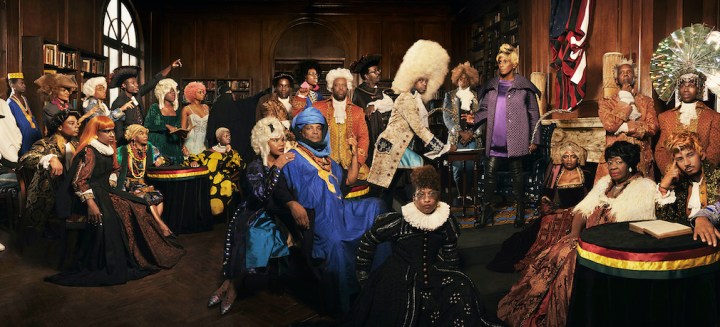
Renee Cox, The Signing, 2018, inkjet print, 122 × 213 cm
(Princeton University Art Museum)
◊ ◊ ◊ ◊ ◊
From Princeton University Art Museum:
Object Lessons in American Art: Selections from the Princeton University Art Museum
Georgia Museum of Art, University of Georgia, Athens, 4 February — 14 May 14 2023
Florence Griswold Museum, Old Lyme, Connecticut, 3 June — 10 September 2023
Speed Art Museum, Louisville, 29 September 2023 — 7 January 2024
Curated by Karl Kusserow

Henry Inman, O-Chee-Na-Shink-Ka a, 1832–33, oil on canvas, 78 × 645 cm (Promised gift from a Private Collection, member of Class of 1982).
Object Lessons in American Art features four centuries of works from the Princeton University Art Museum that collectively explore American history, culture, and society. Inspired by the concept of the object lesson—the study of a material thing to communicate a larger idea—the exhibition brings groups of objects together to ask fundamental questions about artistic significance, materials, and how meaning changes across time and contexts. With a focus on race, gender, and the environment, these pairings demonstrate the value of juxtaposing diverse objects to generate new understanding. Object Lessons presents Euro-American, Native American, and African American art from contemporary perspectives, illustrating how fresh investigations can inform and enrich its meaning, affording new insights into the American past and present. Curated by Karl Kusserow, John Wilmerding Curator of American Art.
Karl Kusserow, ed., with contributions by: Horace Ballard , Kirsten Pai Buick , Ellery Foutch , Karl Kusserow , Jeffrey Richmond-Moll, and Rebecca Zorach, Object Lessons in American Art (Princeton: Princeton University Press, 2023), 200 pages, ISBN: 978-0691978857, £35 / $40.
Object Lessons in American Art explores a diverse gathering of Euro-American, Native American, and African American art from a range of contemporary perspectives, illustrating how innovative analysis of historical art can inform, enhance, and afford new relevance to artifacts of the American past. The book is grounded in the understanding that the meanings of objects change over time, in different contexts, and as a consequence of the ways in which they are considered. Inspired by the concept of the object lesson, the study of a material thing or group of things in juxtaposition to convey embodied and underlying ideas, Object Lessons in American Art examines a broad range of art from Princeton University’s venerable collections as well as contemporary works that imaginatively appropriate and reframe their subjects and style, situating them within current social, cultural, and artistic debates on race, gender, the environment, and more.
C O N T E N T S
Foreword
Preface and Acknowledgments
• Introduction — Lenticular: Subject and Object in American Art — Karl Kusserow
• ‘Race’ as Object Lesson: Objects of Rebellion — Kirsten Pai Buick
• Looking Back and Looking Forward: A Feminist Lens on a Collection of American Art — Ellery E. Foutch
• Oblique Assemblies: Toward Queer Ecologies in American Art — Horace D. Ballard
• Intimations of Ecology: Varieties of Environmental Experience in American Art — Karl Kusserow
• Material Echoes, Traumatic Histories, and Liquid Transformations: The Romance of the Sea in American Art — Rebecca Zorach
• Learning from Object Lessons: Toward a Curatorial Pedagogy of Unfixing and Defamiliarizing the Past — Jeffrey Richmond-Moll
Contributors
Index
Photography Credits
Exhibition | Peter Brathwaite: Rediscovering Black Portraiture
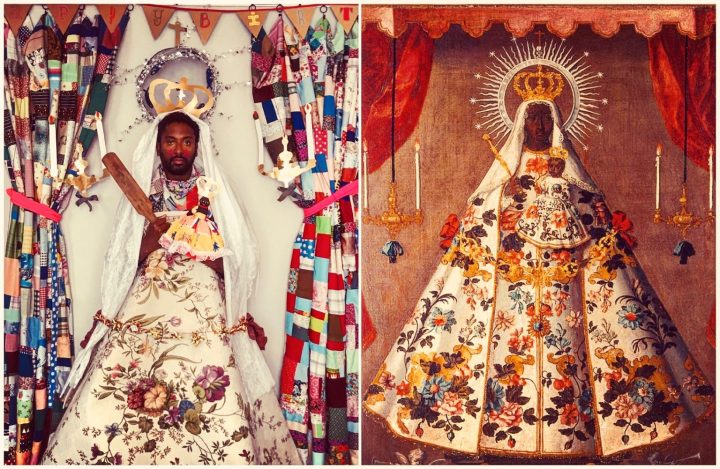
Left: Peter Brathwaite’s restaged version of The Virgin of Guadalupe. Right: Unknown painter, The Virgin of Guadalupe, oil painting, 1745 (London: Wellcome Collection), cropped from original and colour saturated.
◊ ◊ ◊ ◊ ◊
From the Bristol Museum & Art Gallery:
Peter Brathwaite: Rediscovering Black Portraiture
King’s College London, Strand Campus, October 2021 — February 2022
Bristol Museum & Art Gallery, 14 April — 3 September 2023
During the first lockdown in 2020, with all his performances cancelled, baritone, artist, broadcaster, and writer Peter Brathwaite began researching and reimagining more than 100 artworks. These artworks featured portraits of Black sitters, as part of the online #GettyMuseumChallenge to use household objects to restage famous paintings. He called the photographic series Rediscovering Black Portraiture. Alongside this project he also intensified his research into his dual heritage Barbadian roots, uncovering a wealth of detail about his enslaved and enslaver ancestors and their history, including an uprising of enslaved people in 1816 and songs of resistance they sang. Three years on, with a London exhibition behind him and a book out with Getty Publications, Peter Brathwaite brings his whole practice to the history of Georgian House Museum and the collections of Bristol Museum & Art Gallery. New interventions and sound installations reveal the Black presence hidden at the heart of our spaces and objects. The exhibition opened to coincide with the anniversary of the Barbados insurrection, 14 April 1816.
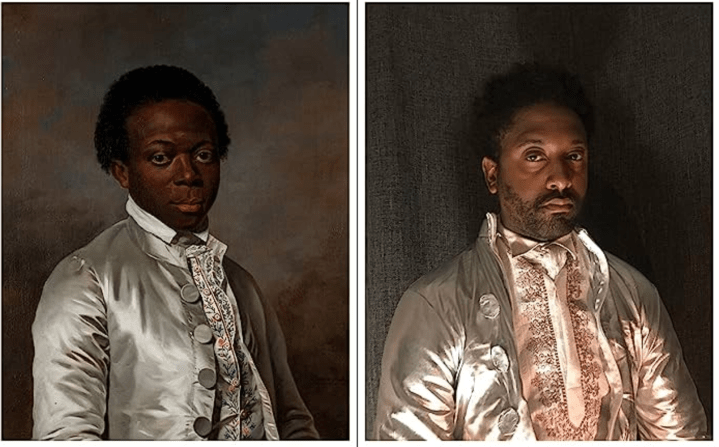
Left: Marie-Victoire Lemoine, Portrait of a Youth in Embroidered Vest, 1785, oil on canvas, 68 × 50 cm (Jacksonville, Florida: Cummer Museum of Art & Gardens). Right: Peter Brathwaite’s restaged version of a Youth in Embroidered Vest.
◊ ◊ ◊ ◊ ◊
From The Getty:
Peter Brathwaite, with contributions by Cheryl Finley, Temi Odumosu, and Mark Sealy, Rediscovering Black Portraiture (Los Angeles, Getty Publications, 2023), 168 pages, ISBN: 978-1606068168, $40.
 Join Peter Brathwaite on an extraordinary journey through representations of Black subjects in Western art, from medieval Europe through the present day. Since the beginning of the COVID-19 pandemic, Peter Brathwaite has thoughtfully researched and reimagined more than one hundred artworks featuring portraits of Black sitters—all posted to social media with the caption “Rediscovering #blackportraiture through #gettymuseumchallenge.”
Rediscovering Black Portraiture collects more than fifty of Brathwaite’s most intriguing re-creations. Introduced by the author and framed by contributions from experts in art history and visual culture, this fascinating book offers a nuanced look at the complexities and challenges of building identity within the African diaspora and how such forces have informed Black portraits over time. Artworks featured include The Adoration of the Magi by Georges Trubert, Portrait of an Unknown Man by Jan Mostaert, Rice n Peas by Sonia Boyce, Barack Obama by Kehinde Wiley, and many more. This volume also invites readers behind the scenes, offering a glimpse of the elegant artifice of Brathwaite’s props, setup, and process. An urgent and compelling exploration of embodiment, representation, and agency, Rediscovering Black Portraiture serves to remind us that Black subjects have been portrayed in art for nearly a millennium and that their stories demand to be told.
Peter Brathwaite is an acclaimed baritone who performs in operas and concerts throughout Europe. He is a presenter on BBC Radio 3 and has been shortlisted for a Royal Philharmonic Society Award. Cheryl Finley is inaugural distinguished visiting director of the Atlanta University Center Art History and Curatorial Studies Collective and the author of Committed to Memory: The Art of the Slave Ship Icon (2018). Temi Odumosu is an art historian, curator, and assistant professor at University of Washington Information School and the author of Africans in English Caricature 1769–1819: Black Jokes, White Humour (2017). Mark Sealy is director of Autograph and professor of photography, race, and human rights at University of the Arts London. His numerous publications include Different (2001), coauthored with Stuart Hall; Decolonising the Camera: Photography in Racial Time (2019); and Photography: Race, Rights, and Representation (2022).
New Book | The Nation That Never Was
From The University of Chicago Press:
Kermit Roosevelt, The Nation That Never Was: Reconstructing America’s Story (Chicago: The University of Chicago Press, 2022), 256 pages, ISBN: 978-0226817613, $25.
 Our idea of the Founders’ America and its values is not true. We are not the heirs of the Founders, but we can be the heirs of Reconstruction and its vision for equality.
There’s a common story we tell about America: that our fundamental values as a country were stated in the Declaration of Independence, fought for in the Revolution, and made law in the Constitution. But, with the country increasingly divided, this story isn’t working for us anymore—what’s more, it’s not even true. As Kermit Roosevelt argues in this eye-opening reinterpretation of the American story, our fundamental values, particularly equality, are not part of the vision of the Founders. Instead, they were stated in Lincoln’s Gettysburg Address and were the hope of Reconstruction, when it was possible to envision the emergence of the nation committed to liberty and equality.
We face a dilemma these days. We want to be honest about our history and the racism and oppression that Americans have both inflicted and endured. But we want to be proud of our country, too. In The Nation That Never Was, Roosevelt shows how we can do both those things by realizing we’re not the country we thought we were. Reconstruction, Roosevelt argues, was not a fulfillment of the ideals of the Founding but rather a repudiation: we modern Americans are not the heirs of the Founders but of the people who overthrew and destroyed that political order. This alternate understanding of American identity opens the door to a new understanding of ourselves and our story, and ultimately to a better America.
America today is not the Founders’ America, but it can be Lincoln’s America. Roosevelt offers a powerful and inspirational rethinking of our country’s history and uncovers a shared past that we can be proud to claim and use as a foundation to work toward a country that fully embodies equality for all.
Kermit Roosevelt III is a professor of constitutional law at the University of Pennsylvania Law School. A former law clerk to Supreme Court Justice David Souter, he is the author of The Myth of Judicial Activism, as well as two novels, Allegiance and In the Shadow of the Law.
C O N T E N T S
Introduction
1 Stories of America
2 Questioning the Standard Story: Dissenters
3 The Exclusive Declaration
4 The Ambiguous Revolution
5 The Geostrategic Constitution
6 The Story of Continuity
7 The March of the Declaration
8 Why We Tell the Standard Story
9 Why We Shouldn’t Tell the Standard Story
10 Magic Tricks and Revolutions
11 Why, How, and Who We Are
12 Redemption Songs: Inclusive Equality and Exclusive Individualism in Modern America
13 The Better Story
Bibliographical Essay
Acknowledgments
Notes
New Book | Media and the Mind
To mark the book’s launch, Matthew Eddy will give a 45-minute talk this Friday (16 June, 5pm) at the University of Edinburgh Main Library to mark the book’s launch; there will also be on view a small exhibition of student manuscripts that Eddy used in writing the book. From The University of Chicago Press:
Matthew Daniel Eddy, Media and the Mind: Art, Science, and Notebooks as Paper Machines, 1700–1830 (Chicago: The University of Chicago Press, 2023), 512 pages, ISBN: 978-0226183862, $65.
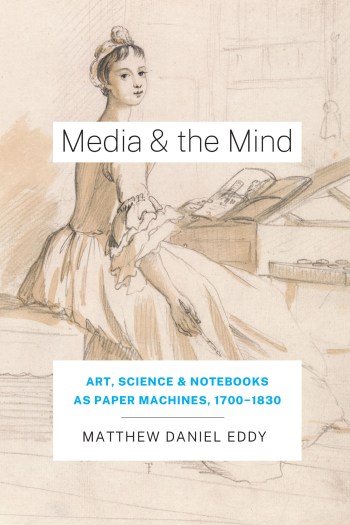 A beautifully illustrated argument that reveals notebooks as extraordinary paper machines that transformed knowledge on the page and in the mind.
Information is often characterized as facts that float effortlessly across time and space. But before the nineteenth century, information was seen as a process that included a set of skills enacted through media on a daily basis. How, why, and where were these mediated facts and skills learned? Concentrating on manuscripts created by students in Scotland between 1700 and 1830, Matthew Daniel Eddy argues that notebooks functioned as workshops where notekeepers learned to judge the accuracy, utility, and morality of the data they encountered. He shows that, in an age preoccupied with ‘enlightened’ values, the skills and materials required to make and use notebooks were not simply aids to reason—they were part of reason itself.
Covering a rich selection of material and visual media ranging from hand-stitched bindings to watercolor paintings, the book problematizes John Locke’s comparison of the mind to a blank piece of paper, the tabula rasa. Although one of the most recognizable metaphors of the British Enlightenment, scholars seldom consider why it was so successful for those who used it. Eddy makes a case for using the material culture of early modern manuscripts to expand the meaning of the metaphor in a way that offers a clearer understanding of the direct relationship that existed between thinking and notekeeping. Starting in the home, moving to schools, and then ending with universities, the book explores this argument by reconstructing the relationship between media and the mind from the bottom up.
Matthew Daniel Eddy is professor and chair in the history and philosophy of science at Durham University. He is the author and editor of numerous works on the cultural history of Britain and its former empire.
C O N T E N T S
Bibliographic Note
Prologue
Introduction
1 Recrafting Notebooks
The Tabula Rasa and Media Interface
Notebooks as Artifacts
Notekeeping as Artificing
Notekeepers as Artificers
Thought as a Realtime Activity
Science as a System
Book Outline
Part I | Inside the Tabula Rasa
2 Writing
Writing as a Knowledge-Creating Tool
The Place of Writing within Literacy
Script and Observational Learning
Grids and Verbal Pictures
Copies and the Exercise of Memory
3 Codexing
Paper Machines as Material Artifacts
Paper as an Informatic Medium
Quires and Knowledge Management
Books and Customized Packaging
4 Annotating
Revisibilia Made through Annotation
Marginalia as Scribal Interface
Paratexts and Editorial Training
Ciphers and the Acquisition of Numeracy
Part II | Around the Tabula Rasa
5 Categorizing
Headings as Realtime Categories
Headings as Mnemonic Labels
Headings as Visual Cues
Headings as Coordinates for Scanpaths and Sightlines
6 Drawing
Description and Movement across a Page
Learning to Draw a Picture
Figures as Developmental Tools
Scenes as Observational Training
Observation and the Utility of Perception
7 Mapping
Mapkeepers and Knowledge Systems on Paper
Map-Mindedness and Embodied Experience
Desk Maps as Crafted Constructions
Field-Mindedness in the Classroom
Field Maps and Visualized Data
Maps as Mnemonic Devices
Part III | Beyond the Tabula Rasa
8 Systemizing
The Syllabus as a System and a Machine
Lecture Notebooks and Knowledge Formation
The Syllabus and Its Organizational Technologies
Scroll Books and the Strategies of Realtime Learning
Transcripts and the Extension of Memory
Lines and the Media of the Mind
9 Diagramming
Paths and Diagrammatic Knowledge
Schemata as Useful Mnemonic Aids
Shapes as Repurposed Perceptual Devices
Pictograms and Visual Judgment
Tables as Kinesthetic Diagrams
Traces and Realtime Observation
10 Circulating
Local and Global Networks
Personal and Institutional Libraries
Commodities within Knowledge Economies
Courts of Law and Public Opinion
Conclusion
11 Rethinking Manuscripts
The Tabula Rasa and Manuscripts
Manuscripts as Dynamic Artifacts
Manuscript Skills as Artifice
Manuscript Keepers as Artificers
Acknowledgments
Bibliography
Abbreviations
Primary Sources
Manuscripts and Ephemera
Printed Primary Sources
Secondary Sources
Index
New Book | Great Irish Households: Inventories
From Distributed by ACC Art Books:
Tessa Murdoch, ed., with a foreword by Toby Barnard, a preface by Leslie Fitzpatrick, inventory transcriptions by Jessica Cunningham and Rebecca Campion, and inventory preambles by Jessica Cunningham Rebecca Campion, Edmund Joyce, Alec Cobbe, and John Adamson, Great Irish Households: Inventories from the Long Eighteenth Century (Cambridge: John Adamson, 2022), 436 pages, ISBN: 978-1898565178, £75.00 / $115.
 Inventories of fourteen great Irish country houses, three Dublin town houses, and one London town house yield remarkable insights into the lifestyle of leading families across Ireland and the households that supported them. With startling directness, they record in detail the goods and chattels inherited, accumulated, or acquired for enjoyment or everyday use.
Two sections in colour feature likenesses of many of the owners or householders of the properties at the time, including portraits by Pompeo Batoni, Michael Dahl, Thomas Gainsborough, Godfrey Kneller, Thomas Lawrence, and Joshua Reynolds, as well as the Irish artists Hugh Douglas Hamilton and Charles Robertson.
The value of inventories in charting how houses were arranged, furnished and used is now widely appreciated. Typically, the listings and valuations were occasioned by the death of an owner and the consequent need to deal with testamentary dispositions. That was not always so. The inventory for Castlecomer House, Co. Kilkenny, for example, was drawn up to make a claim following the house’s devastation in the 1798 uprising. Mostly hitherto unpublished, the inventories chosen give new-found insights into the lifestyle and taste of some of the foremost families of the day. Above stairs, the inventories show the evolving collecting habits and tastes of eighteenth-century patrons across Ireland and how the interiors of great town and country houses were arranged or responded to new materials and new ideas. The meticulous recording of the contents of the kitchen and scullery likewise sheds light on life below stairs. Itemized equipment required for the brewhouse, dairy, stables, garden and farmyard reflects the at times significant scale of the communities the houses supported and the remarkable degree of self-sufficiency at some of the demesnes.
A comprehensive index facilitates access to the myriad items within the inventories, while the books listed at three of the houses are tentatively identified in separate appendices. A foreword, together with preambles to the inventories, sets the households in their historical context. Illustrated with historical engravings of the houses and with portraits of the owners of the time, the inventories will appeal to country-house visitors, historians of interiors, patronage, collecting and material culture as well as to scholars, curators, collectors, creative designers, film directors, bibliographers, lexicographers, and historical novelists.
The eighteenth century is the period onto which the Knight of Glin directed his penetrating gaze as art historian. The book is dedicated to his memory.
Tessa Murdoch, FSA, is Research Curator, Rosalinde and Arthur Gilbert Collection at the Victoria and Albert Museum. Toby Barnard, FBA, is Emeritus Fellow in History at Hertford College, University of Oxford, and a specialist in the political, social and cultural histories of Ireland and England, c. 1600–1800. Leslie Fitzpatrick is the former Samuel and M. Patricia Grober Associate Curator, European Decorative Arts, at the Art Institute of Chicago.
C O N T E N T S
1 Lismore Castle, Co. Waterford, 1702/3
2 Kilkenny Castle, Co. Kilkenny, 1705
3 Dublin Castle, 1707
4 The Duke of Ormonde’s House, London, c. 1710
5 Bishop’s mansion house, Elphin, Co. Roscommon, 1740
6 Captain Balfour’s town house, auction sale, Dublin, 1741/2
7 Hillsborough Castle, Co. Down, 1746 and 1777
8 Kilrush House, Freshford, Co. Kilkenny, 1750
9 No. 10 Henrietta Street, Dublin (Luke Gardiner’s house), 1772
10 Morristown Lattin, Co. Kildare, 1773
11 Baronscourt, Co. Tyrone, 1782
12 Castlecomer House, Co. Kilkenny, 1798
13 Killadoon, Co. Kildare, 1807–29
14 Shelton Abbey, near Arklow, Co. Wicklow, 1816
15 Borris House, Co. Carlow, 1818
16 Carton House, Co. Kildare, 1818
17 Newbridge House, Co. Dublin, 1821
18 Mount Stewart, Co. Down, 1821
Glossary
Appendix I: Buyers at Captain Balfour’s Town House Sale, 1741/2
Appendix II: Books in the Second Duchess of Ormonde’s Closet at Kilkenny Castle, 1705
Appendix III: Books in the Study at the Bishop’s Mansion House, Elphin, Co. Roscommon, 1740
Appendix IV: Books in the Library at Newbridge House, Co. Dublin, 1821
List of Inventory Sources
List of Plates
Bibliography
Index of Personal Names
General Index
Print Quarterly, June 2023

Left: Edmé Jeaurat after Antoine Watteau, Talagrepo, Monk of Pégou, ca. 1731, etching and engraving, 24 × 17 cm (Cambridge, MA, Harvard Art Museums / Fogg Museum). Right: Gabriel Huquier after François Boucher, Flautist and Child Timpanist, ca. 1742, etching and engraving, sheet, trimmed 30 × 24 cm (New York, The Metropolitan Museum of Art).
◊ ◊ ◊ ◊ ◊
The long eighteenth century in the latest issue of Print Quarterly:
Print Quarterly 40.2 (June 2023)
A R T I C L E S

Roger Vandercruse Lacroix, Secretaire with Marquetry, ca. 1765, tulipwood, stained marquetry with bronze mounts and marble top, 114 × 73 × 38 cm (Private collection, Image courtesy Christie’s, London).
• Kee Il Choi Jr., “Watteau and Boucher Conjoined: Imagining China in Marquetry,” pp. 138–49.
This article examines the previously unknown pairing of Chinoiserie prints based on designs by Antoine Watteau (1684–1721) and François Boucher (1703–70) to create the pictorial marquetry veneered onto two nearly identical writing desks (secrétaires en armoire) attributed to the cabinetmaker Roger Vandercruse called La Croix or Lacroix (1727–99). Each cabinet retains traces of either the original engraving or the colour deployed to bring these ‘paintings in wood’ to life. This discovery not only exemplifies the role of prints in disseminating the chinoiseries of both Watteau and Boucher but also sheds light on the working practices of marqueteurs in eighteenth-century Paris.
• Lesley Fulton, “Johann Heinrich Wilhelm Tischbein’s Album of Prints in the British Museum,” pp. 150–69.
Fulton explores the Homeric subject matter and scenes depicted in the British Museum’s album of 81 previously unidentified etchings and engravings. Intended for Tischbein’s Vases and Homer projects, the etchings and engravings were prepared in Naples towards the end of the eighteenth century. Connections are made to motifs derived from painted vases and their relationship to Tischbein’s project for Sir William Hamilton’s Collection of Engravings from Ancient Vases (Naples and Germany, 1791–1803). Further analysis links the prints to the artist’s massive Illustrated Homer project in the first quarter of the 19th century. The paper highlights the discrepancy between the identification of an antique motif made in the late eighteenth century and how it is interpreted today. A contemporary document—probably a stocklist—from the Tischbein archive at Oldenburg in Germany, undated but drawn up between 1799 and 1808, has made it possible to identify the subject of each print and also to explain its original place in the album. The Appendix correlates the British Museum prints with their description as given in the Oldenburg document and also their correspondence with Tischbein’s various publication projects. Fulton concludes that the British Museum album probably served as a sales catalogue to which new material could be added as it arrived in the artist’s workshop.
N O T E S A N D R E V I E W S
• An Van Camp, Review of Gitta Bertram, Nils Büttner, and Claus Zittel, eds., Gateways to the Book: Frontispieces and Title Pages in Early Modern Europe (Brill, 2021), pp. 175–76. This edited volume presents fifteen essays on frontispieces and title-pages found in books printed between 1500 and 1800. Written by established academics as well as PhD candidates, the contributions explore how frontispieces intersect art and literature and how the printed images can be interpreted (contributions by Malcolm Baker, Martijn van Beek, Miranda L. Elston, Alison C. Fleming, Daniel Fulco, Lea Hagedorn, Constanze Keilhoz, Fabian Kolb, Hole Rößler, Delphine Schreuder, Alice Zamboni, and Cornel Zwierlein).
• Séverine Lepape, Review of Małgorzata Łazicka, ed., Old Master Prints from the 15th Century to the 1820s: German School, Barthel Beham and Sebald Beham. The Print Room of the University of Warsaw Library, Catalogue of the Collection (University of Warsay Library, 2019), pp. 176–78.
 • Michael Matile, Review of the exhibition catalogue, Kurt Zeitler, ed., Venedig, La Serenissima: Zeichnungen und Druckgraphik aus vier Jahrhunderten (Deutscher Kunstverlag, 2022), pp. 180–83. The Staatliche Graphische Sammlung in Munich recently presented a cross-section of its rich treasures of Venetian prints and drawings from the late fifteenth to the eighteenth century.
• Antony Griffiths, Review of Joyce Zelen, Blinded by Curiosity: The Collector-Dealer Hadriaan Beverland (1650–1716) and his Radical Approach to the Printed Image (Primavera Pers, 2021), pp. 186–89. The book focuses on Hadriaan Beverland’s activities during his last years, from 1680, which he spent as a ‘paranoid alcoholic drifting through the pubs and brothels of London’. He also assembled at least two little known manuscripts with new images composed of cut-out fragments of prints. The review highlights two portrait prints seemingly commissioned by Beverland himself which Griffiths believes ‘stand far outside the traditional canons of portraiture’, as well as the discovery by Zelen of a major sale of Beverland’s print collection held in 1690.
• Kristel Smentek, Review of Marianne Grivel, Estelle Leutrat, Véronique Meyer and Pierre Wachenheim, eds., Curieux d’Estampes. Collections et collectionneurs de gravures en Europe, 1500–1815 (Universitaires de Rennes, 2020), pp. 189–91. This review presents a swift overview of newly found documentary insights relating to individual and institutional collections of prints, largely focusing on French collectors and on the eighteenth century. Of the latter, mention is made of Albert Duke of Saxe-Teschen correspondences, Joseph-Dominique d’Inguimbert’s display practices, which included mounting between rollers, the collecting and marketing of French fashion prints, and the formation of print collections documenting the history of France, as was the case with Charles-Marie Fevret de Fontette.
• Mark McDonald, Review of Jessica Maier, The Eternal City: A History of Rome in Maps (University of Chicago Press, 2020) pp. 192–94. This review highlights interesting anachronistic features in topographical depictions of a reinvented Rome, for example, in Leonardo Bufalini’s woodcut map from 1551, the Baths of Trajan are depicted as a complete structure when it was in fact ruinous at the time. Further analysis pertains to the functions of printed maps, often as guides for pilgrims and secular tourists visiting important churches and historic sites.
• Christian Rümelin, Review of the exhibition catalogue, Celia Haller-Klinger, and Anette Michels, eds., Graphiksammler Ernst Riecker (1845–1918) und Otto Freiherr von Breitschwert (1829–1910) (Graphik-Kabinett Backnang, 2018), pp. 194–95. A review relating to two German collections formed around the turn of the nineteenth century, one of which focused on eighteenth- and nineteenth-century regional artists.
• Michael Matile, Review of the exhibition catalogue, Anne Buschoff, Marcus Dekiert and Sven Schütte, eds., Linie lernen: Die Kunst zu zeichnen (Wallraf-Richartz Museum & Fondation Corboud, 2021), pp. 195–96. This review pertains to a catalogue illustrating the history of drawing education from Cennino Cennini to their depictions in sixteenth- to eighteenth-century prints.
◊ ◊ ◊ ◊ ◊
Note (added 12 June 2023) — The original posting was updated to include reproductions of the two prints after Watteau and Boucher.










leave a comment