New Book | Danish-British Consort Portraiture, c.1600–1900
From Lund Humphries:
Sara Ayres, Danish-British Consort Portraiture, c.1600–1900 (London: Lund Humphries, 2023), 176 pages, ISBN: 978-1848225183, £60 / $100.
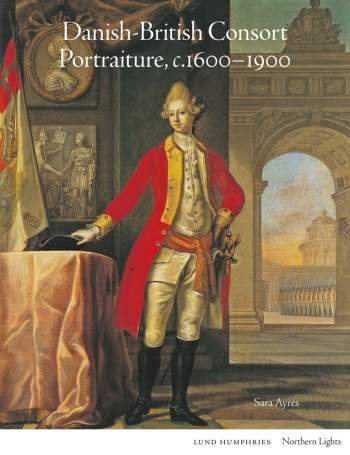 This is the first book to address the long art history of dynastic marriage exchange between Denmark and Britain between 1600 and 1900. It explores an intersection of three themes trending in early modern studies: portraiture, gender, and the court as a centre of cultural exchange. This work re-evaluates the construction and staging of gender in Northern consort portraiture over a span of three hundred years, examining the development of the scientific and social paradigms inflecting consort portraiture and representation, with a view to excavating portrait images’ agency at the early modern moment of their conception and making. The consort’s liminal position between royal houses, territories, languages, and sometimes religion has often been equated with political weakness, but this new work argues that this position endowed the consort with a unique space for innovation in the representation of elite identity. As such, consort imagery drew upon gender as a generative resource of motifs and ideas. Each chapter is informed by new archival research and introduces the reader to little known, yet astonishing works of art. Collectively, they seek to trace a shift in practices of identity formation over time: the transition from an emphasis on rank to an increasingly binary emphasis on gender.
• The book builds on the recent interest around the quatercentenary in 2019 of Anna of Denmark’s death, and the burgeoning interest in Nordic history and art history.
• Anna of Denmark was born 12 December 1574; so the year 2024 will mark the 450th anniversary of that occasion.
• The tercentenary of Louise of Great Britain’s birth takes place in 2024.
• The centenary of Alexandra of Denmark’s death takes place in 2025.
Sara Ayres obtained her doctorate in Art History from Birkbeck College, University of London, in 2012. She has published in the Oxford Art Journal, the Journal of Historians of Netherlandish Art, and the Court Historian. Between 2016 and 2018 she held the position of the Queen Margarethe II Distinguished Postdoctoral Fellow at the National Portrait Gallery in London. Recent publications include the co-edited volume Sculpture and the Nordic Region (2017).
C O N T E N T S
Acknowledgements
Figure List
Introduction
1 Anna of Denmark (1574–1619)
2 Prince George of Denmark (1653–1708)
3 Louisa of Great Britain (1724–1751)
4 Caroline Matilda of Great Britain (1751–1775)
5 Alexandra of Denmark (1844–1925)
Bibliography
Endnotes
New Book | Rosalba Carriera
Oberer’s first biography of Carriera appeared in 2020 from Amsterdam UP; her second is available from The Getty and Lund Humprhies:
Angela Oberer, Rosalba Carriera (Los Angeles: Getty Publications, 2023), 144 pages, ISBN: 978-1606068601, $45 / (London: Lund Humprhies, 2023), 144 pages, ISBN: 978-1848225190, £35.
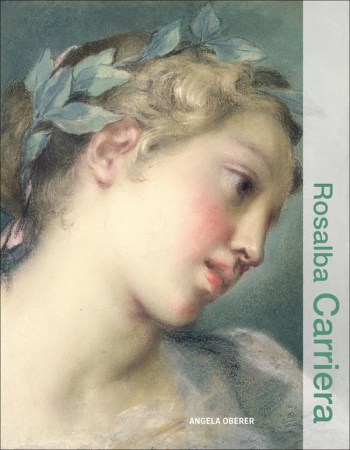 This stunning new volume is the first accessibly written, illustrated, English-language biography of Rosalba Carriera, one of the most famous women artists in eighteenth-century Europe.
Born in Venice in 1673 to a lawyer and a lace maker, Rosalba Carriera began her career painting decorative objects and rose to international renown as a portraitist in Italy, Germany, France, and England. In 1757 she died nearly blind from cataracts, a tragic end for a painter acclaimed for exquisite miniatures and innovative pastels. During the 1700s she was deemed “the most talented female artist of our century,” so famous that she was referred to by her first name only. Today, however, she is little known outside Venice, despite the attribution to her of more than seven hundred surviving artworks.
This accessibly written, gorgeously illustrated biography surveys Carriera’s career, considering her miniatures alongside better-known works of larger scale. Interpreting her oeuvre against the historical context of her experience as a single woman in Venice, the book takes readers through the full arc of her life, including the people she met, her clients, and her artistic approach. Author Angela Oberer’s original iconographic analysis of some of Carriera’s work reveals that she was an erudite painter who drew on antiquity as well as Renaissance precedents such as Leonardo da Vinci and Paolo Veronese. Published in conjunction with the 350th anniversary of her birth, this book is a long overdue tribute to an important and prolific artist.
Angela Oberer is a lecturer in art history with a PhD from the Technische Universität Berlin. She has written and lectured extensively on the work of Rosalba Carriera.
C O N T E N T S
Acknowledgements
1 Venice at the Dawn of the Eighteenth Century and the Beginning of Carriera’s Artistic Career
2 An Independent Single Female Painter
3 Carriera, the First Female Trendsetter in Technique and Style
4 Invitations Abroad and Carriera’s International Network
5 Pastel Painting: Carriera’s Greatest Success
6 An Exceptional Life Comes to an End
Notes
Bibliography
Index
Exhibition | Rosalba Carriera: Perfection in Pastel

Rosalba Carriera, Portrait of an Unknown Lady in a Blue Coat over a Light Dress, detail, pastel on paper, 76 × 64 cm
(Dresden: Gemäldegalerie Alte Meister)
◊ ◊ ◊ ◊ ◊
From Dresden’s Zwinger:
Rosalba Carriera – Perfection in Pastel / Perfektion in Pastell
Gemäldegalerie Alte Meister, Zwinger, Dresden, 9 June — 24 September 2023
On the occasion of the 350th anniversary of the birth of Rosalba Carriera (1673–1757), the Gemäldegalerie Alte Meister (Old Masters Picture Gallery) is dedicating a special exhibition to the most famous pastel painter. More than 100 objects will be presented, including around 70 works by the portraitist, who was one of the first female artists to enjoy success throughout Europe. With 73 pastels, Dresden possesses the world’s largest collection of the Venetian artist’s work. Under August III, more than twice as many pieces by Carriera were in the gallery’s holdings, and in 1746 a separate pastel cabinet was even set up in the Johanneum near the Frauenkirche and named after her.
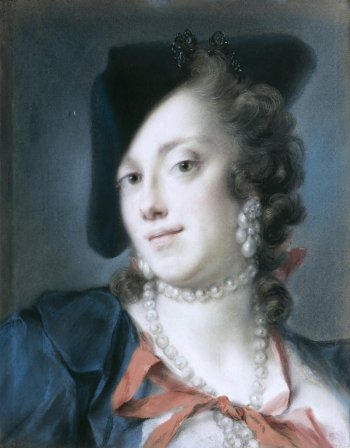
Rosalba Carriera, A Venetian from the House of Barbarigo (Caterina Sagredo Barbarigo), ca. 1735/40, pastel on paper, 42 × 33 cm (Dresden: Gemäldegalerie Alte Meister).
Pastel painting was still considered a comparatively young genre at the time. Carriera was instrumental in making this technique a valued form of painting. The many portraits of princes of the ruling dynasties of Europe show how much in demand the artist was. But she also captured the likenesses of literary figures, musicians, and dancers from her native Venice; a visit to her studio was part of the regular programme of the numerous travellers through Italy. Thus, portraits constitute the largest part of her oeuvre.
Carriera’s pastels bear witness to the beauty ideals of the Rococo period, whose cosmetics were dominated by powder: pale, even skin, powdered hair, and wigs. The powdery surfaces of pastel painting reflect this fashion and thus bring us closer to this bygone era. In cooperation with the Theatre Design/Mask Design course at the Dresden University of Fine Arts, students are illustrating the maquillage of the 18th century in a project that will thus be brought to life in the exhibition.
Carriera’s artistic beginnings lay in miniature painting, as she had little competition to fear from male painter colleagues in this field. In 1705, the San Luca Academy of Art in Rome appointed her a member. This high distinction was bestowed on only a few women, especially as academic training was still denied them for a long time. The Accademia Clementina in Bologna also accepted her as a member in 1720, and a year later the Académie Royale in Paris.
The exhibition shows over 100 objects, taking the public first to the lagoon city of Venice, with views of the Grand Canal, where Carriera had her residence. In addition to the pastel paintings, there are also typical Venetian handicraft products such as glass, lace, and fine cloth to discover.
Roland Enke and Stephan Koja, Rosalba Carriera: Perfection in Pastel (Dresden: Staatliche Kunstsammlungen Dresden, 280 pages, ISBN: 978-3954987580 (English) / ISBN 978-3954987573 (German), €44.
Installation | Nicolas Party and Rosalba Carriera
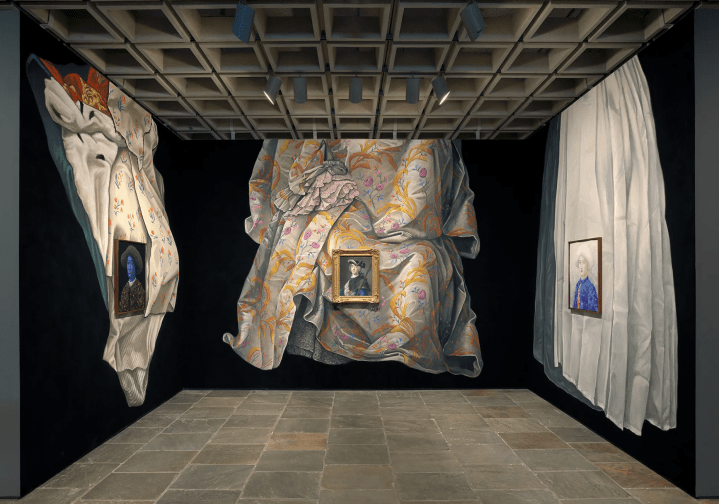
Installation View of Nicolas Party and Rosalba Carriera at Frick Madison, 2023
(Photo by Joseph Coscia Jr.)
◊ ◊ ◊ ◊ ◊
From the press release for the installation:
Nicolas Party and Rosalba Carriera
The Frick Madison, New York, 1 June 2023 — 3 March 2024
Organized by Xavier F. Salomon
The Frick Collection has unveiled a large pastel mural commissioned from the Swiss-born artist Nicolas Party at the museum’s temporary home, Frick Madison. This site-specific work was created in response to Rosalba Carriera’s Portrait of a Man in Pilgrim’s Costume—one of two eighteenth-century pastels by Rosalba bequeathed to the Frick by Alexis Gregory in 2020. The installation features Rosalba’s superb portrait at the center of a three-wall mural designed by Party, as well as two new related works specially created by Party for this presentation.
On view from 1 June 2023 through the remainder of the Frick’s residency at the Breuer building (until 3 March 2024), this installation will inspire the Frick’s summer and early fall programming as well as a new publication.
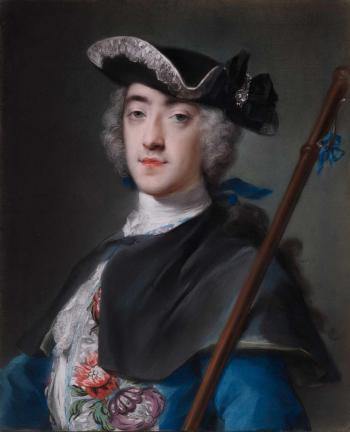
Rosalba Carriera, Portrait of a Man in Pilgrim’s Costume, ca. 1730. pastel on paper, glued to canvas, 59 × 48 cm (New York: The Frick Collection, Gift of Alexis Gregory, 2020.3.01).
The project, which also marks the 350th anniversary of Rosalba’s birth, is organized by Xavier F. Salomon, the Frick’s Deputy Director and Peter Jay Sharp Chief Curator. Salomon comments, “It has been a particular pleasure to work with Nicolas Party. I met Nicolas in April 2021 and since then have enjoyed an ongoing and enlightening conversation on pastels. Nicolas’s installation at Frick Madison is the result of our exchanges, and I am delighted with the result.”
Party adds, “When I first fell in love with pastels, some ten years ago, my research quickly led me to the queen of pastel, Rosalba. Her practice and love for the powdery sticks increased the popularity of the medium and were crucial to the development of the art form. I felt a powerful attraction to her pastels. Today, I like to think our approaches might not be all that different.”
Born in Venice, Rosalba Carriera (1673–1757) was celebrated throughout Europe during her lifetime for her portraiture. She was the preeminent portraitist in Venice in the mid-eighteenth century, at the same time the Venetian Carnival reached its zenith. During this period, foreign travelers flocked to Venice for the masked revelries that became synonymous with the city, and Rosalba’s studio was a popular stop for visiting foreigners, who often posed for her in their elegant Carnival costumes. Portrait of a Man in Pilgrim’s Costume (ca. 1730) is most likely one such work. The sitter is possibly French, British, or German, but his identity remains unknown. With his black cape, staff, and jaunty tricorn hat, he is depicted as a pilgrim.
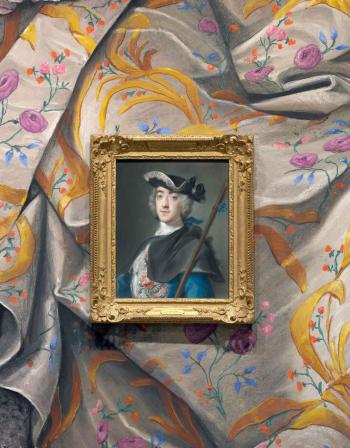
Installation View of Nicolas Party and Rosalba Carriera at Frick Madison, 2023 (Photo by Joseph Coscia Jr.)
Party’s mural includes elaborate draperies that highlight the Rosalba portrait along with two additional pastel portraits he created in response to it. These ornate draperies evoke the work of two other towering figures in European pastels—Jean-Étienne Liotard (1702–1789) and Maurice-Quentin de La Tour (1704–1788)—echoing the function of Venetian Carnival masks, designed to conceal and reveal the features of their wearers. Party’s installation engages devices of disguise and disclosure, from masks to draperies to makeup (often produced with the same chemical components used to make pastel sticks).
The large-scale murals created by Party, whose primary medium since 2013 has been pastel, are ephemeral, lasting only for the duration of a specific exhibition at a unique location. The historical nature of his practice aligns perfectly with the installation at Frick Madison, which has given the museum a unique opportunity to re-imagine its permanent collection display, presented for the first time outside the domestic setting of the Gilded Age mansion at 1 East 70th Street.
This project is part of a series of initiatives in recent years that invite contemporary responses to the Frick’s holdings. Party’s installation not only offers a fresh perspective on an important recent acquisition, but furthers Frick Madison’s prompting of visitors to question the impact of site and setting on their perception of historic objects in the collection.
Born in Lausanne in 1980, Party is a figurative painter who has achieved critical admiration for his familiar yet unsettling landscapes, portraits, and still lifes that simultaneously celebrate and challenge conventions of representational painting. His works are primarily created in soft pastel, which allows for exceptional degrees of intensity and fluidity in his depictions of objects both natural and manmade. Transforming these objects into abstracted, biomorphic shapes, Party suggests deeper connections and meanings. His unique visual language has coalesced in a universe of fantastical characters and motifs where perspective is heightened and skewed to uncanny effect.
Over the years, Party has created work in response to that of European painters including Louis-Léopold Boilly (1761–1845), Arnold Böcklin (1827–1901), and René Magritte (1898–1967). In 2019, Party organized the pastel exhibition at the FLAG Art Foundation in New York, where he created large—and ephemeral—pastel murals inspired by French eighteenth-century artists including François Boucher (1703–1770) and Jean-Honoré Fragonard (1732–1806), both of whom are represented in the Frick’s permanent collection.
Nicolas Party and Xavier Salomon, Rosalba Carriera’s Man in Pilgrim’s Costume (London: Giles, 2023), 80 pages, ISBN: 978-1913875510, £20 / $25.
Funding for the installation is generously provided by The Christian Humann Foundation and the David L. Klein, Jr. Foundation, with the support of the Swiss Arts Council Pro Helvetia.
◊ ◊ ◊ ◊ ◊
Note (added 25 August 2023) — The posting was updated with details on the publication.
Display | The Wildmans in Bedford Square and Newstead Abbey
Now on view at the Mellon Centre:
A Harpy and His Brothers: The Wildmans in Bedford Square and Newstead Abbey
Paul Mellon Centre, London, 30 May — 15 September 2023
Curated by Martin Myrone

George Romney, Portrait of Thomas Wildman MP, detail, oil on canvas, 78 × 64 cm (Private Collection).
This Drawing Room display shows some of the ways that the architectural and cultural histories of Bedford Square and Newstead Abbey have been addressed in the past and the ways in which those stories might be revised and complicated. The inclusion of the film project Blood Sugar, developed by volunteers at Newstead Abbey, offers further perspectives on these historical stories.
Bedford Square has always been esteemed as one of London’s most prestigious addresses. Built in 1775–82, it is widely considered to be the finest surviving example in London of a Georgian town square, embodying in its orderly architecture appearance the favoured self-image of the British social elite. This display explores the history and reputation of Bedford Square by focusing on two brothers who were among its first inhabitants: the successful lawyer Thomas Wildman (1740–1795) and his younger brother James Wildman (1747–1816). Together with a third brother, the merchant Henry Wildman (1746–1816), they made a fortune through their connections with the fabulously wealthy William Beckford, managing his legal affairs and his extensive plantations in the West Indies. Thomas Wildman’s wealth allowed his son, also Thomas (1787–1859), to purchase Newstead Abbey, a historic property in Nottinghamshire previously owned by the poet Lord Byron.
A digital version of the accompanying 36-page booklet is available here»
◊ ◊ ◊ ◊ ◊
More information about “Blood Sugar: The Slavery History of Newstead Abbey” can be found here, with the 5-minute 2018 film itself available on YouTube.
New Book | A Biographical Dictionary of RA Students, 1769–1830
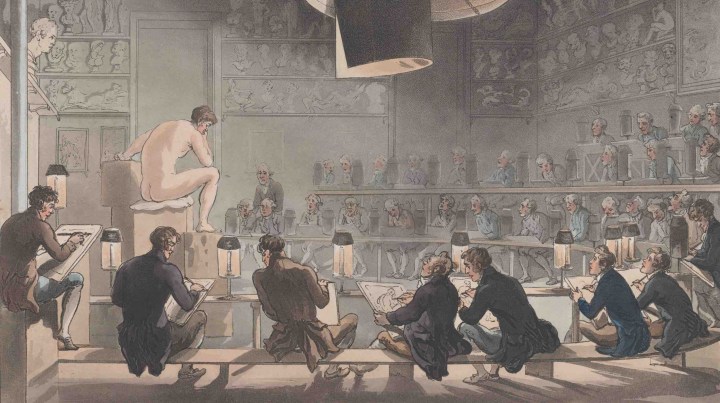
Thomas Rowlandson, Auguste Charles Pugin, and John Bluck, Drawing from Life at the Royal Academy, (detail), 1808, hand-coloured etching and aquatint, sheet: 28 × 34 cm (New York: The Metropolitan Museum of Art, New York, Elisha Whittlesey Collection, 59.533.2084).
◊ ◊ ◊ ◊ ◊
Recently published by The Walpole Society:
Martin Myrone, “A Biographical Dictionary of Royal Academy Students, 1769–1830,” The Walpole Society 84 (2022).
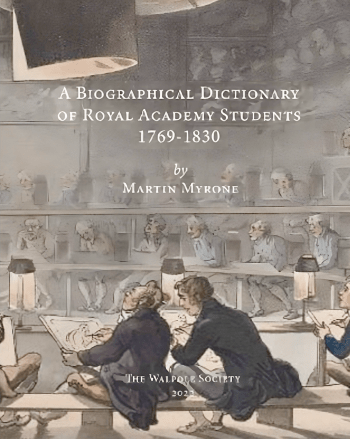 An essential new reference work for students of 18th- and 19th-century British art, Martin Myrone’s A Biographical Dictionary of Royal Academy Students 1769–1830 records every student known to have attended the RA schools in London during its first six decades. The book contains 1,800 biographical entries and draws on extensive new archival research, offering a comprehensive account of the extraordinarily diverse life stories of former RA students and an unprecedented overview of British art during the Romantic period. It provides a revealing new context for such familiar figures as John Constable, William Blake, and J.M.W. Turner, and a wealth of fresh information about three generations of obscure, forgotten, or previously unknown British painters, sculptors, engravers, and architects. As the first national art school, enjoying Royal patronage, prestige, and prominence, the Royal Academy has a pivotal role in British art history, with almost every notable figure of the era passing through its walls.
Martin Myrone is Head of Grants, Fellowships, and Networks at the Paul Mellon Centre for Studies in British Art, London.
A Biographical Dictionary of Royal Academy Students 1769–1830 is for sale to the general public exclusively through Thomas Heneage Art Books, London. It is also available free online and to download for members of the Walpole Society via their newly launched website, where a growing number of volumes can be found in a dedicated member’s area. Members of the Walpole Society support the research and publication of British art history; membership subscriptions—starting at only £20 annually for a student membership—contribute to the cost of producing new volumes, and, in return, members receive a free copy of the current year’s volume, either as a digital file or a hardback book.
The Walpole Society was formed in 1911 chiefly through the efforts of Alexander Finberg (1866—1939), who had been employed to arrange the paintings in the bequest of J.M.W. Turner. In the course of his work, Finberg saw that many artists of the 18th century lay unrecognised, and established the Society to address this lack of knowledge and to shine a light on earlier periods which were then entirely neglected. The Society was named after Horace Walpole (1717—1797), who published the first history of art in Britain, basing his work on the manuscript notebooks of George Vertue (1684—1756), which he had acquired. One of the first goals of the Walpole Society was to publish the notebooks in their original form, which included much material that Walpole omitted. This took up six volumes as well as an index volume, and was finally completed in 1950. This publication is the single most important source of information concerning art collections, artists, architects, and craftsmen working in Britain before the mid-18th century. They form part of more than 80 volumes that the Society has so far published containing articles, catalogues, and editions of original documents.
New Book | Landscape and Authority in the Early Modern World
From Penn Press:
Summer Reading Sale! 40% off all Penn Press books, plus free U.S. shipping with discount code SUMMER23-FM, until June 9 (excluding pre-order sales).
Stephen Whiteman, ed., Landscape and Authority in the Early Modern World (Philadelphia: University of Pennsylvania Press, 2023), 360 pages, ISBN: 978-1512823585, $80.
 Courts and societies across the early modern Eurasian world were fundamentally transformed by the physical, technological, and conceptual developments of their era. Evolving forms of communication, greatly expanded mobility, the spread of scientific knowledge, and the emergence of an increasingly integrated global economy all affected how states articulated and projected visions of authority into societies that, in turn, perceived and responded to these visions in often contrasting terms. Landscape both reflected and served as a vehicle for these transformations, as the relationship between the land and its imagination and consumption became a fruitful site for the negotiation of imperial identities within and beyond the precincts of the court.
In Landscape and Authority in the Early Modern World, contributors explore the role of landscape in the articulation and expression of imperial identity and the mediation of relationships between the court and its many audiences in the early modern world. Nine studies focused on the geographical areas of East and South Asia, the Islamic world, and Europe illuminate how early modern courts and societies shaped, and were shaped by, the landscape, including both physical sites, such as gardens, palaces, cities, and hunting parks, and conceptual ones, such as those of frontiers, idealized polities, and the cosmos. The collected essays expand the meaning and potential of landscape as a communicative medium in this period by putting an array of forms and subjects in dialogue with one another, including not only unique expressions, such as gardens, paintings, and manuscripts, but also the products of rapidly developing commercial technologies of reproduction, especially print. The volume invites a deeper and more nuanced understanding of the complexity with which early modern states constructed and deployed different modes of landscape for different audiences and environments.
Stephen H. Whiteman is Reader in the Art and Architecture of China, The Courtauld, University of London.
C O N T E N T S
Acknowledgments
1 Connective Landscapes: Mobilizing Space in the Transcultural Early Modern — Stephen Whiteman
Part I | Circulating Discourses
2 From Imperial to Confessional Landscapes: Engelbert Kaempfer and the Disenchantment of Nature in Safavid and Tokugawa Cities — Robert Batchelor
3 Constructing an Authentic China: Henri Bertin and Chinese Architecture in Eighteenth-Century France — John Finlay
Part II | Constructing Identities
4 Landscape and the Articulation of the Imperium: Safavid Isfahan — Seyed Mohammad Ali Emrani
5 Bridge into Metaphorical Space: Hideyoshi’s Imperial Landscapes at Osaka — Anton Schweizer
Part III | Defining Margins
6 Views of Victory: The Landscapes of the Battle of the Boyne — Finola O’Kane
7 Delineating the Sea: Maritime Law and Painting in Willem van de Velde the Elder’s Sea-Drafts — Caroline Fowler
8 Dutch Representations of Southeast Asia — Larry Silver
Part IV | Imagining Spaces
9 Landscape and Emperorship in the Connected Qing: Leng Mei’s View of Rehe — Stephen Whiteman
10 The Princely Landscape as Stage: Early Modern Courts in Enchanted Gardens — Katrina Grant
Contributors
Index
Exhibition | The Shape of Time: Art and Ancestors of Oceania
A portion of The Met’s Oceanic Collection, now on view in Shanghai at the Museum of Art Pudong:
The Shape of Time: Art and Ancestors of Oceania
Museum of Art Pudong, Shanghai, 1 June — 20 August 2023
National Museum of Qatar, Doha, 16 October 2023 — 15 January 2024
Accompanies the reopening of The Michael C. Rockefeller Wing at The Metropolitan Museum of Art, Spring 2025

Maori Weaving Peg (Turuturu), late 18th–early 19th century, wood, 14 inches high (NY: The Metropolitan Museum of Art, The Michael C. Rockefeller Memorial Collection, Bequest of Nelson A. Rockefeller, 1979.206.1600. ‘Ko te taura whiri, he whiri i te tangata’ (‘The woven cord is like the cord that connects people’). –Māori proverb
The exhibition The Shape of Time: Art and Ancestors of Oceania from The Metropolitan Museum of Art is produced by the Lujiazui (Group) Co., Ltd., and co-organized by The Metropolitan Museum of Art (The Met) and the Museum of Art Pudong (MAP). The exhibition marks the first time that MAP collaborates with The Met, a world-renowned art institution. Meanwhile, it is also the first time ever that an exhibition taken entirely from The Met’s collection has come to Shanghai, China, adding extraordinary historical significance to the event.
The Shape of Time centers around The Met’s Oceanic art collection, showing the exuberant and diverse culture of Oceania. Divided into three main sections— Voyaging, Ancestors, and Time—the exhibition displays more than 110 valuable artworks from the past four centuries. Encompassing the arts and cultures of the Pacific Islands, The Met’s collection of Oceanic art comprises over 2,800 works that reflect the rich history of creative expression and innovation that is emblematic of the region. Since joining in The Met’s permanent collection, these treasures of Oceania have never left New York. The exhibition The Shape of Time therefore is the first time after about half a century that these works will travel out of the United States, and MAP is honoured to be the first stop of this historic voyage.
From The Met’s catalogue entry for the weaving peg (at right):
This weaving peg incorporates a distinctively carved male figure with elaborate designs that accentuate his tattooed skin (moko). Carved in the round, intricate low-relief carvings cover the entire surface of the figure’s body except for the back of his head, which is the seat of an individual’s mana or personal sanctity. With elbows resting on each knee, the arms extend up towards the chin, which is supported by five-fingered hands. The face is dynamic—serial notching accentuates the pronounced arch of each brow, giving way to more fluid grooves, lengthened lines that delineate elongated eyes and the contours of the lips and mouth. The nostrils flare, the mouth is wide open and gaping, as if to consume this flow of energy. Spiral designs on each knee spill over onto the top section of the polished shaft and create a characteristic double spiral motif. This feature frames the face of a further face which faces the other direction, drawing the eye around to the back, creating an energy and dynamism much admired in Māori figural sculpture. . . . The process of twining began when the weaver drove two pegs into the ground and stretched between them a single cord from which the strands of flax were hung. The left-hand peg was always left plain, while the right-hand one was carved and dedicated to the female deity associated with the moon, Hine-te-iwaiwa. The more complex form of carved weaving pegs, such as this one, were designed to incorporate the spiritual potency associated with the goddess whose efficacy was believed to become integrated into the bound texture of the cloak, thus enhancing the spiritual armature of the wearer. . .
The catalogue is published by Yale UP:
Maia Nuku, Oceania: The Shape of Time (New Haven: Yale University Press, 2023), 208 pages, ISBN: 978-1588397669, $50.
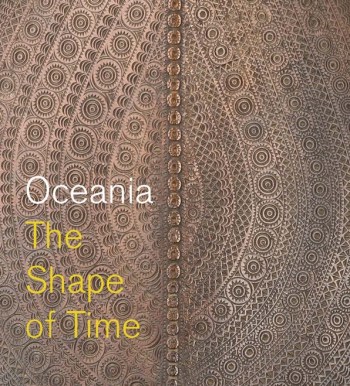 The visual arts of Oceania tell a wealth of dynamic stories about origins, ancestral power, performance, and initiation. This publication explores the deeply rooted connections between Austronesian-speaking peoples, whose ancestral homelands span Island Southeast Asia, Australia, Papua New Guinea, and the island archipelagoes of the northern and eastern Pacific. Unlike previous books, it foregrounds Indigenous perspectives, alongside multidisciplinary research in art history, ethnography, and archaeology, to provide an intimate look at Oceania, its art, and its culture. Stunning new photography highlights more than 130 magnificent objects, ranging from elaborately carved ancestral figures in ceremonial houses, towering slit drums, and dazzling turtle-shell masks to polished whale ivory breastplates. Underscoring the powerful interplay between the ocean and its islands, and the ongoing connection with spiritual and ancestral realms, Oceania: The Shape of Time presents an art-focused approach to life and culture while guiding readers through the artistic achievements of Islanders across millennia.
Maia Nuku is Evelyn A. J. Hall and John A. Friede Associate Curator for Oceanic Art at The Metropolitan Museum of Art.
The Burlington Magazine, May 2023
The eighteenth century in the May issue of The Burlington . . .
The Burlington Magazine 165 (May 2023)
E D I T O R I A L
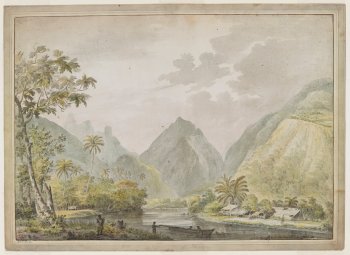
John Webber, A View Looking up the Vaitepiha River with Two Tahitians in a Canoe in the Foreground and Two Others on the Bank with Tahitian Houses to the Right. August 1777, 1777, pen, wash, and watercolour, 45 × 63 cm (London: British Library, Add. 15513, No.13).
• Digitizing the Conway and Witt Libraries, p. 491.
L E T T E R S
• Peter Barber, “The Background of Portrait of Mai,” pp. 492–93.
“Given Reynolds’s lack of interest in landscape painting, but the special place of the portrait of Mai in his oeuvre, it is at least possible that Reynolds may have decided to paint an authentically Tahitian background in order to add further ‘authenticity’. Given his high opinion of [John] Webber, it would have been natural to have copied the scene from one of his friend’s ‘excellent’ paintings of Vaitepiha Bay” (493).
• Christina Strunck, “Laguerre’s Painted Hall at Chatsworth,” p. 493.
“Since in his article ‘A Modello by Louis Laguerre and the Programme of the Painted Hall at Chatsworth’, published in The Burlington Magazine in August 2022 (pp. 760–67), François Marandet came to the same conclusions [that I did in my 2021 monograph Britain and the Continent, 1660–1727: Political Crisis and Conflict Resolution in Mural Paintings at Windsor, Chelsea, Chatsworth, Hampton Court and Greenwich], I thought your readers might like to be referred to the more extended analysis of the programme in both my book and an article I published in January 2022 that discusses the channels through which the two versions of Maratta’s painting may have been known to Laguerre and his patron, William Cavendish.”
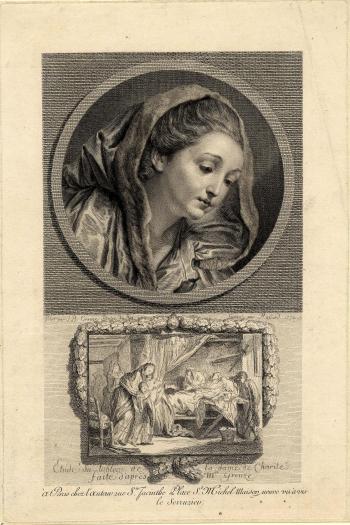
Jean Massard, after Jean Baptiste Greuze, A Woman (Madame Greuze) with a Fur-trimmed Hood Drawn over Her Head, Detail from Greuze’s ‘La Dame de Charité’ above a Sketch of the Painting, 1772, etching and engraving, 24 × 16 cm (London: British Museum, 1978,0121.291).
R E V I E W S
• Mark Evans, Review of Leopoldine van Hogendorp Prosperetti, Woodland Imagery in Northern Art, c.1500–1800: Poetry and Ecology (Lund Humphries, 2022), pp. 568–69.
• Alastair Lang, Review of Yuriko Jackall, Jean-Baptiste Greuze et ses têtes d’expression: La fortune d’une genre (CTHS and INHA, 2022), pp. 569–71.
• Lisa Monnas, Review of Michael Peter, Gewebtes Gold: Eine Kleine Geschichte der Metallfadenweberei von der Antike bis um 1800 (Abegg-Stiftung, 2022), p. 576.
• Alexandre Maral, Review of Christopher Tadgell, The Louvre and Versailles: The Evolution of the Proto-Typical Palace in the Age of Absolutism (Routledge, 2020), pp. 576–77.
• Wim Nys, Review of Beatriz Chadour-Sampson, Sandra Hindman, and Carla Van De Puttelaar, eds., Liber Amicorum in Honour of Diana Scarisbrick: A Life in Jewels (Ad Ilissvm, 2022), p. 577.
O B I T U A R Y
• Elizabeth Pergam, Obituary for Duncan Robinson (1943–2022), p. 578–79.
Successively the Director of the Yale Center for British Art, New Haven, and the Fitzwilliam Museum, Cambridge, Duncan Robinson had a major influence on the appreciation, study, and collecting of historic and modern British art in both the United States and the United Kingdom.
Call for Essays | Material Metamorphosis
From the Call for Essays for a project with Brepols:
Material Metamorphosis: Natural Resources, Artmaking, and Sustainability in the Early Modern World
Volume edited by Louise Arizzoli and Susanna Caviglia
Proposals due by 15 July 2023, with final papers due 15 May 2024
Between the sixteenth and the early nineteenth century, raw materials circulated globally to be traded, studied, and transformed into luxury goods for the consumption of Europeans, whose mishandling of the colonies’ natural resources turned some of the potentially wealthiest countries into the poorest ones. This volume proposes to investigate craftsmanship and artmaking against the backdrop of colonial trade and in relation to current issues such as environmental, social, cultural, and economic sustainability. The focus will be on natural resources, in particular their materiality, extraction, migration, and transformation through labor and manufacturing processes as well as on the effects of their cultivation and the exploitation of territories.
Global trade routes interconnecting distant parts of the world existed since Antiquity. The famous Silk Road allowed to bring silk and spices from China to Rome in exchange of wool, gold, or silver; the Incense Route facilitated the transport of frankincense and myrrh from Southern Arabia to the Mediterranean; and the Amber Road permitted to carry the precious homonymous stone from the Baltic Sea to the Mediterranean. These well-established complex networks of commercial trade boosted economies but were also vital means of intercultural exchanges. Global trade soared in the fifteenth and sixteenth centuries, with the lead of the Portuguese and the Spanish who opened new maritime routes, followed in the seventeenth century by the Dutch, the English, and the French. Renewed commercial relationships with India, China, Japan, and the Americas were the occasion for the Europeans to establish a stronghold on local economies and make profit on the trade of local products; the infamous triangular trade between Europe, Africa, and the Americas from the sixteenth to the nineteenth century represents one of the apexes of these exploitative systems.
These systems and their long-lasting impact on people, labor, production, and the landscape have gathered renewed scholarly interest. Here, we aim to investigate the effects of global trade routes on the exploitation of natural resources as related to artistic production, since raw materials were imported to Europe from abroad to produce goods of all kinds. The aim is to approach these objects not as finished products but as the final results of a long production process anchored in the exploitation of natural resources that contributed to the increasing environment’s degradation and led to question the relationship between the human being and nature.
We seek papers dealing with materials that travelled from Asia, the Americas, and Africa to Europe (such as sugar, coffee, tobacco, wood, cotton, indigo as well as gold, iron, and ivory). Papers could interrogate the fate of such natural resources and ask, in particular, how they were received, transformed, represented, collected, displayed, or consumed. In general, we welcome research that deconstructs the artwork and looks at the material itself, its origin, exploitation, metamorphosis, reuse, preservation, and consumption through the lenses of global exchange and development related to the modern concept of sustainability, the prodromes of which appear in the seventeenth century. This period coincides indeed with the occurrence of the first ecological damages (deforestation, soil erosion, silted rivers, drought, etc.) which can be directly related to the new commercial strategies.
The volume will be articulated around three areas of the world where Europe founded colonies and exploited natural resources. For example:
• Asia: silk, cotton, spices, precious stones, tea, cotton
• Africa: ivory, wood, iron, horn, gold, cloth
• The Americas: silver, gold, pigments, sugar, tobacco, coffee, cotton
This inquiry welcomes a variety of media, including but not limited to: the decorative arts, ephemeral arts (theatre, exhibitions, masquerades), visual arts, textiles, cabinets of curiosities, and jewelry. Please send proposals to Louise Arizzoli (larizzol@olemiss.edu) and Susanna Caviglia (susanna.caviglia@duke.edu). Include in your proposal: name and affiliation, paper title (maximum of 15 words), abstract (maximum of 200 words), and a brief CV (maximum of 300 words, in ordinary CV format) by 15 July 2023.
Submission Timeline
• 15 July 2023 — submit your abstract
• 1 September 2013 — notification of acceptance
• 15 May 2024 — submission of your contribution (information on publication format and guidelines available upon acceptance)










leave a comment