The Burlington Magazine, April 2023
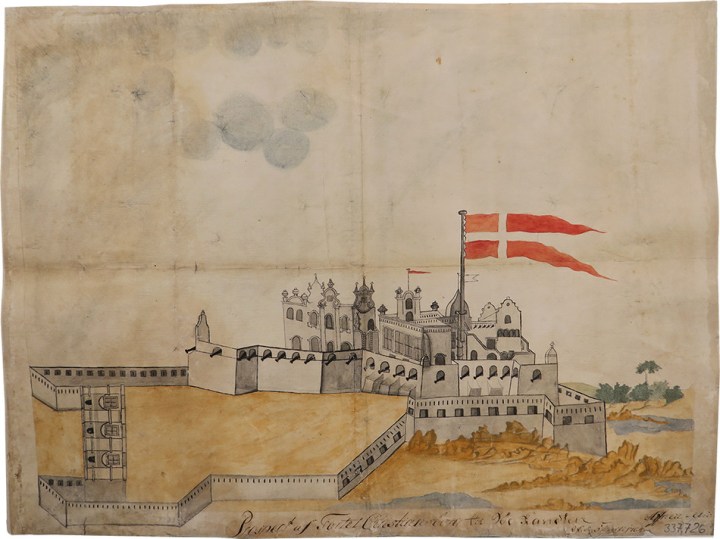
View of Fort Christiansborg [Christiansborg Castle, Osu] from the Shore, March 1764, ink and coloured wash on paper
(Danish National Archives)
◊ ◊ ◊ ◊ ◊
The eighteenth century in the April issue of The Burlington . . .
The Burlington Magazine 165 (April 2023)
A R T I C L E S
• Gauvin Alexander Bailey, “The Design of Cape Coast Castle and Dixcove Fort, Ghana,” pp. 378–93.
The first analysis of the design of two of the principal eighteenth-century British slave castles and forts of the Gold Coast reveals the Western engravings used as prototypes but also acknowledges these buildings’ engagement with African cultures and forms. Identifying the people who built them and assessing the forts’ association with the coastal African community challenges the popular misconception that they were no more than European transplants.
R E V I E W S
 • Morlin Ellis, Review of the exhibition Spain and the Hispanic World: Treasures from the Hispanic Society Museum and Library (Royal Academy of Arts, 2023), pp. 442–45.
• Simon Jervis, Review of the exhibition catalogue, Reinier Baarsen, Process: Design Drawings from the Rijksmuseum 1500–1900 (Rotterdam: 2022), pp. 456–58.
• Philip Ward-Jackson, Review of the exhibition catalogue, Yvette Deseyve, ed., Johann Gottfried Schadow: Embracing Forms (Hirmer Verlag, 2023), pp. 463–66.
• Thomas P. Campbell, Review of Helen Wyld, The Art of Tapestry (Philip Wilson Publishers, 2022), pp. 472–75.
• Charles Saumarez Smith, Review of András Szántó, Imagining the Future Museum: 21 Dialogues with Architects (Hatje Cantz, 2022), pp. 482–83.
• John Martin Robinson, Review of Dudley Dodd, Stourhead: Henry Hoare’s Paradise Revisited (Head of Zeus, 2021), pp. 484–85.
O B I T U A R I E S
• Christopher Wood, Obituary for Hans Belting (1935–2023), pp. 486–88.
New Book | This Is America
From Oxford UP:
Keri Watson and Keidra Daniels Navaroli, This Is America: Re-Viewing the Art of the United States (Oxford: Oxford University Press, 2023), 416 Pages, ISBN: 978-0190084882, $100.
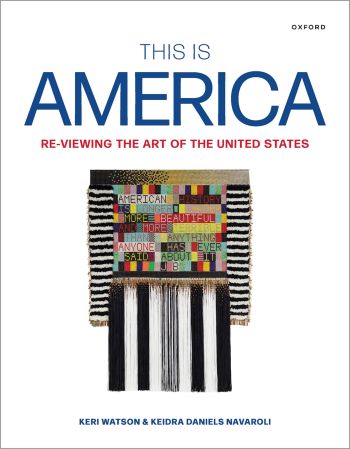 This Is America: Re-Viewing the Art of the United States is a new, inclusive introduction to American visual culture from early history to the present. Reimagining the traditional survey of American art, the book provides expanded coverage of underrepresented stories through the inclusion of marginalized makers, diverse media, and vast geographic regions. Accessible to students with no background in art history, This Is America offers links between recent works of art and the rich cultural history of each major era with succinct and illuminating analysis of key contemporary works in ‘Contemporary Connections’ boxes. By combining close visual and historical analyses with discussion of how works of art operated within specific cultural contexts and for us today, this publication prioritizes art’s critical role in social discourse.
Keri Watson is Associate Professor of Art History at University of Central Florida. Keidra Daniels Navaroli is a McKnight Doctoral Fellow in the Texts and Technology Program at University of Central Florida.
C O N T E N T S
Preface
1 Constructing Indigenous America
Early America: Mound Builder Cultures
Adena Culture
Hopewell Culture
Art of the Pacific Northwest
Old Bering Sea Culture
The Tlingit and Haida Cultures of the Northwest Coast
Art and Architecture of the Southwest
The Hohokam Culture
The Mimbres Culture
Art of the Caribbean Taíno
2 Colonial Disruptions: Un/Making a ‘New World’
Constructing and Circulating Images of the Other
In Search of Spices
In Search of Gold
Labor and Luxury
Forced Labor, Conquest, and Colonization
Power and Portraiture
Building the ‘New World’
New Spain
New England and New Netherland
New France
3 Establishing an Anglo American Nation: Art during the Federal Period
Visualizing Revolution
The War of the Conquest
The Sons of Liberty
Picturing America and Americans
Framing the Other
Establishing a National Iconography
Building American Institutions
Staging Rebellion
The Myth of Benevolence
4 The Nineteenth Century: Westward Expansion and Indian Removal
Remaking the Nation
Florida and the American South
The Trans-Mississippi West
Portraying Native Bodies
From ‘Noble Savage’ to ‘Vanishing Race’
Fashioning the Self: Native Subjects Speak Back
Imagining the West
Survey Paintings and Photography
‘Cowboys and Indians’
5 The Nineteenth Century: Stitching Together a New Body Politic
Painting Scenes of Everyday Life
Americans at Work and at Home
Prints and Patrons
Performing the Other
Mythologizing the Past
Art, Literature, and the Penny Press
The Mexican American War
The Civil War
Go West!
Race, Art, and Activism
Representing Slavery and Freedom
Images of Reconstruction
6 The Nineteenth Century: Reshaping the Landscape
Rural Cemeteries and Public Parks
Philadelphia: Athens of America
The American Sublime
Plantation Portraits
American Impressionism
The End of Landscape Painting
7 From the Gilded Age to the Progressive Era: Picturing Gender, Race, and Class
Exhibiting Wealth and Class in the Gilded Age
Portraits and Power
Building the Gilded Age
Globalism and Imperialism at World’s Fairs
Scientific Racism and the Centennial International Exposition of 1876
Women, Race, and the World’s Columbian Exposition of 1893
The War of 1898 and the Louisiana Purchase Exposition
Picturing Gender, Race, and Class in the Progressive Era
How the Other Half Lives
Out of the Ash Can
8 The Multiple Modernisms of the Interwar Period
The New Negro Movement
The Jazz Age
Sculpting the Harlem Renaissance
Stieglitz, Precisionism, and Surrealism
The Stieglitz Circle
Capturing the Machine Age
Surrealism in the Americas
Pueblo Artists and the Taos School
Figuration
Abstraction
Regionalism and the American Scene
American Regionalism
Painting the American Scene
9 Depression and Recovery: The New Deal, World War II, and the Post-War Boom
The New Deal
Public Works of Art
Social Realism
The Art of War
Representing War
Illustrating Internment
Mythmaking: Postwar Abstraction
Abstract Expressionism
Color Field Painting
‘Out in the World’: Found Objects, Funk, and Pop
Neo-Dada
Pop
10 Challenging the Past and Imagining the Future
Art and/as Activism
The Black Arts Movement
The Feminist Arts Movement
The Chicano Arts Movement
Disability Rights
The Gay Rights Movement
Art in the Expanded Sphere
Minimalism, Conceptualism, and Earth Art
Faith and Reason
Neo-Expressionism and Afro-Futurism
Key Terms
Index
New Book | The Rediscovery of America
From Yale UP:
Ned Blackhawk, The Rediscovery of America: Native Peoples and the Unmaking of U.S. History (New Haven: Yale University Press, 2023), 616 pages, ISBN: 978-0300244052, $35.
 A sweeping and overdue retelling of U.S. history that recognizes that Native Americans are essential to understanding the evolution of modern America
The most enduring feature of U.S. history is the presence of Native Americans, yet most histories focus on Europeans and their descendants. This long practice of ignoring Indigenous history is changing, however, with a new generation of scholars insists that any full American history address the struggle, survival, and resurgence of American Indian nations. Indigenous history is essential to understanding the evolution of modern America. Ned Blackhawk interweaves five centuries of Native and non‑Native histories, from Spanish colonial exploration to the rise of Native American self-determination in the late twentieth century. In this transformative synthesis he shows that
• European colonization in the 1600s was never a predetermined success
• Native nations helped shape England’s crisis of empire
• The first shots of the American Revolution were prompted by Indian affairs in the interior
• California Indians targeted by federally funded militias were among the first casualties of the Civil War
• The Union victory forever recalibrated Native communities across the West
• Twentieth-century reservation activists refashioned American law and policy
Blackhawk’s retelling of U.S. history acknowledges the enduring power, agency, and survival of Indigenous peoples, yielding a truer account of the United States and revealing anew the varied meanings of America.
Ned Blackhawk (Western Shoshone) is the Howard R. Lamar Professor of History and American Studies at Yale University, where he is the faculty coordinator for the Yale Group for the Study of Native America. He is the author of Violence over the Land: Indians and Empires in the Early American West.
C O N T E N T S
List of Maps
Introduction: Toward a New American History
Part I | Indians and Empire
1 American Genesis: Indians and the Spanish Borderlands
2 The Native Northeast and the Rise of British North America
3 The Unpredictability of Violence: Iroquoia and New France to 1701
4 The Native Inland Sea: The Struggle for the Heart of the Continent, 1701–55
5 Settler Uprising: The Indigenous Origins of the American Revolution
6 Colonialism’s Constitution: The Origins of Federal Indian Policy
Part II | Struggles for Sovereignty
7 The Deluge of Settler Colonialism: Democracy and Dispossession in the Early Republic
8 Foreign Policy Formations: California, the Pacific, and the Borderlands Origins of the Monroe Doctrine
9 Collapse and Total War: The Indigenous West and the U.S. Civil War
10 Taking Children and Treaty Lands: Laws and Federal Power during the Reservation Era
11 Indigenous Twilight at the Dawn of the Century: Native Activists and the Myth of Indian Disappearance
12 From Termination to Self-Determination: Native American Sovereignty in the Cold War Era
Notes
Acknowledgments
Index
Lecture | Forgeries, Replicas, and Native American Art
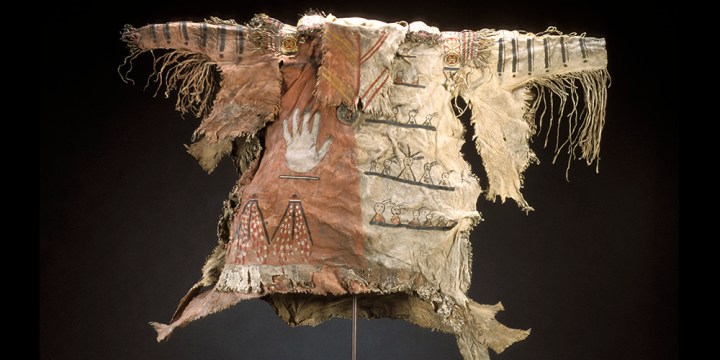
‘Mato-tope’s Shirt’, likely made by George Catlin (Washington, DC: National Museum of Natural History, Smithsonian Institution, NMNHanthropology 8420507). More information is available here»
◊ ◊ ◊ ◊ ◊
From the Bard Graduate Center:
Janet Catherine Berlo | Not Native American Art? Forgeries, Replicas and Other Vexed Identities
Bard Graduate Center, New York, 3 May 2023, 6.00pm
In Native North American artistic traditions, what is a replica? What constitutes a copy? In contrast with the larger field of art history, there is almost no literature on forgeries and replicas in this sub-field. Join us for Janet Catherine Berlo’s lecture, adapted from the introduction to her forthcoming book, Not Native American Art, where she considers notions of replicas, copies, tributes, forgeries, pastiches, and even digital surrogates as they apply to archaeological, historical, and contemporary Native arts of North America.
Register here»
Janet Catherine Berlo, professor of art history and visual and cultural studies emerita at the University of Rochester, holds a PhD in the history of art from Yale University. She is the author of many publications on the Indigenous arts of the Americas, including the most widely-used textbook in the field, Native North American Art, with Ruth B. Phillips (Oxford, second edition 2015). Berlo has also written on American art history and quilt history. Her forthcoming book, Not Native American Art: Fakes, Replicas, and Invented Traditions will be published by the University of Washington Press in July 2023.
New Book | Native American Art from the Weisel Collection
From the FAMSF press release for the catalogue, co-published with DelMonico Books:
Bruce Bernstein, Hillary C. Olcott, Christina Hellmich, Deana Dartt, and Jill D’Alessandro, eds., Native American Art from the Thomas W. Weisel Family Collection (New York: DelMonico Books, 2023), 432 pages, ISBN: 978-1636810966, $85.
 The Fine Arts Museums of San Francisco are pleased to announce the publication of Native American Art: From the Thomas W. Weisel Family Collection, co-published with DelMonico Books, and co-edited by Bruce Bernstein, Hillary C. Olcott, Christina Hellmich, and Deana Dartt with Jill D’Alessandro. The expansive 432-page catalogue celebrates a transformative gift to the Museums that spans nearly one thousand years of artistic creativity by Native American artists.
The volume brings together 206 works of art, exemplifying the exquisite artistry and rich cultural histories represented therein. Highlights of objects researched and presented in the book include 19th-century Diné/Navajo weavings, Ancestral and historic Pueblo pottery, Hopi and Zuni carved figures, and Yavapai and Apache basketry, as well as works from the Pacific Northwest and the Plains. Developed in collaboration with cultural advisors, including Joseph R. Aguilar (San Ildefonso), Stewart B. Koyiyumptewa (Hopi), Arden Kucate (Zuni), Christopher Toya (Jemez) and Brian Vallo (Acoma), the catalogue reflects the complex and multilayered nature of the works in the collection and, more broadly, the field of Native American art.
“The publication of Native American Art has been a monumental, five-year undertaking for the Fine Arts Museums of San Francisco,” said Thomas P. Campbell, Director and CEO of FAMSF. “Our team has worked directly with communities of origin represented in the collection, cultural practitioners, artists, art historians, and museum professionals to share different perspectives on the objects in this collection. We are enormously proud of this collaboration and grateful to each of our authors and advisors for the care they have extended to this project and the knowledge they have shared with us.”
Building upon the Fine Arts Museums’ first publication on the Thomas W. Weisel Family Collection, Lines on the Horizon (2014), Native American Art is an expanded scholarly catalogue that features new research, 30 specially commissioned essays, and 100 extended captions. Contributions by more than 80 authors from different disciplines and cultural backgrounds illuminate details about the living histories of the works. The multitude of perspectives and voices offered here embraces the complexity of the dialogue surrounding Native works past and present, ensuring that Native American Art will be a cornerstone publication in the field of Native American art history.
“The gift of the Thomas W. Weisel Family Collection of Native American Art to the Fine Arts Museums of San Francisco provided the extraordinary opportunity for an open-ended, two-year-long conversation between the Museums and Native communities about the display, imaging, care, and disposition of our Ancestral pottery.” write Joseph R. Aguilar, Stewart B. Koyiyumptewa, Arden Kucate, Christopher Toya and Brian Vallo in their introduction. The results of the dialogue are in this catalogue, including a culturally sensitive approach to reproducing Ancestral pottery images. Every pot was individually considered, most generating lively discussions, and others soliciting respectful silence. The work we have been doing together has been an opportunity to learn from one another.”
Among the important scholarly innovations in Native American Art is the representation of Mimbres bowls and other Ancestral Pueblo pottery forms. Working closely with cultural advisors from five Pueblo communities, the editors and advisory group developed three representative styles for the Mimbres bowls and other Ancestral pottery reproduced in the catalogue. A screen of gold dots takes the place of objects that are culturally sensitive; while drawings made by Acoma artist Michelle Lowden represent bowls that were determined to be from burial contexts but do not feature culturally sensitive imagery. Photography is used when objects are not culturally sensitive.
The catalogue was designed by James Brendan Williams of The Common Era.
A free, public launch event celebrating Native American Art was held Saturday, April 22 at the de Young’s Koret Auditorium. The program included an introduction by volume co-editor Deana Dartt (Coastal Band, Chumash), followed by presentations about Ancestral and historic Pueblo pottery by project contributors Bobby Silas (Hopi-Tewa) and Deborah A. Jojola (Isleta/Jemez Pueblo). The program concluded with a panel discussion between members of the book’s Pueblo Advisors group, Governor Arden Kucate (Zuni), Brian Vallo (Acoma), and Joseph R. Aguilar (San Ildefonso), with volume co-editor Bruce Bernstein.
New Book | Under the Skin
From Penn Press:
Mairin Odle, Under the Skin: Tattoos, Scalps, and the Contested Language of Bodies in Early America (Philadelphia: University of Pennsylvania Press, 2022), 176 pages, ISBN: 978-1512823165, $40.
 Under the Skin investigates the role of cross-cultural body modification in seventeenth-century and eighteenth-century North America, revealing that the practices of tattooing and scalping were crucial to interactions between Natives and newcomers. These permanent and painful marks could act as signs of alliance or signs of conflict, producing a complex bodily archive of cross-cultural entanglement.
Indigenous body modification practices were adopted and transformed by colonial powers, making tattooing and scalping key forms of cultural and political contestation in early America. Although these bodily practices were quite distinct―one a painful but generally voluntary sign of accomplishment and affiliation, the other a violent assault on life and identity―they were linked by growing colonial perceptions that both were crucial elements of ‘Nativeness’. Tracing the transformation of concepts of bodily integrity, personal and collective identities, and the sources of human difference, Under the Skin investigates both the lived physical experience and the contested metaphorical power of early American bodies.
Struggling for power on battlefields, in diplomatic gatherings, and in intellectual exchanges, Native Americans and Anglo-Americans found their physical appearances dramatically altered by their interactions with one another. Contested ideas about the nature of human and societal difference translated into altered appearances for many early Americans. In turn, scars and symbols on skin prompted an outpouring of stories as people debated the meaning of such marks. Perhaps paradoxically, individuals with culturally ambiguous or hybrid appearances prompted increasing efforts to insist on permanent bodily identity. By the late eighteenth century, ideas about the body, phenotype, and culture were increasingly articulated in concepts of race. Yet even as the interpretations assigned to inscribed flesh shifted, fascination with marked bodies remained.
Mairin Odle is Assistant Professor of American Studies at the University of Alabama.
C O N T E N T S
Introduction: Stories Written on the Body
1 Pownced, Pricked, or Paynted: Colonial Interpretations, Indigenous Tattoos
2 The ‘Ill Effects of It’: Reading and Rewriting the Cross-Cultural Tattoo
3 Pricing the Part: Economies of Violence and Stories of Scalps
4 Playing Possum: Scalping Survivors and Embodied Memory
Epilogue: Narrative Legacies and Settler Appropriations
Notes
Index
Acknowledgments
New Book | Stigma: Marking Skin
From Penn State UP:
Katherine Dauge-Roth and Craig Koslofsky, eds., Stigma: Marking Skin in the Early Modern World (University Park: The Pennsylvania State University Press, 2023), 294 pages, ISBN: 978-0271094427, $120.
 The early modern period opened a new era in the history of dermal marking. Intensifying global travel and trade, especially the slave trade, bought diverse skin-marking practices into contact as never before. Stigma examines the distinctive skin cultures and marking methods of Asia, Europe, Africa, and the Americas as they began to circulate and reshape one another in the early modern world. By highlighting the interwoven histories of tattooing, branding, stigmata, baptismal and beauty marks, wounds and scars, this volume shows that early modern markers of skin and readers of marked skin did not think about different kinds of cutaneous signs as separate from each other. On the contrary, Europeans described Indigenous tattooing in North America, Thailand, and the Philippines by referring their readers to the tattoos Christian pilgrims received in Jerusalem or Bethlehem. When explaining the devil’s mark on witches, theologians claimed it was an inversion of holy marks such as those of baptism or divine stigmata. Stigma investigates how early modern people used permanent marks on skin to affirm traditional roles and beliefs, and how they hybridized and transformed skin marking to meet new economic and political demands.
Katherine Dauge-Roth is Associate Professor of Romance Languages and Literatures at Bowdoin College in Brunswick, Maine. She is the author of Signing the Body: Marks on Skin in Early Modern France.
Craig Koslofsky is Professor of History and Germanic Languages and Literatures at the University of Illinois, Urbana-Champaign. He is the author of Evening’s Empire: A History of the Night in Early Modern Europe and The Reformation of the Dead: Death and Ritual in Early Modern Germany, 1450–1700, and the coeditor of A German Barber-Surgeon in the Atlantic Slave Trade: The Seventeenth-Century Journal of Johann Peter Oettinger.
C O N T E N T S
List of Illustrations
Acknowledgements
Introduction, Marking Skin: A Cutaneous Collection — Katherine Dauge-Roth and Craig Koslofsky
Part I | Marked Encounters in America, Asia, and Africa
1 ‘Pownced, Pricked, or Paynted’: English Ideas of Tattooing as Indigenous Literacy — Mairin Odle
2 Indigenous Taiwanese Skin Marking in Early Modern European and Chinese Eyes — Xiao Chen
3 Following the Trail of the Slave Trade: Branding, Skin, and Commodification — Katrina H. B. Keefer and Matthew S. Hopper
Part II | Marks of Faith
4 Jerusalem Under the Skin: The History of Jerusalem Pilgrimage Tattoos — Mordechay Lewy
5 Stigmata and the Mind-Body Connection — Allison Stedman
6 The Invisible Mark: Representing Baptism in Early Modern French Dramaturgy — Ana Fonseca Conboy
7 Rabies and Relics: Cutaneous Marks and Popular Healing in Early Modern Europe — Katherine Dauge-Roth
Part III | Standing Out: Marks of Honor, Shame, and Beauty
8 Skin Narratives: Speaking about Wounds and Scars in Shakespeare’s Coriolanus — Nicole Nyffenegger
9 Branding on the Face in Early Modern Europe — Craig Koslofsky
10 Mouches Volantes: The Enigma of Paste-On Beauty Marks in Seventeenth-Century France — Claire Goldstein
Afterword, Cultural Inscriptions: Body Marking after 1800 — Peter S. Erickson
List of Contributors
Index
New Book | Tokens of Love, Loss, and Disrespect, 1700–1850
Published by Paul Holberton and distributed by The University of Chicago Press:
Sarah Lloyd, ed., Tokens of Love, Loss, and Disrespect, 1700–1850 (London: Paul Holberton Publishing, 2023), 360 pages, ISBN: 978-1911300946, £45 / $55. With other contributions by Timothy Millett, Tim Hitchcock, Susan Whyman, Steve Poole, Sally Holloway, Katrina Navickas, Joe Cozens, Hamish Maxwell-Stewart, Graham Dyer, Gary Oddie, and Brian Maidme.
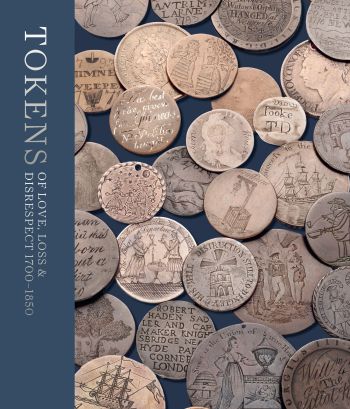 Coins are physically and visually intriguing. Explicitly designed to have monetary value, they can be used for their intended purpose. But coins have also frequently been repurposed to communicate private and public messages—from ad hoc scratchings and punch marks to complete re-engraving of surfaces. As carriers of messages, coins have the advantage of being unobtrusive: They can easily be carried around, and their exchange does not arouse suspicion.
Tokens of Love, Loss and Disrespect gives insight into the many unofficial purposes coins served in the past. Drawing on the largest extant collection of defaced coins and tokens, Sarah Lloyd brings together the full range of expertise required to understand the phenomenon, with contributions from eleven scholars and collectors. Tokens of Love, Loss and Disrespect focuses on a period in British history when modification of coinage expressed political commentary, commercial activity, familial and emotional commitment, personal identity, and life history. It examines the coins and tokens themselves and looks at who modified them, where, why, and how. Defaced coins and tokens are often enigmatic objects, and this book offers a means of decoding and assessing them, while also drawing attention to their value as a distinctive source of historical evidence. Tokens of Love, Loss and Disrespect considers what these surviving coins reveal about the society in which they were produced and the light they shed on major historical developments of the period.
Sarah Lloyd is a fellow of the Royal Historical Society and a public historian with extensive experience of working with twenty-first-century communities on history and heritage projects. She researches the social and cultural history of eighteenth-century Britain.
Exhibition | Coins, Medals, and the Rule of Law

Der Medailleur Jacques-Antoine Dassier setzte 1753 Charles de Montesquieu ins Medaillenrund. In dessen Hauptwerk De l’Esprit des lois von 1748 entfaltete er eine Theorie der Gewaltentrennung, die erheblichen Einfluss auf die Entwicklung des modernen Verfassungsstaates hatte (Staatliche Museen zu Berlin, Münzkabinett, ex Slg. Thomas Würtenberger / Karsten Dahmen)
◊ ◊ ◊ ◊ ◊
From the Staatliche Museen zu Berlin:
Ius in nummis: Die Sammlung Thomas Würtenberger
Bode-Museum, Berlin, 26 May 2023 — 7 April 2024
Eine Sonderausstellung des Münzkabinetts der Staatlichen Museen zu Berlin
Ius in nummis: Die Sammlung Thomas Würtenberger ist in ihrer Breite einzigartig. Sie wurde über den Zeitraum eines halben Jahrhunderts zusammengetragen und umfasst mehr als 3.000 Objekte—vornehmlich Medaillen und einige Münzen—mit dem Fokus auf die neuzeitliche Rechtsgeschichte Westeuropas in zunehmend globaler Perspektive. Jedes Objekt erschließt dabei ein Stück juristischer Vergangenheit.
Iūs, iūris, n. bedeutet unter anderem Recht. Regeln und Gesetze ordnen und durchdringen seit Jahrtausenden den Alltag der Menschen. Recht und Gerechtigkeit bilden dabei dynamische Spannungsfelder. Rechtshandlungen und Rechtsauffassungen gehen von Individuen aus. Rechtsstaat und Unrechtsstaat oder Verfassungsstaat und Willkürherrschaft erinnern an die Konsequenzen gelebter Wertesysteme. Die Rechtsgeschichte erkundet mittels vielfältiger Quellen Ereignisse wie Rechtssetzungen und Rechtsakte, aber auch individuelle Rechtspersonen und Rechtskulturen.
nummus -ī, m. bezeichnet eigentlich Münzen und Geldstücke, doch hat es sich bewährt, auch ein verwandtes Medium unter diesen Begriff zu fassen: die Medaille. Für die Rechtsarchäologie bietet sie eine ergiebige Primärquelle. Von Moses bis zu den Menschenrechten eröffnet die Medaillenkunst ein weites Panorama der Inszenierung von Recht.
Die Ausstellung Ius in nummis: Ein Sammlungsüberblick in zwölf Segmenten
Das Münzkabinett hat es sich zur Aufgabe gesetzt, die Sammlung Würtenberger zu verwahren und zugänglich zu machen. Die digitale Erfassung seit 2020 ist die Voraussetzung der ersten systematischen Erschließung dieses Kulturguts. Ausstellung, Katalog und Begleitprogramm sind dicht am Puls laufender Forschungsarbeiten um diese wichtige Neuerwerbung angesiedelt. Präsentiert wird zunächst die Fragestellung der Spezialsammlung „Ius in nummis“. Weiterführend geht es aber nicht zuletzt um die Erkenntnispotenziale numismatischer Quellen für die Rechtsgeschichte.
Weitgehend geschlossen überliefert, zeigen numismatische Objekte das nahezu vollständige Bild einer erfolgreichen Kulturtechnik. Je nach Materialität und Auflage exklusiv oder für Jedermann halten sie Personen, Dinge und Ereignisse fest. Als mobile und beständige Medien können Medaillen über politische, religiöse und kulturelle Barrieren hinweg von Mensch zu Mensch gehen. Und bisweilen künden die Oberflächen dieser handlichen Denkmale von wechselvollen Objektgeschichten.
Die Ausstellung bietet innerhalb des thematisch, geografisch und diachron vielfältigen Bestandes eine erste Orientierung. Zwölf Segmente präsentieren anhand von Schwerpunkten einen Sammlungsüberblick. Von Symbolen, Individuen, Strukturen, Institutionen, bis hin zu Revolutionen und Verfassungsfragen werden dabei stets weiterhin aktuelle Themen im Medaillenrund vergleichbar.
Heutige Perspektiven auf Fragen von Recht und Gerechtigkeit
Eine eigens für Ius in nummis ins Leben gerufene Edition des Berliner Medailleurkreises flankiert die Ausstellung. Aktuelle Perspektiven auf die großen und kleinen Fragen von Recht und Gerechtigkeit kommentieren im Medaillenrund die Ausstellungsthemen. Beteiligt sind der Berliner Medailleurkreis sowie Mitglieder der Deutschen Gesellschaft für Medaillenkunst.
Zur Ausstellung wird ein Begleitband erscheinen.
New Book | Numismatic Antiquarianism
From Brepols:
Francçois de Callataÿ, ed., Numismatic Antiquarianism through Correspondence, 16th–18th Centuries (Turnhout: Brepols, 2023), 400 pages, ISBN: 978-0897223911 , €150.
 This book brings together 14 articles into a volume of conference proceedings from the 2017 meeting on numismatic antiquarianism held in Rome.
C O N T E N T S
Foreword — François de Callataÿ
About the Authors
1 Fool Me Once, Don’t Fool Me Twice: Collecting Forgeries to Train the Eye, 17th–early 19th Centuries — Daniela Williams
2 Moulages de monnaies antiques ou comment produire des copies, XVIe–XVIIIe siècles — Guy Meyer
3 The Missing Caesar: Inventing Bronze Coins for Otho — Johan van Heesch
4 Speaking about Manuscripts: Unpublished Works in Correspondence — Michiel Verweij
5 Recording Coin Finds and Hoards in Early Modern England — Ute Wartenberg and Jonathan H. Kagan
6 Two Centuries of Collecting, Describing, and Explaining Contorniates — John Cunnally
7 Di vizi e di virtù: Di Pertinaci e di Didii, di Pescenniie di Gordiani — Federica Missere Fontana
8 Numismatic Antiquarianism: Coins from the Ancient East in Early Modern Europe — Martin Mulsow
9 Queen Elizabeth and the Twelve Caesars — Andrew M. Burnett
10 Peiresc and the Coins through his Correspondence — Elena Vaiani
11 About Books and Coins: The Letters of Charles Patin to Giulio Antonio Arevoldi between 1679 and 1693 — Marco Callegari
12 The Story of Francesco Gottifredi’s Unpublished Book through the Analysis of the Letters of his Contemporaries — Maria Cristina Molinari
13 Monastic Antiquarianism in Austria and the République de Médailles: The Numismatic Collection of Göttweig Abbey — Manuela Mayer
14 Publishing the Doctrina Numorum Veterum: New Evidence on the Three Editions of Joseph Eckhel’s Masterwork — Bernhard E. Woytek










leave a comment