New Book | Shakespeare, Hogarth & Garrick
Happy Shakespeare Day! . . . Distributed by Paul Holberton Publishing and The University of Chicago Press:
Robin Simon, Shakespeare, Hogarth, and Garrick: Plays, Painting and Performance (London: Hogarth Press,, 2023), 256 pages, ISBN: 978-1913645441, £55 / $65.
 In London in 1770 Georg Christoph Lichtenberg (1742–1799) remarked, “What a work could be written on Shakespeare, Hogarth and Garrick! There is something similar in the genius of all three.” Two-and-a-half centuries on, Robin Simon’s highly original and illuminating book takes up the challenge.
William Hogarth (1697–1764) and David Garrick (1717–1779) closely associated themselves with Shakespeare, embodying a relationship between plays, painting, and performance that had been understood since Antiquity and which shaped the rules for history painting drawn up by the Académie royale in Paris in the seventeenth century. History painting was considered the highest form of art: a picture illustrating a moment drawn from just a few lines in a revered text. Hogarth’s David Garrick as Richard III (1745) transformed those ideas because, although it looked like a history painting, it was also a portrait of an actor in performance. With it, Hogarth established the genre of theatrical portraiture, a new and distinctively British kind of history painting. This book offers a fresh examination of theatrical portraits through close analysis of the pictures and of the texts used in performance. It also examines the central role of the theatre in British culture, while highlighting the significance of Shakespeare, Hogarth, and Garrick in the European Enlightenment and the rise of Romanticism. In this context another trio of genius features prominently: Lichtenberg, Gotthold Ephraim Lessing, and Denis Diderot. Familiar paintings and performances are seen in an entirely new light, while unfamiliar pictures are also introduced, including major paintings and drawings that have never been published. The final chapter shows that the inter-relationship between plays, painting, and performance survived into the age of cinema, revealing the pictorial sources of Laurence Olivier’s legendary film Richard III.
Robin Simon FSA is Editor of The British Art Journal and author of the acclaimed Hogarth, France, and British Art: The Rise of the Arts in Eighteenth-Century Britain (2007). He is Visiting Professor in the Department of English, University College London, and Professorial Research Fellow in the History of Art at Buckingham University.
New Book | Environment, Society, and The Compleat Angler
Coming in June from Penn State UP (Walton’s text appeared in multiple editions throughout the eighteenth century) . . .
Marjorie Swann, Environment, Society, and The Compleat Angler (University Park: The Pennsylvania State University Press, 2023), 268 pages, ISBN: 978-0271095196, $125.
 First published in 1653, The Compleat Angler is one of the most influential environmental texts ever written. Addressing a politically and religiously polarized nation devastated by warfare, disease, ecological degradation, and climate change, Izaak Walton’s famous fishing treatise stages a radical thought experiment: how might humanity’s enhanced relationship with the natural world generate a new kind of sustaining—and sustainable—social order beyond the traditional boundaries of the church, the state, and the biological family?
Challenging the current scholarly consensus that reads Walton’s how-to manual as a conservative polemic camouflaged by fishlore, Marjorie Swann examines this richly complicated portrayal of the natural world through an ecocritical lens and explores other neglected aspects of Walton’s writings, including his depictions of social hierarchy, gender, and sexuality. In the process, Swann analyzes a host of noncanonical environmental texts and provides a groundbreaking reappraisal of Charles Cotton’s “Part II” of The Compleat Angler. This study extends the hydrological turn in early modern ecocriticism and demonstrates how, as a genre, angling manuals provide new insights into the environmental, cultural, social, and literary history of early modern England. Taking its place alongside landmark works of ecocriticism such as Green Shakespeare and Milton and Ecology, this fresh and timely reassessment of The Compleat Angler rightly ranks Izaak Walton among the most important environmental writers of the early modern era.
Marjorie Swann is Professor of English at Ottawa University. She is the author of Curiosities and Texts: The Culture of Collecting in Early Modern England and editor of a new critical edition of The Compleat Angler (Oxford University Press, 2014).
New Book | Versed in Living Nature: Wordsworth’s Trees
Marking Earth Day (with Arbor Day just around the corner, on April 28) . . . distributed by The University of Chicago Press:
Peter Dale and Brandon Yen, Versed in Living Nature: Wordsworth’s Trees (London: Reaktion Books, 2022), 256 pages, ISBN: 978-1789146448, $40.
 Verdant with illustrations, a meditation upon the rootedness of trees in Wordsworth’s writing and beyond.
This is the first book to address William Wordsworth’s profound identification of the spirit of nature in trees. It looks at what trees meant to him, and how he represented them in his poetry and prose: the symbolic charm of blasted trees, a hawthorn at the heart of Irish folk belief, great oaks that embodied naval strength, yews that tell us about both longevity and the brevity of human life. Linking poetry and literary history with ecology, Versed in Living Nature explores intricate patterns of personal and local connections that enabled trees—as living things, cultural topics, horticultural objects, and even commodities—to be imagined, theorized, discussed, and exchanged. In this book, the literary past becomes the urgent present.
Peter Dale lives in Essex. His previous books include The Irish Garden: A Cultural History. Brandon C. Yen divides his time between the United Kingdom and Taiwan. He is the author of ‘The Excursion’ and Wordsworth’s Iconography.
C O N T E N T S
Preface
1 Between the Royal Oak and the Liberty Tree
2 An Ash Tree in Cambridge
3 Yews and the Earth
4 Ways of Seeing
5 Gardens and Parklands
6 Peregrinations
7 Scotland, 1803
8 Burns Taking Root in Cumbria
9 A Voyage to Ireland
Epilogue
References
Further Reading
Acknowledgments
Photo Acknolwedgments
Index
Exhibition | Léopold and Aurèle Robert
From the Musée d’art et d’histoire in Neuchâtel:
Léopold et Aurèle Robert. Oh saisons…
Musée des beaux-arts, La Chaux-de-Fonds / Musée d’art et d’histoire, Neuchâtel, 14 May — 12 November 2023
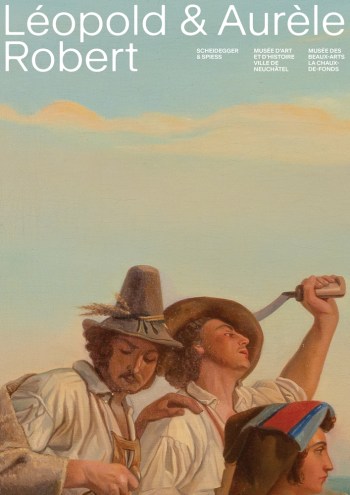 The Neuchâtel artist Léopold Robert (1794–1835), who enjoyed European acclaim during his lifetime, embodies the myth of the Romantic painter, doomed to a tragic fate and shrouded in mystery.
Educated in Paris at the École des Beaux-Arts and later in the studio of Jacques-Louis David, Robert moved to Italy in 1818. His genre paintings brought him great popular success during the first half of the 19th century but were less fulsomely received by the critics. The Musée d’art et d’histoire de Neuchâtel and the Musée des beaux-arts de La Chaux-de-Fonds have joined forces to pay tribute to the work of Léopold Robert and his brother Aurèle (1805–1871). The exhibition also re-examines Aurèle’s role, considering him not only as a ‘disseminator’ of Léopold’s oeuvre, but also as an artist in his own right. The joint exhibition focuses on Léopold Robert’s unfinished Seasons cycle and features works from both institutions as well as several prestigious loans. The exhibition in La Chaux-de-Fonds is given over to ‘Spring’, while Neuchâtel celebrates ‘Summer’ and ‘Winter’. The exhibition also explores how these masterpieces were produced and circulated, and examines their depiction of music, dance, and the beauty ideal. The exhibition is enriched by contributions from artist Gina Proenza that offer a direct, contemporary response to the historical works of Léopold and Aurèle Robert.
The catalogue (in French) is distributed by ACC Art Books:
David Lemaire and Antonia Nessi, eds., Léopold & Aurèle Robert (Scheidegger & Spiess, 2023), 240 pages, ISBN: 978-3858818874, £45.
◊ ◊ ◊ ◊ ◊
Note (added 26 October 2023) — The posting was updated to correct the dates of the exhibition (here originally given as 15 May — 15 October).
Online Conversation | Paris Spies-Gans, A Revolution on Canvas
From the invitation:
Paris Spies-Gans and Martina Droth in Conversation | A Revolution on Canvas: The Rise of Women Artists in Britain and France, 1760–1830
Online, 3 May 2023, 12.00pm (Eastern Daylight Time)

Maria Cosway, The Duchess of Devonshire as Cynthia from Spenser’s ‘Faerie Queene’, 1781–82 oil on canvas (Chatsworth: The Devonshire Collection).
Please join the MA State Committee of the National Museum of Women in the Arts (MA-NMWA) and our sister committees in the UK and France for an exciting virtual event on Wednesday, 3 May 2023. Paris Spies-Gans and Martina Droth will discuss Spies-Gans’ important first book, A Revolution on Canvas: The Rise of Women Artists in Britain and France, 1760–1830.
Just as the National Museum of Women in the Arts founder Wilhelmina Cole Holladay sought to challenge the assumption that there have been ‘no great women artists’ by collecting and publicly exhibiting many indisputably ‘great’ works of artist women, so too has Paris Spies-Gans investigated the same assumption, through evidence-based analysis. Her body of work includes site and time-specific research that reveals how women have found ways to achieve critical and commercial success despite the obstacles they have faced. Both women—Wilhelmina, the collector, and Paris, the scholar—intend their work not as end-points but as part of ongoing discussion and learning. Tracing the activity of more than 1,300 women who exhibited more than 7,000 works of art across genres at premier exhibition venues in London and Paris throughout the Revolutionary era, the book demonstrates that women artists professionalized in significant numbers a century earlier than scholars have previously thought.
Paris Spies-Gans’s scholarship and resultant discoveries complement the mission of the National Museum of Women in the Arts and its committees, three of which are presenting this event. Martina Droth, as interlocutor, will use her expertise to contextualize the material in A Revolution on Canvas: The Rise of Women Artists in Britain and France, 1760–1830. We hope you can join us for what promises to be a fascinating discussion. Although this event is free of charge, advance registration is required; details about the event will then be sent to registered attendees. International guests are invited to use this email to register: contact@ma-nmwa.org.
Paris Spies-Gans is a historian and historian of art with a focus on women, gender, and the politics of artistic expression. She holds a PhD and MA in History from Princeton University, an MA in Art History from the Courtauld Institute of Art, and an AB in History and Literature from Harvard University. Her work prioritizes women artists and their writings, paintings, drawings, sculptures, prints, illuminating how women have navigated sociopolitical barriers to participate in their societies through diverse forms of intellectual and creative expression, even with the obstacles they regularly faced—and especially at moments of political revolution and change. Her first book, A Revolution on Canvas: The Rise of Women Artists in Britain and France, 1760–1830, was published by the Paul Mellon Centre for Studies in British Art in Association with Yale University Press in June 2022. It was named one of the top art books of 2022 by The Art Newspaper and The Conversation and received the American Society for Eighteenth-Century Studies’ Louis A. Gottschalk Prize, Honorable Mention, for an outstanding historical or critical study on the eighteenth century. She is currently working on her second book, A New Story of Art (Doubleday/US and Viking/UK).
Martina Droth is Deputy Director and Chief Curator of the Yale Center for British Art, where she oversees collections, exhibitions, and publications. Her curatorial work and research focus on sculpture and British art. She was the Chair of the Association of Research Institutes in Art History from 2016 to 2022. Current and recent curatorial projects include: Bill Brandt | Henry Moore (Hepworth, Sainsbury Center, and YCBA, 2020–23); Things of Beauty Growing: British Studio Pottery (YCBA and Fitzwilliam Museum, 2017–18); and Sculpture Victorious: Art in an Age of Invention, 1837–1901 (YCBA and Tate Britain, 2014–15). Prior to joining the Center, she was at the Henry Moore Institute in Leeds, where her exhibitions included Taking Shape: Finding Sculpture in the Decorative Arts (HMI and John Paul Getty Museum, 2008–2009) and Bronze: The Power of Life and Death (HMI, 2005). Her forthcoming projects include an exhibition on Hew Locke.
Exhibition | Hogarth’s Britons
Now on view in Derby:
Hogarth’s Britons: Succession, Patriotism, and the Jacobite Rebellion
Derby Museum & Art Gallery, 10 March — 4 June 2023
Curated by Jacqueline Riding and Lucy Bamford
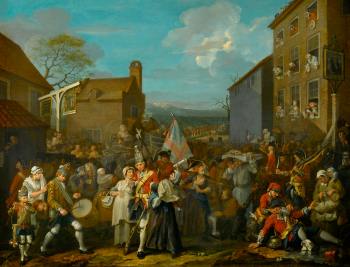
William Hogarth, The March of the Guards to Finchley, 1749–50, oil on canvas (London: The Foundling Museum).
No other artist defines our image of 18th-century Britain quite like William Hogarth. His vibrant narrative paintings, reproduced and circulated widely through print, engaged with some of the most pressing social and political issues of the times. Amongst these was Jacobitism, a campaign to restore the exiled Stuart dynasty to the throne of Great Britain. This exhibition explores Hogarth’s response to this threat, including the last and most serious of all attempts: the Jacobite Rebellion of 1745. Led by Prince Charles Edward Stuart (‘Bonnie Prince Charlie’) with support from France, the Jacobite Army would eventually reach Derby before retreating back north to Scotland and defeat at the Battle of Culloden.
Led by Derby Museums, Hogarth’s Britons has been produced in partnership with the National Gallery and the National Portrait Gallery and is the first exhibition of Hogarth’s works to be staged in Derby. It brings many pieces that have never before been seen in the city, including Hogarth’s masterpiece, The March of the Guards to Finchley (Foundling Museum, London). Others, such as the newly discovered portrait of the Prince by Allan Ramsay (National Galleries of Scotland), will be returning to Derby for the first time since the rebellion of 1745. The exhibition also brings together items from national and private collections, representing local divided loyalties and the experience of life under Jacobite-army occupation.
Hogarth’s Britons: Succession, Patriotism, and the Jacobite Rebellion is co-curated by Jacqueline Riding, acclaimed art historian and author of Jacobites (2016) and Hogarth: Life in Progress (2021); and Lucy Bamford, Senior Curator of Art at Derby Museums.
Jacqueline Riding, Hogarth’s Britons (London: Paul Holberton Publishing, 2023), 120 pages, ISBN: 978-1913645458, £18 / $25.
◊ ◊ ◊ ◊ ◊
Note (added 29 February 2024) — The original posting was updated to include information on the catalogue.
New Book | The Secret Diaries of Charles Ignatius Sancho
From Macmillan:
Paterson Joseph, The Secret Diaries of Charles Ignatius Sancho: A Novel (New York: Henry Holt and Company, 2023), 432 pages, ISBN: 978-1250880376, £17 / $28.
 It’s finally time for Charles Ignatius Sancho to tell his story, one that begins on a slave ship in the Atlantic and ends at the very center of London life. . . . A lush and immersive tale of adventure, artistry, romance, and freedom set in eighteenth-century England and based on a true story
It’s 1746 and Georgian London is not a safe place for a young Black man. Charles Ignatius Sancho must dodge slave catchers and worse, and his main ally—a kindly duke who taught him to write—is dying. Sancho is desperate and utterly alone. So how does the same Charles Ignatius Sancho meet the king, write and play highly acclaimed music, become the first Black person to vote in Britain, and lead the fight to end slavery? Through every moment of this rich, exuberant tale, Sancho forges ahead to see how much he can achieve in one short life: “I had little right to live, born on a slave ship where my parents both died. But I survived, and indeed, you might say I did more.”
Paterson Joseph is an award-winning actor who has been fascinated by Sancho for many years. He wrote and starred in the play Sancho: An Act of Remembrance in 2018, which was staged in the UK as well as the US. A veteran of the stage, TV, and film, Paterson has appeared on The Mosquito Coast, an Apple TV+ original series; Doctor Who; Noughts + Crosses; and other BBC programs. The Secret Diaries of Charles Ignatius Sancho is his first novel.
◊ ◊ ◊ ◊ ◊
Thomas Mallon recently reviewed the book for The New York Times (11 April 2023), observing that
. . . in an author’s note, Joseph explains his desire to present Black English characters “in the form in which I met Oliver Twist, David Copperfield and Jane Eyre.” Entering the realm of fiction, he catches the genre’s particular mood in Sancho’s 18th century. All the sudden shifts in fortune, the deathbeds and legacies, along with the guileful use of what Sancho calls “cheek”: These are elements in the episodic, picaresque adventures of every Tom Jones and Moll Flanders that elbowed a way through the Georgian era. . . .
The full review is available here»
New Book | Flora Macdonald: ‘Pretty Young Rebel’
The Battle of Culloden was fought on this day (16 April) in 1746. From Penguin Random House (I much prefer the British cover, shown here, over the American one. –CH) . . .
Flora Fraser, Flora Macdonald: ‘Pretty Young Rebel’: Her Life and Story (Knopf, 2023), 288 pages, ISBN: 978-0451494382, £25 / $30.
 A captivating biography of the remarkable young Scotswoman whose bold decision to help ‘Bonnie’ Prince Charlie—the Stuart claimant to the British throne—evade capture and flee the country has become the stuff of legend.
After his decisive defeat at the Battle of Culloden in 1746, Prince Charles Edward Stuart was a man on the run. Seeking refuge in the Outer Hebrides, hoping to escape to France, he found an unlikely ally in Flora MacDonald, a young woman in her early twenties, loyal to the Stuarts. Disguising the prince as an Irish maid, petticoats and all, Flora conveyed Charles by boat to Skye, where they lodged safely with her family, until the prince’s inexpert handling of feminine attire caused concern, and he was persuaded to forgo the ruse before fleeing the area undetected. Flora never saw him again.
This famous incident led to Flora’s enduring appeal as a courageous Scottish heroine, inspiring and influencing countless novels, poems, and songs—most notably, the classic ballad “Skye Boat Song” adapted from a traditional tune in the late nineteenth century. But her remarkable life didn’t come to a close with her clandestine mission to Skye. Faced with a confession from one of the boatmen, Flora was arrested and taken to London on charges of treason, where under interrogation, she wittily deflected questions and staunchly defended her motives. She was eventually released under the 1747 Act of Indemnity, but disaster would befall her yet again: in 1774, Flora and her husband, Allan MacDonald, fled the impoverished highlands for a brighter future in Cross Creek, North Carolina—utterly unaware of the burgeoning revolution that would upend their lives there, with Allan imprisoned and Flora fleeing, penniless, back home to the Hebrides.
In this probing, evocative portrait of a tumultuous life, Flora Fraser peels away the layers of misinformation, legend, and myth to reveal Flora MacDonald in full. Fraser presents a fascinating picture of this headstrong and irrepressible woman. As Samuel Johnson declared upon visiting her in Scotland, her name was “a name that will be mentioned in history, and if courage and fidelity be virtues, mentioned with honor.”
Flora Fraser is the author of The Washingtons: George and Martha; Beloved Emma: The Life of Emma, Lady Hamilton; The Unruly Queen: The Life of Queen Caroline; and Princesses: The Six Daughters of George III. She lives in London.
New Book | Beauty and the Brain
On Thursday, 4 May 2023, at 7pm (EST), Rachel Walker will discuss her book at the American Antiquarian Society in Worcester, Massachusetts. The event will be live-streamed via YouTube. Registration is required for both in-person and online attendance.
From The University of Chicago Press:
Rachel Walker, Beauty and the Brain: The Science of Human Nature in Early America (Chicago: The University of Chicago Press, 2022), 288 pages, ISBN: 978-0226822563, $45.
 Examining the history of phrenology and physiognomy, Beauty and the Brain proposes a bold new way of understanding the connection between science, politics, and popular culture in early America.
Between the 1770s and the 1860s, people all across the globe relied on physiognomy and phrenology to evaluate human worth. These once-popular but now discredited disciplines were based on a deceptively simple premise: that facial features or skull shape could reveal a person’s intelligence, character, and personality. In the United States, these were culturally ubiquitous sciences that both elite thinkers and ordinary people used to understand human nature. While the modern world dismisses phrenology and physiognomy as silly and debunked disciplines, Beauty and the Brain shows why they must be taken seriously: they were the intellectual tools that a diverse group of Americans used to debate questions of race, gender, and social justice. While prominent intellectuals and political thinkers invoked these sciences to justify hierarchy, marginalized people and progressive activists deployed them for their own political aims, creatively interpreting human minds and bodies as they fought for racial justice and gender equality. Ultimately, though, physiognomy and phrenology were as dangerous as they were popular. In addition to validating the idea that external beauty was a sign of internal worth, these disciplines often appealed to the very people who were damaged by their prejudicial doctrines. In taking physiognomy and phrenology seriously, Beauty and the Brain recovers a vibrant—if largely forgotten—cultural and intellectual universe, showing how popular sciences shaped some of the greatest political debates of the American past.
Rachel E. Walker is an Assistant Professor at the University of Hartford, where she teaches courses on the history of race, gender, and science in America. Her recent article “Facing Race,” received the Murrin Prize for the best article published in Early American Studies in 2021.
C O N T E N T S
Introduction
1 Founding Faces
2 A New Science of Man
3 Character Detectives
4 The Manly Brow Movement
5 Criminal Minds
6 Facing Race
Conclusion
Acknowledgments
Notes
Bibliography
Index
New Book | The Anglican Episcopate, 1689–1800
Published by the University of Wales and distributed by The University of Chicago Press:
Nigel Aston and William Gibson, eds., The Anglican Episcopate, 1689–1800 (Cardiff: University of Wales Press, 2023), 368 pages, ISBN: 978-1786839763, £70 / $88.
 The eighteenth-century bishops of the Church of England and its sister communions had immense status and authority in both secular and religious society. In this volume, leading experts offer a comprehensive survey of all things episcopal between the ‘Glorious Revolution’ of 1688 and the early nineteenth century, when the Anglican Church enjoyed exclusive establishment privileges in much of Britain. The essays consider the appointment and promotion of bishops, their parliamentary duties, and their relation to Wales, Ireland, Scotland, and the American colonies.
Nigel Aston is a Research Associate at the University of York and Reader Emeritus in the School of History, Politics, and International Relations at the University of Leicester, where he taught for two decades. He is the author of several books and numerous articles on British and French eighteenth-century religious and political history, including the forthcoming book Enlightened Oxford: The University and the Cultural and Political Life of Eighteenth-century Britain and Beyond (Oxford University Press, 2023).
William Gibson is Professor of Ecclesiastical History at Oxford Brookes University and Director of the Oxford Centre for Methodism and Church History. His most recent book is Samuel Wesley and the Crisis of Tory Piety, 1685–1720 (Oxford University Press, 2021).
C O N T E N T S
Introduction — Nigel Aston and William Gibson
The Politics of Church and State
1 Securing the Mitre: The Promotion and Progress of a Bishop — Nigel Aston (University of Leicester)
2 Lord Bishops: The Episcopate in National Politics — Ruth Paley (History of Parliament)
3 Bishops and the Monarchy — Grayson Ditchfield (University of Kent)
Performance
4 Pastors of Their Flock: Visitation, Ordination, Confirmation — Colin Haydon (University of Winchester)
5 Authority, Conflict, and Consensus: Bishops, Their Clergy, and Diocesan Government — William Gibson (Oxford Brookes University)
6 Bishops and Patronage — Daniel Reed (Oxford Brookes University)
Cultures
7 Wives and Families: The Domestic Life of Bishops — Nigel Aston (University of Leicester) and William Gibson (Oxford Brookes University)
8 Bishops and Eighteenth-Century Intellectual Life — Robert Ingram (University of Ohio)
9 Bishops, Taste, and Culture — Matthew Craske (Oxford Brookes University)
Beyond England
10 Episcopacy in Scotland — Rowan Strong (Murdoch University)
11 Anglican Bishops in Wales — John Morgan-Guy (University of Wales: Trinity St David)
12 The Other Establishment: Bishops in the Church of Ireland — Toby Barnard, (University of Oxford)
13 Anglican Bishops, the Wider World, and the Other Christian Churches — Ted Campbell (Southern Methodist University)
Appendix: Episcopal Incomes — Ruth Paley (History of Parliament)










leave a comment