New Book | Intimate Interiors
From Bloomsbury:
Tara Zanardi and Christopher M. S. Johns, eds., Intimate Interiors: Sex, Politics, and Material Culture in the Eighteenth-Century Bedroom and Boudoir (London: Bloomsbury, 2023), 296 pages, ISBN: 978-1350277601, $120.
 A desire for intimacy in domestic spaces—motivated by a growing sense of individualistic expression, an incentive to conceal the labor or enslavement taking place, and an appetite for solace and comfort—led to interiors taking on more specific roles in the eighteenth century. By examining the architectural, visual, and material culture of eighteenth-century spaces, Intimate Interiors foregrounds the interrelated concepts of intimacy, privacy, informality, and sociability in order to show how these ideas played an increasingly integral role in the period’s architectural and material design. Across eleven innovative chapters that explore issues of gender, politics, travel, exoticism, imperialism, sensorial experiences, identity, interiority, and modernity, this volume demonstrates how intimacy was a fundamental goal in the planning of private quarters. In doing so, the political nature of private spaces is uncovered, whilst highlighting the contradictions and complexities of these highly performative ‘private’ interiors. Employing distinct methodological perspectives across various geographical sites, from Turkey to Versailles, Britain to Benin, Intimate Interiors draws as-yet untraced connections between Enlightenment Europe, imperial outposts, and major metropolitan centers across the globe.
The volume is part of the Material Culture of Art and Design series, edited by Michael Yonan.
Tara Zanardi is Associate Professor of Art History at Hunter College, CUNY. She publishes on eighteenth-century Spanish visual and material culture, including “Silver” (Journal18 special issue, 2022), Visual Typologies from the Early Modern to the Contemporary: Local Practices and Global Contexts (co-edited with Lynda Klich, 2018), and Framing Majismo: Art and Royal Identity in Eighteenth-Century Spain (2016). She has received fellowships from NEH, the Metropolitan Museum of Art, the Fulbright Program, and the John Carter Brown Library.
Christopher M. S. Johns was the Norman L. and Roselea J. Goldberg Professor of History of Art at Vanderbilt University in Nashville. He began his teaching career at the University of Virginia in 1985 and rose to the position of endowed chair at Vanderbilt in 2003. A specialist in eighteenth-century Italian art, decorative art, material culture, and architecture, he published widely on the relationship between art, politics, and religion in early modern Italian culture in particular. He was a founding member of the Historians of Eighteenth-Century Art and Architecture. Sadly, Johns passed away in 2022.
C O N T E N T S
List of Contributors
List of Plates
List of Figures
Foreword
Introduction — Tara Zanardi (Hunter College, CUNY) and Christopher M.S. Johns (Vanderbilt University, until 2022)
Part 1: Power, Authority, Agency, Privacy
1 Sex, Lies, and Books: Staging Identity in the Comte d’Artois’s Cabinet Turc — Ashley Bruckbauer (Independent Scholar)
2 Enlightenment Naples Imagines Imperial China: Queen Maria Amalia’s Chinoiserie Boudoir — Christopher M. S. Johns (Vanderbilt University, until 2022)
3 Who Let the Dogs In?: The Hundezimmer in the Amalienburg Palace — Christina Lindeman (University of South Alabama)
4 Material Temptations: Isabel de Farnesio and the Politics of the Bedroom — Tara Zanardi (Hunter College, CUNY)
Part 2: Staging Identity and Performing Sociability
5 A Stage for Wealth and Power in Eighteenth-Century Lima: The Estrado of Doña Rosa Juliana Sánchez de Tagle, First Marchioness of Torre Tagle — Jorge Rivas (Denver Art Museum)
6 An Artist’s Bedrooms: Angelica Kauffman in London and Rome — Wendy Wassyng Roworth (University of Rhode Island)
7 The Mask in the Dressing Room: Cosmetic Discourses and the Masquerade Toilet in Eighteenth-Century British Print Culture — Sandra Gómez Todo (Independent Scholar)
Part 3: Hidden Lives and Interiority
8 Mythologies of the Boudoir: Jacques-Louis David’s The Loves of Paris and Helen — Dorothy Johnson (University of Iowa)
9 Political Interiority and Spatial Seclusion in West African Royal Sleeping Rooms — Katherine Calvin (Kenyon College)
10 On the Wings of Perfumed Reverie: Multisensory Construction of Elsewhere and Elite Female Authority in Marie-Antoinette’s Boudoir Turc — Hyejin Lee (Independent Scholar)
11 ‘Virginian Luxuries’ at Thomas Jefferson’s Monticello — Maurie McInnis (Stony Brook University)
Index
New Book | All Walks of Life
From Arnoldsche:
Vanessa Sigalas and Meredith Chilton, eds., with additional contributions by André van der Goes, Jennifer Mass, and Aaron Shugar, and photography by Melissa Shimmerman, All Walks of Life: A Journey with The Alan Shimmerman Collection, Meissen Porcelain Figures of the Eighteenth Century (Stuttgart: Arnoldsche Art Publishers, 2023), 672 pages, ISBN: 978-3897906419, €68 / £75 / $115.
 All Walks of Life offers a unique opportunity to get to know the eighteenth-century people of Saxony, Paris, London, and St. Petersburg through the Meissen porcelain sculpture of the Alan Shimmerman Collection. Readers will become participants in a tour through Dresden and Meissen with Johann Joachim Kaendler as their guide, with excursions to London, Paris, and St. Petersburg also on the itinerary. Kaendler, along with his fellow modellers and painters at Meissen, captured glimpses of everyday life by paying meticulous attention to the smallest details: the carefully arranged tray of a trinket seller, the personal writing of a love letter, the larding tools of a cook preparing a hare. Whimsical glimpses into the lives of these everyday characters are created by inserting the porcelain figures into their eighteenth-century setting, using period illustrations and engravings as a backdrop.
The outstanding porcelain figures and groups of the Alan Shimmerman Collection form an unrivalled assemblage of the finest creations from one of the most famous porcelain manufactories in the world. The collection, which includes not only the most excellent examples of courtly and commedia dell’arte figures, but also lesser known and under-researched representations of everyday people, presents an aspect of Meissen production missing from many other collections. Alan Shimmerman’s focus on collecting complete series of figures, such as the Criers and Artisans, enables a fresh look at the creation, output, and distribution of Meissen porcelain. The publication includes the first comprehensive large-scale scientific analysis of a major collection of Meissen figures revealing new and unexpected findings.
Vanessa Sigalas is the David W. Dangremond Associate Curator for Collections Research at the Wadsworth Atheneum Museum of Art in Hartford, Connecticut. Her research focuses on European decorative arts, especially German porcelain and ivory. She also serves as the Managing Editor of the American Ceramic Circle Journal.
Meredith Chilton, C.M., is an independent art historian and curator who lives in Warwickshire, UK. She is a specialist in European ceramics of the 1700s, court and theatre history, and food and dining culture. Her publications include Harlequin Unmasked (2001), Fired by Passion (2009), and The King’s Peas (2019).
Melissa Shimmerman is a Toronto-based freelance photographer. Specializing in fine art and in commercial and portrait photography, her work is featured in art publications and catalogues for museums, galleries, and private collectors. Her oeuvre includes photography of art by Pablo Picasso, Marc Chagall, and the collections of the Gardiner Museum in Toronto.
André van der Goes is a former director of the Museum of Applied Arts, Staatliche Kunstsammlungen Dresden, and lecturer of the History of Art at the Technische Universität Dresden. Since 2012 he has been organizing study tours to museums, collections, and palaces in Dresden and other important European cultural cities for Grand Tour Dresden. His publications principally cover the history of material and nonmaterial culture.
Jennifer Mass is the Andrew W. Mellon Professor of Cultural Heritage Science at Bard Graduate Center and the President and Founder of Scientific Analysis of Fine Art. She also leads the scientific vetting committee at TEFAF New York and has co-authored several publications on Meissen porcelain colorants and technologies.
Aaron Shugar is the Andrew W. Mellon Professor of Conservation Science in the Art Conservation Department at Buffalo State College, New York. He received his PhD in Archaeometallurgy from the Institute of Archaeology, University College London. He has published and conducted extensive scientific analysis on a wide range of art and archaeological materials for over twenty years.
New Book | Piranesi@300
From Artemide Edizioni:
Mario Bevilacqua and Clare Hornsby, eds., Piranesi@300 (Rome: Artemide Edizioni, 2023), 296 pages, ISBN: 978-8875754327, €48.
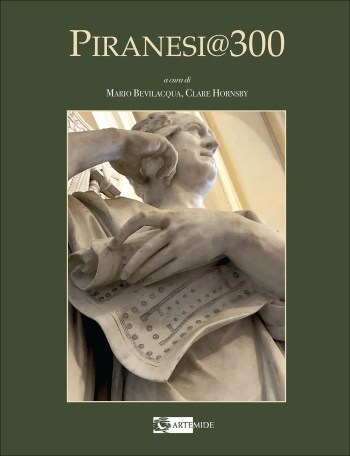 A volume of essays celebrating the 300th anniversary of the birth of Giovanni Battista Piranesi (1720–1778).
Piranesi: printmaker, architect, antiquarian, art theorist, art dealer, and polemicist, passionate in his praise of the greatness of Rome. He was a protagonist in 18th-century European arts and letters, a brilliant artistic innovator, and a controversial and exuberant personality, universally celebrated and admired. The 26 essays in this volume—from a wide range of authors writing in Italian, English, and French—include the contributions to the 2021 conference celebrating the 300th anniversary of his birth, a collaboration between architectural historian Mario Bevilacqua, director of the Centro di Studi sulla Cultura e l’Immagine di Roma, and art historian Clare Hornsby, Research Fellow at the British School at Rome; they are also the editors of this volume published by Artemide Edizioni. The essays represent new research on the artist, on the collecting of his work internationally, and on his profound and long lasting influence in Europe and beyond, from the age of the Grand Tour until now.
C O N T E N T S
Piranesi incisore, architetto, antiquario e teorico
• Ginevra Mariani — Progetto Piranesi: il catalogo generale delle matrici di Piranesi, 2010–2020. Riflessioni e nuovi dati
• Lucia Ghedin — Deduzioni e ipotesi sulla tecnica incisoria di Piranesi
• Giovanna Scaloni — Piranesi riflette su Montano: la genesi della pianta del Campo Marzio
• Maria Grazia D’Amelio, Fabrizio De Cesaris — Giovanni Battista Piranesi e l’architettura pratica
• Paolo Pastres — Fantasia al potere: Piranesi, Algarotti e la lezione di Antonio Conti
• Lola Kantor-Kazovsky — Piranesi’s Invenzioni capric di carceri and the Cartesian concept of dream
• Silvia Gavuzzo-Stewart — La dedica di Piranesi a Lord Charlemont nella tavola II delle Antichità Romane
• Adriàn Fernàndez Almoguera — Rêver le Nil depuis le Tibre: le regard de Piranèse sur la question égyptienne
• Eleonora Pistis — The thinkability of architecture: Piranesi without images
• Heather Hyde Minor — Piranesi’s Epistolic Art
Collezionare Piranesi
• Ebe Antetomaso — Materiali piranesiani nella collezione Corsini: appunti dai bibliotecari
• Georg Schelbert, Charleen Rethmeyer — Piranesi in Prussia: spotlights on a variable relationship
• Gudula Metze — 1720–1778: Giovanni Battista Piranesi and the Kupferstich-Kabinett Dresden
• Delfin Rodríguez Ruiz — Piranesi e la Spagna: rapporti culturali, artistici e architettonici durante l’illuminismo spagnolo
L’influenza di Piranesi: Europa e oltre
• Clare Hornsby — Piranesi’s Ichnographiam Campi Martii Antiquae Urbis: an investigation into its sources and innovations and its influences on the work of Robert Adam
• Valeria Mirra — Dalla fortuna di Giovanni Battista Piranesi in Francia allo stabilimento dei Piranesi frères a Parigi
• Olga Medvedkova — La Dévideuse italienne ou habiter la Ruine
• Aleksander Musiał — Beyond capriccio: Piranesi’s transgressive classicism and its Eastern European receptions
• Mario Bevilacqua — Piranesi in eighteenth-century America
• Angela Rosch Rodrigues — Piranesi at the Brazilian National Library: a trajectory of the ruine parlanti from Rome to Rio de Janeiro
• Helena Perez Gallardo — Sotto il cielo di Parigi: Piranesi negli incisori e fotografi francesi nel 1850
• Hiromasa Kanayama — Piranesi nel Giappone dell’Ottocento: le vicende della collezione Kamei
Piranesi XX–XXI secolo
• Victor Plahte Tschudi — Carceri and Cubism
• Giacomo Pala — Architetto postumo, o il postmoderno e ‘Piranesi’
• Angelo Marletta — Forma Urbis forma Architecturae: Piranesi, Kahn e i frammenti di Roma
• Jeanne Britton, Michael Gavin, Zoe Langer, Jason Porter — The Digital Piranesi
New Book | Mudlark’d: Hidden Histories from the River Thames
Mudlarking depends upon tides, and the Thames is particularly affected by robust tidal churning (as the Seine is not, as noted by Jason Goodwin in a 2019 Country Life essay). From Princeton UP:
Malcolm Russell, Mudlark’d: Hidden Histories from the River Thames (2022), 224 pages, ISBN: 978-0691235783, $35.
 A captivating history of London as told through objects recovered from the muddy banks of the Thames and the lives of the people who owned them.
Mudlark’d combines insights from two hundred rare objects discovered on the foreshore of the River Thames with a wealth of breathtaking illustrations to uncover the hidden histories of ordinary people from prehistory to today. Malcolm Russell tells the stories behind each find, revealing the habits, customs, and artistry of the people who created and used it.
In the eighteenth and nineteenth centuries, London was the busiest port in the world, exchanging goods and ideas with people from every continent. The shores of the Thames have long been densely packed with taverns, brothels, and markets, and the river’s muddy banks are a repository of intriguing and precious objects that evoke long-forgotten ways of life. With Russell as your guide, a bottleneck of a jug is shown to be a talisman to counter the ill effects of witchcraft. Glass beads expose the brutal realities of the transatlantic slave trade. Clay tobacco pipes uncover the lives of Victorian magicians. A scrap of Tudor cloth illuminates the experiences of Dutch and French religious refugees. These are just some of the stories told in Mudlark’d, which also contains a primer, giving advice on how to mudlark on tidal rivers around the world and outlining the tools and equipment you will need.
Malcolm Russell has contributed to publications such as Treasure Hunting, The Searcher, and Beachcombing. A lifelong mudlark, he studied history at the University of Sheffield, where he was recently an honorary research fellow in the Department of History. His remarkable finds were featured in the Thames Festival exhibition Foragers of the Foreshore.
New Book | Enslaved: The Sunken History
From Simon & Schuster:
Sean Kingsley and Simcha Jacobovici, with a preface by Brenda Jones, Enslaved: The Sunken History of the Transatlantic Slave Trade (New York: Pegasus Books, 2023), 336 pages, ISBN: 978-1639362387, $29.
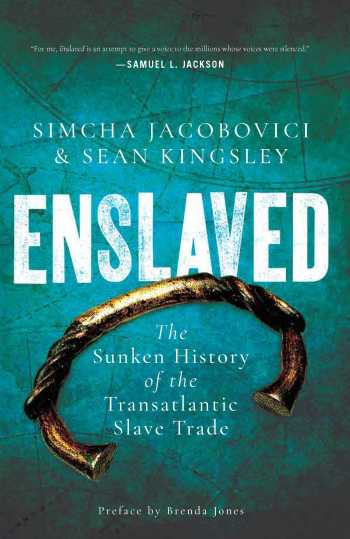 From the writers behind the acclaimed documentary series Enslaved (starring Samuel L. Jackson), comes a rich and revealing narrative of the true global and human scope of the transatlantic slave trade. The trade existed for 400 years, during which 12 million people were trafficked, and 2 million would die en route.
In these pages we meet the remarkable group, Diving with a Purpose (DWP), as they dive sunken slave ships all around the world. They search for remains and artifacts testifying to the millions of kidnapped Africans that were transported to Europe, the Americas, and the Caribbean. From manilla bracelets to shackles, cargo, and other possessions, the finds from these wrecks bring the stories of lost lives back to the surface.
As we follow the men and women of DWP across eleven countries, Jacobovici and Kingsley’s rich research puts the archaeology and history of these wrecks that lost between 1670 to 1858 in vivid context. From the ports of Gold Coast Africa, to the corporate hubs of trading companies of England, Portugal and the Netherlands, and the final destinations in the New World, Jacobovici and Kingsley show how the slave trade touched every nation and every society on earth.
Though global in scope, Enslaved makes history personal as we experience the divers’ sadness, anger, reverence, and awe as they hold tangible pieces of their ancestors’ world in their hands. What those people suffered on board those ships can never be forgiven. Enslaved works to ensure that it will always be remembered and understood, and is the first book to tell the story of the transatlantic slave trade from the bottom of the sea.
Sean Kingsley is a marine archaeologist who has explored over 350 wrecks from Israel to America. Off the UK he identified the world’s earliest Royal African Company English ‘slaver’ ship. Dr. Kingsley writes for National Geographic and is the founder of Wreckwatch Magazine about the world’s sunken wonders.
Simcha Jacobovici is a three-time Emmy winning Israeli/Canadian filmmaker, New York Times bestselling author, and an internationally acclaimed journalist. He is also an adjunct professor in the Department of Religion at Huntington University in Ontario. Jacobovici was Showrunner/Director of the 6-part series Enslaved: The Lost History of the Transatlantic Slave Trade, for which he has received numerous awards including two NAACP Image Award nominations. Enslaved is his fourth book. He divides his time between Toronto and Israel.
New Book | The Odyssey of Phillis Wheatley
From Macmillan:
David Waldstreicher, The Odyssey of Phillis Wheatley: A Poet’s Journeys through American Slavery and Independence (New York: Farrar, Straus and Giroux, 2023), 496 pages, ISBN: 978-0809098248, $30.
A paradigm-shattering biography of Phillis Wheatley, whose extraordinary poetry set African American literature at the heart of the American Revolution.
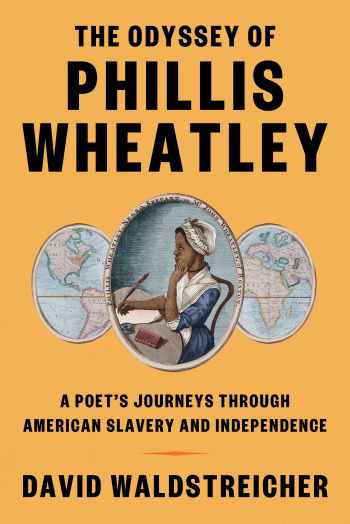 Admired by George Washington, ridiculed by Thomas Jefferson, published in London, and read far and wide, Phillis Wheatley led one of the most extraordinary American lives. Seized in West Africa and forced into slavery as a child, she was sold to a merchant family in Boston, where she became a noted poet at a young age. Mastering the Bible, Greek and Latin translations, and the works of Pope and Milton, she composed elegies for local elites, celebrated political events, praised warriors, and used her verse to variously lampoon, question, and assert the injustice of her enslaved condition. “Can I then but pray / Others may never feel tyrannic sway?” By doing so, she added her voice to a vibrant, multisided conversation about race, slavery, and discontent with British rule; before and after her emancipation, her verses shook up racial etiquette and used familiar forms to create bold new meanings. She demonstrated a complex but crucial fact of the times: that the American Revolution both strengthened and limited Black slavery. In this new biography, the historian David Waldstreicher offers the fullest account to date of Wheatley’s life and works, correcting myths, reconstructing intimate friendships, and deepening our understanding of her verse and the revolutionary era. Throughout The Odyssey of Phillis Wheatley, he demonstrates the continued vitality and resonance of a woman who wrote, in a founding gesture of American literature, “Thy Power, O Liberty, makes strong the weak / And (wond’rous instinct) Ethiopians speak.”
David Waldstreicher teaches history at the City University of New York Graduate Center and is the author of Slavery’s Constitution: From Revolution to Ratification and Runaway America: Benjamin Franklin, Slavery, and the American Revolution. He has written for The New York Times Book Review, Boston Review, and The Atlantic, among other publications.
◊ ◊ ◊ ◊ ◊
From Jennifer Schuessler’s review for The NY Times:
Jennifer Schuessler, “A Fresh Look at a Pioneering Black Voice of Revolutionary America,” The New York Times (2 March 2023). A new biography places the poet Phillis Wheatley in her own time — and in the middle of the current hot debate about the American Revolution and slavery.
. . . Waldstreicher, who teaches at the Graduate Center of the City University of New York, is known for deeply researched, tightly written studies, which aim to complicate any comforting idealization of the founding. . . .
His books (which include a study of Ben Franklin and slavery) and his blunt intellectual style haven’t always made him popular. Some traditionalists in the field, he said tartly, prefer to “pretend I don’t exist.”
Waldstreicher is also a longtime scourge of “Founders’ Chic,” as historians refer to reverential best sellers extolling the character of the founders (often by exaggerating their opposition to slavery). But his new book, published by Farrar, Straus and Giroux, is itself a founder biography of sorts, treating Wheatley not only as the progenitor of the African American literary tradition but an important political voice in the creation of the nation itself. . . .
New Book | Scripts of Blackness
From Penn Press—and see Ellen Welch’s recent review for Journal18 . . .
Noémie Ndiaye, Scripts of Blackness: Early Modern Performance Culture and the Making of Race (Philadelphia: University of Pennsylvania Press, 2022), 376 pages, ISBN: 978-1512822632, $65. RaceB4Race: Critical Race Studies of the Premodern series
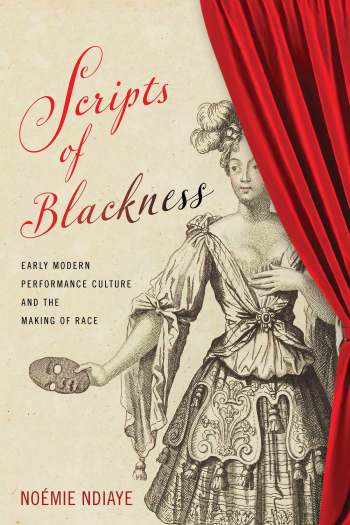 Scripts of Blackness shows how the early modern mass media of theatre and performance culture at-large helped turn blackness into a racial category, that is, into a type of difference justifying emerging social hierarchies and power relations in a new world order driven by colonialism and capitalism. Noemie Ndiaye explores the techniques of impersonation used by white performers to represent Afro-diasporic people in England, France, and Spain in the sixteenth and seventeenth centuries, using a comparative and transnational framework. She reconstructs three specific performance techniques―black-up (cosmetic blackness), blackspeak (acoustic blackness), and black dances (kinetic blackness)―in order to map out the poetics of those techniques, and track a number of metaphorical strains that early modern playtexts regularly associated with them. Those metaphorical strains, the titular scripts of blackness of this book, operated across national borders and constituted resources, as they provided spectators and participants with new ways of thinking about the Afro-diasporic people who lived or could/would ultimately live in their midst. Those scripts were often gendered and hinged on notions of demonization, exclusion, exploitation, animalization, commodification, sexualization, consensual enslavement, misogynoir, infantilization, and evocative association with other racialized minorities. Scripts of Blackness attempts to grasp the stories that Western Europeans told themselves through performative blackness, and the effects of those fictions on early modern Afro-diasporic subjects.
Noémie Ndiaye is Assistant Professor of English at the University of Chicago.
C O N T E N T S
Introduction: Performative Blackness in Early Modern Europe
1 A Brief History of Baroque Black-Up: Cosmetic Blackness and Religion
2 A Brief History of Baroque Black-Up: Cosmetic Blackness, Gender, and Sexuality
3 Blackspeak: Acoustic Blackness and Accents of Race
4 Black Moves: Race, Dance, and Power
Post-Script: Ecologies of Racial Performance
Appendix: Selection of Early Modern Plays Featuring Black Characters
Notes
Bibliography
Index
Acknowledgments
New Book | Boundaries of Belonging
From Penn Press:
April Lee Hatfield, Boundaries of Belonging: English Jamaica and the Spanish Caribbean, 1655–1715 (Philadelphia: University of Pennsylvania Press, 2023), 320 pages, ISBN: 978-1512824018, $45.
 In the decades following England’s 1655 conquest of Spanish Jamaica, the western Caribbean became the site of overlapping and competing claims—to land, maritime spaces, and people. English Jamaica, located in the midst of Spanish American port towns and shipping lanes, was central to numerous projects of varying legality, aimed at acquiring Spanish American wealth. Those projects were backdrop to a wide-ranging movement of people who made their own claims to political membership in developing colonial societies, and by extension, in Atlantic empires.
Boundaries of Belonging follows the stories of these individuals—licensed traders, smugglers, freedom seekers, religious refugees, pirates, and interlopers—who moved through the contested spaces of the western Caribbean. Though some were English and Spanish, many others were Sephardic, Tule, French, Kalabari, Scottish, Dutch, or Brandenberg. They also included creole people who identified themselves by their local place of origin or residence–as Jamaican, Cuban, or Panamanian.
As they crossed into and out of rival imperial jurisdictions, many either sought or rejected Spanish or English subjecthood, citing their place of birth, their nation or ethnicity, their religion, their loyalty, or their economic or military contributions to colony or empire. Colonial and metropolitan officials weighed those claims as they tried to impose sovereignty over diverse and mobile people in a region of disputed and shifting jurisdictions. These contests over who belonged in what empire and why, and over what protections such belonging conferred, in turn helped to determine who would be included within a developing law of nations.
April Lee Hatfield is Associate Professor of History at Texas A&M University and author of Atlantic Virginia: Intercolonial Relations in the Seventeenth Century, also available from the University of Pennsylvania Press.
C O N T E N T S
List of Maps
Introduction ‘In the Midst of the Spaniards’
1 ‘The Lawless Motions of Privateers’
2 ‘A Mungrel Breek of Spaniards’
3 ‘Free Negroes Must Not Be Sold’
4 ‘Amongst the White and Civilized People of the World’
5 ‘Our Holy Catholic Faith and the Asiento’
6 ‘The Trading World’
7 ‘In the Hands of Creolians’
Conclusion: ‘The Law of Nations’
Notes
Index
Acknowledgments
Symposium | Spain and the Hispanic World

Giovanni Vespucci, World Map, 1526, ink and colour on four sheets of parchment, 85 × 262 cm
(New York: The Hispanic Society of America)
◊ ◊ ◊ ◊ ◊
This week at the RA, in connection with the exhibition Spain and the Hispanic World, on view until 10 April 2023:
Spain and the Hispanic World Symposium: Cross-Cultural Exchanges
Royal Academy of Arts, London, 24 March 2023
The Royal Academy of Arts will host an academic symposium exploring the global exchange of Spanish art and culture—from the Islamic legacy of Al-Andalus to the transatlantic connections between Spain and Latin America. This interdisciplinary symposium, timed to coincide with our exhibition of treasures from the Hispanic Society Museum & Library, explores current academic perspectives on the histories of cultural exchange surrounding the Spanish and Latin American worlds.
We begin by considering material cultures through the movement of objects, tracing global exchange in the contexts of empire and colonialism. We move on to consider global imperialism through the lens of faith, studying religious art and objects. From the society of Al-Andalus to the history of Spanish Catholicism in Mexico, we look beyond the export of Spanish culture, to the influences and exchanges that were simultaneously being brought back into Iberia. Finally, we explore the legacies of Spanish art and literature in Latin America, investigating the layers of cultural difference caused by colonialism, as well as using a materials-based approach to investigate how these layers appear in objects and artworks. The symposium concludes with an artist in-conversation with Ana Maria Pachecho, exploring how the themes and ideas discussed throughout the day are still relevant to contemporary artist practice.
This intensive one-day symposium is a key moment in driving forward conversations and discussions on the art of the Latin world and is open to scholars, enthusiasts, and anyone wanting to know more about this groundbreaking exhibition. Ticket fees (£45 / £15) include exclusive early-morning access to the RA’s exhibition Spain and the Hispanic World starting at 8:30am and a drinks reception at 6:00pm.
This will be the first iteration of an annual symposium made possible by the Armando Garza-Sada Sr. Endowment for the Arts.
S P E A K E R S
Andrew M. Beresford is Professor of Medieval and Renaissance Studies at the University of Durham, and has published widely on Iberian art and literature, focusing principally on the cults of the saints and the signifying potential of the human body. His most recent book (2020) offered a study of the flaying of St Bartholomew.
Caroline Egan is Assistant Professor of Colonial Latin American Literature in the Department of Spanish and Portuguese at Northwestern University. Her research examines the portrayal of Indigenous languages in the sixteenth and seventeenth centuries, focusing especially on works composed in and about Nahuatl, Quechua, and Tupi and their circulation in the transatlantic world. Dr Egan has published in the Bulletin of Hispanic Studies, Hispanic Review, and Latin American Literature in Transition Pre-1492-1800, edited by Rocío Quispe-Agnoli and Amber Brian (Cambridge University Press).
Akemi Luisa Herráez Vossbrink is a Researcher at Nicolás Cortés Gallery in Madrid, an Old Master gallery focusing on Spanish, Italian, and Latin American art from the fifteenth century to the early twentieth century. She has been the Enriqueta Harris Frankfort Curatorial Fellow at the Wallace Collection, as well as a curatorial fellow at the National Gallery and the Meadows Museum. Her doctoral thesis at Cambridge focused on Spanish seventeenth-century artist Francisco de Zurbarán and his reception in the Americas.
Claudia Hopkins is Director of the Zurbarán Centre for Spanish and Latin American Art at Durham University, and Associate Editor of the Getty-funded journal Art in Translation. She has published widely on nineteenth- and twentieth-century Spanish art and curated the exhibition La España romántica. David Roberts y Genaro Pérez Villaamil (Real Academia de Bellas Artes de San Fernando, Madrid, 2021–22). Her forthcoming book discusses Spanish art in relation to attitudes to al-Andalus and Morocco (from Romantic liberalism in the 1830s, to colonial discourse before Moroccan independence in 1956).
IIona Katzew is Curator and Department Head of Latin American Art at the Los Angeles County Museum of Art (LACMA). Her most recent exhibition Archive of the World: Art and Imagination in Spanish America, 1500–1800 (2022) foregrounds the museum’s notable holdings of viceregal art. She was project director and co-curator of Painted in Mexico, 1700–1790: Pinxit Mexici (2017–18), which travelled to the Metropolitan Museum of Art and Fomento Cultural Banamex, Mexico City. She holds fellowships from the Metropolitan Museum of Art, the Getty, and Fulbright. In 2018 she was selected by Artsy as one of the top 20 international curators taking a cutting-edge approach to art history.
Emmanuel Ortega is the Marilynn Thoma Scholar and Assistant Professor in Art of the Spanish Americas at the University of Illinois at Chicago, and a Scholar in Residence at the Newberry Library for 2022–23. Ortega has lectured internationally on images of autos-de-fe, nineteenth-century Mexican landscape painting, and visual representations of the New Mexico Pueblo peoples in Novohispanic Franciscan martyr paintings. Ortega has curated the exhibition Contemporary Ex-Votos: Devotion Beyond Medium, at the New Mexico State University Art Museum.
Adjoa Osei is a Research Fellow at Trinity College, University of Cambridge. She is a cultural historian whose research explores themes that are at the intersection of Performing Arts, Afro-Latin American Studies, and Francophone Studies. Her PhD, from the University of Liverpool, was in Latin American Studies, and her MPhil, from the University of Oxford, was in Portuguese Studies. Her research has been published in journals including Atlantic Studies and the Journal of Romance Studies, and she is a BBC New Generation Thinker.
Gabriela Siracusano is Scientific Researcher at CONICET (National Research Council, Argentina) and Director of the Centro MATERIA at the Universidad Nacional de Tres de Febrero (UNTREF), as well as Chair Professor at the Universidad de Buenos Aires. She has been a Guggenheim Fellow and a Getty Scholar, and has authored books including Pigments and Power in the Andes (London, Archetype, 2011) and Materia Americana (2020) (in co-edition with Agustina R. Romero). She received the 2022 Gratia Artis Award by the National Academy of Fine Arts.
Lucy West is Assistant Curator at Dulwich Picture Gallery, where her focus is on the Spanish and Italian paintings. She was previously Assistant Curator of Paintings at the Royal Collection Trust, London, and has worked across curatorial departments at the Ferens Art Gallery, Hull; the National Gallery, London; and Compton Verney, Warwickshire. Lucy is also completing an AHRC-funded PhD with the National Gallery, the Bowes Museum, and Leeds University, interrogating the roles of art dealers and agents in the market for Old Master paintings in nineteenth-century Britain.
Ana Maria Pachecho is a Brazilian artist who has lived in England since 1973. Pacheco is best known for her dramatic polychrome wooden sculptures. Her work draws upon the rich diversity of Latin American culture with echoes of African art, a reminder of the slave trade’s links with Brazil. She was the National Gallery’s Associate Artist between 1997 and 2000, when she produced the monumental multi-figured sculpture Dark Night of the Soul, inspired by the work of the sixteenth-century Spanish mystic, Saint John of the Cross. Her work has been shown in Cathedrals at Chichester, Norwich, and Salisbury, and most recently at the Galway International Arts Festival in 2022.
Colin Wiggins was Head of Education and Special Projects Curator at the National Gallery. He was responsible for the Associate Artist scheme and worked with artists such as Paula Rego, Peter Blake, and Michael Landy.
New Book | The Art of Witnessing
From the University of Toronto Press:
Michael Iarocci, The Art of Witnessing: Francisco de Goya’s Disasters of War (Toronto: University of Toronto Press, 2022), 296 pages, ISBN: 978-1487543785, $90 / ISBN: 978-1487545277, $35.
 Widely acknowledged as a major turning point in the history of visual depictions of war, Francisco de Goya’s renowned print series The Disasters of War remains a touchstone for serious engagement with the violence of war and the questions raised by its artistic representation. The Art of Witnessing provides a new account of Goya’s print series by taking readers through the forty-seven prints he dedicated to the violence of war. Drawing on facets of Goya’s artistry rarely considered together before, the book challenges the notion that documentary realism and historical testimony were his primary aims. Michael Iarocci argues that while the depiction of war’s atrocities was central to Goya’s project, the lasting power of the print series stems from the artist’s complex moral and aesthetic meditations on the subject. Making novel contributions to longstanding debates about historical memory, testimony, and the representation of violence, The Art of Witnessing tells a new story, print by print, to highlight the ways in which Goya’s masterpiece extends far beyond conventional understandings of visual testimony.
Michael Iarocci is a professor of Spanish Literature and Culture at the University of California, Berkeley.
C O N T E N T S
Preface
Introduction
1 Tristes presentimientos de lo que ha de acontecer
2 Con razón o sin ella
3 Lo mismo
4 Las mujeres dan valor
5 Y son fieras
6 Bien te se está
7 Qué valor!
8 Siempre sucede
9 No quieren
10 Tampoco
11 Ni por ésas
12 Para eso habéis nacido
13 Amarga presencia
14 Duro es el paso!
15 Y no hay remedio
16 Se aprovechan
17 No se convienen
18 Enterrar y callar
19 Ya no hay tiempo
20 Curarlos y a otra
21 Será lo mismo
22 Tanto y más
23 Lo mismo en todas partes
24 Aún podrán servir
25 También éstos
26 No se puede mirar
27 Caridad
28 Populacho
29 Lo merrecía
30 Estragos de la guerra
31 Fuerte cosa es
32 Por qué?
33 Qué hay que hacer más?
34 Por una navaja
35 No se puede saber por qué
36 Tampoco
37 Esto es peor
38 Bárbaros!
39 Grande hazaña! Con muertos!
40 Algún partido saca
41 Escapan entre llamas
42 Todo va revuelto
43 Tambien esto
44 Yo lo vi
45 Y esto también
46 Esto es malo
47 Así sucedió
Afterword
Notes
Bibliography










leave a comment