New Book | Looking for Longitude
From Liverpool UP:
Katy Barrett, Looking for Longitude: A Cultural History (Liverpool: Liverpool University Press, 2022), 304 pages, ISBN: 978-1802070538, £76 / $130.
 Why make a joke out of a niche and complex scientific problem? That is the question at the heart of this book, which unearths the rich and surprising history of trying to find longitude at sea in the eighteenth century. Not simply a history on water, this is the story of longitude on paper, of the discussions, satires, diagrams, engravings, novels, plays, poems, and social anxieties that shaped how people understood longitude in William Hogarth’s London. We start from a figure in one of Hogarth’s prints—a lunatic incarcerated in the madhouse of A Rake’s Progress in 1735—to unpick the visual, mental, and social concerns which entwined around the national concern to find a solution to longitude. Why does longitude appear in novels, smutty stories, political critiques, copyright cases, religious tracts, and dictionaries as much as in government papers? This sheds new light on the first government scientific funding body—the Board of Longitude—established to administer vast reward money for anyone who found a means of accurately measuring longitude at sea. Meet the cast of characters involved in the search for longitude, from famous novelists and artists, to almost unknown pamphleteers and inventors, and see how their interactions informed the fate of longitude’s most famous pursuer, the clockmaker John Harrison.
Dr Katy Barrett is an interdisciplinary curator, scholar, and writer focusing on interactions between art and science. Currently she works as Deputy Curator of Art and Head of Interpretation at the Houses of Parliament. She has previously worked as Curator of Art Collections at the Science Museum, London; Curator of Art, pre-1800, at Royal Museums Greenwich; and has held various posts in national and university museums. She has higher degrees in History of Art and History of Science and is active on social media as @SpoonsonTrays.
Call for Articles | Gastronomic Criticism
From the Appel à contribution:
La critique gastronomique : histoire, rhétorique, valeurs, institutions
Edited by Julia Csergo and Frédérique Desbuissons
Proposals due by 15 February 2023, with full texts due by 15 January 2024
Il s’agit de produire un volume de synthèse (reader) qui analyse, dans une perspective tant historique que contemporaine, le phénomène de la critique gastronomique : son émergence, ses relations avec la critique s’exerçant dans les autres domaines de la création, en s’attachant à ses fonctions, ses formes et sa rhétorique, aux valeurs qui la structurent, aux institutions, media et instances qui la légitiment, et à l’économie dans laquelle elle s’inscrit.
Plutôt qu’une approche monographique des figures célèbres de la gastronomie, nous aborderons la question à partir d’une grille d’analyse organisée selon les thématiques suivantes :
1. L’émergence du phénomène de la critique gastronomique : généralement datée du tournant des XVIIIe et XIXe siècles, en lien avec l’essor des commerces de bouche, puis des restaurants, elle connaît des développements inédits et des métamorphoses au cours des XXe et XXIe siècles. Ce chapitre vise à mieux définir sur cette période les quatre fonctions principales de la critique — informer, instruire, juger, promouvoir — telles qu’elles sont perceptibles dans le domaine spécifique de la gastronomie. L’objectif est de souligner ses liens avec la critique s’exerçant dans les autres domaines de la création, sa spécialisation et sa professionnalisation.
2. Les formes et les rhétoriques : ce chapitre portera sur les discours produits à travers la littérature, la philosophie, l’érudition, la chronique, le billet, etc. Il scrutera les postures auctoriales — qui parle ? de quel point de vue ? — autant qu’il interrogera l’existence d’éventuels mouvements ou styles à partir desquels les autres formes de critique ont pu structurer leurs propos. Il abordera aussi la place qu’y occupent les illustrations, la façon dont celles-ci contribuent aux fonctions dévolues à la critique afin de s’écarter du logocentrisme souvent associé à la gastronomie.
3. Les valeurs qui structurent la production et la diffusion de la critique : à partir de quels critères ou indicateurs — esthétiques, éthiques, sociaux, économiques, politiques — s’opèrent les jugements de goût, et plus largement les évaluations particulières ? Sont-elles toujours explicitées et justifiés ? Les valeurs généralement reconnues à l’art constituent-elles une grille d’analyse pertinente pour la critique gastronomique ? Qu’en est-il de l’indépendance dont elle revendique les vertus ? Entre mise en ordre et représentation du « bien manger » seront abordées les questions de genre, d’identité et de pouvoirs.
4. Institutions critiques : ce chapitre vise à analyser le rôle des clubs, sociétés, réseaux, médias dans la légitimation de la critique gastronomique. Le rôle des palmarès, ainsi que des transformations induites par les nouvelles technologies, réseaux sociaux, influenceurs, etc.
Les articles proposés, rédigés en français, devront contenir une part inédite de recherche, d’hypothèses ou de mises à jour ; ils ne sauraient reprendre la totalité d’un article déjà paru. La taille des articles sera d’environ 35 000 signes, notes comprises. Propositions et articles seront adressés conjointement à : csergo.julia@uqam.ca / frederique.desbuissons@univ-reims.fr
Calendrier
Soumission des propositions accompagnées d’une notice bio-bibliographique : 15 février 2023
Sélection des propositions par le Comité scientifique : 15 mars 2023
Remise des textes par les auteur·e·s pour double évaluation : 15 janvier 2024
Retours aux auteur·e·s : 15 mars 2024
Remise des textes définitifs : 30 juin 2024 Sortie du volume : automne 2024
Éditeur
Menu Fretin, Chartres
Éditrices
Julia Csergo (université du Québec à Montréal / Chaire de recherche du Canada en patrimoine urbain)
Frédérique Desbuissons (université de Reims Champagne-Ardenne / HiCSA)
Comité scientifique
Matthieu Aussudre (historien et critique indépendant, Paris)
Benedict Beaugé (auteur gastronomique, Paris)
Michael Garval (North Carolina State University, Raleigh)
Bertrand Marqueur (université de Strasbourg)
Catherine Méneux (université Paris 1 Panthéon-Sorbonne)
Laure Ménétrier (musée du vin de Champagne et d’Archéologie d’Épernay) Sidonie Naulin (Sciences Po Grenoble)
Denis Saillard (université Versailles Saint-Quentin-en-Yvelines)
New Book | Heritage
Available from Blackwell’s:
James Stourton, Heritage: A History of How We Conserve Our Past (London: Apollo, 2022), 496 pages, ISBN: 978-1838933166, £40.
 Heritage is all around us: millions belong to its organisations, tens of thousands volunteer for it, and politicians pay lip service to it. When the Victorians began to employ the term in something approaching the modern sense, they applied it to cathedrals, castles, villages, and certain landscapes. Since then a multiplicity of heritage labels have arisen, cultural and commercial, tangible and intangible—for just as every era has its notion of heritage, so does every social group, and every generation. In Heritage, James Stourton focuses on elements of our cultural and natural environment that have been deliberately preserved: the British countryside and national parks, buildings such as Blenheim Palace and Tattersall Castle, and the works of art inside them. He charts two heroic periods of conservation—the 1880s and the 1960s—and considers whether threats of wealth, rampant development, and complacency are similar in the present day. Heritage is both a story of crisis and profound change in public perception, and one of hope and regeneration.
James Stourton is a British art historian, a former Chairman of Sotheby’s UK, and the author of Great Houses of London, British Embassies, and the authorized biography of Kenneth Clark. Stourton frequently lectures for Cambridge University History of Art Faculty, Sotheby’s Institute of Education, and The Art Fund. In addition, he is a senior fellow of the Institute of Historical Research, and he sits on the Heritage Memorial Fund, a government panel that decides what constitutes heritage and thus what should be saved for the nation.
C O N T E N T S
Preface
Introduction
1 The First Threats
2 The Search for Arcadia
3 Assembling a National Collection
4 The Exodus of Paintings
5 Brave New World
6 Birmingham and Anti-Heritage
7 The Backlash: The Heroic Period of Conservation
8 Rescuing a City: York
9 The Sack of Bath
10 The Archaeologists
11 Beyond the Town
12 The Fall and Rise of Country Houses
13 The Enthusiasts: Canals and Railways
14 Regeneration: Mills, Housing, and Power Stations
15 Regeneration: Cities, Docklands, and Basins
16 Liverpool Story
17 Margate Sands
18 The Heritage Industry and the Lottery
19 Churches
20 Museums
21 Heritage: An Unfinished History
Acknowledgments
Endnotes
Select Bibliography
New Book | Portraits of Resistance
From Yale UP:
Jennifer Van Horn, Portraits of Resistance: Activating Art during Slavery (New Haven: Yale University Press, 2022), 344 pages, ISBN: 978-0300257632, $60.
 A highly original history of American portraiture that places the experiences of enslaved people at its center
This timely and eloquent book tells a new history of American art: how enslaved people mobilized portraiture for acts of defiance. Revisiting the origins of portrait painting in the United States, Jennifer Van Horn reveals how mythologies of whiteness and of nation building erased the aesthetic production of enslaved Americans of African descent and obscured the portrait’s importance as a site of resistance. Moving from the wharves of colonial Rhode Island to antebellum Louisiana plantations to South Carolina townhouses during the Civil War, the book illuminates how enslaved people’s relationships with portraits also shaped the trajectory of African American art post-emancipation. Van Horn asserts that Black creativity, subjecthood, viewership, and iconoclasm constituted instances of everyday rebellion against systemic oppression. Portraits of Resistance is not only a significant intervention in the fields of American art and history but also an important contribution to the reexamination of racial constructs on which American culture was built.
Jennifer Van Horn is associate professor of art history and history at the University of Delaware.
C O N T E N T S
Acknowledgments
Introduction: Neptune Thurston’s Portraits
1 Making Portraits
2 Fleeting Portraits
3 Haunted Portraits
4 Viewing Portraits
5 Destroying Portraits
Epilogue: Archibald Motley’s Portraits
Notes
Illustration Credit
Index
New Book | Adam Smith’s America
From Princeton UP:
Glory Liu, Adam Smith’s America: How a Scottish Philosopher Became an Icon of American Capitalism (Princeton: Princeton University Press, 2023), 384 pages, ISBN: 978-0691203812, £30 / $35.
 The unlikely story of how Americans canonized Adam Smith as the patron saint of free markets
Originally published in 1776, Adam Smith’s The Wealth of Nations was lauded by America’s founders as a landmark work of Enlightenment thinking about national wealth, statecraft, and moral virtue. Today, Smith is one of the most influential icons of economic thought in America. Glory Liu traces how generations of Americans have read, reinterpreted, and weaponized Smith’s ideas, revealing how his popular image as a champion of American-style capitalism and free markets is a historical invention.
Drawing on a trove of illuminating archival materials, Liu tells the story of how an unassuming Scottish philosopher captured the American imagination and played a leading role in shaping American economic and political ideas. She shows how Smith became known as the father of political economy in the nineteenth century and was firmly associated with free trade, and how, in the aftermath of the Great Depression, the Chicago School of Economics transformed him into the preeminent theorist of self-interest and the miracle of free markets. Liu explores how a new generation of political theorists and public intellectuals has sought to recover Smith’s original intentions and restore his reputation as a moral philosopher.
Charting the enduring fascination that this humble philosopher from Scotland has held for American readers over more than two centuries, Adam Smith’s America shows how Smith continues to be a vehicle for articulating perennial moral and political anxieties about modern capitalism.
Glory M. Liu is a college fellow in social studies at Harvard University. Her work has appeared in publications such as Modern Intellectual History, The Washington Post, and Aeon.
New Book | Adam Smith Reconsidered
From Princeton UP:
Paul Sagar, Adam Smith Reconsidered: History, Liberty, and the Foundations of Modern Politics (Princeton: Princeton University Press, 2022), 248 pages, ISBN: 978-0691210834, £28 / $35.
 Adam Smith has long been recognized as the father of modern economics. More recently, scholars have emphasized his standing as a moral philosopher—one who was prepared to critique markets as well as to praise them. But Smith’s contributions to political theory are still underappreciated and relatively neglected. In this bold, revisionary book, Paul Sagar argues that not only have the fundamentals of Smith’s political thought been widely misunderstood, but that once we understand them correctly, our estimations of Smith as economist and as moral philosopher must radically change.
Rather than seeing Smith either as the prophet of the free market, or as a moralist who thought the dangers of commerce lay primarily in the corrupting effects of trade, Sagar shows why Smith is more thoroughly a political thinker who made major contributions to the history of political thought. Smith, Sagar argues, saw war, not commerce, as the engine of political change and he was centrally concerned with the political, not moral, dimensions of—and threats to—commercial societies. In this light, the true contours and power of Smith’s foundational contributions to western political thought emerge as never before.
Offering major reinterpretations of Smith’s political, moral, and economic ideas, Adam Smith Reconsidered seeks to revolutionize how he is understood. In doing so, it recovers Smith’s original way of doing political theory, one rooted in the importance of history and the necessity of maintaining a realist sensibility, and from which we still have much to learn.
Paul Sagar is senior lecturer in political theory at King’s College London and the author of The Opinion of Mankind: Sociability and the Theory of the State from Hobbes to Smith (Princeton).
Exhibition | A Japanese Bestiary
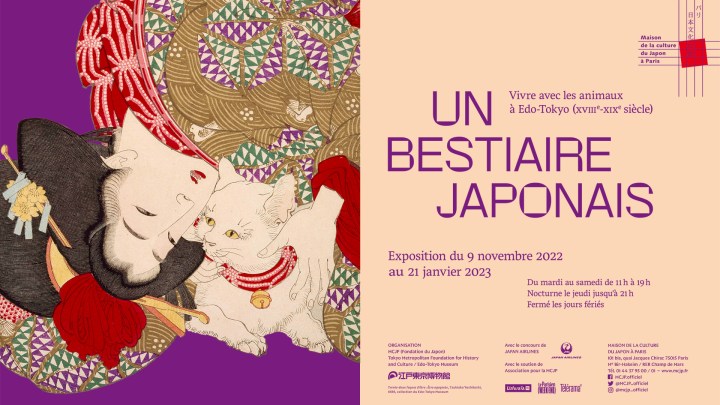
Co-organized with the Edo-Tokyo Museum, this exhibition brings together more than a hundred ukiyo-e prints, paintings, and everyday objects to explore the relationship between humans and animals in Japan during the eighteenth and nineteenth centuries.
Un bestiaire japonais: Vivre avec les animaux à Edo-Tokyo, XVIIIe–XIXe siècle
Maison de la culture du Japon, Paris, 9 November 2022 — 21 January 2023
La gentillesse avec laquelle les Japonais traitent les animaux surprend les premiers Occidentaux qui se rendent dans l’archipel. Les liens entre les humains et le monde animal sont cependant plus complexes comme en témoigne une remarquable réplique d’une paire de paravents de 1634 représentant un panorama détaillé d’Edo et de ses faubourgs. Outre des scènes avec le shogun poursuivant cerfs et sangliers, ou chassant au faucon, on y remarque des montreurs de singes, des chiens errants, des bœufs de labour, des chevaux sacrés…
Dans la section suivante sont présentés les différents rôles des animaux, en lien avec la vie de la noblesse guerrière, des paysans et des commerçants. L’établissement d’Edo comme capitale des guerriers explique une forte présence de chevaux militaires dans les premiers temps. Avec la paix durable, le nombre de chevaux de trait, soutien de la vie citadine, se met à croître. Les bœufs sont utilisés pour le transport des marchandises à Edo ainsi que pour le labour dans les zones rurales à l’extérieur de la ville. Les activités culturelles connaissent un essor important et on s’entoure volontiers d’animaux de compagnie : petits chiens et chats, rossignols et cailles, poissons rouges, ou encore grillons et criquets dont on apprécie le chant. Nombre d’estampes et d’ouvrages sur la façon de s’en occuper sont publiés.
Dans les zones périphériques d’Edo où vit une abondante faune sauvage, la noblesse guerrière pratique régulièrement la chasse. On chasse au faucon des grues, des oies et des canards. Organisées par le shogun, les grandes chasses au cerf visent les cervidés, sangliers, lièvres et faisans. Certains animaux sauvages sont associés à des croyances religieuses, tel le renard, connu pour être le messager d’Inari, dieu des moissons. Les habitants d’Edo, ville riche en collines, rivières, et ouverte sur la mer, vivent profondément en lien avec la nature.La vie des animaux sauvages est un élément familier, étroitement lié aux croyances religieuses et aux rites saisonniers.
À partir du début du XVIIe siècle, Edo s’urbanise rapidement et la population devient friande de nouvelles attractions. Des animaux rares, notamment les paons et perroquets provenant de Chine ou de Hollande, sont exposés dans des lieux spécifiques, ancêtres des zoos, avec des boutiques proposant nourriture et boissons. Très vite, la mode des animaux exotiques connaît un boom sans précédent. Avec l’entrée dans l’ère Meiji (1868–1912), période de modernisation et d’ouverture à l’Occident, le Japon construit des installations sur le modèle occidental, tels que zoos et hippodromes.
À l’époque Edo, la puissance financière nouvelle de la classe commerçante stimule la naissance d’une véritable culture citadine et le raffinement des objets du quotidien: les motifs décoratifs représentant des animaux évoluent vers une plus grande liberté de conception et des variations plus riches. Vers la fin du XIXe siècle, la symbolique des motifs animaliers commence à s’estomper et l’accent est mis de plus en plus sur le côté «kawaii» des animaux de compagnie.
New Book | Buddhist Art of Tibet: In Milarepa’s Footsteps
With postings, I typically aim for editorial invisibility, allowing the marketing materials of an exhibition or book to do the talking. In this case, however, I would also point readers to Erin Thompson’s review “Sex Tourism with Statues: Buddhist Art of Tibet: In Milarepa’s Footsteps Is a Cringe-worthy Display of ‘Spiritual Colonialism’,” Hyperallergic (3 January 2023). As an associate professor of art crime at John Jay College of Criminal Justice (CUNY), Thompson holds a JD from Columbia Law School and a PhD in art history from Columbia University (both 2010). Lots of interesting questions about lots of things; I can imagine using the review in class next time I teach my introduction to Chinese art. –CH
From Rizzoli:
Etienne Bock, Jean-Marc Falcombello, and Magali Jenny, Buddhist Art of Tibet: In Milarepa’s Footsteps, Symbolism and Spirituality (Paris: Flammarion, 2022), 288 pages, ISBN: 978-2080280947, $50.
 Fascinated by Buddhist art and Asian spirituality, Alain Bordier has spent more than forty years building a unique collection of religious objects from the Himalayas (Tibet, Nepal, and Bhutan). On display today at the Tibet Museum in the heart of the medieval city of Gruyères, Switzerland, some six hundred works offer visitors the rare opportunity to discover an endangered world heritage. This volume presents a general historic and artistic framework of Tibetan art through narratives, anecdotes, and commentary from Bordier on the different subjects and the collection itself. Beyond the artistic aspect, this work demonstrates the symbolism and spirituality that emerge from each object and offers an interpretation of the themes from a Buddhist viewpoint. The highlight of the book is the presentation of an unpublished manuscript retracing the life of Milarepa, the great eleventh-century Tibetan yogi, whose analysis provides an excellent introduction to the great Buddhist principles.
Etienne Bock is a specialist in Himalayan art and literature. Jean-Marc Falcombello is a cultural journalist and a disciple of Lama Teunsang, one of the oldest living Tibetan masters, for four decades. Magali Jenny is an ethnologist.
Note: The image used for the cover of the book is a Tibetan depiction of Milarepa, from the 18th century, pigment on cloth, 24 × 16 inches (Gruyères: Tibet Museum: Fondation Alain Bordier).
Exhibition | Jean Bardin (1732–1809)
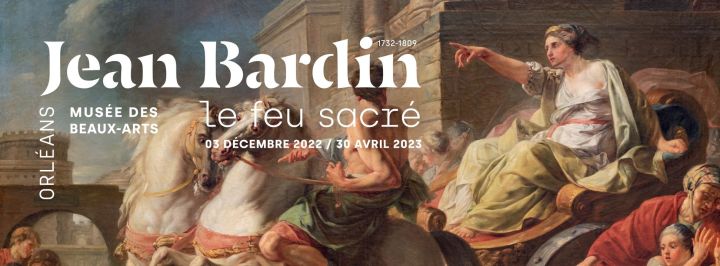
Jean Bardin, Tullia Driving Her Chariot over the Body of Her Father, detail, 1765, oil on canvas, 114 × 146 cm
(Landesmuseum Mainz)
◊ ◊ ◊ ◊ ◊
Now on view at the Museum of Fine Arts in Orléans:
Jean Bardin (1732–1809), le feu sacré
Le musée des Beaux-Arts d’Orléans, 3 December 2022 — 30 April 2023
Curated by Frédéric Jimeno
Le musée des Beaux-Arts d’Orléans présente la première exposition rétrospective consacrée à l’un de ses grands hommes : le peintre Jean Bardin (1732–1809).
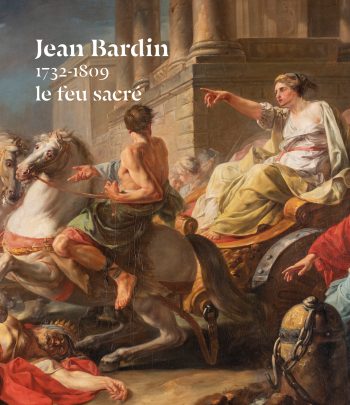 L’exposition Jean Bardin (1732–1809), le feu sacré réunit pour la première fois le corpus de l’artiste. Des tableaux provenant de cathédrales et églises françaises (Bayonne, Mesnil-le-Roi, Charmentray…), récemment restaurés, seront présentés aux côtés d’œuvres provenant des grands musées français (Louvre, Nancy…) et européens (Albertina à Vienne, Mayence…) ainsi que de collections particulières. L’un des temps forts sera le cycle monumental des Sept sacrements, réalisé entre 1780 et 1791 pour la chartreuse de Valbonne et aujourd’hui conservée à la chartreuse d’Aula Dei à Saragosse. Cette série monumentale est exposée en France pour la première fois.
Cette exposition, initiée en 2016 avec Frédéric Jimeno, spécialiste de l’artiste et commissaire scientifique de l’exposition, est le fruit de plusieurs années de recherches. Elle révèle un artiste parmi les principaux de son temps, dans les premières lueurs du néoclassicisme. Le catalogue de l’exposition constitue la première monographie du peintre et propose également une synthèse sur la naissance des institutions artistiques orléanaises sous son égide. Jean Bardin (1732–1809), le feu sacré déploie ainsi un parcours allant de ses débuts dans l’atelier de Jean-Baptiste- Marie Pierre jusqu’à sa mort, qui laisse en héritage les fondements du musée des Beaux-Arts actuel qui ouvrira en 1825. Cette exposition est par ailleurs l’occasion d’évoquer l’entourage familial du peintre, à commencer par la figure de sa fille, Ambroise- Marguerite (1768–1842), artiste formée par son père, seconde femme peintre orléanaise connue après Thérèse Laperche (1743–1814), elle-même révélée au public en 2020 dans le cadre de l’exposition Jean- Marie Delaperche.
Mehdi Korchane, ed., Jean Bardin (1732–1809), le feu sacré (Paris: Les éditions Le Passage, 2023), 304 pages, ISBN: 978-2847424973, €38.
Additional information and more images can be found here»
Exhibition | Hieroglyphs: Unlocking Ancient Egypt

Mummy bandage of Aberuait, linen, Egypt, Ptolemaic Period 332–30 BC (Paris: Musée du Louvre / photo: Georges Poncet). This bandage was a souvenir from one of the earliest ‘mummy unwrapping events’ in the late seventeenth century, where attendees would witness a mummy’s unwrapping and receive a piece of the wrapping linen, preferably inscribed with hieroglyphs.
◊ ◊ ◊ ◊ ◊
From the press release (July 2022) for the exhibition:
Hieroglyphs: Unlocking Ancient Egypt
The British Museum, London, 13 October 2022 — 19 February 2023
Curated by Ilona Regulski
Hieroglyphs: Unlocking Ancient Egypt, a major exhibition at the British Museum, marks one of the most important moments in our understanding of ancient history: the decipherment of Egyptian hieroglyphs. The exhibition explores the inscriptions and objects that helped scholars unlock one of the world’s oldest civilisations 200 years ago.
At the exhibition’s heart is the Rosetta Stone, amongst the world’s most famous ancient objects and one of the British Museum’s most popular exhibits. Before hieroglyphs could be deciphered, life in ancient Egypt had been a mystery for centuries with only tantalising glimpses into this forgotten world. The discovery of the Rosetta Stone in 1799, with its decree written in hieroglyphs, demotic, and the known language of ancient Greek, provided the key to decoding hieroglyphs in 1822—a breakthrough that expanded the modern world’s knowledge of Egypt’s history by some 3,000 years.
 This immersive exhibition brings together over 240 objects, including loans from national and international collections, many of which will be shown for the first time. It will chart the race to decipherment, from initial efforts by medieval Arab travellers and Renaissance scholars to more focussed progress by French scholar Jean-François Champollion (1790–1832) and England’s Thomas Young (1773–1829). The Rosetta Stone is on view alongside the very inscriptions that Champollion and other scholars studied in their quest to understand the ancient past. The exhibition also features stunning objects that highlight the impact of that breakthrough.
Star objects include ‘the Enchanted Basin’, a large black granite sarcophagus from about 600 BCE, covered with hieroglyphs and images of gods. The hieroglyphs were believed to have magical powers and that bathing in the basin could offer relief from the torments of love. The reused ritual bath was discovered near a mosque in Cairo, in an area still known as al-Hawd al-Marsud—‘the enchanted basin’. It has since been identified as the sarcophagus of Hapmen, a nobleman of the 26th Dynasty.
Rarely on public display, the richly illustrated Book of the Dead papyrus of Queen Nedjmet is over 3,000 years old and more than four metres long. A recitation of the texts demonstrates the power of the spoken word, with ritual spells there to be pronounced. The papyrus is presented alongside a set of four canopic vessels that preserved the organs of the deceased. These were dispersed over French and British collections after discovery, and this is the first time this set of jars has been reunited since the mid-1700s.
Among the exceptional loans to the exhibition is the mummy bandage of Aberuait from the Musée du Louvre, which has never been shown in the UK. It was a souvenir from one of the earliest ‘mummy unwrapping events’ in the 1600s where attendees received a piece of the linen, preferably inscribed with hieroglyphs. The exhibition also brings together personal notes by Champollion from the Bibliothèque nationale de France, and by Young from the British Library. A 3,000-year-old measuring rod from the Museo Egizio in Turin was an essential clue for Champollion to unravel Egyptian mathematics, discovering that the Egyptians used units inspired by the human body.
The striking cartonnage and mummy of the lady Baketenhor, on loan from the Natural History Society of Northumbria, was studied by Champollion in the 1820s. In correspondence with colleagues in Newcastle, Champollion correctly identified the inscription on the mummy cover as a prayer addressed to several deities for the soul of the deceased only a few years after he cracked the hieroglyphic writing system. Baketenhor lived to about 25–30 years of age, sometime between 945 and 715 BCE.
From love poetry and international treaties, to shopping lists and tax returns, the exhibition reveals fascinating stories of life in ancient Egypt. As well as an unshakeable belief in the power of the pharaohs and the promise of the afterlife, ancient Egyptians enjoyed good food, writing letters, and making jokes.
Many people in ancient Egypt could not read or write so language was enjoyed through readings, recitations, and performances. The exhibition includes digital media and audio to bring the language to life alongside the objects on display. As part of the interpretation, the British Museum has worked with Egyptian colleagues and citizens from Rashid (modern day Rosetta), with their voices featured throughout the exhibition.
Ilona Regulski, Curator of Egyptian Written Culture at the British Museum, said: “The decipherment of hieroglyphs marked the turning point in a study that continues today to reveal secrets of the past. The field of Egyptology is as active as ever in providing access to the ancient world. Building on 200 years of continuous work by scholars around the globe, the exhibition celebrates new research and shows how Egyptologists continue to shape our dialogue with the past.”
Hartwig Fischer, Director of the British Museum, said: “Hieroglyphs: Unlocking Ancient Egypt marks 200 years since the remarkable breakthrough to decipher a long-lost language. For the first time in millennia the ancient Egyptians could speak directly to us. By breaking the code, our understanding of this incredible civilisation has given us an unprecedented window onto the people of the past and their way of life. I would like to express my gratitude to our long-term exhibition partner BP. Without their support, the British Museum would not be able to present such exhibitions, allowing visitors to discover the art, culture and language of ancient Egypt through the eyes of the pioneering scholars who unlocked those ancient secrets.”
Ilona Regulski, Hieroglyphs: Unlocking Ancient Egypt (London: The British Museum, 2022), 272 pages, ISBN: 978-0714191287 (hardback), £35 / ISBN: 978-0714191294 (paperback), £20.










leave a comment