Exhibition | The Key to Life: 500 Years of Mechanical Amusement

From the press release (30 May 2022) from the Staatliche Kunstsammlungen Dresden:
The Key to Life: 500 Years of Mechanical Amusement
Kunsthalle im Lipsiusbau, Dresden, 3 June — 25 September 2022
Automatons, androids and robots—they now dominate our professional and private environments and are expressions of the human desire to create artificial life. The Mathematisch-Physikalischer Salon and the Museum für Sächsische Volkskunst and Puppentheatersammlung of Staatliche Kunstsammlungen Dresden (SKD) are presenting roughly 70 of these artefacts in the exhibition The Key to Life: 500 Years of Mechanical Amusement on view from 3 June to 25 September 2022 in the Kunsthalle im Lipsiusbau.
 For the first time, the SKD is showing the full range of its unique collection of mechanical figurines and amusements in one exhibition, supplementing them with constructions of artificial life. Beside the unique wealth of mechanical objects spanning from the Renaissance to the present day from the inventory of the Mathematisch-Physikalischer Salons, the Grünes Gewölbe, and the Puppentheatersammlung, the exhibition also features selected loans from the Bayerisches Nationalmuseum, the Maximilianmuseum in Augsburg, and the Roentgen-Museum Neuwied, among others. Through several exhibition chapters on the mechanical figurines and tableaux from the period around 1600, 18th-century-androids and mechanical amusements in the 19th century, to the nickelodeons and slot machines of the early 20th century and contemporary moving art, the exhibition showcases how the mechanical has fascinated people for 500 years.
The items on display include complicated mechanical tableaux from the late 16th century that feature not only agile figurines and playing drummers, but also movements on the tableau itself. A fur-covered bear beats its drum every hour on the hour. The replica ‘iron hand’ of knight Götz von Berlichingen is an excellent example of early modern prosthetics. Contemporary research is also represented: the prototype ‘mika²’ from Dresden University of Technology’s historical acoustic and phonetic collection is a mechanical simulation of the main parts of the human vocal tract, which was developed at the Chair of Speech Technology and Cognitive Systems. The exhibition’s interactive design allows visitors to bring the amusements to life themselves and understand their movements. There will be a varied program of tours and workshops, including some during the school holidays and the Dresden Night of Museums.
Peter Plaßmeyer, Hagen Schönrich and Igor A. Jenzen, eds., Der Schlüssel zum Leben: 500 Jahre mechanische Figurenautomaten (Dresden: Sandstein Verlag, 2022), 224 pages, ISBN: 978-3954986828, €38.
New Book | A Revolution on Canvas
Distributed by Yale UP:
Paris Spies-Gans, A Revolution on Canvas: The Rise of Women Artists in Britain and France, 1760–1830 (London: Paul Mellon Centre, 2022), 384 pages, ISBN: 978-1913107291, £45 / $55.
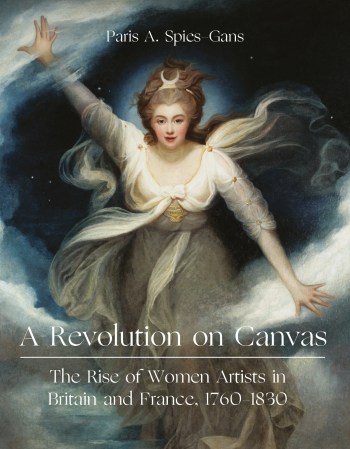 The first collective, critical historical study of women artists in Britain and France during the Revolutionary era
In the late eighteenth and early nineteenth centuries, hundreds of women in London and Paris became professional artists, exhibiting and selling their work in unprecedented numbers. Many rose to the top of their nations’ artistic spheres and earned substantial incomes from their work, regularly navigating institutional inequalities expressly designed to exclude members of their sex. In the first collective, critical history of women artists in Britain and France during the Revolutionary era, Paris Spies-Gans explores how they engaged with and influenced the mainstream cultural currents of their societies at pivotal moments of revolutionary change.
Through an interdisciplinary analysis of the experiences of these narrative painters, portraitists, sculptors, and draughtswomen, this book challenges longstanding assumptions about women in the history of art. Importantly, it demonstrates that women built profitable artistic careers by creating works in nearly every genre practiced by men, in similar proportions and to aesthetic acclaim. It also reveals that hundreds of women studied with male artists, and even learned to draw from the nude. Where traditional histories have left a void, this generously illustrated book illuminates a lively world of artistic production.
Featuring an extensive range of these artists’ paintings, drawings, sculptures, and writings, alongside contemporary prints, satires, and works by their male peers, A Revolution on Canvas transforms our understanding of the opportunities and identities of women artists of the past.
Paris A. Spies-Gans is a historian and an art historian. She has held fellowships at the Harvard Society of Fellows, the Paul Mellon Centre for Studies in British Art, the Getty Research Institute, the Lewis Walpole Library, and the Yale Center for British Art. Her research concentrates on the history of women, gender, and the politics of artistic expression.
◊ ◊ ◊ ◊ ◊
Note (added 17 January 2024) — As announced in January 2024, A Revolution on Canvas was awarded an HBA Book Prize, for a single-authored book with a subject between 1600 and 1800. It’s recognition to add to that which has already been heaped on the book by other organizations:
• Winner of the 2023 Stansky Book Prize, sponsored by NACBS
• Shortlisted for the 2023 Berger Prize, sponsored by The British Art Journal
• Received Honorable Mention from the Louis A. Gottschalk Prize, sponsored by ASECS
• Named one of the Top Art Books of 2022 by The Art Newspaper
• Named one of the Top Art Books of 2022 by The Conversation
New Book | Women Healers
From Penn Press:
Susan Brandt, Women Healers: Gender, Authority, and Medicine in Early Philadelphia (Philadelphia: University of Pennsylvania Press, 2022), 312 pages, ISBN: 978-0812253863, $40.
 In her eighteenth-century medical recipe manuscript, the Philadelphia healer Elizabeth Coates Paschall asserted her ingenuity and authority with the bold strokes of her pen. Paschall developed an extensive healing practice, consulted medical texts, and conducted experiments based on personal observations. As British North America’s premier city of medicine and science, Philadelphia offered Paschall a nurturing environment enriched by diverse healing cultures and the Quaker values of gender equality and women’s education. She participated in transatlantic medical and scientific networks with her friend, Benjamin Franklin. Paschall was not unique, however. Women Healers recovers numerous women of European, African, and Native American descent who provided the bulk of health care in the greater Philadelphia area for centuries.
Although the history of women practitioners often begins with the 1850 founding of Philadelphia’s Female Medical College, the first women’s medical school in the United States, these students merely continued the legacies of women like Paschall. Remarkably, though, the lives and work of early American female practitioners have gone largely unexplored. While some sources depict these women as amateurs whose influence declined, Susan Brandt documents women’s authoritative medical work that continued well into the nineteenth century. Spanning a century and a half, Women Healers traces the transmission of European women’s medical remedies to the Delaware Valley where they blended with African and Indigenous women’s practices, forming hybrid healing cultures.
Drawing on extensive archival research, Brandt demonstrates that women healers were not inflexible traditional practitioners destined to fall victim to the onward march of Enlightenment science, capitalism, and medical professionalization. Instead, women of various classes and ethnicities found new sources of healing authority, engaged in the consumer medical marketplace, and resisted physicians’ attempts to marginalize them. Brandt reveals that women healers participated actively in medical and scientific knowledge production and the transition to market capitalism.
Susan H. Brandt is a Lecturer in the Department of History at University of Colorado, Colorado Springs.
New Book | Patterns of Plague
From MQUP:
Lori Jones, Patterns of Plague: Changing Ideas about Plague in England and France, 1348–1750 (Montreal: McGill-Queens University Press, 2022), 408 pages, ISBN 978-0228010791 (hardcover), $130 / ISBN: 978-0228010807 (paperback), $40.
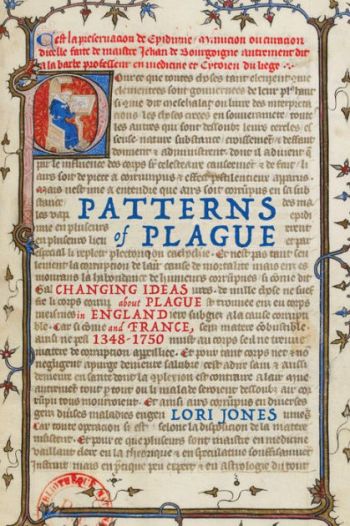 An innovative study of plague in medieval and early modern Europe reveals the changing perceptions surrounding epidemic disease over centuries and across national borders.
For centuries, recurrent plague outbreaks took a grim toll on populations across Europe and Asia. While medical interventions and treatments did not change significantly from the fourteenth century to the eighteenth century, understandings of where and how plague originated did. Through an innovative reading of medical advice literature produced in England and France, Patterns of Plague explores these changing perceptions across four centuries. When plague appeared in the Mediterranean region in 1348, physicians believed the epidemic’s timing and spread could be explained logically and the disease could be successfully treated. This confidence resulted in the widespread and long-term circulation of plague tracts, which described the causes and signs of the disease, offered advice for preventing infection, and recommended therapies in a largely consistent style. What, where, and especially who was blamed for plague outbreaks changed considerably, however, as political, religious, economic, intellectual, medical, and even publication circumstances evolved. Patterns of Plague sheds light on what was consistent about plague thinking and what was idiosyncratic to particular places and times, revealing the many factors that influence how people understand and respond to epidemic disease.
Lori Jones is a historian of medieval and early modern medicine at Carleton University and the University of Ottawa.
New Book | Rhetoric, Public Memory, and Campus History
From Clemson University Press in association with Liverpool University Press:
Rhondda Robinson Thomas, ed., Rhetoric, Public Memory, and Campus History (Clemson: Clemson University Press, 2022), 264 pages, ISBN: 978-1638040200, £95 / $130.
 This essay collection explores the inextricable link between rhetoric, public memory, and campus history projects. Since the early twentieth century after Brown University appointed its Steering Committee on Slavery and Justice, higher education institutions around the globe have launched initiatives to research, document, and share their connections to slavery and its legacies. Many of these explorations have led to investigations about the rhetorical nature of campus history projects, including the names of buildings, the installation of monuments, the publication of books, the production of resolutions, and the hosting of public programs. The essays in this collection examine the rhetorical nature of a range of initiatives, including the creation of land acknowledgement statements, the memorialization of universities’ historic financial ties to the slave trade, the installation and removal of monuments or historical markers, the development of curriculum for campus history projects. The book takes a chronological approach, beginning with the examination of a project at a university that was built on the site of a historic Native American town, moving through a series of essays about initiatives that grew out of universities’ associations with slavery and its legacies in the United Kingdom and America, and ending with a critique of several pedagological approaches in campus history courses designed for undergraduate students.
Rhondda Robinson Thomas is the Calhoun Lemon Professor of Literature at Clemson University where she teaches and researches early African American Literature. She is author of Call My Name, Clemson: Documenting the Black Experience in an American University Community and Faculty Director of the award-winning Call My Name Project for which she has received grants from the National Endowment for the Humanities. She has published articles and books with Cambridge University Press and Oxford University Press as well as in African American Review and American Literary History. She is also the research and community engagement coordinator for the Clemson’s Woodland Cemetery Project.
C O N T E N T S
Rhondda Robinson Thomas — Introduction: The Inextricable Link between Rhetoric and Remembrance in Campus History Projects
1 Andrew Denson — ‘Always Cherokee Land’: Campus History and Indigenous Placemaking in Western North Carolina
2 Stephen Mullen — Acknowledging the Legacies of Enslavement in British Universities: Slavery, Abolition, and the University of Glasgow
3 Christopher P. Lehman — Acknowledging Slavery’s Ties to Minnesota’s Public Universities through Historical Markers
4 Monet Lewis-Timmons — Beyond Kitty’s Cottage: The Double-Containment of Catherine ‘Miss Kitty’ Boyd and Black Commemoration Practices in Oxford, Georgia
5 Cecelia Moore — Reckoning with Silent Sam: The Confederate Monument at the University of North Carolina at Chapel Hill
6 Charles F. Irons — White Memory and White Violence at Elon University
7 Prithi Kanakamedala — ‘We Must Stand United’: Re-telling a Radical History of Bronx Community College at the City University of New York
8 Charissa Fryberger — Looking Racism in the Face at Clemson University
New Book | The Alchemy of Slavery: Human Bondage and Emancipation
First published in 2018 and now available in paperback from Penn Press:
M. Scott Heerman, The Alchemy of Slavery: Human Bondage and Emancipation in the Illinois Country, 1730–1865 (Philadelphia: University of Pennsylvania Press, 2022), 248 pages, ISBN: 978-0812225174 (paperback), $25.
 In this sweeping saga that spans empires, peoples, and nations, M. Scott Heerman chronicles the long history of slavery in the heart of the continent and traces its many iterations through law and social practice. Arguing that slavery had no fixed institutional form, Heerman traces practices of slavery through indigenous, French, and finally U.S. systems of captivity, inheritable slavery, lifelong indentureship, and the kidnapping of free people. By connecting the history of indigenous bondage to that of slavery and emancipation in the Atlantic world, Heerman shows how French, Spanish, and Native North American practices shaped the history of slavery in the United States.
The Alchemy of Slavery foregrounds the diverse and adaptable slaving practices that masters deployed to build a slave economy in the Upper Mississippi River Valley, attempting to outmaneuver their antislavery opponents. In time, a formidable cast of lawyers and antislavery activists set their sights on ending slavery in Illinois. Abraham Lincoln, Lyman Trumbull, Richard Yates, and many other future leaders of the Republican party partnered with African Americans to wage an extended campaign against slavery in the region. Across a century and a half, slavery’s nearly perpetual reinvention takes center stage: masters turning Indian captives into slaves, slaves into servants, former slaves into kidnapping victims; and enslaved people turning themselves into free men and women.
M. Scott Heerman is Associate Professor of History at the University of Miami.
C O N T E N T S
Introduction: Slavery and Freedom on the American Continent
1 Making the French Negroes
2 Another Law and Empire
3 Remaking the French Negroes
4 Contesting Bondage in the Slave North
5 Paths to Independence
6 Freedom Practices, Freedom Politics
Conclusion: North of Slavery, South of Freedom
Notes
Bibliography
Index
Acknowledgments
Print Quarterly, June 2022

Hippolyte Pochon, Du Courage ! En avant Marche (Courage, forward march!), 1815, hand-coloured etching, 23 × 31cm
(Paris, Bibliothèque Nationale)
◊ ◊ ◊ ◊ ◊
The long eighteenth century in the latest issue of Print Quarterly:
Print Quarterly 39.2 (June 2022)
Antony Griffiths, “The Publication of Caricatures in Paris in 1814 and 1815, Part II.”
Part II of Antony Griffiths’ article on “The Publication of Caricatures in Paris in 1814 and 1815” discusses the numerous new names, found only in these years, who deposited prints giving their surname and address. Most of these were the actual producers, and many of the most frequent names can be identified. The article turns to each of the main artists individually, many of whom were leading figures in the school of Jacques Louis David. They included Louis François Charon, Gautier, Charles François Gabriel Levachez, Pierre Audouin, Pierre Marie Bassompierre Gaston, Charles Marie Dubois-Maisonneuve, Pierre Lacroix, Louis Félix Legendre, Jean Jacques Théodore Sauvé, Desalle, Charles Elie, Michael Raphael Vautier and Hippolyte Pochon, whose work was particularly well-executed and imaginative.
The issue also includes these relevant reviews:
Johann Georg Edlinger (1741–1819)
Hans Jakob Meier, Review of Brigitte Huber, Georg Edlinger: Porträts ohne Schmeichelei (Munich: Hirmer Verlag, 2021), p. 194.
Dutch and Flemish Flower Pieces
Nadine Orenstein, Review of Sam Segal and Klara Alen, Dutch and Flemish Flower Pieces: Paintings, Drawings and Prints up to the Nineteenth Century (Leiden: Brill and Hes & De Graaf, 2020), p. 226.
New Book | Madame de Pompadour: Painted Pink
Forthcoming from Harvard Art Museums and distributed by Yale UP:
A. Cassandra Albinson, ed., Madame de Pompadour: Painted Pink (Cambridge: Harvard Art Museums, 2022), 88 pages, ISBN: 978-0300263817, $25.
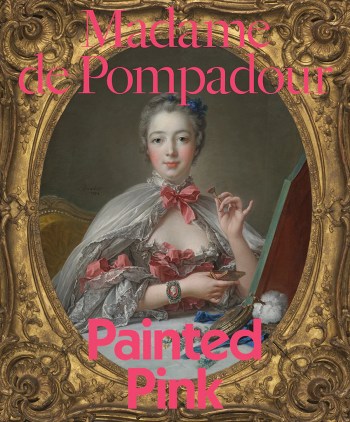 A fresh take on a beloved masterpiece of portraiture, focusing on the complex significance of the color pink in 18th-century France
François Boucher’s 1750 half-length portrait of Madame de Pompadour—influential court figure and mistress to King Louis XV—has been the subject of much art historical attention, particularly with regard to gender and representation. Building on that foundation, this volume turns toward an underappreciated aspect of the portrait: the use and significance of the color pink. Four scholarly essays, including one by noted Boucher expert Mark Ledbury, establish a framework that connects Pompadour’s fondness and promotion of the color, Boucher’s artistic association with the color, and developments in the material basis of the color, including its application in other media such as porcelain. This engaging close look offers new ways to understand the portrait, revealing its links to motherhood and sentiment, race and the transatlantic slave trade, and the crosscurrents of natural history and scientific discovery.
A. Cassandra Albinson is the Margaret S. Winthrop Curator of European Art and Head of the Division of European and American Art at the Harvard Art Museums. With additional contributions by Mark Ledbury, Power Professor of Art History and Visual Culture and director of the Power Institute at the University of Sydney; Gabriella Szalay, PhD candidate, Georg-August-Universität Göttingen, and 2018–20 Renke B. and Pamela M. Thye Curatorial Fellow in the Busch-Reisinger Museum, Harvard Art Museums; and Oliver Wunsch, Assistant Professor of Art History at Boston College and 2018–19 Maher Curatorial Fellow of American Art at the Harvard Art Museums.
New Book | Clothing the New World Church
From the University of Notre Dame Press:
Maya Stanfield-Mazzi, Clothing the New World Church: Liturgical Textiles of Spanish America, 1520–1820 (South Bend: University of Notre Dame Press, 2021), 400 pages, ISBN: 978-0268108052, $50.
 The first broad survey of church textiles of Spanish America, demonstrating that, while overlooked, textiles were a vital part of visual culture in the Catholic Church.
When Catholic churches were built in the New World in the sixteenth century, they were furnished with rich textiles known in Spanish as ‘church clothing’. These textile ornaments covered churches’ altars, stairs, floors, and walls. Vestments clothed priests and church attendants, and garments clothed statues of saints. The value attached to these textiles, their constant use, and their stunning visual qualities suggest that they played a much greater role in the creation of the Latin American Church than has been previously recognized. In Clothing the New World Church, Maya Stanfield-Mazzi provides the first comprehensive survey of church adornment with textiles, addressing how these works helped establish Christianity in Spanish America and expand it over four centuries. Including more than 180 photos, this book examines both imported and indigenous textiles used in the church, compiling works that are now scattered around the world and reconstructing their original contexts. Stanfield-Mazzi delves into the hybrid or mestizo qualities of these cloths and argues that when local weavers or embroiderers in the Americas created church textiles they did so consciously, with the understanding that they were creating a new church through their work.
The chapters are divided by textile type, including embroidery, featherwork, tapestry, painted cotton, and cotton lace. In the first chapter, on woven silk, we see how a ‘silk standard’ was established on the basis of priestly preferences for this imported cloth. The second chapter explains how Spanish-style embroidery was introduced in the New World and mastered by local artisans. The following chapters show that, in select times and places, spectacular local textile types were adapted for the church, reflecting ancestral aesthetic and ideological patterns. Clothing the New World Church makes a significant contribution to the fields of textile studies, art history, Church history, and Latin American studies, and to interdisciplinary scholarship on material culture and indigenous agency in the New World.
Maya Stanfield-Mazzi is an associate professor of art history at the University of Florida. She is the author of Object and Apparition: Envisioning the Christian Divine in the Colonial Andes.
The Burlington Magazine, May 2022
The eighteenth century in the May issue of The Burlington . . .
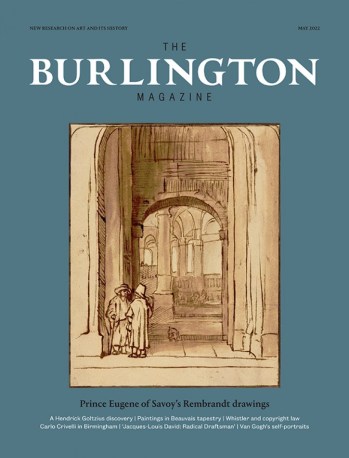
The Burlington Magazine 164 (May 2022)
 E D I T O R I A L
• “The Rustat Memorial,” p. 443.
When the statue of Edward Colston was defaced and thrown into Bristol harbour on 7th June 2020 the resulting publicity was so enormous that it seemed likely that a wholesale assault on memorials to men who took part in the slave trade or were racist would inevitably follow. In fact, remarkably little has happened. . . .
Little more has been done in the case of church monuments. . . . Only one such case is outstanding, an application by St Peter’s church, Dorchester, to move a late eighteenth-century wall memorial to the slave owner John Gordon from the church to Dorchester Museum. If such an application is contested the matter is referred to the judgment of a diocesan Chancellor in a Consistory Court. This was the result of the ecclesiastical case that has attracted most attention, the application by the Master and governing body of Jesus College, Cambridge, to remove the monument to Tobias Rustat (1608–94) from the college chapel, which was opposed by a group of former members of the college. The case was heard in February by David R. Hodge, Deputy Chancellor of the Diocese of Ely, who in March dismissed the application. Last month the college announced that it would not appeal against his decision. . .
A R T I C L E S
• Antoinette Friedenthal, “Prince Eugene of Savoy’s Rembrandt Drawings: A Newly Discovered Provenance,” pp. 450–61.
• Pascal-François Bertrand and Charissa Bremer David, “Paintings in Beauvais Tapestry, 1764–67,” pp. 462–72. In 1764, at a time when the Royal Tapestry Manufactory at Beauvais was short of work, its directors, Laurent and André Charlemagne Charron, initiated the weaving of small tapestry panels based on designs by François Boucher. Intended as inexpensive, independent works of art, they were in essence a short-lived marketing venture. Records of their weaving in the firm’s payment registers allow a number of surviving examples to be identified.
• Sofya Dmitrieva, “Carle Van Loo at the 1737 Salon,” pp. 473–77. Although not pendants in the traditional sense, since they were painted for different patrons, it is argued here that Carle Van Loo’s A Pasha Having His Mistress’s Portrait Painted and The Grand Turk Giving a Concert to His Mistress, shown at the Salon of 1737, were meant to be read as a pair|—as portraits of the artist and his wife and as allegories of Painting and Music. By linking the paintings, Van Loo, may have intended them to make a statement on the changing relations between art and patronage.
R E V I E W S
• Duncan Robinson, Review of Susan Sloman, Gainsborough in London (Modern Art Press, 2021), pp. 478–85.
• Satish Padiyar, Review of the exhibition Jacques-Louis David: Radical Draftsman (The Metropolitan Museum of Art, 2022), pp. 492–95.
• Kee Il Choi, Jr., Review of the exhibition Inspiring Walt Disney: The Animation of French Decorative Arts (The Metropolitan Museum of Art, The Wallace Collection, and The Huntington, 2022–23), pp. 504–07.
• Camilla Pietrabissa, Review of the re-installation of seventeenth- and eighteenth-century Venetian paintings at the Gallerie dell’Accademia in Venice (from August 2021), pp. 507–09.
• Stefania Girometti, Review of Joachim Jacoby, Städels Erbe: Meisterzeichnungen aus der Sammlung des Stifters (Sandstein Verlag, 2020), pp. 529–30. Comprehensive analysis of “the collection of drawings assembled by Johann Friedrich S (1728–1816), the founder of the art institute and museum in Frankfurt that bears his name.”
• Christoph Martin Vogtherr, Review of the exhibition catalogue Watteau at Work: La Surprise (Getty, 2021), pp. 530–31.
• Hugo Chapman, Review of Cristiana Romalli, Cento Disegni dalla Collezione della Fondazione Marco Brunelli (Ugo Bozzi, 2020), pp. 531–32.










leave a comment