New Book | African Founders
From Simon & Schuster:
David Hackett Fischer, African Founders: How Enslaved People Expanded American Ideals (New York: Simon & Schuster, 2022), 960 pages, ISBN: 978-1982145095, $40.
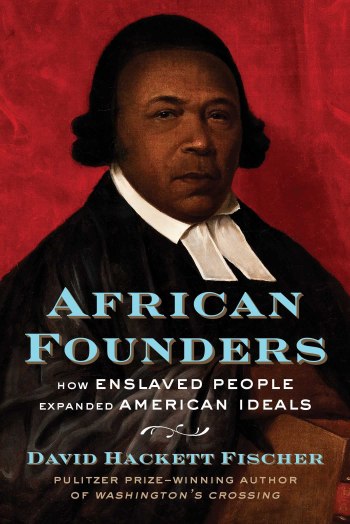 In this sweeping, foundational work, Pulitzer Prize–winning historian David Hackett Fischer draws on extensive research to show how enslaved Africans and their descendants enlarged American ideas of freedom in varying ways in different regions of the early United States.
African Founders explores the little-known history of how enslaved people from different regions of Africa interacted with colonists of European origins to create new regional cultures in the colonial United States. The Africans brought with them linguistic skills, novel techniques of animal husbandry and farming, and generations-old ethical principles, among other attributes. This startling history reveals how much our country was shaped by these African influences in its early years, producing a new, distinctly American culture. Drawing on decades of research, some of it in western Africa, Fischer recreates the diverse regional life that shaped the early American republic. He shows that there were varieties of slavery in America and varieties of new American culture, from Puritan New England to Dutch New York, Quaker Pennsylvania, cavalier Virginia, coastal Carolina, and Louisiana and Texas. This landmark work of history will transform our understanding of America’s origins.
David Hackett Fischer is a University Professor and Warren Professor of History emeritus at Brandeis University in Waltham, Massachusetts. He is the author of numerous books, including the 2005 Pulitzer Prize winner Washington’s Crossing and Champlain’s Dream. In 2015, he received the Pritzker Literature Award for Lifetime Achievement in Military Writing.
New Book | The Fountain of Latona
From Penn Press:
Thomas Hedin, The Fountain of Latona: Louis XIV, Charles Le Brun, and the Gardens of Versailles (Philadelphia: University of Pennsylvania Press, 2022), 296 pages, ISBN: 978-0812253757, $70.
 Ovid tells the story of Latona, the mother by Jupiter of Apollo and Diana. In her flight from the jealous Juno, she arrives faint and parched on the coast of Asia Minor. Kneeling to sip from a pond, Latona is met by the local peasants, who not only deny her effort but muddy the water in pure malice. Enraged, Latona calls a curse down upon the stingy peasants, turning them to frogs.
In his masterful study, Thomas Hedin reveals how and why a fountain of this strange legend was installed in the heart of Versailles in the 1660s, the inaugural decade of Louis XIV’s patronage there. The natural supply of water was scarce and unwieldy, and it took the genius of the king’s hydraulic engineers, working in partnership with the landscape architect André Le Nôtre, to exploit it. If Ovid’s peasants were punished for their stubborn denial of water, so too the obstacles of coarse nature at Versailles were conquered; the aquatic iconography of the fountain was equivalent to the aquatic reality of the gardens.
Latona was designed by Charles Le Brun, the most powerful artist at the court of Louis XIV, and carried out by Gaspard and Balthazar Marsy. The 1660s were rich in artistic theory in France, and the artists of the fountain delivered substantial lectures at the Académie royale de peinture et de sculpture on subjects of central concern to their current work. What they professed was what they were visualizing in the gardens. As such, the fountain is an insider’s guide to the leading artistic ideals of the moment.
Louis XIV was viewed as the reincarnation of Apollo, the god of creativity, the inspiration of artists and scientists. Hedin’s original argument is that Latona was a double declaration: a glorification of the king and a proud manifesto by artists.
Thomas F. Hedin is Emeritus Professor of Art History at the University of Minnesota Duluth. He is the author, with Robert W. Berger, of Diplomatic Tours in the Gardens of Versailles, also published by University of Pennsylvania Press.
C O N T E N T S
Acknowledgments
Note on Measurements
List of Illustrations
Prologue
1 Foundations
2 Fountains in Context
3 Original State
4 Visual Narrative
5 Latona Group
6 Lycean Peasants
7 Panegyric and Manifesto
Epilogue
Appendix A: Execution of the Fountain
Appendix B: Mansart’s Marble Cone
Appendix C: Marsy’s Lecture of 7 December 1669
Appendix D: Nathan Whitman’s ‘Fronde Thesis’
Appendix E: Translations of Ovid
Appendix F: Elaborations of the Western Axis, Briefly
List of Abbreviations
Notes
Bibliography
Index
Illustrations follow page 90
New Book | Carrying All before Her
From the University of Delaware Press:
Chelsea Phillips, Carrying All before Her: Celebrity Pregnancy and the London Stage, 1689–1800 (Newark: University of Delaware Press, 2022), 304 pages, ISBN: 978-1644532492, $120 / ISBN: 978-1644532485, $35.
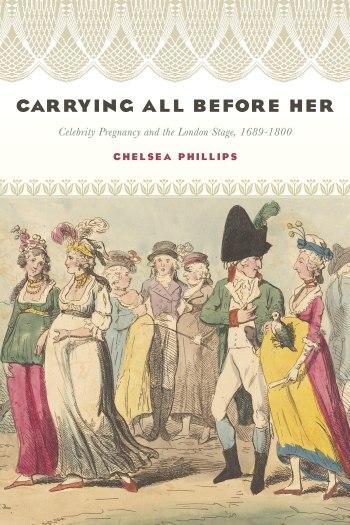 The rise of celebrity stage actresses in the long eighteenth century created a class of women who worked in the public sphere while facing considerable scrutiny about their offstage lives. Such powerful celebrity women used the cultural and affective significance of their reproductive bodies to leverage audience support and interest to advance their careers, and eighteenth-century London patent theatres even capitalized on their pregnancies. Carrying All Before Her uses the reproductive histories of six celebrity women—Susanna Mountfort Verbruggen, Anne Oldfield, Susannah Cibber, George Anne Bellamy, Sarah Siddons, and Dorothy Jordan—to demonstrate that pregnancy affected celebrity identity, impacted audience reception and interpretation of performance, changed company repertory and altered company hierarchy, influenced the development and performance of new plays, and had substantial economic consequences for both women and the companies for which they worked. Deepening the fields of celebrity, theatre, and women’s studies, as well as social and medical histories, Phillips reveals an untapped history whose relevance and impact persists today.
Chelsea Phillips is an associate professor of theatre at Villanova University in Pennsylvania.
C O N T E N T S
Figures
Acknowledgments
Introduction
1 Inheriting Greatness: Susanna Mountfort Verbruggen and Anne Oldfield
2 Pregnant Sensibility: Susannah Cibber and George Anne Bellamy
3 Conceiving Genius: Sarah Siddons
4 Prolific Muse: Dorothy Jordan
Conclusion: Celebrity Pregnancy, Then and Now
Appendix: Birth and Christening Dates
Notes
Bibliography
Index
New Book | Celebrity across the Channel, 1750–1850
From the University of Delaware Press:
Anaïs Pédron and Clare Siviter, eds., Celebrity across the Channel, 1750–1850 (Newark: University of Delaware Press, 2021), 336 pages, ISBN: 978-1644532126, $120 / ISBN: 978-1644532133, $35.
 Celebrity across the Channel, 1750–1850 is the first book to study and compare the concept of celebrity in France and Britain from 1750 to 1850 as the two countries transformed into the states we recognize today. It offers a transnational perspective by placing in dialogue the growing fields of celebrity studies in the two countries, especially by engaging with Antoine Lilti’s seminal work, The Invention of Celebrity, translated into English in 2017.
With contributions from a diverse range of scholarly cultures, the volume has a firmly interdisciplinary scope over the time period 1750 to 1850, which was an era marked by social, political, and cultural upheaval. Bringing together the fields of history, politics, literature, theater studies, and musicology, the volume employs a firmly interdisciplinary scope to explore an era marked by social, political, and cultural upheaval. The organization of the collection allows for new readings of the similarities and differences in the understanding of celebrity in Britain and France. Consequently, the volume builds upon the questions that are currently at the heart of celebrity studies.
Anaïs Pédron is an independent scholar based in London, England. She has recently published the article “‘Nous aussi nous sommes citoyennes’: Female Activism during the French Revolution” in Women in French Studies (special issue 2019) and the chapter “Olympe de Gouges, anti-esclavagiste et anticolonialiste?” in Les Lumières, l’esclavage et l’idéologie coloniale: XVIIIe–XIXe siècle (2020), edited by Pascale Pellerin.
Clare Siviter is a theater historian of the longer French Revolutionary period and is lecturer in French Theatre at the University of Bristol. She is the author of Tragedy and Nation in the Age of Napoleon.
C O N T E N T S
List of Illustrations
Antoine Lilti, Preface
Anaïs Pédron and Clare Siviter, Introduction
Section I: Theorizing Celebrity
1 Chris Haffenden, ‘Immortality in This World’: Reconfiguring Celebrity and Monument in the Romantic Period
2 Blake Smith, The Scholar as Celebrity: Anquetil-Duperron’s Discours Préliminaire
3 Meagan Mason, The Physiognomies of Virtuosi in Paris, 1830–1848
Section II: Representing Celebrity
4 Anna Senkiw, ‘To Perdition’: Politicians, Players, and the Press
5 Anaïs Pédron, Clairon’s Strategies to Achieve Celebrity and Glory
6 Miranda Kiek, Celebrity—Thou Art Translated! Corinne in England
7 Clare Siviter, Celebrity across Borders: The Chevalier d’Eon
Section III: Inheriting Celebrity
8 Emrys D. Jones: ‘Knowing My Family’: Dynastic Recognition in Eighteenth-Century Celebrity Culture
9 Gabriel Wick, Princes of the Public Sphere: Visibility, Performance, and Princely Political Activism, 1771–1774
10 Ariane Viktoria Fichtl, Ancient Parallels to Eighteenth-Century Concepts of Celebrity
11 Laure Philip, The Celebrity, Reputation, and Glory of the Empire and Restoration France through the Lens of Adèle de Boigne’s Memoirs
Bibliography
About the Contributors
Conference | Portrait Miniatures
From the Tansey Miniatures Foundation and the conference programme:
Portrait Miniatures: Artists, Functions, and Collections
Celle Castle, Tansey Miniatures Foundation, Celle Castle (near Hanover), 9–11 September 2022
This conference will take place in conjunction with the seventh exhibition of the Tansey Miniatures Foundation and the publication of the accompanying catalogue Miniatures from the Time of Napoleon in the Tansey Collection. 23 speakers from 11 different countries will address a range of topics related to portrait miniatures:
• Individual miniaturists, specific workshop contexts, and places of production
• Use and functions of both court and private types and their protagonists
• Iconographic aspects in the context of representation or intimacy
• Evolution of techniques and materials
• Private and public collections
The conference will be in English. The presentations will subsequently be published in a richly illustrated book. Admission is free. Both conference venues are within walking distance (20 minutes) from the railway station. Trains from Hannover take approximately 25 to 45 minutes (Deutsche Bahn, Metronom, and S-Bahn). For registration, please contact Juliane Schmieglitz-Otten, The Tansey Miniatures Foundation, juliane.schmieglitz-otten@tansey-miniatures.com. For more information, please contact Bernd Pappe, The Tansey Miniatures Foundation, bernd.pappe@tansey-miniatures.com.
F R I D A Y , 9 S E P T E M B E R 2 0 2 2
16.00 Registration
18.00 Welcome and Opening Lectures
• Juliane Schmieglitz-Otten, Realism and Modernism in the Likenesses of a New Epoch: Highlights of the Exhibition Miniatures from the Time of Napoleon
• Bernd Pappe, Making a Small Man Great: Miniatures of Napoleon I
• Birgitt Schmedding, Two Views: The Power of Seeing
S A T U R D A Y , 1 0 S E P T E M B E R 2 0 2 2
9.00 Objects, Agencies, and Social Practices
• Gerrit Walczak (Berlin), Icons of Intimacy: Sex, Agency, and the Portrait Miniature
• André and Anne-Marie Regnard-Denis (Belgium), Gestures and Their Meaning in Portrait Miniatures
• Karin Schrader (Bad Nauheim), ‘Telling Objects’: Miniatures in 18th-Century Courtly Portraits
• Lea C. Stephenson (Philadelphia), Racial Capital: Peter Marié’s Miniatures and Gilded Age Whiteness
• Jann Matlock (London), The Museum of Lost Portraits: Paris, 1794–1805
• Damiët Schneeweisz (London), Shipped, Worn, or Carried: Portrait Miniatures in the Atlantic Ocean World
13.00 Lunch
14.15 Politics and Representation
• Juliane Schmieglitz-Otten (Celle), Pictorial Family Ties: Series of Portrait Miniatures Serving Political Networks
• Martin Miersch (Ulm), Fashion and Political Statement: Portrait Miniatures from the Time of the French Revolution
• Maxime Charron (Paris), Examples of Intimate Portraits from the Royal and Imperial Courts of France during the First Half of the 19th Century
• Agnieszka Fulińska (Krakow), A Reputed Portrait Miniature of the King of Rome and Images of Children from Napoleon’s Entourage
• Marina Vidas (Copenhagen), Portrait Miniatures Set in Jewellery and Objects of Personal Adornment Connected to Queen Louise of Denmark and Her Daughter, Maria Feodorovna, Empress of Russia
17.30 Special Techniques and Materials
• David Hradil, Janka Hradilová, and Olga Trmalová (Prague), Benefits of Non-Invasive Macro X-Ray Fluorescence Scanning for the Analysis of Materials in Portrait Miniatures
S U N D A Y , 1 1 S E P T E M B E R 2 0 2 2
9.00 Special Techniques and Materials
• Christine Slottved Kimbriel, Paola Ricciardi, and Flavia Fiorillo (London), Unlocking the English Portrait Miniature: The Materiality of Isaac Oliver’s Oeuvre
• Alan Derbyshire and Lucia Burgio (London), The William Wood Manuscripts
10.00 Miniature Painters
• Martin Spies (Giessen), In Search of Charles Townley, Painter of Miniatures and Engraver to the King of Prussia
• Luise Schreiber Knaus and Peter Knaus (Bodelshausen), The Miniature Painter Jeremiah Meyer: His Life and Career during the Reign of King George III
• Sonja Remensberger (Winterthur), Pierre-Louis Bouvier (1765–1836): Life and Work of a Geneva Miniature Painter whilst Working Abroad
• Nathalie Lemoine-Bouchard (Paris), Ambroise Charlemagne Victor Le Chenetier: When a 19th-Century Artist Hides Another One
13.00 Lunch
14.15 Collections of Portrait Miniatures
• Stephen Lloyd (Liverpool), Horace Walpole’s Recently Discovered Plan for Displaying His Miniatures and Enamels in the Cabinet of the Tribuna at Strawberry Hill
• Maria Dunina (Moscow), The Collection of Miniatures of the State Pushkin Museum of Fine Arts, Moscow
• Tatiana Udras (Moscow), Portrait Miniatures of the Romanoff Family in Russian and Foreign Collections
• Cecilia Rönnerstam (Stockholm), On Origins and Originals: The History of a Collection
• Blythe Sobol (Kansas City), An Outsized Passion for Miniatures: The Starr Collection of Portrait Miniatures at the Nelson-Atkins Museum of Art
Exhibition | Miniatures from the Time of Napoleon
From the Tansey Miniatures Foundation:
Miniatures from the Time of Napoleon / Miniaturen der Zeit Napoleons
Tansey Miniatures Foundation, Bomann-Museum, Celle, from 26 June 2020
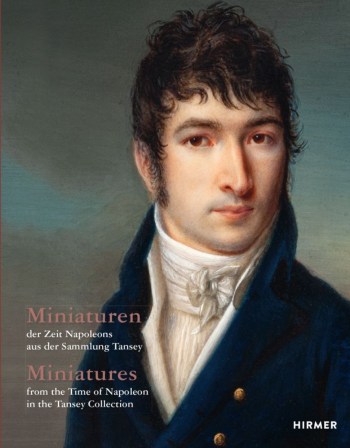 The Tansey miniatures, now held by the Bomann Museum in Celle, represent one of the most significant collections of European miniature paintings. This exhibition showcases a total of 150 works from the time of Napoleon I (1795–1815). These tiny portraits, which were generally intended for personal use, date from the ‘golden age’ of miniature painting. They exhibit a high degree of artistic skill and refined craftsmanship. Unlike the staged, theatrical portraits of absolutism, now for the first time we see realistic likenesses of people who appear ‘modern’—a gallery of women, men, and children from a period of political upheaval dominated by wars.
The accompanying bilingual catalogue (in German and English) provides comprehensive insight into the art of miniature painting in this magnificent era. Specialists have contributed detailed and richly illustrated introductory essays. This volume joins earlier entries in the series, exploring the collection in key periods and presenting new photographic reproductions of the miniatures at actual size.
Bernd Pappe and Juliane Schmieglitz-Otten, with photography by Birgitt Schmedding, Miniatures from the Time of Napoleon in the Tansey Collection (Munich: Hirmer Verlag, 2022), 452 pages, ISBN: 978-3777436098, €58 / $65.
New Book | America’s Philosopher
From The University of Chicago Press:
Claire Rydell Arcenas, America’s Philosopher: John Locke in American Intellectual Life (Chicago: The University of Chicago Press, 2022), 280 pages, ISBN: 978-0226638607, $35.
 America’s Philosopher examines how John Locke has been interpreted, reinterpreted, and misinterpreted over three centuries of American history.
The influence of polymath philosopher John Locke (1632–1704) can still be found in a dizzying range of fields, as his writings touch on issues of identity, republicanism, and the nature of knowledge itself. Claire Rydell Arcenas’s new book tells the story of Americans’ longstanding yet ever-mutable obsession with this English thinker’s ideas, a saga whose most recent manifestations have found the so-called Father of Liberalism held up as a right-wing icon.
The first book to detail Locke’s trans-Atlantic influence from the eighteenth century until today, America’s Philosopher shows how and why interpretations of his ideas have captivated Americans in ways few other philosophers—from any nation—ever have. As Arcenas makes clear, each generation has essentially remade Locke in its own image, taking inspiration and transmuting his ideas to suit the needs of the particular historical moment. Drawing from a host of vernacular sources to illuminate Locke’s often contradictory impact on American daily and intellectual life from before the Revolutionary War to the present, Arcenas delivers a pathbreaking work in the history of ideas.
Claire Rydell Arcenas is assistant professor of history at the University of Montana.
C O N T E N T S
Preface
1 Locke’s Legacy in Early America
2 Locke’s Authority in the Revolutionary and Founding Eras
3 Problematizing Locke as Exemplar in the Early United States
4 Locke Becomes Historical
5 Making Locke Relevant
6 Locke and the Invention of the American Political Tradition
7 Lockean ‘-isms’
Epilogue
Acknowledgments
List of Abbreviations
Notes
Bibliography
Index
New Books | Recent Biographies
If biographies are your summer thing, some possibilities . . .
Leo Damrosch, Adventurer: The Life and Times of Giacomo Casanova (New Haven: Yale University Press, 2022), 432 pages, ISBN: 978-0300248289, $35.
 A fast-paced narrative about the world-famous libertine Giacomo Casanova, from celebrated biographer Leo Damrosch
The life of the iconic libertine Giacomo Casanova (1725–1798) has never been told in the depth it deserves. An alluring representative of the Enlightenment’s shadowy underside, Casanova was an aspiring priest, an army officer, a fortune teller, a con man, a magus, a violinist, a mathematician, a Masonic master, an entrepreneur, a diplomat, a gambler, a spy—and the first to tell his own story. In his vivid autobiography Histoire de Ma Vie, he recorded at least a hundred and twenty love affairs, as well as dramatic sagas of duels, swindles, arrests, and escapes. He knew kings and an empress, Catherine the Great, and most of the famous writers of the time, including Voltaire and Benjamin Franklin.
Drawing on seldom used materials, including the original French and Italian primary sources, and probing deeply into the psychology, self-conceptions, and self-deceptions of one of the world’s most famous con men and seducers, Leo Damrosch offers a gripping, mature, and devastating account of an Enlightenment man, freed from the bounds of moral convictions.
Leo Damrosch is the Ernest Bernbaum Professor of Literature Emeritus at Harvard University. His many books include The Club: Johnson, Boswell, and the Friends Who Shaped an Age and Jonathan Swift: His Life and His World, winner of the National Book Critics Circle award and Pulitzer finalist for biography. He lives in Newton, MA.
◊ ◊ ◊ ◊ ◊
Tristram Hunt, The Radical Potter: The Life and Times of Josiah Wedgwood (Metropolitan Books, 2021), 352 pages, ISBN: 978-1250128348, $30.
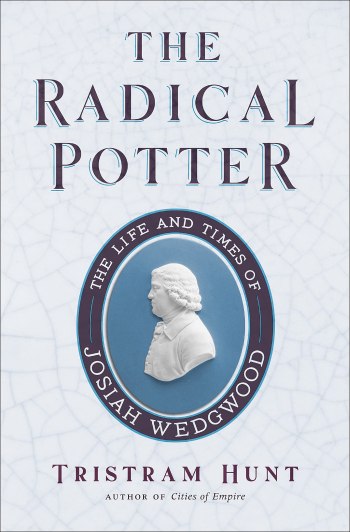 From one of Britain’s leading historians and the director of the Victoria & Albert Museum, a scintillating biography of Josiah Wedgwood, the celebrated eighteenth-century potter, entrepreneur, and abolitionist
Wedgwood’s pottery, such as his celebrated light-blue jasperware, is famous worldwide. Jane Austen bought it and wrote of it in her novels; Empress Catherine II of Russia ordered hundreds of pieces for her palace; British diplomats hauled it with them on their first-ever mission to Peking, audaciously planning to impress China with their china. But the life of Josiah Wedgwood is far richer than just his accomplishments in ceramics. He was a leader of the Industrial Revolution, a pioneering businessman, a cultural tastemaker, and a tireless scientific experimenter whose inventions made him a fellow of the Royal Society. He was also an ardent abolitionist, whose Emancipation Badge medallion—depicting an enslaved African and inscribed “Am I Not a Man and a Brother?”—became the most popular symbol of the antislavery movement on both sides of the Atlantic. And he did it all in the face of chronic disability and relentless pain: a childhood bout with smallpox eventually led to the amputation of his right leg.
As historian Tristram Hunt puts it in this lively, vivid biography, Wedgwood was the Steve Jobs of the eighteenth century: a difficult, brilliant, creative figure whose personal drive and extraordinary gifts changed the way we work and live. Drawing on a rich array of letters, journals, and historical documents, The Radical Potter brings us the story of a singular man, his dazzling contributions to design and innovation, and his remarkable global impact.
Tristram Hunt is the director of the Victoria & Albert Museum and one of Britain’s best-known historians. His previous books, which include Cities of Empire: The British Colonies and the Creation of the Urban World and Marx’s General: The Revolutionary Life of Friedrich Engels, have been published in more than a dozen languages. Until taking on the leadership of the V&A, he served as Member of Parliament for Stoke-on-Trent, the home of Wedgwood’s potteries. A senior lecturer in British history at Queen Mary University of London, he appears regularly on BBC radio and television.
◊ ◊ ◊ ◊ ◊
Catherine Ostler, The Duchess Countess: The Woman Who Scandalized Eighteenth-Century London (New York: Atria Books, 2022), 432 pages, ISBN: 978-1982179731, $30.
 As maid of honor to the Princess of Wales, Elizabeth Chudleigh (1721–1788) enjoyed a luxurious life in the inner circle of the Hanoverian court. With her extraordinary style and engaging wit, she both delighted and scandalized the press and public. She would later even inspire William Thackeray when he was writing his classic Vanity Fair, providing the inspiration for the alluring social climber Becky Sharp. But Elizabeth’s real story is more complex and surprising than anything out of fiction. A clandestine, candlelit wedding to the young heir to an earldom, a second marriage to a duke, a lust for diamonds, and an electrifying appearance at a masquerade ball in a gossamer dress—it’s no wonder that Elizabeth’s eventual trial was a sensation. Charged with bigamy, an accusation she vehemently fought against, Elizabeth refused to submit to public humiliation and retire quietly.
Catherine Ostler has been editor-in-chief of Tatler, the Evening Standard (London), and editor of The Times (London) Weekend Edition. She has also written for a wide range of publications, including Vogue, Daily Mail (London), and Newsweek. She read English at Oxford University, specializing in literature.
◊ ◊ ◊ ◊ ◊
Andrew Roberts, The Last King of America: The Misunderstood Reign of George III (New York: Viking, 2021), 784 pages, ISBN: 978-1984879264, $40. In the UK: George III: The Life and Reign of Britain’s Most Misunderstood Monarch.
 The last king of America, George III, has been ridiculed as a complete disaster who frittered away the colonies and went mad in his old age. The truth is much more nuanced and fascinating—and will completely change the way readers and historians view his reign and legacy.
Most Americans dismiss George III as a buffoon—a heartless and terrible monarch with few, if any, redeeming qualities. The best-known modern interpretation of him is Jonathan Groff’s preening, spitting, and pompous take in Hamilton, Lin-Manuel Miranda’s Broadway masterpiece. But this deeply unflattering characterization is rooted in the prejudiced and brilliantly persuasive opinions of eighteenth-century revolutionaries like Thomas Paine and Thomas Jefferson, who needed to make the king appear evil in order to achieve their own political aims. After combing through hundreds of thousands of pages of never-before-published correspondence, award-winning historian Andrew Roberts has uncovered the truth: George III was in fact a wise, humane, and even enlightened monarch who was beset by talented enemies, debilitating mental illness, incompetent ministers, and disastrous luck.
In The Last King of America, Roberts paints a deft and nuanced portrait of the much-maligned monarch and outlines his accomplishments, which have been almost universally forgotten. Two hundred and forty-five years after the end of George III’s American rule, it is time for Americans to look back on their last king with greater understanding: to see him as he was and to come to terms with the last time they were ruled by a monarch.
Andrew Roberts is the bestselling author of Churchill: Walking with Destiny; Leadership in War; The Storm of War: A New History of the Second World War; Masters and Commanders: How Four Titans Won the War in the West, 1941-1945; Waterloo: Napoleon’s Last Gamble; and Napoleon: A Life, winner of the Los Angeles Times Book Prize for biography and a finalist for the Plutarch Award. He has won many other prizes, including the Wolfson History Prize and the British Army Military Book of the Year. He is the Roger and Martha Mertz Visiting Fellow at the Hoover Institution at Stanford University, chair of the judges of the Gilder Lehrman Military History Prize, and a visiting professor in the Department of War Studies at King’s College, London.
◊ ◊ ◊ ◊ ◊
Anna Marie Roos, Martin Folkes (1690–1754): Newtonian, Antiquary, Connoisseur (Oxford: Oxford University Press, 2021), 432 pages, ISBN: 978-0198830061, $100.
 • First full-length biography of this eminent Enlightenment figure, mathematician, and protégé of Isaac Newton
• Contains the first complete analysis and reconstruction of the tragic life and career of Folkes’s wife, Drury Lane star Lucretia Bradshaw
• Features a novel analysis of the prints and drawings of William Hogarth with regard to the Royal Society, freemasonry, and coffeehouse culture
Martin Folkes (1690–1754): Newtonian, Antiquary, Connoisseur is a cultural and intellectual biography of the only President of both the Royal Society and the Society of Antiquaries. Sir Isaac Newton’s protégé, astronomer, mathematician, freemason, art connoisseur, Voltaire’s friend, and Hogarth’s patron, his was an intellectually vibrant world. Folkes was possibly the best-connected natural philosopher and antiquary of his age, an epitome of Enlightenment sociability, and yet he was a surprisingly neglected figure, the long shadow of Newton eclipsing his brilliant disciple.
Anna Marie Roos is a Professor of the History of Science and Medicine at the University of Lincoln.
New Books | Recent Historical Fiction
If historical fiction is your summer thing, some possibilities . . .
Jessie Burton, The House of Fortune (New York: Bloomsbury, 2022), 304 pages, ISBN: 978-1635579741, $28.
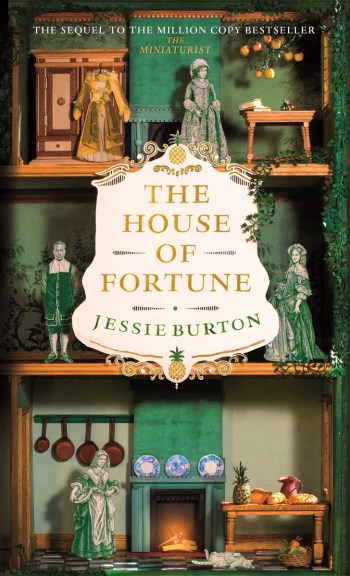 Alive with the magic of 18th-century Amsterdam, an enchanting, fantastical stand-alone companion novel to the sensational New York Times bestseller The Miniaturist, which has sold over two million copies worldwide.
Amsterdam in the year 1705. It is Thea Brandt’s eighteenth birthday. She is ready to welcome adulthood with open arms, but life at home is increasingly difficult. Her father Otto and her Aunt Nella argue endlessly over their financial fate, selling off furniture in a desperate attempt to hold on to the family home.
As catastrophe threatens to engulf the household, Thea seeks refuge in Amsterdam’s playhouses. She loves the performances, and the stolen moments afterwards are even better. In the backrooms of her favorite theater, Thea can spend a few precious minutes with her secret lover, Walter, the chief set-painter, a man adept at creating the perfect environments for comedies and tragedies to flourish. The thrill of their hidden romance offers Thea an exciting distraction from home. But it also puts her in mind of another secret that threatens to overwhelm the present: Thea knows her birthday marks the day her mother, Marin, died in labor. Thea’s family refuses to share the details of this story, just as they seem terrified to speak of ‘the miniaturist’—a shadowy figure from their past who is possessed of uncanny abilities to capture that which is hidden.
Aunt Nella believes the solution to all Thea’s problems is to find her a husband who will guarantee her future. An unexpected invitation to Amsterdam’s most exclusive ball seems like a golden opportunity. But when Thea finds, on her doorstep, a parcel containing a miniature figure of Walter, it becomes clear that someone out there has another fate in mind for the family . . . A feat of sweeping, magical storytelling, The House of Fortune is an unputdownable novel about love and obsession, family and loyalty, and the fantastic power of secrets.
Jessie Burton’s first novel, The Miniaturist, was a New York Times bestseller and was adapted into a PBS series, starring Anya Taylor-Joy. Jessie’s second novel, The Muse, was also a #1 international bestseller. Jessie has written essays and reviews for The New York Times and The Wall Street Journal. She lives in London.
◊ ◊ ◊ ◊ ◊
James Runcie, The Great Passion (London, Bloomsbury, 2022), 272 pages, ISBN: 978-1635570670, $28.
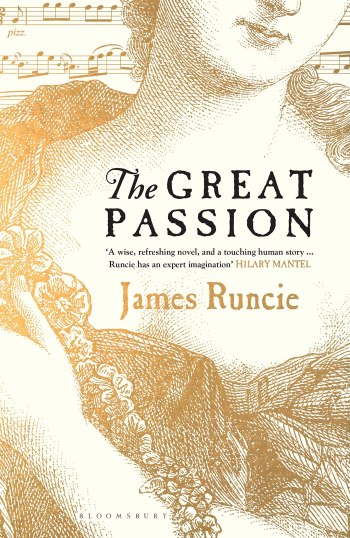 From acclaimed bestselling author James Runcie, a meditation on grief and music, told through the story of Bach’s writing of the St. Matthew Passion.
In 1727, Stefan Silbermann is a grief-stricken thirteen-year-old, struggling with the death of his mother and his removal to a school in distant Leipzig. Despite his father’s insistence that he try not to think of his mother too much, Stefan is haunted by her absence, and, to make matters worse, he’s bullied by his new classmates. But when the school’s cantor, Johann Sebastian Bach, takes notice of his new pupil’s beautiful singing voice and draws him from the choir to be a soloist, Stefan’s life is permanently changed.
Over the course of the next several months, and under Bach’s careful tutelage, Stefan’s musical skill progresses, and he is allowed to work as a copyist for Bach’s many musical works. But mainly, drawn into Bach’s family life and away from the cruelty in the dorms and the lonely hours of his mourning, Stefan begins to feel at home. When another tragedy strikes, this time in the Bach family, Stefan bears witness to the depths of grief, the horrors of death, the solace of religion, and the beauty that can spring from even the most profound losses.
Joyous, revelatory, and deeply moving, The Great Passion is an imaginative tour de force that tells the story of what it was like to sing, play, and hear Bach’s music for the very first time.
James Runcie is an award-winning film-maker, playwright and literary curator. He is the author of twelve novels that have been translated into twelve languages, including the seven books in the Grantchester Mysteries series. He has been Artistic Director of the Bath Literature Festival, Head of Literature and Spoken Word at the Southbank Centre, London, and Commissioning Editor for Arts on BBC Radio 4. He is a Fellow of the Royal Society of Literature. He lives in Scotland.
◊ ◊ ◊ ◊ ◊
Eva Stachniak, The School of Mirrors: A Novel (New York: William Morrow, 2022), 416 pages, ISBN: 978-0063119604, $17.
 A scintillating, gorgeously written historical novel about a mother and a daughter in eighteenth-century France, beginning with decadence and palace intrigue at Versailles and ending in an explosive new era of revolution.
During the reign of Louis XV, impoverished but lovely teenage girls from all over France are sent to a discreet villa in the town of Versailles. Overseen by the King’s favorite mistress, Madame de Pompadour, they will be trained as potential courtesans for the King. When the time is right, each girl is smuggled into the palace of Versailles, with its legendary Hall of Mirrors. There they meet a mysterious but splendidly dressed man who they’re told is merely a Polish count, a cousin of the Queen. Living an indulgent life of silk gowns, delicious meals, and soft beds, the students at this “school of mirrors” rarely ask questions, and when Louis tires of them, they are married off to minor aristocrats or allowed to retire to one of the more luxurious nunneries.
Beautiful and canny Veronique arrives at the school of mirrors and quickly becomes a favorite of the King. But when she discovers her lover’s true identity, she is whisked away, sent to give birth to a daughter in secret, and then to marry a wealthy Breton merchant. There is no return to the School of Mirrors.
This is also the story of the King’s daughter by Veronique—Marie-Louise. Well-provided for in a comfortable home, Marie-Louise has never known her mother, let alone her father. Capable and intelligent, she discovers a passion for healing and science, and becomes an accredited midwife, one of the few reputable careers for women like her. But eventually Veronique comes back into her daughter’s life, bringing with her the secret of Marie-Louise’s birth. But the new King—Louis XVI—is teetering on his throne and it’s a volatile time in France…and those with royal relatives must mind their step very carefully.
Eva Stachniak was born in Wroclaw, Poland. She moved to Canada in 1981 and has worked for Radio Canada International and Sheridan College, where she taught English and humanities. Her first novel of Catherine the Great, The Winter Palace was a #1 international bestseller and was followed by another Catherine the Great novel Empress of the Night, also a bestseller. She lives in Toronto.
Exhibition | Bernardo Bellotto at the Court of Saxony
From the Staatliche Kunstsammlungen Dresden:
Enchantingly Real: Bernardo Bellotto at the Court of Saxony
Zwinger, Gemäldegalerie Alte Meister, Dresden, 21 May — 28 August 2022
Royal Castle, Warsaw, 23 September 2022 — 8 January 2023
 Coinciding with the 300th anniversary of his birth, the Gemäldegalerie Alte Meister is holding a major monographic exhibition in celebration of the work of Venetian painter Bernardo Bellotto (1722–1780). The artist—who, like his uncle and teacher Antonio Canal, also called himself Canaletto—ranks as one of the most important 18th-century painters of city views or vedute. The Dresden retrospective is the culmination of a years-long conservation project and results from a cooperation with the Royal Castle in Warsaw. It features the Gemäldegalerie’s own collection of Bellotto’s paintings, itself the largest in the world.
The show presents Bellotto’s life and work by tracing the most important phases and milestones of his career. After formative years in Venice, he came to Dresden in 1747 and painted large-scale vedute for the Saxon elector and Polish king, Augustus III, as well as for his prime minister, Count Heinrich von Brühl. Bellotto’s paintings continue to offer unique insights into the architecture and life of the royal capital of Saxony as well as the nearby town of Pirna and the fortresses of Sonnenstein and Königstein. After working briefly at the courts of Vienna and Munich, in 1766 Bellotto took up residency in the royal city of Warsaw, painting numerous views of that city until his death in 1780.
Several etchings by the master present another side to Bellotto as printmaker and entrepreneur. The prints stem from Dresden’s Kupferstich-Kabinett, which boasts a remarkably complete collection of the artist’s printmaking oeuvre. Further enriched with drawings loaned from Warsaw and Darmstadt, the survey show reveals the range of Bellotto’s lively pictorial innovations. Also on view are books, porcelain objects, sculptures, and scientific instruments that together create a vivid snapshot of an era that Bellotto, as an artist, helped define.
Stephan Koja and Iris Yvonne Wagner, Zauber des Realen: Bernardo Bellotto am sächsischen Hof (Dresden: Staatliche Kunstsammlungen Dresden, 2022), 256 pages, ISBN: 978-3954986774, €48.










leave a comment