New Book | Rhapsodic Objects
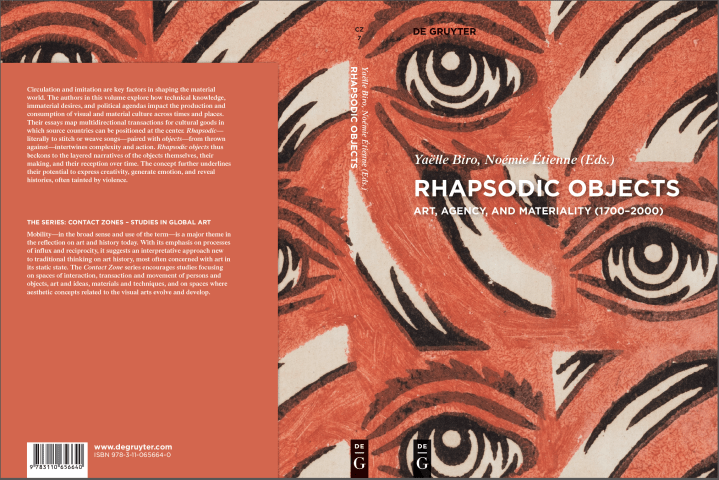
From De Gruyter:
Yaëlle Biro and Noémie Étienne, eds., Rhapsodic Objects: Art, Agency, and Materiality, 1700–2000 (Berlin: De Gruyter, 2022) 236 pages, ISBN: 97-83110656640, $80. Also available as a free PDF file from the publisher.
Circulation and imitation are key factors in shaping the material world. The authors in this volume explore how technical knowledge, immaterial desires, and political agendas impact the production and consumption of visual and material culture across times and places. Their essays map multidirectional transactions for cultural goods in which source countries can be positioned at the center. Rhapsodic—literally to stitch or weave songs—paired with objects—from thrown against—intertwines complexity and action. Rhapsodic objects thus beckons to the layered narratives of the objects themselves, their making, and their reception over time. The concept further underlines their potential to express creativity, generate emotion, and reveal histories—often tainted with violence.
Edited by Yaëlle Biro (Metropolitan Museum of Art) and Noémie Étienne (Universität Bern).
C O N T E N T S
Yaelle Biro and Noemie Etienne, Introduction
Part 1 | Interlaced Patterns
• Dorothy Armstrong, Wandering Designs: The Repossession of the ‘Oriental’ Carpet and Its Imaginary
• Aziza Gril-Mariotte, The Art of Printed Textiles: Selecting Motifs in the Eighteenth Century
• Chonja Lee, Chintzes as Printed Matter and Their Entanglement within the Transatlantic Slave Trade around 1800
Part 2 | Embedded Relationships
• James Green, Interpretations of Central African Taste in European Trade Cloth of the 1890s
• Helen Glaister, The Picturesque in Peking: European Decoration at the Qing Court
• Rémi Labrusse and Bernadette Nadia Saou-Dufrêne, Cultural Intersections and Identity in Algeria on the Eve of the French Invasion: The Case of the Bey Palace in Constantine
Part 3 | Crafted Identities
• Ashley V. Miller, ‘What Is Colonial Art? And How Can It Be Modern?’: Design and Modernity in France and Morocco, 1925
• Victoria L. Rovine, Crafting Colonial Power: Weaving and Empire in France and French West Africa
• Thomas Grillot, A World of Knowledge: Recreating Lakota Horse Effigies
• Gail Levin, Frida Kahlo’s Circulating Crafts: Her Painting and Her Identities
Authors
Picture Credits
New Book | Luisa Roldán
On this day (10 January) in 1706, Luisa Roldán died, as both a celebrated and impoverished artist. From the Getty Store:
Catherine Hall-van den Elsen, Luisa Roldán (Los Angeles: Getty Publications, 2021), 144 pages, ISBN 978-1606067321, $40.
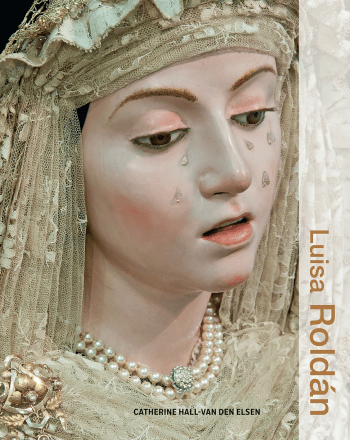 This initial book in the groundbreaking new series Illuminating Women Artists is the first English-language monograph on the extraordinary Spanish Baroque sculptor Luisa Roldán.
Luisa Roldán (1652–1706), also known as La Roldana, was an accomplished Spanish Baroque artist, much admired during her lifetime for her exquisitely crafted and painted wood and terracotta sculptures. Roldán trained under her father and worked in Seville, Cádiz, and Madrid. She even served as sculptor to the royal chambers of two kings of Spain. Yet despite her great artistry and achievements, she has been largely forgotten by modern art history. Written for art lovers of all backgrounds, this beautifully illustrated book offers an important perspective that has been missing—a deeper understanding of the opportunities, and the challenges, facing a woman artist in Roldán’s time. With attention to the historical and social dynamics of her milieu, this volume places Roldán’s work in context alongside that of other artists of the period, including Velázquez, Murillo, and Zurbarán, and provides much-needed insight into what life was like for this trailblazing artist of seventeenth-century Spain.
Catherine Hall-van den Elsen studied Spanish art at La Trobe University in Melbourne, Australia. She completed her MA and PhD on the life and work of Luisa Roldán.
C O N T E N T S
Series Foreword
Preface
Introduction
1 Women in Early Modern Spain
2 Sculpture in Early Modern Seville
3 Andalucía: Building a Career
4 Madrid: Challenge and Opportunity
5 Luisa Roldán through the Lenses of History
Chronology
Notes
List of Extant Works in Public and Church Collections
A Selection of Further Reading
Image Credits
Index
Call for Papers | Close Encounters: The Low Countries and Britain

Jacob Jordaens, A Maidservant with a Basket of Fruit, and Two Lovers, detail, 1629–35
(Glasgow: Kelvingrove Art Gallery and Museum)
◊ ◊ ◊ ◊ ◊
From the RKD:
Close Encounters: Cross-Cultural Exchange between the Low Countries and Britain, 1500–1800
RKD – Netherlands Institute for Art History, The Hague, 22 September 2022
Proposals due by 1 March 2022
The risks and challenges of migration are of compelling interest today. Over the last thirty years, research on early modern artists’ migration and on cultural exchange between the Low Countries and Britain has advanced rapidly, and has addressed many themes. The Dutch and Flemish artists’ communities in London, and the careers of individual artists at the English/British and Scottish courts, in particular, have received attention, as has the history of the collecting of Netherlandish art in the UK.

Gerrit van Honthorst, King Charles I, 1628 (London: NPG).
On 22 September 2022, a symposium at the RKD – Netherlands Institute for Art History will mark the launch of the heavily annotated and illustrated digital English language version of Horst Gerson’s chapter on ‘England’ from his Ausbreitung und Nachwirkung der holländischen Malerei des 17. Jahrhunderts of 1942 (The Dispersal and Legacies of Dutch 17th-Century Painting). For historians of Dutch 17th-century painting, in 1942, Gerson’s study of the integration of Dutch art in Britain was largely uncharted territory, although earlier British art historians, including Horace Walpole and C.H. Collins Baker, had been well aware of the involvement of Netherlandish migrants and visitors in art in the British Isles. The launch of the translated and annotated version of Gerson’s text marks the perfect occasion to discuss, contextualize, and rethink his original ideas in the light of present and developing knowledge.
The organizers welcome unpublished contributions on a broad range of areas relating to Dutch and Flemish artists, artisans and art production in Britain. These include: painting, drawing, graphic arts, tapestry, sculpture and architecture, collecting and the art market, as well as the contribution of Dutch and Flemish migrants to many forms of material culture.
Papers will be 20 minutes long, and might address the following themes and questions:
• Fresh approaches to the careers of practitioners from the Low Countries at the English/British and Scottish courts, and in UK urban centres (including monographic studies).
• How did those courts and urban centres function as hubs of cross-cultural exchange between individuals, and of production?
• Less-studied works by Dutch and Flemish artists and artisans who were active in Britain between 1500 and 1800.
• What were the workshop practices and techniques employed by Dutch and Flemish artists and artisans in Britain, and how did these inter-act with local artistic traditions and impact on technical and art literature?
• What were the social networks and professional relationships that linked and supported Netherlandish and British makers, art dealers and collectors?
• What was the market for Dutch and Flemish artistic goods in Britain, and how did it develop over time?
Please submit a preliminary title, abstract (max. 300 words) and a short CV to Angela Jager (jager@rkd.nl) and Rieke van Leeuwen (leeuwen@rkd.nl) before 1 March 2022. Speakers will be notified by 1 April 2022. Selected presentations will be considered for publication.
Close Encounters will be a hybrid symposium to allow for national and international COVID-19 restrictions. Speakers and attendees may choose whether to participate in person or online. For those presenters who decide to come to The Hague, travel and accommodation expenses will be covered (in consultation with the organization).
Academic Committee
Karen Hearn (University College London), Angela Jager (RKD), Sander Karst (University of Amsterdam), Rieke van Leeuwen (RKD), David A.H.B.Taylor (Independent; previously National Trust and National Galleries Scotland) and Joanna Woodall (Courtauld Institute of Art, London)
Online Publication | Gerson Digital
Published online and freely accessible by the Netherlands Institute for Art History, the RKD (Rijksbureau voor Kunsthistorische Documentatie) . . .
Gerson Digital — Dispersal and After-Effect of Dutch Painting of the 17th Century
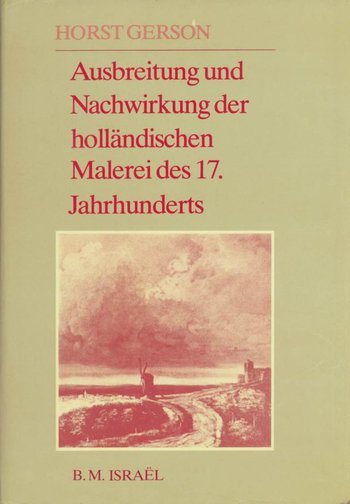 The series of Gerson Digital is a translated, critically annotated, and illustrated edition of Horst Gerson’s Ausbreitung und Nachwirkung der holländischen Malerei des 17. Jahrhunderts (Dispersal and After-Effect of Dutch Painting of the 17th Century, 1942/1983), supplemented with new articles on artistic exchange and transnational mobility of artists from the Low Countries in the early modern period. So far, the following volumes have been published:
1 Gerson Digital: Poland (2013/2014)
2 Gerson Digital: Denmark (2015)
3 Gerson Digital: Germany I (2017/2018)
4 Gerson Digital: Germany II (2018)
5 Gerson Digital: Italy (2019)
6 Masters of Mobility (2020)
Exhibition | Alison Watt: A Portrait without Likeness

Alison Watt, Centifolia, detail, 2019, oil on canvas, 76 × 62cm
(Collection of the Artist, © Alison Watt)
◊ ◊ ◊ ◊ ◊
Closing this month at the Scottish National Portrait Gallery:
Alison Watt: A Portrait without Likeness
Scottish National Portrait Gallery, Edinburgh, 17 July 2021 — 9 January 2022
Curated by Julie Lawson
Alison Watt (born 1965) is widely regarded as one of the leading painters working in the UK today. This significant body of new work consists of sixteen paintings made in response to the practice of the celebrated eighteenth-century portrait artist Allan Ramsay (1713–1784) and are on show for the first time.
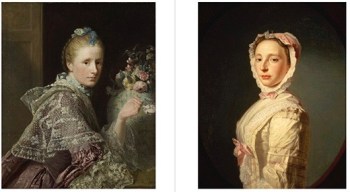
Left: Allan Ramsay, Portrait of the Artist’s Wife, Margaret Lindsay of Evelick, 1758–60, 74 × 62 cm (National Galleries of Scotland). Right: Allan Ramsay, Portrait of the Artist’s Wife, Anne Bayne, ca.1739, 68 × 55 cm (National Galleries of Scotland).
Alison Watt | A Portrait Without Likeness explores the artist’s continuing fascination with Ramsay’s portraits. Watt, most known for her beautiful and intricate large-scale paintings of drapery and folds, has long been an admirer of Ramsay’s portraits of women, in particular the intensely personal images of his first and second wives, Anne Bayne (died 1743) and Margaret Lindsay of Evelick (1726–1782). Both portraits reside in the Gallery’s collection and will be shown alongside Watt’s new work.
The exhibition is the fruit of a long period of study of Ramsay paintings, in addition to the drawings and sketchbooks from his extensive archive held by National Galleries of Scotland. Watt has said, “Looking into an artist’s archive is to view the struggle that takes place to make a work of art. A painting is a visual record of the inside of the artist’s mind. A painting is something that takes place over time; it is not static. To look at a work of art is to engage with an idea, and that is not a one sided activity. It’s more of a conversation.”
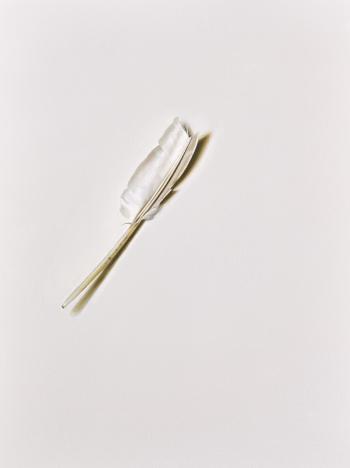
Alison Watt, Fortrose, 2019, oil on canvas, 61 × 46 cm (Collection of the Artist © Alison Watt).
A Portrait Without Likeness is accompanied by a publication featuring conversations between the artist and Julie Lawson, the Chief Curator of European, Scottish Art, and Portraiture at National Galleries of Scotland, who has curated the exhibition, as well as an essay from art historian Dr Tom Normand and a new work of short fiction by Booker Prize-nominated novelist Andrew O’Hagan.
Normand writes: “The fascination with flowers is uncommon within Watt’s oeuvre, but she has recently been engaged with the works of Allan Ramsay held in the Scottish National Portrait Gallery. Most particularly she has reflected upon his painting The Artist’s Wife, Margaret Lindsay of Evelick, painted between 1758 and 1760. This is an exquisite and mysterious portrait. At one level a tender study of his second wife, some thirteen years younger than the artist, at another a poignant essay on the enigma of human passion.”
Alison Watt, Julie Lawson, Tom Normand, and Andrew O’Hagan, Alison Watt: A Portrait without Likeness (Edinburgh: National Galleries of Scotland, 2021), 96 pages, ISBN: 978-1911054450, £20.
New Book | Scottish Portraiture, 1644–1714: David and John Scougall

From Brepols:
Carla van de Puttelaar, Scottish Portraiture, 1644–1714: David and John Scougall and Their Contemporaries, 2 vols. (Turnhout: Brepols, 2021), 756 pages, ISBN: 978-2503597270, €195.
This book is the first comprehensive publication on Scottish portraiture from the period 1644 to 1714, with an emphasis on the painters David Scougall (1625–1685) and his son John Scougall (1657–1737). It is based on in-depth art historical and archival research. As such, it is an important academic contribution to this thus far little-researched field. Virtually nothing was known about the Scougall portraitists, who also include the somewhat obscure George Scougall (active c. 1690–1737). Thorough archival research has provided substantial biographical information. It has yielded life dates and data on family relations and also has shown that David Scougall had two parallel careers: as a portrait painter and as a writer (solicitor). The legal community in which the Scougalls were embedded has been defined, as well as an extended group of sitters and their social, economic, and family networks. The book includes a catalogue raisonné of the oeuvre of David Scougall.
The most important contemporaries of the Scougalls were the portraitist L. Schüneman (active c. 1655/60–1667 or slightly later); his successor James Carrudus (active c. 1668–1683 or later), whose work is identified for the first time in this book; David Paton (c. 1650–in or after 1708); Jacob Jacobsz. de Wet (1641/42–1697); and Sir John Baptist Medina (1659–1710). Their lives and work are discussed. An extensive survey of Scottish portraits, with an emphasis on the work of the Scougall painters, is presented for the period 1644 to 1714. Numerous attributions to various artists and sitter identifications have been established or revised. An overview of the next generation is provided, in which the oeuvres and biographical details are highlighted of the principal portrait painters, such as William Aikman (1682–1731), Richard Waitt (1684–1733), and John Alexander (1686–1767). Numerous paintings have been photographed anew or for the first time and have been compared in detail, which had hardly been done before, while information is also included on technical aspects and original frames. The resulting data have been complemented by analysing the social and (art-) historical context in which the portraits were made. The works of the portrait painters in Scotland from this period, as this book shows, now form a solid bridge between the portraits painted prior to George Jamesone’s death in 1644 and those by the renowned Scottish painters of the eighteenth century.
Carla van de Puttelaar (b. 1967, Zaandam, The Netherlands) is an artist and art historian. She holds a PhD in art history from Utrecht University (2017). In 1996, she graduated from the Gerrit Rietveld Academy in Amsterdam. Since then, her photographic work has gained worldwide recognition, and has been exhibited and published extensively. Her skills as a photographer were an important asset in producing the illustrations with which this publication is so lavishly furnished.
C O N T E N T S
Volume 1 — The Scougalls and Their Circle
Abbreviations
Foreword
Acknowledgements
Introduction
Current State of Published Research on the Scougalls and Their Circle and the Appreciation of Their Work Through the Centuries
The Elder Scougall/Old Scougall and the Younger Scougall
Dates and Scarcity of Known Archival Material
Artistic Context: Painting in Scotland, the Start of a Portrait Tradition, c. 1575–1660
David Scougall (Edinburgh, 1625–1685), His Life and Career
Emerging from the Shadows
Father and Son, John (d. after 13 October 1627) and David (1625–1685)
Writer and Painter
Family Patrons
The Outset of a Career
Father and Son, David (1625–1685) and John (1657–1737)
The Advocate’s Close
The Profession of a Writer or Clerk in the Time of David Scougall
The Profession of a Painter in the Time of David Scougall
Possible Teachers and Family Creativity
Decline and Death
Skougall or Scougall
Personal Network, Legal Community, and Further Family Relations
John Scougall (Edinburgh, 1657–1737), His Life and Career
A Long and Prosperous Life
Becoming a Limner
Family Patrons
Increased Prosperity
Lack of Competition
1694: A Year of Important Changes
Decline in Skill and Death
David Scougall: The Oeuvre, Characteristics, Development, and Sources of Inspiration
The Outset of a Career
Core Works, the Basis for a Compilation of the Oeuvre
Associated Works
Miniatures or Pocket Pictures
Stylistic Features and Motifs
Consistency in Style
Late Works, 1675–1685
Technical Aspects of David Scougall’s Paintings
Technical Research and Painting Technique
Painting Materials
David Scougall as a Copyist
Costumes and Jewellery
Use of Motifs from Portraits by Other Painters
No Inventor, but Painting Real People
Production
Studio Practice and Legal Community
John Scougall: The Oeuvre, Characteristics, Development, and Sources of Inspiration
The Early Years
Indisputable Works
Associated Works
Use of Motifs from Portraits by Other Painters
Stylistic Features and Motifs
Technical Aspects of John Scougall’s Paintings
Technical Research and Painting Technique
John Scougall as a Copyist
Production
Mending and Washing
Studio Practice and Apprentices
George Scougall (b. 1670?, active c. 1690– c. 1737)
Lack of Biographical Data
In the Studio of John Scougall
Inadequate Traces of Work
Clients/Sitters
Nobility and Clergy
Clients and Religious Beliefs
Loyal Patrons
Bonding Portraits
Competition from Abroad
Ladies and Gentlemen
Portraying Children
Problems in Sitter Identification
Known Sitter, but Problem in Period and Handling
Portraits Telling the Truth?
Scougall’s Clients, Where Were They Based, and the Painter’s Studio
Backs and Frames
The Back of the Painting
Period Frames
Prices for Portraits and Frames
Prices for Portraits by David Scougall, 1664–1683
Prices for Portraits by John Scougall, 1674–1728
Prices for Frames
The Contemporaries of the Scougalls
John Michael Wright (1617–1694)
L. Schüneman (active c. 1655/60–1667 or shorty after)
James Carrudus (active 1671 or earlier–1683 or later)
David Paton (c. 1650–in or after 1708)
Thomas Murray (1663–1735)
Jacob Jacobsz. de Wet (1641/42–1697)
Portraits, Painters Unknown
Painters, Portraits Unknown
Sir John Baptist Medina (1659–1710)
The Next Generation
William Aikman (1682–1731)
Richard Waitt (1684–1733)
John Alexander (1686–1767)
John Smibert (1688–1751)
And Beyond
Summary and Conclusion
Appendices
Appendix I: The Scougall Family, Reconstruction of the Family Tree
Appendix II: Transcriptions of Various Archival Documents Concerning the Scougall Painters
Appendix III: The Mysterious Portrait of ‘John Scougall’
Appendix IV: Transcription of the Memoir by Sir John Clerk of Penicuik, 1st Baronet (1649–1722) of His Wife Elizabeth Henderson, Lady Clerk (1658–1683)
Volume 2 — Catalogue Raisonné of the Paintings by David Scougall (1625–1685)
Introduction
Glossary
Catalogue A: Authentic Works
Catalogue AW: Works Known Only from Written Sources
Catalogue B: Copies by David Scougall after Works by Others
Catalogue C: Doubtful Works
Catalogue D: Works Known Only through Copies and Prints
Catalogue E: Rejected Works
Concordance
Notes
Bibliography
Websites
Guides to Houses and Other Venues
Exhibitions
Inserted Details
Index
New Book | Uncommon Sense: Jeremy Bentham
From the University of Virginia Press:
Carrie Shanafelt, Uncommon Sense: Jeremy Bentham, Queer Aesthetics, and the Politics of Taste (Charlottesville: University of Virginia Press, 2022), 194 pages, ISBN: 978-0813946863 (hardcover), $95 / ISBN: 978-0813946870 (paperback), $32. Also available as an ebook.
 Infamous for authoring two concepts since favored by government powers seeking license for ruthlessness—the utilitarian notion of privileging the greatest happiness for the most people and the panopticon—Jeremy Bentham is not commonly associated with political emancipation. But perhaps he should be. In his private manuscripts, Bentham agonized over the injustice of laws prohibiting sexual nonconformity, questioning state policy that would put someone to death merely for enjoying an uncommon pleasure. He identified sources of hatred for sexual nonconformists in philosophy, law, religion, and literature, arguing that his goal of ‘the greatest happiness’ would be impossible as long as authorities dictate whose pleasures can be tolerated and whose must be forbidden. Ultimately, Bentham came to believe that authorities worked to maximize the suffering of women, colonized and enslaved persons, and sexual nonconformists in order to demoralize disenfranchised people and prevent any challenge to power.
In Uncommon Sense, Carrie Shanafelt reads Bentham’s sexual nonconformity papers as an argument for the toleration of aesthetic difference as the foundation for egalitarian liberty, shedding new light on eighteenth-century aesthetics and politics. At odds with the common image of Bentham as a dehumanizing calculator or an eccentric projector, this innovative study shows Bentham at his most intimate, outraged by injustice and desperate for the end of sanctioned, discriminatory violence.
Carrie D. Shanafelt is Associate Professor of Literature and Philosophy at Fairleigh Dickinson University.
New Book | Ogata Korin: Art in Early Modern Japan
From Yale UP:
Frank Feltens, Ogata Kōrin: Art in Early Modern Japan (New Haven: Yale University Press, 2002), 240 pages, ISBN: 978-0300256918, $60.
 A lush portrait introducing one of the most important Japanese artists of the Edo period
Best known for his paintings Irises and Red and White Plum Blossoms, Ogata Kōrin (1658–1716) was a highly successful artist who worked in many genres and media—including hanging scrolls, screen paintings, fan paintings, lacquer, textiles, and ceramics. Combining archival research, social history, and visual analysis, Frank Feltens situates Kōrin within the broader art culture of early modern Japan. He shows how financial pressures, client preferences, and the impulse toward personal branding in a competitive field shaped Kōrin’s approach to art-making throughout his career. Feltens also offers a keen visual reading of the artist’s work, highlighting the ways Korin’s artistic innovations succeeded across media, such as his introduction of painterly techniques into lacquer design and his creation of ceramics that mimicked the appearance of ink paintings. This book, the first major study of Korin in English, provides an intimate and thought-provoking portrait of one of Japan’s most significant artists.
Frank Feltens is Japan Foundation Associate Curator of Japanese Art at the Freer Gallery of Art and Arthur M. Sackler Gallery, Smithsonian Institution.
C O N T E N T S
Acknowledgments
Note to the Reader
Introduction
1 Before Painting: Ogata Kōrin and His Turn to Art
2 Of Poets and Flowers: Kōrin’s Early Paintings
3 Art and Family: Kōrin’s Lacquer Works and Hon’ami Kōetsu
4 Heading East: Kōrin in Edo
5 Beyond Ink: Ceramics by Kōrin and Kenzan
6 Toward the End: Kōrin’s Late Work
Epilogue
Notes
Bibliography
Index
Exhibition | France and Russia: Ten Centuries Together

Pierre-François Drais, snuffbox, made in Paris between 1776 and 1789, with portraits added sometime between 1814 and 1830; gold, enamel, and lapis lazuli, mounted with miniatures in watercolour on ivory (London: V&A, 905-1882). The portraits depict Marie Antoinette and her children Marie-Thérèse-Charlotte (1778–1851), the Dauphin Louis (1781–1789), and Louis-Charles the future Louis XVII (1785–1795), along with a sculptured bust of Louis XVI.
◊ ◊ ◊ ◊ ◊
From the press release for the exhibition:
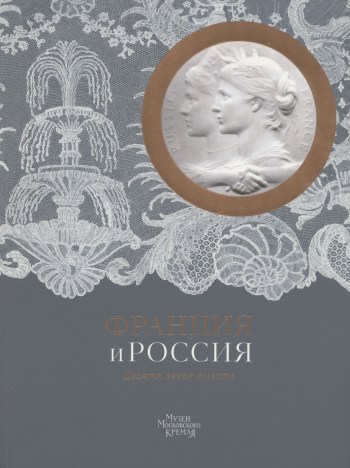
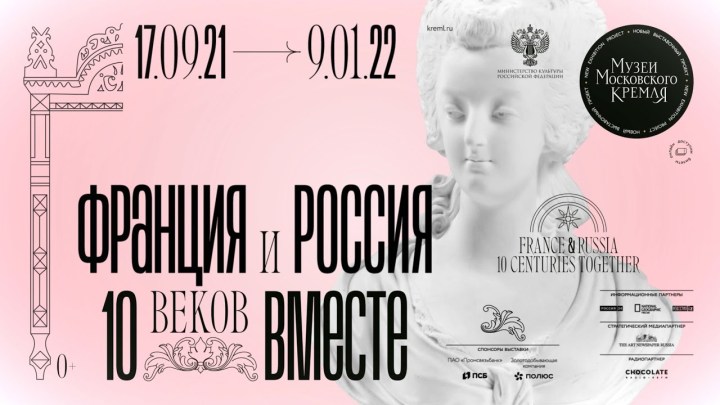
France and Russia: Ten Centuries Together / Франция и Россия: 10 веков вместе
Exhibition Halls of the Patriarch’s Palace and the Assumption Belfry, Moscow, 7 September 2021 — 9 January 2022
The Moscow Kremlin Museums present the exhibition France and Russia: Ten Centuries Together as part of the cross-cultural year between Russia and France, highlighting their interregional cooperation. The project, dedicated to the centuries-long history of cultural and diplomatic relations between the two countries, showcases over two hundred artifacts: memorial objects, archival documents, and artworks from national Russian and European museums. The exhibition explores the history of Russian-French relations through intertwining fates of outstanding personalities including prominent statesmen, scientists, writers, artists, and craftsmen. The chosen approach aims at reconstructing the character of the relationship between the two countries as an immediate, multifaceted, somewhat contradictory, but an ultimately fruitful process for both parties.
 The show opens with a unique charter, dating back to 1063 and recalling the important political event of the 11th century: the dynastic marriage of Princess Anna Yaroslavna, daughter of the Great Prince Yaroslav the Wise, to King Henry I of France. The charter, provided by the National Library of France, is believed to be the only surviving document that bears the handwritten sign of the cross and monogram of King Philip I with his mother’s authentic signature ‘ANA RHNA’ (Queen Anne) placed underneath in Cyrillic letters. Visitors are also afforded the rare opportunity of seeing the Reims Gospel—a unique illuminated manuscript of great cultural and historical significance. Generously offered for the exhibition by the Municipal Library of Reims, it will take centre stage among the key objects on display.
Among the later period pieces featured in the exhibition is a drawing by artist J. Desmarets capturing Peter I and Louis XV in Paris on 11 May 1717 and presented to the Soviet leaders as a diplomatic gift in 1944 to commemorate the visit of Charles de Gaulle, the Chairman of the Provisional Government of the French Republic, to Moscow. The development of the 18th-century political dialogue between Russia and France is chronicled through paintings and sculptures, weapons, textiles, and jewellery commissioned for the Russian Imperial Court from famous French masters or created by prominent French artists invited to Russia. The passion for French art is evidenced by luxurious tapestries, the ceremonial dress of the young Emperor Peter II, the exquisite lacework adorning the gowns of Russian monarchesses, the pieces from the silver Paris set owned by Empress Elizaveta Petrovna, and magnificent weapons, including a pair of pistols belonging to Emperor Peter II and made by the Arquebusier du Roi (royal gunmaker) Jean-Baptiste Laroche.
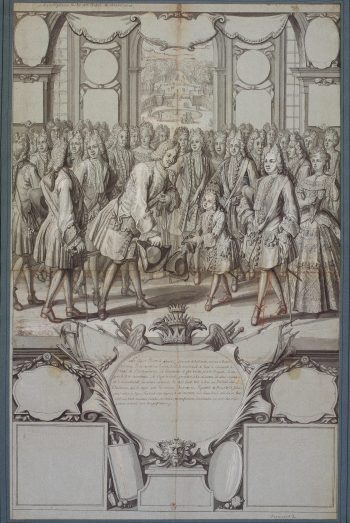
J. Desmarets, Peter I and Louis XV in Paris on 11 May 1717, 1717, ink, watercolour, red chalk, and gouache on tinted paper (Moscow Kremlin Museums)
Portraits from the collection of the Pushkin State Museum of Fine Arts recreate a gallery of outstanding political and cultural figures from the reigns of Empresses Elizaveta Petrovna and Catherine the Great. The section on Catherine the Great’s reign showcases pieces from the legendary Orlov porcelain service executed by the Parisian silversmiths Jacques and Jacques-Nicolas Roettiers along with the precious desk clock with inkstand—the work of a Parisian master—that belonged to the Empress. Unique pieces from the collection of the Pavlovsk Museum and Heritage Site will hark back to Grand Duke Pavel Petrovich and Grand Duchess Maria Feodorovna’s tours of Europe. The years preceding the Great French Revolution are epitomised by the rare memorial objects and are captured in the portraits painted by Élisabeth Vigée-Le Brun, Queen Marie-Antoinette’s favourite artist.
A special section of the exhibition is devoted to relations between Russia and France during the reign of Emperor Alexander I. Here, visitors will see a magnificent cased set of weapons made by the famous French gunsmith and bladesmith Nicolas-Noël Boutet—the gift presented to the Russian governor-general of Paris, Baron Fabian Gottlieb Fürst von der Osten-Sacken from the grateful Parisians. Another highlight is the Olympic porcelain service produced at the Sèvres porcelain factory and presented in 1807 by Napoleon to the Emperor Alexander I in commemoration of the Treaty of Tilsit. The star of the Order of the Holy Spirit, awarded to Alexander I by King Louis XVIII after the former’s victory over Napoleon and the restoration of the monarchy in France, is another showpiece not to miss! The exhibition introduces visitors to the history of ‘Russian Nice’ and feature stories of the World Exhibition that took place in Paris in 1867. It also offers insights into the process of strengthening of Franco-Russian friendship and formation of the Franco-Russian Alliance at the turn of the 19th century.
Participating Institutions
The Moscow Kremlin Museums, the Palaces of Versailles and Trianon, Victoria and Albert Museum, the National Museums of Castles Malmaison and Bois-Préau, National Library of France, the Reims Municipal Library, the State Tretyakov Gallery, the Pushkin State Museum of Fine Arts, the Shchusev State Museum of Architecture, the State Hermitage, Museum and Heritage Site ‘Pavlovsk’, the Russian State Library, the Archive of the Russian Academy of Sciences, the Russian State Archive of Ancient Documents
Svetlana Amelekhina et al. Frantsiia i Rossiia: Desiat’ vekov vmeste / Франция и Россия: 10 веков вместе (Moscow: Muzei Moskovskogo Kremlia, 2021), 383 pages, ISBN: 978-5886783872. Available here»
New Book | Les ébénistes de la Couronne sous le règne de Louis XIV
From Bib des Arts:
Calin Demetrescu, Les ébénistes de la Couronne sous le règne de Louis XIV (Lausanne: La Bibliothèque des Arts, 2021), 448 pages, ISBN: 978-2884532273, €59 / $94.
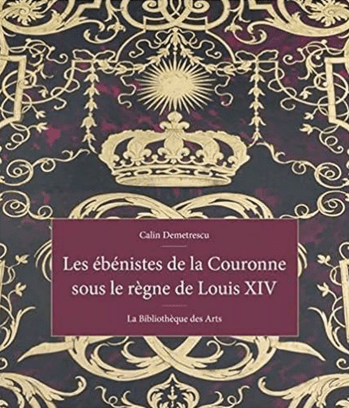
Cet ouvrage est le fruit d’un travail de recherche mené sur plus de dix ans. Par un dépouillement de nombreux documents d’archives, la plupart inédits, l’auteur révèle des aspects méconnus de la biographie des artisans ayant œuvré pour le Garde Meuble de la Couronne et pour les Bâtiments du Roi. Cette approche donne vie aux relations de travail—et de famille—au sein d’une véritable nébuleuse d’artisans (menuisiers ébénistes, bronziers, ornemanistes) français et étrangers, catholiques venus d’Italie et protestants venus des pays du nord de l’Europe.
Une méthode de travail originale, fondée sur l’approche des séries analogiques, a permis des identifications et des attributions d’œuvres majeures : notamment à Alexandre-Jean Oppenordt, par exemple, dont la possible collaboration avec André-Charles Boulle est ici mise en évidence. Outre une étude des œuvres de Domenico Cucci déjà connues, l’auteur propose également une révision des attributions à Pierre Golle ainsi qu’une nouvelle chronologie de l’œuvre d’André- Charles Boulle. Plus de 400 illustrations en couleur documentent utilement la démarche de l’auteur de cette somme qui comblera tous les admirateurs du Grand Siècle et qui sera un outil de travail indispensable pour les conservateurs de musée comme pour les antiquaires et les collectionneurs.
Auteur d’articles et d’ouvrages sur les styles Louis XIV et Régence, Calin Demetrescu, historien d’art, ancien conservateur des musées de la Ville de Bucarest et collaborateur scientifique du département des objets d’art du musée du Louvre pendant plusieurs années, est l’un des spécialistes connus et réputés pour ses recherches et publications relatives aux ébénistes et au mobilier des XVIIe et XVIIIe siècles. Ses découvertes dans le domaine ont permis des avancées notables dans les connaissances sur les ébénistes de cette période, dont ceux faisant l’objet de cette remarquable étude. Sa thèse sur le sujet reçut le Prix Georges-Nicole de la Société d’Histoire de l’Art français.










 Enfilade
leave a comment