Call for Papers | Image and Text in Travel Narratives
From the Call for Papers:
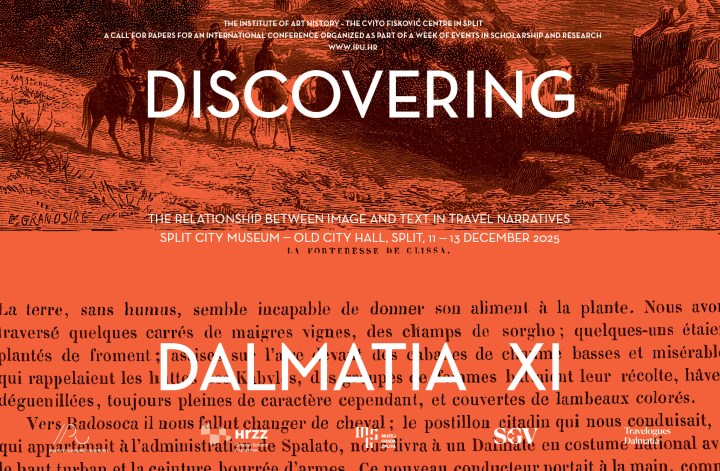
Discovering Dalmatia XI
The Relationship Between Image and Text in Travel Narratives
Split, 11–13 December 2025
Proposals due by 15 July 2025
Keynote Speaker: Heather Hyde Minor, Professor of Art History, Concurrent Professor of Romance Languages and Literatures, University of Notre Dame
Travelogues take shape through the wide range of travel experiences recorded in books, periodicals, diaries, letters, drawings, paintings, prints, and photographs. They represent invaluable historical and cultural sources in which textual and visual narratives are often intertwined in order to convey complex impressions of places, people, and cultural heritage in as much detail as possible. In forming such responses, artist-authors are engaged in an intense dialogue with place, often leaving behind experiences recorded in both text and image. These documents of experience strongly mark, in turn, the spaces they mediate, often becoming models themselves for future travel writers. Among those regions recorded in travel narratives, Dalmatia occupies a significant place: often depicted in this rich relationship between image and text, these together shape a layered perception of its complex identity.
This year’s Discovering Dalmatia conference in Split is specifically dedicated to exploring the ways in which these two forms of representation intertwine within the travel genre. The focus will be on the dynamic relationship between words and images: on the function of visual elements (illustrations, graphics, photographs) within, and alongside, the travel text, and on how—together—they shape the narrative tone of the travelogue and the perception of a particular place. We encourage presenters to think about diachronic perspectives—which follow changes in the relationship between image and text over time—as well as the dialogical nature of this interaction, and how this might raise questions about authorship, credibility, cultural translation, and intermediality in travel literature.
The visual component of the travelogue has often worked to confirm the credibility of the text or to attract a reading audience fascinated by the ‘exotic’ southeastern edge of Europe. At the same time, images bring their own visual rhetoric—sometimes supporting and sometimes replacing the written narrative. Theoretical approaches that consider image and text not as parallel, but as interdependent semiotic systems, are necessary for understanding the specifics of the travel genre. We therefore invite contributions that offer theoretical reflections on this relationship, or which discuss concrete case studies, particularly those concerning travel accounts about Dalmatia and within the intense period of study trips to the region from the eighteenth to the mid-twentieth century.
The conference aims to bring together scholars from different disciplines—the history of art, architecture, literature, visual culture, anthropology, and media studies—to reflect on how the interrelationship between image and text in travelogues contributes to the construction of meaning, memory, and cultural identity. Dalmatia, with its rich presence in the European travel writing tradition, offers particularly fertile ground for such research.
We ask participants to reflect on two central questions:
• How do visual and textual representations of places, particularly Dalmatia, work together in shaping perceptions of space, heritage, identity, and otherness?
• What historical and conceptual models help us understand the relationship between image and text in travel literature?
We welcome proposals that examine a wide range of travel material that combines text and image. It is our hope that the conference will contribute to a deeper understanding of various aspects of the interplay of image and text, to promote rich reflections on Dalmatia’s place in the European cultural imagination, as well as to defining the travelogue as an autonomous, multidisciplinary, and multimedia practice. Proposals for 20-minute papers, consisting of a 250-word abstract and a short CV in Croatian or English, should be sent via email as a PDF attachment to discoveringdalmatia@gmail.com by 15 July 2025.
Registration will take place on the evening of the 10th of December, the closing address will take place on the 13th of December, and the hosts will organise coffee and refreshments for conference participants during breaks. No participation fee will be charged for this conference. The organisers do not cover travel and accommodation costs. The organisers can help participants to find reasonably-priced accommodation in the historic city centre. Papers and discussions will be conducted in English. The duration of a spoken contribution should not exceed 20 minutes. Presentations will be followed by discussions. We propose to publish a collection of selected papers from the conference.
Scientific Committee
Joško Belamarić (Institute of Art History – Cvito Fisković Centre Split)
Davide Lacagnina (University of Siena, School of Specialization in Art History)
Tod Marder (Rutgers University, Department of Art History)
Katrina O’Loughlin (Brunel University London)
Cvijeta Pavlović (University of Zagreb, Faculty of Humanities and Social Sciences, Department of Comparative Literature)
Marko Špikić (University of Zagreb, Faculty of Humanities and Social Sciences, Department of Art History)
Ana Šverko (Institute of Art History – Cvito Fisković Centre Split)
Elke Katharina Wittich (Leibniz Universität Hannover)
Sanja Žaja Vrbica (University of Dubrovnik, Arts and Restoration Department)
Organizing Committee
Joško Belamarić (Institute of Art History – Cvito Fisković Centre Split)
Tomislav Bosnić (Institute of Art History – Cvito Fisković Centre Split)
Ana Ćurić (Institute of Art History)
Katrina O’Loughlin (Brunel University London)
Ana Šverko (Institute of Art History – Cvito Fisković Centre Split)
Sanja Žaja Vrbica (University of Dubrovnik, Arts and Restoration Department)
The conference is organized as part of the Croatian Science Foundation project Travelogues Dalmatia IP-2022-10-8676.
Call for Papers | The Ancient Mediterranean and the British Museum

Charles Roberts, At the British Museum — A Peripatetic Art Lecturer, wood-engraving, from the periodical The Graphic (5 November 1881), p. 476 (London: The British Museum, EPH-ME.705). Features a group of women listening to a female guide at the south end of the main sculpture gallery of the British Museum.
◊ ◊ ◊ ◊ ◊
From ArtHist.net:
The Ancient Mediterranean and the British Museum: Pasts and Futures
Senate House, Malet Street, London, 25–27 February 2026
Proposals due by 16 June 2025
The Department of Greece and Rome at the British Museum and the Institute of Classical Studies are inviting proposals for contributions to a conference exploring the past impact and future potential of the Museum’s collections from the ancient Mediterranean world. The conference is being organised in the context of the British Museum’s ‘Masterplan’, a once-in-a-century opportunity to redisplay and re-interpret the collections from the ancient Mediterranean, Egypt, Assyria, and the Middle East for twenty-first century publics. The Department of Greece and Rome is one of the Museum’s curatorial departments leading this work.
To avoid the repetition of old narratives and to ensure that the redisplay of the galleries is based on a comprehensive reimagining of the Museum’s collections, the Department considers it vital to explore the ways in which the Museum’s collections and displays have influenced (for better or worse) modern constructions of Mediterranean antiquity. We wish to invite the widest possible range of contributions and perspectives to inform this reflection. A dialogue has already begun, in a public seminar series co-organised with our neighbour, the Institute of Classical Studies (Revisiting the Ancient Mediterranean World at the British Museum). This conference, also in partnership with the ICS, aims to extend the conversation. Whether you engage with the Museum and its ancient Mediterranean collection academically, creatively, professionally, or in other ways, we invite you to help us investigate its history and plan for the future.
We will consider proposals for single or paired papers of 20–30 minutes each in length that reflect any line of research relevant to the ways in which the Museum’s ancient Mediterranean collections have shaped and been shaped by culture, politics and society, from the Museum’s foundation in 1753 to the present day. We particularly welcome papers on topics related to the three strands described below, which we have identified as particularly promising areas for exploration. While the focus of the conference will be on the British Museum and on the ancient Mediterranean, we also welcome proposals which introduce cross-institutional, comparative, or international perspectives. Proposals for alternative formats, such as panel discussions or creative workshops, are also encouraged.
Artistic Engagement
How have artists and other makers (including for example filmmakers and craftspeople) engaged with the British Museum’s collections from the ancient Mediterranean? What was the impact of the collection and its display on artistic practice, and vice-versa? The role of the Parthenon Sculptures in inspiring artists of the early nineteenth century is well-known, as is the extensive use of the Townley and later Graeco-Roman sculpture galleries for the training of artists (Jenkins 1992). There has been vibrant engagement with the classical world, in general, by modern and contemporary artists (Holmes 2017; Squire et al 2018). But there is much more to uncover about artistic engagement with the British Museum’s collection.
Literary Engagement
From Lord Byron to HD and beyond, the British Museum is well-known as a site of poetic inspiration and provides a setting and reference-point in numerous works of literature (Ellis 1981; Stallings 2023). What do literary receptions make of the British Museum’s ancient Mediterranean collection? Has attention been concentrated on certain objects or tropes, and which figures and receptions have been overlooked to date? In what ways do the Museum’s collections from the ancient Mediterranean continue to inspire and provoke contemporary literature?
Scholarship and Intellectual History
The role of museums in the evolution of academic disciplines is an established topic of study (Marchand 1996; Dyson 2006). We welcome papers that examine how the British Museum’s collections and galleries have been instrumental in shaping approaches to the material culture of the ancient Mediterranean, or to understandings of ancient societies more widely. How has their interrelation with academic disciplines such as Archaeology, Classics, and Art History changed over time? What have been the impacts of the British Museum’s approach to chronological, regional, and thematic display to the representation of different ethnicities or the division of material into different curatorial departments? Have the particular strengths and omissions of the British Museum collection directed or limited the field of study of the ancient Mediterranean world?
Through all these themes and throughout the conference will be threaded questions of the Museum’s relationship with social, political, and historical contexts, including colonialism, imperialism, nationalism, gender, race, and class. How and why did collections from the ancient Mediterranean take on such prominence in the British Museum? To what extent has the British Museum reinforced messages of power and control? What histories have been neglected and elided? Are there also narratives of subversion and resistance to be found?
The conference will be held in-person only at Senate House (Malet St, London WC1E 7HU) from Wednesday 25th to Friday 27th February 2026. Abstracts of maximum 300 words should be submitted by Monday 16th June 2025, together with a short (100 words) speaker biography. A limited number of travel bursaries will be available to help support attendance for speakers who cannot access alternative sources of funding. Please indicate in your submission if you would need to apply for a bursary and we will be in touch with details of the separate application process. Please send paper proposals to Dr Isobel MacDonald, IMacdonald@britishmuseum.org.
This conference is co-sponsored by the British Museum and the Institute of Classical Studies, University of London School of Advanced Study.
Call for Papers | England in Thuringia: Art, Sports, Gardens, Architecture
From ArtHist.net:
England in Thüringen: Kunst, Sport, Gärten, Architektur
Friedenstein Stiftung Gotha, 7–9 May 2026
Proposals due by 6 June 2025
Die historischen Verbindungen Englands nach Thüringen sind vielfältig und reichen weit in die Geschichte zurück. Ein Fundament dieser Beziehungen liegt in den dynastischen Allianzen des Thüringer Adels zum englischen Königshaus: 1736 heiratete Augusta von Sachsen-Gotha-Altenburg den englischen Prinzen Friedrich Ludwig von Wales. Ihr gemeinsamer Sohn bestieg als König George III. den englischen Thron. Adelheid von Sachsen-Meiningen wurde 1818 durch ihre Heirat mit Prinz William, Herzog von Clarence, dem späteren König William IV., Königin von Großbritannien und Irland. Weil das Paar keine überlebenden Kinder hatte, fiel die britische Krone 1837 an Adelheids Nichte Victoria, die 1840 ihren Cousin Albert von Sachsen-Coburg und Gotha heiratete. Mit deren Sohn Alfred und dem Neffen Carl Eduard regierten später ‘Engländer’ das Herzogtum Sachsen-Coburg und Gotha.
All diese dynastischen Verbindungen stärkten die politischen und kulturellen Beziehungen zwischen Großbritannien und Thüringen. Bislang kaum betrachtet wurde jedoch, wie weitreichend die damit einhergehenden kulturellen Impulse nach Thüringen waren, insbesondere im Bereich der Gärten, der Kunst, des Sports, und der Architektur. So inspirierten im 18. und 19. Jahrhundert englische Gärten maßgeblich die Gestaltung von Parks und Landschaften in Thüringen, zudem brachte die Industrialisierung englische Technologien und Geschäftsmodelle nach Thüringen, wodurch sich die Region wirtschaftlich weiterentwickelte. Literarisch und kulturell wirkten die Werke von William Shakespeare, sowie die Ideen der Aufklärung aus England auf deutsche Schriftsteller und Denker, insbesondere in Weimar.
Mit Schwerpunkt auf der Zeit zwischen der Mitte des 18. Jahrhunderts bis zum Ausgang des viktorianischen Zeitalters Anfang des 20. Jahrhunderts sollen in der Tagung die kulturellen Einflüsse Englands auf Thüringen wissenschaftlich beleuchtet werden. Inwiefern beförderten die dynastischen Beziehungen zwischen den beiden Ländern den kulturellen Transfer? Welche Persönlichkeiten traten besonders als Vermittler:innen der englischen Kultur hervor? Welche Objekte, Phänomene und Ideen wurden übernommen oder als nachahmenswert erachtet? Wie nahmen englische Gäste die Region und ihre Bevölkerung wahr? An welchen Orten in Thüringen lassen sich noch heute die Verbindungen der beiden Länder nachvollziehen?
Diesen und weiteren Fragen will die interdisziplinär angelegte Tagung nachgehen, um neue Erkenntnisse über die Spuren Englands in Thüringen zu gewinnen. Für die Tagung werden Beiträge der Fachrichtungen Geschichte, Kunstgeschichte, Sportgeschichte, Kultur- und Literaturwissenschaft sowie verwandter Fächer erbeten, die sich mit dem Thema befassen, wobei der Fokus der Tagung auf Thüringen, und nicht allgemein auf englisch-deutschen Kulturbeziehungen, liegt.
Die Ausschreibung richtet sich an etablierte Wissenschaftler:innen ebenso wie an Nachwuchswissenschaftler:innen. Die Vortragsdauer beträgt 30 Minuten (plus anschließende Diskussion von zirka 10 Minuten). Eine Publikation der Tagungsergebnisse wird angestrebt. Die Konferenzsprachen sind Deutsch und Englisch. Die Tagungsgebühr beträgt 50 Euro, für Nachwuchswissenschaftler:innen 25 Euro.
Die Tagung wird am Abend des 7. Mai 2026 mit einem Eröffnungsvortrag beginnen, die weiteren Vorträge sind für den 8. und 9. Mai vorgesehen. Geplant ist zudem ein vielseitiges Begleitprogramm mit Besichtigungen bedeutender Thüringer Kulturstätten, das optional wahrgenommen werden kann. Bitte senden Sie Ihren Beitragsvorschlag (1.500 – 2000 Zeichen inkl. Leerzeichen) sowie ihre Kurzbiografie (max. 500 Zeichen) an die Programmkoordinatorin, Frau Angelika Eder, unter: angelika.eder@friedenstein-stiftung.de. Bewerbungsschluss ist der 6. Juni 2025. Fragen richten Sie bitte an angelika.eder@friedenstein-stiftung.de.
Kontakt
Friedenstein Stiftung Gotha
Schlossplatz 1
D-99867 Gotha
angelika.eder@friedenstein-stiftung.de
Call for Papers | Staging the Heroine, 1350–1800
From ArtHist.net:
Staging the Heroine: The Construction and Performance of Female Heroism in
Literature, the Visual Arts, and Theatre, 1350–1800
Leiden University, 3–5 June 2026
Proposals due by 1 September 2025
In early modern culture, heroines are almost omnipresent: they play an important role in narrative fiction and poetry, are described in biographies and collections of epigrams, are depicted in paintings and engravings, rendered in sculptures, and staged in tragedies, melodramas, pastorals, and in the early modern opera. Our conference/project aims at mapping the presence, representation, adaptation, and evaluation of female heroines in literature as well as in the visual and performative arts.
The fundamental aim of the project is to understand how literary, rhetorical, pictorial, and performance-related devices were used to stage heroines across different media. Rhetoric is here understood in a broader sense, e.g., including the literary techniques of heroic characterization and the narratological strategies used to turn actions by women into acts of female heroism. We also include here the conceptualisations of heroic (normally tragic) female characters, as they were prescribed in early modern artes poeticae, often in explicit or implicit dialogue with Aristotle’s influential Poetics. We are further interested in pictorial devices, such as the ability of visual artists to express emotions through the body language and facial expressions of the protagonists, and through the creation of a mis-en-scene. We especially encourage participants to investigate possible cross-fertilisation between artistic fields: how did textual rhetoric influence the visual and performative arts—and vice versa, what role did pictorial rhetoric play in the composition of literary texts, theater plays, or opera? Was there a theatrical manner of staging heroines in painting? We are also interested in the influence of performance practices on the conceptualisation of female heroism: how did the then current embodied techniques that actors and singers used to express emotions influence the construction of the heroine? Were there specific performance guidelines for male actors portraying female characters?
Closely related to this set of questions is another major area of interest to the project, which regards the role that exemplary heroines from classical antiquity and the biblical tradition played in the formation of early modern heroines. What textual and pictorial sources were used by early modern artists and writers, how did they interpret, appropriate, adapt, reshape, and apply them? How do female heroic figures acquire a new configuration or greater heuristic complexity in the translation of sources into another medium, language, or historical or cultural context? How do artworks redefine female heroism in this process of transmission and reception? The project especially encourages cross-medial and/or diachronic analyses of the representation of prominent heroines (e.g., Judith, Dido, Medea). What points of continuity and discontinuity can be discerned in different interpretations and representational strategies of the female heroism of such well-known figures in literature, the visual arts and on the stage? How do differences relate to specific historical circumstances and institutions, and to ongoing philosophical debates about female virtuosity, religious beliefs, intellectual practices, and political developments?
From this perspective, we particularly welcome source-oriented contributions tracing the reception or afterlife of specific textual models. What exactly was the impact of formative models such as the tragedies of Seneca or Ovid’s Epistulae heroidum on the early modern construction of heroines? And what was the role of early modern textual models such as Boccaccio’s 14th-century mythographical works De mulieribus claris and Genealogia deorum gentilium? De mulieribus claris was one of the most successful works of the period, appearing in numerous translations and editions. It would be interesting to map its reception between c. 1360 and c. 1700 and to tease out the role it played in the formation of the early modern heroine. The same is true for other modern models: how did, e.g., the great female figures of vernacular epics like Ariosto’s Orlando furioso or Tasso’s Gerusalemme liberata impact representations of and discourse on female heroism?
Since the project aims at yielding new insights into early modern approaches to female virtue and heroism, literary, rhetorical, and visual analyses should be based on fundamental, culturally grounded questions such as: is there a specific set of female virtues and vices that recur in heroines, and if there is, how does it relate to traditional catalogues of male virtues and male exemplarity? Is mental complexity ascribed to those female characters who were generally portrayed as negative, destructive, or sinful (like Medea or Cleopatra), or rather to those who were positively evaluated for displaying a kind of moral behaviour that was in line with current Christian values? Was it specifically the violation of current moral values that fuelled the early modern fascination with heroines? Was the attention paid to female heroism (and anti-heroism) part of the emerging interest in cultural criticism, e.g. by humanists and other early modern intellectuals? Was it also part of the moral education of males who were taught not to fall victim of so-called destructive women?
We invite proposals that engage with the approaches and questions outlined above. Abstracts (of max. 250 words) should be sent to Christoph Pieper (c.pieper@hum.leidenuniv.nl) by 1 September 2025. We plan to publish the results of the conference as an edited volume in the series Intersections (Brill/De Gruyter) in 2027.
Karl Enenkel (Münster)
Emma Grootveld (Leiden)
Christoph Pieper (Leiden)
Jed Wentz (Leiden)
Call for Papers | Cemeteries as Part of the Landscape
From ArtHist.net:
Cemeteries as Part of the Landscape through the Centuries
Institute of Art History, Czech Academy of Sciences, Prague, 5–6 November 2025
Proposals due by 31 May 2025
The Institute of Art History of the Czech Academy of Sciences cordially invites you to participate in an international interdisciplinary conference focused on funerary culture, which will take place on 5 and 6 November 2025 in Prague. This conference builds upon a long-standing tradition of International Sessions on the Issue of Sepulchral Monuments, aiming to expand both the thematic and methodological scope of the discussion. This year’s theme is Cemeteries as Part of the Landscape through the Centuries, focusing on the role of burial grounds in social, urban, and natural environments. The conference seeks to create a space for scholars from various academic fields and methodological backgrounds and to offer a platform for discussing cemeteries’ historical, anthropological, artistic, and social aspects.
Suggested topics include, but are not limited to, the following:
• Cemeteries as part of the anthropological landscape — the role of cemeteries in collective memory and social identity
• Cemeteries as part of the cultural landscape — the role of burial sites in urban and natural environments, their preservation and transformation
• Cemeteries as part of the social landscape — the social role of burial grounds and their place within human communities
• The ‘sepulchralization’ of public space — from individual graves to family chapels, from churchyards to large cemeteries and memorial complexes, their development and functions across different cultural contexts
Contributions may address all aspects of the above topics, with a preference for materials or methodological approaches relating to Central Europe. We especially welcome contributions by early-career researchers, as well as studies on Jewish or Muslim sepulchral monuments, which may be included in a dedicated conference session. Conference languages: Czech, Slovak, German, and English. No conference fee will be charged.
Presentation formats
• Individual papers (20 minutes)
• Research reports (10 minutes)
• Panel presentations (including student panels)
Selected papers will be published in a collective volume within the Epigraphica & Sepulcralia—monographia series by Artefactum, the publishing house of the Institute of Art History, CAS. Other papers may be considered for publication in the journals Historie–Otázky–Problémy, Archivní časopis, or Studia historica et archivistica. The organizing committee reserves the right to select which papers will be published.
Please submit an abstract (max. 200 words) along with a short academic bio by 31 May 2025 to founova@udu.cas.cz. Authors will be notified of the acceptance or rejection of their papers by 15 June. We look forward to your contributions and engaging discussions.
On behalf of the organizing committee,
Vanda Fouňová, Eva Jarošová, Kristina Uhlíková
Institute of Art History, the Czech Academy of Sciences
Call for Papers | Legacies: Why Museum Histories Matter
From ArtHist.net:
Legacies: Why Museum Histories Matter
Leiden, 13–15 January 2026
Organized by Laurie Kalb Cosmo, Marika Keblusek, and Susanne Boersma
Proposals due by 1 June 2025
The 21st century is a particularly engaging moment to study the history of museums. Due to pressing concerns about new ways to make old art accessible, global art, decolonization, and the social, ecological, and political responsibilities of culture, museums are sustaining great periods of self-reflection and debate. One could argue that museums are renewing their 18th-century Enlightenment origins as institutions of civility and hope, although these values are also undergoing reevaluation and change, in a global world.
Amidst such profound and urgent topics, what about the ideas of museums themselves? How do their storied origins—as private palace collections and Wunderkammern, houses of worship, monuments to the nation, sites of commemoration, or new archistar containers for art—relate to their significance in contemporary life? How do their physical structures, be it cabinets, palaces, white cubes, temples, churches or mausolea, and their collections reflect the museums’ histories, wherever they may be in the contemporary world? How do we navigate the idea of the museum as an inherited construct, within the context of its many debates? What is it about a museum’s past that keeps us curious, and how does it inform what it does in the present?
This international conference invites papers that focus on museums with significant founding histories—broadly defined by their buildings, collections, commemorative functions, collectors, or founders—that are currently engaged in some manner of institutional introspection, by way of exhibitions, acquisitions, restitutions, or renovations. We invite papers that address, but are not limited to, the following questions:
Museums and Buildings
How does architecture shape a museum’s legacy and/or how does legacy shape a museum’s architecture?
Museums and Geopolitics
How do museums respond to war, vis-à-vis their collections, provenance, and national identities of the artists, whose work they exhibit or collect?
Museums and Social Responsibility
As museums take on ownership of their pasts, what do they owe the visiting public, and what do visitors owe them?
Museums and Their Pasts
How can a museum’s history be reconstructed through its collections, exhibitions and building?
Museum Founders and Their Legacies
How do founders’ stipulations inform contemporary museum practices?
Museums in the World
How are the legacies of Western museums realized and/or revised across the globe?
Please submit your abstract (200 words) and author biography (100 words) to Dr. Susanne Boersma via s.w.boersma@hum.leidenuniv.nl by Sunday, 1 June 2025. We welcome applications from the broadest range of researchers, scholars, and museum professionals. You will be notified about the acceptance of your proposal by 1 July 2025.
This in-person conference is organized by Dr. Laurie Kalb Cosmo, Dr. Marika Keblusek and Dr. Susanne Boersma, Leiden University Centre for the Arts in Society.
Call for Papers | Exhibition Catalogues beyond the Visual Arts
From ArtHist.net:
Autres objets, autres enjeux ?
Les catalogues d’exposition hors du champ des arts visuels
Université Grenoble Alpes and Musée dauphinois, 6–7 November 2025
Proposals due by 2 June 2025
Après plusieurs journées d’études appréhendant le catalogue d’exposition d’arts visuels comme un objet d’étude en soi (Paris 2023 et 2024, Bordeaux 2025), ce titre sous forme de question est volontairement provocateur. Il reprend en effet, pour évidemment le questionner, un partage entre musées des Beaux-arts et musées autres qui a structuré la vision des musées du point de vue de l’action publique, et qui a renvoyé dans une catégorie définie par défaut des musées extrêmement divers et hétérogènes. Il s’agit ici d’interroger les formes, les pratiques et les enjeux liés aux catalogues d’expositions et aux publications liées à celles-ci, dans les musées de société, les écomusées ou les musées de science, mais aussi les catalogues dédiés à des œuvres d’art de nature essentiellement allographique, c’est-à-dire qui ne se matérialisent pas dans un objet unique ou en un nombre limité d’exemplaires, mais qui s’incarnent sur le temps long dans des objets dont la diversité ne modifie pas l’œuvre idéale, comme le livre, la partition, et/ou qui s’interprètent sous des formes immatérielles, comme le concert, le spectacle de danse, la représentation théâtrale, etc.
Alors que la mise en exposition de tels artefacts a elle-même déjà fait l’objet de plusieurs travaux dans chacun de ces domaines, le catalogue qui l’accompagne n’a pas encore été vraiment interrogé, pas plus que ces différents domaines n’ont été traités ensemble. La réunion de ces différents domaines, très hétérogènes, doit d’ailleurs être immédiatement interrogée : y a-t-il réellement des différences essentielles entre le catalogue d’une exposition réunissant des œuvres autographiques (peinture, sculpture, etc.) et celui d’une exposition d’œuvres allographiques (littérature, musique, danse, etc.) ? Peut-on considérer les ouvrages édités à l’occasion d’expositions reliées à des problématiques en sciences humaines et sociales, comme des « catalogues », définis plutôt dans ce cas à partir d’un usage lié à la visite d’exposition ?
Existe-t-il vraiment des catalogues « autres », comme on a voulu désigner des musées « autres », ceux qui n’étaient pas des beaux-arts ? Y aurait-il d’un côté les catalogues d’exposition réunissant des artefacts d’abord considérés comme des œuvres d’art, de l’autre des catalogues réunissant des artefacts d’abord compris comme documents ? En retour, dans quelle mesure le choix même de la forme catalogue d’exposition témoigne-t-il du statut que l’on souhaite donner aux artefacts exposés ?
Cette journée d’étude propose de réfléchir à la fois aux similitudes et aux différences, aux enjeux communs et aux spécificités de chaque forme éditoriale, aux passages comme aux rejets, avec l’idée que cette réflexion peut permettre en retour d’éclairer le rôle des différents lieux d’exposition et d’interroger le statut des artefacts comme l’articulation entre le document et l’œuvre d’art. L’appel est donc ouvert aussi bien aux chercheur·euses qu’aux professionnel·les des musées, de l’exposition, de l’édition et de la médiation.
Les propositions pourront s’inscrire dans différents axes, qui ne sont néanmoins en rien exclusifs :
La diversité des formes, des auteur·trices et des échelles
Travailler sur les catalogues d’exposition hors du champ des arts visuels suppose de prendre en compte leur hétérogénéité, en ne se contentant pas d’une définition en creux. Une diversité thématique, d’abord, qui pose la question de la multiplicité des catalogues : peut-on penser de la même manière un catalogue portant sur la littérature ou sur les sciences, sur l’ethnologie ou sur la musique ? Une diversité d’auteur·trices, ensuite. Qui écrit dans des catalogues si divers ? S’agit-il de spécialistes de chacune de ces questions, de professionnel·les des musées ou de la médiation ? Une place peut-elle être faite aux historien·nes de l’art et des images ? Une diversité d’échelles, enfin : si certaines expositions thématiques sont de très grandes manifestations à la fréquentation exceptionnelle, nombre de musées de société sont au contraire de très petites structures. Cela pose donc la question de la possibilité même d’accompagner l’exposition d’un catalogue, et des formes d’édition choisies ou imposées, y compris par le recours à l’auto-édition.
La forme du catalogue
Le catalogue d’exposition artistique a longtemps été défini d’une part par les listes d’œuvres, d’autre part par la présence de notices pour chacune de ces œuvres, enfin par les reproductions. Dans le cadre d’expositions où les objets sont présentés plutôt pour leur valeur d’usage que pour leur valeur esthétique—ou pour leur intérêt tout à la fois documentaire et artistique—comment la forme catalogue d’exposition est-elle investie ? La question de la place des images, et de l’articulation entre texte et image paraît particulièrement pertinente, et participe du statut accordé à chacun des artefacts exposés. Par ailleurs, comment, par le catalogue, rendre compte de mises en exposition spécifiques ? Là où les musées de science misent souvent sur l’interactivité, où les musées de société ont une attention particulière à la participation des publics, l’objet catalogue ne pourrait-il pas sembler dépassé ou désuet ? Le catalogue d’exposition serait-il devenu dans ce cas un livre d’histoire ou un ouvrage accompagnant le thème de l’exposition mais sans faire catalogue ? Enfin, quand la distinction entre beau livre ou monographie d’art et catalogue d’exposition repose souvent sur l’apport heuristique du rapprochement physique des œuvres d’art en un lieu, quelle est la place de catalogues d’exposition de musées de science ou de société par rapport à des ouvrages thématiques sur les mêmes questions ?
Enjeux de médiation
L’un des enjeux principaux des catalogues d’exposition est celle de la médiation auprès des publics, lecteur·rices et spectateur·rices. Quels sont les points communs et les différences avec les catalogues d’expositions artistiques ? Dans quelle mesure les enjeux d’articulation entre science et société sont-ils portés par les catalogues d’exposition et quel public/lectorat est ici visé ? Comment s’emparer de ces enjeux dans un format historiquement et socialement situé ? Alors même que les musées de société mettent l’accent sur un activisme muséal et l’ancrage culturel dans la cité, donnant la parole aux publics, la question est ici double : les catalogues d’exposition peuvent-ils être le support de mémoires et d’histoires jusque-là non racontées, au même titre que les expositions elles-mêmes, et peuvent-ils s’adresser à des publics divers ? Dans quelle mesure ces catalogues peuvent-ils s’appuyer sur une co-construction avec les publics et sur une narration participative ? Enfin, alors même que le catalogue centré sur les arts visuels participe de la construction de la valeur des œuvres d’art, et a donc aussi une fonction économique, quelles fonctions remplissent d’autres formes de catalogues ?
Les propositions de communication (5 000 signes maximum), rédigées en français ou en anglais, seront accompagnées d’une courte bibliographie et de quelques lignes de présentation bio-bibliographique de l’auteur·ice. Elles sont à envoyer par mail jusqu’au 2 juin 2025 aux membres du comité d’organisation :
• Marie Gispert, professeure d’histoire de l’art contemporain, Université Grenoble Alpes, LARHRA : marie.gispert@univ-grenoble-alpes.fr
• Hélène Trespeuch, professeure d’histoire de l’art contemporain, Université Bordeaux Montaigne, CRHA – F.-G. Pariset : helene.trespeuch@u-bordeaux-montaigne.fr
Comité scientifique
Marie-Christine Bordeaux (Université Grenoble Alpes), Alice Buffet (Musée de la Résistance et de la Déportation de l’Isère), Marie-Charlotte Calafat (MUCEM), Olivier Cogne (Musée dauphinois), Marie Gispert (Université Grenoble Alpes), Aziza Gril-Mariotte (Musée des Tissus et des Arts Décoratifs de Lyon / Aix Marseille Université), Joëlle Le Marec (Museum National d’Histoire naturelle), Federica Tamarozzi (MEG, Genève), Hélène Trespeuch (Université Bordeaux Montaigne), Erika Wicky (Université Grenoble Alpes)
Call for Papers | 18th-C. Painting between Italy and the Hapsburg Empire
From ArtHist.net:
Settecento Malerei: Cultural Transfer between Italy and the Habsburg Territories
Department of Art History of the University of Vienna, 23–24 October 2025
Organized by Eleonora Gaudieri and Erika Meneghini
Proposals due by 30 May 2025
This two-day workshop aims to explore 18th-century Italian painting as the focus of transfer phenomena between the Italian peninsula and the territories of the then Habsburg Empire, with Vienna at its centre. The high quality and renowned tradition of Italian painting, fostered by a dense network of international connections, enabled numerous artists of Italian origin or Italians by adoption to pursue successful careers at the Habsburg imperial court in Vienna. This phenomenon must be understood within the context of broader diplomatic and artistic networks that connected Vienna with key centres on the Italian peninsula such as Venice, Bologna, Rome, and Naples.
The beginning of the Settecento was characterised by a considerable expansion of the transalpine art market, driven by a strong interest in collecting Italian artworks. This phenomenon attracted numerous Italian artists, including many painters, to Vienna and to the allied courts of the German prince-electors, such as the Schönborn and Wittelsbach Houses. At the same time, a number of Austrian painters were encouraged to further their training in Italy, where they were profoundly influenced by the local visual language.
The workshop will address two main currents. First, it will investigate the meanings and functions of Italian painting within the socio-political and cultural context of the Habsburg imperial court in Vienna and its allied courts. Second, it seeks to explore the various dynamics that fostered the transfer of Italian painting and Italian artistic knowledge to Vienna and the territories of the then Habsburg Empire. We welcome innovative proposals that address the following topics:
• The reception of Italian painting in Vienna and allied territories, and the role of workshops and art academies in this process
• Italian painting as a medium of Habsburg representation
• The role of regional schools of Italian painting in the context of Viennese and Central European art collections
• Grand Tour and Kavalierstour
• The reconstruction of networks of diplomatic, artistic, and patronage relations
Contributions addressing other topics relevant to the workshop’s main focus are also welcome.
Please send your proposal—in English, German, or Italian—including the title of your presentation, an abstract (approx. 300 words), and a short CV to settecentomalerei@gmail.com by 30 May 2025. Speakers will have 20 minutes for their presentations. Applicants will be informed about the acceptance of their proposals by 30 June 2025. The conference languages are English, German, and Italian. The conditions and procedures for reimbursement of travel and accommodation costs will be communicated following confirmation of participation.
If you have any questions, please contact the organisers:
Dr. Eleonora Gaudieri, eleonora.gaudieri@univie.ac.at
Project assistant (APART-GSK funding programme)
Department of Art History, University of Vienna
Erika Meneghini, erika.meneghini@univie.ac.at
PhD Candidate
Department of Art History, University of Vienna
Call for Papers | Romantic Circulations
From ArtHist.net:
Romantic Circulations
Nordic Association of Romantic Studies Conference
University of Oslo, 10–12 September 2026
Organized by Ellen Rees with Tonje Haugland Sørensen
Proposals due by 1 October 2025
This three-day conference at the University of Oslo invites scholars engaged in the study of romanticism writ large from the expanded Nordic region to present new research on the circulation of romantic ideas and objects. The topic Romantic Circulations encompasses both romantic discourses that arose in the period most typically associated with romanticism, but also the afterlives of romantic ideas, people, objects, discourses, etc. Focusing on processes like dissemination, circulation, and transference, we aim to challenge traditional understandings of the relationship between center and periphery in the spread of romantic discourses and aesthetics. We also posit that the recent turn toward transnational and transdisciplinary aspects of romanticism in scholarship demands a reassessment of approaches, methodologies, and historiographic structures of the field. We therefore encourage meta-theoretical perspectives, as well as meta-critical reevaluations of entrenched narratives about romantic phenomena. We also welcome cultural interventions from various perspectives, including Indigenous, environmental, postcolonial, gender, and other marginalized groups.
With this conference, we aim to expand our understanding of romanticism and explore together how it manifests and adapts in different times, place, and artistic forms. We encourage contributions from a broad range of fields, including art history and visual culture, literary studies, musicology, history of ideas, philosophy, cultural studies and museology, and history.
Keynote Speakers
• Timothy Tangherlini (University of California, Berkeley)
• Stephanie O’Rourke (University of St. Andrews)
We welcome individual proposals as well as pre-constituted panels. Early career scholars are particularly encouraged to apply. Please send an abstract (of no more than 500 words) and a short biography (200 words) by 1 October 2025 to romanticcirculations@gmail.com. Note of acceptance will follow by 1 February 2026.
Organized by Ellen Rees (University of Oslo) in collaboration with Tonje Haugland Sørensen (NARS Executive Committee) and co-funded by the ERC project NORN.
Call for Papers | ‘Deviant’ Women and the Visual Arts
From ArtHist.net:
‘Deviant’ Women and the Visual Arts
University of Bristol, 10 July 2025
Proposals due by 5 May 2025
The Women and the Visual Arts Research Cluster at the University of Bristol is excited to announce our forthcoming symposium taking place at the University of Bristol on Thursday, 10th July 2025. Women have long been viewed as ‘deviant’ in their roles as artists, authors, models, patrons, and collectors. Their paths to becoming artists or patrons may ‘deviate’ from the norm, their chosen medium or subjects may diverge from those expected by the market, and their representations of themselves and those around them may be unorthodox compared to the art historical canon. How can we, as researchers, contextualise this ‘deviancy’ in our work on women and the visual arts?
We welcome submissions that think about women’s ‘deviancy’ in their relationship to the visual arts in diverse ways: women who push the boundaries on what has been seen as the norm or whose work is divergent from accepted standards. While we are explicitly seeking contributions that foreground the visual, we are excited to hear from colleagues working across fields and disciplines, including (but not limited to) history of art, visual culture, classics, film and theatre studies, history, religious studies, and those doing practice-based research.
Potential topics could include, but are not limited to
• Exhibiting and collecting strategies used by women or the curation and collecting of work by women
• Self-representation and self-portraiture — identity and sexuality
• Transnational feminine identities — culture, race, immigration, and exile
• The nude and representations of the body
• The archive — the formation of celebrity, reception, and legacy
• Women and the environment
• Women’s work — motherhood, domesticity, labour, artist collectives
• ‘Deviant’ use of artistic medium through textual approaches, the applied arts, craft, performance, etc.
In addition to proposals for papers, we also welcome submissions for videos or artist talks related to the symposium’s themes. To apply, please submit a 150- to 200-word abstract with a short bio to Helena Anderson (helena.anderson@bristol.ac.uk) and Valéria Fülöp-Pochon (vf15404@bristol.ac.uk) by Monday, 5th May 2025.










leave a comment