Call for Papers | Material Culture Pre-1850 Workshop, Lifecycles
From the announcement:
Lifecycles | Material Culture Pre-1850 Workshop, University of Cambridge
Hybrid format, alternate Monday evenings, Easter Term 2025
Proposals due by 28 April 2025
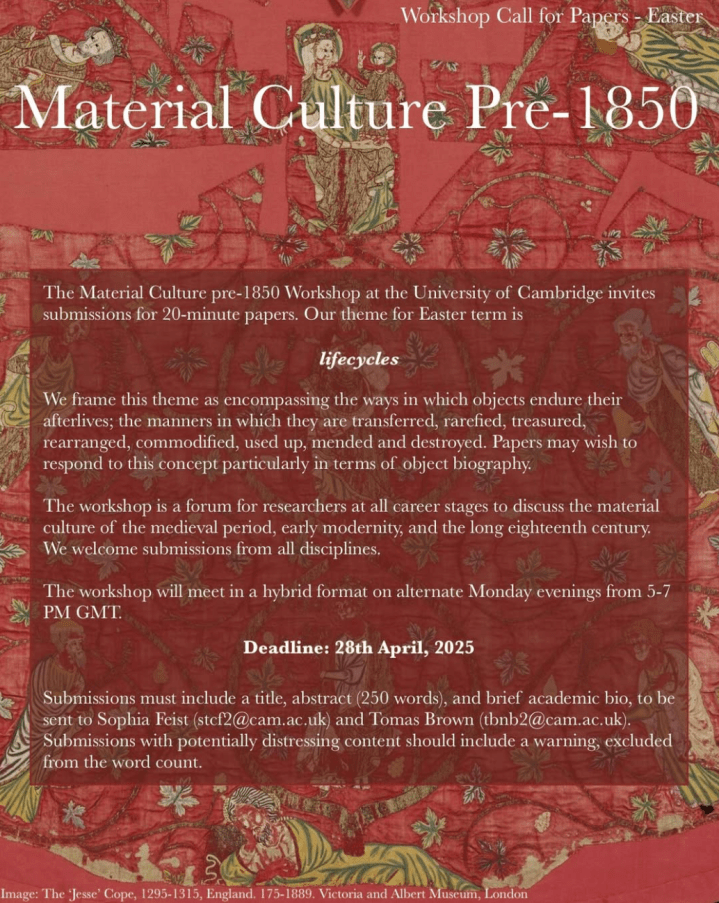 The Material Culture pre-1850 Workshop at the University of Cambridge invites submissions for 20-minute papers. Our theme for Easter term is Lifecycles, which we frame as encompassing the ways in which objects endure their afterlives; the manners in which they are transferred, rarefied, treasured, rearranged, commodified, used up, mended and destroyed. Papers may wish to respond to this concept particularly in terms of object biography.
The workshop is a forum for researchers at all career stages to discuss the material culture of the medieval period, early modernity, and the long eighteenth century. We welcome submissions from all disciplines. The workshop will meet in a hybrid format on alternate Monday evenings from 5 to 7pm GMT.
Submissions must include a title, abstract (250 words), and brief academic bio, to be sent to Sophia Feist (stcf2@cam.ac.uk) and Tomas Brown (tbnb2@cam.ac.uk) by 28 April 2025. Submissions with potentially distressing content should include a warning, excluded from the word count.
Call for Papers | The Future of the Antique
From the Call for Papers:
The Future of the Antique: Interpreting the Sculptural Canon
Warburg Institute and Institute of Classical Studies, London, 10–12 December 2025
Organized by Adriano Aymonino and Kathleen Christian
Proposals due by 15 May 2025
The University of Buckingham, the Census of Antique Works of Art and Architecture Known in the Renaissance (Humboldt-Universität zu Berlin), the Warburg Institute, and the Institute of Classical Studies (University of London) are organising an interdisciplinary conference to celebrate the publication of the new edition of Francis Haskell and Nicholas Penny’s seminal work Taste and the Antique (Harvey Miller/Brepols, December 2024).
 This landmark publication provides an opportunity to review and coordinate recent achievements and new initiatives in the study and interpretation of the Greek and Roman sculptural legacy. The original 1981 Yale University Press edition of Taste and the Antique significantly shaped the field’s direction over four decades, influencing both academic research and curatorial practices. The revised and expanded three-volume edition, featuring numerous newly commissioned photographs, substantially updates the scholarship with research from recent decades. It broadens the exploration of these works’ reception and influence, from Renaissance collectors to contemporary artists. The edition particularly examines how classical statues impacted European imagery beyond direct replication, including:
• Their adaptation across diverse media
• Their impact on art and architectural theory and pedagogy
• Their influence on anatomical study and proportional theory
• Their role in modernist culture and modern / postmodern popular culture
• Their enduring presence in contemporary imagery and conceptions of the human body
The conference aims to assess the current state of research, rethinking established methodologies and exploring possible future directions in the field. Its primary goal is to foster discussion among different generations of scholars whose research outputs are often separated by language and methodological barriers. We invite proposals for twenty-minute papers on interrelated topics such as the following, outlined by the book or extending beyond it. Priority will be given to innovative papers focusing on the legacy of antique sculptural models in European/Colonial art and culture since the Renaissance:
Academy and Canon — examining their establishment, radical alteration, and dissolution in the modern era.
New Canons — the antique in modern and postmodern theoretical frameworks and practices.
Antique / Modern Bodies — classical statuary’s influence on human anatomical study; proportioned and disproportioned body concepts; the representation of the male and female body; physiognomy; conceptions of race and ethnicity.
Empire and its Enemies — political and racial implications of the antique.
Priorities and Display — the antique within modern museum contexts.
Restorations and Forgery — reconfigurations of the antique and notions of authenticity.
Narrative Patterns — the classical language of gesture, story-telling/narrative.
Please submit your title and abstract of no more than 200 words, along with a short biography (about 100 words—please do not send CVs) to Mattia Ciani (m.ciani8@student.unisi.it) by noon (BST), 15 May 2025. The abstract and biography should be combined in a single Word document and submitted as an email attachment. Incomplete or late submissions will not be considered. Notification of the outcome will be communicated via email by 1 July 2025. We intend to publish the proceedings of the conference.
Call for Articles | Sculpture and the Non-Normative Body
From ArtHist.net:
Sculpture and the Non-Normative Body
Thematic issue of Sculpture Journal
Proposals due by 1 June 2025; completed articles will be due 1 September 2025
The normative body has been the traditional subject of sculpture since antiquity. Its ubiquity, however, has led to the invisibility of the diversity of bodies in the history of art: from the disabled body of Aesop and the ‘hermaphrodite’ from antiquity to the ‘grotesque’ or ‘monstrous’ from the Renaissance garden to the polychrome ‘ethnographic’ portrait busts from the nineteenth century. We want to question these categories and address bodies that have been under-represented in sculpture, either through representational strategies, materials that reflect on lived experience, and/or sculptural practice itself.
In the first of a series of recurring themed issues around sculpture and the body, the Editors of the Sculpture Journal encourage abstracts that rethink the traditional methods of sculpture in art history in relation to gender, sexuality, race, class and/or disability. We invite proposals for contributions that stem from but are not limited to the following: fragmentation and decay; queer and trans perspectives; health and disability; processes of othering; materiality; redefinitions/responses to normativity/the normative body; artists engaging in their work via lived experience or through materiality. We are looking at this issue transhistorically and globally, across a range of sculpture practices, from the figurative to the abstract.
We invite abstracts of up to 250 words to be submitted to Teresa Kittler (teresa.kittler@york.ac.uk) and Natasha Ruiz-Gómez (natashar@essex.ac.uk) by 1st June 2025. Final submission of full-length articles of 6000–8000 words including endnotes will be requested by 1st September 2025.
Sculpture Journal is the foremost scholarly journal devoted to sculpture in all its aspects across the globe. It provides an international forum for writers and scholars in the wider field of sculpture, including all three-dimensional art and monuments. Published by Liverpool University Press, the journal offers a keen critical overview and a sound historical base, encouraging contributions of fresh research from new and established names in the field.
Call for Essays | Rethinking the Material Afterlives of Animals
From ArtHist.net:
Essay Collection | Rethinking the Material Afterlives of Animals, 1500–1800
Edited by Catherine Girard and Sarah Grandin
Proposals due by 30 April 2025; final essays due February 2026
Do animals introduce a material difference to objects from the early modern period? Should scholars think differently about objects that include animal remains than they do about other materials? The editors of this volume invite essays that examine human and non-human animal relations through objects made of animal remains in the early modern period to investigate this possible difference. This era saw intensified zoological research alongside the expansion of armed trade, overland and maritime travel, and extractive industries dependent on biotic materials. These shifts shaped the ways in which animal remains were preserved, transformed, and recontextualized within artistic and economic networks. Rather than treating these materials in terms of visual encounters alone, contributors to this volume are asked to foreground the visceral and tactile engagements generated by objects crafted with materials such as fur, skin, quills, feathers, shells, ivory, and bones.
We encourage essays that stem from diverse epistemologies and that explore alternative approaches to thinking about artistic materials. How might perspectives that emphasize reciprocity and relationality, for instance, reshape art historical approaches to objects made with and from animals? How does animal presence both ‘construct and disrupt’ human culture? How are the material ‘affordances’ of biomatter—their ability to alert, lubricate, protect, join, support—preserved, distorted, or deferred in human-made objects? How do such materials maintain continuity with their former life and how are they fundamentally altered? We invite contributors to reflect on how their work can be a site of reconciliation, acknowledging both the original contexts of these materials and the contemporary responsibilities of their material, intellectual, and spiritual caretakers.
The book seeks full-length essays that examine moments of transformation in the lives of these animal materials: from the deep ecological knowledge of those who sourced these materials, to the artisans and artists who processed them, to the wearers and collectors who recontextualized them. How do the acts of sourcing, crafting, and collecting materialize particular worldviews? How do these objects navigate tensions between organic and inorganic, sentient and non-sentient entities? What are the limits of such categories?
We also invite shorter contributions that explore the specific ethical and methodological challenges that museological care and conservation raise. How does the field of conservation reckon with biotic materials’ instability and latent animacy? What are the ethical implications of working with such materials? How do artists, scholars, curators, and knowledge-keepers participate in the care of historical objects that include animal substrates?
As a whole, this volume aims to chart new methods for engaging with animal materials in the archive, interrogating how anthropocentrism and colonialism have shaped art history’s disciplinary practices and omissions. We welcome contributions from scholars in art history, visual and material culture, museum studies, and related disciplines who are interested in rethinking the material afterlives of animals from diverse cross-cultural, temporal, and methodological perspectives.
Please submit a 500-word abstract to Catherine Girard (St. Francis Xavier University, cgirard@stfx.ca) and Sarah Grandin (The Courtauld Institute of Art, Sarah.Grandin@courtauld.ac.uk) by 30 April 2025, specifying whether you are planning to write a full-length essay of up to 8000 words or a shorter contribution of up to 4000 words, including notes. Final essays will be due in February 2026.
Call for Papers | Visual Culture of Gastronomy, 16th–20th Century
From the full Call for Papers, which includes the French Appel à communication) . . .
Visual Culture of Gastronomy, 16th–20th Century
La culture visuelle de la gastronomie, XVIe–XXe siècles
Galerie Colbert, Paris, 18–19 December 2025
Organized by Frédérique Desbuissons and Ryan Whyte
Proposals due by 1 June 2025
This international conference addresses the visual dimension of gastronomy, whose study surpasses traditional disciplinary limits for historical research (Allen Weiss, Déborah L. Krohn, Marcia Reed). In contrast to the logocentric definition that prevails in most of the work on gastronomy of the last century (Jean-Louis Flandrin, Pascal Ory, Priscilla Ferguson, Jean-Robert Pitte), we propose to consider gastronony as a qualitative relationship to food (Julia Csergo) constituted not least by images in their sensory and material manifestation. Whether as visual perception or material representation in the visual arts, printed matter, consumer goods such as games and toys, or popular and mass culture more broadly, images have played an active role in the construction and experience of the “art of eating well” [art de bien-manger] (Brillat-Savarin). Due to their quantity and ubiquity, such images, whether traditional or more often “popular,” are as essential to gastronomy as those of the fine arts, usually more difficult to access due to their socially restricted sites, relative rarity, and elite visual language. Visual culture, far from being subordinated to or dependant on text as mere illustration, commentary or archival record, immediately and directly defines “eating well.” D’abord l’à bord [first of all the on (the) bo(a)rd(er)], in the formula of Jacques Derrida, the very immediacy of gastronomic images defines the perimeters of gastronomy, thereby to furnish foundational models of experience and desire. In this way images, inseparable from other forms of signification, testify to the composite nature of gastronomy.
In the early modern period, the culture of the table began to free itself from both the rules of dietetics and the religious morality stigmatizing sensual pleasures that Louis de Jaucourt, in the Encyclopédie, evoked in defining cuisine as “lust for good food” [cette luxure de bonne chere dont on fait tant de cas], perpetuating its denigration by Michel de Montaigne as the “science of the gullet” [science de gueule] two centuries earlier. Meanwhile, banquets abandoned the ostentatious symbolism that prevailed before the Renaissance. Cuisine became a product of intellectual exchange in which images played a key role, including frontispieces and other images for cookbooks, reference books and other works relating to domestic economy. In urban spaces, images of consumer products were disseminated in the form of shopsigns, window displays, and trade cards. In France, on the eve of the Revolution, “eating well” no longer necessarily meant eating to maintain physical and moral health according to the precepts of medicine and religion, but also eating good things, with the right table setting, in an appropriate environment, and in good company. All these dimensions of table culture are described, not without irony, in the poem of Joseph de Berchoux, “Gastronomy: Or the Rural Philosopher Dines” [La gastronomie, ou l’homme des champs à table] (1801), whose title would furnish the term for the “art of good cheer” finally accepted by the Académie française in its Dictionary of 1835.
Like the various prints published in successive editions of Berchoux’s poem, images participated in the diffusion of the knowledge, practice, and social imaginary of gastronomy well beyond the narrow social and geographic limits of the table culture of the Old Regime. The multiplication of images and print technologies in the nineteenth century emancipated gastronomy from the houses and restaurants accessible only to those capable of employing the services of great chefs, consuming luxury products, and frequenting good tables. In addition to the fine grocery stores, caterers, and restaurants emblematic of the urban spectacularization of food from the nineteenth century, representations disseminated in books, journals, and posters revealed the labour, implements, stagings, uses, and forms of conviviality once inaccessible to most people.
If images established a new visual regime of gastronomy, they also fixed and standardized norms transcending local and regional variations and facilitating their broader recontextualization. This is why this conference will focus on developments in Europe in the early modern period and following the French Revolution, as well as on other gastronomic cultures and geographies, whether in themselves or operating in the context of colonial empires and other forms of globalization of food products, standards, and practices. How, in particular, may one describe and conceptualize qualitative relationships to food in non-European cultures using emic images and terms rather than the etic discourses of European gastronomy? And how can subaltern communities create visual cultures as vectors of resistance and emancipation, as in the exemplary case of Soul Food? We invite proposals from all disciplines on the visual dimensions of gastronomy, whether international or local, elite or popular. Possible themes include, but are not limited to:
Physiology, psychology
• Food synesthesias
• Ephemeral consumption and visual memory
Presentation, representation, conservation
• Representing taste
• Staging the table
• Gastronomical exhibitions (displays, markets, shop windows, museums and galleries …)
• Museums and heritage
Media and technologies
• Print culture and gastronomy: almanacs, newspapers, magazines, posters, pamphlets, etc.
• Design, packaging, labels
• Food and image technologies
Geographies, spaces, sites
• Perimeters and geographies of the gastronomic image
• Sites of production and consumption: kitchen, pantry, dining room, restaurant
• Empire and gastronomy
Values, customs, ideologies
• Images, egos, personifications: eaters, chefs, critics, gastronomes, servants, merchants
• Moralities of food
• Political and gastronomic economies
• Gastronomic laughter: satire, burlesque, comedy
Please submit proposals in French or English, including an abstract of maximum 700 words and a brief curriculum vitae by 1 June 2025 to frederique.desbuissons@univ-reims.fr and rwhyte@ocadu.ca.
Université Paris 1 Panthéon-Sorbonne / OCAD University, Toronto) / Bibliothèque des Arts Décoratifs
Frédérique Desbuissons (université de Reims) & Ryan Whyte (OCAD University, Toronto)
Scientific Committee
James Benn, McMaster University, Hamilton
Valérie Boudier, université de Lille
Gwenhael Cavanna-Kernemp, Les Arts Décoratifs, Paris
Julia Csergo, Université du Québec à Montréal
Michael Garval, North Carolina State University
Jérémie Koering, Université de Fribourg
Camille Paulhan, École nationale supérieure des Beaux-Arts de Lyon
Bibliographie indicative / Preliminary Bibliography
L’Art de manger. Rites et traditions en Afrique, Insulinde et Océanie, exh. cat. Paris, musée Dapper, 2014–2015.
L’Art gourmand, exh. cat. Bruxelles, Galerie du Crédit communal, 1996–1997.
Atelier + Küche = Labore der Sinne, cat. exp. Hertford, Marta Herford, 2012.
Victoria Avery (ed.), Feast & Fast: The Art of Food in Europe, 1500–1800, exh. cat. Cambridge, Fitzwilliam Museum, 2019
Sylvette Babin (ed.), Eating the Universe : vom Essen in der Kunst, exh. cat. Kunsthalle Düsseldorf, 2009–2011
Kate Baldwin, The Racial Imaginary of the Cold War Kitchen: From Sokol’niki Park to Chicago’s South Side, Chicago, Dartmouth College Press, 2015
Judith A. Barter (ed.), Art and Appetite: American Painting, Culture, and Cuisine, exh. cat. Chicago, Art Institute, 2013–2014.
Daniel Bender (ed.), Food Mobilities: Making World Cuisines, Toronto, University of Toronto Press, 2024
Diane Bodart and Valérie Boudier (ed.), Le banquet de la Renaissance : images et usages, Prédella. Journal of Visual Arts, n° 33, 2013.
Nicolas Bourriaud (ed.), Cookbook. Quand l’art passe à table, exh. cat. Paris, Palais des Beaux-Arts, 2013–2014.
Susan Bright, Feast for the eye. The Story of Food in Photography, New York, Aperture, 2017.
Germano Celant (ed.), Arts & Foods. Rituali da 1851, exh. cat. Milano, Triennale di Milano, 2015.
Germano Celant (ed.), Cucine & Ultracorpi, exh. cat. Milano, Triennale design Museum, 2015.
Julia Csergo, La gastronomie est-elle une marchandise culturelle comme une autre ?, Chartres, Menu fretin, 2016.
Julia Csergo and Frédérique Desbuissons (eds), Le cuisinier et l’art. Art du cuisinier et cuisine d’artiste (XVIe-XXIe siècle), Chartes, Menu Fretin ; Paris, Institut national d’histoire de l’art, 2018.
Jörg Dürrschmidt and York Kautt (eds.), Globalized Eating Cultures: Mediation and Mediatization, Cham (Switzerland), Palgrave Macmillan, 2019.
Zilkia Janer, The Coloniality of Modern Taste: A Critique of Gastronomic Thought, London, Routledge, 2023.
Shana Klein, The Fruits of Empire: Art, Food, and the Politics of Race in the Age of American Expansion, Oakland, University of California Press, 2020.
Jonatan Leer and Karen Klitgaard Povlsen (eds), Food and Media: Practices, Distinctions, and Heterotopias, London, Routledge, 2016.
Nina Levent and Irina D. Mihalache (eds), Food and Museums, London [etc.], Bloomsbury, 2017.
Deborah Lupton and Zeena Feldman (eds) Digital Food Cultures, New York, Routledge, 2020.
Simeon Magliveras (ed.), Odysseys of Plates and Palates: Food, Society, and Sociability, Oxford, Inter-Disciplinary Press, 2015
Marcia Reed (ed.), The Edible Monument: The Art of Food for Festivals, exh. cat.. Los Angeles, The Getty Research Institute, 2015.
Jérémie Koering, Les iconophages, une histoire de l’ingestion des images, Arles, Actes Sud, 2021.
Deborah L. Krohn, Food and Knowledge in Renaissance Italy: Bartolomeo Scappi’s Paper Kitchens, London and New York, Ashgate Publishing, 2015.
Linda Roodenburg, Food is fictie verhalen over voedsel en vormgevin / Food is fiction. Stories about food and design, Rotterdam, nai010 Publisher, 2018.
Nancy K. Stalker (ed.), Devouring Japan: Global Perspectives on Japanese Culinary Identity, New York, Oxford University Press, 2018.
Nelleke Steughels and Peter Scholliers (eds), A Taste of Progress: Food at International and World Exhibitions in the Nineteenth and Twentieth Centuries, London, Ashgate, 2017.
John Varriano, Tastes and Temptations: Food and Art in Renaissance Italy, Oakland, University of California Press, 2009.
Kim M. Williams and Warwick Frost, Gastronomy, Tourism, and the Media, Bristol, Channel View Publications, 2016.
Call for Papers | SAVAH 2025: Practices of Entanglement
From ArtHist.net and the Call for Papers:
Practices of Entanglement
38th Annual Conference of the South African Visual Arts Historians
University of KwaZulu-Natal, Pietermaritzburg, 25–27 September 2025
Proposals due by 11 April 2025
The term entanglement has been widely used in academic discourse across multiple disciplines—postcolonial studies, anthropology, philosophy, art history, physics and beyond. It often refers to the complexity of relationships between histories, cultures, and identities, with Karen Barad extending these ideas to apply to what she calls agential realism, where concepts of entanglement (or intra-action) describe how entities emerge through relationships with other entities, challenging traditional distinctions between subject/object, human/nonhuman.
Nicolas Bourriaud applies entanglement to contemporary art, arguing that artists navigate and intertwine multiple cultural and historical references, making art a process of relational engagement rather than fixed meaning. Achille Mbembe, on the other hand, applies notions of entanglement to postcolonial and decolonial thought, as a means to demonstrate how Africa’s colonial past and present are inextricably linked, producing complex subjectivities and overlapping temporalities. Conceptualisations such as these challenge linear narratives of history and explore how colonial and postcolonial conditions are mutually constitutive.
The concept of entanglement has gained traction in art history, especially in relation to postcolonial theory, global art histories, material culture, and the decolonial turn. Okwui Enwezor’s curatorial work, such as Documenta 11 (2002), foregrounded the idea of art as a site of entangled histories, where space and meaning are in constant negotiation. Mieke Bal proposes that the interplay between visuality and textuality is a fundamental aspect of interdisciplinarity, and this dualism is also central to the discipline of art history, which at its core involves writing about visual things. The tension produced through the entanglement of verbal and visual languages has also been foregrounded since the Practice Turn insisted on the ability of creative practice to produce original knowledge.
The 2025 SAVAH conference aims to pull at these entangled threads and connections in order to begin an untangling that might reveal the richness of the layers in between. In the spirit of creative curiosity, we ask that submissions focus on the many possible questions rather than the conclusions. We welcome provisional research in progress and hope that the conference will be a platform for knowledge sharing and exchange. We also, therefore, welcome submissions that think through some of these webs across disciplines, and are interested in novel research of any kind that extends beyond the themes outlined below.
Abstract submissions could focus on (but are not limited to) the following topics:
• Visual and verbal entanglements: language, image, and knowledge production
• Postcolonial and decolonial art histories
• Materiality and entangled objects
• Entangled histories and temporalities
• Materiality and the making of tntanglements
• Entangled objects, archives, and memory
• Decolonial entanglements and the politics of space
• Curatorial entanglements: exhibitions, practice, and knowledge sharing
• Entangled performances of self and society
• Other novel research and experimental approaches to entanglement
We invite papers and visual presentations from scholars, researchers, and post‐graduate students. Practice-led research is particularly welcome. We also invite contributions from SAVAH members on current research that engages topics not included in this call for papers. Please submit an abstract of 300–400 words via the savah.org.za website by 11 April 2025. Successful applicants will be notified by 30 April 2025. For any queries, please contact conference@savah.org.za.
Call for Panels | CAA in Chicago, 2026
From CAA:
114th Annual Conference of the College Art Association
Hilton Chicago, 18–21 February 2026
Panel Proposals due by 25 April 2025
The CAA Annual Conference is the largest convening of art historians, artists, designers, curators, and visual arts professionals. Each year we offer sessions submitted by our members, committees, and affiliated societies that deliver a wide range of program content. The 114th Annual Conference will take place at the Hilton Chicago, 18–21 February 2026. The conference will be held in person with a selection of hybrid sessions and events. CAA leadership, in collaboration with the Annual Conference Committee, is reviewing participant and attendee feedback from the 113th Annual Conference to determine any format adjustments needed for the 2026 program. Please check back regularly for updates and see this page for important information.
t i m e l i n e
March 15: Call for Proposals period begins; submission forms open
April 25: Deadline for CAA114 session, workshop, and presentation submissions
Mid-July: Submitters notified of acceptance or rejection
July: Affiliated Society Business Meeting & Reunion or Reception request forms open
Late July: Call for Participation (CFP) opens
Late August: Deadline for CFP submissions
Mid September: Deadline for chairs of sessions soliciting contributors to make decisions and add to session entry
Early October: Registration opens and conference schedule is announced
December 5: Access accommodation requests for in-person and/or remote participants due to CAA.
February 18–21: Annual Conference
Call for Papers | ‘National’ Churches in Foreign Mediterranean Ports
This panel is part of the AISU conference in Palermo:
‘National’ Churches and Mediterranean Ports in the Early Modern Period
Foreign Communities Reshaping the Urban Fabric
Chiese ‘nazionali’ nei porti del Mediterraneo in età moderna (secoli XV–XVIII)
Il ruolo delle comunità forestiere nella riconfigurazione del tessuto urbano
Associazione Italiana di Storia Urbana Congress, Palermo, 10–13 September 2025
Organized by Nadia Rizzo and Carl Alexander Auf der Heyde
Proposals due by 3 May 2025
The establishment of ‘national’ mercantile groups in major Mediterranean port cities—key hubs for cross-cultural exchange—developed continuously from the Middle Ages into the early modern period (Colletta 2012). These ports became meeting places for foreign merchants who organised themselves into ‘nations’, structured associations based primarily on geographical origin, but also on shared language and religion (Petti Balbi 2001). These communities did not limit their activities to commercial spaces such as ‘fondaci’ and ‘logge’.
From at least the fifteenth century, they established meeting and worship places, often gaining patronage for chapels within existing churches. The most ambitious goal of the foreign communities, however, was the construction of a dedicated church, consecrated to their patron saint and intended primarily to meet the religious and liturgical needs of the group (Koller, Kubersky-Piredda 2015 [for national churches in Rome]). In addition to serving as a devotional landmark, the construction of a national church was a clear statement of the community’s presence, identity, and wealth, exerting a tangible and visible influence on the urban and architectural landscape of the host city.
From the mid-sixteenth century, coinciding with a wave of significant urban redevelopment, there was a marked increase in the construction of national churches independent of local religious communities. This phenomenon intensified during the seventeenth century, alongside the architectural fervour of the newly emerging Counter-Reformation orders, fostering a virtuous cycle of competition not only between nations, but also among religious congregations and national communities.
This panel seeks to explore the impact of foreign communities on the urban transformation of Mediterranean port cities between the sixteenth and eighteenth centuries, with a focus on the institution of the national church as a key reference point. We invite proposals in Italian, English, Spanish, and French that approach this topic from different perspectives and levels of analysis, including:
• Research on the settlement system of a single nation in multiple mercantile centers
• Specific studies on individual national churches
• Diachronic investigations on the settlement of a foreign group in a specific center (from chapels to national churches)
• Comparative overviews of multiple national churches in the same city
To apply, please fill out the form available at the bottom of each session presentation. The link for session 4.1 can be found here. Applicants are required to submit the paper abstract (maximum 5000 characters) and a brief biographical note. For any further information regarding the session, please contact the panel coordinators: Nadia Rizzo (Scuola Normale Superiore, nadia.rizzo@sns.it) and Carl Alexander Auf der Heyde (Università degli Studi di Palermo, carlalexander.aufderheyde@unipa.it).
The congress of the Associazione Italiana di Storia Urbana (Italian Association of Urban History / AISU International) will meet in Palermo, 10–13 September 2025. This year’s theme is The Crossroad City: Relations and Exchanges, Intersections and Crossing Points in Urban Realities.
Call for Papers | What Does Sculpture Do to a Garden? 17th–21st Century
From ArtHist.net, which includes the French version:
What Does a Sculpture Do to a Garden? What Does a Garden Do to a Sculpture?
Que fait une sculpture à un jardin? Que fait un jardin à une sculpture?, 17e–21e siècle
Musée Rodin, Paris, 6 June 2025
Proposals due by 31 March 2025

Edvard Munch, Le Penseur de Rodin dans le parc du Dr Max Linde à Lübeck, ca. 1907, oil on canvas, 143 × 98 cm (Paris: Musée Rodin).
Part of the 22nd edition of the Rendez-vous aux jardins taking place 6–8 June 2025 under the theme “Stone Gardens / Garden Stones,” the symposium is under the scientific direction of Emmanuelle Héran, Chief Curator and Head of Garden Collections at the Musée du Louvre. The event will be webcast live.
While closely linked since Antiquity, the relationship between sculpture and gardens was rekindled during the Renaissance. Rodin himself pondered this connection, as Paul Gsell recounts in Art: “Statues are usually placed in gardens to embellish them. For Rodin, gardens are here to adorn the statues. For him, Nature remains the supreme mistress, an infinite perfection.” And yet, works tracing the history of gardens often give little consideration to the statuary that inhabits them. Conversely, sculpture scholars rarely reflect on the unique setting of gardens, or on what a sculpture, in turn, can bring to a garden. In both fields, publications are frequently illustrated with tightly framed photographs of sculptures, isolating them as if displayed within a museum—or even entirely cut out from their surroundings. Yet, a garden is not a museum; it offers to three-dimensional works neither the neutrality of a ‘white cube’ nor even the illusion of a ‘green cube’ beneath an open sky.
Indeed, what could be more subject to change, more ephemeral, than a garden? As seasons pass, with the shifting hours of the day and the whims of the weather, the environment surrounding a sculpture is in constant flux. While there does exist a ‘museography’ for gardens—defined both as the art of displaying sculptures within them and as the composition of gardens incorporating sculpture—it has never been the subject of a comprehensive study. It is scarcely taught, neither to curators overseeing an ‘open-air sculpture museum’ nor to landscape architects and garden designers responsible for their creation and upkeep. In this regard, Louis Gevart’s dissertation broke new ground [1].
The question of meaning also arises. In royal and aristocratic parks and gardens, a sculptural ensemble may follow a coherent iconographic program, whose analysis reveals political intentions—such as the renowned Grande Commande of 1674 for Versailles. More often, however, groves and lawns host a disparate collection, whose coherence—if it ever existed—may have faded over time. The history of a collection displayed in a garden can mirror that of a museum. Yet it may also be entirely different, as the works placed in a garden are not necessarily commissioned pieces or first choices. Some may have arrived belatedly, by default, left outdoors for lack of a better option, or, when too damaged or vandalized, removed in haste.
It is thus possible that a restoration, conversion or ex nihilo creation project requires a landscape architect to address the difficult issue of sculptures. In the world of historical monuments, managing a set of statues does not always fall under the responsibility of the chief architect, but of a heritage curator. This separation of powers is worth examining: is it relevant or counterproductive? How can dialogue be established? The choice of materials, their adaptability and durability can all be considered. Site-specific works created in close collaboration with a garden can be cited, such as Giuseppe Penone and Pascal Cribier’s L’Arbre des voyelles in the Tuileries Gardens.
During the 20th century, sculpture parks and gardens—created with this intent—focused more on presenting a “living history of sculpture under construction” (Louis Gevart). Iconographic objectives may have been replaced by the production of a historical-stylistic narrative, without soliciting the help of a landscape architect. However, as the profound changes recently made to Middelheim Park in Antwerp and the recreation of entire programs at Stowe demonstrate, a return to iconographic coherence does seem to be taking place, in response to the public’s presumed expectations.
This symposium welcomes case studies of the same work in different sizes and materials, whose effect on a garden can be decisive for its composition or, on the contrary, become unremarkable. Think of copies of famous ancient sculptures—the Farnese Hercules, the Diana of Versailles—whose use, identified by Haskell and Penny in 1981 and recently revised, continues. Also welcome are examples of sculptures whose contribution to a garden does not appear to be essential, or of attempts that have proved inconclusive, or of bases that have been left empty or refilled. The crucial question remains that of the usefulness and relevance of a three-dimensional work within a garden environment. In other words, what does a sculpture do to a garden? And what does a garden do to a sculpture?
This call is addressed to art historians specializing in gardens or sculpture. It is also aimed at park and garden managers, heritage architects and landscape architects who have carried out preliminary studies or restoration work on historic gardens, so that they can share their thoughts and recent field practices, carried out in close collaboration with art historians and sculptors. It will focus on the following questions:
• What is the use of sculpture in a garden?
• Iconography: the search for coherence
• When the statue is missing / The empty base
• What materials are used in a garden?
• Landscape architects and sculptors / Site-specific works
Submissions—with a title, an abstract (1500–2000 characters), and a brief biographical note (500–1000 characters)—should be sent to colloques@musee-rodin.fr before 31 March 2025.
Research Committee
• Emmanuelle Héran, Chief Curator, Head of Garden Collections, musée du Louvre
• Amélie Simier, Chief Curator, Director, musée Rodin
• Véronique Mattiussi, Head of the Research Department, musée Rodin
• Franck Joubin, Researcher and Conference Coordinator, musée Rodin
[1] Louis Gevart, “La Sculpture et la terre. Histoire artistique et sociale du jardin de sculpture en Europe (1901–1968),” PhD thesis in art history, under the direction of Thierry Dufrêne, Université Paris Ouest La Défense, January 2017.
Call for Papers | Body Hair in Early Modern Visual Culture
From ArtHist.net and NIKI:
Hirsute, Downy, Hairless:
Meanings and Forms of Body Hair in Early Modern Visual Culture
Nederlands Interuniversitair Kunsthistorisch Instituut, Florence, 24–25 October 2025
Organized by Mathilda Blanquet, Michael Kwakkelstein, and Mandy Richter
Proposals due by 1 April 2025
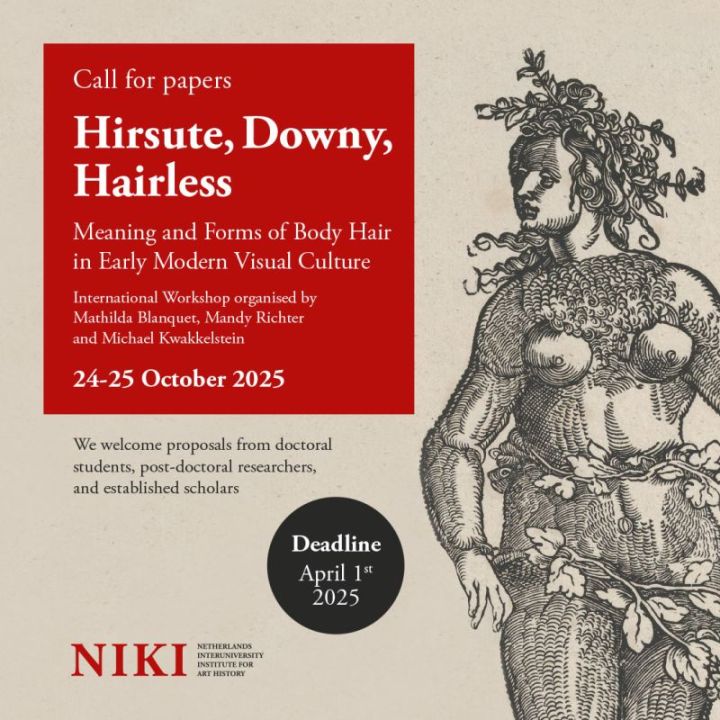 While long overlooked in art historical studies, over the past two decades body hair has emerged as a significant field of research, offering new perspectives on early modern visual culture. The presence or absence of body hair serves as an indicator of aesthetic (or artistic) preferences and prevailing social norms specific to certain periods and locations, revealing complex intersections between art and real life.
In profane art, the representation of male body hair tends to be quite common. It often points to idealized virility, strength, or even a natural state of being. However, its excess or misplacement might indicate mockery, degradation, or even alienation of the depicted subject. In comparison, female hirsuteness appears less frequently in artworks from the early modern period due to different canons of beauty associated with the female body. These rare instances of representation thus hold particular interest for this workshop.
In religious art, hair in general is of notable importance and this significance extends to body hair as well. Various iconographies of saints include these distinct features, raising questions not only about visual traditions in different cultural contexts but also querying particular hermeneutic meanings, such as notions of humanity, carnality, and spiritual transformation. In some cases, there could be a connection to preserved body hair relics of specific saints, which has never been part of a broader study thus far.
Technical challenges in representing hair are another point of interest. Artists and art theorists addressed these challenges across different media throughout the early modern period, as evidenced in theoretical treatises, anatomical studies, and workshop practices. Not only does this include the question of how to differentiate between human and animal hair but extends as well to artistic experiments in finding new and creative ways of treating or even avoiding body hair.
This two-day workshop aims to explore the multiple dimensions of body hair in visual culture through an interdisciplinary approach. Contributions may address, but are not limited to, the following themes:
1 Gender and Social Norms
• Male vs. female body hair in art
• Social and cultural implications of hair presence or absence
• Body hair as an indicator of social status and cultural norms
2 Religious and Symbolic Dimensions
• Hair in religious iconography
• Symbolic meanings in sacred versus profane contexts
• The role of body hair in representing humanity versus divinity
3 Artistic Theory and Practice
• Technical challenges in depicting body hair across different media
• Body hair in artistic treatises and anatomical studies
• Relationships between artistic theory and artistic practice
4 Cultural and Geographic Variations
• Comparative studies across European regions
• Cross-cultural perspectives on body hair representation
We welcome proposals from doctoral students, post-doctoral researchers, and established scholars. Papers may be presented in English or Italian. Please submit an abstract (300–500 words), a brief biographical note (150 words), your current institutional affiliation, and contact information to m.blanquet@udk-berlin.de and richter@khi.fi.it by 1 April 2025. Acceptance notifications should arrive by 15 April 2025.
Selected papers will be considered for publication in a peer-reviewed volume following the workshop. The workshop will be held at the Nederlands Interuniversitair Kunsthistorisch Instituut in Florence (NIKI). Accommodation and travel information will be provided to accepted participants. For any queries, please contact m.blanquet@hotmail.fr and richter@khi.fi.it.
Organizers
• Mathilda Blanquet, Universität der Künste in Berlin, Université Fédérale de Toulouse, Universität Hamburg
• Dr. Michael W. Kwakkelstein, Dutch University Institute for Art History in Florence (NIKI) – Utrecht University
• Dr. Mandy Richter, Kunsthistorisches Institut in Florenz – Max-Planck-Institut










leave a comment