Call for Papers | Women and the Household in the Book Trade
From the Call for Papers:
Women and the Household in the Early Modern Book Trade, 1550–1750
Antwerp, 5–7 November 2025
Proposals due by 31 March 2025
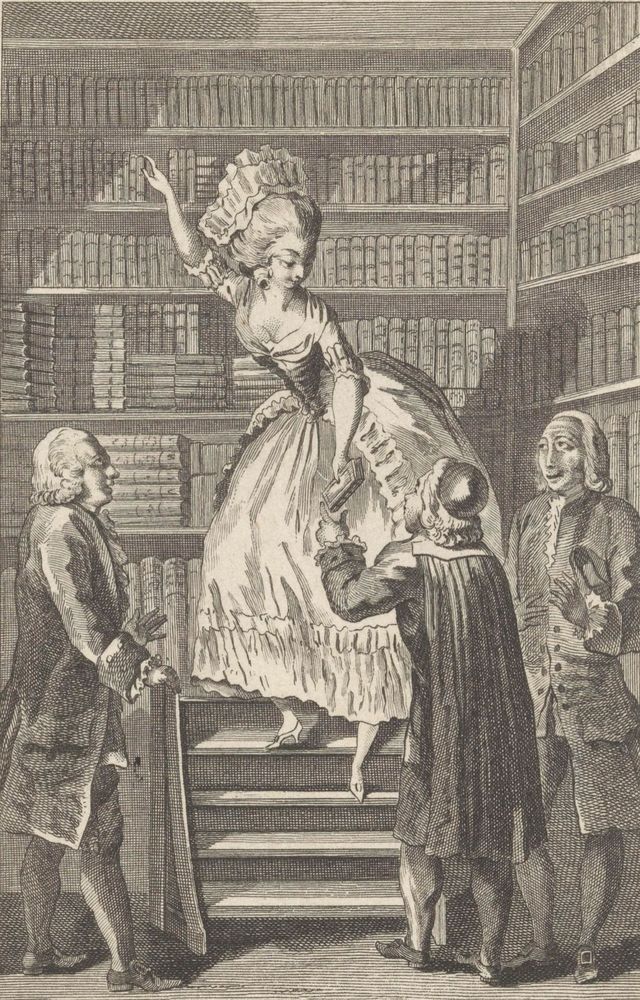
Young saleswoman in a bookstore, Paris, 1782, etching.
This two-day conference aims to share knowledge of women’s rich and varied lives and works in the period before the rapid industrialisation of book production, which changed the face of home labour for early modern women.
The growing field of feminist bibliography has been built upon a recognition that early modern books were mostly products of the interwoven sectors of domesticity and trade. Many book trade practices took place within the home, enabling the unofficial training and labour of women and children. It was only the most successful enterprises that prompted investment in bespoke buildings, prompting a public-private dialectic which was sometimes merely superficial, since many were also managed or served by female family members and domestic servants. Some women owned businesses, premises and stock; managed apprentices and shops; and held ijaza (licenses) or copyright. Many others laboured invisibly, printing and sewing volumes, engraving blocks, and making ink and paper from home.
Traditionally understood as a male-dominated domain, pioneering research of the 1990s by, for example, Helen Smith, Paula McDowell, Susan Broomhall, Mark Lehmstedt, and Leslie Howsam enabled us to reconsider the place of women in the book trade in a much more systematic way. Since then, scholars such as Sarah Werner, Saskia Limbach, Heleen Wyffels, and Rémi Jimenes have developed the field, and Kate Ozment, Cait Coker, and Michelle Levy have provided new and valuable tools for feminist bibliography in The Women in Book History Bibliography and The Women’s Print History Project. And yet, the work of recovering the history of women and their place in the book trade remains challenging and labour-intensive.
Historiography, record-keeping, and even the process of archiving have been androcentric, and the historical—and for the most part, printed—evidence that survives about women and book production predominantly concerns widows. Often, we need to look beyond the imprint and the advertisement to the material culture of book production, to the physical evidence of the codex and the personal records of journals and correspondence to identify female family members like daughters, sisters, and wives. With this turn to material cultural methodologies, the under-explored collections in museums and archives can provide a richer picture, one that is improving with new collections development practices and increased resources being allocated by heritage sites and major research libraries to women’s histories and to the recovery of marginalised figures in the History of the Book.
This conference, as a part of the FWO research project Partners in Innovation: Women Publishers as Knowledgeable Agents in the Low Countries’ Book Trade, 1550–1750, coincides with the year devoted to the many women living and working in the Officina Plantiniana in 2025 at Museum Plantin-Moretus, a UNESCO World Heritage Site, and is co-hosted with the Rubens House Museum, Antwerp. We invite participants to consider the supposed binary between home and work for women in the early modern book trade worldwide. Through this approach, we hope to share knowledge of women’s rich and varied lives and works in the period before the rapid industrialisation of book production which changed the face of home labour for early modern women. The event features a guided tour of Museum Plantin-Moretus and a show and tell of key artefacts from the collection.
We invite submissions for 20-minute papers addressing the following areas:
• Marriage and inheritance
• Networks, kinship, and patronage
• Representations of the household and women in the book trade
• Impact of women on the history of knowledge production
• Spatial and architectural perspectives
• Apprentices and apprenticing, formal and informal
• Reflections on methodologies for feminist recovery of women’s work in the book trade
• Transnational comparisons of home labour in the book trade
• Material cultural approaches to women’s book history
• Women’s work in all sectors of book production, including binding, paper making, etc.
Please send an abstract of 200 words to womenandplantin@antwerpen.be with your name, affiliation, email address, and a short bio of no more than 50 words by 31 March 2025. There will be a registration fee for presenters. Queries are welcomed.
Keynote Speakers
Susan Broomhall (Australian Catholic University) and Alicia Montoya (Radboud University)
Organising Committee
Nina Geerdink (Utrecht University), Kristof Selleslach (Museum Plantin-Moretus), Lieke van Deinsen (KU Leuven), Zanna Van Loon (Museum Plantin-Moretus), Helen Williams (Northumbria University), Patricia Stoop (University of Antwerp), and Pierre Delsaerdt (University of Antwerp)
Call for Papers | Carpentry and Sculpture
From ArtHist.net:
Carpentry and Sculpture from Gothic to Art Nouveau
Hôtel de la Roche, Mons, Belgium, 19–21 July 2025
Proposals due by 30 March 2025
A combined effort of the Centre de Recherches Historiques sur les Maîtres Ébénistes and The Low Countries Sculpture Society, whose libraries and archives have merged and are housed in the Hôtel de la Roche (1750) at Mons, the inaugural edition of the Annual Seminar on European Sculpture and Decorative Arts will take place in July 2025. This first edition will address questions about the production, consumption, collecting, and display of ‘carpentry furniture’ (in the Parisian sense of the expression) across Europe and North America, from the Gothic period to Art Nouveau. Issues of design history, collaborations between creators and producers, artists and artisans, as well as the relations with any other people involved are sought. Specificities of ‘carpentry furniture’, as opposed to other types of furniture design and production, may be investigated. This includes the study of relations between carpenters and sculptors, as well as that of historic sources, such as those published by André Jacob Roubo (1739–1791).
Its theme will draw, amongst others, but not exclusively, on the rich tradition of carpentry in the Low Countries, often in combination with magnificent sculpture in solid oak, particularly for church furniture, and on the Parisian tradition for meubles de menuiserie (‘carpentry furniture’), as differentiated from meubles d’ébénisterie (‘veneered furniture’) from the the 17th century onward, as formalised with separate guilds. ‘Carpentry furniture’ included seat furniture, console tables, floors and wall pannelling often with ornate sculptural elements, and always in solid wood, frequently painted and/or gilt, as opposed to veneered furniture. Gilt console tables were a particularly respected product of the Paris menuisiers.
The seminar has an international and multidisciplinary orientation. As such, we hope to attract lively participation from junior and senior scholars in the history of furniture and furnishings, sculpture, as well as practitioners of restoration-conservation in the same and other relevant fields. Short papers (maximum 30 minutes) of new research or work in progress may be presented in English or French. A minimal passive knowledge of both English and French is highly recommended to enable full participation in the ensuing discussions, which form the core of the seminar. The seminar will take place without an audience (apart from the speakers), but it will be filmed and broadcast live on YouTube.
The Society will cover accommodation expenses for foreign speakers at the seminar, as well as all group meals and the Sunday excursion. On the other hand, travel arrangements to and from Mons are the responsibility of the individual participants, and their travel expenses will not be reimbursed. We will endeavour to help with a shuttle from Maubeuge to Mons (20 km), as there is a direct train line from Paris to Maubeuge that is more reliable than the one to Mons.
Please send participation proposals with a 200-word abstract of the intended paper and a 200-word CV by email to info@lcsculpture.art by midday, 31 March 2025. We prefer to receive your abstract written in your mother tongue. We will then have it professionally translated into English and French for our scientific committee. News of the committee’s decisions will be sent in April. For further information, please contact The Low Countries Sculpture Society at info@lcsculpture.art.
Call for Papers | Sacred Ceramics
From the Call for Papers:
Sacred Ceramics: Devotional Images in European Porcelain
Victoria & Albert Museum, London, 30 September 2025
Organized by Matthew Martin and Rebecca Klarner
Proposals due by 30 April 2025
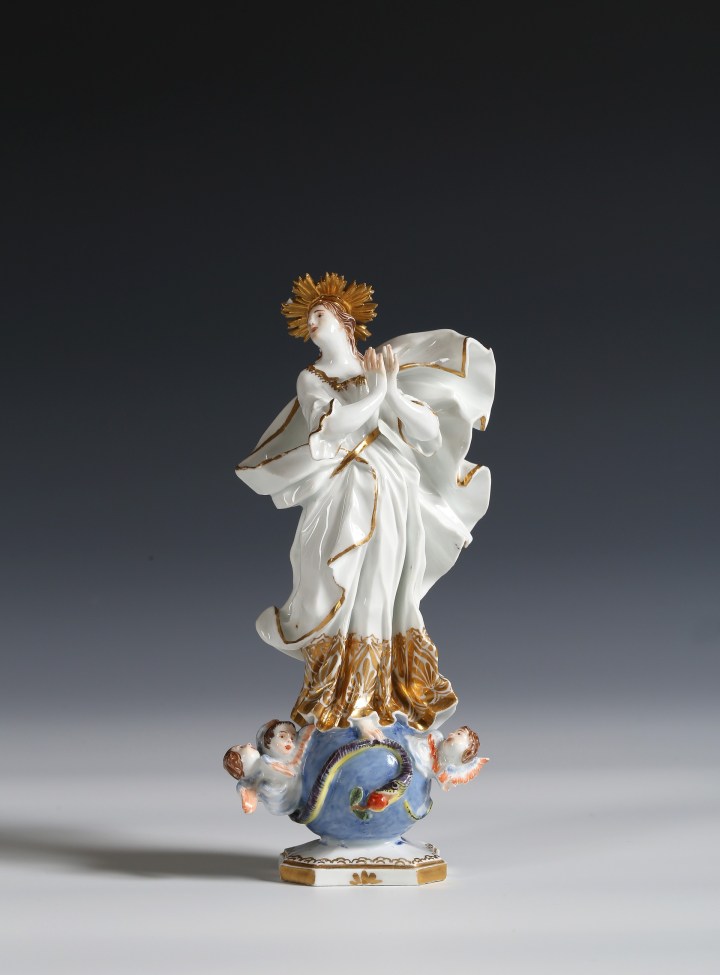
Meissen Figure of the Virgin Immaculata, probably modelled by Johann Gottlieb Kirchner, ca.1730–33 (Courtesy of E & H Manners, London).
The extensive sculptural output of Europe’s first kaolinic porcelain factory, the Saxon Meissen manufactory, has long attracted the attention of art historians. The large-scale animal sculptures executed so early in the factory’s history for the Japanese Palace, impress both for their technical ambition, and as evidence of the genius of Johann Joachim Kändler in capturing the liveliness of his animal subjects. But there is a significant area of Meissen’s sculptural output that has not to date received sustained attention: the sculptures on religious subjects produced during the reigns of Augustus II and Augustus III. Works such as Kändler’s Death of St Francis Xavier of c.1738–40 and the large Crucifixion group of 1743, represent some of the most complex sculptural works ever produced at Meissen. Yet these, and related works, have only relatively recently begun to be studied in detail (Antonin 2010; Leps 2020).
Despite this relative neglect, it is clear that Meissen’s religious sculptures played an important role in the projection of power at the Saxon Polish court. In part this was political: the conversion of Augustus II and Augustus III to Catholicism was necessary for them to be eligible for election to the crown of Poland. The marriage of Augustus III to the Catholic Maria Josepha of Austria also suggests much loftier political ambitions on the part of the Wettin electors, with the imperial crown clearly a potential prize. Signalling the Saxon court’s Catholicism was a vital political exercise and Meissen’s religious sculpture played a central role in this project (Cassidy-Geiger 2007).
But there are indications that a more complex cultural phenomenon lay behind the creation of porcelain devotional images. The pioneering work of Baxandall on limewood sculpture of the Renaissance has drawn attention to the deep significance that medium can hold in the conception and creation of devotional sculpture (Baxandall 1980). We suggest that a similar phenomenon may have been at play in the creation of porcelain religious images. The 1712 letter penned by the Jesuit Father François Xavier d’Entrecolles not only conveyed to Europe first-hand knowledge of Chinese porcelain production at Jingdezhen, it also construed access to this knowledge as a triumph of the Jesuit global mission—the successes of the Jesuits in China made the secret of kaolinic porcelain available to the Catholic princes of Europe. Porcelain’s alchemical heritage was also not without significance: success at the alchemical enterprise had always been deemed a donum dei (Principe 2013). Only with God’s blessing could the experimentalist succeed. These factors could lead to porcelain assuming a sacral character in Catholic court contexts. Devotional images in European porcelain exploited these cultural associations of the medium itself.
Of course, Meissen was not the only European porcelain factory to produce sculpture that employed counter-reformation iconography. The Doccia factory of Count Ginori—himself a natural philosophical experimentalist—was responsible for outstanding religious sculptures in a Florentine Late Baroque manner (Biancalana 2009), while Catholic court manufactories across the Holy Roman Empire—Vienna, Höchst, Fulda, Nymphenburg—produced devotional images in porcelain. Even factories in mid-eighteenth-century England—Chelsea and Derby—produced sculptures employing Catholic devotional imagery (Martin 2013). In each instance, cultural-political motives for the creation of these images can be reconstructed.
This one-day conference aims to investigate this neglected area of eighteenth-century European porcelain production. Topics for 20-minute papers to be presented at the V&A South Kensington on 30 September 2025 might include, but are not limited to:
• Who were the artists and patrons involved in these sculptures’ creation?
• What sources informed their production?
• How did these sculptures function in private and public contexts?
• What significance lay in the use of porcelain, or other ceramic mediums, to create devotional images?
To submit a paper proposal, please send an abstract of 200 words and a biography of up to 100 words to the convenors Dr Matthew Martin, University of Melbourne (mmartin1@unimelb.edu.au), and Rebecca Klarner, University of Leeds (fhrlmk@leeds.ac.uk), by 30 April 2025. Speakers will be informed of whether their proposals have been accepted by mid-May.
Call for Papers | Creating the Museum, 1600–2025
From ArtHist.net:
Creating the Museum: Exploring the Museum Impulse in Local, Regional, and National Contexts
Conference of the National Gallery and the Museums and Galleries History Group
London, 26–27 September 2025 (dates still to be confirmed)
Proposals due by 14 March 2025
While the birth of the concept of the museum has attracted lots of scholarly attention and the desire to create new museums is now a global phenomenon, the question of how individual museums, their collections, buildings, and personnel come into being has not been widely considered. As complex organisations, museums have been created through multifaceted sets of initiatives, practices, and activities—raising money, sourcing or commissioning buildings and storage, assembling, organising and interpreting collections, developing expertise, engaging communities, fulfilling a purpose which some groups were more able to prosecute than others. Various periods have seen the flourishing of local, regional, national museums, of large or smaller scale, and of different specialisms and audiences, with varying models of governance. Some passionately wished for museums ultimately stalled, and some proposed museums never quite appeared. Some museums were created for particular audiences, at particular moments, while others evolved from earlier forms of collecting; some required particular buildings in order to begin; some have taken up residence like hermit crabs in whichever spaces were available.
To develop our understanding of the reasons for creating museums and to coincide with the 200th anniversary of the creation of the National Gallery in London, we invite proposals for a conference hosted by the National Gallery and the Museums C Galleries History Group (MGHG). The conference will focus on why and how galleries and museums internationally/globally have emerged and evolved. It will explore the different ways in which museums and public art galleries come into existence and the impulses, rationales, and objectives for ‘creating’ museums, foregrounding the wide range and variety of museum creation and exploring core questions of purpose, meaning, and context, whilst also drawing attention to the specificity of the National Gallery, reflecting on the contexts for its founding impulses and exploring the future roles, purpose, and functions of (inter)national galleries.
We seek papers covering any aspect of museum creation between about 1600 and the present day, for any type of museum, anywhere in the world. Papers should be 15–20 minutes in length; we invite individual proposals as well as proposals for a panel of papers (maximum 4 papers for a panel).
Papers may respond to these questions:
• What impulses led to the creation of museums?
• Under what circumstances have completely new types of museum been created?
• What can museums that never quite came into being, or museums that came and went, tell us?
• What role do collections (if any) play in the creation of museums?
• What role do museum buildings play in acts of creating the museum, or how has the need for physical space of various kinds impacted on the creation of museums?
• What has it taken to create a museum from public funds such as local or national taxes?
• Which individuals have created museums, out of philanthropy, passion, memorialisation or other motivations, and how?
• Is the creation of museums distinctive by specialism (natural history, art gallery, social history, etc)?
• How has the orientation of museums towards particular audiences promoted museum creation in particular ways?
• How do museums’ links with other organisations such as libraries impact on their creation?
• Are there museums whose creation is inexplicable?
• How has the National Gallery positioned itself in relation to other London, UK, and international museums in the past?
• What are the aims and objectives, benefits and drawbacks of branch museums emerging from the ‘centre’ (e.g. VCA, Tate, Guggenheim)?
• How have partnerships developed and what have been the fruits of such partnerships in diverse areas of museum life including Research, Conservation, and Education/Learning?
• What are the funding models currently available which ensure openness and parity within the sector which are worth highlighting for future reference?
• Are there any historical or actual international collaborations which offer particularly positive models for current and future practice (e.g. ICOM)?
• How should an institution like the National Gallery relate to other institutions today?
• How and in what ways is a museum like the National Gallery representative of ‘national’ art?
Please send proposals (200–300 words) with an indication of affiliation and job title to contact@mghg.info by Friday, 14 March 2025. Successful proposals will be informed by 30 April 2025. We welcome proposals from researchers at all career stages. As the conference will be exclusively ‘in person’, please note that successful speakers will be responsible for their own expenses. We gratefully acknowledge the support of the Paul Mellon Centre for Studies in British Art.
Call for Papers | Fashioning the Body: Dress in New England, 1600–1900
From the Call for Papers:
Fashioning the Body: Dress in New England, 1600–1900
Historic Deerfield, Deerfield, Massachusetts, 12–13 September 2025
Organized by Lauren Whitley
Proposals due by 3 May 2025
Fashion has garnered great interest in recent decades, and research into the history of clothing has yielded new insights into culturally embedded ideas around self-styling and the body. Understanding the mechanisms of stylish dress was the subject of several publications including Extreme Beauty (Metropolitan Museum of Art, 2001), Fashioning the Body (Bard Museum, 2015), and Structuring Fashion: Foundation Garments through History (Bayerisches Nationalmuseum, 2019). Yet, few studies have explored New England’s relationship with styling the body and fashionable dress.
In conjunction with the exhibition Body by Design: Fashionable Silhouettes from the Ideal to the Real, opening 3 May 2025, Historic Deerfield will host a Fall Forum, Fashioning the Body: Dress in New England 1600–1900, that aims to examine men’s and women’s fashion through a specific New England lens by convening a group of experts in the field to explore the rich history of dressing the body in this region. The Forum seeks to explore the following questions:
• What was distinctive about dress in New England, 1600–1900?
• How did aspirational fashion silhouettes form an aspect of New England dress?
• Was the cold weather of New England a factor in attaining stylishness?
• What were the connections between the clothing practices of indigenous people and English Colonists?
• What was the connection between religion and clothing in New England?
• How did attitudes around the body in New England influence self-styling?
• How were foundation garments a factor in New England clothing?
• What was the role of homespun in New England clothing?
• What can we say about either agency or subjugation in the dress of enslaved New Englanders?
• How was New England a place of innovation in fashion?
• If not aligned with prevailing fashions, how did New Englanders express anti-fashion?
• How was New England’s past revisited in Colonial Revival fancy dress?
• What is the role of painted portraits in documenting clothing styles or presenting an aspirational ideal? Does the representation of clothing in photography play a different role?
Historic Deerfield invites paper proposals for its two-day forum. Priority will be given to paper submissions that present new research and examine topics in non-traditional ways. Submissions beyond the geographical scope of New England but informative to this area are also encouraged. Topics and themes might include but are not limited to:
• Object Studies
• Artisan/Artist Biographies
• Analysis and Conservation
• Collectors and Collections
• Social and Cultural Meanings
To submit a proposal, please send (as a single email attachment) a lecture title, a 250-word abstract that describes the lecture, and a one-page vita or biography to Lauren Whitley, Curator of Historic Textiles and Clothing and Forum organizer, at lwhitley@historic-deerfield.org. Papers should be 25 minutes in length and must be object/image based. Proposals will be accepted until 3 May 2025. You will be notified of the status of your proposal no later than 24 May 2025. Speakers whose papers are accepted will be given complimentary registration to the symposium, lodging, and meals. The forum will convene in Deerfield, Massachusetts, as a hybrid program, with both on-site and virtual registration options for attendees. Speakers are expected to present their papers on site at Historic Deerfield.
Historic Deerfield is home to one of the finest collections of New England architecture, interiors, and decorative arts, including clothing. Historic dress was a particular interest of Historic Deerfield’s founder, Helen Flynt (1895–1986), who in the 1940s actively acquired high-style European dress as well as clothing made and worn locally in New England. The textile and clothing collection now boasts 8,000 objects including important examples of fashionable 18th– and 19th-century European, English, and American dresses and suits, the undergarments that were worn with them, and stylish accessories such as shoes, hats, gloves, purses, and aprons. Over the course of the last fifty years, Historic Deerfield has also amassed related materials, from fashion plates to original account books, that document the role of fashion in the lives of New Englanders.
Call for Papers | Luxury in Fabrics and Fashion
From ArtHist.net:
Luxury in Fabrics and Fashion: 5th Colloquium of Textile and Fashion Researchers
El luxe en els teixits i la moda / El lujo en los tejidos y la moda
Barcelona Design Museum, 6–7 November 2025
Organized by Sílvia Rosés and Sílvia Ventosa
Proposals due by 31 March 2025
The Design History Foundation and Catalonia’s textile museums announce their 5th Colloquium of Textile and Fashion Researchers, to be held at the Barcelona Design Museum on 6 and 7 November 2025. This year’s theme is textiles and fashion as powerful instruments of social stratification and distinction. On the one hand, luxury has positioned itself at the service of the ruling classes by consolidating established, imposed hierarchies, although, on the other hand, it has also helped to blur and rewrite them. This is why the concept of luxury has been one of the best-guarded bastions by the privileged sectors, given that it is one of the most powerful resources of social significance, the legitimation of power and the recognition of the elites. What is understood as luxury has consequently changed its semantics in order to adapt to the various facets that power has assumed.
In the past, colours such as purple or black, the quality of fabrics or jewellery were major indicators of status. Items of clothing such as ruffles, chopines, corsets, togas or crinoline indicated the high social class of those who did not have to work. Today, more subtle aspects such as hygiene, the cut of suits, the concept of good taste or the recent obsession with brands have become intangible added values that distinguish those who have political or economic power from those who do not.
This congress aims to examine the various facets of luxury, both in the field of fabrics and clothing and the changes in meaning that this concept has undergone at different times throughout history and in various cultures. It intends to provide an in-depth analysis from a historical and sociological perspective (through its role in shaping societies), from a technical perspective (through the tradition and innovation of crafts and their adaptation to the industrial paradigm), from an anthropological perspective (through the analysis of multiple cultural realities), and from an economic perspective (through the study of the implications of luxury in the configuration of fashion systems).
This 5th Colloquium therefore proposes various strands to submit your papers:
• Luxury throughout History
• The Aesthetics of Luxury: Tastes and Ornaments
• Luxury and Elitism
• The Moral and Psychological Implications of Practicing Luxury
• The Semantics of Luxury
• The Production of Luxurious Objects
• Craftsmanship and Luxury: Tradition, Innovation, and Modernity
• Economy and Luxury
• Luxury and the Issue of Gender
• Luxury and Sustainability
With this fifth edition of the TFR Colloquium—prior editions were held in 2017, 2019, 2021, and 2023—the Design History Foundation and Catalonia’s textile museums have established themselves as a forum for exchange designed to promote top-level research and the dissemination of knowledge in the fields of textiles and fashion. These Colloquiums have showcased public and private archives and collections and have helped to place the spotlight on a group of historians and scholars who had previously worked in isolation. The TFR Colloquium brings together people of the highest academic level. The committee will not accept abstracts from artists and designers who come to promote their work.
The conference languages will be Catalan, Spanish, and English, and the papers to be presented in person during the conference will last a maximum of 15 minutes. Registered participants will receive a certificate, as will the researchers presenting the papers. The papers will be published in the conference proceedings. They will have a DOI if they are published online and an ISBN if they are published in paper form.
Proposals (maximum of 500 words) should address the general aims of the research, theoretical framework (reference authors), methodology, and the originality of research within context of textile and fashion history and studies. Proposals should also include a paper title and details of the researcher (full name, academic post, current occupation, and email address), as well as the strand in which the abstract belongs. Abstracts must be sent in Word format (absolutely not in PDF format) to coloquiotextil@gmail.com, with no images or citations, for subsequent processing on paper and/or in digital format.
Once the abstract has been accepted, the researcher will register through the website of the Design History Foundation. All researchers must register and pay the appropriate fee, which will be announced when the programme is published. Diplomas will be issued only to registered individuals in the case of group research. The organisation reserves the right to cancel the colloquium in the event of exceptional circumstances beyond its control.
Call for Papers | Out of Scale
From ArtHist.net:
Out of Scale: From ‘Miniature’ Material Cultures to the Anthropic Principle
The Courtauld Institute of Art, London, 16–18 June 2025
Organized by Wenjie Su, Yizhou Wang, and Stephen Whiteman
Proposals due by 15 March 2025
Scale—the relative dimension, magnitude, or scope of objects, and their proportional relationship to the observer—is often understood through the lens of individual or collective visual assumptions. As inhabitants of the terrestrial sphere, we tend to rely on our bodies and cultural paradigms to interpret the scale of geographical terrain, human-made structures, material artifacts, social phenomena, and historical events. Technological advancements—from maritime expeditions to space exploration, from telescopic and microscopic investigations to the detection of cosmic microwave background—have urged humanity to redefine its scale of existence. Meanwhile, various philosophical and religious traditions have long pondered humanity’s place and purpose in relation to natural and supernatural realms.
By exploring designs and creations conceived on a micro-scale or as small-sized, this conference invites discussion on human creativity and human existence through the theme of scale. Examples abound across diverse human traditions, including burial and ritual objects, microarchitecture, portrait miniatures, and accessorial items such as netsukes, snuff boxes, and pocket watches. These objects appear diminutive when compared to the human body, the ‘worlds’ they represent, or their counterparts within more dominant socio-cultural systems. At times dismissed as frivolous and superficial, these streamlined and recontextualized objects can evoke out-of-scale resonances, transcending the original limitations of data or resources.
This conference connects studies that examine the art historical, historiographical, and ideological significance of scaled objects. First, we aim to deepen discussions on the sensorial, spiritual, intellectual, and technical implications of scaling. Particularly understudied are ephemeral objects and repositioned sites, such as lab settings and festival stagings. Second, we seek to investigate how the scale—of originals, reproductions, or paradigms—has shaped the central or peripheral status of specific objects and sites in art historical scholarship. Third, we aim to highlight the unique contributions that humanities and art historical scholars can make in addressing cutting-edge intellectual challenges in fields including AI and astrophysics. Throughout the global history of visual and material cultures, creatively re-scaled objects have played a central role in conceiving and simulating worlds that surpass our optical and epistemological thresholds. By exploring how humans have continually shifted scales to position themselves within and across realms, this conference reflects on humanity’s inherently limited yet endlessly creative perspective and envisions pathways to launch beyond boundaries.
Further questions and topics include but are not limited to:
• Material, aesthetic, sensory, and affective qualities unique to small-scale objects
• Practices of modeling and scaling in the production of scientific knowledge, such as mapping and laboratory experiments
• The dialectics of miniature and monumentality
• Relationships between scale, virtuality, and reality
• Critical reflections on the interpretational framework of ‘miniaturization’, such as the so-called miniature paintings of various Asian and Islamic traditions
• Challenges posed by small-scale objects or fragments in archaeological, museum, and pedagogical contexts
• The role of scale-shifting in methodological turns, such as global history, gender criticism, and eco-criticism
We invite proposals from scholars in a range of disciplines, including art and architecture history, museum studies, cultural history, intellectual history, and the history of science. Please send an abstract (ca. 250 words) for a 20-minute presentation and a 150-word bio as a single PDF file by 15 March 2025 to w-su@nga.gov; yizhouwang@hkbu.edu.hk; and stephen.whiteman@courtauld.ac.uk. Acceptance notification: 30 March 2025.
Conveners
Wenjie Su (Princeton University; CASVA)
Yizhou Wang (Hong Kong Baptist University)
Stephen Whiteman (The Courtauld Institute of Art)
Keynote Speakers
Andrew James Hamilton (The Art Institute of Chicago)
Wei-Cheng Lin (The University of Chicago)
The conference will be held 16–18 June 2005 at the Courtauld Institute of Art. Optional group viewing sessions will be arranged on June 18 in or around London. Accepted speakers will be invited to propose objects from London-based collections or sites that resonate with the themes of scale and the miniature.
Call for Papers | History of Map Collecting
From ArtHist.net:
History of Map Collecting: Vienna, Central Europe, and Beyond
University of Vienna, 12 June 2025
Organized by Eva Chodějovská and Silvia Tammaro
Proposals due by 17 March 2025
This one-day event will be held on 12 June 2025 at University of Vienna. Organised jointly by the Vienna Center for the History of Collecting (University of Vienna, Austria) and the Moravian Library in Brno (Czech Republic), the conference will be accompanied by a poster exhibition on Bernard Paul Moll (1697–1780) and his map collection, formed in 18th-century Vienna and now preserved at the Moravian Library.
Vienna—thanks to personalities of international fame such as the archduke Leopold Wilhelm, Eugene of Savoy, Albert von Sachsen-Teschen, and others—was one of the most important centres of collecting in the early modern period. This international conference aims to go beyond the general public’s conceptions of the collecting of paintings, drawings, and sculptures in two ways. Firstly, to enlarge the group of collected objects to printed sheets with a special focus on maps; secondly, there are important pieces of collectors’ interests of this kind kept in Vienna worth displaying and discussing (including the world-famous Blaeu-Van der Hem Atlas preserved in the Austrian National Library). Based on a long-lasting scholarly discussion of maps as objects of art and products of science, we welcome case studies addressing the practices of map collecting from the 17th to 20th centuries, including the creation of composite atlases in Central Europe.
A paper title, an abstract of 5–8 sentences, and a short CV in English are welcome by 17 March 2025. The acceptance notification is scheduled on 31 March 2025. Presentations should be 20 minutes. The conference language is English. Travel costs will be reimbursed up to €200. The conference is supported by “Stadt Wien Kultur/City of Vienna Culture.” Should you have further questions, please contact the organisers, Eva Chodějovská (chodejovska@mzk.cz) and Silvia Tammaro (silvia.tammaro@univie.ac.at).
Call for Papers | Re-Imagining Allegory in Alchemical Tradition
From ArtHist.net:
Visita Interiora: Re-Imagining Allegory in the Alchemical Tradition, 1400–1800
Palazzo Giustinian Lolin, University of Warwick Venice Centre, Venice, 16–17 June 2025
Keynote Speaker: Jennifer M. Rampling
Organized by Sergei Zotov
Proposals due by 15 April 2025
Alchemy is often associated with the imagery of flasks, furnaces, and laboratories. However, the universe of alchemical iconography extends far beyond these familiar motifs, encompassing a rich tapestry of symbols and allegories tied to both chemical processes and cultural phenomena. Thanks to extensive archival efforts and digitisation projects, we now have access to thousands of alchemical image series preserved in manuscripts and printed books. How might our understanding of this visual tradition deepen if we approach alchemical allegorical iconography using the same methodologies applied to other forms of imagery—such as iconographic analysis and the study of text-image relationships?
This conference invites case studies on the allegorical iconography of alchemy (1400–1800), aiming to foster new perspectives on the role of visual culture in the history of science. We particularly emphasise manuscripts and material culture and encourage submissions that engage with previously unstudied or undigitised sources. The key topics include, but are not limited to:
• Iconographic Trends: What trends emerge in alchemical iconography? Why did certain allegories gain widespread popularity while others remained obscure?
• Sources of Influence: What visual or textual traditions—including non-European and non-alchemical ones such as sacred art, emblem books, or scientific imagery—influenced specific images or image series in European alchemy?
• Methods of Analysis: How can we assess the role and function of allegorical images in alchemy? For instance, what do variations in the same image series across different manuscripts reveal about cultural, religious, or laboratory contexts?
• Material Evidence: What insights can be gained from the imagery on objects such as alchemical medals, coins, book covers, or laboratory apparatus like furnaces?
• Reception: How was allegorical alchemical imagery received in later alchemical or non-alchemical traditions?
We warmly invite you to the historic Palazzo Giustinian Lolin in Venice this June, where the Baroque setting will provide a fitting backdrop for scholarly discussions on alchemical allegories and their visual traditions. Please complete the registration form here. Alternatively, send your submissions to sergei.zotov@sas.ac.uk, including a short biographical note (50 words) and a presentation abstract (250 words) by 15 April 2025.
Call for Papers | Trade and Its Representations, 17th & 18th Centuries

.
Gerrit Adriaensz Berckheyde, The ‘Dam’ in Amsterdam, 1668, oil on canvas
(Antwerp, Royal Museum of Fine Arts)
◊ ◊ ◊ ◊ ◊
From the Call for Papers and ArtHist.net, which includes the French version:
Trade and Its Representations: Commercial Activity in Art and Architecture in the 17th and 18th Centuries
Le commerce et ses representations: L’activite marchande dans ses arts t l’architecture aux XVIIe et XVIIIe siècles
Institut national d’histoire de l’art (INHA), Paris, 12–13 June 2025
Proposals due by 31 March 2025
During the seventeenth and eighteenth centuries, the many transformations and significant expansion of commercial activities led to the diversification of consumption and the expansion of commercial areas. These phenomena reflected improvements in transport conditions, better organisation of trade networks and the resources of capitalism. The images and literature related to the world of commerce diversified and transformed society’s perception of this practice and its players (pedlars, itinerant merchants, manufacturers, wholesalers, entrepreneurs, etc.). While the ideal of the mercator sapiens (Caspar van Baerle, Athenaeum illustre, 1632) gradually came to fruition, culminating in the eighteenth century, the opposition between otium and negotium continued to change, with the nobility becoming increasingly interested in the lucrative activities of commerce and industry. How did artists perceive these sociological transformations, which thrust into the spotlight characters who had hitherto often been ignored?
The development of trade in all its forms also calls for the renewal of existing types, their multiplication and the introduction of new programmes. From the shop counter to the square, from the market and the bazaar to the annual fair, from the Atlantic ports to the great Dutch and Hanseatic exchanges, to the han of the Islamic world, the places of exchange are multiple, polymorphous and hybrid. In their turn, specialised trading spaces transformed the city (major routes, storage areas, etc.), whose urban growth could no longer be confined to guild houses and market squares.
Anchored in the city, the corporate system was shaken by the transformation of trade. Although they had helped to defend and protect the interests of each profession since the Middle Ages, the arts and crafts associations in Europe were increasingly seen as restrictive. Conflicts between these different players and institutions changed the way trade was conducted in the city. How do the representations of these places of professional sociability reflect these societal changes?
The rise of commercial capitalism was accompanied by an improvement in communication routes: river navigation benefited from the expansion of canals and road links were developed and paved, supporting the development of both domestic and foreign trade. Founded in the seventeenth century, the European colonial companies underwent unbridled expansion in the eighteenth century, as trade shifted into triangular. How did artists reflect this attraction to international trade? What emblematic projects did architects undertake to establish the reputation of companies involved in transatlantic trade?
The conference is organised around the following three main themes:
• Axis 1 | Merchants’ strategies of representation
• Axis 2 | Ways in which commerce is represented ‘in action’ and places where it is practised
• Axis 3 | Commercial activity as a vector of forms, ideas and images on a European and extra-European scale
Proposals may fit into one or more of these areas, but the axes remain indicative. It should be noted that the selection committee will favour contributions that break out of the paradigm of the art dealer and the marchand mercier. The first axis looks at the merchants’ strategies of representation. In addition to the varied images of these actors—often positive, sometimes picturesque—this section will look at the artistic practices and representations they have used to develop an image of themselves, their role or their place in society. These practices include patronage, collecting, speculation and socially valued techniques such as learning and drawing. The different types of portraits, whether individual or group, can also be explored. Similarly, we could look at architectural formulas that were codified or designed to be practical in terms of the status and activity of the client. These various approaches will also provide an opportunity to question the existence of a distinctive ‘merchant taste’, whether it was voluntarily established by the merchants themselves or formed on the basis of criticism from other classes in society and disseminated through printmaking, among other means. However, the aim will not be to essentialise the bourgeois merchants, but to identify in greater detail common representations or specific features.
The second axis will explore the ways in which commerce is represented ‘in action’ and the places where it is practised. How did the visual arts and architecture reflect, accompany, frame or guide the practice of commerce? The economic upheavals of pre-industrial societies and the expansion of the field of the representable by artistic modernity have challenged the iconography of commercial practices. This focus will encourage formal and iconographic analysis of trades that are poorly represented in the arts; studies questioning the iconographic domination of certain commercial scenes; and examinations exploring the gap between the reality of practices and their representation. Alongside the study of the shop, its decorations and the art of “window-dressing”, the aim will also be to open up perspectives to European and nonEuropean ommercial architecture. How do architects design these commercial buildings? This type of architecture will be understood in its broadest sense: all buildings with a commercial purpose as well as buildings and public spaces linked to the commercialisation of pleasure and leisure.
This corpus of graphic, pictorial, sculptural and architectural works will be enriched by all the images which, without representing a specific commercial practice or location, convey a commercial discourse with political or religious connotations. What representations and iconography do artists use to evoke the idea of commerce in their work? Drawing on allegory, fable, philosophy or books of words, these discourses, often disseminated through engraving, were also displayed on façades or asserted through major building programmes. The third axis will aim to open up the subject to the various forms of commercial activity, understood as a vector of forms, images and ideas, as well as the circulation of people and materials, on a global scale. Trade between cities and nations encouraged the development of trade routes (roads, bridges, lighthouses, ports, etc.) and the production of facilities (trading posts, stock exchanges, new cities, etc.). Here we examine the impact of the development of internal and external trade on the territory, in terms of architectural and visual production.
Proposals for papers, individual or collaborative, in French or English, of approximately 300 words, may take the form of general statements or case studies. Please send proposals and a curriculum vitae, along with any questions, to asso.grham@gmail.com by 31 March 2025.
Organising Committee
Élisa Bérard (doctoral student, Sorbonne Université), Maxime Bray (doctoral student, Sorbonne Université), Justine Cardoletti (doctoral student, Université Paris 1 Panthéon-Sorbonne), Florence Fesneau (PhD, Université Paris 1 Panthéon-Sorbonne), Barbara Jouves-Hann (PhD, Université Paris 1 Panthéon-Sorbonne), Maxime-Georges Métraux (expert, Galerie H. Duchemin), Alice Ottazzi (post-doctoral fellow, Kunsthistorisches Institut in Florenz), Maël Tauziède-Espariat (lecturer, Université Paris-Nanterre), members of the board of the Groupe de Recherche en Histoire de l’art moderne (GRHAM). Clémence Pau (Phd, Sorbonne Université), Jean Potel (doctoral student, Sorbonne Université), members of the Board of Directors of the Groupe Histoire Architecture Mentalités Urbaines (GHAMU).
s e l e c t e d b i b l i o g r a p h y
ABAD Reynald, Le grand marché. L’approvisionnement alimentaire de Paris sous l’Ancien Régime, Paris, Fayard, 2002.
AGUILAR Anne-Sophie, « L’enseigne, histoires et représentations », dans Anne-Sophie Aguilar et Eléonore Challine (dir.), L’Enseigne. Une histoire visuelle et matérielles (XIXe– XXe siècles), Paris, Citadelles & Mazenod, 2020, p. 18–33.
ANGIOLINI Franco et ROCHE Daniel (dir.), Cultures et formations négociantes dans l’Europe moderne, Paris, EHESS, 1995.
BAKER Emma (dir.), Art, Commerce, and Colonialism 1600–1800, Manchester, Manchester University Press, 2017.
BENTLEY Tamara H. (éd.), Picturing Commerce in and from the East Asian Maritime Circuits, 1550–1800, Amsterdam, Amsterdam University Press, 2020.
BOUCHERON Patrick, « Espace public et lieux publics : approches en histoire urbaine », dans Patrick Boucheron et Nicolas Offenstadt (dir.), L’espace public au Moyen âge. Débats autour de Jürgen Habermas, Paris, Presses universitaires de France, 2011, p. 99–117.
BRAUDEL Fernand, Civilisation, économie et capitalisme, Paris, Librairie générale française, 1993, 3 vol.
CABESTAN Jean-François, La conquête du plain-pied. L’immeuble à Paris au XVIIIe siècle, Paris, Picard, 2004.
CASTELLUCCIO Stéphane, Le prince et le marchand. Le commerce de luxe chez les marchands merciers parisiens pendant le règne de Louis XIV, Paris, SPM, 2014.
CHRISTENSEN Stephen Turk et NOLDUS Badeloch, Cultural Traffic and Cultural Transformation around the Baltic Sea, 1450–1720, numéro thématique du Scandinavian Journal of History, n° 28, 2003, 3/4.
COQUERY Natacha (dir.), La Boutique et la ville. Commerces, commerçants, espaces et clientèles. XVIe–XXe siècles, Tours, Centre d’histoire de la ville moderne et contemporaine / Publications de l’université François Rabelais, 2000.
COQUERY Natacha, Tenir boutique à Paris au XVIIIe siècle. Luxe et demi-luxe, Paris, Éd. du CTHS, 2011.
COQUERY Natacha et VARLET Caroline, « Urbanité, rationalité, fonctionnalité : la ville des Lumières et ses boutiques (Paris, XVIIIe siècle) », Annuaire de l’EHESS, 2002.
CROUZET François et DAUDIN Guillaume, Commerce et prospérité : la France au XVIIIe siècle, Paris, Presses de l’Université Paris-Sorbonne, 2005.
CUVELIER Laurent, « Les codes de l’enseigne dans l’espace public parisien, XVIIe–XXe siècles », dans Anne-Sophie Aguilar et Eléonore Challine (dir.), L’Enseigne. Une histoire visuelle et matérielle (XIXe–XXe siècles), Paris, Citadelles & Mazenod, 2020, p. 34-37.
DAVIS Dorothy, Fairs, Shops, and Supermarkets. A History of English Shopping, Londres, Routledge & K. Paul, 1966.
DENNISON Patricia, EYDMANN Stuart, LYELL Annie et al., Painting the Town. Scottish Urban History in Art, Edimbourg, Society of Antiquaries of Scotland, 2013.
DESCAT Sophie, « La boutique magnifiée : commerce de détail et embellissement à Paris et à Londres dans la seconde moitié du XVIIIe siècles », Histoire urbaine, n°6, 2002, p. 69–86.
DESSERT Daniel, Argent, pouvoir et société au Grand Siècle, Paris, Fayard, 1984.
FINDLEN Paula et SMITH Pamela (dir.), Merchants and Marvels. Commerce, Science, and Art in Early Modern Europe, Londres, Routledge, 2002.
FOURNIER Guenièvre, « La mise en image du port méditerranéen à travers les vues et les plans de Marseille, Gênes et Barcelone », dans Lionel Dumond, Stéphane Durand et Jérôme Thomas (dir.), Les ports dans l’Europe méditerranéenne. Trafics et circulation, images et représentations, XVIe–XXIe siècles, Montpellier, Presses Universitaires de la Méditerranée, 2007, p. 359–386.
FROMONT Cécile, « The Taste of Others. Finery, the Slave Trade, and Africa’s Place in the Traffic in Early Modern Things », dans Paula Findlen (éd.), Early Modern Things: Objects and Their Histories, 1500–1800, 2e édition, Abingdon, Routledge, 2021, p. 273–292.
GARRIOCH David, « House Names, Shop Signs, and Social Organization in Western European Cities, 1500–1900 », Urban History, 1994, n°21, p. 20–48.
GAUVIN Alexander Bailey, Architecture and Urbanism in the French Atlantic Empire. State, Church and Society, 1604–1830, Montréal / Londres / Chicago, McGill-Queen’s University Press, 2018.
GOMEZ Y CACERES Georges et PIERREDON Marie-Ange de (dir.), Le Décor des boutiques parisiennes, Paris, Délégation à l’Action Artistique de la Ville de Paris, 1987.
GRANDJEAN Gilles, « Les Marchands Levantins, un décor inspiré par Claude-Joseph Vernet », dans Autour de Claude-Joseph Vernet. La marine à voile de 1650 à 1890 (cat. exp.), Rouen, Musée des Beaux-Arts, 1999, p. 69–75.
HAMON Philippe, L’or des peintres. L’image de l’argent du XVe au XVIIe siècle, Rennes, Presses universitaires de Rennes, 2010.
JACOB Margaret C. et SECRETAN Catherine (éd.), The Self-Perception of Early Modern ‘Capitalists’, New York, Palgrave Macmillan, 2008.
JEANNIN Pierre, Marchands d’Europe. Pratiques et savoirs à l’époque moderne, Paris, Éd. rue d’Ulm/Presses ENS, 2002.
LAND Jeremy, Colonial Ports, Global Trade, and the Roots of the American Revolution, 1700–1776, Leyde, Brill, 2023.
LYON-CAEN Nicolas, « Les marchands du temple. Les boutiques du Palais de justice de Paris aux XVIe‑XVIIIe siècles », Revue historique, 2015/2, n°674, p. 323–352.
LYON-CAEN Nicolas, « L’immobilier parisien au XVIIIe siècle. Un marché locatif », Histoire & mesure, 2015/43, n°2, p. 55–70.
MARGAIRAZ Dominique, Foires et marchés dans la France préindustrielle, Paris, Éd. de l’École des hautes études en sciences sociales, 1988.
MARRAUD Mathieu, Le pouvoir marchand. Corps et corporatisme à Paris sous l’Ancien Régime, Seyssel, Champ Vallon, 2021.
MILLIOT Vincent, Les Cris de Paris ou le Peuple travesti. Les représentations des petits métiers parisiens (XVIe–XVIIIe siècles), Paris, Éditions de la Sorbonne, 2014.
NÈGRE Valérie (dir.), L’Art du chantier. Construire et démolir du XVIe au XXIe siècle, Paris, Snoeck/Cité de l’architecture, 2018.
NÈGRE Valérie et VICTOR Sandrine (dir.), « L’Entrepreneur de bâtiment : nouvelles perspectives (Moyen Âge-XXe siècle) », Aedificare. Revue internationale d’histoire de la construction, no 5, février 2020, p. 23–39.
NÈGRE Valérie, « Remarques sur les entrepreneurs-architectes parisiens du siècle des Lumières », dans Thomas Kirchner et Sophie Raux (dir.), L’Art de l’Ancien régime. Sortir du rang, Paris, Heidelberg University Library / Centre Allemand d’histoire de l’art, 2022, p. 37–55.
NOLDUS Badeloch, Trade in Good Taste. Relations in Architecture and Culture between the Dutch Republic and the Baltic World in the Seventeenth Century, Turnhout, Brepols, 2005.
NOTTER Annick et METREAUX Maxime Georges (dir.), Chic et emprise : culture, usages et sociabilités du tabac du XVIe au XVIIIe siècle (cat. exp.), La Crèche, La Geste, 2019.
OTTENHEYM Koen E., CHATENET Monique et DE JONGE Krista, Public Buildings in Early Modern Europe, Turnhout, Brepols, 2006.
OTTENHEYM Koen E. et DE JONGE Krista, The Low Countries at the Crossroads. Netherlandish Architecture as an Export Product in Early Modern Europe, 1480–1680, Turnhout, Brepols, 2013.
PICON Antoine, Architectes et ingénieurs au siècle des Lumières, Marseille, Éditions Parenthèses, 1988.
PINON Pierre, « Lotissements spéculatifs, formes urbaines et architectes à la fin de l’Ancien Régime », dans Soufflot et l’architecture des Lumières, Paris, Ministère de l’environnement et du cadre de vie, Direction de l’architecture, C.N.R.S, 1980, p. 178–191.
RABREAU Daniel, « Royale ou commerciale, la place à l’époque des Lumières », Revue des monuments historiques, n°120, 1982, p. 31–37.
RABREAU Daniel, Apollon dans la ville. Essai sur le théâtre et l’urbanisme à l’époque des Lumières, Paris, Éditions du Patrimoine, 2008.
ROCHE Daniel, « Négoce et culture dans la France du XVIIIe siècle », Revue d’histoire moderne et contemporaine, t. XXV, n°3, juillet-septembre 1978, p. 375–395.
ROCHE Daniel, Histoire des choses banales. Naissance de la consommation dans les sociétés traditionnelles (XVIIe–XIXe siècles), Paris, Fayard, 1997.
SARGENTSON Carolyn, Merchants and Luxury Market. The Marchands Merciers of Eighteenth‑Century Paris, Londres, Victoria and Albert Museum Ed., 1996.
SECRETAN Catherine, Le « Marchand philosophe » de Caspar Barlaeus. Un éloge du commerce dans la Hollande du Siècle d’Or. Étude, texte et traduction du Mercator Sapiens, Paris, Champion, 2002.
STROSETZKI Christoph (dir.), El poder de la economía : la imagen de los mercaderes y el comercio en el mundo hispánico de la Edad Moderna, Madrid, Iberoamericana-Vervuert, 2018.
YAMEY Basil, Art & Accounting, New Haven, Yale University Press, 1989.










leave a comment