Call for Papers | AAH 2013 at Reading
From AAH:
39th Annual Association of Art Historians Conference
University of Reading, 11-13 April 2013
Proposals due by 12 November 2012
 AAH2013 will represent the interests of an expansive art-
historical community by covering all branches of its discipline/s and the range of its visual cultures. Academic sessions will reflect a broad chronological range, as well as a wide geographical one. We will address topics of methodological, historiographical, and interdisciplinary interest as well as ones that open up debates
about the future of the discipline/s.
Keynote Speakers: Adrian Forty (Professor of Architectural History, The Bartlett, University College London) and Okwui Enwezor (Curator and Director of Haus der Kunst, Munich)
If you would like to propose a paper for one of the sessions listed below, please follow the proposal guidelines outlined on the paper proposal form.
◊ ◊ ◊ ◊ ◊
The following selections might be relevant for dixhuitièmistes. A full list of panels along with descriptions is available here (as a PDF file).
• (In)formal Networks and the Professionalisation of Art and Design History: Conversations with art and design historians
Liz Bruchet (Voices in Art History) and Joanne Gooding (Design History Society)
• Painted Gladiatrices: Women, art and the 18th-century social arena
Heather Carroll and Lauren Puzier (Sotheby’s)
• Landscape and Economy
Kevin Chua (Texas Tech University) and Ross Barrett (University of North Carolina)
• Poster Session
Susan Grange (Independent) and Lawrence Buttigieg (Independent)
• The Art History of the Animal
Alastair Harden (University of Reading)
• Ceremonial and the City
Caroline Arscott (Courtauld Institute of Art) and Pat Hardy (Museum of London)
• Rhythm in Art and Life
Michelle Ying-Ling Huang (Hong Kong Baptist University) and Charlotte de Mille (Courtauld Institute of Art)
• ‘Action Painting’: The theatrical and the dramatic in narrative art
Mark Ledbury (University of Sydney) and Andrei Pop (University of Basel)
• Shut your Eyes! Iconophobia in the modern era
Sarah Lippert (University of Michigan-Flint)
• The Permanence of the Transient: Precariousness in art
Camila Maroja (Duke University) and Caroline Menezes (University of the Arts – UAL)
• The Knowing Gaze: The shifting role of the connoisseur and connoisseurship in art and its histories
Jordan Mearns (University of Edinburgh Jordan) and Tom Denman (University of Reading)
• Into the Light: The changing significance of light in art, design and architecture
Melissa Miles (Monash University)
• The Imaginary Drinker: Bodies and beverages in art and society
Frédérique Desbuissons (Institut national d’histoire de l’art) and Edward Payne (Courtauld Institute of Art)
• From Utopian Teleologies to Sporadic Historiographies: ‘Interfaces’ of art and cybernetics
Maia Toteva (Montana State University) and Jennifer Way (University of North Texas)
• Twitchers: Birds and art
Tracey Warr (Oxford Brookes University), Paul Kilsby (Oxford Brookes University), and Clair Chinnery (Oxford Brookes University)
• Photography and the Histories of Sculpture: What role has photography played in forming sculpture’s place in art history?
Lisa Le Feuvre (Henry Moore Institute) and Jon Wood (Henry Moore Institute)
• Student Session: Collaboration
Sibyl Fisher (University of Leeds)
• Visualising Architecture: Fictive buildings c.1300 – c.1750
Amanda Lillie (University of York)
• Sculpture and the Sea: Figureheads and ship sculpture
Alison Yarrington (University of Hull), Douglas Hamilton (University of Hull and Maritime Historical Studies Centre), and Julia Kelly (University of Hull)
• Museums & Exhibitions Session: Curating the Book: Exhibiting books, archives and manuscripts
Layla Bloom (Stanley & Audrey Burton Gallery, University of Leeds) and Ben Thomas (University of Kent)
Call for Papers | ASECS 2013 in Cleveland
2013 American Society for Eighteenth-Century Studies Conference
Cleveland, 4-7 April 2013
Proposals due by 15 September 2012
The 2013 ASECS conference takes place in Cleveland, 4-7 April. Along with our annual luncheon and business meeting, HECAA will be represented by two panels chaired by Christopher Johns and Heather McPherson. In addition to these, a wide selection of sessions that might be relevant for HECAA members are also included below. A full list of panels is available here.
◊ ◊ ◊ ◊ ◊
Anne Schroder New Scholar’s Session (Historians of Eighteenth-Century Art and Architecture)
Christopher M.S. Johns, 1112 Wildwind Ct., Nashville, TN 37209; Tel: (615) 516 9337; Christopher.Johns@vanderbilt.edu
Named in honor of the late Anne Schroder, this seminar will feature outstanding new research by emerging scholars.
◊ ◊ ◊ ◊ ◊
Interiors as Space and Image (Historians of Eighteenth-Century Art and Architecture)
Heather McPherson, Dept. of Art and Art History, 113 HUM , 900 13th St. South, U. of Alabama at Birmingham, Birmingham, AL 35294; Tel: (205) 934-4942, Fax: (205)-996-6986; hmcphers@uab.edu
In recent years scholars have reconsidered the significance of the eighteenth-century interior as a complex site of social interaction and nexus of display associated with daily life, exhibition practices, and conspicuous consumption. This session invites papers on eighteenth-century interiors as actual spaces experienced in multiple ways (socially, aesthetically, temporally, etc.) OR as represented in paintings, prints, or other art forms. Topics might include functions of different types of interior spaces, furnishings, decorative arts, display of artworks or other objects, etc. in any geographical area during the long eighteenth century.
◊ ◊ ◊ ◊ ◊ (more…)
Call for Entries | Travellers’ Conceptions of Unlikely Creatures
As noted at Le Blog de L’ApAhAu:
Dictionnaire des créatures mythiques, légendaires et improbables des voyageurs
Proposals due 15 August 2012; completed entries for approved topics due 31 January 2013
Le but de ce dictionnaire serait, dans la lignée du numéro spécial consacré par la revue Chemin d’étoiles, dirigée par Emeric Fisset et Julie Boch, au Bestaire des voyageurs, de présenter les créatures humaines et animales, aperçues, décrites, imaginées, rêvées ou fantasmées par les voyageurs de l’Antiquité au XXIe siècle.
Parmi ces créatures et parmi une liste non exhaustive figureront le Géant patagon, le nain fuégien, le Lapon, le Hottentot, le Niam-Niam, l’Amazone, le Sciopode, le Blemye, le Garamante, le Monoculus, la Sirène, le Kraken, le Lézard du Cap, la Vache marine, l’Ile baleine… Les notices devront allier informations scientifiques et anecdotes. Le style devra être vif, alerte, éviter le jargon. Le lecteur devra pouvoir en même temps se cultiver et se distraire.
Il s’agira pour chacune d’entre elles de remonter à ses origines, de présenter ses représentations, de mettre en évidence leur évolution et leur fortune, dans la culture populaire, dans la culture littéraire et dans la culture scientifique ; dans l’imaginaire des voyageurs comme dans l’imaginaire collectif appréhendé de manière plus globale.
Toutes les personnes désireuses de rédiger une ou plusieurs notices sont priées de m’indiquer la ou les notices sur lesquelles elles souhaiteraient travailler, au plus tard au 15 août, afin que Valérie Dumeige et moi-même puissions établir la liste des entrées. Une fois celle-ci établie et les notices confirmées avec chaque auteur, les textes, établis suivant le protocole indiqué ci-dessous, devront m’être adressés au plus tard le 31 janvier 2013 par courriel à l’adresse suivante : dominiquelanni@yahoo.fr (more…)
Call for Papers | The Permissive Archive
From CELL:
The Permissive Archive: A CELL Conference
Queen Mary, University of London, early November 2012
Proposals due by 31 July 2012
For ten years, the Centre for Editing Lives and Letters has pioneered original archival research that illuminates the past for the benefit of the modern research community, and beyond. To celebrate this anniversary, in early November 2012 we will be holding a conference examining the future of the ‘Permissive Archive’. The scope of archival history is broad, and this conference seeks presentations from a wide range of work which opens up archives – not only by bringing to light objects and texts that have lain hidden, but by demystifying and demonstrating the skills needed to make new histories. Too long associated with settled dust, archival research will be championed as engaged and engaging: a rigorous but permissive field.
We welcome proposals for papers on any aspect of early modern archival work, manuscript or print, covering the period 1500 – 1800. Topics may include, but are not limited to:
 • The shape of the archive – ideology and interpretation
• The permissive archive: its definition and its past, present and future
• Alternatives to the permissive archive
• Archival research as discovery or construction
• The archive which challenges or disrupts
• Uncatalogued material – how to find it, how to access it, how to use it
• New findings
• Success and failure
• Broken or dispersed collections
• The archive and the environment
• The archivist and the historian
• The ethics of the archive
• The comedy of the archive
• Order and anarchy
Please send 300-word proposals to hjgrahammatheson@gmail.com by 31 July 2012. Submissions are not limited to the 25-minute paper. CELL will be holding a work-shop on the use of archival materials, and we are keen to hear from scholars with ideas for alternative presentations such as group sessions, trips or guided walks. Submissions will be peer-reviewed by Professor Lisa Jardine.
Call for Papers | Art and Its Afterlives at The Courtauld
From The Courtauld:
Fourth Early Modern Symposium: Art and Its Afterlives
The Courtauld Institute of Art, London, 17 November 2012
Proposals due by 1 July 2012
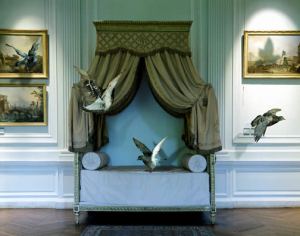
Karen Knorr, The Green Bedroom of Louis XVI. © Eric Franck Fine Art
Art and Its Afterlives aims to address the ways in which the work of art continues to resonate after its creation. While much art history takes as its focus the initial facture of the work of art, this one-day symposium explores what happens to early modern art after the moment of its making. How did early modern works continue to be created in their display, preservation, and reception from the moment of their creation on? Papers will examine how art is shaped by its afterlives – whether these collect, curate, cut up, cut out, copy or correct it – and the ways in which art both persists and changes through time as a material object, a field of generative meaning, and a subject of debate and interpretation. Material, technical and social histories as well as theoretical approaches drawn from the discipline of art history and other fields of the humanities
are welcome. Accounts from curatorial practice and the field
of museology are also encouraged. (more…)
Call for Papers | The Work of Art, Particular and Universal
As noted at Le Blog de L’ApAhAu:
L’œuvre d’art entre ambition identitaire et aspiration à l’universel
Institut Catholique de Paris (ICP), 5-6 April 2013
Proposals due by 31 July 2012

Institut Catholique de Paris, founded in 1875
L’œuvre d’art et le sens qu’on lui donne sont porteurs d’une tension : la création est tout à la fois symbole d’une identité culturelle spécifique et dépositaire d’un message d’ordre universel. Ce phénomène s’accentue dans le contexte contemporain de mondialisation des échanges où l’art semble constituer plus que jamais un repère stable dans un monde au caractère mouvant parfois perçu comme inquiétant. Le propos de ce colloque est d’explorer, dans une perspective historique, cette dialectique identité / universalité de l’œuvre d’art par le biais de trois thématiques :
• L’étude des œuvres hybrides, combinant ostensiblement différentes traditions artistiques, culturelles, techniques… et les conséquences de l’intégration de nouveaux modèles sur la formation d’une identité culturelle.
• La thématique du transfert : voyages d’artistes, circulation d’œuvres, décentrement des foyers artistiques… : autant d’éléments aux conséquences majeures sur la création de nouvelles formes d’art, sur leur appropriation et la portée du sens qui s’y attache.
• La question muséale avec le contraste entre un spectaculaire développement du nombre de musées à vocation plus ou moins universelle et les difficultés croissantes liées à la circulation et à la propriété des œuvres, considérées tantôt comme des marqueurs identitaires nationaux tantôt comme des icônes universelles.
Le colloque se tiendra sur deux jours dans les locaux de l’ICP. Les propositions de candidatures devront être envoyées avant le 31 juillet 2012 à l’adresse suivante : colloqueicp-2013@yahoo.fr. Elles comporteront un exposé du projet de communication 1500 signes environ ainsi qu’un bref CV ou résumé biographique. La durée des communications est fixée à 20 mn.
Call for Papers | Politeness & Prurience
From the conference website:
Politeness & Prurience: Situating Transgressive Sexualities in the Long Eighteenth Century
History of Art Department, the University of Edinburgh, 2-3 September 2013
Proposals due by 10 September 2012
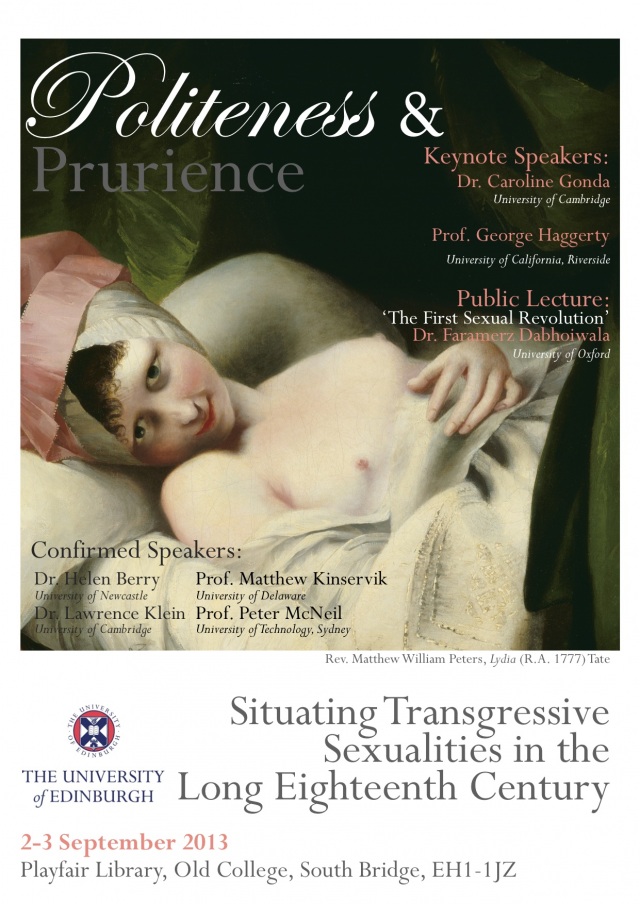 Embedded within the narrative of John Cleland’s infamous novel Fanny Hill, or Memoirs of a Woman of Pleasure (1748), is a vignette which affronts the moral compass of even the tale’s sexually promiscuous protagonist. Having attended a ‘drag masquerade’, Fanny bears witness, through a convenient crack in a wall, to a sodomitical act, which she finds ‘not only universally odious but absurd’. Despite her apparent condemnation, Fanny pruriently watches on. In its dichotomous nature, Fanny’s reaction – suggestive of both outrage and intrigue – mirrors reactions to homosexuality in the eighteenth-century and its subsequent historiography, wherein it is treated at once as a site of fascination, but considered separately from the history of normative sexualities. Situated as it is, within this feast of heterosexual eroticism, Fanny Hill’s same-sex love scene may seem incongruous. Cleland’s text however, proffers a way to approach homosexuality as both explicitly aberrant and problematic, but still located within the general lexicon of eighteenth-century sexual congress. By the same token, Cleland offers a model for resituating the homosexual narrative within a wider historiography of sexuality, where its relationality to dominant modes, not its difference from them, might fruitfully be used as a way to re-evaluate transgressive sexualities during the period.
In his 2006 article ‘Queering Horace Walpole’ George Haggerty advocates an approach to the history of sexuality wherein the search for a ‘concrete account of same-sex sexual behaviour’ is rejected, forcing the historian ‘to look elsewhere in almost every case’. Accordingly, this conference will privilege the assessment of cultural evocations of the ‘other eighteenth century’; the transgressive will be identified as, and sought within, dominant modes of eighteenth-century culture and its discourses. In the realm of visual culture, transgressive and deviant sexualities have previously been interpreted as autonomous and distinct from these prevailing modes. Hogarth’s famous print-series A Harlot’s Progress (1732) and A Rake’s Progress (1735) have been interpreted simplistically – in accordance with their appellation – as ‘modern moral subjects’. As such they have routinely been presented as providing antitheses to a broadly defined exemplar of ideal polite culture. Such a prima facie interpretation however, boldly precludes the rich scopophilic potential provided by scenes of prostitution and illicit sexuality, locating it instead within the polite framework of moralising art. Like Fanny, the viewer of such images is at once repulsed and titillated. Yet Hogarth’s satirical oeuvre is not merely a visualisation of moral imperatives central to polite culture, but a vivid visualisation of a real section of contemporary society. In reintegrating these apparently oppositional forms of behaviour a clearer picture of eighteenth-century society and culture emerges. Hogarth’s images may therefore be viewed not as simply the commentary on the mores of an apparently ‘polite’ society via the representation of its very opposite, but, analogous to David Halperin’s definition of ‘queer’ in Saint Foucault: Towards a Gay Hagiography (1997), as ‘a positionality vis à vis the normative’.
In an attempt to highlight underwritten facets of contemporary sexuality, texts such as G. S. Rousseau and Roy Porter’s Sexual Underworlds of the Enlightenment (1987) which label themselves as examining the ‘other’ or ‘underworld’ have instead further problematised the role and import of such histories to wider eighteenth-century culture. The aim of this conference is therefore not to present illicit sexuality as an underbelly to a dominant polite culture, but to reconcile the ‘two eighteenth centuries’ that have for too long been presented as the subject of two discrete discourses – politeness and prurience. As well as dealing with the interface between politeness and prurience as it appears throughout eighteenth-century visual, material and literary culture more generally, specific topics for papers could include:
• Bodies – the venereal body, castrati, physicalities, sadomasochism
• Settings – home and abroad, urban centres, rural backwaters
• Spaces – the architectural exterior and the private interior, the bagnio, the brothel, the masquerade
• Gaze/Experience – viewing sexualities, the keyhole testimony, description and biography
• Material Evidence – the objects of sexuality, dress, sex aids, collections, erotica
• Masculinities and Femininities – gender roles, reversals and subversions
• Modes of the illicit – sodomitical, Sapphic, pathological, pederastic, extra-marital, rape
• Public & Private – reception/reaction, fear/celebration, homophobia, display, expression
• Language – parlance, designation, rumour, slander, code
We invite abstracts of no more than 500 words to Dr. Viccy Coltman, Head of History of Art, Jordan Mearns & Freya Gowrley at politeness.prurience@gmail.com by 10 Sept 2012. Website: http://www.politenessandprurience.com
Call for Papers | Botany and the Visual Arts at UAAC-AAUC
From the conference website (which includes information on additional sessions). . .
Cross-pollinations: Botany and the Visual Arts, 1700 to the Present
Concordia University, Montreal, 1-3 November 2012
Proposals due 4 June 2012
Panel at the Universities Art Association of Canada (UAAC-AAUC) Annual Conference
This session explores intersections between botany and the visual arts since 1700. Plants have held iconographic significance since the Middle Ages, serving as traditional Christian allegories or as more abstract symbols in the Romantic period. Have the botanical sciences, such as phytognomy or Linnaean taxonomy, contributed to the symbolic charge of particular plants? Vegetation has similarly played an ongoing role in the decorative arts, inspiring motifs as diverse as arabesques to the wallpaper patterns of the Arts and Crafts Movement. How has vegetal ornament engaged with the expanding repertoire of botanical illustrations supplied by imperial expeditions? The eighteenth century also witnessed a major shift from a mechanistic to an organic paradigm of the creative mind. Did the study of plant growth and procreation provoke theories of vegetable genius? This session invites proposals across mediums and cultures that consider how botany has influenced the subjects of art, artistic practice, and concepts of artistic generation. Papers that investigate how the arts have shaped knowledge of the vegetable kingdom are also welcome.
Please email abstracts (250 words) and a short bio to Nina Amstutz, the session chair, at nina.amstutz@utoronto.ca. Membership to the UAAC-AAUC required for conference participation.
Call for Reviews from BSECS
Online Reviews of Events

◊ ◊ ◊ ◊ ◊
The British Society for Eighteenth-Century Studies has established a new online system for reviews of events which involve significant performances of eighteenth-century works, or the input of scholarship on the eighteenth century. The system is designed to cover theatre, music, media (in all forms), and fine art. The Society is keen to cover as many countries and exhibitions as possible.
The reviews are designed to be more discursive than the usual press reviews, and they remain online with a permanent URL, and are therefore citable. The system can be found at: http://www.bsecs.org.uk/Reviews/.
The Society is looking both for reviewers and for recommendations for fine art events to be covered. In particular we would be delighted to hear of smaller events which might otherwise not receive press attention. The reviews editor, Matthew McCormack, can be contacted through the BSECS website.
Call for Papers | RSA Panel on Confraternities, 1350-1750
This session at next year’s meeting of the Renaissance Society of America could include eighteenth-century topics — and good to know there’s a group dedicated to confraternity studies. Coming from the Midwest, I think April in San Diego sounds lovely. -CH
◊ ◊ ◊ ◊ ◊
RSA Session: Confraternities and Urban Performance, 1350-1750
San Diego, 4-6 April 2013
Proposals due by 1 June 2012
The performances staged by confraternities in the streets and squares of medieval and early modern cities have been the focus of considerable scholarly attention in recent years. The Society for Confraternity Studies seeks to further this conversation by soliciting submissions for a series of panels that examine the relationship between corporate devotion and urban theatre.
Possible topics include, but are not limited to, devotional theatre, sacre rappresentazioni, execution rites, miracle plays, charitable performances, alms collections, relic translations, funeral ceremonies. Submissions are especially welcome from scholars using innovative methodologies to frame and characterize the role of confraternal performance, broadly conceived, in popular devotion. Submissions from all geographical areas and through the time period of 1350 to 1750 are welcome. Please email a brief abstract (maximum 250 words) and a CV to Diana Presciutti (dpresciutti@wooster.edu). The submission deadline is 1 June 2012. The session is sponsored by the Society for Confraternity Studies.










1 comment