Call for Papers | CAA 2013: Open Session for New Scholars
In addition to the session chaired by Hector Reyes on ‘Art in the Age of Philosophy’, HECAA is sponsoring an ‘Open Session for New Scholars’ at the annual meeting of the College Art Association in New York, 13-16 February 2013. The deadline is slightly later for this 1.5 hour slot, though I’m sure the chair, Amelia Rauser would appreciate receiving them as early as possible. -CH
◊ ◊ ◊ ◊ ◊
CAA 2013 | HECAA Affiliate Session: Open Session for New Scholars
New York, 13-16 February 2013
Proposals due by 1 June 2012
Open session for new scholars, sponsored by the Historians of Eighteenth-Century Art and Architecture, at the 2013 meeting of the College Art Association in New York. Proposals welcomed on any aspect of eighteenth-century art. Please email CV and abstract by 1 June 2012 to Professor Amelia Rauser at: amelia.rauser@fandm.edu.
Call for Papers | Digital Revolutions
Digital Revolutions: Interpreting and Historicizing American Culture
New England American Studies Association 2012 Conference
University of Rhode Island, Providence, 12-13 October 2012
Proposals due 3 May 2012 (extended from the original 15 April deadline)
Recent developments in digital technologies have transformed the place of the humanities in American life. From online versions of Cotton Mather’s Magnalia Christi Americana to a daily John Quincy Adams Twitter feed to the Smithsonian’s publicly accessible Archives of American Art to the Women Writers Online Project, digital technologists are reshaping our sense of history, place, community, and identity. Digitization of America’s cultural heritage has also fundamentally transformed work in the humanities itself. From universities to libraries to cultural institutions, the information infrastructure has brought forth digital collaborations across disciplines and beyond the academy, as well as between scholars, educators, archivists and programmers. But it has also brought forward concerns about copyright, control and access to information and the future of print media.
Are such changes unprecedented? Prior evolutions in communications technology suggest otherwise. From broadsides to blogs, such changes have reshaped the way Americans interact and understand themselves both in the present and the past. The 2012 NEASA conference, Digital Revolutions, invites participants to consider what these developments are, how they are redefining work in the humanities and what previous media revolutions suggest for the future.
This conference will combine scholarly investigation of the cultural, political and economic significance of communications media with a series of panels, workshops and participatory forums that can take advantage of technologies now available to us. In addition to individual paper proposals, we also welcome submissions for roundtable discussions, hands-on workshops and multimedia sessions such as film screenings, online presentations and 5-minute micropapers.
Proposals should include a one page abstract and title, as well as the author’s name, address (including email), and institutional or professional affiliation. For panel proposals please include contact information for all participants, as well as a brief (no more than two page) description of the session topic and format. Submit proposals to neasaconference12@gmail.com by the revised deadline of May 3, 2012.
Proposal or queries may also be sent to:
Sara Sikes, NEASA President
Massachusetts Historical Society, The Adams Papers
1154 Boylston Street
Boston, MA02215
ssikes@masshist.org
For more information about the conference and NEASA, including an expanded Call for Papers, please visit www.neasa.org.
Call for Session Proposals | 2013 ASECS in Cleveland
2013 American Society for Eighteenth-Century Studies Conference
Cleveland, Ohio, 2-7 April 2013
Session proposals due by 1 May 2012
The 2013 ASECS conference takes place in Cleveland, Ohio at the Renaissance Cleveland Hotel. Committee organizers are now accepting proposals for sessions. The form (as a PDF file) is available for download here.
Call for Papers | CAA in New York 2013
The following represents a selection of panels that might be of interest for scholars of the eighteenth century, though readers are encouraged to consult the full Call for Papers. HECAA members are asked to pay special attention to the session organized by Hector Reyes ‘Art in the Age of Philosophy?’ along with an Open Session for New Scholars. -CH.
◊ ◊ ◊ ◊ ◊
101st Annual Conference of the College Art Association
New York, 13-16 February 2013
Proposals due by 4 May 2012
The 2013 Call for Participation for the 101st Annual Conference, taking place February 13–16 in New York, describes many of next year’s programs sessions. CAA and the session chairs invite your participation: please follow the instructions in the booklet to submit a proposal for a paper or presentation. This publication also includes a call for Poster Session proposals and describes the eight Open Forms sessions.
◊ ◊ ◊ ◊ ◊
Historians of Eighteenth-Century Art and Architecture
Art in the Age of Philosophy?
Hector Reyes, University of California, Los Angeles, hreyes@humnet.ucla.edu
The relationship between philosophy and art has been a rich field of research for scholars of eighteenth-century painting. Such inquiry has identified philosophical motivations for the pursuit of pleasure, especially aesthetic pleasure, and led to a new understanding of the intellectual foundations and commitments of supposedly frivolous painters, such as Fragonard, Greuze, Boucher, and Chardin. This panel seeks to broaden the inquiry in eighteenth-century philosophy and art by considering a wide range of philosophical and artistic practices. Are there neglected philosophies that might relate to artistic theory or production? How might philosophical approaches help us to rethink the status of other media or artistic production more generally in the eighteenth century? Does an emphasis on philosophical questions occlude or lead us away from important formal questions? Papers that question or interrogate the philosophical approach to art-historical research are as welcome as those that present new research or propose new approaches and methodologies.
◊ ◊ ◊ ◊ ◊
The Decorative Arts within Art Historical Discourse: Where Is the Dialogue Now and Where Is It Heading?
Christina Anderson, University of Oxford, and Catherine Futter, Nelson-Atkins Museum of Art; cm.anderson@usa.net and cfutter@nelson-atkins.org.
The decorative arts are frequently regarded as minor arts in comparison with the “beaux arts” of painting, sculpture, and architecture. Although William Morris wished to democratize art, his writings tended to exacerbate this gulf. The Wiener Werkstätte, Omega Workshops, and Bauhaus also all tried, but failed, to bridge the gap. Today, art history students often encounter the decorative arts late in their careers, if at all. Even among scholars, the decorative arts have become associated with “material culture,” a social science term. This panel will investigate the current status, and future direction, of the decorative arts within art history from a number of different approaches, including material culture, gender studies, Marxism, and semiotics. Are museums better repositories of decorative arts scholarship than universities? Is the term “decorative arts” appropriate, or is it as limiting as “applied arts,” “material culture,” “design,” and “craft?”
◊ ◊ ◊ ◊ ◊
The Watercolor: 1400–1750
Susan Anderson, Harvard Art Museums, and Odilia Bonebakker, Harvard University; susan.anderson.phd@gmail.com and bonebakk@gmail.com
Art history tends to view watercolor as a modern phenomenon. However, the medium (including gouache and distemper) enjoyed broad-ranging application in a wide spectrum of independent, finished objects produced before 1750. Neither painting nor drawing, and practiced by professionals and amateurs, watercolor resisted contemporary categorization and cohesive analysis during this period of institutionalizing art and its makers. Despite watercolor’s conspicuous presence, a thorough discussion of its theory, practice, and collecting habits from 1400–1750 has been wanting. We seek to re-inscribe watercolor as a significant category in the history of early modern art. Rather than view early watercolors as inevitably leading to the grand British tradition as codified by the Royal Watercolor Society, this session first and foremost aims to place these earlier objects within their own historical, geographical, and cultural moments. Papers from a range of topics and methodological approaches are welcome.
◊ ◊ ◊ ◊ ◊
Open Session: French Art, 1715–1789
Colin B. Bailey, The Frick Collection, New York, Bailey@frick.org
Papers that shed new light on individual painters, draftsmen, printmakers, sculptors, practitioners of the decorative arts, and architects in the period between the Regency and the end of Louis XVI’s reign are encouraged. It is hoped that the presentations will also illuminate the range of approaches and methodologies that have revitalized the study of eighteenth-century French art in the past two decades.
◊ ◊ ◊ ◊ ◊
Tapestry and Reproduction
Barbara Caen, Universität Zürich, and K.L.H. Wells, University of Southern California; barbaracaen@gmail.com and katharlw@usc.edu
The session will examine how the tapestry has developed as a reproductive art from the sixteenth century, when Raphael’s famous Acts of the Apostles tapestries were widely copied throughout Europe, to the present day, when digital imaging facilitates the creation of almost photorealist tapestries by contemporary artists. Focusing on tapestry suggests not only that the issue of reproduction was relevant long before the onset of photography, but also that the workshop traditions of the early modern period continue to shape artistic production today. This session asks how tapestry’s status as a collaboratively crafted reproduction of a prior design, cartoon, or model has influenced its production and reception. Papers could address the working relationship between designers and weavers, the role of the market, or perceived differences between manual and mechanical reproduction. We invite papers by scholars working in a range of historical time periods and methodologies, as well as by artists who have participated in tapestry production.
◊ ◊ ◊ ◊ ◊
Historians of British Art
Parallel Lines Converging: Art, Design, and Fashion Histories
Julie Codell, Arizona State University; Julie.codell@asu.edu
Historians of art, design, and fashion, long separated into discrete disciplines, have begun shared investigations of British culture, often focused on material objects from which radiate a range of topics: domesticity, collecting, museums, gender, consumption, empire, objects’ social and economic trajectories, and social identities constructed through things, among others. Yet, scholars may retain different disciplinary methodologies through which they examine social, historical and cultural meanings of art, objects, dress, furnishings, and spaces. Papers on British visual culture from all historical periods and media are welcome and should address aspects of this convergence, such as (but not limited to) its history in the Arts and Crafts movement or the Gesamtkunstwerk; its appearance as a consequence of commercial or academic changes; its effects on rethinking periodicity and styles; similar objects studied through different methods; design or fashion in paintings; advertising and art history; film costume and mise-en-scene; art and design histories converging in studies of empire.
◊ ◊ ◊ ◊ ◊
Imagining Creative Teaching Strategies in Art History
Marit Dewhurst and Lise Kjaer, City College, City University of New York; mdewhurst@ccny.cuny.edu and lkjaer@ccny.cuny.edu
Exciting discoveries and challenging new scholarship in the field of art history are commonly taught in a pitch-dark classroom, in a classical lecture style. This session calls for papers that will address, rethink, and critique alternative pedagogical strategies in teaching art history on both graduate and undergraduate levels. Papers may address a variety of teaching theories that actively engage students, such as cooperative learning, critical pedagogy, experiential learning, and inquiry-based learning. Papers may consider methods that empower students in an active and self-motivated investigation of art history. Finally, creative teaching strategies that explore critical research and writing assignments are also welcome.
◊ ◊ ◊ ◊ ◊
The Darwin Effect: Evolutionary Theory, Art, and Aesthetic Thought
Michael Dorsch, The Cooper Union for the Advancement of Science and Art, and Jean M. Evans, The Oriental Institute of the University of Chicago; michaelscottdorsch@gmail.com and jmevans@uchicago.edu
Charles Darwin’s theory of evolution bore a decisive influence on aesthetic thought that was nothing if not diverse. Its impact has cropped up in a variety of places, ranging from the dating of geometric ornament of so-called primitive cultures to Emmanuel Frémiet’s sculptures of entanglements between simians and prehistoric humans and ultimately to the work of contemporary artists. Using the wealth of new scholarship that resulted from the 200th anniversary of Darwin’s birth and the 150th anniversary of the publication of The Origin of the Species as a springboard, this session will examine the impact of evolutionary theory. To that end, we seek papers that examine the role of Darwinian theory in the construction of trans-cultural, trans-historical discourses on artistic practice, aesthetic theory, and the historiography of art history.
◊ ◊ ◊ ◊ ◊
Putting Design in Boxes: The Problem of Taxonomy
Craig Eliason, University of St. Thomas; cdeliason@stthomas.edu
When design historians label a chair as “Louis XV” style or a typeface as a “humanist sans-serif,” they are imposing classification schemes upon these design artifacts. This taxonomic approach, which has shaped much of design history, itself deserves attention. This panel welcomes papers that address the problem of taxonomy in the historiography of design, whether through case studies or theoretical reflections. Papers might consider the entrenchment of classification systems in the practice of design studies (e.g., in textbooks and syllabi); might address the roles of industry in both demanding and supplying classification schemes; or might probe the points at which taxonomic systems fail. Looking ahead, papers might also propose new strategies for effective classification (perhaps employing bottom-up semantic tagging in place of top-down fixed categorical schemes). The panel will consider how the intentional examination of the problem of taxonomy can generate insights both about design and about the scholarship thereof.
◊ ◊ ◊ ◊ ◊
Material and Narrative Histories: Rethinking Studies of Inventories and Catalogues
Francesco Freddolini and Anne Helmreich, The Getty Research Institute; AHelmreich@getty.edu
This session aims to identify innovative scholarly approaches to inventories and catalogues by exploring these texts as narratives and material objects. Rethinking the role of these texts is particularly pertinent now when digital humanities have fuelled a quest for “empirical data.” Our questions include: What is the role of authorship and who constitutes the author(s) and additional protagonists? How were these texts developed as multivalent strategies? How is meaning produced at the linguistic, semantic, rhetorical, visual, and material levels? Are there sufficient commonalities to regard these texts as genres? How is the reader understood at the original point of production and in subsequent reception histories? How do such temporal shifts impact on our approach? Papers may investigate case studies but should nonetheless explore the larger theoretical and methodological significance of the materials. We are particularly interested in lesser-known inventories and catalogues posing unusual problems as well as exploring a diverse breadth of chronological and geographic material.
◊ ◊ ◊ ◊ ◊
Building for the “Common Good”: Public Works, Civic Architecture, and Their Representation in Bourbon Latin America
Luis J. Gordo-Peláez, University of Texas at Austin, and Paul B. Niell, University of North Texas; pelaezluis@mail.utexas.edu and paul.niell@unt.edu
In 1700, a new king, Philip V, and a new royal dynasty, the French Bourbons, ascended the Spanish throne and introduced ambitious governmental, military, and fiscal reforms in the overseas colonies. For the next century, the cities of colonial Latin America experienced a considerable transformation in their urban landscapes. Viceroys, Corregidores, Intendentes, and Cabildos promoted drastic improvements of public works, buildings, and repairs of city halls, jails, bridges, fountains, paved roads, granaries, slaughterhouses, and parks. This panel seeks to examine civic architecture, public infrastructures, and their representation, built for the “common good,” during the eighteenth and early nineteenth centuries in Latin America. It also explores the relationship between such public improvements and late colonial identities. The panel thus invites papers dealing not only with architectural history, but also with the history of the image and other forms of material culture.
◊ ◊ ◊ ◊ ◊
CAA International Committee
Crossing Continents: Expatriate Experiences and the History of Art History
Geraldine A. Johnson, University of Oxford; geraldine.johnson@hoa.ox.ac.uk
The history of art history has often been a history of expatriate experiences. Already in the sixteenth century, Van Mander not only read Vasari, but traveled to Italy. The influence of time spent abroad continues to shape the discipline as seen in the peripatetic careers of Okwui Enwezor or T. J. Clark. In intervening centuries, Italy in particular attracted Winkelmann, Burckhardt, Ruskin, Berenson, and many others. From the later nineteenth century, art historians began traveling farther afield, as seen in Warburg’s 1895–96 trip to New Mexico or Sirén’s 1918 visit to Asia. Later, Panofsky, Gombrich, and others fled National Socialism in Europe, with their subsequent writings inevitably affected by their expatriate status. This session explores how such experiences have shaped art history, both what has been studied (or ignored) and how. Proposals on individual scholars, particular approaches or travel to specific countries/regions from Early Modern times to the present are welcome.
◊ ◊ ◊ ◊ ◊
Harems Imagined and Real
Heather Madar, Humboldt State University, Art Department,
1 Harpst St., Arcata, CA, 95521; Heather.Madar@humboldt.edu
The eroticized odalisque is a familiar cliché of Orientalist art. The harem of the Ottoman sultans in particular was much mythologized by Western Europeans, creating a lurid popular image rife with misconceptions. The harem became a key trope of Orientalist thought, encapsulating European perceptions of the decadent, despotic yet desirable East. Images of the harem produced by nineteenth-century Orientalist artists are well known. Yet harem imagery both predates and postdates the time frame of canonical Orientalist art; it was produced by both internal and external observers and, in some cases, by and for women. This panel seeks to critique harem imagery and harem discourse, and to reconsider the sociopolitical freight of harem imagery and the symbolic significance born by depictions of women’s bodies and spaces gendered as female. Papers that examine lesser-known works, including imagery from outside the nineteenth century, depictions of less commonly represented harems, and images by women artists or indigenous representations, are particularly invited.
◊ ◊ ◊ ◊ ◊
Artists, Architects, Libraries, and Books, 1400–1800
Sarah McPhee, Emory University, and Heather Hyde Minor, University of Illinois, Urbana-Champaign; bookscaa2013@gmail.com
Bernini possessed a manuscript of Galileo’s Mecchaniche and Marino’s poetry. Inigo Jones owned books by Plato and Plutarch. Jacques Lemercier collected 3,000 books, including the Koran; Velazquez had books on navigation and the planets. How are historians to understand the content of these libraries? What kinds of libraries did architects/artists assemble and how did they use them? How did their reading affect their art? Traditional approaches to these questions have followed a bibliographic method, equating the contents of books with the owner’s mind and considering individual volumes as sources in the creation of buildings or works of art. But this approach oversimplifies the historical reality of books and the ways people read them. Recently, the basic constituents of study—author, book, reader—have been revised; with this session we hope to gauge the current state of research. We seek papers that consider artists and architects as authors, readers, publishers, borrowers, and collectors of books.
◊ ◊ ◊ ◊ ◊
Interpreting Animals and Animality
Susan Merriam, Bard College; merriam@bard.edu
This session will focus on the representation of animals or animality in Western visual culture from about 1500 to the present. Since the publication of Peter Singer’s Animal Liberation in 1975, animal studies has emerged as an important topic in the humanities. Historical studies, philosophy, and literature have increasingly devoted attention to the study of animals. Yet, arguably, animals are more important in the visual arts than in any field excepting anthropology or the environmental and biological sciences. The extent to which we believe things to be true about animals (that, for example, they think and feel in certain ways) has been informed by images; these beliefs, in turn, have important environmental and ethical consequences. Papers might examine anthropomorphism, or analyze how images of animals shape attitudes about human relationships and cultural practices. Aesthetics is another topic that might be addressed: What type of artistic techniques or compositional forms are used to convey information about animals? The concept of animality itself might also be considered.
◊ ◊ ◊ ◊ ◊
The Art of the Gift: Theorizing Objects in Early Modern Cross-Cultural Exchange
Nancy Um, Binghamton University, and Leah Clark, Saint Michael’s College; nancyum@binghamton.edu and leah.clark@mail.mcgill.ca
This panel focuses on the visual culture of gifts during the dynamic early modern era, when objects of exchange played an important role in burgeoning cross-cultural encounters, long-distance economic interactions, and diplomatic engagements. Its aim is to examine the unique contributions that art history may offer to the critical legacy of the gift, with its anthropological and sociological roots, such as a concern for the visuality of objects in motion, an interest in collecting and display, and an awareness of how objects of exchange may give rise to new social and artistic practices. The panel organizers encourage theoretically engaged papers that represent the broad geographic scope of the gift encounter, locate gifts in dynamic cross-cultural matrices of circulation and consumption, stake out territory within or in response to exchange theory, and/or consider the shifting and unstable meanings of objects as they changed hands across time and space.
Call for Essays | Interpeting Sexual Violence, 1660-1800
Interpreting Sexual Violence, 1660-1800
Volume Editor: Anne Greenfield, Valdosta State University
Abstracts due by 15 May 2012
Sexual violence was a favorite subject of many (long) eighteenth-century writers, artists, and thinkers. This collection seeks to examine the conflicting, intersecting, and shared ideologies within representations of sexual violence over the course of the long eighteenth century. Since depictions of sexual violence appeared in various forms and in a variety of genres, papers examining sexual violence in one or more venues between 1660 and 1800 are welcome.
Please submit to the editor a 250-500 word abstract, along with a biographical statement (indicating your affiliation, prior publications, and contact information) by May 15, 2012. If accepted, a final version of the paper (6,000-8,000 words) would be needed by fall 2012 (details to follow). Inquiries and questions may be directed to Anne Greenfield, algreenfield@valdosta.edu.
Call for Papers | European Portrait Miniatures
European Portrait Miniatures: Artists, Functions, and Collections
Residence Museum, Celle, Germany, 25-27 January 2013
Proposals due by 31 May 2012

Unknown (probably German), "Portrait of a Miniaturist," ca. 1740 (Tansey Collection Ref.-No. 010.958)
From the 16th century well into the 19th century, portrait miniatures represented the most widely circulating form of portraiture. Mounted as jewellery or often framed on everyday objects, they were easily worn or carried on one’s person and easily transported. They served within a wide range of social functions. Portrait miniatures could be offered as gifts at court and were frequently exchanged as keepsakes among loved ones. They could be displayed within one’s circle or contemplated in private. The portrait miniature often combined a high level of technical craftsmanship with artistic ingenuity and inspiration.
Indeed, the intrinsic attributes of the portrait miniature, its distillation within a minuscule format as well as its intimate nature, have tended to limit art historical research and museum exhibits to the greater advantage of large-scale portraiture. The expertise of a small circle of specialists is, thus, confronted with conspicuously limited findings in comprehensive research and the publication of regretfully few monographs. Knowledge about works in many existing collections remains to date substantially incomplete. The following topics will be addressed at the conference:
• Individual miniaturists, specific workshop contexts, and places of production
• Use of both court and private types and their protagonists
• Iconographies of representation or intimacy
• Evolution of techniques and materials
• Less well-known collections in museums
The symposium will be held on the occasion of the planned opening of the fifth exhibit of the Tansey Collection and the publication of the accompanying catalogue, Miniatures of the time of Marie-Antoinette from the Tansey Collection on January 25, 2013. The conference will be in English. Lectures should not exceed 25 minutes and are to be published separately following the conference. The Tansey Foundation will assume travelling expenses, accommodations, and meals. Proposals from curators of less well-known miniature collections and younger academics are particularly most welcome. Exposés should be in English and no longer than 1500 characters. They should be submitted by May 31, 2012, including name, address, and, if applicable, institution, and be sent to: bernd.pappe@miniaturen-tansey.de
Organisation
Bernd Pappe, Berne (Art Historian and Restorer)
Juliane Schmieglitz-Otten, Celle (Head of the Residence Museum at Celle Castle)
Gerrit Walczak, Berlin (Substitute Professor at the Ruhr-Universität Bochum)
Visual Conception – IT Coordination
Birgitt Schmedding, Hamburg (Photo Designer)
Call for Papers | European Networks in the Baroque Era
As pointed out by Hélène Bremer, from H-Soz-u-Kult:
European Networks in the Baroque Era
Vienna, 26-29 September 2012
Proposals due by 30 April 2012
The first general conference of the ENBaCH Project is intended to bring together research on Baroque forms of exchange and networking, as a basis for a modern network of researchers working on themes related to the cultural heritage of Europe in the seventeenth and eighteenth centuries. The European Network for Baroque Cultural Heritage (ENBaCH, www.enbach.eu) — is a research project supported and funded by the European Commission.
“Baroque” of course has various connotations depending on regions and cultural contexts but also on various approaches in different research fields. As ENBaCH is defined as an interdisciplinary project it is intended to confront these aspects and discuss their impact on what might be defined as “European Cultural Heritage.”
A well-known historiograpical conundrum is the question of periodization. One useful, practicable approach is the collection of characteristics of an epoch from the cultural point of view: works of art, intellectual activities and developments, societal structures and contemporary ways of coping with diverse challenges in a specific society. Baroque culture was influenced by war, famine and epidemic diseases, and the resulting urgency of finding collaborative solutions for survival. New environments and infrastructures, increased mobility of craftsmen, artists and workers as well as the trade of artefacts and goods, and a vivid exchange of knowledge mark the period as much as its art, which represents a reaction to these threats to life in various ways.
We welcome papers on the following aspects of Baroque culture and exchange in particular:
• formal and informal networks of politics (e.g. the role of courts, diplomacy, agents) in the seventeenth and eighteenth centuries
• the Baroque circulation of ideas and knowledge (e.g. the Republic of Letters)
• the development of arts and cultural practices (“artists and artefacts on the move,” baroque festivals and piety, fashion, cooking, etc.)
• (with particular relevance to the venue of the conference): the Baroque perception of the human body in various works of art, death and dying in relation to confessional frameworks, coping with disease and disaster from a medical point of view (e.g. health care provisions, facing famine and epidemic disease) and collaboration in medicine and health care
Conference language: English. The papers should be given in English and should take max. 20 minutes. Discussions and commentaries by attending delegates may include also other languages. Abstracts of one page max., in English, accompanied by a very short CV, should be sent to baroquebodies@meduniwien.ac.at by the end of April 2012. We will be able to cover moderate travelling costs and accommodation for invited speakers other than those involved in the ENBaCH project. Please enquire for details.
Rooms are reserved at two hotels at a convenient location; speakers and conference delegates will benefit from a reduced room rate. Rooms are limited and available on first come, first served basis only. For any further questions about the conference practicalities please contact Paul Zogmann (paul.zogmann@meduniwien.ac.at).
Call for Papers | 2012 NEASECS Conference
The 2012 NEASECS Annual Conference
Wesleyan University, Middletown, Connecticut, 11-14 October 2012
Proposals due by 30 April 2012

I would kindly call your attention to the Call for Papers for the 2012 NEASECS conference to be held at Wesleyan University in October. At the conference website, you will find descriptions of several panels that might be of interest, including my session on “Dislocated Sociability,” and several others chaired by HECAA members. It would be lovely to have a strong art historical contingent at the conference, so I hope that you will consider submitting a proposal.
With thanks, and all best wishes,
Laura Auricchio
Call for Papers | Satire Across Borders
Satire Across Borders
Utrecht University, 17-18 January 2013
Proposals due by 1 June 2012
Satire has the ability to contest cultural boundaries in several ways. By addressing political topics or touching upon sensitive issues within a society (e.g. religious and sexual taboos), satirical works intervene in on going cultural debates. This is but one of the reasons why these works can be considered as interculturally charged. By mixing multiple media within one work, or by creatively transposing styles and techniques from one medium to another, satire shows that it can also contest medial boundaries, i.e. that it can be considered as intermedially charged as well. These two conditions, interculturality and intermediality, have framed the functioning of satire in the past and continue to do so in the present. They turn satire into a rather ambiguous phenomenon, for both its producers and its consumers. This assumed ambiguity of satire forms the point of departure of the international conference Satire Across Borders.
Satire’s ability to cross borders will be addressed from five different perspectives:
1) Time
In a historical perspective, satire seems to manifest itself at very specific occasions, for example during officially sanctioned festive activities (carnival, harvest rituals) or in moments of political crisis (during revolts, civil wars, religious upheavals etc.). How do these temporal conditions influence and define the functioning of satire? Is satire bound by such conditions, or does it also contest them?
2) Space
Although western society today seems to be rather tolerant towards satire, controversies still occur every now and then and censorship is sometimes called for. This suggests that the freedom of satirical expression is limited to certain zones, like the ritual context of carnival or the performative space of the television screen or, more generally, the (ideal) public space as one which establishes reciprocal understanding between its participants. What happens if satire crosses the borders of these zones? And can the establishment of these zones also lead to the inclusion or exclusion of certain audiences?
3) Target
One characteristic of satire is that it is always aimed at someone or something, i.e. that it has one or several targets. These can vary from royal figures and political/religious authorities to social taboos, cultural practices and moral values. Are there any general patterns to be discerned in the qualities of these targets themselves, and in the manner in which they are approached by satire? Does satire always contest its targets, or can it also legitimize them in one way or another?
4) Media
Satire is not bound to one medium or genre. On the contrary, it often combines multiple media or refers to the conventions of several styles or genres at the same time. How does this intermediality influence satire’s functioning in society? Does it limit or instead extend the potential audiences of satire? And what role do the material forms (manuscript, printing press, television, internet) of specific satirical works play in all this?
5) Rhetoric
Certain techniques, tactics and rhetorical figures recur time and again in satire, such as humour, irony, parody, burlesque and caricature. Such rhetorical techniques seem to play a pivotal role in the production and reception of satire. Historically speaking, to what extent can the use of them be called cyclical? And in what way do they contribute to satire’s ability to contest cultural boundaries?
The conference language will be English. (more…)
Call for Papers | The Spaces of Art
From the project website:
The Spaces of Arts: Thinking the National and Transnational in a Global Perspective
Purdue University, 27-29 September 2012
Proposals due by 15 May 2012
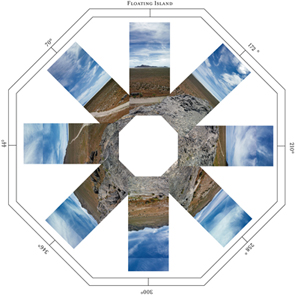
Katherine E. Bash, "Compass Rose, Floating Point Operation," 2008.
Is art history global enough to take up the challenge of cultural mixing, transnationalism, internationalization, and globalization, without neglecting cultural nationalisms and artistic territorialization processes, which are the fabric of our discipline? How do we understand the relationships between circulations, globalizations, and the production of ethnicity or nationality in the arts? What strategies can we develop, besides narration and description, to write a new history of the arts that escapes both historiographical nationalism and blind globalism, while paying due to the national and transnational dimensions of artistic creation?
In response to these questions the École normale supérieure in Paris (ENS-Ulm) and Béatrice Joyeux-Prunel launched a vast research project in 2009. The ambition was to study arts and letters in a socio-spatial perspective that takes into account the spatial turn of Social Sciences. The result is ARTLAS, a digital atlas of arts and literature history which combines spatial, social, cultural, and esthetic questionings, with a narrative/descriptive approach, and visualization techniques, including charts and maps created with GIS technologies (Geographic Information Service).
The reliance on a cartographic approach and multi-scale analysis grows from the conviction that we can transform the geohistorical reflections that Thomas DaCosta Kaufmann presented in Toward a Geography of Art (2004) into maps, and that the atlas model can contribute to meeting the challenge of global art history James Elkins exposed with Is Art History Global? (2006). Still, the format of ARTLAS is motivated by the conviction that we cannot separate the analysis of artistic circulations and globalization from the study of territorialization of artistic practices.
In order to present ARTLAS on the American continents and engage in a dialogue with American scholars, the ENS is teaming with Purdue University to organize a conference which will take place on September 27-29, 2012 at Purdue. We have invited Professor DaCosta Kaufmann and Professor Elkins to present their respective takes on a global art history and the use of maps as art historical tools, while philosopher Edward S. Casey will address the links between art and maps.
We are now inviting scholars, whose research is grounded in socio-spatial analysis and/or aims at meeting the daunting challenge of ubiquity in art history, to join the conversation and offer their perspectives. We welcome papers that explore the connection between the national and transnational in a global perspective for any object, period, and place in the history of arts and letters. (more…)










leave a comment