Call for Papers | 2012 NEASECS Conference
The 2012 NEASECS Annual Conference
Wesleyan University, Middletown, Connecticut, 11-14 October 2012
Proposals due by 30 April 2012

I would kindly call your attention to the Call for Papers for the 2012 NEASECS conference to be held at Wesleyan University in October. At the conference website, you will find descriptions of several panels that might be of interest, including my session on “Dislocated Sociability,” and several others chaired by HECAA members. It would be lovely to have a strong art historical contingent at the conference, so I hope that you will consider submitting a proposal.
With thanks, and all best wishes,
Laura Auricchio
Call for Papers | Satire Across Borders
Satire Across Borders
Utrecht University, 17-18 January 2013
Proposals due by 1 June 2012
Satire has the ability to contest cultural boundaries in several ways. By addressing political topics or touching upon sensitive issues within a society (e.g. religious and sexual taboos), satirical works intervene in on going cultural debates. This is but one of the reasons why these works can be considered as interculturally charged. By mixing multiple media within one work, or by creatively transposing styles and techniques from one medium to another, satire shows that it can also contest medial boundaries, i.e. that it can be considered as intermedially charged as well. These two conditions, interculturality and intermediality, have framed the functioning of satire in the past and continue to do so in the present. They turn satire into a rather ambiguous phenomenon, for both its producers and its consumers. This assumed ambiguity of satire forms the point of departure of the international conference Satire Across Borders.
Satire’s ability to cross borders will be addressed from five different perspectives:
1) Time
In a historical perspective, satire seems to manifest itself at very specific occasions, for example during officially sanctioned festive activities (carnival, harvest rituals) or in moments of political crisis (during revolts, civil wars, religious upheavals etc.). How do these temporal conditions influence and define the functioning of satire? Is satire bound by such conditions, or does it also contest them?
2) Space
Although western society today seems to be rather tolerant towards satire, controversies still occur every now and then and censorship is sometimes called for. This suggests that the freedom of satirical expression is limited to certain zones, like the ritual context of carnival or the performative space of the television screen or, more generally, the (ideal) public space as one which establishes reciprocal understanding between its participants. What happens if satire crosses the borders of these zones? And can the establishment of these zones also lead to the inclusion or exclusion of certain audiences?
3) Target
One characteristic of satire is that it is always aimed at someone or something, i.e. that it has one or several targets. These can vary from royal figures and political/religious authorities to social taboos, cultural practices and moral values. Are there any general patterns to be discerned in the qualities of these targets themselves, and in the manner in which they are approached by satire? Does satire always contest its targets, or can it also legitimize them in one way or another?
4) Media
Satire is not bound to one medium or genre. On the contrary, it often combines multiple media or refers to the conventions of several styles or genres at the same time. How does this intermediality influence satire’s functioning in society? Does it limit or instead extend the potential audiences of satire? And what role do the material forms (manuscript, printing press, television, internet) of specific satirical works play in all this?
5) Rhetoric
Certain techniques, tactics and rhetorical figures recur time and again in satire, such as humour, irony, parody, burlesque and caricature. Such rhetorical techniques seem to play a pivotal role in the production and reception of satire. Historically speaking, to what extent can the use of them be called cyclical? And in what way do they contribute to satire’s ability to contest cultural boundaries?
The conference language will be English. (more…)
Call for Papers | The Spaces of Art
From the project website:
The Spaces of Arts: Thinking the National and Transnational in a Global Perspective
Purdue University, 27-29 September 2012
Proposals due by 15 May 2012
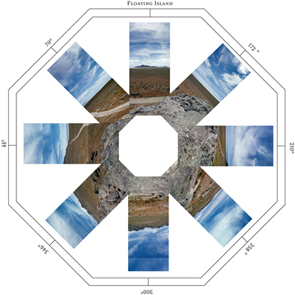
Katherine E. Bash, "Compass Rose, Floating Point Operation," 2008.
Is art history global enough to take up the challenge of cultural mixing, transnationalism, internationalization, and globalization, without neglecting cultural nationalisms and artistic territorialization processes, which are the fabric of our discipline? How do we understand the relationships between circulations, globalizations, and the production of ethnicity or nationality in the arts? What strategies can we develop, besides narration and description, to write a new history of the arts that escapes both historiographical nationalism and blind globalism, while paying due to the national and transnational dimensions of artistic creation?
In response to these questions the École normale supérieure in Paris (ENS-Ulm) and Béatrice Joyeux-Prunel launched a vast research project in 2009. The ambition was to study arts and letters in a socio-spatial perspective that takes into account the spatial turn of Social Sciences. The result is ARTLAS, a digital atlas of arts and literature history which combines spatial, social, cultural, and esthetic questionings, with a narrative/descriptive approach, and visualization techniques, including charts and maps created with GIS technologies (Geographic Information Service).
The reliance on a cartographic approach and multi-scale analysis grows from the conviction that we can transform the geohistorical reflections that Thomas DaCosta Kaufmann presented in Toward a Geography of Art (2004) into maps, and that the atlas model can contribute to meeting the challenge of global art history James Elkins exposed with Is Art History Global? (2006). Still, the format of ARTLAS is motivated by the conviction that we cannot separate the analysis of artistic circulations and globalization from the study of territorialization of artistic practices.
In order to present ARTLAS on the American continents and engage in a dialogue with American scholars, the ENS is teaming with Purdue University to organize a conference which will take place on September 27-29, 2012 at Purdue. We have invited Professor DaCosta Kaufmann and Professor Elkins to present their respective takes on a global art history and the use of maps as art historical tools, while philosopher Edward S. Casey will address the links between art and maps.
We are now inviting scholars, whose research is grounded in socio-spatial analysis and/or aims at meeting the daunting challenge of ubiquity in art history, to join the conversation and offer their perspectives. We welcome papers that explore the connection between the national and transnational in a global perspective for any object, period, and place in the history of arts and letters. (more…)
Call for Project Participants | Revival: Utopia, Identity, Memory
The format of this project is worth noting: a one-day workshop is planned for June that will in turn shape the program for the November two-day conference. Despite the emphasis on the nineteenth century, perhaps there’s room for the eighteenth century, too; or for that matter, nineteenth-century revivals of key eighteenth-century movements could certainly be interesting. –CH
From The Courtauld:
Revival: Utopia, Identity, Memory
The Courtauld Institute of Art, London, 20 June 2012 and 23-24 November 2012
Proposals due by 16 April 2012
Revivalism in art and architecture is a fundamental though often overlooked aspect of modernity. From the nineteenth century to the present, styles, ideologies, techniques and approaches have been revived and re-framed. Revival: Utopia, Identity, Memory seeks to investigate the diverse dimensions of revivalism, exploring its meanings and impacts across cultures, periods and media. The extent to which revivalism has been harnessed to promote utopian visions, assert aspects of personal or corporate identity, and grant fresh purchase on memorialization and nostalgia are all productive trajectories for investigation. Studies of art and architectural revivals tend to focus on biographical or stylistic approaches. This project, consisting of a workshop and major conference for an international cohort of interdisciplinary scholars, encourages intersecting and broadening views in order to chart the notion of revivalism itself. The phenomenon’s implications for art and architectural history in relation to tradition, repetition, originality, transnationality, patronage, religion, colonialism, historicism, reproduction, authenticity, resistance and power have yet to be intensively investigated.
This project consists of two events at The Courtauld Institute of Art in London. The first, on Wednesday 20 June 2012, will be a day-long workshop. The second, on 23-24 November 2012, will be a two-day conference. The purpose of the workshop is to explore intersections and encourage dialogue between scholars, and to discuss the importance of revivalism in broad terms. Workshop participants will also be invited to contribute research and topics for discussion to the November conference. The conference’s purpose is to crystalize and refine initial workshop conversations, establishing new ways of understanding revivalism. Participants will be drawn from early career and more established scholars, as well as artists and architects who actively engage with revival within their practice. Papers specifically addressing revivalism in relation to utopia, identity or memory are especially encouraged. It is hoped that speakers will attend both the summer workshop and the autumn conference in order to establish cohesion within the project and to create sophisticated collaborative responses to the theme.
The deadline for expressions of interest is 16 April 2012. Please email a CV and 200-word statement of how your work engages with revivalism to the project convener, Ayla Lepine (ayla.lepine@courtauld.ac.uk).
Call for Papers | Before Publication, Montage
Before Publication: Montage Between Privacy and Publicity
Zurich, 28-29 September 2012
Proposals due by 30 April 2012
Idea and Conception: Dr. des. Nanni Baltzer (Institute for Art History, University of Zurich) and Dr. Martino Stierli (Institute for the History and Theory of Architeture (gta), ETH Zurich)
At the moment of their going to press, publications irreversibly reach their definite form. At the same time, they also reach an audience. What is frequently forgotten in this process is that printing is preceded by several, sometimes complex steps towards the construction and montage of (visual) meaning. This conference sees these constructions of meaning as montages, and addresses the materials and processes involved before publication. Our focus is on concrete artistic and visual artifacts such as scrapbooks, diaries, book mock-ups, and press layouts by artists, authors, and graphic designers. In particular, we intend to shed light on the relationship between the spheres of privacy and publicity. This aspect has so far received only sparse attention, whereas questions concerning the historical genealogy of montage and collage as well their theoretical bases have increasingly been addressed in more recent research.
The conference is divided into two sections:
1) In the private realm: scrapbooks and diaries
2) For the public domain: layouts and mock-ups
Scrapbooks and diaries are for normally intended as a collection of intimate memories and souvenirs or as a kind of personal archive. They are usually only published posthumously, as documentary material or in the sense of an autonomous artistic expression. In contrast, press or book publications usually lack the mock-ups, i.e. the layout and mock-ups consisting of text and image montages. Depending on the archival situation, the more or less numerous steps that lead to a publication can be reconstructed only in singular cases in order to shed light on the production processes as well as the author’s intentions.
Products of the press are from the very beginning intended for a larger audience and aim to trigger a particular reaction by the public. For this reason, they are of high interest with regard to questions of aesthetic response. In this respect, the most important issue is how books and magazines are being produced by authors, photographers, graphic designers, and editors in reference to their audience. The relationship of montage to politics and propaganda remains to be discussed, but also questions concerning the interpretative strategies that allow for the construction of an (intended) meaning. Possible key questions on specific case studies include: the unfinished in the production of meaning through montage; the relationship of text and image; montage in press and book; ‘tabular’ montage as spatial dispositif for the production of meaning.
The focus of the conference will be on the presentation and interpretation of artifacts for which the concepts of montage, collage, and assemblage form a productive frame of reference. Individual case studies are not limited to a certain historical epoch, but should address one of the two sections sketched out above. Contributions on pre-modern subjects are explicitly welcome. We invited interested individuals from art and architectural history, history and cultural studies as well as related disciplines to send a 250-word abstract and short cv to Nanni Baltzer and Martino Stierli (nannibaltzer@gmx.net, martino.stierli@gta.arch.ethz.ch) by April 30, 2012.
Confirmations will be sent out by end of May, 2012. The definitive program will by communicated by the end of May 2012. The conference will take place in Zurich on September 28 and 29, 2012. The conference is co-organized by the Institute for Art History of the University of Zurich and the Institute for the History and Theory of Architecture (gta), ETH Zurich. Depending on funding, grants for travel and accommodation will be made available. A selection of the contributions will be published.
Call for Papers | Graduate Student Conference on Travel
Transporting Bodies and Minds: 18th- and 19th-Century Travel
University of Michigan, Ann Arbor, 15 September 2012
Proposals due 1 May 2012
Throughout the eighteenth and nineteenth centuries, travelers of all kinds documented their experiences in private letters and diaries, official correspondence, life writing, spiritual and religious narratives, and ethnographic accounts. Furthermore, these experiences were often transformed into works of art, with real and imagined moments of contact serving as the inspiration for painting, music, poetry, prose fiction, photography, and other creative ventures. These aesthetic productions transformed the foreign into the national, the known into the unknown, appearing to expand access to other cultures–a model of cultural transportation that recent criticism is troubling.
Scholarship drawing on theories of post-colonialism, gender, material and visual culture, cognitive studies, posthumanism, and other critical paradigms has challenged our understanding of the impact–not just aesthetic, but also commercial, martial, and religious–of travel in the eighteenth and nineteenth centuries. This work has made strides in elucidating a more dynamic picture of the way travel and cultural encounter could transform (or fail to transform) prior understandings of both time and space. Moreover, it has allowed for a more capacious appreciation of how influence happens, extending beyond more uni-directional, Eurocentric approaches.
Continuing this work, the University of Michigan’s Eighteenth-Century Studies Group and Nineteenth-Century Forum will co-host an interdisciplinary graduate student conference on these topics, to take place in Ann Arbor, MI, on September 15, 2012. We are pleased to announce that Kate Flint, Provost Professor of English and Art History (University of Southern California), will be our keynote speaker.
Graduate students are encouraged to submit papers that explore the implications of travel, tourism, boundary crossing, exploration, and other related topics–from a wide range of disciplinary perspectives. Submissions of either individual papers or full panels are welcome. Please send abstracts of no more than 300 words to Karen McConnell (mcconnka@umich.edu) by May 1, 2012.
Suggested paper topics include (but are not limited to): (more…)
Call for Papers | The Rake’s Progress
The Rake’s Progress: Stravinsky, Hogarth, Hockney, Auden, and Kallman
The University of Colorado at Boulder, 26-27 October 2012
Proposal due by 1 May 2012

William Hogarth, "A Rake's Progress," plate 3, 1735
This conference will be held in conjunction with the CU-Boulder Opera’s performances of The Rake’s Progress and the CU Art Museum’s exhibit, Hockney and Hogarth: Selections from the CU Art Museum’s Collection of British Art (featuring Hockney’s A Rake’s Progress, 1961-63). The program committee for the conference seeks papers relating to Stravinsky’s music, Hogarth and Hockney’s art, and/or Auden’s and Kallman’s libretto to The Rake’s Progress. The conference seeks to be interdisciplinary, and will consider relevant papers from the standpoint of music history, musical analysis, art and art history, aesthetics, literary studies, and stagecraft. Papers will be limited to 20 minutes, with ten minutes for further discussion. Those interested in participating are asked to submit a 500-word proposal in
MSWord or pdf format. E-mail by May 1, 2012 to
CBISassistant@gmail.com
Call for Papers | Art of Death and Dying
From the symposium website:
The Art of Death and Dying
University of Houston, 25-27 October 2012
Proposals due by 1 May 2012
The University of Houston Libraries, in partnership with the Blaffer Art Museum, the Cynthia Woods Mitchell Center for the Arts, the Department for Hispanic Studies, the Honors College and School of Art, will host a three day symposium titled “The Art of Death and Dying.” We welcome scholars in all disciplines to submit paper proposals on
literary, visual, and performing arts topics related to death and dying. Topics of the symposium include, but are not limited to:
– Literary, performing, or visual depictions or interpretations of death and dying
– Commemoration of the dead in art and performance
– Artifacts of death and dying as represented in archival or museum collections
– Artistic depictions of the after life
– Cultural death rituals
– Cultural expressions of mourning
– Death and dying in Latin American arts and culture
– Readings of original creative material on the subject
– Performances of material on the subject
– Presentation of visual material on the subject
– Memorial architecture
– Cemetery design
– Analysis of an artist’s, performer’s, filmmaker’s or writer’s work related to the subject
– Depictions of death and dying in film, radio, and television
Proposals related to death in Latin American art and visual culture are encouraged. The organizers will accept presentations in both Spanish and English. Papers will be selected based upon the quality of the proposal (including merit of the topic, clarity of expression, and relevance to the conference theme), the proposal’s ability to provoke critical exchange and debate, and opportunities for interaction between participants that will enable attendees to engage in a truly interdisciplinary exchange of ideas and viewpoints. Presenters will be afforded the opportunity for their symposium paper/presentation to be published in the Texas Digital Library. Papers will be twenty minutes in length and will be followed by ten minutes of discussion. Abstracts of no more than 300 words should be submitted on the symposium website.
Call for Papers | Gardening and Knowledge
Gardening and Knowledge: Landscape Design and the Sciences in the Early Modern Period
Hanover, 17-19 September 2012
Proposals due by 29 February 2012
Gardening and Knowledge is co-organised by the Centre of Garden Art and Landscape Architecture at the Leibniz Universität Hannover and the Interdisciplinary Centre for Science and Technology Studies (IZWT) at the Universität Wuppertal in Hannover. The workshop will open on the evening of 17 September with a keynote lecture by Professor Dr. Michael Leslie and will conclude on September 19. Because experts from the USA and several European countries will be participating, the conference language will be English.
Speakers have already committed to presenting on such topics as:
– Gardening nature, gardening knowledge: early modern gardens and the rise of natural knowledge
– John Evelyn, the Elysium Britannicum and the generation/ creation of knowledge
– Water technology, the increase of knowledge and its impact on gardens in the time of the Renaissance
– Botanical illustrations and the cultivation of botanical knowledge in the early modern era
– Water technology and the theory of perspective in Early Modern garden art
– the scientific approach and professionalism in garden art historiography in the Early Modern Period
Proposals for papers are welcome by February 29, 2012. The workshop’s scope and aims invite interdisciplinary collaboration:
proposals from all disciplines that can meaningfully contribute to expanding the field of “Gardens and Knowledge”are welcome. Special consideration will be given to proposals from emerging scholars. Proposals must include a proposed title and an abstract (1–3 pages) of a 20-minute talk. The intention is to publish the conference proceedings promptly.
Please send titles, abstracts (1-3 pages) and a short CV (one page max.) via post or e-mail to:
cgl@uni-hannover.de
Zentrum für Gartenkunst und Landschaftsarchitektur
Leibniz Universität Hannover Herrenhäuser Straße 8 D-30419 Hannover, Germany
Call for Book Proposals: New Series from Ashgate
As noted at Richard Woodfield’s site at Academia.edu:
Monographs in Art Historiography
A New Series from Ashgate Publishing Edited by Richard Woodfield
The aim of this series is to support and promote the study of the history and practice of art historical writing focusing on its institutional and conceptual foundations, from the past to the present day in all areas and all periods. Besides addressing the major innovators of the past it also encourages re-thinking ways in which the subject may be written in the future. It ignores the disciplinary boundaries imposed by the Anglophone expression ‘art history’ and allows and encourages the full range of enquiry that encompasses the visual arts in its broadest sense as well as topics falling within archaeology, anthropology, ethnography and other specialist disciplines and approaches. It welcomes contributions from young and established scholars and is aimed at building an expanded audience for what has hitherto been a much specialised topic of investigation. It complements the work of the Journal of Art Historiography. Proposals should take the form of either
1) a preliminary letter of inquiry, briefly describing the project; or
2) a formal prospectus including: abstract, table of contents, sample chapter, estimate of length (in words, not pages), estimate of the number and type of illustrations to be included, and a c.v.
Please send a copy of either type of proposal to both the series editor and to the publisher:
Professor Richard Woodfield, Editor of the Journal of Art Historiography, http://arthistoriography.wordpress.com,
r.woodfield@bham.ac.uk and Erika Gaffney, Publishing Manager, Ashgate Publishing Company, 101 Cherry Street, Suite 420, Burlington VT 05401-4405, USA, egaffney@ashgate.com










leave a comment